debate · israel

We are not going to agree about Israel.

It is a blessing in synagogue life when rabbis really get on with each other, and I am so lucky that Rabbi Jordan and I do. We drop in and out of each other’s offices, check in on how the other is doing, and always look for ways to support each other.

And we don’t agree about Israel.

We don’t agree, and we’re not going to. That’s OK. That’s good. It means we can have real conversations. It means when we need to make decisions or work out our thoughts, we can bounce ideas off each other as critical friends. 

Last week, after a discussion on Zionism, he did what he often does, and left an earmarked book on my desk. The book, edited by Rabbi Larry Englander, is called ‘The Fragile Dialogue.’ It includes various reflections on Israel. 

The chapter Jordan highlighted was by a self-proclaimed TwentySomething Congregant. In a heartfelt letter to her rabbi, she pleads not be excluded from her synagogue because of her views on Israel. She speaks on behalf of her generation, which opposes occupation and supports boycotts. She begs that she, and the rest of the Jews of her generation, will not be cut off from their own communities.

The letter highlights something many of us already know but struggle to articulate: the debates around Israel and Zionism are largely generational. 

These differences were visibly lived out last week at a funeral. The great Israeli singer and poet, Yehonatan Geffen, died. He had been a cultural icon, associated with the songs of Israeli childhood. 

In three generations of his family, you can see the wildly different approaches to Israel. 

Yehonatan Geffen’s uncle was Moshe Dayan, a fierce Israeli military chief famed for his eyepatch and hard right attitudes. He had been a combatant in Haganah, the guerilla army that founded Israel, led the IDF, and gone on to become a politician. 

As far as he was concerned, the Holocaust left only one imperative: to conquer and settle the land and become so strong that Jews could never be hurt again. He pledged to blot out Palestine, and respond to hate with greater hate. He was a true hawk.

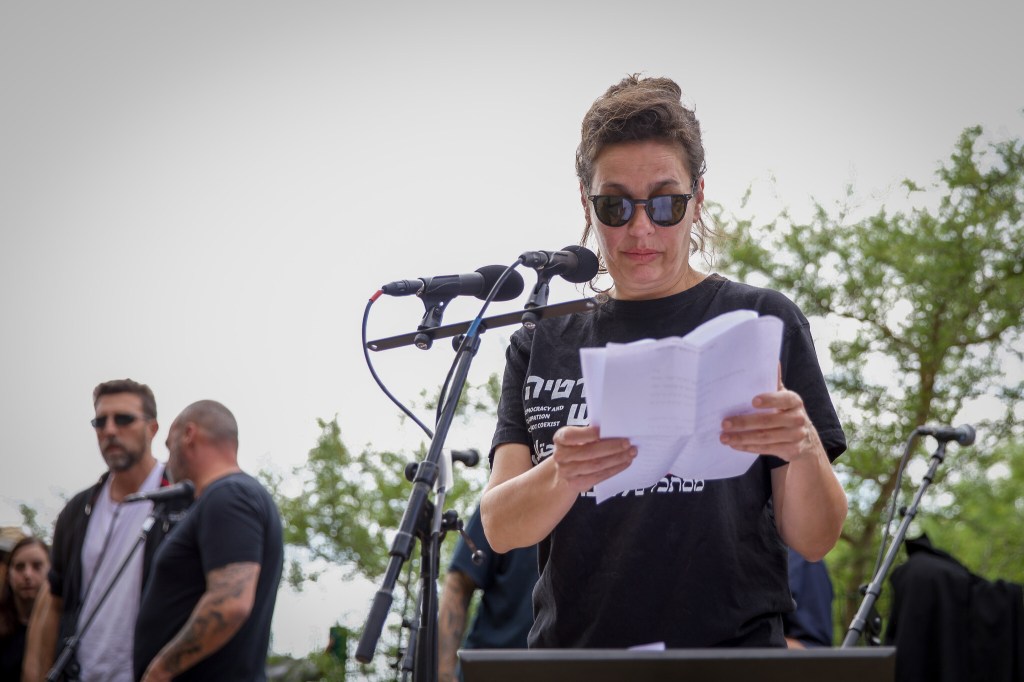
Fast forward to the funeral of his nephew. The mourners arrived wearing shirts that carried the slogan: אין דמוקרטיה עם כבוש – there is no democracy with occupation.

Yehonatan’s daughter, Shira Geffen, wore this slogan as she gave the hesped. 

This slogan argues that Israelis cannot protest Netanyahu’s anti-democratic measures while ignoring the millions of Palestinians denied basic democratic rights to vote, freely assemble, and even walk to their homes without facing checkpoints and guns. 

The t-shirts are produced by מסתכלים לכבוש בעיניים – an Israeli left organisation who insist on looking the occupation in the eye. They speak out about what they call “the power relations between the coloniser and the colonised,” urging the public to see how the occupation is destroying the dignity of Palestinians and the humanity of Israelis.

Sandwiched in the middle between these generations was the man they mourned, Yehonatan Geffen. He had been part of Israel’s cultural establishment, and a true icon. He was associated with what many Israelis saw as the best in their culture. One of his eulogisers was the centre-right politician Yair Lapid.

Geffen was also an outspoken peace campaigner. He wrote extensive criticisms of the army. In 2018, he wrote lyrics in praise of the Palestinian child protester, Ahed Tamimi, resulting in him being cancelled on Israeli military radio and censured by government officials. 

Within one family, within one century, you can see such a huge diversity of Jewish views.

They do not agree about Israel. They will not agree. But they prayed together. They came together to say kaddish and mourning prayers. They joined each other as a family.

Of course, these differences of opinion on Israel are not just generations-based. I know anti-occupation activists in their 80s and I know pro-settlement campaigners in their teens. Nevertheless, what we have seen of Israel in our formative years is decisive.

I belong to Shira’s generation, and one of my most formative memories of Israel was witnessing the inexcusable assault on Gaza in 2009: Operation Cast Lead.

During the commemorations of Yom HaAtzmaut last week, I could not hide my discomfort. I find prayers for a state tantamount to idolatry, and when I hear blessings for troops, I can only think of those priests who poured holy water onto bombs. I do not see how one can pray for peace while praising the instruments of war.

Yet I understand why, for many in this community, honouring Israeli independence and those who fought for it feels like an important undertaking. 

Some of you belong to the generation that came just after the Shoah. The memories of genocide and antisemitism still loom, and it is understandable that you should want to know there is some security against that. For you, defending Israel matters.

Others of you came up in the generation of Peace Now. You believed in Israel and its mission, and held onto its constitutional claims of what it would be: a safe haven for all its peoples. You hoped, even campaigned, for an Israel where Jewish culture could thrive while Palestinian minorities received justice and human rights. For you, holding on to that dream of what Israel could be matters.

My generation came after. I was born not long before the signing of the Oslo Accords, and came of age as they failed. During my 34 years on this planet, Netanyahu has been Israeli Prime Minister for nearly half of them. I have never known Israel as anything but the aggressor and the occupying power. 

Based on our ages and experiences, we will have different views. If we cannot have disagreements about Israel, we cannot have an intergenerational community.

We will not agree about Israel. And that’s fine. That’s good.

Rabbinic literature prizes disagreement. One of my heroes in the Talmud is Rabbi Eliezer. He stood solidly by his principles, no matter how unpopular they were. It’s not that I agree with Eliezer’s principles: he was a conservative surrounded by liberals and radicals. It’s the fact that he held fast to what he believed.

He was so strict in his adherence to religious law that the other rabbis eventually excommunicated him. They wouldn’t talk to him unless he recanted his views, and he never did. Only at the end of his life did his students and colleagues realise what an error they had made by cutting him out. 

They placed him in the Mishnah, the foundational Jewish text, as one of its most-cited rabbis. Even though they completely disagreed with him, you can find his opinions everywhere.

The Maharasha says the reason for this is for future generations. While one position may be minority at one time, it may become majority, and those who follow will need to know what they rest on. Even if they never agree with it, they need to see how the conclusions they support were reached.

This is why we welcome disagreements: for the sake of intergenerational conversation. 

For those growing up now, they are entering a polarised and febrile environment. 

Future generations will develop their own politics, and find their own relationships to Israel, Zionism, and the occupation. 

And I hope they can do so within the synagogue. 

I hope they will find an environment that embraces Zionists, non-Zionists and anti-Zionists. I hope they will find communities that do not impose red lines that keep them out.  I worry that the TwentySomething writing to her rabbi will be proven right, and synagogues will become platforms for single positions on Israel.

What then? Will we split into Zionist and anti-Zionist shuls? Will we keep splitting further, based on varying different policy proposals for what should happen in the Middle East? Those aren’t synagogues – those are political parties!

Such divisions have pulled apart Reform communities before. In the period prior to World War II, Zionists were forbidden from studying at Hebrew Union College, the Reform Rabbinical school in America. This meant that for nearly a century you could not be a Zionist and become a Reform rabbi. One early Reform Zionist, Maurice Perlzweig, said that professing his views in polite Jewish company was like admitting to being a member of the Flat Earth Society.

At the turn of the century, the Reform Movement completely reversed its position. The 1997 Miami Platform declared that Reform Judaism was unequivocally Zionist. It said that Jews were a people; that we should all move to Israel and build it up. Ensuing from that came a programme parallel to the early push to exclude Zionists from the Jewish community, but this time, flipped: to exclude critical voices from the Jewish community and maintain only a pro-Israel consensus.

Is this really what we want? Do we want to keep going back and forth drawing new lines depending on which position has the upper hand? Do we want to enforce conformity of political views in Reform congregations?

Surely what we stand for is bigger than that! Surely our Judaism, our God, our people is bigger than that! 

The joy of a synagogue is that it brings together so many different people. Where else are you going to find people of different backgrounds, classes, genders, abilities, beliefs, and ethnicities, all under one roof, bound together by something greater than themselves? Only the synagogue – greek for beit knesset  – the House of Gathering – can achieve that. 

We are not going to convince each other of our political opinions, and that’s fine. That’s good. If we have a space filled with diverse views, we have a community. If you have uniformity, you have an echo chamber.

We are Reform because we understand that the Jews of tomorrow will not look like the Jews of yesterday. The Judaism of tomorrow will not look like the Judaism of yesterday. Reform Judaism is an ongoing commitment to learn and struggle and grow, always adapting to new ideas and developments. That is what makes it Reform.

And what makes it Jewish is that we do it together. We hold on to belief in the same God, the same cause, the same traditions. We hold all the manifold opinions of the congregation in a single setting.

So, let us answer the question posed in Larry Englander’s book: will this TwentySomething be excluded from her synagogue? 

More pressingly, will she have a home in ours

The answer depends on how we act. If we draw red lines and kick people out based on their views; if we define our Judaism solely by its relationship to Israel; if we make public policies about the synagogue’s stance, then, no. She probably will not.

On the other hand, we can model an alternative Jewish future. A better Jewish future. A Jewish future where we don’t repeat the mistakes and have the same regrets as the framers of the Mishnah. A Jewish future based on plurality and discussion.  We can demonstrate through our relationships with each other and the synagogue that Judaism is diverse, creative and engaging across divisions. 

We can show that we do not have to agree. Even about Israel. 

Shabbat shalom.
festivals · theology

We are still leaving Egypt

We are still leaving Egypt.

There was a time when we lived at the whim of tyrants; when we worked without a break and only rested so we could work more; when we owned nothing but debts. 

There was a time when we lived in mitzrayim. Today, we translate that word as ‘Egypt,’ fixing it to a specific time and place. 

Our Torah does not permit us to read the story as if from a history textbook. Which Egypt were we living in? What were its borders? In which century did it take place? Who was the Pharaoh?

In Torah, all Pharaohs are simply called Pharaoh. To the migrant labourers and the chattel slaves of the ancient world, it made no difference whether the emperor was Ramses, Amenhotep or Cleopatra. As far as their lives were concerned, each century was broadly the same.

We want to imagine that this place is miles away from here and centuries apart from now. We want to draw a line to divide ourselves from the past.

The word for Egypt – mitzrayim – means ‘narrow, oppressive straits.’ It means places of anguish and control. That place does not have fixed borders between Sudan and the Mediterranean sea. It is a place we have all inhabited. It is a place we all still inhabit.

At Pesach, we are commanded to tell the story of the Exodus as if we ourselves had lived it. The haggadah instructs us to recall the events as if they are part of our collective experience. 

It is not just so that we can remember the bitterness of slavery in the taste of maror, or the tears of persecution in our salt water. This is far more than bringing a story to life. 

It is so that we will understand that Egypt was not simply one place and time. It is any place and time in which people are not free. And because it is any place and time, it is every place and time.

We must understand that we really were slaves in Egypt. We must believe, deep within the sinews of our bodies, that we are still there.

Because if we can remember how we were oppressed, we will remember that we were able to free ourselves. 

We will feel the strength and joy that comes from rising up and leaving constricting spaces. It is so that we will feel empowered to do it again. We must still leave Egypt.

The seder is a process of embodied retelling to help us understand that message.

Yes, in the first half of the seder, we read that we were slaves in the land of Egypt. But, in the second, we invoke Messianic redemption. 

When our plates are cleared and the afikoman has been retrieved and the dinner is done, we turn back to our haggadahs and complete our seder. 

We pour out a fifth glass of wine, open the door, and implore the prophet Elijah to return and finally bring us to freedom. We acknowledge that the struggle is not yet complete. We still have to leave the Egypts of our era.

As the seder concludes, we lift our glasses and promise: “next year in Jerusalem!”

Please do not mistake this toast for a tourism brochure. We are not praying for cheap easyJet tickets to Tel Aviv. The Jerusalem we hope to reach next year is miles away from the one in Israel today. 

Our fellow Reform Jews in Israel are still very much in exile, and crying out to leave their own narrow straits. If the Jerusalem in the contemporary Levant were the one we were reaching for, Judaism would be over. History would be complete, and so would the sacred purpose of the Jews.

If that were Jerusalem, the ultimate Jerusalem, we would have to say that we are satisfied with segregation, militarism, and fanaticism. 

But we are not. 

We are not in Jerusalem until the whole world knows unending freedom. Until there is no more oppression, we are all in Egypt.

We British Jews are still in Egypt too. We have made many advancements. We are citizens in our country with full civic rights. When this was granted to European Jews, many felt it was so miraculous that they considered the exile to be over.

Moses Mendelssohn, the founder of the Jewish Enlightenment, proposed that the social and moral progress encapsulated by Jewish emancipation would bring about a new society. A utopia of tolerance and conclusion based on the values Judaism had imparted to humanity. What would such a place be called? Jerusalem. 

He titled his book as such, anticipating that, when we reached such an age, Berlin would be Zion.

For all our greatest aspirations, Europe has not become the Promised Land. Not yet. Nor is Israel. Not yet. 

If we limit ourselves to imagining emancipation as a geographical phenomenon, we will keep chasing after new countries, hoping they will be our final destination, only to find that, in every location, we remain in exile.

That is because exile is not simply a place. It is a state of being isolated from the true and complete justice of God. 

That promised land is yet to be found.

As long as there is progress to be made, we will keep journeying.

As long as there are slopes to freedom, we will continue to climb that mountain. 

Until the day when we are all free, every year, we will pray that, next year, we will live in a world redeemed. 

Now, we are still leaving Egypt.

Next year in Jerusalem. 

psalms · theology

Sore lungs sing out of sync

By the rivers of Babylon, we sat down and there we wept as we remembered Zion. 

Why did we weep by those waterways? Some times are harder than others to find songs inside your lungs. Faced with a strange land and held captive by a power you do not understand, it is hard to find the music within.

Some say that we could not sing because we could not stop crying. Every time we imagined we had run out of tears, new wailing broke out of our chests. Panting, we could not hold a note.

Midrash teaches that the rivers of Babylon were the industrial canals of the imperial capital. Where once we had drunk from freshwater springs, we now sat by sewage works and polluted channels. Our choleric lungs heaved and choked the psalms we wished to sing.

There on willow branches we hung up our violins.

Stringed instruments hung on stringed trees. If we cannot make music, maybe these old branches will play our lyres on our behalf. 

Maybe we will sing again, so we won’t lay our tools on the ground, but gently tie them up in knotted bark. We will return to you, violins. 

Maybe we hoped that the long leaves of willows drooping in layers would provide cover so that nobody would know we once used to play such melodies in our religious buildings. Maybe if they don’t know how joyous we once were, they won’t expect us to be joyous again. Pray they don’t ask us to sing.

For the wicked carried us away to captivity, and required of us a song. 

We are in a strange land of captivity. We live in times that people keep calling unprecedented. Six months ago, few of us would have imagined we would be in the midst of a response to a global pandemic. None of us have lived through mass government responses to a pandemic in Britain. It is unusual to realise we do not have the freedoms we once knew.

Even though governments around the world have announced easing of restrictions, we cannot yet return to activities we once knew. We have to be careful, because the captor, Covid, still exists. We have to make choices about how we respond.

The Israelites lasted 70 years in Babylon. We could endure 3 months in our homes.

But in some ways, those 70 years were easier than the ones that followed. In captivity, Jeremiah told us to make the most of where we were because we would not be coming out any time soon. But when Jerusalem reopened, we did not know whether to stay or leave, and every option seemed like it would be the wrong choice.

In some ways, lockdown was easier. We knew what the parameters were and how to operate within them. Now, we are confused about what is the right thing to do is, as the conflicting needs of our mental health, our physical security and our economic livelihoods clash. 

And somehow we are supposed to sing.

How can we sing the song of God in a strange land?

No, we cannot sing. It is one of the highest risk activities. The virus is airborne and transmitted when people dig deep in their lungs and project droplets from their diaphragms into someone else’s mouth. The collective singing involved in synagogue services, music concerts and sports matches is the greatest threat to overcoming the pandemic.

We enter a strange land where, for the first time in many decades, most progressive synagogues will be closed for Rosh Hashanah and Yom Kippur. Once, Zoom felt like alien soil, although we have come to comfortably inhabit it for our Friday nights and Saturday mornings. Maybe it won’t feel like such a strange land by the time we arrive.

But how can we sing? Didn’t we try collective singing over Zoom? Everyone goes at a different tempo, completely out of synch, creating disharmony and awkward clangs. The first time we tried to sing together in disunity I felt like I had to go back and patch over all the cracks in our voices.

But in captivity, the Israelites learnt that even in the unprecedented land of Babylon, they had to find a way to sing. The Psalms are testament that even when we felt we could not make music, we still composed new material. 

For centuries, the Hassids have rejoiced in singing out of sync. The nign, a wordless song intended to elevate the spirit, finds its strength in discordance and repetition. These mystics sing the same note sequence repeatedly, without aiming for harmony. They trust that, however it is arranged, the tune will reach God. 

Perhaps we, too, can learn to enjoy singing out of sync.

That challenge feels even more pertinent now in a country whose rhythms have fallen out of sync. Some worry about losing their jobs. Some worry about losing their health. Some worry about losing their minds. And, with these concerns, everyone is making different decisions based on their comfort levels.

It is hard to feel like we are not singing in time with our neighbours. Some wish that everyone would just stay inside until we find a cure. Some wish that everyone would relax and go out. We look at each other with confusion, and struggle to find acceptable social norms.

Like the Israelites in Babylon, we have to find ways for sore lungs to sing out of sync. Anyone in the community who does not feel ready to go out yet should be supported to stay home. Anyone who feels they need to see their loved ones should be encouraged. And people who just need to get their hair cut or buy a coffee from a cafe should feel empowered to do so responsibly.

There is nothing wrong with feeling unease. The terrain we stand on is unfamiliar and there is much we do not know. But of all the things we can sacrifice, trust in the other members of our community should not be one of them. 

The reason the Israelites survived their exile was because they knew they could depend on each other. They had different experiences and different aspirations, but knew they were created by the same God.

As we sit by these rivers in a strange land, let us trust each other to sing out of synch, and know that one day, we will return home, and sing together in harmony once again.

nora-kronstein-rosen-moire-removed.height-588

I gave this sermon on Friday 10th July 2020 for Three Counties Liberal Judaism. I thank my housemate, Joanna Phillips, for her support with the audio recording.


debate · israel · sermon

The end of the two state solution

In 1982, Rabbi David Goldberg, z”l, gave a sermon so controversial that half the congregation at the Liberal Jewish Synagogue stormed out. The other half stuck around for the rest of it just to make sure they disagreed.

I have no way of knowing whether this was strictly true, but it is certainly plausible. It is most believable because, even though I haven’t yet mentioned the word, you already know which topic would elicit such a reaction. 

Israel. Of course it is Israel. It is a topic so contentious that friends and families have refused to speak to each other over it. As a result, although I do have strong views on the matter, I have so far managed to go three years without preaching on it. I have been strongly tempted to do the same thing today and just speak about the Torah portion, but I feel that I cannot do so this week.

What has happened in Israeli politics in the last two weeks will likely fundamentally change the way that Diaspora Jewry will engage with the country. Already every major Jewish communal body has released a statement, some of which I know have been circulated among members of this community. It would be a cowardly dereliction of duty if I did not comment. 

If you are surprised by the gravity of what I’m saying, it’s not because you’ve missed anything. There is no new president or prime minister. No new war, no withdrawal, no peace treaty, no assassination. What has happened is really the result of bureaucratic decision making at the end of another stalemate election. But its result is that the fabled two-state solution to the conflict between Israelis and Palestinians is now impossible.

Previously, sitting Israeli prime minister Benjamin Netanyahu announced that if he won the next general election, he would annex the Jordan Valley. In the last year, there have been three elections, each resulting in impossibly hung parliaments, but it looks like Bibi has now secured the majority to pursue his agenda. 

As such, he will now go through with his plan for annexation, supported by the smaller right wing parties in the Knesset. That means that the entire Jordan Valley will become formally part of Israel. There will remain isolated enclaves of Palestinian towns in the West Bank and Gaza, but what remains of Palestinian territory will never form a viable state.

For most Palestinians, this won’t mean much of a change to their daily lives. For some time now, West Bank Palestinians have lived under Israeli rule. Although able to elect representatives to the Palestinian Authority, Israel has maintained control over the military, borders and economy. Israeli control will become tighter and more far-reaching, but annexation will only formalise a policy that has been in place since at least 2005.

Nor will it make a difference to most Israelis. With official backing from Donald Trump and the United States, an international military backlash is unlikely. It is already the case that few Israelis live east of Jerusalem. For those who do live in settlements, their private security will likely be supplemented by state army support. 

There will, however, be a shift in Israel’s relationship with its Jewish diaspora, especially among progressives. Most Jews in Britain do consider themselves connected to Israel, but want a just peace, even if it means giving up land or power. For decades, Diaspora Jewish support for Israel has been contingent on the possibility of a peaceful solution that involved a Palestinian state alongside Israel.

With Israel’s proposed annexation, a Palestinian state will now become formally impossible. I suspect that the two state solution has not been truly viable for some time. But if the door was closed before, it is now being locked.

In response to these unfolding events, Rabbi Lea Muhlstein of the Liberal Zionist group Artzeinu released a statement insisting that the two state solution was still possible.  I am afraid I do not see how. Most efforts to defend the viability of the two state solution seem more concerned with reassuring Diaspora Jewry than with grappling with the conditions on the ground. 

Diaspora Jewry is, however, not reassured, and the British community has seen considerable fallout. The President of the Board of Deputies, Marie van der Zyl, urged communal unity as representatives from StandWithUs, Habonim Dror and LJY-Netzer wrote to express their opposition.

Even in unlikely quarters, people are lining up to attack Bibi’s decision. Sir Mick Davis, former Treasurer of the Conservative Party, has urged against annexation, saying that it would run contrary to Jewish values.

I think that is right, and that the values that would be contravened are given in precisely this parashah. Moses tells the Israelites: “You shall have one standard for stranger and citizen alike.” (Lev 24:22) Both right and responsibility, privilege and punishment, must be the same for all those living under the same rule.

Annexation will create a situation in which a people is formally and irrevocably governed by a party it did not elect and could not deselect. It will formalise a tiered class system, where Jewish Israelis have full rights, Palestinian citizens of Israel have fewer and West Bank Palestinians have none, while all live in the same space under the same rule. This is unjustifiable. 

Most of the attacks against Bibi’s plans seemed to have focused on belated efforts to salvage the two state solution. As I have made clear, I think that option is already politically defunct. But that does not mean progressives must give up entirely on any hope of a just solution in the Middle East.

One possibility which has so far only been advocated from the political fringes is of enfranchising the Palestinians. It is, strangely, a position that unites both some settlers and Israel’s radical left, but has been considered outside of acceptable political discourse among mainstream Diaspora Jewry until recently.

If Israel is to be a single state from the Mediterranean to the Jordan, let it be a democratic one, where everyone who lives there has full voting rights and representation. The Palestinians should be able to set the political direction of the country just as much as Israelis, if it is indeed to be one country.

The main reason that this has remained a fringe view is that it would certainly mean an end to a Jewish political majority. The Palestinians living in the region almost outnumber the Israelis and could thus theoretically out-vote them. As such, Israel would cease to be a Jewish state, at least in an ethnic sense.

In that sense, a single democratic state could not be considered within the spectrum of Zionist opinion. But I am less concerned by the certainty of an ethnic Jewish majority than I am by the moral standing of the Jewish people. 

If Israel is indeed willing to implement policies tantamount to occupation, segregation and apartheid, and the Diaspora Jewish community does indeed continue to meet such policies with indifference and even support, what will be left of Judaism? Who are Jews if we refuse our God-given task of being a light unto the nations? What are we if we do not meet but exceed the ethical standards our tradition has taught us?

For years, Progressive Zionists have faced a tension between being progressives and being Zionists. Many have managed to hold nuanced aspirations that balanced their desire for peace with their desire for security; their commitment to other Jews with their commitment to all humanity; their belief that Israel could be both Jewish and democratic. That tightrope has now fallen under the weight of the two poles it was balancing, and most Jews will have to choose one or the other. Politically, they will either be Progressives or they will be Zionists.

Given a choice between a Jewish state and Jewish ethics, I will certainly choose the latter. But even then, I do not think that abandoning the idea of Jewish ethnic majority means sacrificing concern for Israelis’ ability to live and thrive where they are now. I believe it is fully possible for Israel to maintain its cultural autonomy and distinctly Jewish character without clinging to an ethnically based majority or to political supremacy.

The third largest grouping in the Israeli Knesset is the Joint List – a coalition of Palestinian and Jewish leftists. They are non-Zionists who hope for joint political power between Israelis and Palestinians. 

Their leader is Ayman Odeh, a lawyer from Haifa. He has now become the de factol opposition leader as Gantz goes into coalition with Bibi. In 2015, in his maiden speech before the Israeli Parliament, he shared his vision for the country:

The year is 2025, the 10-year plan to combat racism and inequality has borne fruit. Hundreds of thousands Arab employees have been integrated into the private sector, the high-tech economy and the public service.

The social gaps between Arab and Jewish citizens have been reduced remarkably and the economy has been prosperous for the benefit of all residents.

Jews are learning Arabic, Arabs are diligently honing their Hebrew skills. Jewish and Arab students are being introduced to the great thinkers and philosophers of both peoples.

His vision has become my vision. That aspiration for a just, peaceful and shared country chimes more with my idea of what would constitute a Jewish state than one based on racial ideas of citizenship or Orthodox ideas of laws. 

I hope that, as you wrestle with the tensions that will be drawn out over the coming weeks and years, others will be able to support that dream.

Of course, many will not. Despite the calls for unity, I think this is more a time for diversity. A collapse in political consensus need not mean fallout of the Diaspora Jewish community, but could mean a flourishing of new ideas and renewed conversations. We now have a true opportunity to intellectually engage each other about what Israel’s future will be and how we will relate to it.

If nothing else, I hope that at least less than half of you will storm out in anger.

Shabbat shalom.

israel palestine flags

I gave this sermon over Zoom on Saturday 9th May 2020 (Parashat Emor) for Three Counties Liberal Judaism. I am especially grateful to Tal Janner-Klausner, for being my political tour guide of Israel-Palestine, and for all their help with editing this sermon.