high holy days · sermon

The power of naming

Each of us has a name
given by God
and given by our parents

Each of us has a name
given by our stature and our smile
and given by what we wear

Each of us has a name
given by the mountains
and given by our walls

Each of us has a name
given by the stars
and given by our neighbours

Each of us has a name
given by our sins
and given by our longing

Each of us has a name
given by our enemies
and given by our love

Each of us has a name
given by our celebrations
and given by our work

Each of us has a name
given by the seasons
and given by our blindness

Each of us has a name
given by the sea
and given by
our death.

This poem was written by Zelda, an Israeli poet, born in Ukraine, and translated into English by her friend, the American Marcia Falk. Although written as recently as the 20th Century, these words have achieved iconic status. “Each of us has a name” has become part of the Jewish liturgy for funerals, stonesettings, and Holocaust Memorial Day.

Zelda


It speaks to something we know: the power of names.

When Adam, the first human being, named the animals, he gave life to their souls.

Knowing somebody’s name tells you about them. We hear a name and, in it, hear language, history, culture, connection.

You know, when you hear your own name, the power it holds. Your full name. Your government name. Your nickname. A secret name only someone you love deeply ever calls you. In hearing your name, you know your relationship to the one who says it.

Speaking someone’s name can summon them, invite their presence; or can scold them, cast them away. When we speak a name, we exert our own power.

We give names at birth through baby blessings. We call up somebody by their Hebrew name when they come to Torah. We change names with marriages, after life-changing experiences, and as a way of affirming gender. We etch names on tombstones and recite names during El Malei Rachamim.

When we understand the power of names, we can understand the significance of the rituals of Yom Kippur.

Long before there was a synagogue in Kingston, or Jews in Europe, or an academy in Babylon, or a Temple in Jerusalem, there was a Tabernacle in Shiloh.

It was a great tented structure on a great hill north of Bethel, whose songs could be heard deep in the Jordan valley and whose burning incense could be smelt as far away as Jericho.

This fabric sanctuary had many layers. Everyone could stand around the edges. Then, past the first gate, only the true believers could enter. Then, into the inner sanctum, only the priests from the ancient tribal hierarchy would go. And then, right at the centre of the mishkan, behind many curtains, hidden away from all view, was the Holy of Holies.

Only one man could enter there: the High Priest. And he could only enter once a year: on Yom Kippur. And he could only say one word, a secret word: the name of God.

We do not know what that name was or how it was pronounced.

Even Moses did not know it. While tending Jethro’s flocks in Midian, a great burning bush appeared before Moses and demanded he return to Egypt and free the people.

Then Moses asked for God’s name. God roared in reply “ehyeh asher ehyeh”: I will be what I will be. “Tell the people that ‘I will be’ is the one who sent you.”

God did not share the name with Moses in that moment. Maybe Moses never heard it at all. Indeed, maybe Moses could not have known it, because to know someone’s name is to know their inner essence, and God’s is beyond our comprehension.

But, we are told, God did let someone in on the secret of the Name: an initiate; one in every generation: the High Priest. He is a semi-mythic figure in our Torah, who, in legend, was beholden to the secrets of the Universe. But, insofar as God’s Name was ever knowable, the High Priest knew it.

We do not know how he said the name. Perhaps he shut his eyes and whispered it into the empty space behind all the drapery. Or maybe he cocked his head back and cried it aloud up to the Heavens. We know he said it ten times.

And, by saying God’s ineffable name, some great magic happened. In this pre-rational time of mystics and miracles, God’s holy presence descended on the Israelites, and granted them all forgiveness.

Yes, a name grants connection across the veils of reality. In ancient times, to say God’s unspeakable name breached God’s innermost essence. Saying the name summoned God from behind the veil of reality. The name ruptured through the boundaries of real and spiritual; finite and eternal.

You have seen this name written down. Above our ark here are the words in Hebrew ‘ivdu et Hashem besimchah- “serve God with joy” but the word is not written as it sounds.

Scholars call it the Tetragrammaton, meaning “four letter word” because it is inscribed with four Hebrew characters. Yod-heh-vav-heh.

But these letters are unpronounceable themselves. Even with vowels added, the letters struggle to make a discernible word. Protestant Christians in Germany tried to render it as Jehovah, which we know is impossible in Hebrew.

According to the Talmud, the name the High Priest may actually have said in the Holy of Holies was forty-two letters long. The High Priest intoned it quietly under the sweet melodies of the priests so that nobody could hear it.

Legend says that perhaps this name was passed on through generations but only to those who lived a life of absolute discretion, never once got angry, never tasted alcohol, and never insisted on anything. If such people exist, they are too modest to reveal their knowledge. If they ever existed, they probably no longer do.

So we read it as “Adonai,” literally meaning “my ruler,” even though we know that is not really God’s name.

In common speech, we just call God “HaShem”: literally, the name. Baruch HaShem: thank God; b’ezrat HaShem, please God. God is the Name; the Name of all Names; the Name beyond Names.

We come to the Yizkor ceremony. In the space-time of Yom Kippur, this service of remembrance is our holy of holies. Now, we say names.

In the build-up to this ritual, members send in the names of all those they remember, so that they can be read aloud. Some names, too, remain unspoken, but rest silently on lips, or stay gently placed on grieving hearts. Here, the names of our dead are called out.

Just as when the High Priest entered the Tabernacle at Shiloh so many centuries ago, something intangible happens with the naming.

Just as Adam once named the animals and animated their spirits, we name our loved ones and breathe new life into their memories.

We breach past death and touch an essence of the person that cannot be reduced or destroyed. We rupture the boundaries of real and spiritual, and see that something of our loved one has never left us.

Through saying the names of our loved ones, we bring their presence into our lives. They bring us comfort, and the pain of their loss. They bring us forgiveness, and the opportunity to forgive. They bring us the past, and point us to the future.

David Eagleman is a neuroscientist at the University of Stanford. He wrote a small book called Sum, which imagines forty different possible afterlives. In the eighth possible ending to our time on earth, Eagleman writes:

There are three deaths. The first is when the body ceases to function. The second is when the body is consigned to the grave. The third is that moment, sometime in the future, when your name is spoken for the last time.

This popular imagining of the afterlife is, in some ways, anticipated by our rituals of remembering.

Today, we say the names of our loved ones, and, if only for a moment, we give them life with us here once more. In a way we cannot explain, that is beyond reason, their names stand in for their whole being.

We know that, in our naming, and in our remembering, we keep something important of the dead with us. Just as they were once called in from playing in the street, or called up to read from Torah, or called out to in a crowded room, we call them again to come and pray with us.

May their names be remembered for a blessing.

Adam naming the animals

Yizkor 5787, Kingston Liberal Synagogue
high holy days · judaism · sermon

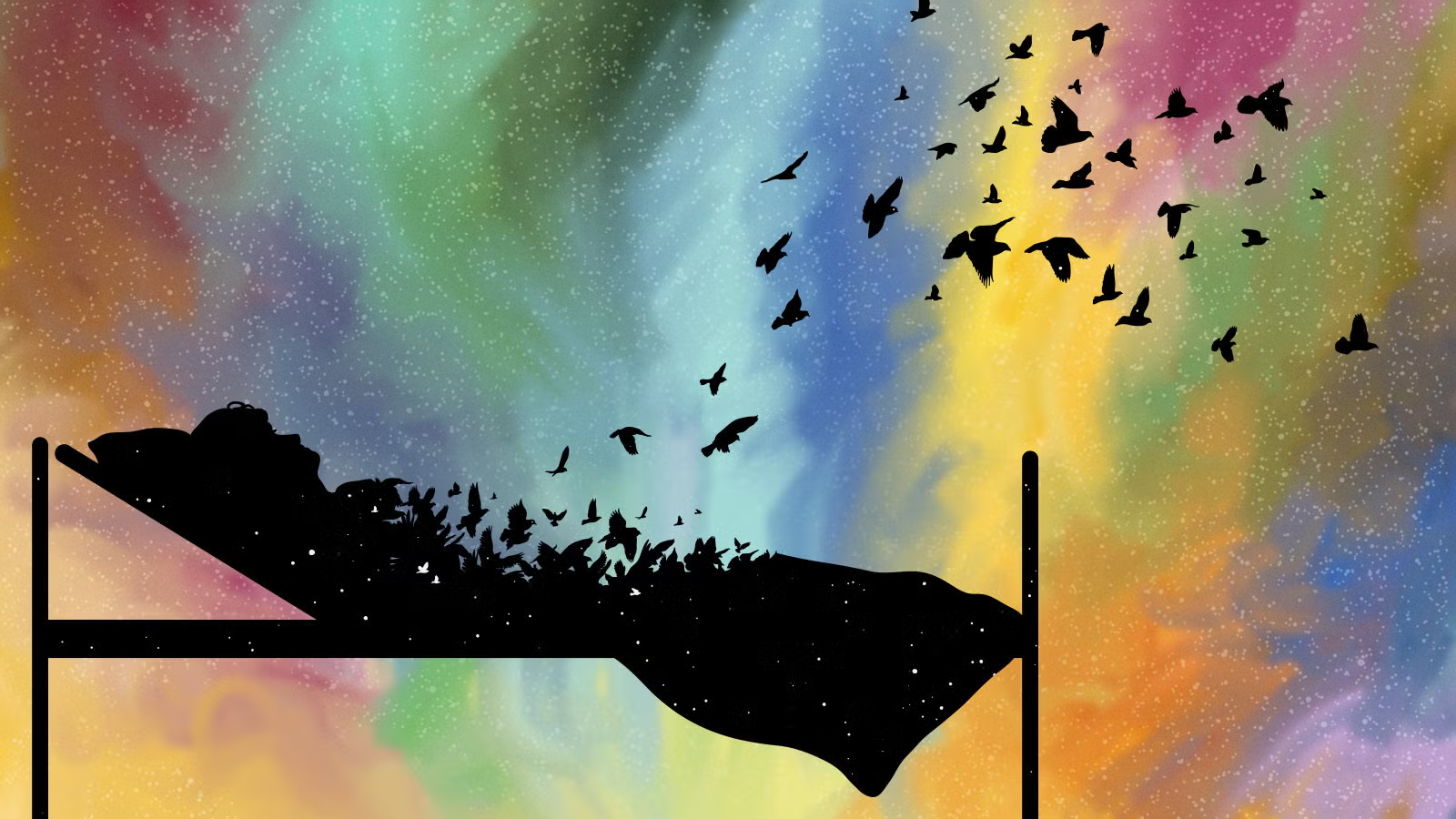
Knowing we will die helps us live to the fullest

Here’s the deal. Let’s see who will take it.

Today, you get a million pounds. But the catch is, tomorrow you die.

Any takers?

I didn’t think so.

You value living more than you value money. 

In fact, when you put death into the equation, you realise how much living matters to you. It matters more than any amount of wealth or status you could accrue.

Knowing we will die helps us understand what we value from life.

In many ways, Yom Kippur is a death rehearsal.

We act out today as if these were the last moments we would be alive.

Like the dying, we refrain from food and water. 

We turn up in modest clothes, without jewellery. Some wear white, the colour of the funeral shroud. Some wear kittels, the gowns in which we will be buried. Some wear tallits all day, from evening to evening – a unique point in the year when we do so – just as the dead are traditionally buried wearing their tallits. 

Over the course of this fast, we repeatedly recite vidui, the prayer of deathbed confession. We say psalms and chant petitions that are associated with death and funerals.

All of this serves as a ritual memento mori: a reminder that we will die.

Then, as we approach the end, we erupt into songs. We joyfully recite the neilah prayers. For many of us, there is a great rush of relief and joy as we realise we have made it through this marathon day. 

Yes, today is a reminder of our death, and it is one that affirms life. 

On this day, our Torah instructs us: “choose life.” Only by recognising that death is inevitable can we do so.

By really considering the finite amount of time we have on this earth, we are able to celebrate the days we have and live them to the fullest.

So much of modern Western society shies away from death.

For previous generations, death was a sacred process undertaken among family and community.

Today, it is sanitised: dealt with in hospitals and hospices by qualified experts.

There are great advantages to this. The professionalisation of death means that the sick can receive high quality care and pain relief right up to the last moments of their life. It takes a great deal of pressure off of family and friends, because the care for the dying does indeed require constant work.

But one downside to our compartmentalisation of death is that it means it is kept out of sight and taboo. 

When we do have to face death, it is often a shock, and can cause great trauma to living loved ones. Intellectually, all of us know we are mortal, but facing death as a lived and embodied experience can feel like a real rupture.

Having the Yom Kippur experience – which draws our attention to our mortality and makes us reflect on the quality of our lives – can be a powerful way to help us face death. In these rituals and fasts, we can prepare for our mortality. 

This real confrontation with death isn’t morbid. It’s a direction to truly embrace life. 

Knowing we will die helps us consider what we want to do with life.

In Progressive Judaism, we have a tendency to downplay some of the more explicit symbolism of death and mortality in our services. It is there in the machzor – in our silent confessions, themed readings, and traditional prayers. But our services often tiptoe over death’s undercurrents in the prayers.

This year, I have tried to reintroduce some of those themes to the service. 

Last night, at Kol Nidrei, we joined the rest of the Jewish world in holding the scrolls out of the ark, leaving it bare. The great American Reform liturgist, Rabbi Larry Hoffman, points out that the open ark is supposed to evoke a coffin. We stare into the empty space, which usually includes our Book of Life, and lay witness to our own tomb.

This morning, during shacharit prayers, we reintroduced the prayer “who by fire,” a traditional part of Unetaneh Tokef, which recounts the many ways in which a person might die. It is painful to consider life’s fragility, and all the vulnerabilities we face in life. 

But, by facing up to the possibility we will die, we get better at deciding how we will live.

We realise that we value life, and we take stock of what it is we love about it.

Marie de Hennezel is a French therapist focused on end-of-life care. In the early 90s, she was among the first staffers at a palliative care unit for people dying of HIV/AIDS. At this time, there was no cure – the deaths of HIV patients often involved rapid deterioration and great suffering. 

In 1995, de Hennezel wrote up her experiences of accompanying the dying into a memoir, entitled Intimate Death: How the Dying Teach Us to Live. The book even carried a foreword by French president Francois Mitterand.

She recounts stories of individual patients, as well as their carers, doctors, and nurses. In each vignette, she tenderly lays out how important it is to be with the dying. 

From her support, the patients often learn to live through challenging ordeals. Those who feel like giving up or who contemplate suicide decide that they will indeed live until their last moments on earth. By helping them face their death, the patients gain the strength to embrace their life.

This work, it seems, also transforms the carer. De Hennezel writes that she has learnt so much about living from the dying.

She writes poignantly:

Life has taught me three things: The first is that I cannot escape my own death or the deaths of the people I love. 

The second is that no human being can be reduced to what we see, or what we think we see. Any person is infinitely larger and deeper than our narrow judgments can discern. 

And third: one can never be considered to have uttered the final word on anything, is always developing, always has the power of self-fulfilment, and a capacity through all the crises and trials of life.

Let us take this as our message from Yom Kippur today.

Our lives are not over. We can affirm them. We can do so much with them.

And, though we do not always realise it, we love our lives more than any amount of wealth or status.

By facing up to the fact that we will die, we can live the days we have to the fullest.

Gmar chatimah tovah – may you be inscribed in the Book of Life for good.

Yom Kippur Yizkor 5786

fast · high holy days · sermon

Closing the Gates

These are the short sermons I delivered for the final two services of Yom Kippur 5781.

Yizkor

This morning, I talked about how this year could be understood through the lens of grief. Yet nothing can compare to the grief of losing a loved one. Every feeling we described, of denial, bargaining, sadness, anger and acceptance, is intensely heightened by the enormity of the lives that have been lost in this last year.

I will not say numbers. Their lives were not statistics. They cannot be reduced to the collateral damage in government reports about which measures worked best. They were full human beings, imbued with the sacred light of God. They were people with pasts and dreams, filled with stories. They were complete people, with flaws and complexities and little idiosyncrasies.

And we have not yet even begun to mourn them. In the midst of a pandemic, we have been like the Israelites in the desert, forced to keep on moving and maintaining high spirits for an undefined period of time. We keep looking straight ahead to keep our spirits awake, so struggle to look back at the hurt. Even old wounds from people long dead have returned to us, and we have struggled to find ways to heal.

Here, in this moment, for this brief service, we can take the time. Let’s stop in this space and reflect. We remember the names of everyone who mattered to us. We loved them. We cared for them. They cared for us. We admired them. We looked up to them. They took inspiration from us. We laughed with them. We cried with them. We got angry with them. We hated them. Sometimes. We spent precious time with them. We did not spend enough time with them.

And now, in this moment, we remember them. And we refuse to let them ever be forgotten.

Neilah

This year has been challenging for all of us. As much as our physical health has been at stake, everyone’s psychological wellbeing has taken a toll. Public health experts warn that we are facing a delayed mental health crisis. 

This morning, I spoke about how the year could be understood through the stages of grief. Those feelings, however, can be pathological when taken to an extreme. Sadness can become depression. Anger can become anxiety. Denying what exists and accepting what does not can result in psychosis. 

We will need to pull together in the coming year. We will need to check in on each other more than ever and find new ways to support each other. Above all, please talk about your feelings. If it feels like it’s going too much, do talk to a rabbi for pastoral support, or to a doctor for medical help. It is important that we all look after each other.

I know that we begin Yom Kippur by annulling the vows we have made with God. I think, however, this year, we need to end by making a new one. We need to promise each other we will make it. We must swear to each other that we will do everything we can to keep our bodies, minds and souls alive in the coming year. Say it to God, make it a vow.

As the gates of prayer close, I vow that I will care for myself and my community. I vow that I will be honest with my feelings and kind to my body. I vow that I will be here next year.

Next year, in a world without pandemic. Next year, in a world built back better without racism and injustice. Next year, in a world where we can see each other in person. Next year, in the building, with each other, holding hands and singing together.

We will make it to next year. Shanah tovah.