protest · sermon · social justice

Do British Jews have dual loyalty?


Friends, at this season of teshuvah, I want to begin with an apology. I am terribly sorry, because I have been selling KLS short.

When people asked me over the last couple of years what Kingston Liberal Synagogue was like, I told them that we were a friendly suburban family shul with good Progressive values.

What an embarrassment, because all this time I neglected to tell anyone that we are really the centre of a Zionist conspiracy. That’s right, this community in Thames Ditton is, in fact, the beating heart of a Mossad plot to control the Green Party.

If you’re surprised, you can only imagine what a shock this is for our Green Party members.

Although I joke, something quite serious has happened. The Canary, a conspiracy website owned by a used car salesman, has decided to run “an exposé” on some of our Green-affiliated members.

On their social media channels, they ran with the headline “Zionist synagogues in the pipeline to defend Zionism.” It explains that some of the core Jewish Greens are members of Kingston Liberal Synagogue, which was part of Liberal Judaism, and is now part of Progressive Judaism, then declares: “all these organisations and all member synagogues are formally signed up to the Zionist movement.”


Its author, David Miller, is a TV host for Iran’s state-run media channel, Press TV. He has collected a database of “foreign influences” on British policy, which now includes members of the synagogue Council who are not even members of the Greens. His database looks remarkably like a list of British Jews.

This incident has inspired many feelings. I do feel scared, as this carries frightening historical memories. This is not the first time somebody has decided to collect a list of enemy Jews, whether they were labelled as “Zionists” in Iraq, “counter-revolutionaries” in Russia, or “Communists” in America.

I feel outraged that people I care about should be subjected to such attacks. I feel sad that people who have devoted their lives to causes like sustainable transport, fair economic distribution, and indeed Palestinian human rights, have been tarred with such an ugly brush.

But most of all, I feel proud. Proud to be a Progressive Jew and proud to be a rabbi to Progressive Jews. Proud to know and support people who consistently stand up for their values, even when faced with hostility.

People like David Miller want to stop Jews from participating in public life. But when people want you to shut up, the best thing to do is get louder.

So I want to bolster our members with proud defiance. The values of Progressive Judaism cut across party, affiliation and creed, and those who uphold them should always be encouraged in what they do.

Now, if you are not au fait with internal Green Party bureaucracy, you may be wondering what crime these notorious Israel propagandists committed.

Some of them criticised a motion to the Green Party, which said that Zionism is racism. The goal of its proposers was that the Greens would be Europe’s first anti-Zionist Party and declare all Zionists unwelcome.

Unsurprisingly, some Jews had reservations. Party leader Zack Polanski said it depended entirely on how Zionism was defined. There are, we know, versions of Zionism that promote racist and murderous policies.

And then there are versions, such as we have supported here, that involve Jews going out to provide protective presence to Palestinian olive farmers in the West Bank, or to promote democracy and minority rights, or that seek to defend the land’s natural resources.

Any of these projects might be subjected to legitimate critique, from left or right, but I cannot see how any of them would warrant being kicked out of public life. Indeed, the most vociferous critiques, that these are liberal plasters on nationalist wounds, come from the exact people named as Zionist agitators by Miller.

And that is precisely the concern that some raised. Our member, Dr Joshua Alston, warned that declaring the party free from all Zionists would disqualify most Jews from party membership.

As Miller has demonstrated, that is not quite true. The witch hunt for Zionists excludes all Jews from public life.

The logic for Miller in pinpointing our congregants as part of this great conspiracy is precisely their Jewishness. They are suspicious because they are Jews doing Jewish things.

A Jew goes to synagogue. A synagogue is part of a national organisation. The national organisation is part of an international denomination. And, all of them, says Miller, are signed up to the “Zionist movement.”

Only Jews who have no connection to other Jews or to Judaism could possibly pass Miller’s purity test. And that’s the point.

This database of Zionist lobbyists and suspicion of all Jews has roots in a deep-seated European prejudice that Jews have a “dual loyalty.” On the one hand, we may seem to be citizens of Britain, but, in reality, our secret loyalty is to the global network of Jews.

This was notoriously demonstrated by the Dreyfus Affair of 1894. Captain Alfred Dreyfus, a Jewish artillery officer in the French Army, was accused of spying for Germany. He was stripped of his title and shipped off to a penal colony.

As many noted at the time, Dreyfus was a scapegoat for the military establishment. The government and army knew that the real spy was one of their own, but used a Jew to deflect blame and cover up their failings.

Dreyfus worked as a foil because, being Jewish, he could never be trusted to be truly loyal to France, despite having done nothing wrong. Jews could never be true patriots to their country.

The Dreyfus Affair

To think that, only a year ago, Kingston Liberal Synagogue was a touted hot bed of anti-Zionism. It feels like only yesterday that our little shul was expelled from the Board of Deputies for being insufficiently loyal to Israel.

Our elected Deputy committed the heinous offence of joining with Israeli civil society by opposing the war on Gaza. Along with 35 other representatives, she condemned the Israeli government for breaking the ceasefire and attacking civilians in Gaza, rather than engaging in diplomacy to bring the hostages home.

These incidents are, I believe, related. They show examples of Progressive Jews refusing to be forced into binary choices. Whether it is Greens defending the presence of Zionists in their party, or Deputies insisting on their right to oppose war, these are people demonstrating real compassion and nuance in an increasingly polarised culture.

And they are both examples of that Jewish dual loyalty. The Jewish Greens have refused to hide their Jewishness to appear more palatable as Progressives.

The rebellious Deputies refused to compromise their Progressive values for their Jewishness. They would not engage in slavish national loyalty when they saw their core ethical principles violated.

So, perhaps British Jews do have dual loyalty. This was the reason given by Tory politicians in the early 19th Century for refusing to allow Jews civic rights in England. In 1830, Catholics had just been emancipated, and the Jews hoped they were next.

One of the greatest advocates for Jewish emancipation was a Whig MP named Thomas Babington Macaulay. Macaulay was a liberal historian and powerful orator with a firm belief in equal rights.

Macaulay issued a pamphlet addressing the claim by opponents of progress that Jews “are not Englishmen. They are a separate people, living locally in this island, but living morally and politically in communion with their brethren who are scattered over all the world.”

Rather than refuting the charge of being insufficiently patriotic Macaulay said: of course they are! So is everyone!

Who is so simple minded that they can only swear allegiance to one nation, or so naive that they only feel sympathy for one cause?

Look at those pesky Quakers, the cantankerous Wesleyans, or those treacherous Huguenots. Everyone feels loyalty to multiple people and causes.

Just look at the Catholics. If you wait two hundred years, one of them may even become prime minister!

Macaulay argued that if Jews didn’t feel passionate enough about Britain, it was the job of the government to give people reasons and responsibilities to care about building the country.

People are not mindless servants. They are full human beings, with ethical codes, family attachments, sacred texts, personal histories, and values. The role of Britain wasn’t to force Jews into some box, but to make the box bigger.

Thomas Babington Macaulay


Jews, in turn, responded to the Whigs’ call. They threw themselves into English civic life and volunteered for every posting where they could be helpful. (If you’ve ever wondered why we say weekly prayers for the King and his government but no other religion does, it’s a hangover from Victorian efforts by Jews to be accepted in Britain.)

We have fully embraced the modern world, and taken on the universal promises of the Enlightenment: peace; equality; human rights for everyone; the triumph of love over all. And we have synthesised them completely with our love of Judaism, its ancestral traditions, its strange ways, and its peculiar people.

We have indeed embraced multiple loyalties: to the country where we live; to Jews everywhere; and to our deeply-held beliefs in universal religion.

This is the way of Progressive Judaism. It requires a constant mediation between our particular attachment to the Jews and our universal concern for human rights. It is an ongoing struggle to love one’s people and all other people in a world beset by hatred.

How easy it would be to only have one! To only be Progressive or only be Jewish. To ditch empathy for pride and be a vulgar nationalist. Or to forfeit self-respect for compassion and welcome our own annihilation.

In late October 2023, as Israeli society was still reeling from the horrors of Hamas attacks, and violent reprisals against Palestinians were well underway, the peace activist Neta Hazan reflected on this dichotomy.

The Israeli Left, she said, is constantly accused of dual loyalty for advocating for the Palestinians as well as their own. She said that now it was time to take that label as an honour. She wrote:

“Dual loyalty is probably not the right word. It is double pain, double heartbreak, double caring, double love. It is holding onto everyone’s humanity. And it is hard. It is so hard to hold onto humanity here. It is exhausting, and it feels like time after time the world simply asks you to give up. It would be so much easier to “choose a side”—any side. Just to choose, to stick to one, and at least reduce the amount of pain you hold. At least to feel part of a group and less alone in all of this… And this pain that some of us in our small community hold, this “dual loyalty,” is probably the only hope this place has.”

So, dear Progressive Jews, we will never be sufficiently British for the white supremacists. We will never be Zionist enough for Netanyahu’s cheerleaders. And we will never be anti-Zionist enough for Iran’s Islamic Revolutionary Guard.

And that’s great. That’s a cause for real pride.

It means that we are full people with open hearts, who care about ourselves and about others. We are capable of love that those bigots cannot comprehend.

As a community, we span ideologies and political parties. The way we vote and hold party memberships is just one of our loyalties.

Another is the love and support we show for each other. Let us strengthen that loyalty.

Our loyalty to our members. To our movement. To our cause. And to our God.

Let us hold our hands together and keep our heads high, in love and pride.

Shabbat shalom.

Progressive Jewish thought leaders
judaism · sermon

Have you considered therapy?

Isaiah stood up on his soap box and preached to the people:

‘Listen to this, you wasters who sit in a drunken stupor, though not from drinking wine. This is what the Sovereign, your God and Defender, says: “See, I have taken the terrible cup from your hands. You will drink no more of my fury. Instead, I will hand that cup to your tormentors, those who trampled you into the dust and walked all over your backs!”’

The people stood and watched his prophecy, then replied: “Isaiah, have you considered therapy?”

Isaiah, you should go to therapy.

Isaiah, beloved prophet, seer of justice, speaker of truth, visionary of God, I do think you would have benefited from a bit of counselling. I read your words, so filled with passion, as you swing between abject rage against all humanity’s follies and then salivating at the possibility of God’s vengeance against your enemies. And I love your words, these are such beautiful Torah, but I also just want to give you a hug.

Isaiah, my friend, my favourite prophet of them all, do you need someone to talk to? Are you going through something just now? When was the last time you were able to open up and be vulnerable? Because this… these speeches… they’re beautiful, they really are, and I think you might need some help processing all of this.

There are tools available. There are ways you can access your feelings and address some of the root causes of your pain. 

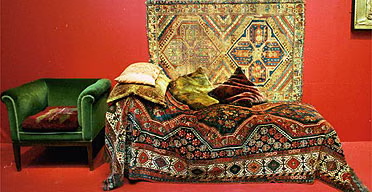
I’d like to introduce you to a nice Jewish boy who lives in Hampstead. He doesn’t care much for shul, but he likes studying some of our texts, and he’s had some good ideas. His name is Sigmund Freud. 

He had this fantastic idea that, if a person spoke freely about all that was worrying them, they might feel a little better. 

He found trends that showed that some of what makes us angry or sad or anxious can be connected to our childhood. Now, being honest, some of his theories have lost their appeal. He put a lot of stock in a couple of Greek myths. But, in general, he understood that by re-telling our internal narratives, we can live in ways that are calmer and more fulfilling. 

During his lifetime, Freud had to deny that his techniques were a “Jewish science,” but later his daughter Anna was able to reclaim the label as a “badge of honour.” 

I think it probably is something of a Jewish science, and I wish more Jews would try it.

I look at some of the characters in our Torah and think how much they might have benefited from a trip to a therapist’s couch. 

Would Isaac have pitted his sons Jacob and Esau against each other so callously if he’d been able to cope with the betrayal he felt when his father Abraham tried to kill him?

Could Moses have kept his temper in check a little if he’d had space to talk through the displacement of discovering he had been adopted?

Maybe Rachel and Leah could have done with some family therapy to process their jealousy and build better relationships.

Of course, they wouldn’t have given us such compelling stories if they’d been better adjusted, and we wouldn’t have the Torah we do. 

It’s too late now for the biblical protagonists, but it’s not too late for us. We actually can go to therapy, and learn to like others and ourselves a little better.

As a community, one of our great highlights is Sandra Webber’s Shabbat Island Discs, where members share their life stories alongside their favourite tunes.

Believe it or not, the idea didn’t begin at KLS, but originated on BBC Radio 4, where it is called Desert Island Discs. On 4 August 1989, the show welcomed on a castaway by the name of Rabbi Lionel Blue. You can still listen now on iPlayer, as he speaks with such gentle warmth, and offers up a song about his Yiddishe Momme. 

But there is a really profound moment when Rabbi Lionel describes the benefits of therapy to us all. He had learnt about himself through a self-taught psychotherapist who took him on for free. His first session took 10 hours! 

He says his reason for promoting the benefits of therapy is that “you can only love God as much as you love yourself.”

This approach, that we ought to get to like ourselves better through therapy, positively impacted on how rabbis were trained at Leo Baeck College. For several decades, it has been actively encouraged as part of rabbinic training.

On and off, in various forms, I’ve been going to therapy for about 15 years. And I swear by it. It has helped me know myself better and love myself more. It has made me a better pastor, partner, and friend. 

And I think Lionel was right: it has made me love God more.

With the lengthy commute between Essex and Surrey, I wasn’t able to go so often. But now, with space and time for it, I find myself back on the couch. It’s doing me a world of good.

As Jews, we don’t evangelise, but if I were asked to give a rabbinic endorsement to anything, it would be psychotherapy. If you’re not already bought in, I encourage you to give it a try. 

Spend just under an hour talking to a trained listener, and see how much better you feel.

Shabbat shalom.

social justice · spirituality · theology

One God, No Masters

We are, all of us, sparks of the divine.

There is something within each of us that is holy. 

We are more than moving limbs and functioning organs. We have a quality that cannot be reduced to DNA, or psychology, or narrative. 

There is something about a person that makes them who they are: more than their physical experiences, and more than our experiences of them. 

It is a feature that we can’t perceive by touch, sight or smell, but we know it is definitely there. It is the unfathomable essence within a human being that glows invisible and breathes without lungs and animates without moving.

This property cannot really be named, but it has been known in English as soul, spirit, or lifeforce; in Hebrew as neshama, ruach, nefesh.

There is something unique about life. And, if anything deserves to be called sacred, it is that.

In Judaism, we call it “the spark of the Divine.” As if God were one burning bonfire in which all of us were the flames. As if, inside every one of us, a candle was lit before we were born and cannot be extinguished after we die. 

There have been moments in my life when I have truly felt it. When I have seen the sacred spark in myself and realised, in a way I still cannot explain, that I am made in God’s image. 

There have been times when I have truly seen the sacred spark in others. Not just that another person was special or lovable, but infinite: that, qualitatively, their true essence could never be contained. 

I hope you have felt this at times too, or already know it to be true, because I want to talk about how radical this concept is.

If you truly believe, as I do, that we all have sacred souls, how could it ever make sense for one person to be better than another? 

In the light of God’s majesty, the divisions of gender, race, nation, and physical characteristics look like pale imitation of reality. Our bodies are real and diverse, but our spirits have a reality that is incomprehensibly more real and more diverse.

The Divine Spark within us comes from the Source of all Truth. And because God has implanted it within us, every life is equally, completely, and unassailably holy.

Every human spirit is remarkably equal. Not because each one is in some way alike, but because each one is infinitely different. 

In this week’s haftarah, the Prophet Isaiah proclaims: “O Eternal God, masters other than you have ruled over us, but we only remember your Name. Those others are dead and lifeless; sunken beings who will never rise. You, O God, have wiped them out and obliterated their memory.”

Who are these other masters? And why can God destroy them so decisively?

We might be tempted to imagine this as we do the Pagan pantheon, where one god comes in and destroys the others, as the Titan Cronus usurped his father, Uranus, only in turn to be vanquished by Zeus. 

But this is not a myth of many gods. In the Jewish understanding, there is only one God. So who else has ruled over us?

Midrash Tehillim says that this is referring to Nebuchadnezzar, the tyrant of the Neo-Assyrian Empire. Nebuchadnezzar ran colonial campaigns throughout the Middle East, suppressing all revolt, and establishing himself as sole dictator over the Levant. In 586, Nebuchadnezzar besieged and ransacked Jerusalem. He bulldozed Solomon’s Temple, conquered the Land of Israel, and carried away its leaders as captives. 

According to our tradition, Nebuchadnezzar demanded that the Israelites he had imprisoned bow down to idols. They refused. Nebuchadnezzar heated a furnace to seven times its regular temperature and attempted to burn the Israelites alive. But, by a miracle, God saved them, and the three pious believers walked out from the fire unscathed.

In this understanding of the text, there is only one True Ruler, and that is God. The lords who attempt to subjugate others are men. Sure, they may be able to win some wars, defeat some people, and make some people bow down to their will. But, ultimately, they are mortal.

Their lives are nothing in the span of God’s eternity. Their empires are worthless in the expanse of God’s universe. They are lying to themselves and others that they can be anything but dust and ashes. 

Only one being is immortal – that is God – and all are equal in the Eternal One’s beneficent eyes. The rulers of the world can never conquer us in a way that truly matters, because our spirits belong to something greater than their meager understanding.

If we deeply internalised this sanctity of every life, our entire world order would seek to function. Consider what it would mean to believe in the profound equality of every soul. How could anyone take more than they need from society, or abide for anyone else to have less? Surely nobody would ever be able to kill another and there would be no more wars. 

How would we have borders and checkpoints, when no human being can own the earth, because everything is God’s possession? Nobody could ever dominate or govern another.

And, in truth, if we truly got rid of all borders, states, laws, militaries, and inequalities, civilisation would fall apart. Society, as we know it, would cease to exist.

Well, good, said Rabbi Avraham Yehuda Heyn. He was one of the leading intellectuals among the Chabad Chassidim in 20th Century Ukraine. He taught that Judaism was a rejection of hierarchy, force, and inequality. We wrestle against the strong arm to make everyone strong and uproot weakness. 

He outlined a view of the world that would upturn all order. Absolute equality for everyone in everything. Complete refusal to participate in states or war. The abolition of all classes, and the levelling of all people.

Avraham Yehuda Heyn was part of a cohort of rabbis from Eastern Europe, profoundly educated in Talmud, as well as the modern thought of Tolstoy, Nietzsche, and Kropotkin. There were many like him, in the 19th and 20th Centuries, who believed that the only logical conclusion to Judaism’s insistence on the sanctity of life was freedom and equality for all. In his recent book, No Masters but God, Hayyim Rothman calls this ideology of strictly Orthodox mystics “anarcho-Judaism.”

This idea may sound radical, and even intimidating. You can feel that it belongs to the heady days of a time when Jews were becoming free and anything felt possible. It belongs with the revolutionary optimism of mystics in another era. It is bold.

And yet: it is hard to honestly believe what we do – in God and the sanctity of the spirit – without arriving at some pretty bold conclusions. 

Think seriously about what it would mean to say that we are all holy embers. To say that we are sparks of the divine.

As if God were one burning bonfire in which all of us were the flames. As if, inside every one of us, a candle was lit before we were born and cannot be extinguished after we die. 

Breathe life into the flames. Give fuel to the candle. And, perhaps, something within us all, will set this world ablaze.

Shabbat shalom.