high holy days · judaism · sermon

Everything hangs in the balance

Everything hangs in the balance.

Rosh Hashanah is a moment when all judgement is suspended. The scales are suspended, and the weights could fall either way.

At this moment, anything can happen. We reflect on how precarious life is, and how delicately all is held together.

In the light of Rosh Hashanah, our own lives come into focus. How fragile is our existence. 

The rest of the year, we take for granted this delicate balance that allows us to go on living. Today, we notice how remarkable our lives are, and assess what we are doing with them.

Have we embraced life’s blessings and sought to make the most of our days? Have we multiplied joy and generosity in others? What were the moments we squandered or took for granted?

At Rosh Hashanah, we acknowledge our vulnerability. We listen for God’s voice within us. We hear the messages this day brings. God, in turn, hears us. 

Then, we find a way to go on. We affirm our lives.

The stories of Rosh Hashanah point us to moments of precarity. We read of times when life almost did not come about, and of moments when life almost came to an end. Through these ancestral tales, we access our own vulnerability. 

Hannah longs for a child to be born to her barren womb. She asks: “why do I exist?” Then, God hears her anguish, and she gives birth to a boy. His name is Samuel, meaning God hears.

Sarah laughs at the thought that she could conceive in old age, then God remembers her, hears her, and she has Isaac.

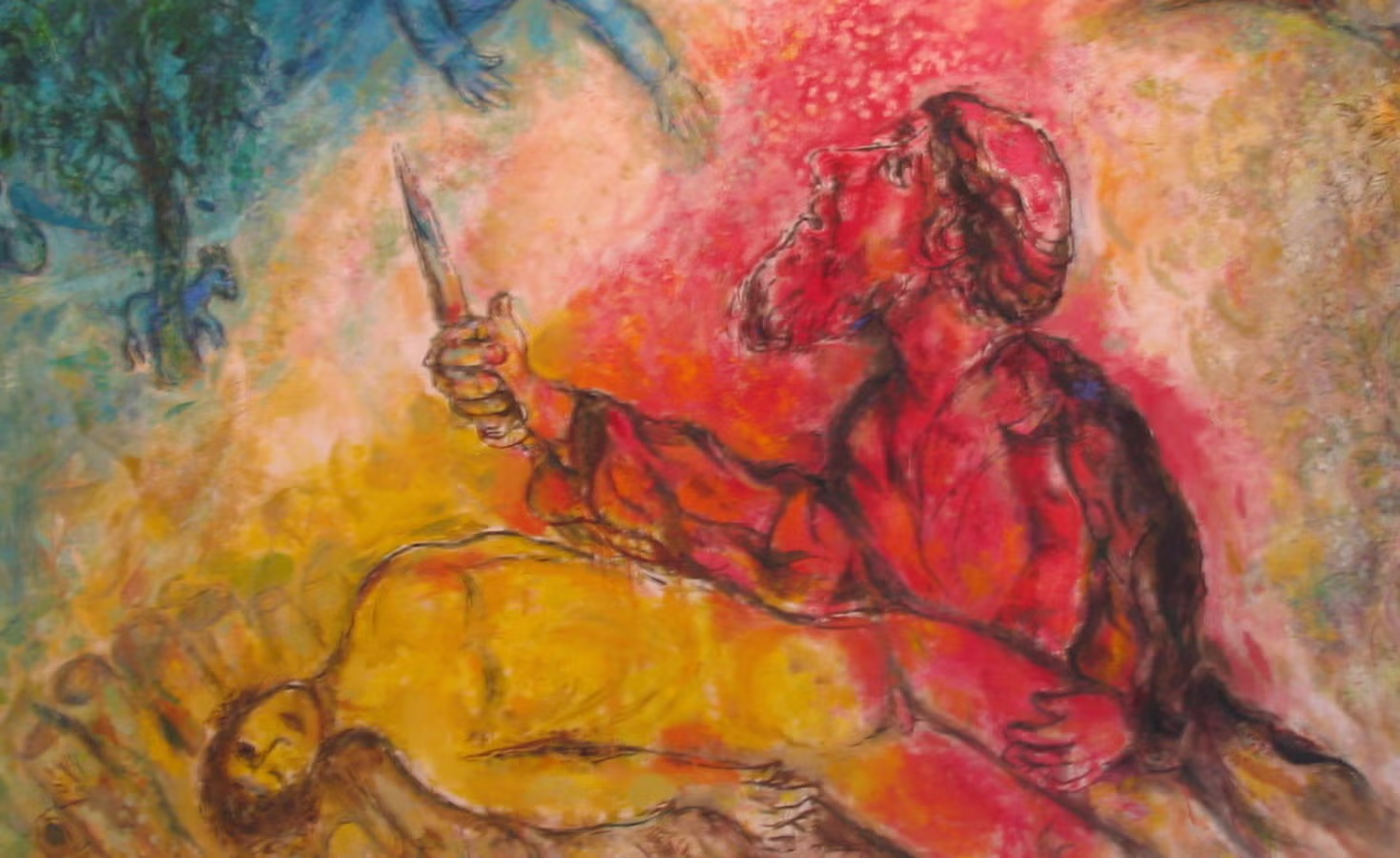
Isaac is destined to be Abraham’s heir, then Abraham takes him up to Mount Moriah to kill him. 

When we picture the Binding of Isaac, we can clearly see Abraham’s raised hand – slaughtering knife outstretched to the sky – ready to murder his own son. We are struck by the moment when all hangs in the balance. 

Finally, God speaks, and Isaac is to be killed no more.

In all these vignettes, we find ourselves caught in stories of people whose lives are racked with precarity, but who listen out for God’s voice, take away a message, and find a way to go on that affirms life.

Interwoven with this story of the main characters, our ancestors, is another story, of people living more marginal lives. The story of Hagar and Ishmael speaks even more explicitly to life’s precarity.

In Orthodox communities, where they observe the second day of Rosh Hashanah, the story of Hagar and Ishmael is usually read today. Here, in the Liberal lectionary, wherein we follow the Israelis and  hold by one day chag, we are given the option of reading either Isaac’s or Ishmael’s story. 

I have opted to read the story of Ishmael because I believe it speaks most clearly to the festival’s theme of life’s uncertainty. Everything about the lives of Hagar and Ishmael is left to the hands of those more powerful than themselves.

Hagar is called a handmaid – a word that glosses over the gross crime inherent in a purchased human being. 

A handmaid had no property, no income, and no family to come and redeem her. Most handmaidens were separated from their own kin, and stripped of their original language. 

Hagar’s name means “the foreigner.” The Torah calls her “the Egyptian.”

She was beholden to her mistress, Sarah. Hers is the most precarious position one could have in life.

A handmaid cost more than a male servant because the handmaid could produce the most valuable good: more slaves. 

Unlike the other women in our readings, Hagar does not long for a child. She expresses no desire; she offers no consent. She is simply used as a vehicle so that Sarah can have a son. 

Abraham will take her as a concubine. The child will be Sarah’s property and Abraham’s heir.

This is already a dangerous situation. If she does not give birth, Hagar fails to deliver on the terms of her purchase. If she does have a child, she could become a rival to her mistress.

That is precisely what happens. 

Hagar becomes pregnant, and Sarah immediately flies into a jealous rage. Hagar runs away, but has nowhere to go. She can either risk the harsh desert as a single pregnant woman, or she can return to an abusive household. 

For Hagar, everything hangs in the balance. Then, God hears her and intervenes. An angel tells her that God knows her suffering, but promises that her life will get better. 

She will bear a son. He will be a highwayman, attacking everyone, and attacked by everyone. His name will be Ishmael, meaning “God has heard.”

As with all our protagonists in Rosh Hashanah stories, Hagar finds her life in the balance. She realises how precarious her existence is. Then, she listens for God. Hearing God, she finds a way to move forward.

So, Hagar returns. And her life hangs in the balance once more. 

This is where the Rosh Hashanah reading begins.

Here, Sarah sees Ishmael playing and demands of Abraham “cast out that slave and her child, because that son-of-a-slave will not share in the inheritance of my son Isaac.”

Abraham followed Sarah’s words, and sent Hagar out into the desert with nothing more than some bread and a skin of water. 

She wandered about in the wilderness of Beersheva until they had completely exhausted her water.

We are told that Hagar sat an arrow-shot away from Ishmael. 

This language seems to make us consider Hagar’s own thoughts: in this moment, Hagar thinks: “maybe I could put the boy out of his misery.” But she cannot do it. She cries out “I do not want to see the child die” and bursts into tears. 

Then God hears. God hears Ishmael’s voice crying out, and sends forth an angel from Heaven. 

Every bit of hope was lost. Everything hung in the balance. But Hagar listened. And God listened. And they heard each other. And Hagar found a way to go on.

The angel says: “כִּי שָׁמַע אֱלֹהִים אֶל קוֹל הַנַּעַר בַּאֲשֶׁר הוּא שָׁם” – “for God has heard the voice of the boy where he is.”

In the Talmud’s treatise on Rosh Hashanah, this is the hook our rabbis use to tell us about our own place before God. 

The rabbis say this means that God hears Ishmael in the moment when he cries out.

To God, Ishmael’s past and future actions matter not. 

God does not care that Ishmael comes from the lowest and most vulnerable place within Israelite society. God does not care about the prediction that Ishmael will go on to be a highwayman. All that matters is that Ishmael cries out at that moment.

This, says the Talmud, is how we should all see ourselves on Rosh Hashanah. Rabbi Yitzhak declares “every person is only judged according to their deeds at their moment of trial.” 

We are only judged by our hearts in this moment of reflection. 

We are not our past mistakes, nor our future errors. We are the people that God beholds today. We are the people who chose to turn up, on this Rosh Hashanah, who knew we wanted to engage with our own souls. 

That is all that God sees.

This is a part of the Talmud’s more general argument about Rosh Hashanah, that it is a time when everything hangs in the balance. 

Our rabbis teach that we should all imagine that the whole world is finely balanced between good and evil, and that it is our responsibility to tip the scales. 

Moreover, say the rabbis, our own hearts are precariously weighted, with an even chance of falling to the side of good or evil. In this analysis, then, the fate of the whole world can rest on just how we direct our own hearts.

So, we need to take every opportunity to place a greater load on the scale of good.

The Talmud offers things we can do to make such a change: give to charity, call out in prayer, and change our behaviour. Any one of these actions can cause a shift in that delicate balance. 

A small prayer, a slight modification to how we act, a donation to a righteous cause – any of these can transform everything.

We live in a time when all can feel uncertain. Life seems nerve-wracking. At times, it does indeed feel like the balance of all the scales in the world is tilting ever more toward evil. 

The Talmud tells us that we still have some control. We can still be a force for good. We can still nudge the fine weightbridge an inch towards goodness.

The Torah gives us examples of people whose own lives hung in the balance. They listened for God, and God listened for them. And God answered “I have heard you where you are.”

So, if you feel like you are hanging in the balance, hang on in there.

God is hanging in there with you.

Shanah tovah. 

high holy days · judaism · sermon

If God can change, why can’t you?

Everyone changes. People change all the time.

In our Scriptures, the changes are often dramatic. 

Avram is an idol worshipper who lives in Mesopotamia, then undergoes complete conversion to monotheism and sets out on foot to a new country. With that, he gets a new name: Abraham.

Sarai is barren then, miraculously, in her old age, conceives a son. God gives her a new name: Sarah.

Jacob is a lying trickster who wrestles with an angel in the wilderness. When his heart has truly changed, he gets a new name: Yisrael. 

In fact, in each biblical story, a change of direction, outlook, and often name, are the key points of the narrative.

So, what about our Rosh Hashanah reading? Who is it that changes there?

In the Aqeidah, our Torah reading for the new year, Abraham is called upon to climb a mountain and sacrifice his son.

We know nothing about Sarah, who is largely kept out of the story. We don’t know anything of how Isaac feels about this, since he stops talking once he realises what his dad could do to him. 

Abraham is remarkably unchanged. At the bottom of the mountain, he is willing to do whatever God says. At the top, God says Abraham is no longer required to sacrifice his son, and to sacrifice the ram instead. At the top of the mountain, Abraham still just does whatever God says.

But there is a character who really changes in this story: God. 

God begins the narrative as zealous and demanding of human sacrifice. God ends the story compassionate and eager to enter into meaningful relationships. God begins by effectively threatening to blot out all of Abraham’s children, then ends by promising Abraham as many descendants as stars in the sky.

And, yes, God undergoes a change of name. Through the whole of the story, God is called Elohim, a name associated with strict justice and universal truth. At the very end, God is revealed by a new name – יהוה – Adonai, a name associated with the close personal relationship God has with every human being. 

In this story, the character who undergoes the greatest change is God.

Even God, the Creator of the world, the Almighty and All-Powerful, can transform. The Holy One, who by nature is completely eternal, can shift from being strict and distant to close and loving.

So, if even God can change, why can’t you?

In our Talmud, the rabbis introduce us to the idea that we are supposed to imitate God.

Rabbi Hama baRabbi Hanina teaches: be like God. Just as God clothed Adam, you will care for the poor. Just as God visited Abraham when he was unwell, you will visit the sick in your community. Just as God consoled Isaac over the death of his father Abraham, you will comfort the mourners. Just as God buried Moses, you will inter the dead.

God shows us a model of how we ought to live. Like God, we are supposed to be compassionate, loving, kind, morally clear, and doing justice in the world.

But more than that. Like God, we are supposed to change.

Here, at Rosh Hashanah, we learn: just as God can change, so can we.

We are made in God’s image. At the start of each year, we read a story where our Creator transforms. So we know that we can change too.

We can face our fast-shifting world. We can rise to the challenge of our changing community. We can look inside ourselves and love our own souls a little more.

Blessed are You, Eternal One our God, who gives us the power to change.

israel · sermon · theology · torah

Why does God not just stop the war?

“How many more signs do you need that God is not there?”

This was the question one congregant asked last week when I went round for a cup of tea. In fact, a few of you have asked similar things recently.

None of you was asking out of arrogance or triviality, but expressing a real despair at the state of the world.  The ongoing war, which has claimed far too many lives, is enough to incite a crisis of faith in even the most devout believers.

Why will God not just stop the war? It is a serious question, and one that deserves a serious answer.

How desperate are we all to see a ceasefire, to see Gaza rebuilt, to see the hostages returned home, to know that the Israelis will no longer hide in bomb shelters, to know that no more people will be rushed to hospitals, to see an end to all the violence and bloodshed?

And it goes deeper than that. How much do we all wish that none of this had ever happened; that there was no war for us to wish to end?

In our anguish at the cruelty, we cry out to the Heavens. There is no answer from On High, so we wonder if there is Anyone there listening at all.

I will not be so presumptuous as to imagine I have the answers. I do not know the nature of God and can give no convincing proof of how our Creator lives in this world. In fact, if I found anyone who thought they did, I would consider them a charlatan.

The great 15th Century Sephardi rabbi, Yosef Albo, said: “If I knew God, I would be God.” We are, all of us, animals scrambling in the dark, as we try to make sense of the mystery.

But we come to synagogue so that we can scramble in the dark together, feeling that if we unpick the mystery in community, we will get further, and develop better ideas. Allow me, then, to share some of my own thinking, so that we can be in that conversation together.

How many more signs do you need that God is not there?

In our Torah, there were times when God did indeed show signs of presence. In the early chapters of Genesis, God walks through the Garden of Eden in the cool of day. At the exodus from Egypt, God came with signs and wonders and an outstretched arm. As the Israelites wandered in the desert, God appeared as a pillar of cloud by day and a pillar of fire by night.

This is the kind of sign that we might want from God now, then.

At a hostel in Jerusalem, I met an evangelical Christian who was absolutely convinced that everything happening in the Middle East was already foretold by the Bible and that God was about to rain down hell on the Palestinians and then all the Jews would finally accept Jesus.

Suffice to say I do not think such a God would be worthy of worship.

And I highly doubt this is the kind of divine intervention any of us would embrace.

Is there an alternative way we could wish for a sign?

Some great indication that Someone greater than us is involved in the story and cares about human suffering. Perhaps just a gentle hand to reassure us everything will be OK.

Deep down, most of us know that no such sign will come.

God did, however, send another sign in the Torah. A sign, perhaps, not to look for signs. A sign that God was not going to get involved, no matter how desperate it all seemed.

The rainbow.

At the start of the story of Noah, the world was filled with violence. Everyone had turned to war – nation against nation – all against all. The entire planet was rife with destruction.

God slammed down on the reset button. God sent a flood so catastrophic that it killed everyone bar one family. The flood was like a thorough system cleanse, designed to strip the earth back to its original state and allow Noah to rebuild.

Then, as soon as the rains had stopped and the land had returned, God looked at the devastation, and swore: “never again.”

God promised Noah: “I will maintain My covenant with you: never again shall all flesh be cut off by the waters of a flood, and never again shall there be a flood to destroy the earth.”

God hung a rainbow in the sky, and told Noah it was a symbol that there would be no more divine interventions:

“When I bring clouds over the earth, and the bow appears in the clouds, I will remember My covenant between Me and you and every living creature among all flesh, so that the waters shall never again become a flood to destroy all flesh.”


The rainbow, then, is a sign that God is there, and a sign that God will not get involved. Even if humanity goes back to being as violent as it was in the Generation of the Flood, God is not going to step in and destroy as at the start.

If the rainbow is a sign that God will not come and strike people down when the world is in crisis, it is also a sign of the other half of the covenant. Human beings must now be God’s hands on earth. We have to be the ones to do what we wish God would.

For Jews in the rabbinic period, every rainbow was a reminder to them that God would not act, so they had to take the initiative. They would look up at the sky and say “blessed is God, who remembers the covenant.”

According to the Jerusalem Talmud, no rainbow was seen during the entire lifetime of Rabbi Shimeon bar Yochai. He was so righteous and brought so many others to do good deeds that there was no need to be reminded any more of the covenant. Bar Yochai was one who acted so much like he was God’s actor on earth that even God did not need to send reminders.

The idea that human beings had to be God’s hands became even more important in the post-Holocaust world. Rabbi Eliezer Berkovits escaped from Germany in 1939 and went on to become one of the leading Orthodox rabbis of the 20th Century. For him, a traditional religious Jew, grappling with the enormity of the Shoah, he had to find a way to deal with God’s seeming absence at Auschwitz.

So, Rabbi Berkovits said, the problem lay not with God’s inaction, but with humanity’s. In his book, Faith After the Holocaust, Berkovits wrote:


“Since history is man’s responsibility, one would, in fact, expect [God] to hide, to be silent, while man is going about his God-given task. Responsibility requires freedom, but God’s convincing presence would undermine the freedom of human decision. God hides in human responsibility and human freedom.”

What Berkovits is saying is that it might be in God’s nature to prevent catastrophe, but it would undermine human nature if God did. In order that people can realise our freedom and our full potential, God has to stand back.

It seems that, in almost every generation, Jews are asking why God does not intervene to stop violence.

In each generation, we find an answer: God does not intervene, because that’s our job.

It’s not that any of these classical sources doubt God’s existence or question God’s presence. They just don’t think it is God’s responsibility to act. It is ours.

There is no flood coming to wipe out war or lightning bolt coming from the sky to strike down the wrongdoers.

We began with a question.

How many more signs do you need that God is not there?

Perhaps we can now reframe it positively.

How many more signs do you need that you must act?

God is not going to stop war. So we have to do our bit to bring it to an end.

Even in our small corner of the world, we have to do all we can to push for peace and justice.

So, on the days when you find yourself looking for the sign, you be the sign.

You need to be the sign to somebody else that there is hope in this world.

You need to be the sign that peace is possible.

You need to be the rainbow.

Shabbat shalom.

high holy days · israel · sermon

The point was not to sacrifice your children

In 1922, archaeologists dug up a site in modern-day southern Iraq. There, they found incredible spans of gold and sophisticated armour, and Iron Age Sumerian artefacts, encased within stone walls. They dubbed this place “the Royal Cemetery of Ur,” an ancient Babylonian mausoleum. 

On that site, they also discovered evidence of hundreds of human sacrifices. Among the human sacrifices, a considerable number were children.

Nearly all of the skeletons were killed to accompany an aristocrat or member of the royal family into the afterlife. Some had drunk poison. Some had been bashed over the head with blunt objects. After their death, many were exposed to mercury vapour, so that they would not decompose, but would remain in a lifelike posture, available for public display.

Excavations from the Royal Cemetery at Ur

This site dates to sometime around 2,500 BCE in the ancient city of Ur. According to our legends, another figure came from the  ancient city of Ur sometime around 2,500 BCE. 

His name was Abraham. 

In the biblical narrative, Abraham wandered from Ur to ancient Canaan, where he began to worship the One God, and founded Judaism.

The world in which Abraham purportedly lived was rife with child sacrifice. Across the Ancient Near East, archaeologists have uncovered remains of children on slaughtering altars. They have found steles describing when and why they sacrificed children. They have found stories of child sacrifice from the Egyptian, Greek, Sumerian, and Assyrian civilisations.

So problematic was child sacrifice in the ancient world that our Scripture repeatedly condemns it. The book of Leviticus warns: “Do not permit any of your children to be offered as a sacrifice to Molech, for you must not bring shame on the name of your God.” The prophet Jeremiah describes disparagingly how the Pagans “have built the high places to burn their children in the fire as offerings to Baal.” In the Book of Kings, King Josiah tears down the altars where people are sacrificing their children.

Abraham put a stop to the practice of child sacrifice. It seems to happen suddenly, and without warning, and with even less explanation. No reason is given why he abruptly ended all the cultural deference that had gone before and opposed an entrenched religious practice. 

The question we now must ask is: why?

One reason that comes to mind is that it is so obviously immoral. Surely it should be self-evident that you don’t kill kids! But that wasn’t obvious to all the people around Abraham. And that wasn’t obvious to traditional commentators, either. In their world, the morally right thing was always to obey God.

Fresco of the Binding of Isaac at the 3rd Century Duro Europos Synagogue, Syria

A traditional reading says that Abraham stopped child sacrifice in obedience to God. In the story we read today, Abraham is called upon by God to go up on Mount Moriah and slay his son. Only at the summit, when he holds up his arm to murder Isaac, does God stop him, telling Abraham that he has proved his devotion to God by not withholding his son, and that he does not have to kill Isaac. 

Yet there are several problems with this story. If we adhere to the traditional reading, God still wanted child sacrifice, and felt that doing so would prove Abraham’s devotion. In fact, nearly all traditionalist readers interpret it this way,saying that obedience before God should be a sacred virtue. A conservative reader of the Bible says that the moral of the story is that we should be subservient to God, and do what we are told.

God said not to perform child sacrifices, so we no longer do. That would mean, then, that if God had said child sacrifice was permitted, we would still be doing it.

In 2007, the Israeli philosopher Omri Boehm offered a radical reinterpretation of the story of the binding of Isaac. The story, Dr Boehm argues, is not about Abraham’s fealty to God, but his disobedience. Dr Boehm shows how, reading against the grain of traditional interpretation, this is not a story where God changes tact and decides not to ask for child sacrifices anymore, but where Abraham rebels against authority and refuses to commit murder.

For Boehm, what was truly radical about the Binding of Isaac was that it set out a new set of values, completely at odds with those of the Ancient Near East. Where other cultures practised child sacrifice because it was part of their established culture, Abraham resisted and put life above law. Where others encouraged obedience to authority, so much that poor people could be killed in the palaces of Ur to serve their masters in the afterlife, Abraham made a virtue of rebellion. For our ancestor Abraham, refusing to follow orders, even God’s, was the true measure of faith. By not killing, even if God seemingly tells you to, you show where your values really lie.

This is not a story about obedience, but rebellion. And that message – of resistance against authority in defence of human life – has much to teach us today.

Boehm reconstructs what the archetypal story of child sacrifice was in the Ancient Near East. Across many cultures and time periods, there was a familiar refrain to how the story went. The community is faced with a crisis: some kind of famine, natural disaster, or war. The community realises that its gods are angry. To placate the gods, the community leader brings his most treasured child and sacrifices him on an altar following the traditional rites. Then, the gods are pleased and the disaster is averted.

We can see that the biblical narrative clearly subverts the storytelling tradition that was around it. In other cultures, the community leader really did sacrifice his special child, and that really did please their Pagan god. In our story, the community leader does not sacrifice his special child, and the national God proclaims no longer to desire human sacrifice. This is already then, a bold message to the rest of the world: you might sacrifice children, but we will not.

Boehm takes this a step further and looks at source criticism for the text. Most scholars of Scripture accept that Torah is the work of human hands over several centuries. One of the ways we try to work out who wrote which bits is by looking at what names for God they use. Whenever we see the name “Elohim” used for God, we tend to think this source is earlier. Whenever we see the name “YHVH” used for God, we tend to assume the source is a later edit by Temple priests.

The story of the binding of Isaac is odd because it uses the name “Elohim” almost the entire way through, until the very end, when the angel of God appears and tells Abraham not to kill Isaac. That means that most of the text is from the early tradition and only the very end part, where the angel of God tells Abraham not to kill Isaac, comes from the later priests.

So, Boehm asks, what was the earlier version of the text? If you take out the verses where God is YHVH and have only the version where God is Elohim, what story remains?

Well, in the version that we know, where both stories are combined, an angel of God calls out and tells Abraham not to sacrifice Isaac. That’s the bit where God is YHVH. If you take that out, and have only God as Elohim, Abraham makes the decision himself. No angel comes to tell him what to do. Next, if we cut out the parts where God is YHVH, there is no praise from the angel, telling Abraham he made the right choice. Instead, you get a story where Abraham deliberately disobeys his God because he loves the life of his son more.

Adi Nes, ‘Abraham and Isaac’, 2004

The earliest version of the text, before the Torah was edited and a later gloss was added, is one in which Abraham is commanded by God to sacrifice Isaac, goes all the way up Mount Moriah, and then refuses. Without prompt or praise from God, Abraham decides to sacrifice a ram instead of his son. In the earliest version of the biblical narrative, when source critics have stripped away priestly edits, God tells Abraham to sacrifice his son and Abraham rebels.

The earliest version, then, is an even more radical counter-narrative to the other stories of the Ancient Near East. Not only do we not sacrifice children. We also recognise that sometimes you have to say no to your god. In this version, rebellion is more important than obedience, especially when it comes to human life.

This isn’t just a modern Bible scholar being provocative and trying to sell books. In fact, Boehm shows, this was also the view of respected Torah scholars like Maimonides and ibn Caspi. These great mediaeval thinkers didn’t think of the Torah as having multiple authors, but they could see that multiple stories were going on in one narrative. One, they thought, was the simple tale of obedience, intended for the masses. But hiding between the lines was another one, for the truly enlightened, that tells the story of Abraham’s refusal.

Boehm terms this “a religious model of disobedience.” By the end of the book, you go away with the unshakable impression that Boehm is right. True faith, he says, is not always doing what you think God is telling you. Sometimes it is reaching deep within your own soul to find moral truth. Sometimes you really show your values by how you defy orders.

In his conclusion, Boehm takes aim at Rabbi Shlomo Riskin, an American religious leader, who lives in the West Bank settlement of Efrat. Rabbi Riskin had said, in his analysis of the binding of Isaac, that Abraham was a model of faith by his willingness to kill his son. Riskin insisted that he was willing to sacrifice his own children in service of the state of Israel.

This, says Boehm, is precisely the opposite of the message of the binding of Isaac. The point was not to let your children die. The point was to bring a final end to child sacrifice. The point was not to submit to unjust authority, but to rebel in defence of life. 

Rabbi Riskin does not realise it, but by offering child sacrifice, he is really advocating for the Pagan god. He is describing the explicitly forbidden ritual of allowing your children to die. 

Abraham thoroughly opposed these false gods who demanded ritual murder. They were idols; and child sacrifice a monstrous practice that we were supposed to banish to the past. The very essence and origin of Jewish monotheism is its thorough rejection of killing children.

Boehm could not have known how pertinent his words would become. This year has been one of the worst that those of us connected to Israel can remember. Beginning on October 7th, with Hamas’s horrendous massacres and kidnappings, the last Jewish year has seen us rapt in a horrific and seemingly never-ending war.

This year, thousands of Israelis were killed. This is the first time in a generation that more Israeli youth have died in war than in car crashes. Reading through the list of names, it is remarkable how many of the soldiers were teenagers. 

That is not to even mention the 40,000 Palestinians whom the IDF have killed. According to Netanyahu’s own statements, well over half were civilians. Around a third were children. As famine and food insecurity rises, the risk of deaths will only accelerate. It has been agonising to witness, and I cannot imagine how painful it has been to live through.

Yet, during my month in Jerusalem, I saw that the voice of Abraham has not been extinguished. There are few groups I hold in higher esteem than the Israeli peace movement. Against untold threats and coercion, in a society that can be intensely hostile to their message, they uphold Abraham’s injunction against killing.

One of the leaders of the cause against war was Rachel Goldberg-Polin. On October 7th, her 19-year-old son, Hersh, was kidnapped by Hamas. His arm was blown off and he was taken hostage in Gaza. From the very outset, Mrs. Golderg-Polin argued fervently for a ceasefire and a hostage deal that would bring her son home. She warned that the only way her son would come home alive would be as part of political negotiations. 

At the end of August, as Israeli forces neared to capture Hersh as part of a military operation, Hamas shot her son, Hersh, in the head. 

Rachel Goldberg-Polin’s refusal to give up hope, refusal to sacrifice her son, and steadfast insistence on peaceful alternatives is a true model of Abraham’s faith.

Israeli peace protestors

And it involves serious rebellion too. When I met with hostage families in Jerusalem, I was shocked to hear how, for protesting against the war to bring their families home, they had been beaten up by Ben Gvir’s police. I saw this with my own eyes when I marched alongside them. People shouted and jeered at them, and the police came at them with truncheons.

In July, when I went with Rabbis for Human Rights to defend a village in the West Bank against settler violence, we were joined in our car full of nerdy Talmud scholars by a surprising first-timer. A strapping 18-year-old got in to volunteer in supporting the Palestinian village. What was most remarkable was that he himself lived in a West Bank settlement. 

He explained that he had refused to serve in the military. He did not know that others had done it before, or that there were organisations to support Israeli military refusers. Instead, he said, he thought to himself: “if I don’t go, they won’t kill me; if I do go, I might kill someone.” What could be a truer expression of Abraham’s message: no to death! No to death, no matter the cost.

He really had to rebel. For refusing to serve in the war, the conscientious objector I met spent seven months in jail. Still now, there are dozens of Israeli teenagers in prison because they would not support the war.

Throughout my time in Jerusalem, I attended every protest against the war and for hostage release that I could. One of the most profound groups I witnessed was the Women in White, a feminist anti-war group going back decades. One of these women, with grey hair and the look of a veteran campaigner, held a placard that read in Hebrew: “we do not have spare children for pointless wars.”

Is this not exactly what Abraham would say? We will not sacrifice our children on the altar of war!

Theirs is truly the voice of Abraham, the true voice of Judaism. It is the voice that opposes child sacrifice. Theirs is the voice that upholds the God who chooses life. 

Talmud tells us that, when we blast the shofar one hundred times on Rosh Hashanah, we are repeating the one hundred wails of Sisera’s mother when she heard her son had died. Sisera was, in fact, an enemy of the Israelites, who waged war on Deborah’s armies, and was killed by the Jewish heroine, Yael. Still, at this holy time of year, we place the grief of Sisera’s mother at the forefront of our prayers. 

We take the cry of every mother who has lost a child and we make it our cry.

Thousands of years after the Sumerian Empire had ceased existing, archaeologists dug up its remains, and saw a society that practised child sacrifice. From the very fact of how they carried out murder and permitted death, the excavators could tell a great deal about what kind of society this was. One that killed people to serve their wealthy and their gods.

One day, thousands of years from now, historians may look upon us too, and ask questions about what our society was like, and what we valued. May we take upon ourselves the mantle of Abraham. 

May they look back and say that we chose to value life. May they look back and see that our people despised death and war. May they look back on us and see a society that practised faithful disobedience.

Amen.

sermon · torah

You can’t be in a community on your own

Can you help me build a community?

Hi, my name is Lev, and I’m a rabbi. I’m here because I need your help.

I’m looking for a Jewish community. I’ve been trying to build one on my own, but it’s been so difficult.

Last week, I put on my best clothes, and sat in my living room alone saying “amen.” Honestly, it wore off after only five minutes. So I went into my kitchen, where I lay out a lovely spread of bridge rolls and fish balls. I stood around awkwardly with crisps on a paper plate, but there was nobody to make small-talk with.

It was worse during the Holidays. At Purim, I played every character in the spiel, and acted it out to myself. At Pesach, I had the Afikoman in a place I thought my guests  would never find it, but then, I was the only guest, and I found it straight away. At Simchat Torah. I danced around fervently to klezmer, but there were no musicians, and the hora doesn’t work solo.

All I wanted to do was go to a bat mitzvah, find a friend, and kvetch about the rabbi. But there was no bat mitzvah. There was no friend. And I was the rabbi!

So I’m looking for your help. Can you tell me what I’ve been doing wrong?

It seems like in order to do anything Jewish, you need a community.

Apparently I’m not alone in coming up against this problem. In fact, the Talmud relates that even back in Babylon, rabbis needed communities in order to be Jews.

Once, according to the very beginning of Berachot – the tractate on blessings –  Rav Nahman had not been to the synagogue for a little while.

Rav Yitzhak came to see him, and said: “where have you been? Why haven’t you been at shul?”

Rav Nahman answered: “I’ve been sick.”

So Rav Yitzhak suggested: “Gather ten of your students, and we’ll hold services in your house.”

Rav Nahman said: “I don’t want to impose on anyone.”

So Rav Yitzhak suggested: “Why not get a messenger who will come and tell you when we’re doing prayers, so you can join in?”

Rav Nahman went to protest, and then Rav Yitzhak finally asked: “what’s really going on here?”

And Rav Nahman finally answered: “You have told me many things the community could do for me, but nothing that I can do for the community. I need to feel like God won’t hear your prayers unless I’m there.”*

What do we learn from this story?

First, we learn that it really is important to come to synagogue.

Second, we learn that if you can’t come to synagogue, the synagogue can still come to you.


And, third, we learn that people need to feel needed.

A synagogue is not a subscription service. It’s a membership organisation. You only get out of it what you put into it. And people only come when they have something to put in.

It is the definition of community: we are all in it together, building it together, with a shared stake in its future.

Sometimes, in previous synagogues, Jews said to me: “I’m a member, but I don’t want to be involved.” And I used to say: “don’t worry, Judaism will still be here when you need it.”

But that’s not necessarily true, is it? Judaism needs people who believe in it; who turn up, week in, week out, to keep it living. There is no Judaism without Jews, and Judaism needs every single Jew.

In our Torah portion this week, Moses teaches that if you have an extra sheaf of corn, you need to set it aside for others. When you have olives left on your trees, leave them so that people wandering by can eat them. Got leftover grapes? Share them round.

The point is, in the economy of the Torah, you don’t just feed yourself. You feed everyone. Yes, you make sure you have enough to eat, and then you give away the rest.

The same is true with our religious selves. Yes, we all need the spiritual sustenance we get from coming to synagogue. We all need the companionship; the moments of the serenity; and the support through tough times.

But, when you feel full up on Judaism, that’s when it’s time to share what you have. If your cup overflows, make sure you give the other synagogue goers a sip.

Everyone in this community needs you here. You have skills, strengths, time, and energy that are completely unique to you.

We need you.

I need you. I’m here because I’m a rabbi and I can’t build a Jewish community alone.

This synagogue is in an important moment of transition. Just a couple of weeks ago, you said goodbye to your beloved rabbi of seven years, Rene. In the next few weeks, you will spend Rosh Hashanah and Yom Kippur with our wonderful colleague, Daniel. And then, at Sukkot, I’ll be starting with you.

I am really hoping that this will be a long term partnership, where we will grow together. For that to happen, I really do need your help. I need you to turn up to synagogue, do mitzvot here, and make all our Shabbats and festivals meaningful. I need you to offer up your time and skills, wherever you can, to make this community run successfully.

Above all, I am asking you to make room for me.

In this week’s haftarah, the prophet Isaiah says: “Enlarge the site of your tent, extend the size of your dwelling.”

So that’s my request to you. I’m a Jew looking for a community. Can you make your dwelling a bit bigger to let me in? Can I come and be part of your tent?

I can’t be a Jew alone. And I’d like to be a Jew with you.

Shabbat shalom.

*Not exactly what he says, but it’s a sermon, and I’m taking license.

sermon · torah

Love is at the heart of the Torah

Within the Torah, there are 5 books.

There are 54 parshiyot.

There are 5,888 verses.

There are 79,980 Hebrew words.

And there are 304,805 letters.

The counting of numbers, verses and spaces actually has a great importance in the Jewish tradition. The word in Hebrew for a scribe is the same as for one who counts (sofer). The Talmud says this is because the original sages spent their time counting the numbers and letters of scrolls.

Now, sometimes, the Talmud is making stuff up, or telling a joke that has been lost to the ages, but in this case, they are almost certainly right. 

Counting words, numbers and verses was a great way to ensure that the Torah was standardised, so there could be no differences between the authoritative versions of God’s Word.

Counting words helps us to work out important things about Torah. For example, the Talmud tells us, you can count from the beginning to the end and find the word that is slap bang in the middle of the scroll.

If you do it by letter, says the Babylonian Talmud, you get the word “belly” – gachon. Yes, right in the middle of our Torah is a big tummy, just like on a human being. It fits, doesn’t it? How much of Jewish culture is about food?

If you do it word by word, then the middle two words of the whole Torah are “darosh darash” – search and search; diligently enquire. The middle words of the Torah are all about asking and questioning. How fitting! We love asking, and searching for answers. Aren’t we always questioning, adding questions to our questions? (Well, are we?)

And, if you do it by verse, then you get to the central verse of the whole Torah, Leviticus 13:33. Here it is, the great lesson our Scripture has been trying to tell us: “then the man or woman must shave themselves, except for the affected area, and the priest is to keep them isolated for another seven days.”

I’ve got nothing. 

Now, the Babylonian Talmud has given us some good answers about the middle of the Torah. But none of them are quite what we’re looking for.

Because if you hold the Torah in your hands, if you physically roll the Torah looking for a midpoint, you’d think it would be here, in this week’s parasha. 

Spatially, the centre of the Torah is here, at the start of Kedoshim. Here, at the beginning of Leviticus 19, God tells the Israelites: “you shall be a holy people, for I, God, am holy.”

And if you follow this bit of Torah down to its centre, right to the middle here, you get the central commandment of the Holiness Code: “love your neighbour as yourself.”

That, says the Palestinian Talmud, is the real heart of the Torah. Never mind all the numbers and counting. If what you are looking for is what the Torah is all about, follow your heart, and get to its intuitive core.

There, in the Yerushalmi, Rabbi Akiva says: “the greatest principle of the Torah is to love your neighbour as yourself.” He says, if someone is going astray, this is the only thing you have to remind them of to get them back on track. 

You may have heard this before. In the Christian Gospel of Mark, Jesus says that the greatest principle of Torah is to love your neighbour as yourself. He might have got more famous than Rabbi Akiva, but he certainly wasn’t the saying’s originator. That’s just a nice Jewish boy, repeating a good rabbinic tradition. 

In fact, anyone who spends more than a minute with our religious tradition will understand that to be so. Love is at the heart of the Torah. That is all any of it is about. 

Yes, the belly matters, of course it does. But it’s not just because we need food to keep ourselves sustained. It’s not even because food is a way of transmitting culture. It’s because through feeding and being fed we can show how much we love each other. These kiddishes, these Friday night dinners, the old recipes handed down, the food bank drives, the seder meals, the cakes we bake… they are all simply different ways of demonstrating love.

And yes, the searching and inquiring matters too. But it’s not just because we’re a learned and inquisitive people. It’s not just because we put such high value on education and on our Scriptures. It’s because it is a beautiful way of showing each other how much we love each other. You sit with a child to tell them a Bible story. You sit with a friend to study some text together. You sit with an elder to ask them for their wisdom. Sure, on some level, you’re just trying to get information. But, at core, these are ways of showing love.

Hold that in mind, then, as we return to the central verse of Torah, in the purity laws given to priests: “they must shave themselves, except for the infected area…”

No, sorry, I’ve still got nothing.

A few weeks ago, I sat down here with the Council to talk about what it would look like to come here as a rabbi, and whether we might be a match. One of your leaders asked: “what do you think are the core functions of the synagogue?” I gave my honest answer: “The synagogue only really serves one purpose, and that is to get people to love each other more.”

We come together, in these Jewish communities, to show that we love others as we love ourselves. We will eat together and learn together and pray together because we love each other. 

We will love each other enough to be with each other in our most trying moments of death, disease and disaster. We will love each other enough to celebrate together through our joys of life, and build each other up.

This synagogue already has a wonderful reputation. Rene, your outgoing rabbi, has told me how much he loves you. Charley, your former rabbi, and now movement head, has shared the same. Danny, your rabbi emeritus, has told me how lucky I am to be coming here. 

I meet adults who grew up here, friends of Laurence, and they share what a warm and wonderful place this is. In just the few meetings I have had with members, I can already see why.

The love that people speak of you all with is because of the love that you put out and create in your community.

I cannot wait to start here, and to love you as much as everyone else does.

וְאָהַבְתָּ לְרֵעֲךָ כָּמוֹךָ

May you love your neighbour as you love yourself.

Shabbat shalom.

sermon · talmud

Approaching an ending

We are approaching the end of our time together.

In January, I handed in my notice. 

Over the last few months, I have packed away my books and cleared my office.

On Wednesday, I will hand back my keys to the synagogue building.

Today is the last time I will stand up here and address you. 

We are approaching the end of Pesach. In two days from now, we will carry out our final service of this festival. In the evening, we will start eating leaven again, and bring back out our toasters and bread machines.

We are also approaching the end of the rainy season. In ancient Israel, this time of year marked the transition from when they hoped for life-giving downpours to the dry heat of summer when they prayed for morning dew.

The rabbis could not agree on exactly when the change took place. The Mishnah asked when we should stop praying for the rain and switch to asking for dew.

Rabbi Yehudah said: “We should keep our prayers going until the festival of Pesach has ended.” 

Rabbi Meir disagreed: “We should keep our prayers going until the end of the month of Nissan.” 

Centuries later, in Babylon, Rav Hisda came along and said: “this is not difficult.”

Now, this is the Talmud. If I’ve learnt one thing from studying the Talmud, it’s that, when a rabbi comes along and says something isn’t difficult, what follows will be really confusing.

Rav Hisda says these rabbis do not actually disagree at all! They’re just talking about different things. There’s a difference, he says, between praying for rain, and mentioning rain in your prayers. 

Clear? As muck.

You can see why this question made the rabbis feel anxious. Endings are hard. And knowing when one thing ends and another begins is important. 

Don’t worry. Another rabbi, Ulla, comes in. He says the problem isn’t that Rabbi Meir and Rabbi Yehudah disagree with each other. It’s that there are two different ways of reading Rabbi Yehudah. 

We are going to have to agree with Rabbi Yehuda, says Ulla. We’re just not sure what he means.

Rabbi Yehuda says that prayers for rain end when Pesach ends. And we agree with him.

But hang on a minute! When does Pesach end?

A whole new raft of rabbis enter the discussion, each with conflicting opinions. 

Personally, I would have thought Pesach would end at evening on the eighth day. The rabbis do not even consider this as an option.

No – their first suggestion is that Pesach is the first day, so that is when we should shift our prayers.

But we don’t put requests into our prayers at festivals. They’re like Shabbat – they’re God’s days off from being bothered by us. So that can’t possibly be the day we stop asking for rain. We weren’t going to ask for anything then anyway.

So maybe,  instead, after Pesach means after the need for slaughtering a paschal lamb has passed. In Temple times, the paschal lamb was killed just before the Pesach festival started. 

So the prayers for rain end when we would have slaughtered the paschal lamb. 

But that would mean Pesach ends before Pesach starts!

And the Talmud is even more confused now, because we no longer have a Temple and we live in the Diaspora and we are still nowhere closer to knowing when one prayer for rain stops and another one starts.

Clear? But Rav Hisda said it wasn’t difficult!

OK I have chosen a really complicated bit of Talmud to hang this sermon on. I still don’t understand it myself. Maybe that’s just because the changes of seasons really are confusing.

Perhaps the Talmud doesn’t quite want to resolve the question. They want to leave us hanging, so that there is always a slight liminal time when one season is ending and another is beginning.

Transitions are hard. In fact, this sugya of Talmud keeps coming back to the same stock phrase: this isn’t difficult. It seems to say it so often because it knows that it is.

This obviously matters to me, because I am standing here in liminal time, in the gap between having been a rabbi here and not being one anymore. It is important to say, with surety, that there is an end date. I won’t be preaching here again.

But I think we can learn something from the Talmud too. The Talmud knows that sometimes dew comes in winter and sometimes there are heavy downpours when it’s dry. All water is part of a bigger cycle of seasons. 

The rain teaches us how transitions carry within them all that has gone before and all that is yet to come.

Seasons and rainfalls are strange, transitory moments. We can read great meaning into them. 

Having a clear sense of when one passes into another matters. So let’s make this our moment of acknowledging a shift. 

This is our last time praying on Shabbat together. It is my last time preaching from here. 

You will continue to grow in this community, and I will go and minister elsewhere. 

And, just like the passing between the winter and the summer rains, we will always be part of the same water cycle. Our rains will be part of each other forever.

I will hold onto and cherish the droplets I carry from Oaks Lane. Your piety, your care for the sick, your love of music, your attention to detail, your Yiddish soul. 

I pray that some of the best of the waters I poured here will stay, and that you will find some use in them too, after I have gone.

It has been a privilege.

Shabbat shalom. 

judaism · sermon · torah

Perhaps we are not powerless

I have a horrible, on-off relationship with the news. I wouldn’t call it a love-hate relationship so much as a hate-hate relationship. 

There are days when I can do nothing but stare at it, soaking in every detail: climate collapse; species extinction; earthquakes: natural disasters; social breakdown; cost of living; refugees in detention centres; wars, wars, wars…

And then there are days when I switch off entirely. I become so overwhelmed I refuse to hear the radio or see current events on TV. I don’t look at any of the news apps or social media for fear that I’ll be reminded of all that is wrong in the world.

Whether endlessly scrolling through the horrors or studiously avoiding admitting they are there, I think I’ve become trapped in a cycle of feeling powerless. It’s all so big, and so frightening. 

But what can I do? I’m one person, seeing the world collapse, and all I can do is observe. 

If this feels at all relatable to you, perhaps you’ll find some comfort in this week’s Torah portion, as I did.

After all, didn’t Moses feel too small and powerless too, at the beginning? He tried to change things, and look where that got him. Stuck in exile, looking after sheep. Moses looked at all that was wrong in his world, found it far too much to bear, and retreated into the wilderness. 

And he would have stayed there too. He could have lived out the rest of his life with a lovely family tending flocks in Midian. 

But God had other ideas. God heard the cry of the Israelites in bondage and decided it was time to set them free. 

So God reached out to Moses from a thornbush. God set a small thicket in the wilderness ablaze and called Moses on his mission.

A thornbush, of all things. Why would God decide to speak from such a lowly and despised place? The thornbush is, at best, a plant to be ignored and, at worst, an annoyance that scratches against bare legs. It’s the desert equivalent of stinging nettles. 

In our Talmud, Rav Yosef says: not because the thornbush is the greatest of plants did God choose to speak from it, but because it is the least of the creatures. God disregarded all the most beautiful trees of the desert in order to be with the lowliest. 

Similarly, God chose to give the Torah from Mount Sinai not because it was the highest or most magnificent of desert peaks, but because it was small and covered in unremarkable roughage. 

In the natural world, God singles out the powerless and unimportant. That’s where God works the real miracles. 

That’s why God chose Moses too. Moses had no idea of his miraculous birth or impressive destiny. As far as he was concerned, he was a loner in the desert.

When Moses gets the call, it’s not God that he doubts. He doubts himself

His first question is: “Who am I that I should go to Pharaoh and bring the Israelites out of Egypt?”

God doesn’t build Moses up or tell him how he wonderful he is. He says: just trust. Have faith.

We don’t get to decide what times we live in or what role we have to play in them. God decided that Moses was going to take the Israelites from Egypt and that was what was going to happen.

But Moses still can’t see how he can make a difference. He doesn’t doubt God’s power, he doubts his own. He says: “what if nobody believes me? What if they don’t listen to me? What if they don’t trust that I spoke with God?”

At this point, God shows Moses some miracles. We might think these miracles are about God flexing Divine might, showing Moses all the wonders. In fact, a bush burning in the desert without being consumed by flames would be quite enough to achieve that.

These miracles aren’t about showing God’s power: they’re about showing Moses his own. 

First, God turns Moses’s shepherd’s crook into a venomous snake. Moses recoils in fear. Then God turns it back again.

Next, God afflicts Moses with a deadly skin disease. Moses thinks his life is over. Then God heals him.

Both miracles make Moses face his greatest fears. They are exposure therapy. The worst thing that Moses could imagine is death. God shows him that he can stare it in the eye. Moses thinks he is not brave enough. God shows him that he is.

It’s not that Moses ever doubted God’s power. What he doubted was his own. Now God shows him he does indeed have power. He is stronger and more resilient than he realised.

It’s not that Moses ever doubted God’s importance. What he doubted was his own. Why would anyone care what a stammering wreck like him had to say? 

When God performs miracles through Moses, the message is clear: “I, the Eternal One, care. I care enough to work wonders on you. I care enough to meet you in the desert. I care enough to save you from death.”

And, if God can care about Moses that much, why can’t the Israelites? Why can’t Moses care about Moses that much?

Still, Moses is not ready to own his power. He protests to God: “I can’t speak. I’m slow of speech and stammer constantly.”

God gives the perfect answer: “And who made you that way?”

God made Moses that way. God decided that Moses would be who he was. His speaking ability is not a flaw – it’s the characteristic God gave him that makes him exactly the right man for the moment.

What a message this brings for us, who feel so powerless and insignificant. 

What are we but matter in the void, and yet the Creator of the Universe has chosen for us to be alive at this time?

Who are we with all our foibles and imperfections? But God has made us exactly as we are.

So why don’t we trust in ourselves, and recognise our own power? 

Don’t ask why God made a world with so many problems and sent no solution. The solution is here: God made us.

So I think I need to stop the cycle of doomscrolling and avoiding. Life isn’t just something that happens to me – it’s something I make, too. Society doesn’t just exist apart from me, I’m an active player in making it. And the news isn’t just something that lives on TVs and in devices – it’s something that we can create, every day, if we so choose.

In the Mishnah, Ben Azzai teaches: “Hate nobody, because everyone has their time and everything has its place.” 

We did not choose to be born here and now, but God saw fit that we should be alive at this place and time. God wants us here, in this moment. 

We are like that weedy thornbush in the desert. We might seem insignificant. But God has chosen for us to be here. And, because of that, we can burn brightly enough to change everything.

Shabbat shalom.

debate · israel

We are not going to agree about Israel.

It is a blessing in synagogue life when rabbis really get on with each other, and I am so lucky that Rabbi Jordan and I do. We drop in and out of each other’s offices, check in on how the other is doing, and always look for ways to support each other.

And we don’t agree about Israel.

We don’t agree, and we’re not going to. That’s OK. That’s good. It means we can have real conversations. It means when we need to make decisions or work out our thoughts, we can bounce ideas off each other as critical friends. 

Last week, after a discussion on Zionism, he did what he often does, and left an earmarked book on my desk. The book, edited by Rabbi Larry Englander, is called ‘The Fragile Dialogue.’ It includes various reflections on Israel. 

The chapter Jordan highlighted was by a self-proclaimed TwentySomething Congregant. In a heartfelt letter to her rabbi, she pleads not be excluded from her synagogue because of her views on Israel. She speaks on behalf of her generation, which opposes occupation and supports boycotts. She begs that she, and the rest of the Jews of her generation, will not be cut off from their own communities.

The letter highlights something many of us already know but struggle to articulate: the debates around Israel and Zionism are largely generational. 

These differences were visibly lived out last week at a funeral. The great Israeli singer and poet, Yehonatan Geffen, died. He had been a cultural icon, associated with the songs of Israeli childhood. 

In three generations of his family, you can see the wildly different approaches to Israel. 

Yehonatan Geffen’s uncle was Moshe Dayan, a fierce Israeli military chief famed for his eyepatch and hard right attitudes. He had been a combatant in Haganah, the guerilla army that founded Israel, led the IDF, and gone on to become a politician. 

As far as he was concerned, the Holocaust left only one imperative: to conquer and settle the land and become so strong that Jews could never be hurt again. He pledged to blot out Palestine, and respond to hate with greater hate. He was a true hawk.

Fast forward to the funeral of his nephew. The mourners arrived wearing shirts that carried the slogan: אין דמוקרטיה עם כבוש – there is no democracy with occupation.

Yehonatan’s daughter, Shira Geffen, wore this slogan as she gave the hesped. 

This slogan argues that Israelis cannot protest Netanyahu’s anti-democratic measures while ignoring the millions of Palestinians denied basic democratic rights to vote, freely assemble, and even walk to their homes without facing checkpoints and guns. 

The t-shirts are produced by מסתכלים לכבוש בעיניים – an Israeli left organisation who insist on looking the occupation in the eye. They speak out about what they call “the power relations between the coloniser and the colonised,” urging the public to see how the occupation is destroying the dignity of Palestinians and the humanity of Israelis.

Sandwiched in the middle between these generations was the man they mourned, Yehonatan Geffen. He had been part of Israel’s cultural establishment, and a true icon. He was associated with what many Israelis saw as the best in their culture. One of his eulogisers was the centre-right politician Yair Lapid.

Geffen was also an outspoken peace campaigner. He wrote extensive criticisms of the army. In 2018, he wrote lyrics in praise of the Palestinian child protester, Ahed Tamimi, resulting in him being cancelled on Israeli military radio and censured by government officials. 

Within one family, within one century, you can see such a huge diversity of Jewish views.

They do not agree about Israel. They will not agree. But they prayed together. They came together to say kaddish and mourning prayers. They joined each other as a family.

Of course, these differences of opinion on Israel are not just generations-based. I know anti-occupation activists in their 80s and I know pro-settlement campaigners in their teens. Nevertheless, what we have seen of Israel in our formative years is decisive.

I belong to Shira’s generation, and one of my most formative memories of Israel was witnessing the inexcusable assault on Gaza in 2009: Operation Cast Lead.

During the commemorations of Yom HaAtzmaut last week, I could not hide my discomfort. I find prayers for a state tantamount to idolatry, and when I hear blessings for troops, I can only think of those priests who poured holy water onto bombs. I do not see how one can pray for peace while praising the instruments of war.

Yet I understand why, for many in this community, honouring Israeli independence and those who fought for it feels like an important undertaking. 

Some of you belong to the generation that came just after the Shoah. The memories of genocide and antisemitism still loom, and it is understandable that you should want to know there is some security against that. For you, defending Israel matters.

Others of you came up in the generation of Peace Now. You believed in Israel and its mission, and held onto its constitutional claims of what it would be: a safe haven for all its peoples. You hoped, even campaigned, for an Israel where Jewish culture could thrive while Palestinian minorities received justice and human rights. For you, holding on to that dream of what Israel could be matters.

My generation came after. I was born not long before the signing of the Oslo Accords, and came of age as they failed. During my 34 years on this planet, Netanyahu has been Israeli Prime Minister for nearly half of them. I have never known Israel as anything but the aggressor and the occupying power. 

Based on our ages and experiences, we will have different views. If we cannot have disagreements about Israel, we cannot have an intergenerational community.

We will not agree about Israel. And that’s fine. That’s good.

Rabbinic literature prizes disagreement. One of my heroes in the Talmud is Rabbi Eliezer. He stood solidly by his principles, no matter how unpopular they were. It’s not that I agree with Eliezer’s principles: he was a conservative surrounded by liberals and radicals. It’s the fact that he held fast to what he believed.

He was so strict in his adherence to religious law that the other rabbis eventually excommunicated him. They wouldn’t talk to him unless he recanted his views, and he never did. Only at the end of his life did his students and colleagues realise what an error they had made by cutting him out. 

They placed him in the Mishnah, the foundational Jewish text, as one of its most-cited rabbis. Even though they completely disagreed with him, you can find his opinions everywhere.

The Maharasha says the reason for this is for future generations. While one position may be minority at one time, it may become majority, and those who follow will need to know what they rest on. Even if they never agree with it, they need to see how the conclusions they support were reached.

This is why we welcome disagreements: for the sake of intergenerational conversation. 

For those growing up now, they are entering a polarised and febrile environment. 

Future generations will develop their own politics, and find their own relationships to Israel, Zionism, and the occupation. 

And I hope they can do so within the synagogue. 

I hope they will find an environment that embraces Zionists, non-Zionists and anti-Zionists. I hope they will find communities that do not impose red lines that keep them out.  I worry that the TwentySomething writing to her rabbi will be proven right, and synagogues will become platforms for single positions on Israel.

What then? Will we split into Zionist and anti-Zionist shuls? Will we keep splitting further, based on varying different policy proposals for what should happen in the Middle East? Those aren’t synagogues – those are political parties!

Such divisions have pulled apart Reform communities before. In the period prior to World War II, Zionists were forbidden from studying at Hebrew Union College, the Reform Rabbinical school in America. This meant that for nearly a century you could not be a Zionist and become a Reform rabbi. One early Reform Zionist, Maurice Perlzweig, said that professing his views in polite Jewish company was like admitting to being a member of the Flat Earth Society.

At the turn of the century, the Reform Movement completely reversed its position. The 1997 Miami Platform declared that Reform Judaism was unequivocally Zionist. It said that Jews were a people; that we should all move to Israel and build it up. Ensuing from that came a programme parallel to the early push to exclude Zionists from the Jewish community, but this time, flipped: to exclude critical voices from the Jewish community and maintain only a pro-Israel consensus.

Is this really what we want? Do we want to keep going back and forth drawing new lines depending on which position has the upper hand? Do we want to enforce conformity of political views in Reform congregations?

Surely what we stand for is bigger than that! Surely our Judaism, our God, our people is bigger than that! 

The joy of a synagogue is that it brings together so many different people. Where else are you going to find people of different backgrounds, classes, genders, abilities, beliefs, and ethnicities, all under one roof, bound together by something greater than themselves? Only the synagogue – greek for beit knesset  – the House of Gathering – can achieve that. 

We are not going to convince each other of our political opinions, and that’s fine. That’s good. If we have a space filled with diverse views, we have a community. If you have uniformity, you have an echo chamber.

We are Reform because we understand that the Jews of tomorrow will not look like the Jews of yesterday. The Judaism of tomorrow will not look like the Judaism of yesterday. Reform Judaism is an ongoing commitment to learn and struggle and grow, always adapting to new ideas and developments. That is what makes it Reform.

And what makes it Jewish is that we do it together. We hold on to belief in the same God, the same cause, the same traditions. We hold all the manifold opinions of the congregation in a single setting.

So, let us answer the question posed in Larry Englander’s book: will this TwentySomething be excluded from her synagogue? 

More pressingly, will she have a home in ours

The answer depends on how we act. If we draw red lines and kick people out based on their views; if we define our Judaism solely by its relationship to Israel; if we make public policies about the synagogue’s stance, then, no. She probably will not.

On the other hand, we can model an alternative Jewish future. A better Jewish future. A Jewish future where we don’t repeat the mistakes and have the same regrets as the framers of the Mishnah. A Jewish future based on plurality and discussion.  We can demonstrate through our relationships with each other and the synagogue that Judaism is diverse, creative and engaging across divisions. 

We can show that we do not have to agree. Even about Israel. 

Shabbat shalom.

judaism · theology

Why Jews do not believe in Hell

When I was a teenager, I went on some kind of away day with other Progressive Jewish youth.

The rabbi – I can’t remember who – told a story. 

A woman dies and enters the afterlife. There, the angels greet her and offer her a tour of the two possible residencies: Heaven and Hell. 

First, she enters Hell. It is just one long table, filled with delicious foods. The only problem is that they all have splinted arms. Their limbs are fixed in such positions that they could not possibly feed themselves. They struggle, thrusting their hands against the table and the bowl. Even if they successfully get some food, they cannot retract their arms back to their mouths. They are eternally starving, crying out in anguish. That was Hell.

Next, she enters Heaven. Well, it’s exactly the same place! There is a long table, filled with delicious foods, and all the people sitting at it have splinted arms. But here, there is banqueting and merriment; everyone is eating and singing and chatting. The difference is simply that, while in Hell, people only tried to feed themselves, here in Heaven they feed each other. 

She ran back to Hell to share this solution with the poor souls trapped there. She whispered in the ear of one starving man, “You do not have to go hungry. Use your spoon to feed your neighbor, and he will surely return the favour and feed you.”

“‘You expect me to feed the detestable man sitting across the table?’ said the man angrily. ‘I would rather starve than give him the pleasure of eating!’

The difference between Heaven and Hell isn’t the setting, but how people treat each other.

At the conclusion of this story, one of the other teenagers – I can’t remember who, but I promise it wasn’t me – put his hand up and said: “But I thought Jews don’t believe in Hell?”

The rabbi shrugged and said: “True. It’s just a story.”

Years later, though, the story, and the resultant question, have stuck with me. 

Was it just a story? Do Jews really have no concept of Hell?

The truth is complicated. 

Among most Jews, you will find very little assent to the idea of punishment in the afterlife.

In part, that is simply because most of Judaism does not have a clear systematic theology. There is no Jewish version of the catechism, affirming a set of views about the nature of God, the point of this life, and the outcomes in the next. 

Rather, Judaism holds multiple and conflicting ideas. On almost every issue, you can find rabbinic voices in tension, holding opposite views that are part of the Truth of a greater whole. We don’t mandate ideas, we entertain them.

So, a better question would be: does Judaism entertain the idea of Hell?

And the answer is still: it’s complicated. 

Yes, it does. The story that rabbi told of the people with the splinted arms comes from the Lithuanian-Jewish musar tradition. It is attributed to Rabbi Haim of Romshishok.

The idea of pious Jews going on tours of Heaven and Hell has a long history. In the Palestinian Talmud, a pious Jew sees, to his horror, his devoted and charitable friend die but go unmourned. On the same day, a tax collector, a collaborator with the Roman Empire, dies and the entire city stops to attend his funeral. 

To comfort the pious man, God grants him a dream-vision of what happened to each of them in the afterlife. His righteous friend enjoys a life of happiness and plenty in Heaven, surrounded by gardens and orchards. The tax collector, on the other hand, sits by waters, desperately thirsty, with his tongue stretched out, but unable to drink. Where one gave in this life, he received in the next. Where the other took in this life, he was famished in the next. 

This is a revenge fantasy. The story comes from oppressed people coming to terms with the success of their conquerors and the humiliation of the good in their generation.

The fantasy is powerful, and the motifs repeat throughout Jewish history. In almost every generation, you can find people pondering about how bad people will be punished and good people will be rewarded when this life is over.

But, with equal frequency, you can find Jewish scepticism about this view of the world. The Babylonian rabbis warn us not to speculate on what lies in the hereafter, for God alone knows such secrets. Our greatest philosophers like Rambam and Gersonides strenuously deny any concept of post-mortem torture. 

These debates have persisted even into the modern era. During the Enlightenment, there were those who claimed that a rational religion could have no place for the primitive nonsense of Hell. Equally, there were those who said belief in divine retribution was the hallmark of a civilised belief system.

So where did the idea come from, asserted so confidently by that teenager on a day trip, that Jews have no concept of Hell?

The truth is it is very recent.

In surveys of attitudes, Jewish belief in Hell plummeted after the Second World War.

In all the revenge fantasies and horror stories that people could concoct about Hell, not one of them sounded as bad as Auschwitz. 

There is no conceivable God who is cruel enough to do what the Nazis did. No such God would be worthy of worship.

We have no need to fantasise about freezing cold places filled with trapped souls, or raging furnaces. We need not imagine a world after this one where people are starved and tortured and brutalised. We know that world has already existed here on earth.

Isn’t Hell already here still? Doesn’t it still exist right here in this world for all those mothers putting their toddlers in dinghies hoping the sea will take them away from the war? Don’t those horrors already exist in for people working in Congolese gold mines or Bangladeshi sweat shops? 

Hell is already here. It is war and occupation and famine and drought and slavery and trafficking. There is no need for nightmares of brimstone when people are living these things every day.

That was the point of the story that rabbi was telling us. 

The difference between Heaven and Hell isn’t the setting, but how people treat each other.

We already live in a world of plenty. We have the flowing streams and gardens and orchards our sages imagine. But, like the inhabitants of Hell, we are pumping sewage into the streams, turning the gardens into car parks, and logging the orchards for things we do not need. 

We are sat before a fine banquet where there is enough for everyone, but half the population are not eating while a tiny minority are engorged with more than they need. We are living the vision laid out in the parable.

Yes, this world is a Hell, but it could be a Heaven too. 

The difference between Heaven and Hell isn’t the setting, but how people treat each other.

Look at all that we have. Look at the support we can give each other. We may have splinted arms but all we need do is outstretch them. 

We have the capacity to annihilate all hunger, poverty, and war. We really could end all prejudice and oppression. This planet could be a paradise!

And, if we know that we can make this world a Heaven, why would we wait until we die? 

Shabbat shalom.