article · israel

Who will we be now?

The following essay is published in the Movement for Progressive Judaism’s first book, Progressive Judaism, Zionism and the State of Israel, alongside 40 other contributors.

Stand on the edge of the canyon of history.
Clasp your hands around your mouth and call out: who are the Jews?
A hundred answers will echo back at you.
Throughout the cavern, stories will reverberate. Voices saying you are monsters. Voices saying you are victims. Sounds of priests and prophets; legends and laws; heroes and martyrs. How do you choose? Which version of the story of the Jews is you?

***

From out of history come the sounds of persecution.
In September 2025, Rabbi Laura Janner-Klausner appeared as a witness on the BBC’s Moral Maze. One of the panellists brought her a question. He said: “Sadly, the problem in the Middle East conflict is that both sides are right about each other. Do you share that view?”
Rabbi Laura responded with a question: “Can you finish the sentence?”
For a moment, the questioner fumbled, then put forth that both Israelis and Palestinians had “very little good intent, very little willingness to compromise.” He averred that, given half the chance, either the Israelis or the Palestinians would destroy the other. Their positive views of themselves were lies, and their demonisation of each other was the truth.
Rabbi Laura ignored the simplistic stereotyping and talked about how interconnected Israeli and Palestinian lives are.
I shuddered. I heard unspoken echoes of old European prejudices. The questioner certainly did not intend malice, but the well of antisemitism goes deep, and people draw from it without realising. Medieval passion plays depicted Jews as greedy, bloodthirsty baby-killers. Crusader propaganda portrayed Muslims as barbarous, fundamentalist hordes. The unflattering stereotypes of Palestinians and Israelis go back centuries, and do not originate from either party. They are the product of systematic othering.
Who the Jews are is not only determined from within: it is, unfortunately, a conversation with bigotry. In some minds, you are still Shylock pursuing his pound of flesh. You are the snivelling moneylender. No matter how assimilated you have become, you are Fagin trafficking children into crime.

***

Go ask Bondi Beach who the Jews are.
Dare those academics, who arrogantly proclaim that Jews are not oppressed, to tell that to Heaton Park Synagogue Manchester, or Tree of Life Synagogue Pittsburgh, or Hypermarche Paris, or Lee Park Charlottesville, or The Great Synagogue Copenhagen. From coast to coast, the voices echo.
So many places will tell you that Jews are victims. History is littered with millions of Jewish corpses. In some minds, you are still the helpless child in striped pyjamas, with a yellow star stitched on your lapel, and a number tattooed on your arm.
But don’t let that be your only answer. If we think of ourselves as permanent victims, we will rob ourselves of the agency God gave us. We will forget our power: to hurt and to heal.
We must retell our story as Jews. We cannot think of ourselves exclusively as the persecuted, and never as the persecutor.
Jews have entered history. We must take responsibility for what we do there.

***

Take a walk to the well and call into it. Ask the well who the Jews are.
The voice of the prophets will rebound, telling you that righteousness will flow out like an ever-flowing stream. You will hear the song of Miriam, whose fountain followed the Israelites in the desert; the cries of Hagar, who found water when she needed it most.
At the well of Beersheva, our father Abraham and his rival Avimelech chose to share water. Abraham, the first of our people, showed that a Jew was one who could negotiate and apportion according to need.
Still, the well may tell you that there is not enough water for everyone. That either we will drink or they will. The water might tell you that you have only one commandment, and that is to survive. If you do not drink, you will die.
Atop West Bank settlements, religious Jews rejoice at surviving. They chant: “the nation of Israel lives on; our father lives on.”
Let the water show you how some settlers have mains pipes filling their swimming pools, while Bedouin shepherds have to ration their water in butts.
Yet other Jews fight for shared resources and shared futures. Rabbi Dana Sharon stands in the way of settlers who want to attack Palestinian farmers in the West Bank. She is an organiser for Rabbis for Human Rights.
When I first met Rabbi Dana, I asked what had inspired her to get involved in peace activism. She said: “Ever since I was a  child, I wanted to win the Nobel Peace Prize. Of course, I thought the problems in my own country would be sorted by the time I grew up, and I’d have to do it somewhere else.” She knew what kind of Jew she should be, and became it.
In November 2025, Dana was shot with a drone by a settler wearing military fatigues. She was seriously injured. When I think of Dana, I believe that our father Abraham lives on. His message resounds: that sharing is a greater guarantor of survival than fighting.

***

Go to the Cave of Machpelah and stand at its entrance. This is a holy site in Hebron, where the founders of monotheism prayed. It is a tomb many thousands of years old, in Area A of the West Bank. You will have to get past checkpoints and walls and into a fortified compound, but you will find a cave.
Clasp your hands around your mouth and call into the hollow: who are the Jews? A hundred answers will echo back at you.
Here, Abraham procured a burial place for Sarah, and in turn was buried there. Abraham’s two sons, Isaac and Ishmael, came to bury him in Hebron. Ishmael had been cast out by his father. Isaac had nearly been killed by Abraham. We can’t imagine the pain they felt seeing each other, and performing a funeral for this man. Nevertheless, they prayed together at that sacred site.
Here is an answer to who Jews are. We are the descendants of Isaac, who prayed at the same tomb with his brother, Ishmael. We are the people who choose non-violence, reconciliation, and prayer.
The cave’s echoes continue, coming ever closer to the present day. The cave is a mosque and a synagogue, but the brothers do not pray together. In 1929, Palestinian rioters killed 67 Jews as part of a pogrom based on false rumours. In 1994, Baruch Goldstein killed 29 Muslims at prayer.
Murder reverberates over the South Hebron Hills. Only last year, Palestinian peace activist Awdah Hathaleen was murdered by settler Yinon Levy. Despite the assassination being filmed, the killer has not been charged with a crime.
Is this not also an answer about who Jews are? Can we reject it so swiftly because we abhor it?

***

So ask the shtetl yeshiva who you are supposed to be.
Confronted with the horrors of some Jews’ deeds, you may wish to retreat back there. You might imagine life would be simpler before Jews had power that they could weaponise against others. Maybe the Satmar Hassidim were right and we all just need to keep our heads down until the Messiah arrives.
So, go ahead. Pretend the Enlightenment never happened. Go back to the old Jewish study houses of a vanquished world. Sit at the rebbe’s table. Unless you’re a woman, of course. But, gentlemen, by all means, take a seat and open a holy book.
There, in your Mishnah, you will read: “be disciples of Aaron, loving peace, pursuing peace, loving all creatures, and bringing them closer to Torah.”
Hillel reaches out through the millennia-old books and grabs you by your shirt collar, and growls: did you think you could escape your responsibilities that easily? Our tradition demands you seek peace in your own world and lifetime. You cannot shirk away from the task of building a perfected world just because reality frightens you!
The study of Torah may happen in the yeshiva, but you live out its precepts in the streets. You fulfil the commandments by acting and taking risks.
If you want to be Jewish, you must know your past, but you cannot live there. You have to resist hatred, war, and greed in your own time. Be a disciple of Aaron. Love peace and pursue it.

***

Stand on the streets of any major city and start a chant: who are the Jews?
In New York, London, Cape Town, Paris, and Sydney, you will find people protesting for peace. In every demonstration, no matter where you are, you will find a Jewish Bloc. You will see Jews standing proud in their heritage and furious at oppression. You will hear them invoke their ancestors and their traditions in the name of human rights. Truth echoes out through skies and seas as thunderous clouds.
The prophet Jeremiah went to jail for protesting against the powerful. He chastised the false prophets who proclaimed peace where there was none. He accused them of putting tiny plasters on great gashes. Jeremiah’s rebuke of Israel was harshest because he knew that peace was possible and he saw what Jews could be.
Go ask the streets and they will tell you: those who wave placards and chant songs of dissent today stand in the footsteps of the prophets.
But the streets have other stories too. On those same marches, in other sections, there are people who chant words denouncing Jews. There are those who glamourise terror and those who monger hate.
Yes, it is true that not everyone in the coalition for Palestine is there for Palestinian human rights. Some march because they want to see Jews destroyed. Some march against militarism, nationalism, and fundamentalism. Others march for militarism, nationalism and fundamentalism of their own.
When Jeremiah denounced Israel, he chastised them they could not trust Egypt or Babylon. He attacked those who would ally with their enemies. The judgement of the prophet falls on every nation.

***

Go stand at the viewing point in Sderot. Look out over the ruins of the Gaza strip.
From this point, for two years, tourists watched bombs explode on houses like they were fireworks. Spectators could watch Jewish boots carry Jewish guns under Jewish flags into a densely-packed enclave.
Why don’t you ask Gaza who the Jews are? Will you like the answer that you hear from the unnumbered dead and rubble? Does the bombed-out rubble think the Jews are heroes?
You need not speculate. The words of Palestinians are publicly available, if you can brave the burning eyes of Gaza. Asmaa Al-Ghoul is a secular feminist in Gaza, who campaigns against the corruption of Fatah and the terrorism of Hamas. She witnessed more corpses than any soul could bear. After her cousin’s home was bombed, killing everyone inside, she wrote: “the house and its future memories have been laid to waste, its children taken to early graves, homes bombed into oblivion, their inhabitants homeless and lost, just as their camp always had been. Never ask me about peace again.”
In the days of the Judges, Samson was held captive in Gaza; all his strength sapped and his eyes gouged out by Philistines. With the last ounce of energy left in his battled body, Samson pulled down the pillars of the temple, killing himself and everybody in it.
We are brought up with stories of Samson. We call him “Samson the Hero.”
I met with a father from Gaza who had not seen his daughters in two years. They were trapped in that war zone. He told me: “They are destroying the world on top of our heads.” I wondered whether echoes of Samson were still there in Gaza, raining down destruction on their heads. Is this our hero?
In Hebrew, the word for hero, strongman, and warrior are the same. On military checkpoints, teenagers in IDF uniforms smile out from stickers, with words about who they were. For some, they are proof of ongoing Israeli heroism. All I see is dead kids, cast aside as cannon fodder for a vainglorious war.
We need to find a way of separating out heroism, masculinity, and war. Vivian Silver used to transport people from Gaza back and forth from this borderland. She lived on Kibbutz Be’eri, and was murdered there by Hamas on October 7th. 3 days beforehand, she organised a march of thousands of Israeli and Palestinian women against war.
Which is more heroic: to destroy an enemy or to make a friend? We need heroes whose strength is not in force but in fortitude.
Maybe Vivian Silver’s spirit still echoes on Gaza’s borders, too. And maybe, then, there is another way to be a Jew.

***

Go to your own heart and ask it who you are.
The great medieval sage Rabbi Moses ben Maimon told us that the ultimate question was not “what should I do?” but “who should I be?” Rambam wrote that the point of our religious laws, stories, and rituals was to help us morally perfect ourselves. Our goal should be to become the best possible human beings, in terms of character and intellect.
Rambam saw our religious inheritance as a guidebook on how to become moral agents. He taught that human beings are free to choose the right course, and showed that repentance is always available to us.
You are not stuck with a fixed version of who a Jew is. You always have the ability to make yourself anew. You can become more peaceful, more loving, and more devout. Seek to be the kind of person who wants peace and justice. Let your actions follow the highest inclinations of your heart.
Ask your heart who you are as a Jew. Let it tell you that you are a work in progress.

***

Now, return to the valley where it all began. Go stand on Mount Sinai. Surely this is the canyon of history. From atop its peak, the Ancient of Days spoke to you.
Clasp your hands around your mouth and call out: who are the Jews?
From out of this desert, the Jews spread knowledge of ethical monotheism throughout the world. At Mount Sinai, you once heard a voice: “I am the Eternal One your God, who redeemed you from the land of Egypt, to be your God.”
It is time you introduced yourself too.
Ask the canyon: who are the Jews? The question will come echoing back at you.
Canyons echo. The canyon of history is no different. If history repeats itself, it is only because we keep asking the same question.
Like a boomerang, your question returns to you: who are you?
History is Jewish. It likes to answer a question with another question.
This is your power and your burden. You must decide who you will be.
You are the answer to who the Jews are.

high holy days · judaism · sermon

Everything hangs in the balance

Everything hangs in the balance.

Rosh Hashanah is a moment when all judgement is suspended. The scales are suspended, and the weights could fall either way.

At this moment, anything can happen. We reflect on how precarious life is, and how delicately all is held together.

In the light of Rosh Hashanah, our own lives come into focus. How fragile is our existence. 

The rest of the year, we take for granted this delicate balance that allows us to go on living. Today, we notice how remarkable our lives are, and assess what we are doing with them.

Have we embraced life’s blessings and sought to make the most of our days? Have we multiplied joy and generosity in others? What were the moments we squandered or took for granted?

At Rosh Hashanah, we acknowledge our vulnerability. We listen for God’s voice within us. We hear the messages this day brings. God, in turn, hears us. 

Then, we find a way to go on. We affirm our lives.

The stories of Rosh Hashanah point us to moments of precarity. We read of times when life almost did not come about, and of moments when life almost came to an end. Through these ancestral tales, we access our own vulnerability. 

Hannah longs for a child to be born to her barren womb. She asks: “why do I exist?” Then, God hears her anguish, and she gives birth to a boy. His name is Samuel, meaning God hears.

Sarah laughs at the thought that she could conceive in old age, then God remembers her, hears her, and she has Isaac.

Isaac is destined to be Abraham’s heir, then Abraham takes him up to Mount Moriah to kill him. 

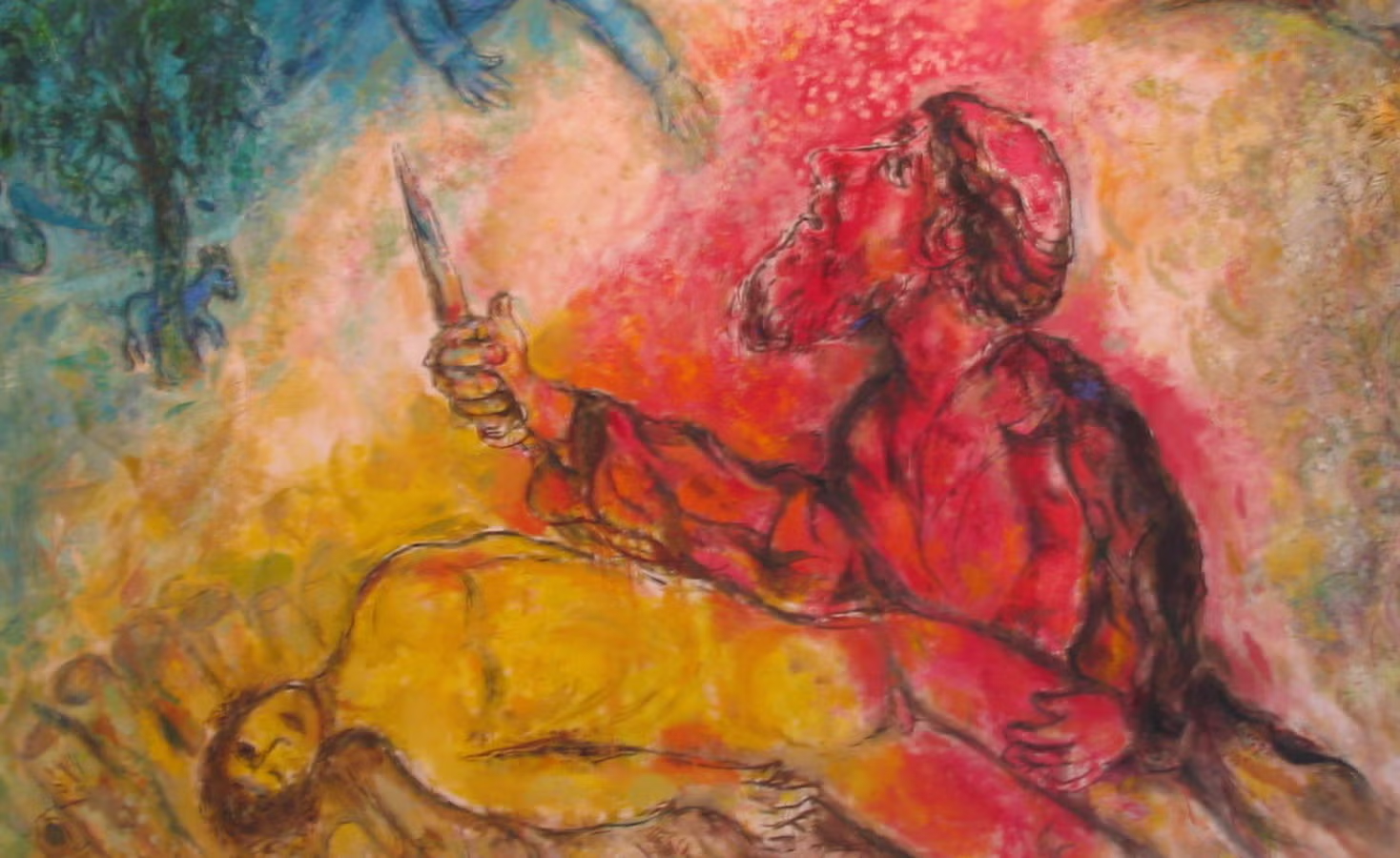
When we picture the Binding of Isaac, we can clearly see Abraham’s raised hand – slaughtering knife outstretched to the sky – ready to murder his own son. We are struck by the moment when all hangs in the balance. 

Finally, God speaks, and Isaac is to be killed no more.

In all these vignettes, we find ourselves caught in stories of people whose lives are racked with precarity, but who listen out for God’s voice, take away a message, and find a way to go on that affirms life.

Interwoven with this story of the main characters, our ancestors, is another story, of people living more marginal lives. The story of Hagar and Ishmael speaks even more explicitly to life’s precarity.

In Orthodox communities, where they observe the second day of Rosh Hashanah, the story of Hagar and Ishmael is usually read today. Here, in the Liberal lectionary, wherein we follow the Israelis and  hold by one day chag, we are given the option of reading either Isaac’s or Ishmael’s story. 

I have opted to read the story of Ishmael because I believe it speaks most clearly to the festival’s theme of life’s uncertainty. Everything about the lives of Hagar and Ishmael is left to the hands of those more powerful than themselves.

Hagar is called a handmaid – a word that glosses over the gross crime inherent in a purchased human being. 

A handmaid had no property, no income, and no family to come and redeem her. Most handmaidens were separated from their own kin, and stripped of their original language. 

Hagar’s name means “the foreigner.” The Torah calls her “the Egyptian.”

She was beholden to her mistress, Sarah. Hers is the most precarious position one could have in life.

A handmaid cost more than a male servant because the handmaid could produce the most valuable good: more slaves. 

Unlike the other women in our readings, Hagar does not long for a child. She expresses no desire; she offers no consent. She is simply used as a vehicle so that Sarah can have a son. 

Abraham will take her as a concubine. The child will be Sarah’s property and Abraham’s heir.

This is already a dangerous situation. If she does not give birth, Hagar fails to deliver on the terms of her purchase. If she does have a child, she could become a rival to her mistress.

That is precisely what happens. 

Hagar becomes pregnant, and Sarah immediately flies into a jealous rage. Hagar runs away, but has nowhere to go. She can either risk the harsh desert as a single pregnant woman, or she can return to an abusive household. 

For Hagar, everything hangs in the balance. Then, God hears her and intervenes. An angel tells her that God knows her suffering, but promises that her life will get better. 

She will bear a son. He will be a highwayman, attacking everyone, and attacked by everyone. His name will be Ishmael, meaning “God has heard.”

As with all our protagonists in Rosh Hashanah stories, Hagar finds her life in the balance. She realises how precarious her existence is. Then, she listens for God. Hearing God, she finds a way to move forward.

So, Hagar returns. And her life hangs in the balance once more. 

This is where the Rosh Hashanah reading begins.

Here, Sarah sees Ishmael playing and demands of Abraham “cast out that slave and her child, because that son-of-a-slave will not share in the inheritance of my son Isaac.”

Abraham followed Sarah’s words, and sent Hagar out into the desert with nothing more than some bread and a skin of water. 

She wandered about in the wilderness of Beersheva until they had completely exhausted her water.

We are told that Hagar sat an arrow-shot away from Ishmael. 

This language seems to make us consider Hagar’s own thoughts: in this moment, Hagar thinks: “maybe I could put the boy out of his misery.” But she cannot do it. She cries out “I do not want to see the child die” and bursts into tears. 

Then God hears. God hears Ishmael’s voice crying out, and sends forth an angel from Heaven. 

Every bit of hope was lost. Everything hung in the balance. But Hagar listened. And God listened. And they heard each other. And Hagar found a way to go on.

The angel says: “כִּי שָׁמַע אֱלֹהִים אֶל קוֹל הַנַּעַר בַּאֲשֶׁר הוּא שָׁם” – “for God has heard the voice of the boy where he is.”

In the Talmud’s treatise on Rosh Hashanah, this is the hook our rabbis use to tell us about our own place before God. 

The rabbis say this means that God hears Ishmael in the moment when he cries out.

To God, Ishmael’s past and future actions matter not. 

God does not care that Ishmael comes from the lowest and most vulnerable place within Israelite society. God does not care about the prediction that Ishmael will go on to be a highwayman. All that matters is that Ishmael cries out at that moment.

This, says the Talmud, is how we should all see ourselves on Rosh Hashanah. Rabbi Yitzhak declares “every person is only judged according to their deeds at their moment of trial.” 

We are only judged by our hearts in this moment of reflection. 

We are not our past mistakes, nor our future errors. We are the people that God beholds today. We are the people who chose to turn up, on this Rosh Hashanah, who knew we wanted to engage with our own souls. 

That is all that God sees.

This is a part of the Talmud’s more general argument about Rosh Hashanah, that it is a time when everything hangs in the balance. 

Our rabbis teach that we should all imagine that the whole world is finely balanced between good and evil, and that it is our responsibility to tip the scales. 

Moreover, say the rabbis, our own hearts are precariously weighted, with an even chance of falling to the side of good or evil. In this analysis, then, the fate of the whole world can rest on just how we direct our own hearts.

So, we need to take every opportunity to place a greater load on the scale of good.

The Talmud offers things we can do to make such a change: give to charity, call out in prayer, and change our behaviour. Any one of these actions can cause a shift in that delicate balance. 

A small prayer, a slight modification to how we act, a donation to a righteous cause – any of these can transform everything.

We live in a time when all can feel uncertain. Life seems nerve-wracking. At times, it does indeed feel like the balance of all the scales in the world is tilting ever more toward evil. 

The Talmud tells us that we still have some control. We can still be a force for good. We can still nudge the fine weightbridge an inch towards goodness.

The Torah gives us examples of people whose own lives hung in the balance. They listened for God, and God listened for them. And God answered “I have heard you where you are.”

So, if you feel like you are hanging in the balance, hang on in there.

God is hanging in there with you.

Shanah tovah. 

high holy days · judaism · sermon

If God can change, why can’t you?

Everyone changes. People change all the time.

In our Scriptures, the changes are often dramatic. 

Avram is an idol worshipper who lives in Mesopotamia, then undergoes complete conversion to monotheism and sets out on foot to a new country. With that, he gets a new name: Abraham.

Sarai is barren then, miraculously, in her old age, conceives a son. God gives her a new name: Sarah.

Jacob is a lying trickster who wrestles with an angel in the wilderness. When his heart has truly changed, he gets a new name: Yisrael. 

In fact, in each biblical story, a change of direction, outlook, and often name, are the key points of the narrative.

So, what about our Rosh Hashanah reading? Who is it that changes there?

In the Aqeidah, our Torah reading for the new year, Abraham is called upon to climb a mountain and sacrifice his son.

We know nothing about Sarah, who is largely kept out of the story. We don’t know anything of how Isaac feels about this, since he stops talking once he realises what his dad could do to him. 

Abraham is remarkably unchanged. At the bottom of the mountain, he is willing to do whatever God says. At the top, God says Abraham is no longer required to sacrifice his son, and to sacrifice the ram instead. At the top of the mountain, Abraham still just does whatever God says.

But there is a character who really changes in this story: God. 

God begins the narrative as zealous and demanding of human sacrifice. God ends the story compassionate and eager to enter into meaningful relationships. God begins by effectively threatening to blot out all of Abraham’s children, then ends by promising Abraham as many descendants as stars in the sky.

And, yes, God undergoes a change of name. Through the whole of the story, God is called Elohim, a name associated with strict justice and universal truth. At the very end, God is revealed by a new name – יהוה – Adonai, a name associated with the close personal relationship God has with every human being. 

In this story, the character who undergoes the greatest change is God.

Even God, the Creator of the world, the Almighty and All-Powerful, can transform. The Holy One, who by nature is completely eternal, can shift from being strict and distant to close and loving.

So, if even God can change, why can’t you?

In our Talmud, the rabbis introduce us to the idea that we are supposed to imitate God.

Rabbi Hama baRabbi Hanina teaches: be like God. Just as God clothed Adam, you will care for the poor. Just as God visited Abraham when he was unwell, you will visit the sick in your community. Just as God consoled Isaac over the death of his father Abraham, you will comfort the mourners. Just as God buried Moses, you will inter the dead.

God shows us a model of how we ought to live. Like God, we are supposed to be compassionate, loving, kind, morally clear, and doing justice in the world.

But more than that. Like God, we are supposed to change.

Here, at Rosh Hashanah, we learn: just as God can change, so can we.

We are made in God’s image. At the start of each year, we read a story where our Creator transforms. So we know that we can change too.

We can face our fast-shifting world. We can rise to the challenge of our changing community. We can look inside ourselves and love our own souls a little more.

Blessed are You, Eternal One our God, who gives us the power to change.

story · torah

When is a person truly dead?

At home, my fiance paces back and forth, preparing for his exams in anaesthetics. In a week, he will be tested orally to see if he can become a consultant. He recites definitions of key medical terms, revises laws of physics, gives diagnoses of uncommon diseases. 

One definition he has repeated so many times it is now imprinted in my mind too.

Death is the irreversible loss of capacity for consciousness and loss of capacity for breathing.

At times, we have pondered over such terms together. On long walks, we have discussed medical ethics through Jewish lenses. We have debated whether and how modern medicine aligns with ancient wisdom. 

Now is not the moment to challenge him on the medical definition of death. But the definition sticks with me, because this is an area where I do not think science and religion align. 

While Laurence prepares for his exams, you will have to listen to my thoughts on what Judaism teaches about mortality.

Death is the irreversible loss of capacity for consciousness and loss of capacity for breathing.

Is it? Is that what it means to die?

If it were, then would living simply be brain activity and breathing? Is that all we are?

Chayyei Sarah – the life of Sarah – is our portion. It opens with her death. By telling us about her life from her death, the Torah is telling us something about how life and death interact. 

The parashah is a recounting of Sarah’s burial. It is a terse text, where the primary narrative concerns Abraham’s attempt to purchase a lot for internment. 

So much is left unsaid. So many emotions are not expressed. In the silences and interstices, we are left to reconstruct our own imaginings of what Abraham was thinking. Let us try.

Abraham proceeded to cry and eulogise Sarah.

He held her hands, once so strong and firm. Those hands had kneaded bread for strangers at a moment’s notice. They had sewn garments for whole families. They had, at times, pointed accusations, separated children, raised objections… Strong hands. Determined hands. Strong, determined hands, that were now drained of all their vigour, and sat coldly in his own palms.

Abraham rose from beside his dead, and spoke to the Hittites.

Abraham sprang into action. Sarah had not died in the land of her own family in Egypt, nor of Abraham’s in Chaldea. They were in a strange place, far from their own homes, among Hittites in the hill-country of Canaan. 

Abraham said: “Here I am, a stranger and a foreigner among you. Please sell me a piece of land so I can give my wife a proper burial.”

Sarah had left her father’s home in the palaces of Egypt, where she lived as a princess. She was an aristocrat in a great empire who gave it up to travel with a wandering man. Abraham claimed to have spoken with the One True God, and Sarah just followed him. She forsook luxury for a life on the road. Now, she lay dead on the road, and there would be no fine processions to pyramids to entomb her.

The Hittites replied to Abraham, “Listen, my lord, you are an honoured prince among us. Choose the finest of our tombs and bury her there. No one here will refuse to help you in this way.”

Sarah used to laugh with her whole belly. Her shoulders bounced up and down. She can find humour where nobody else could. Even when she struggled with infertility, she found ways of making jokes. Abraham would not hear her laugh again.

So Abraham bowed low before the Hittites and said, “Since you are willing to help me in this way, be so kind as to ask Ephron son of Zohar to let me buy his cave at Machpelah, down at the end of his field. I will pay the full price in the presence of witnesses, so I will have a permanent burial place for my family.”

Sarah had been so beautiful people tripped over themselves staring at her. On their wanders, every prince desired her. Sarah was as beautiful at 127 as she had been when they had first met. She was still just as honourable and God-fearing. Nobody would be as good and beautiful and true again. 

Ephron was sitting there among the others, and he answered Abraham as the others listened, speaking publicly before all the Hittite elders of the town. 

Sarah received no ennoblement or reward for marrying Abraham. Yet so much honour came to Abraham through her. She could see visions and speak with God. 

“No, my lord,” he said to Abraham, “please listen to me. I will give you the field and the cave. Here in the presence of my people, I give it to you. Go and bury your dead.” 

Abraham had bargained over everything. He had struck a deal with Avimelech to share water sources. He had even negotiated with God over the destruction of a city. This was a bargain he could not accept.

Abraham again bowed low before the citizens of the land, and he replied to Ephron as everyone listened. 

“No, listen to me. I will buy it from you. Let me pay the full price for the field so I can bury my dead there.”

Abraham was ageing too. Who would bury him? He had cast out one son and tried to murder another. 

Ephron answered Abraham, “My lord, please listen to me. The land is worth 400 pieces of silver, but what is that between friends?”

What is four hundred shekels between strangers? What is a price on the life of Sarah? What sort of burial could ever be enough for her? 

Ephron said: “Go ahead and bury your dead.”

These are some words we may complete into the silences. They come from the other biblical stories and midrash, and they paint a fuller picture. In the spaces, we see that this is not a negotiation over a burial plot, but a negotiation over the nature of death.

Death is the irreversible loss of capacity for consciousness and loss of capacity for breathing.

Is it? Is that what it means to die?

If it were, then would living simply be brain activity and breathing? Is that all we are?

Medically, scientifically… maybe.

Spiritually, Jewishly… no. 

Death is as much a journey as life is. 

For seven days, we eulogise, as the last imprint of a person leaves us. For thirty days, we mourn, as the shock and grief harrow us. For eleven months, we pray, as some part of the soul heads on its journey to Heaven. 

Then, every year, we say the names of the dead, and some part of our loved ones returns to us. Their soul breaks through the gaps in Aramaic words and we feel them with us once more.

Thousands of years later, we still say Sarah’s name, and some part of her keeps living long after breath and consciousness. 

We are more than what we exhale: we are the laughter and joy we bring to others. We are more than our own thoughts: we are the memories living on in others. 

In memory, in prayer, in faith, we grasp something greater than the material world.

Trusting in You, Eternal God, we see life beyond death.

Amen.

Van Gogh, The Cave of Machpelah

high holy days · sermon · theology

You are the impossible child God yearned for.

You are the impossible child God yearned for.

You are a miracle. 

You may not hear that often, and you probably think about it even less, but you truly are.

The British-Indian poet Nikita Gill has written about just how unlikely is the fact of your existence:

“The very idea that you exist considering those extremely low odds is a miracle on its own. You see, the exact DNA that comes from your parents to create you could have only happened when your parents met, which is 1 chance in 20,000. That alone should be enough, but when you add up the fact that it has taken 5-10 million years of human evolution for you to exist at this time, in this moment, you begin to recognise just how much of an impossibility you are.”

– Nikita Gill

Add to that, and remember that you are a Jew. Remember that in those 10 million years of evolution, Judaism has existed for only 3,000 of them, and is still one of the world’s oldest continuously existing cultures. You are the product of a long line of ancestors, dating back to desert nomads, who, at one time, heard the voice of an invisible God, and kept that story alive for hundreds of generations. That is a miracle.

In the last century, the ancestors who held onto that story fled from countries all over the world, and migrated to farthest corners of the earth, and faced down war and genocide, and survived extermination. Faced with such experiences, many turned away from their heritage and disappeared from Jewish life.

But you are here, in the 21st Century, alive, and Jewish, and living out that story. You are the product of billions of years of matter interacting and millions of years of human evolution and thousands of years of cultural transmission. You are here. And that is an incredible, awe-inspiring miracle.

One of the prevailing themes of Rosh Hashanah is the miracle of human life. It is everywhere: in our liturgy, in our Torah portions, and in our haftarah. All of them are bound together by a sense of wonder at our existence.

Three weeks ago, we read the prophet Isaiah, who expressed joy at the wonder of childbirth. His great prophecy opens:

“Sing for joy, infertile woman, you who never bore a child! Sing for joy and laugh aloud, you who never felt a stomach cramp. Because the children of the barren are more numerous than those who suckled infants.”

But who is this talking about? Who is the sterile woman giving birth to the miracle child?

In the 9th Century, the great collection of rabbinic stories, Midrash Pesikta Rabbati, offered us three answers: Sarah, Hannah, and Jerusalem. At Rosh Hashanah, we read the stories of all three.

In the Torah portion, we read of Sarah’s miraculous labour. Sarah was elderly and post-menopausal. When three angels told her she would give birth in a year, she laughed. For years, she had yearned for a child, but, in her old age, she had given up. How would her withered husband and her empty womb bear a child? 

A year later, Sarah gave birth. She ate her words and called her baby boy Yitzhak, meaning ‘laughter.’ She said: “God has brought me laughter, and everyone who hears about this will laugh with me.”

A miracle. An impossible birth. So that infertile woman who had never had a child rejoiced, just as Isaiah described.

In our haftarah, we read, too, of Hannah’s wondrous labour. She was infertile. Her husband Elkanah’s other wife, Peninah, had plenty of children. Peninah became her rival, and relentlessly mocked her, saying that God had closed her womb.

In the depths of her despair, Hannah prayed to God. She whispered fervent promises to God that, if she was allowed a baby, he would be dedicated forever to religious service. 

As Hannah prayed, she was so full of silent anguish and tears, that the High Priest Eli thought she was drunk. He heckled her to sober up. But when she explained that her behaviour was the product of deep distress, Eli prayed with her that her wish be granted.

A year later, Hannah gave birth, and called her baby “Shmuel,” meaning “I asked God for this.”

Another miracle. A barren woman who bore no children rejoiced, just as Isaiah described.

Pesikta Rabbati offers a third infertile woman to whom Isaiah’s proclamation might refer: the city of Jerusalem.

At the last major event in the Jewish calendar, Tisha BeAv, we commemorated Jerusalem’s destruction. We fasted, wept and prayed, remembering how the holy city was razed to the ground. Following the destructions by Assyria and Rome, that city was left stripped of its inhabitants. Its most sacred spaces were desecrated and burned. The whole town was abandoned like an empty womb.

And out of that barren place came Judaism. At the time when it most seemed like the Jews had been destroyed, the rabbis came forward and gave them life previously unknown. They developed tefillah, Mishnah, midrash, and Talmud. 

They spread the message of ethical monotheism throughout the entire globe. Judaism, from its point of near-destruction, became one of the world’s most notable religions, and influenced civilisations everywhere.

Jerusalem was an infertile womb, out of which came more children than could ever have been imagined.

Sarah yearned for a child and was blessed. Hannah yearned for a child and was blessed. Jerusalem yearned for children, and now has millions.

But there is another impossible birth that we must celebrate. An unbridled miracle. A human being created by God out of nothing, who had the potential to be the saviour of all humanity.

Whose birth was that? 

Yours.

What, did you think I was going to say somebody else?

For the Christians, that person was Jesus. In their story, their Messiah was born by immaculate conception to a virgin mother. For them, Jesus’ birth fulfilled the prophecy related by Isaiah.

In the 9th Century CE, when this midrash was composed, Christianity had become a full-fledged international religion. It was the official doctrine of the Roman Empire, and was spreading throughout Europe through the Carolingian Empire. Christian polemicists criticised Jews for denying the truth of their Testament, and insisted that their story completed our Torah. 

Part of the motivation for the compiler of Pesikta Rabbati must have been to show that Isaiah could easily be proven from texts within the Jewish canon. But, more than a difference of interpretation, this midrash speaks to a fundamental difference between how Jews and Christians have seen the world. For us, Jesus is not the beloved child of God born by miracle. You are.

As Lily Montagu, the great religious reformer and East End social worker, put it:

“We have the belief that man can directly commune with his God, that he needs no intercessor […] The Christian feels himself brought into contact with God by means of Jesus, his Saviour. Jesus is conceived as, in a special sense, the son of God, and as able to direct all seekers to the divine sanctuary. We Jews hold that every man is the son of God, and that all His children have access to Him when they try to live righteously.”

– Lily Montagu

So, all humanity is God’s miraculous creation. All humanity is in direct relationship with our Divine Creator. And all humanity has the potential to bring this world closer to its salvation.

Rosh Hashanah, as a festival, marks the sixth day of the world’s creation, on which the first ever human being was made. It celebrates the miraculous creation of Adam HaRishon, the original person, sculpted from clay and breathed alive with the sacred air from God’s nostrils.

Consider what a wonder this is. Knowing all that we do about the history of the universe, how many billions of years must God have spent yearning to create the first ever person. 

How impossibly beautiful is it, that, after the creations of thousands of galaxies and multitudes of planets, the Universe somehow put together the exact elements that would support life. And that life became social and conscious and able to reflect on its own existence. And, conscious of its own selfhood, that being was able to reach beyond itself and worship the Eternal Mystery that created it.

Who knows what the chances are? But it is certainly a miracle.

The cosmos was, at one point, an insignificant speck, devoid even of matter, and now it includes human beings. And now it includes you.

You are the impossible child God yearned for. You are a miracle.

However much you wish to connect with your Creator, just think how much your Creator wants to connect with you. Whenever you feel like you can’t quite find God, just take a second to contemplate how many billions of years God spent trying to find you.

Your existence is a miracle, and I am so glad you are here.

Shana tovah.

high holy days · sermon

The changing face of the Jewish family

Imagine a Jewish family. Go on, close your eyes and envisage what a Jewish family looks like. 

How many of them are there? Where are they? What do they look like? What are they wearing? 

OK, you can open your eyes again. 

Perhaps you pictured one of the families from Shtisel. You’ve conjured up Haredim in black hats and long coats and white socks. You might be picturing women with covered heads, racing around a dinner table, providing food and clearing away dishes, while a bearded patriarch at the head of the table murmurs prayers from a benscher. Yes, that is a Jewish family. 

Or maybe you imagined the family from Gogglebox. A husband and a wife. Two children, a boy and a girl. They sit on the sofa in front of the TV. They eat their meals on their laps. They light the shabbes candles and sing together the brachah, then go back to watching X Factor.

Yes, that’s a Jewish family too.

Or maybe you’re remembering your own family, from your own childhood, at some festival or simchah, and seeing yourself in your own family make-up. 

You might reminisce on siblings, cousins, single mother, married parents, step-parents, step-siblings, uncles, aunties, grandparents, great-grandparents, step-great-grandparents, neighbours, babies, babysitters, cats, dogs, goldfish. You can scratch out and fill in whatever applies. You’ve got a Jewish family. 

If you’ve got a family and there are Jews in it, that’s a Jewish family.

The truth is there is no one way to have a Jewish family. We come in so many shapes and sizes. We are too diverse even for a single stereotype. 

Still, people often have an idealised vision of what a Jewish family should be and how it should look. Take today’s Torah reading. 

On the second day of Rosh Hashanah, we read of Sarah’s anguish at having one too many children. 

In our parashah, Sarah knows she must provide an heir to Abraham. At first, she offers up her handmaid, Hagar, as a surrogate so that Abraham might sire a child. This is successful, and leads to the birth of Ishmael. Later, God blesses her with her own child, Isaac. 

But this is where things get really complicated. Sarah wanted Hagar to have Ishmael when she thought he’d be the only one. She liked the idea when she was providing her heir for her husband. But now Ishmael looked like a competitor for her son Isaac’s birthright. 

Sarah had an image in her head of what her family was supposed to look like. When her surrogate son plays with the child that she gave birth to, Sarah decides only one of them can last. Sarah instructs Abraham to cast out Hagar and Ishmael into the wilderness. Now, the Jewish family of five gets swiftly reduced down to two. 

Sarah had an image in her head of how her Jewish family was meant to look. But it didn’t match up with reality. Rather than adjust her expectations to her reality, Sarah decided to make reality conform with the fantasy. Even if it meant making people destitute and homeless. Even if it meant cutting up the family she had.

Unfortunately, this desire to force reality to fit the fantasy still permeates Jewish life centuries later. In our communities, people still want to police what a Jewish family should look like. 

The result can only be disappointing for everyone. Families that don’t fit the mould find themselves excluded and cast out from communal life. The people who are “on the inside” get increasingly frustrated that nobody is coming along to synagogue who matches up with their idealised vision of the Jewish family. Eventually, synagogue leaders find themselves exasperated that their membership is dwindling and short on children. 

Rather than fighting reality by clinging onto a fantasy, successful synagogues find ways of embracing change. The best and most active shuls make sure they celebrate diversity, rejoicing in how manifold their membership can be. 

So, let’s take stock of what Jewish families really look like today.

Today, a Jewish family may only have one Jew in it. According to research, a quarter of Jews are in mixed relationships with people from other religions and none. 

In the 90s, moral panic about Jews “marrying out” meant a lot of community resources were spent trying to get Jews into relationships with each other by any means possible. After decades of bemoaning mixed families and complaining that these Jewish groupings don’t look right, there are more mixed families than ever. That number is set to grow.

Contrary to Orthodox and establishment Jewry, Reform Jews made it our mission that we would celebrate families in all their diversity. People could know that, no matter who they loved, the synagogue would be here for them and support them through every step of their life’s journey.

Because the family has changed, conversion has changed too. Decades ago, you could reasonably assume that, if somebody was converting, it was for marriage. That is no longer the case. 

The vast majority of Jewish converts over the last few years have been “spiritual seekers”: people looking for God who have found something meaningful in our traditions. Last year, over 80% of candidates at the Reform Beit Din were lesbian, gay, bi and trans. They are people who looked for a religion of integrity that celebrated them as they are, and found it with us. 

Like the rest of the country, our families reflect the choice that people have over how they want to live. Our families are sometimes one dad with three children and sometimes two mums with a baby; they are cousins and grandparents living under one roof; and they are friends raising children together as neighbours. 

So, imagine your Jewish family again. And again. And again. Keep picturing them until, as in Abraham’s promise, you have as many configurations of families as there are stars in the sky.

Yes, now we know what a Jewish family looks like.

And now we can welcome and encourage them in all their diversity. We can find ways to bring everyone into the synagogue and feel like this is a home where they are loved and encouraged. We can make sure that nobody is turned away.

Imagine the possibilities.

Shana tova. 

I gave this sermon on Second Day Rosh Hashanah at South West Essex and Settlement Reform Synagogue

judaism · sermon · torah

Being hospitable

It was a dark night in an Eastern European shtetl. Shabbat was just about to come in. The Baal Shem Tov sat at the dinner table, surrounded by friends and family. Every spare inch of space had somebody sitting in it. The Baal Shem Tov was not a rich man, although many of the acolytes of the movement he founded later would be, and he would have to make a thin chicken soup stretch to feed everyone. Suddenly, there was a knock at the door. Standing in the doorway was a vagabond. He smelt bad, his beard was unkempt, his clothes were untidy. He asked: “can I come in? Can I eat?” The Baal Shem Tov looked back at the full house, looked over at the steaming pot of thin chicken soup, looked back to the man, then up to Heaven and said: “If God has made enough room for him on this planet, then surely I have enough a room at my table.”

The Baal Shem Tov was a model of hospitality. In this week’s parshah, we read about Abraham, who was, too, a model of hospitality. Two strangers come to approach Abraham, and he cannot do enough for them. The Torah is usually noticeably scarce on detail, but on this occasion, we hear everything he did. He bowed, he welcomed them, he gave them water and bread-cakes, he washed their feet, he offered them shade. He even killed a calf for them, and in those days meat was far more expensive than it is today.

Abraham doesn’t even know who these people are yet. As it turns out, they are messengers of God. But they could have been anyone. Nevertheless, from the outset Abraham addresses them as if they are angels. Perhaps it was that Abraham could sense something in them. Perhaps he had been expecting God. But I think, most likely, Abraham simply saw the face of God in everyone.

Rashi tells us that Abraham always used to sit at the entrance to his house, so that he could invite anybody in who walked past. The midrash tells us that Sarah always had a listening ear. She was known everywhere for how tirelessly she worked to cultivate a garden for visitors to sit. Their tent was open on all sides, so that they could welcome people coming from every direction. And from this story, the rabbis derive a mitzvah, perhaps the most important commandment of all: the duty to be hospitable.

The next story in Genesis is a parallel. Two angels turn up in Sodom. Lot invites them to stay the night. Before they had gone to bed, all the men from every part of the city of Sodom—both young and old—surround the house. They threaten to assault their visitors. When Lot objects, they deride him for being a foreigner and try to break down the door. Lot offers his daughters up to the baying mob.

Although there is a modern Christian interpretation that the story of Sodom is in some way about homosexuality, the rabbis did not have such a tradition.  For them, this was a story about hospitality denied. This, they said, was a city so wicked that they would not even allow their residents to show any hospitality or compassion to strangers. This, they said, was a city where even neighbours were not kind to each other; where a dog-eat-dog ideology took root so that nobody worked together. This was a city so wicked that even people like Lot, who should have been righteous, ended up turning against their own daughters and denying them the childhood they deserved. That is why the angels destroyed Sodom.

Which city do we live in? Which house do we inhabit? I often wonder what the two angels would make of our neighbourhoods and homes if they came to visit. While we have more technology and medicine and infrastructure than the prophets and tsaddikim could ever have anticipated, we have just as many people in need of hospitality. Our society seems more isolated than ever.

Manchester is known for its hospitality, but even here we can see the isolation. We already know older people who live in loneliness. We already know younger people who are desperately reaching out for a community, only to find nothing. We have seen newcomers turn up in this city only to encounter racism, hostility and closed doors. We have all seen the number of rough sleepers on our streets rocket over recent years.

In that situation, we have the same choice that was facing Lot and Abraham. Will we throw open our doors to let people in, or will we take the cruelty we experience in society and turn it on the people in our own homes? Will we increase the love or increase the isolation? This is a societal problem, but it will only change if people welcome each other, get to know each other and build solidarity with each other.

So, we must start with ourselves and our own homes. Jewish life is not something that happens in the synagogue. The synagogue is just a place we come to get respite and reenergised as we live a Jewish life. Jewish life happens in what we do the rest of the time. If we spend the rest of our week building communities, showing hospitality and modelling loving-compassion, that is when we’re living Jewish lives. Hospitality is one of the most important mitzvahs because it affects how we interact with everything. Being welcoming to people helps to break down isolation. It helps to create a sense of community. And it makes better, kinder people of ourselves.

Let’s all make the effort to be better hosts and to give more time to each other. Choose to be like Abraham and Sarah. Choose to be like the Baal Shem Tov. As Jews, let’s be the people who decide not to let an isolating and inhospitable society last. The struggle for community begins here, with us.

besht

This sermon was first delivered Shabbat Vayeira, 3rd December, at Manchester Liberal Jewish Community