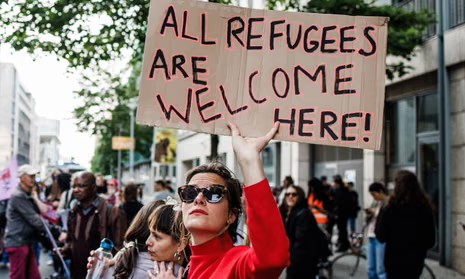
This week, our godson came to stay. We’re used to being in the house just the two of us, but this half term we had people in and out of our house. Sometimes people came for lunch or dinner. Sometimes they stayed over and sometimes they just came for a cup of tea.
By the end of the week, the house was messier, we were smellier, the carpets had a couple of new stains, and we were so much happier. It was hard, it was exhausting, and it was worth it.
My husband and I love each other, but I get bored quite quickly, and I get lonely just going to the toilet. We love seeing people and we love hosting. One visitor said “you just want your house to be filled with children and music.” That’s it exactly. This week reinforced for me that home is made by people.
The prophets knew how important this was. Abraham and Sarah sat with their tent open on all sides so they could welcome strangers. When three travellers come to meet them in the desert, Sarah leaps to her feet.
She’s doing all she can to make her guests feel welcome, cooking up sweet cakes and getting them water. That’s a real Jewish balaboster right there. The kind of host I aspire to be.
Abraham immediately greets them: “welcome, my lords.”
The rabbis wanted to know: how was it that Abraham knew these strange men were angels? They said: Abraham saw the angel in everyone.
He didn’t know they were messengers from God, come to tell Sarah she would have a child. He just saw God’s light shining from every human being and welcomed it into his home. He didn’t know what he was getting himself in for, but he thought it would be worth it.
This is one of the most sacred Jewish values: haknasat orkhim; welcoming in guests. In the story of Elisha, we see the same thing from the experience of the one being hosted.
Elisha goes to the home of a widow who is absolutely destitute. She’s in so much debt she’s considering selling her children into slavery. Elisha connects her with neighbours, and by some miracle, she finds she now has plenty and can save her sons.
The widow didn’t know Elisha was a miracle-worker. She made herself vulnerable by letting a strange man in her home, then she put her faith in her neighbours, and somehow the experience of community brings about wonders.
But Elisha’s story isn’t done. As a true prophet of God, he doesn’t patronise the poor or show favour to the rich. He treats everyone as if they are part of God’s creation. He goes and stays with a wealthy lady, the Shunamit. She takes a risk. She gives him his own room and board. And then he performs miracles for her too.
Elisha and the people he met understood that home was made by people. It might be chaotic and messy, but it was worth the potential rewards.
As Jews, we often tell our stories of migration. We talk about what it was like for our ancestors, and even for us, to come to this country and take the risk on the people who would host us.
I wonder what it was like, actually, for the English, when they first let us back in. For nearly half a century, Jews hadn’t lived openly in their country. They didn’t know who we were or what we would be like.
But this was the English Revolution, a moment of great upheaval in society. Oliver Cromwell had killed the king, shared out the land, and announced freedom of religion for everyone. They were remaking society and decided it was time to let back in the Jews.
It was a risk, and it turned out to be one worth taking. Well, they liked us so much that, even when they reinstated the monarchy and brought back feudalism, they decided to let us stay. And we liked England so much we made it our home.
And they decided that this whole business of allowing immigration and multiple cultures was working quite well for them. Because only a few decades later they let in fifty thousand Huguenot refugees.
And then the Irish came fleeing famine, and the Germans came fleeing war, and then Russian Jews came fleeing pogroms, and then the British Empire came back to the motherland from India, Pakistan, the Caribbean, and Africa.
Recently, I joined other faith leaders in welcoming unaccompanied child refugees, mostly from Sudan and Eritrea, to Surrey. We got together, as Jewish, Christian, Muslim, Sikh, Hindu and Bahai to show the newcomers how we build a society here on friendliness and mutual respect. For these kids, who had fled from countries torn apart by war, the very concept of tolerance blew their minds!
Now, I take great pride in telling my godson that England is the place people come to be safe because we build our country on freedom. 500 years of tolerance. This country is our home, and we are the people who are making it. This is our home and we filled it with music and kids.
And we still take in strangers, and sometimes that does feel risky, but we know after centuries of experience that it’s a risk worth taking.
This week – would you believe it – Ephraim Mirvis was in the news bemoaning immigration. Can you imagine what a parody it is for a Jew born in South Africa to get on the Jewish News and say “our civilisation is under attack” because of “the influence of other cultures coming.”
This apparently religious Jew, in a beard, tzitzit, and kippah, complained “we’re seeing a definite move away from a Christian-based British identity towards a more general-based identity.”
Mirvis, like Farage and others, would like us to believe we have a choice between safety and immigration. The real choice is, and always has been, between diversity and conformity. It is between a shared society and homogeneity. It’s never been a choice between Jews and Muslims. It’s either all of us or none of us.
Who was to blame for this great divergence from ethnic and religious purity? Well, Mirvis says “some Jewish people who are letting us down.” He means us, of course. The Progressives who won’t tow his nationalist, parochial line for “Jewish unity,” but instead rejoice in our shared society.
Of course, it’s not just Progressive Jews. He also blames the Church. The established religion of state, the Church of England, has become to weak, he complains, and moved away from “Judeo-Christian” values. Well, yes, the Church has moved in a more inclusive direction. It’s chosen a woman as Archbishop and proudly taken up the banner of diversity.
But if the Jewish leaders and the Christian leaders are all betraying Judeo-Christian values, who knows what they even are? If we, who uphold the message of Elisha, and the hospitality of Sarah, don’t know what the “Judeo-Christian” message is, then what is our Scripture even for?
The truth is the traditional Britain Mirvis wants back is a fantasy. It doesn’t exist and it never did. And you can waste your life pining after a daydream, but you will miss out on living in the real world. You’ll miss out on this real Britain.
The real Britain sounds like Scottish bagpipes and Rasta steel pans and Punjabi bhangra and klezmer clarinet and Peckham grime and Vera Lynn and K-Pop and bluegrass and Cotswold Morris dancers beating together their claves.
The real Britain tastes like croissants and Turkish kebab and Birmingham Vindaloo and American cheese burgers and sweet gefilte fish from the deli and callaloo and Sunday roast and battered Mars bars and Irish stout and Swiss cheese.
The real Britain speaks Sylheti, Polish, Creole, Arabic, Urdu, Romanian, Welsh, Gujurati, and it speaks them all in a Geordie accent.
The real Britain wears kente cloth, Cornish tartan, a shalwar kameez, a sheitl, a kermaya, a crucifix necklace, a kirpan, dreadlocks, a flat cap, and an artist’s beret.
And it’s all together. We put them together to make something bigger and better because that’s how we like it. The people came together and made this our home. And we filled it up with kids and music.
And it’s messy and it’s busy and it’s tiring and it’s hard work and it is absolutely worth it.
This is our country and these are our people. This is our home and these are our neighbours. This is our community and we won’t have it any other way.
That’s my Britain, and I think that’s a way of life worth defending.
Shabbat shalom.