I woke up this morning in a friend’s home on a moshav in Israel-Palestine. I am here for a month to learn and to volunteer with Rabbis for Human Rights.
The setting is beautiful. As the sun set last night over the mountains, the shrublands lit up in shades of orange and brown. Then jackals began to bray, calling out in the echoing valley. As we went to sleep, we even heard a hyena.
Overlooking us is a massive military compound for Israeli surveillance. On the walk to my friend’s home, I could see the separation wall.
We are on land that was taken during the Nakba of 1948. The people who lived here were dispersed, and their farmland taken. We can now see the native fig vines still, but alongside European pine trees planted by the JNF. The village opposite us is comprised of people who were forcefully evicted from a neighbouring town. They are Palestinian citizens of Israel within the “Green Line.”
It is all here. The beauty and the architecture of war. The reality of cruelty and the possibility of what might be.
“If anything, I am more convinced I want to stay now,” my friend says.
Since the start of the war, they have been protesting for peace several times a week. They have been involved in grassroots solidarity actions and getting aid to the people who need it most. At the very beginning, they were part of underground efforts to get people to safety. (And now you understand why I have to write so vaguely.)
The work looks exhausting. They and their friends have been beaten, imprisoned, shot at, and surveyed, only for trying to bring about peace.
“I have to stay now because I can see what it could be.”
Amidst all the rubble, they can see even more clearly the possibilities of a shared peaceful future with the Palestinians. And feel even more that is worth fighting for.
Once our rabbis were ascending to Jerusalem. When they reached Mount Scopus, they tore their garments. When they reached the Temple Mount, they saw a jackal leaving from the site of the inner sanctum of the Temple ruins. They began weeping, but Rabbi Akiva laughed.
The sages said to him, “Why do you laugh?” He said to them, “Why do you weep?”
They said to him, “Jackals now tread on the site regarding which it is written, ‘And the stranger who approaches shall die’ (Bamdibar 1:51) – shall we not weep?”
He said to them, “For this very reason I laugh… In the context of the prophecy of Uriya it is written, ‘Therefore, because of you, Zion shall be plowed like a field’ (Yirmiyahu 26:18), and in the prophecy of Zekharya it is written, ‘Elderly men and women shall once again sit along the streets of Jerusalem’ (Zekharya 8:5).
Until Uriya’s prophecy was realized, I feared that perhaps Zekharya’s prophecy would not be realized; but now that Uriya’s prophecy has been realized, it is certain that Zekharya’s prophecy will be realized.”
There are jackals braying in the mountains here. There is occupation and division and war.
And there are also the people building solidarity. Because of them, the prophecies of peace may be fulfilled.
Take a moment and think about what you love about being Jewish.
When I think about it, there are certain feelings, sounds, tastes and smells that transport me into this place of true Jewish joy.
I smell cloves, absolutely anywhere and at any time, and I am immediately transported to havdallahs of my childhood.
Similarly, leather seforim- those big bound Jewish books. I touch them and I can suddenly feel myself back in my grandfather’s study.
That feeling of stillness of being in a Jewish sanctuary. I used to love sitting in our little rented synagogue in Reading. Sometimes I come into this space, when nobody is here, and feel that same connection.
There’s the music, there’s the text study, there’s the Friday night dinners, there’s meeting a complete stranger and finding you’re related, there’s the beigels, so much better here in East London than anywhere else… I could go on.
Yes, I love Jewish life. And I love seeing others love their Jewish lives.
Last week, I felt a certain eeriness walking around central London. Wherever I went, wearing my kippah and tzitzit, there was a massive picture of a smashed Star of David in every newspaper stand. The Evening Standard bore the harrowing headline “London’s antisemitism shame.”
This came after Mark Gardner from CST said Central London had become a “no-go area for Jews” on Saturdays. He wasn’t explaining where the eruv boundaries were.
He was saying that Jews were not safe when the protests for Palestine were happening.
I don’t feel I need to go into much detail on the headline. We all know that antisemitism is real, and some members here have had horrible experiences. It is not just about central London, as the local area can feel very intense. The demonstrations outside Lidl this week were intimidating, and clearly did include antisemitic harassment.
We all also know that London is mostly very safe, and comparisons with Nazi Germany of talk of mass Jewish departure are overblown. I have always felt absolutely fine being visibly Jewish in London. I can also feel the great tension that affects this area. We are all smart enough to come to a balanced judgement about the true picture.
What struck me about Mark Gardner’s statement was not in the headline, but buried in the text of the newspaper article. When asked about Jews who themselves go on the Palestine marches on Saturdays, the CST chief said:
“There are two types of Jews who attend the protests in the main – ultra orthodox Jews who believe the state of Israel prevents the Messiah coming. Then you have revolutionary socialists using their Jewishness so people get the impression the movement is not fundamentally antisemitic.”
This was such a dismissive and unkind way to talk about fellow Jews, as if they could just be brushed aside and ignored. I bristled with indignation.
Certainly, Haredim and socialists have always been regular attendees of pro-Palestine rallies. But, so what if they are?
Are Haredim, the most visibly Jewish group and the most likely to experience structural discrimination for being Jewish, any less qualified to comment on what is antisemitic? Are socialists, who pride themselves on their culture and traditions, any less able to say what being Jewish means?
These are two groups of people who love being Jewish.
You may not want to be Haredi (I don’t) and you may have criticisms of their approach to their religion (I do) but I would never dream of questioning their love of Jewishness, or their sincerity of conviction.
The strictly Orthodox Jews in places like Stamford Hill and Hendon are crucial to London Jewish life. We have our kosher delis, our judaica shops, and our bookstores because of the commitment of Haredim to building up Jewish life here.
When I think of the strictly Orthodox, I have no doubt that they, too, love being Jewish. They might not love all the same things that I do, and they might love some things I don’t, but they are fellow Jews, creating vibrant community.
I do not know the Haredi world, and have never been part of it, but I believe they have important things to say about being Jewish and facing antisemitism.
I feel I can speak with more confidence about the revolutionary socialist Jews. That’s much closer to my world, and one that I interact with readily. That is a group of people I can say, with certainty, love being Jewish.
It would be easy for such people to disregard their Jewishness, or downplay it. Plenty of Jews have, in all times and from all political persuasions, for varying different reasons. But the Jewish socialists have chosen to wear their Jewishness as a badge of honour.
These are people who have regular book groups, looking at Jewish thought. They are deep-divers of Jewish history, who keep alive the stories of the East End and the shtetl. They are Jews who will insist on telling me they are atheists, before heading off to Friday night dinners with each other, where they will sing the same songs and recite the same blessings that you all will at your dinner tables.
The revolutionary socialist Jews often see their politics coming precisely from their Jewishness, and not in spite of it. They are, in my experience, serious thinkers about antisemitism, who have done the reading, experienced the vitriol, and arrived at smart and nuanced conclusions about how to combat anti-Jewish hatred.
They are with us, loving being Jewish, and building Jewish life.
What good does it do to dismiss them out of hand like that?
Perhaps it is simply that they are easy to dismiss. They have no stake in the formal institutions of Anglo-Jewry, like the Board of Deputies, nor do they want to. In both cases, they will carry on living their Jewish lives as they want to, unhindered by such dismissal.
But I don’t think Gardner is quite right that socialists and Haredim are the only groups who march on Saturdays: increasingly, they are joined by young people who grew up in movements like Reform Synagogue Youth (RSY-Netzer.) They are the bulk of Jews in groups like Naamod.
To see such people marching, especially in such numbers, was unthinkable only ten years ago. When they demonstrate, they are singing the songs they learnt in Reform youth camps. When they speak, they talk about the rabbis and leaders that shaped our Jewish world. They are attending as Progressive Jews.
One month ago, the movement workers for LJY-Netzer issued a statement, calling for a ceasefire, and decrying Netanyahu’s war. In their public message, they shared their dual sadness: on the one hand, at rising antisemitism; and, on the other, at a seeming inability to talk about Gaza.
LJY-Netzer is Liberal Judaism’s youth movement, parallel to the Reform one, RSY. The “Netzer” part is Hebrew, meaning Reform Zionist Movement. Today, while I lead here, Rabbi Jordan is meeting with them at Chagigah.
These critics of Israel are young people firmly within the institutions, who participate in their local synagogues. They love being Jewish, and, more than that, they love Progressive Judaism, our Judaism.
Are they to be dismissed too? Will they find their Jewishness cast aside in some press release? Will they, for their principled stance, find they are no longer worthy to comment on Jewishness or antisemitism?
Ignoring them is not an option. It would be unconscionable to throw them away, with their opinions.
That doesn’t mean you have to agree with them. You should certainly disagree with them if that is how you feel!
But do so from a place of love. Because you love being Jewish. Because they love being Jewish. Because you should love each other as Jews.
Disagree, by all means, but disagree as Jews. What could be more Jewish than lovingly disagreeing?
If we are faced with hatred, we will only love more. We will love ourselves more. We will love being Jewish more. We will love the sights and smells and sounds and rituals and families and discussions and Scriptures and songs.
We will love each other more. We will love others’ ways of being Jewish more. We will all embrace each other, seriously, and with affection, as fellow Jews. We will encourage others to love what they love about being Jewish. So that they will keep on loving being Jewish, long into the future.
A few weeks back, I attended a retreat with Christian colleagues. At some point, surprisingly enough, we got onto talking about God. I asked one of the priests a question: “do you believe God speaks to you?”
He looked slightly bewildered by the question. “Literally?” he asked. “No, not really.” He shook his head.
The answer seemed obvious. After all, we were liberals, at an interfaith event. That kind of talk is for fundamentalists. We’re all too rational for that.
“Why?” he asked, turning back to me, “do you?”
“No,” I said, sheepishly. I don’t know why I felt so embarrassed. Of course, many believers see the voice of God mostly as a metaphor, or as a way of giving expression to moral intuition. I’m just not one of them.
I do believe in a personal God, who has a loving relationship with every human being on earth. And I do talk to God. It’s not that I expect answers in any sense, but I do believe some One is listening: that prayers are more than idle words I recite to myself.
Perhaps my Christian colleague would have agreed with me if I’d put it in these terms, because finding vocabulary to talk about God is hard. Words like ‘literally’ and ‘metaphorically’ start to evaporate when you are dealing with faith.
I think, perhaps, the reason I gave a sheepish no – maybe even that I asked the question at all – was that I was having a mini-crisis of faith of my own. Ever since the war broke out, I have been praying differently, more fervently, desperately begging the Universe for peace. I have been hurling questions and recriminations into the void. I have been wondering… do I still believe in this God?
My personal relationship with God has carried me through some of the toughest times. When I have felt most lonely, God has been like a best friend. When I have hated myself, God has been like a lover. When I have needed direction, God has been a wise counsellor. I have looked to God in every time of disaster, and always found comfort in a loving Presence that reaches out and caresses from across a boundary of unknowability.
But now I listen for God’s voice. And all I can hear is screaming.
As long as there have been people who believed in religious meaning, there have been those who questioned it. Usually, they were the same people. Abraham, Moses, Hannah, Kohelet, Job: they all had faith, and they all questioned it. They asked questions so that they could challenge their beliefs, and refine them. Lately, although less adequately than those prophets, I have been forced to do the same thing.
The first question we usually ask when confronted with crises of faith is “do I believe in God?” Fairly regularly, people come to me with conclusions one way or the other: “you should know, rabbi, I don’t believe…” or “you should know, I have a strong sense of belief…” My follow-up is always the same “… and what is it that you do (or don’t) believe in?”
For me, the answer is moral truth. When I talk about believing in God, what I am saying is that moral statements are not just opinions. When we say “murder is wrong” we are not just expressing a preference, like “my favourite flavour of ice cream is tutti-frutti.” We are describing a reality, no different to the claim that there are 24 hours in a day. We are describing something literally true.
I think that’s what God is. When we want to know why our feet are firmly on the ground, we give the shorthand answer of “gravity.” When we want to explain why objects in space interact with each other as they do, we use words like “attraction.” And when we want to express how we know that murder is wrong, we use the word “God.”
So, in feeling the great sense of angst I have had since the war began at the end of the High Holy Days, I am forced to return to the old questions. I am forced to ask whether I still think moral statements are true. I am forced to ask whether I still believe murder is wrong.
I do.
And that is why I believe that God is screaming.
What we talk about when we describe God is obviously more complicated: it is something infinite, and greater than we can put into words. That’s why words like “metaphor” and “literal” are so inadequate – because we are describing something more real than reality. So we have to find shortcuts. We have to find ways of talking about God in human language, to make sense of God on human terms. God is then “a tender parent”; “a loving shepherd”; “a righteous judge”; “a generous creator.” All of these are good descriptors, and all of them are incomplete.
I have been relying on a version of God that has worked for me for a while. I have imagined a sweet aunty or a gentle older friend. In times of loneliness, desperation and heartache, that image of a loving God has helped me get through the day. But that image doesn’t serve me now. I think if I used God for comfort in a time like this, I would be retreating from responsibility. God does not need me to feel safe now, but to shake me from illusions and complacency.
If God is the moral voice of the universe, that voice must be crying out in desperation.
In the last few months, 23,000 Palestinians in Gaza have been killed by Israeli bombs. I am kept awake at night thinking about that. I imagine God, smothered by the rubble of obliterated hospitals, calling out. Like Abel, stricken by Cain, the voice of the blood is calling out from the ground (Gen 4:10). I imagine God, pulled from the wreckage, crying: “Thou shalt not kill. (Ex 20:13) Thou shalt not kill. (Deut 5:17)”
Those were the commandments given to the Jews, above all others. In some variations, it is the very first commandment, the one that holds the most power. And as Israel stands in the dock at the Hague, it is not only South Africa that places it on trial, but God too, who comes with the accusation: “did I not tell you: thou shalt not kill.”
Since the war began, Israeli settlers, with governmental support, have seized around 20 villages in the West Bank, displacing thousands of people, so that Jewish Israelis can expand their territory and claim others’ homes. I imagine God calling out from deserted towns, on the trail with refugee families, wailing “thou shalt not steal” (Ex 20:15), “thou shalt not steal” (Deut 5:19).
Netanyahu says, unabashedly, that he will push the Palestinians from Gaza and create a new border with Egypt. The Torah answers, in desperation: “thou shalt not move thy neighbour’s boundary” (Deut 19:14). Land theft is a sin.
Israeli soldiers enter Gaza and use Jewish symbols as weapons. They recite the Shema from the pulpits of mosques and place mezuzahs on Palestinian homes. They desecrate our religion. They destroy our faith. From the depths of history, God cries out “honour thy mother and thy father (Ex 20:12); honour thy mother and thy father (Deut 5:16).” Do not profane the faith of your ancestors with war crimes.
Worse still, the politicians claim that God gave them the right. That this is what the Torah intended. Can you not hear the scream of revulsion as God decries: “thou shalt not take My name in vain (Ex 20:7); thou shalt not take My name in vain (Deut 5:11).” This is what was intended: do not abuse God’s name for worthless pursuits like war, but elevate it for the purposes of peace.
I believe that God is screaming.
The commandments may once have been given as words of instruction or even as a love letter, but now they are a desperate plea.
God says “I am the Eternal One thy God, which brought thee out of the land of Egypt, from the house of bondage. Thou shalt have none other gods before me.”
No other gods. No state, no flag, no military, no leader, no ideology, no grudge, no border, nothing. None of these can ever be placed before God. None of them have any trump over God’s words.
God’s word says: “You shall not pollute the land in which you live; for blood pollutes the land, and no expiation can be made for the land, for the blood that is shed in it.” (Num 35:33)
So I believe I can hear God screaming: thou shalt not kill.
And I do not want to silence that voice. I want to amplify it. I want the Holy Torah to be heard now, more than ever. I hear God screaming, and I want to join in.
Fifteen years ago, the Nigerian author Chimamanda Ngozi Adichie gave a powerful speech, in which she warned about “the danger of the single story.” This, she says, is how you create a single story: “show a people as one thing, as only one thing, over and over again, and that is what they become.”
Because of the single story told about Africa, Westerners knew it only as backwards, poor, and disease-ridden. They did not know how diverse, interesting and resilient Africans were. They did not know that Africans were not, in fact, one people with one story, but billions of people with billions of stories.
She warns her listeners: “The consequence of the single story is this: It robs people of dignity. It makes our recognition of our equal humanity difficult. It emphasises how we are different rather than how we are similar.”
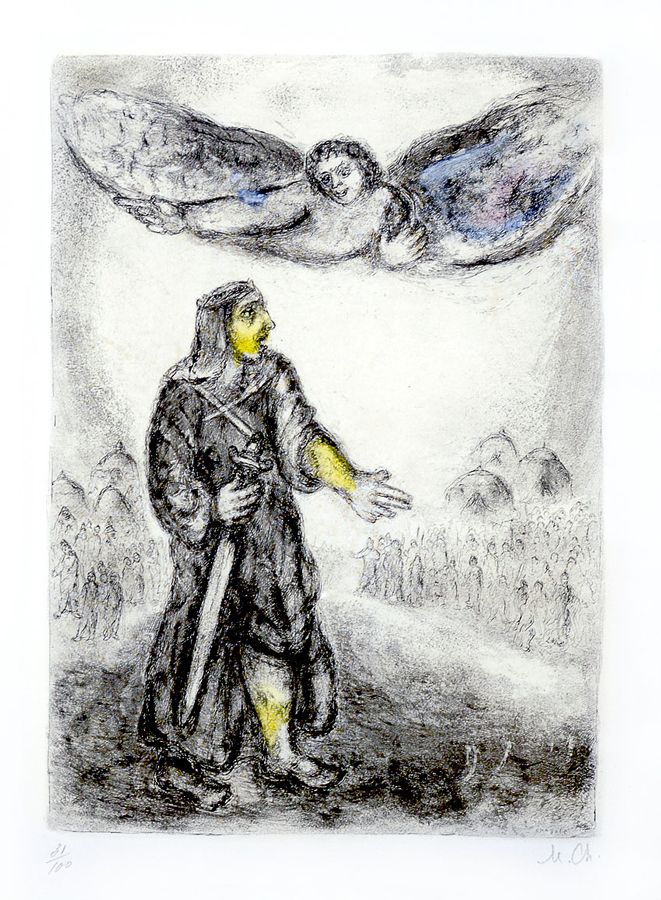
In the book of Joshua, we are presented with a single story about the Israelites and their enemies. In our haftarah, Joshua gathers the tribes of Israel at Shchem and presents his account of the conquest of Canaan. He declares:
You crossed the Jordan and came to Jericho. The citizens of Jericho fought against you, as did also the Amorites, Perizzites, Canaanites, Hittites, Girgashites, Hivites and Jebusites, but I gave them into your hands. I sent the hornet ahead of you, which drove them out before you—also the two Amorite kings. You did not do it with your own sword and bow. So I gave you a land on which you did not toil and cities you did not build; and you live in them and eat from vineyards and olive groves that you did not plant.
In Joshua’s single story, the Israelites are a nation united at war. They all came over at once and went to conquer the land of Canaan. Their enemies were diverse in name but unified in mission. In the list of warring tribes that came up against the Israelites, there is no distinction. Every one of them fought the Israelites. Every one of them lost. By God’s miraculous deeds, the Israelites took over the entire country, and now they have a whole land, ready-made, for them to inhabit.
But wait. There is a flaw with this single story. Just as Joshua decrees that the entirety of these foreign nations has been wiped out, he also warns the Israelites not to mix with them.
All of these other tribes have been completely driven out of the land of Israel; all of them have been vanquished; now the only people left are the Israelites.
But even though the Israelites are the only people remaining, you must not marry the others; or get involved in their cultural practices; or go to their shrines with them and worship their gods.
The Jewish bible scholar, Rachel Havrelock, has written a book looking at why this contradiction is so stark. She suggests that, while the Book of Joshua would love to tell a single story of unanimous military victory, it cannot get away from what the people see with their own eyes.
In reality, all the nations that the Israelites “drove out” are still there. The Israelites are still meeting them, marrying them, striking deals with them, and fraternising with them.
Joshua is putting together the war story as a national myth to bring the people together. In his story, the Israelites must be one people and so must all their enemies. Victory must be total and war must be the only way.
In fact, Havrelock finds that there are lots of contradictions in the book of Joshua. It says that the nation was united in war, while also describing all the internal tribal disagreements and all the rebellions against Joshua.
It says that they took over the whole land, but when it lists places, you can clearly see that plenty of the space is contested, and that the borders are shifting all the time. It says they took over Jerusalem, and also says that it remains a divided city to this day.
So what is the reality? Archaeological digs suggest it is very unlikely that the conquest of Canaan ever happened in the way the Book of Joshua describes. The land was not vanquished in one lifetime by a united army. Instead, more likely, the Israelites gradually merged with, struck deals with, and collaborated with, lots of disparate tribes.
They were never really an ethnically homogenous group. They were never really a disciplined military. They were a group of people who gathered together other groups of people over many centuries to unite around a story. Ancient Israel was the product of cooperation and collaboration.
Our Torah takes all the different stories of lots of different tribes and combines them into a single narrative. That is why the Torah reads more like a library of hundreds of folktales than a single spiel.
But a government at war needs a single story. It needs to tell the story that there is only one nation, which has no internal division. It needs to tell the story that there is only one enemy, and that the whole of the enemy is a murderous, barbarous bloc. It needs to insist that the enemy must be destroyed in its entirety. It needs to tell the story that war is the only way.
Reality, however, rarely lives up to the single story that war propaganda would like us to believe.
Over the last few months, we have been bombarded with a single story of war. We are all at war. Not only Israel, but the whole Jewish people. We are all at war until every hostage is freed from Gaza. We are all at war until Hamas is destroyed. We are all at war and there is no other way.
But hidden underneath that story are other stories. Suppressed stories. Stories that suggest Israel may not be united in war.
There is the single story that Gaza must be bombed to release the remaining hostages.
There is another story. Avihai Brodutch was with his family on Kibbutz Kfar Aza on October 7th. He survived. His wife, Hagar, was taken hostage, along with their three children, aged 10, 8 and 4. His whole family and his neighbours were taken hostage.
Only a week later, at 3am, Avihai took a plastic chair and his family dog, and went to launch a one-man protest outside the Israeli military offices. He insisted that blood was on Bibi’s hands for refusing to negotiate. He said that Netanyahu was treating his family as collateral damage in his war. He initiated a rallying cry: “prisoner exchange.”
This has become a demand of Israeli civil society. They will swap Palestinian prisoners for the Israeli hostages. This was achieved, when 240 Palestinian prisoners were swapped in return for 80 Israelis and 30 non-Israelis captive in Gaza.
There are still over 100 hostages in Gaza. There are still around 4,000 Palestinian political prisoners in Israeli jails. Around 1,000 are detained indefinitely without charge. Around 160 are children.
It is simply the right thing that Hamas should release the hostages. It is also simply the right thing that Netanyahu should release the Palestinian prisoners. If they did agree, everyone would be able to return safely to their families. Doesn’t that sound more worth fighting for than war?
There is a single story, promoted by Netanyahu, that Israel must fight until it has destroyed Hamas.
There is another story. Maoz Inon’s parents were both murdered by Hamas on October 7th. As soon as he had finished sitting shiva, he took up his call for peace. All he wanted was an end to the war.
Speaking to American news this week, he said: “A military invasion into Gaza will just make things worse, will just keep this cycle of blood, the cycle of death, the cycle of violence that’s been going for a century.”
His call for peace is echoed by other families of those who lost loved ones on October 7th. They have lobbied, produced videos, and sent letters to Netanyahu, begging to be heard.
Some are desperate for the government to recognise that further death is not what they want. Now, as Netanyahu has killed more than 20,000 Palestinians, their call has still not been heard.
And after all those dead, is Hamas any closer to being destroyed? Of course not. All this bombing does is ensure that a new generation of Palestinians trapped in Gaza will grow up to hate Israel.
This war is how you get more terrorists. It’s how you ensure that war never ends. Wouldn’t it be better to fight for a ceasefire than to fight for a war?
There is a single story that the nation is united in war.
There is another story. This week, 18-year-old Tal Mitnik was sent to military prison in Israel for refusing to fight in the war. Although this news has barely made it into English-language media, many Israelis have expressed their support.
Writing to Haaretz, one refusenik wrote: “I was inside. We were so brainwashed there. I refused and I’m not the only one. I have a family and this is not a war with a clear purpose. […] My children will have a father and I hope yours will too.” Another parent wrote: “My son is also refusing. I will not sacrifice him for Bibi.”
There is another story: that this is Netanyahu’s war, not ours.
There is another story: that war is not the answer.
There is another story: that every captive must go free.
There is another story: that all bombs and rockets must end.
There is another story: that we will not give licence to any more bloodshed.
There is a story that the nation is at war. In times of war, the government must tell that as the only story, to blot out alternative stories, to ensure that war is the only way.
But there are other stories. And, if we tell those other stories, there will be other ways.
It is a blessing in synagogue life when rabbis really get on with each other, and I am so lucky that Rabbi Jordan and I do. We drop in and out of each other’s offices, check in on how the other is doing, and always look for ways to support each other.
And we don’t agree about Israel.
We don’t agree, and we’re not going to. That’s OK. That’s good. It means we can have real conversations. It means when we need to make decisions or work out our thoughts, we can bounce ideas off each other as critical friends.
Last week, after a discussion on Zionism, he did what he often does, and left an earmarked book on my desk. The book, edited by Rabbi Larry Englander, is called ‘The Fragile Dialogue.’ It includes various reflections on Israel.
The chapter Jordan highlighted was by a self-proclaimed TwentySomething Congregant. In a heartfelt letter to her rabbi, she pleads not be excluded from her synagogue because of her views on Israel. She speaks on behalf of her generation, which opposes occupation and supports boycotts. She begs that she, and the rest of the Jews of her generation, will not be cut off from their own communities.
The letter highlights something many of us already know but struggle to articulate: the debates around Israel and Zionism are largely generational.
These differences were visibly lived out last week at a funeral. The great Israeli singer and poet, Yehonatan Geffen, died. He had been a cultural icon, associated with the songs of Israeli childhood.
In three generations of his family, you can see the wildly different approaches to Israel.
Yehonatan Geffen’s uncle was Moshe Dayan, a fierce Israeli military chief famed for his eyepatch and hard right attitudes. He had been a combatant in Haganah, the guerilla army that founded Israel, led the IDF, and gone on to become a politician.
As far as he was concerned, the Holocaust left only one imperative: to conquer and settle the land and become so strong that Jews could never be hurt again. He pledged to blot out Palestine, and respond to hate with greater hate. He was a true hawk.
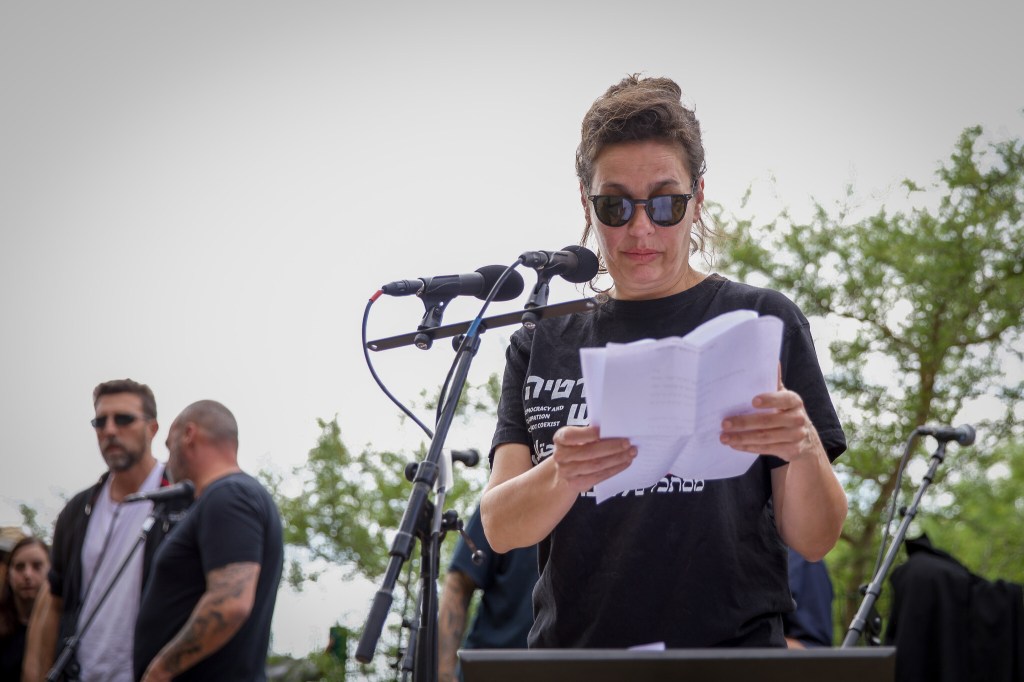
Fast forward to the funeral of his nephew. The mourners arrived wearing shirts that carried the slogan: אין דמוקרטיה עם כבוש – there is no democracy with occupation.
Yehonatan’s daughter, Shira Geffen, wore this slogan as she gave the hesped.
This slogan argues that Israelis cannot protest Netanyahu’s anti-democratic measures while ignoring the millions of Palestinians denied basic democratic rights to vote, freely assemble, and even walk to their homes without facing checkpoints and guns.
The t-shirts are produced by מסתכלים לכבוש בעיניים – an Israeli left organisation who insist on looking the occupation in the eye. They speak out about what they call “the power relations between the coloniser and the colonised,” urging the public to see how the occupation is destroying the dignity of Palestinians and the humanity of Israelis.
Sandwiched in the middle between these generations was the man they mourned, Yehonatan Geffen. He had been part of Israel’s cultural establishment, and a true icon. He was associated with what many Israelis saw as the best in their culture. One of his eulogisers was the centre-right politician Yair Lapid.
Geffen was also an outspoken peace campaigner. He wrote extensive criticisms of the army. In 2018, he wrote lyrics in praise of the Palestinian child protester, Ahed Tamimi, resulting in him being cancelled on Israeli military radio and censured by government officials.
Within one family, within one century, you can see such a huge diversity of Jewish views.
They do not agree about Israel. They will not agree. But they prayed together. They came together to say kaddish and mourning prayers. They joined each other as a family.
Of course, these differences of opinion on Israel are not just generations-based. I know anti-occupation activists in their 80s and I know pro-settlement campaigners in their teens. Nevertheless, what we have seen of Israel in our formative years is decisive.
I belong to Shira’s generation, and one of my most formative memories of Israel was witnessing the inexcusable assault on Gaza in 2009: Operation Cast Lead.
During the commemorations of Yom HaAtzmaut last week, I could not hide my discomfort. I find prayers for a state tantamount to idolatry, and when I hear blessings for troops, I can only think of those priests who poured holy water onto bombs. I do not see how one can pray for peace while praising the instruments of war.
Yet I understand why, for many in this community, honouring Israeli independence and those who fought for it feels like an important undertaking.
Some of you belong to the generation that came just after the Shoah. The memories of genocide and antisemitism still loom, and it is understandable that you should want to know there is some security against that. For you, defending Israel matters.
Others of you came up in the generation of Peace Now. You believed in Israel and its mission, and held onto its constitutional claims of what it would be: a safe haven for all its peoples. You hoped, even campaigned, for an Israel where Jewish culture could thrive while Palestinian minorities received justice and human rights. For you, holding on to that dream of what Israel could be matters.
My generation came after. I was born not long before the signing of the Oslo Accords, and came of age as they failed. During my 34 years on this planet, Netanyahu has been Israeli Prime Minister for nearly half of them. I have never known Israel as anything but the aggressor and the occupying power.
Based on our ages and experiences, we will have different views. If we cannot have disagreements about Israel, we cannot have an intergenerational community.
We will not agree about Israel. And that’s fine. That’s good.
Rabbinic literature prizes disagreement. One of my heroes in the Talmud is Rabbi Eliezer. He stood solidly by his principles, no matter how unpopular they were. It’s not that I agree with Eliezer’s principles: he was a conservative surrounded by liberals and radicals. It’s the fact that he held fast to what he believed.
He was so strict in his adherence to religious law that the other rabbis eventually excommunicated him. They wouldn’t talk to him unless he recanted his views, and he never did. Only at the end of his life did his students and colleagues realise what an error they had made by cutting him out.
They placed him in the Mishnah, the foundational Jewish text, as one of its most-cited rabbis. Even though they completely disagreed with him, you can find his opinions everywhere.
The Maharasha says the reason for this is for future generations. While one position may be minority at one time, it may become majority, and those who follow will need to know what they rest on. Even if they never agree with it, they need to see how the conclusions they support were reached.
This is why we welcome disagreements: for the sake of intergenerational conversation.
For those growing up now, they are entering a polarised and febrile environment.
Future generations will develop their own politics, and find their own relationships to Israel, Zionism, and the occupation.
And I hope they can do so within the synagogue.
I hope they will find an environment that embraces Zionists, non-Zionists and anti-Zionists. I hope they will find communities that do not impose red lines that keep them out. I worry that the TwentySomething writing to her rabbi will be proven right, and synagogues will become platforms for single positions on Israel.
What then? Will we split into Zionist and anti-Zionist shuls? Will we keep splitting further, based on varying different policy proposals for what should happen in the Middle East? Those aren’t synagogues – those are political parties!
Such divisions have pulled apart Reform communities before. In the period prior to World War II, Zionists were forbidden from studying at Hebrew Union College, the Reform Rabbinical school in America. This meant that for nearly a century you could not be a Zionist and become a Reform rabbi. One early Reform Zionist, Maurice Perlzweig, said that professing his views in polite Jewish company was like admitting to being a member of the Flat Earth Society.
At the turn of the century, the Reform Movement completely reversed its position. The 1997 Miami Platform declared that Reform Judaism was unequivocally Zionist. It said that Jews were a people; that we should all move to Israel and build it up. Ensuing from that came a programme parallel to the early push to exclude Zionists from the Jewish community, but this time, flipped: to exclude critical voices from the Jewish community and maintain only a pro-Israel consensus.
Is this really what we want? Do we want to keep going back and forth drawing new lines depending on which position has the upper hand? Do we want to enforce conformity of political views in Reform congregations?
Surely what we stand for is bigger than that! Surely our Judaism, our God, our people is bigger than that!
The joy of a synagogue is that it brings together so many different people. Where else are you going to find people of different backgrounds, classes, genders, abilities, beliefs, and ethnicities, all under one roof, bound together by something greater than themselves? Only the synagogue – greek for beit knesset – the House of Gathering – can achieve that.
We are not going to convince each other of our political opinions, and that’s fine. That’s good. If we have a space filled with diverse views, we have a community. If you have uniformity, you have an echo chamber.
We are Reform because we understand that the Jews of tomorrow will not look like the Jews of yesterday. The Judaism of tomorrow will not look like the Judaism of yesterday. Reform Judaism is an ongoing commitment to learn and struggle and grow, always adapting to new ideas and developments. That is what makes it Reform.
And what makes it Jewish is that we do it together. We hold on to belief in the same God, the same cause, the same traditions. We hold all the manifold opinions of the congregation in a single setting.
So, let us answer the question posed in Larry Englander’s book: will this TwentySomething be excluded from her synagogue?
More pressingly, will she have a home in ours?
The answer depends on how we act. If we draw red lines and kick people out based on their views; if we define our Judaism solely by its relationship to Israel; if we make public policies about the synagogue’s stance, then, no. She probably will not.
On the other hand, we can model an alternative Jewish future. A better Jewish future. A Jewish future where we don’t repeat the mistakes and have the same regrets as the framers of the Mishnah. A Jewish future based on plurality and discussion. We can demonstrate through our relationships with each other and the synagogue that Judaism is diverse, creative and engaging across divisions.
We can show that we do not have to agree. Even about Israel.
In 1982, Rabbi David Goldberg, z”l, gave a sermon so controversial that half the congregation at the Liberal Jewish Synagogue stormed out. The other half stuck around for the rest of it just to make sure they disagreed.
I have no way of knowing whether this was strictly true, but it is certainly plausible. It is most believable because, even though I haven’t yet mentioned the word, you already know which topic would elicit such a reaction.
Israel. Of course it is Israel. It is a topic so contentious that friends and families have refused to speak to each other over it. As a result, although I do have strong views on the matter, I have so far managed to go three years without preaching on it. I have been strongly tempted to do the same thing today and just speak about the Torah portion, but I feel that I cannot do so this week.
What has happened in Israeli politics in the last two weeks will likely fundamentally change the way that Diaspora Jewry will engage with the country. Already every major Jewish communal body has released a statement, some of which I know have been circulated among members of this community. It would be a cowardly dereliction of duty if I did not comment.
If you are surprised by the gravity of what I’m saying, it’s not because you’ve missed anything. There is no new president or prime minister. No new war, no withdrawal, no peace treaty, no assassination. What has happened is really the result of bureaucratic decision making at the end of another stalemate election. But its result is that the fabled two-state solution to the conflict between Israelis and Palestinians is now impossible.
Previously, sitting Israeli prime minister Benjamin Netanyahu announced that if he won the next general election, he would annex the Jordan Valley. In the last year, there have been three elections, each resulting in impossibly hung parliaments, but it looks like Bibi has now secured the majority to pursue his agenda.
As such, he will now go through with his plan for annexation, supported by the smaller right wing parties in the Knesset. That means that the entire Jordan Valley will become formally part of Israel. There will remain isolated enclaves of Palestinian towns in the West Bank and Gaza, but what remains of Palestinian territory will never form a viable state.
For most Palestinians, this won’t mean much of a change to their daily lives. For some time now, West Bank Palestinians have lived under Israeli rule. Although able to elect representatives to the Palestinian Authority, Israel has maintained control over the military, borders and economy. Israeli control will become tighter and more far-reaching, but annexation will only formalise a policy that has been in place since at least 2005.
Nor will it make a difference to most Israelis. With official backing from Donald Trump and the United States, an international military backlash is unlikely. It is already the case that few Israelis live east of Jerusalem. For those who do live in settlements, their private security will likely be supplemented by state army support.
There will, however, be a shift in Israel’s relationship with its Jewish diaspora, especially among progressives. Most Jews in Britain do consider themselves connected to Israel, but want a just peace, even if it means giving up land or power. For decades, Diaspora Jewish support for Israel has been contingent on the possibility of a peaceful solution that involved a Palestinian state alongside Israel.
With Israel’s proposed annexation, a Palestinian state will now become formally impossible. I suspect that the two state solution has not been truly viable for some time. But if the door was closed before, it is now being locked.
In response to these unfolding events, Rabbi Lea Muhlstein of the Liberal Zionist group Artzeinu released a statement insisting that the two state solution was still possible. I am afraid I do not see how. Most efforts to defend the viability of the two state solution seem more concerned with reassuring Diaspora Jewry than with grappling with the conditions on the ground.
Diaspora Jewry is, however, not reassured, and the British community has seen considerable fallout. The President of the Board of Deputies, Marie van der Zyl, urged communal unity as representatives from StandWithUs, Habonim Dror and LJY-Netzer wrote to express their opposition.
Even in unlikely quarters, people are lining up to attack Bibi’s decision. Sir Mick Davis, former Treasurer of the Conservative Party, has urged against annexation, saying that it would run contrary to Jewish values.
I think that is right, and that the values that would be contravened are given in precisely this parashah. Moses tells the Israelites: “You shall have one standard for stranger and citizen alike.” (Lev 24:22) Both right and responsibility, privilege and punishment, must be the same for all those living under the same rule.
Annexation will create a situation in which a people is formally and irrevocably governed by a party it did not elect and could not deselect. It will formalise a tiered class system, where Jewish Israelis have full rights, Palestinian citizens of Israel have fewer and West Bank Palestinians have none, while all live in the same space under the same rule. This is unjustifiable.
Most of the attacks against Bibi’s plans seemed to have focused on belated efforts to salvage the two state solution. As I have made clear, I think that option is already politically defunct. But that does not mean progressives must give up entirely on any hope of a just solution in the Middle East.
One possibility which has so far only been advocated from the political fringes is of enfranchising the Palestinians. It is, strangely, a position that unites both some settlers and Israel’s radical left, but has been considered outside of acceptable political discourse among mainstream Diaspora Jewry until recently.
If Israel is to be a single state from the Mediterranean to the Jordan, let it be a democratic one, where everyone who lives there has full voting rights and representation. The Palestinians should be able to set the political direction of the country just as much as Israelis, if it is indeed to be one country.
The main reason that this has remained a fringe view is that it would certainly mean an end to a Jewish political majority. The Palestinians living in the region almost outnumber the Israelis and could thus theoretically out-vote them. As such, Israel would cease to be a Jewish state, at least in an ethnic sense.
In that sense, a single democratic state could not be considered within the spectrum of Zionist opinion. But I am less concerned by the certainty of an ethnic Jewish majority than I am by the moral standing of the Jewish people.
If Israel is indeed willing to implement policies tantamount to occupation, segregation and apartheid, and the Diaspora Jewish community does indeed continue to meet such policies with indifference and even support, what will be left of Judaism? Who are Jews if we refuse our God-given task of being a light unto the nations? What are we if we do not meet but exceed the ethical standards our tradition has taught us?
For years, Progressive Zionists have faced a tension between being progressives and being Zionists. Many have managed to hold nuanced aspirations that balanced their desire for peace with their desire for security; their commitment to other Jews with their commitment to all humanity; their belief that Israel could be both Jewish and democratic. That tightrope has now fallen under the weight of the two poles it was balancing, and most Jews will have to choose one or the other. Politically, they will either be Progressives or they will be Zionists.
Given a choice between a Jewish state and Jewish ethics, I will certainly choose the latter. But even then, I do not think that abandoning the idea of Jewish ethnic majority means sacrificing concern for Israelis’ ability to live and thrive where they are now. I believe it is fully possible for Israel to maintain its cultural autonomy and distinctly Jewish character without clinging to an ethnically based majority or to political supremacy.
The third largest grouping in the Israeli Knesset is the Joint List – a coalition of Palestinian and Jewish leftists. They are non-Zionists who hope for joint political power between Israelis and Palestinians.
Their leader is Ayman Odeh, a lawyer from Haifa. He has now become the de factol opposition leader as Gantz goes into coalition with Bibi. In 2015, in his maiden speech before the Israeli Parliament, he shared his vision for the country:
The year is 2025, the 10-year plan to combat racism and inequality has borne fruit. Hundreds of thousands Arab employees have been integrated into the private sector, the high-tech economy and the public service.
The social gaps between Arab and Jewish citizens have been reduced remarkably and the economy has been prosperous for the benefit of all residents.
Jews are learning Arabic, Arabs are diligently honing their Hebrew skills. Jewish and Arab students are being introduced to the great thinkers and philosophers of both peoples.
His vision has become my vision. That aspiration for a just, peaceful and shared country chimes more with my idea of what would constitute a Jewish state than one based on racial ideas of citizenship or Orthodox ideas of laws.
I hope that, as you wrestle with the tensions that will be drawn out over the coming weeks and years, others will be able to support that dream.
Of course, many will not. Despite the calls for unity, I think this is more a time for diversity. A collapse in political consensus need not mean fallout of the Diaspora Jewish community, but could mean a flourishing of new ideas and renewed conversations. We now have a true opportunity to intellectually engage each other about what Israel’s future will be and how we will relate to it.
If nothing else, I hope that at least less than half of you will storm out in anger.
Shabbat shalom.
I gave this sermon over Zoom on Saturday 9th May 2020 (Parashat Emor) for Three Counties Liberal Judaism. I am especially grateful to Tal Janner-Klausner, for being my political tour guide of Israel-Palestine, and for all their help with editing this sermon.
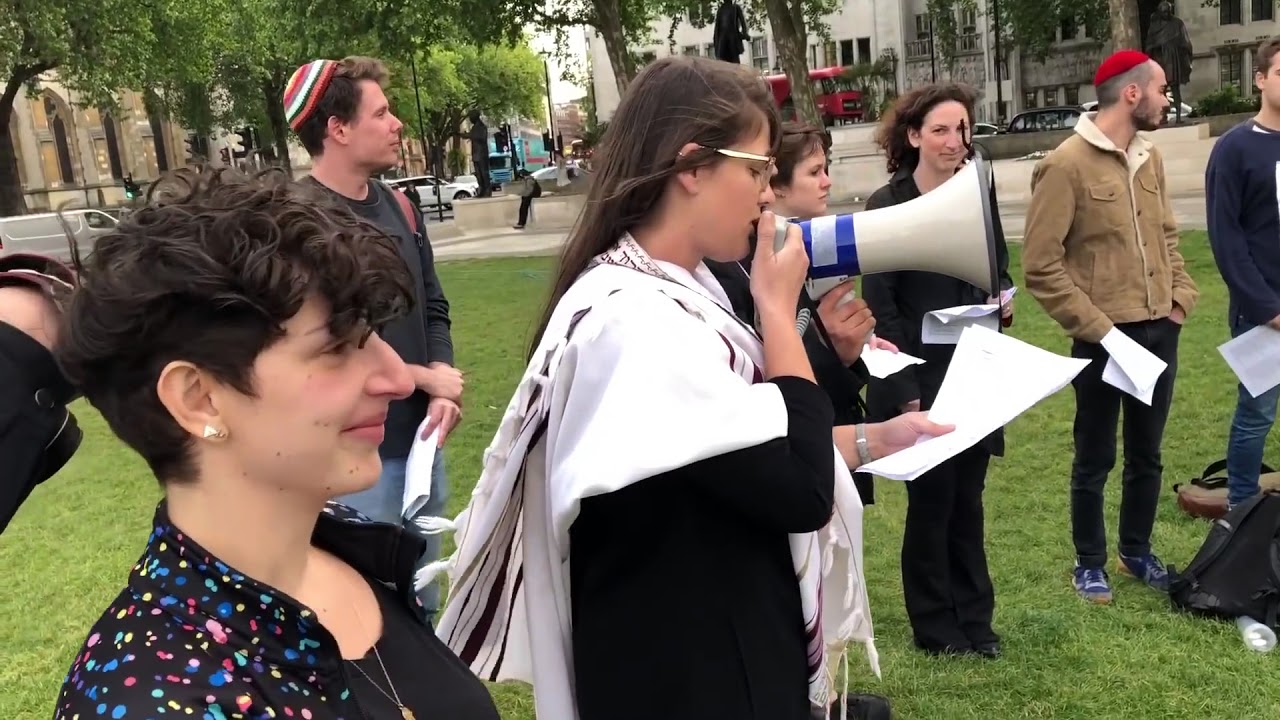
The advent of Eurovision on Saturday reminded me of another anniversary I needed to mark. A year ago, at this time, many of us assembled in Parliament Square to publicly grieve the killing of Palestinians at the Gaza border. At the time, I wrote this sermon. While I shared it with friends and colleagues, the climate felt far too hostile to publish this. Perhaps I should have done. A year on, here is the sermon I never delivered at the time.
We tell ourselves that the grave levels all distinctions. Kittels don’t have pockets. You can’t take any of it with you when you’re gone. In death, all are equal.
Anybody who has ever lost somebody knows that is untrue. The grave shines a light on differences that we could otherwise ignore. As we scramble together the funds for a funeral, often several months’ wages, we realise how much class mattered in life. The poorest families cannot even attend the funerals of their loved ones, as councils bar them while they dispose of the body. People find out how much they were worth in round figures.
Grieving rituals reflect strongly on a person’s life. At the graveside, you can see what a dead person valued, and what people valued about them. You find out how many people their lives touched, and how much. Even early in our roles as rabbinic students, my classmates and I have begun to see what a profound impact a person’s death can have on the people who loved them. You find out what value gets placed on a life.
Jewish mourning rituals help us to make sense of such loss. The kaddish prayer is a blessing for the living; an Aramaic chant in praise of the Almighty; an appeal to Whoever is Up There to intervene and give us peace in every sense of the word. Conducting Yizkor services at Yom Kippur, I have seen how just the fact of reciting those words once a year can alleviate pain and bring healing. Its rhythm has its own power.
But the rules around these rituals can hurt as well as heal. Judith Hauptman, a Talmud scholar, has recorded how the limits on who can be mourned have narrowed over time in Orthodox halachah. A shorter version began as a blessing for any learning experience. From there, it became a graveside prayer one could say for all family members and teachers. Over time, it has been slowly whittled down to include only a mourners’ own parents. Hauptman points out that this system poses a problem in the modern world, where parents regularly re-marry and families are often cobbled together in ways that don’t match up with normative expectations.
I feel like limiting who can be ritually mourned poses a much deeper, existential question: what makes a life worth grieving? How do we decide what makes a death worth commemorating? What does it say about the value we place on somebody’s life when they were living, if we can’t remember them when they die?
In the aftermath of the Nazi genocide, Liberal Jews began saying kaddish weekly, independent of who was in the synagogue. There were too many people left behind who had nobody to mourn for them. There was too much unspeakable suffering to moderate who could be mourned and how much. It was a way to affirm the dignity of Jewish life against a racist movement who sought to wipe it out completely.
That was how I was raised: reciting a blessing every week for members of my family I never knew, and people I’d never met, to sanctify their memories lest they should be forgotten. We prayed, too, for earthquake victims, people dying in famines, those killed in school shootings and terrorist attacks. Whenever there were people whose names needed to be remembered, we remembered them.
Perhaps, my more conservative friends suggest, that ritual expands the bounds of mourning too far. I do not know what it is like to grieve for a parent. I haven’t had that experience. I don’t know how it compares to the loss you feel when you lose a friend, or another family member. I only know what it is like to have somebody die and wonder whether I can grieve for them, and how much I’m allowed to do it.
I know that feeling too well. The gay community is famous for its statistics. Alcohol, drugs, suicide, homelessness, murder, depression, loneliness. I have had friends die and wondered whether I could pray for them. And wondered what I could pray for them. In that moment, I have found out the uncertain value that I myself place on a life. We cannot mourn everyone equally, but we surely can mourn. Somehow. The kaddish is the only vocabulary I have for sanctifying death, so I have said kaddish for people who were not my parents; who were not Jews; who I did not know.
That is the question of deep religious significance behind the conflict in the Jewish community over the recitation of kaddish for those the IDF killed in Gaza last month. Everybody has their own views on who is responsible for violence in the Middle East and how it can be resolved. To the best of my knowledge, nobody has changed their mind significantly on that front. My views on the matter are well-known, and I won’t go into them here. But I do want to talk about the halachic and spiritual concerns that this issue has raised.
I want to affirm, without reservation, that I believe we were right to say kaddish for the Palestinians. Reciting that prayer said something that no other kind of protest or placard or petition could. It said that the souls of those killed were worth grieving. It said that their lives were worth living. In a world beset by war and injustice, that prayer, for those people, at that time, reminded the whole world of the existence of a loving Creator, Whose ways are peace.
They were not the parents of anyone present there. Nobody davening in Parliament Square knew any of the Palestinians who were killed. In a sense, that might make the prayer inappropriate. But only if you accept that we can only grieve for the people who gave birth to us. If that is your position, I respect it, but I don’t agree with it. I think we are right to mourn people with the only religious language we have when we are moved to do so.
None of the people killed in Gaza were Jews. Like most Palestinians living in that area, most of those who died were Muslims. There are some who claim that kaddish should be a prayer reserved only for Jews. If that is your position, I cannot even respect it. Kaddish does not make any religious claims about the status of the person being mourned. It does not have any impact on their metaphysical state. It is a prayer for the living, to help them cope with the trauma of death. If we limit that prayer only to other Jews, we limit ourselves and our capacity to care for others. We send out the horrifying message that only ‘our own’ deserve to be remembered. We suggest that only ‘our own’ led lives worth living.
Perhaps they were members of Hamas. It is, after all, the largest political organisation in Gaza, acting both as an armed militia against Israel and as the primary provider of welfare services to Palestinians. It is a reactionary, fundamentalist, sexist and homophobic party. It is not a group I would ever support or join. But even its members led lives worth living. They had deaths worth mourning. They were created in the image of the Holy One, Whose will brought the Heavens and the Earth into being. No amount of political disagreement can detract from that.
Hamas’s views on Jews are unconscionable. If they ruled the world with the views they hold now, the lives of all Jews would be a misery. But they do not rule the world. They barely have control over a small strip of land, locked in by Egypt and Israel as a military buffer zone. They do not have any control over their neighbouring Mediterranean Sea, where Israel, Cyprus and Turkey police what goes in and out. Even how much food and aid enters the land is rationed by the United Nations. Their skies are not their own. However horrid their ideology, they have no power to enact it. They are, by far, the weaker party.
Perhaps the very fact of how vulnerable they are makes them less worthy of being mourned. In Frames of War, Jewish academic Judith Butler writes about what makes life grievable. She looks at how a media culture that showcases war as a daily occurrence has desensitised people to its unimaginable suffering. She shows that the people whose lives are most precarious – that is, those who we already don’t expect to live very long – are treated as if they are most disposable. Their lives are hardest to completely mourn.
Intuitively, we know this is true. We are so used to hearing about people there dying, or so accustomed to the idea that war is normal in ‘places like that’ that they don’t induce international horror any more. But they should. If we were fully human, living up to the highest values taught in our Torah, we would live in a permanent state of distress. But we don’t, because we have to survive. We treat precarious lives as if they are disposable.
Critics of the kaddish for Gaza have pointed out that the protesters didn’t pray for people killed in Syria, Congo, Central African Republic or Yemen that week. We didn’t. We should. If they are criticising the protesters for not grieving enough, I extend a wholehearted invitation to cry with me about the state of our broken world. There are too many tragedies left ignored. But they want people to hurt less, or not at all, how can we possibly accept? How can anyone agree not to feel rage and sadness at unjust killing and remain human? And call themselves Jewish?
Despite all desensitisation, when Israel gunned down the Land Day protesters in Gaza, suddenly we could not ignore it any more. Only the day before, Netta had won Eurovision. President Trump was in Jerusalem, opening an embassy. All eyes were on Israel. And Israel shot 63 people in one day. Israel, that declares itself the Jewish state, a body politic that has taken up the mantle of our sacred task on earth to be a light unto the nation and spread the message of ethical monotheism, shot down 63 people in one day. They sent out one message about what value they placed on certain lives. The Jews in Parliament Square sent out an alternative message.
I don’t know what makes a life worth grieving. I don’t know who should mourn for whom and how much. I don’t know where to place the limits. But I know that when people do decide to grieve, they decide that a life was worth living. Those Palestinians’ lives were worth living. Their deaths were worth grieving. Their mourners were worth supporting. They did not deserve to die.
By making the decision to pray for the Palestinians, the people in Parliament Square did the most Jewish thing we could. We sanctified life in the name of the Holy One. We recognised that the bonds of faith that bind together humanity are stronger than the bonds of blood that bind together one people. With our words, we gave each other hope for a redeemed world, saying:
“May the Almighty’s Sovereignty be established in your lifetime and during your days, and within the life of the entire Jewish people, speedily and soon.”
And let us say: Amen.
The fallout from this action can still be felt, and many in the community are hurting. I hope that publishing this does not reignite flames but helps demonstrate that we were coming from a place of heartfelt Jewish religious feeling, even for those who disagree.
Life is sacred. It is not just meaningful, though it is that. Nor is it simply beautiful, although it can be. Life is sacred. Given by God, uniquely to everyone in existence, with a specific purpose. Our lives – the lives of everyone in this room, and everyone we know, and everyone we don’t – are loving gifts from our Creator. With them, we can either repair or destroy the world.
I hope that we’ll be able to come out of this Holy Day season more aware of the sanctity of our own lives and of everyone else’s. spiritual ideals to the fore. But whose lives are sacred? Whose lives do we truly value, and whose lives do we treat as disposable? It can be harder to see the sanctity in some lives than it is in others. It is harder – perhaps hardest – to see sanctity in the lives of people we don’t know. There are people we forget and erase before we’ve even had the chance to see God’s spirit in them.
The Torah portion for this week, the Aqedah, is an example of such a problem. One line sticks out for me in this parashah. In this story of the patriarch Abraham preparing to sacrifice his son on the altar, it is perhaps the most troubling. It seems innocuous at first. But I keep coming back to it, and the more I come back to it, the more it bothers me. The text says:
Take your son, your only one, whom you love, Isaac, and go to the land of Moriah.[1]
Take your son, your only one… The text says that same phrase three times. When the angel intervenes and speaks to Abraham, we hear:
Do not raise your hand against the boy, or do anything to him. For I now know that you fear God, since you have not withheld your son, your only one, from Me.[2]
Your only son…
After Abraham sacrifices a ram in the place of Isaac, the angel speaks again:
Since you have not withheld your son, your only one, from Me, I will bestow My blessing upon you and make your descendants as numerous as the stars of heaven and the sands on the seashore…[3]
Again and again, ‘your only son.’ But that’s impossible! Abraham does not have only one son. Isaac is the younger of two children. Abraham has an older son, Ishmael. In only the immediately preceding parashah, Abraham sent away Ishmael and his mother Hagar. Has he forgotten them already?
This problem has bothered rabbinic commentators too. Rashi, the medieval French commentator, offers up a story:
The conversation he puts in Abraham’s mouth is really the conversation of the reader with the text: doesn’t Abraham have another son whom he loves? How can Ishmael be erased so flippantly and insensitively from the text? Rashi suggests a number of solutions:
Perhaps lest Abraham’s mind reeled under the sudden shock. Further, to make his command more precious to him. And finally, that he might receive a reward for every word spoken.[5]
Yes, God is speaking like this to calm Abraham down. If he just blurted out: “Go and kill Isaac!”, Abraham might not have had the strength to do it. So God breaks the commandment down, gently feeding him each bit. But Rashi’s answer doesn’t tell us the most important detail: what on earth has happened to Ishmael?
Some rabbinic commentators have tried other approaches. Some suggest that we could translate יְחִֽידְךָ֤ not as your only one, but as your favourite one.[6] But the root of the word יְחִֽידְךָ֤ is אחד – one, and it doesn’t mean favourite in any other context. We can only really translate it that way if that’s what we want it to mean. And is that what we want it to mean? Do we want to think of Abraham, the father of all nations, as choosing a favourite between the children that will create Judaism and Islam? Does it actually make the text that much better?
Not only is God asking Abraham to kill Isaac, but God has already erased Ishmael. Can that really be true? Is that the God we believe in and worship?
It bothered me so much I went for lunch with a Muslim friend to ask him what he made of it. How did his tradition, that holds Ishmael in such high regard, deal with this troubling passage? I asked: “what does your tradition say about the binding of Isaac?”
“You mean Ishmael?” he said.
“No, no,” I said, “Isaac, who Abraham takes up Mount Moriah to sacrifice.”
“Ishmael,” he countered, “who Abraham takes up Al-Haram…” He grinned at me. “I know your tradition says something different…”
It was so funny. It hadn’t even occurred to me that the Islamic story might be different. We took out a Quran and read the story as it appears:
Abraham said, “Indeed, I will go to where I am ordered by my God; Who will guide me. My God, grant me a child from among the righteous.”
So We gave him good tidings of a forbearing boy. And when he reached the age of exertion, he said, “O my son, indeed I have seen in a dream that I must sacrifice you, so see what you think.” He said, “O my father, do as you are commanded. You will find me, if Allah wills, of the steadfast.”
And when they had both submitted and he put him down upon his forehead, We called to him, “O Abraham, You have fulfilled the vision.” Indeed, We thus reward the doers of good. Indeed, this was the clear trial. And We ransomed him with a great sacrifice, And We left for him favourable mention among later generations: “Peace upon Abraham.”[7]
It’s quite beautiful, isn’t it? But there’s a new problem: this text doesn’t mention Ishmael either. It doesn’t mention Isaac, but it doesn’t mention Ishmael. In fact, it turns out that in the early days of Islamic jurisprudence, the interpreters were undecided. 135 authoritative readings said it was Isaac; 113 said it was Ishmael. But gradually the weight shifted, and by the 10th Century, everyone agreed that it was Ishmael.[8]
So here we have two contradictory traditions: a Jewish tradition that erases Ishmael and an Islamic one that erases Isaac. What do we do with this? How can we reconcile these stories?
I think the Tosefta, that first text of rabbinic commentary, offers a compelling answer. The sages were dealing with a problem of two contradictory schools of thought – the House of Shammai said that a room was unclean and the House of Hillel said a room was clean. The Tosefta reaches this conclusion:
Make yourself a heart of many rooms and bring into it the words of the House of Shammai and the words of the House of Hillel, the words of those who declare unclean and the words of those who declare clean.[9]
David Hartman, a rabbi from the Bronx in New York, suggests this means we need to be able to hold multiple contradictory ideas at once. Whereas Western philosophy tries to drive everyone to one conclusion at the expense of all others, Jewish thought teaches that all words about God are words of God. Judaism teaches us to sustain and embrace contradiction.[10] We learn to build a heart big enough that it can include all voices, especially the voices that we might want to drown out.
So perhaps that’s an answer to my problem. We need to reconcile these two contradictory stories: Isaac was offered up as a sacrifice, and so was Ishmael. Isaac was Abraham’s favourite son, and so was Ishmael. Both a source of blessing, both blessed, both their lives sacred, both our traditions sacred, all stemming from one God.
The Torah says that Isaac was Abraham’s only son because, in a way, there only ever was one son. That one son was both Isaac and Ishmael. Some Christians say that the sacrifice of Isaac prefigured the crucifixion of Jesus, or represented it.[11] Yes, let us include that truth too. Rather than try to erase difference, let’s embrace the tension of contradiction and recognise what is sacred in every story. The message is the same in all of them: a rejection of violence, opposition to the sacrifice of human life, reverence for the God who created us all.
I think this religious analysis has some important political implications. Two years ago, the former Orthodox Chief Rabbi, Lord Sacks, published a book called ‘Not in God’s Name’. The theology of it was subtle and beautiful. He used stories like those of Isaac and Ishmael to suggest that all people were meant for their own blessings. He extrapolated this to thinking about religion: that nobody should make an exclusive claim to truth – that Jews, Muslims and Christians should all be able to respect one another.[12]
But from this solid foundation, Jonathan Sacks went in a troubling direction. He said that people should not try to make exclusive claims to truth, and then focused most of his book on criticising Muslim terrorists for doing that. Of course, I agree with his opposition to such terrorism. But given that his book was inevitably going to be read almost entirely by Jews, shouldn’t he have said more to challenge his own community? In the way he set it out, it felt very much like he was accusing everyone else of carrying out violence, without acknowledging that we, too, are imperfect. Such rhetoric only encourages division and continues the cycle of hate.
It turns out that Jonathan Sacks did not just make a rhetorical error. Earlier in the year, he recorded a film for Mizrachi Olami, a far-right religious nationalist party in Israel, where he encouraged Jews all over the world to join the organisation on a march through Jerusalem.[13] This is an annual march, drawing thousands of people, who run through the Palestinian part of the city in the east, intimidating residents and shouting racist slogans. On this day, shops close and streets clear as people prepare for violence.[14] Under pressure, Jonathan Sacks eventually agreed that he would not actually march with the group, but continued to produce promotional material for them.[15] I have to seriously question what this does to suggest that different religions can be blessed, or that all lives deserve respect.
I think that if we are going to build a heart of many rooms, it must at least be big enough to accommodate the grievances and frustrations of Palestinians. We must be able to see how we can be oppressors, as well as victims. We must confront all the contradictions that living in this modern world involves.
I spent August studying Hebrew in Jerusalem. It is a place that really confronts you to deal with contradictory truths. I spent my days in a university where I learnt so much and met so many exciting people. On my breaks, I’d stare out over the garden. That university overlooks a refugee camp, full of high-rise buildings, crowded with people who have been stateless since the War of 1948, and surrounded by a concrete separation wall.
I found myself feeling safer wearing a kippah than ever before, and at the same time so much more uncomfortable. I quite like wearing the kippah in England, where it feels like a symbol of difference, personal piety and a reminder to live up to the best expectations of others. In Jerusalem, where the religious-right are in power and wield religious symbols to trample on the rights of various people, my clothes took on a new meaning I didn’t like. I know of one rosh yeshiva, a rabbi heading up a study-house in Jerusalem, who wore only half a kippah, to reflect the conflicted place he felt, torn between the religious and secular worlds, externalising his inner turmoil.
I want to be able to live with these tensions, but it is not an easy feeling. Maybe that’s necessary. Dealing with contradictions means being uncomfortable. There is something frightening about truly believing that life is sacred. It means knowing that we are special, unique and placed here by God. But it also means acknowledging that this is true of everyone, including of people whose stories might contradict ours.
This year, may we build hearts large enough to include those stories, and all stories of struggle. May we learn to see the sanctity in all lives and, above all, may we find a way to peace.


 Sim Lev