high holy days · story

How the ancestors tamed their shadows

Some stories only make sense in the light of day. When the morning lights shine on your tent and the campfire no longer illuminates the storyteller in orange, the ghost stories from the night before lose their shimmer. When the puppets have been put away and no longer parade before backlights, the characters that once seemed so real disappear to wherever fictions go when they are finished.

Such is the story of how our ancestors tamed their shadows. 

If you can trust your shadow to do as you do and move as you move, you can thank your ancestors for taming it. Today, you know that when you turn out the light, your shadow will disappear, but that was not always the case.

Once, a shadow was a feral thing that strutted and fretted after every human step until it walked no more, then stapled itself to some other form.

If you tried to write by candlelight, the shadows flew across the pages and distorted every word. If you wanted to read the time from a sundial, the shadows danced in circles to disrupt what you could see. So, when the shadows were unruly, there was no recorded time.

Since the first rays of light beamed down millions of miles and crashed into the first mountains, the shadows had lived on earth. They were older than life – and just as frightening. 

When a tree stood perfectly still on a summer’s day, its shadow performed the forest’s rotting, decaying destruction. If a bush sat contentedly in a field, its shadow depicted it expanding outwards and throttling every other plant.

Shadows followed people. They lurked behind every being, showing human beings their dark side. 

A woman could happily walk through an orchard without touching a thing, but her shadow snatched the apple shadows from every branch, gobbled them up, snapped the branches, chopped down the trunks, and threw salt on the soil. 

When you looked back at the solid world, nothing had really changed. The shadows were just animations of people’s worst fears about themselves.

When human beings created the earliest civilisations, the shadows mocked up their own. The shadows of towns were burnt out ruins turned into snake pits with buzzards circling overhead. From atop a hill overlooking a community like this one, you would see the shadows of smoke and ash rising from a destroyed city.

If you were bold enough to listen, you could even hear the screams.

Yes, the shadows had voices.

When Cain committed the first murder, his shadow crouched, waiting for him in the doorway, like a bailiff to collect debts. The shadow walked behind his every step, reminding him of who he was and what he had done.

When two friends reached out to hug each other, the shadows made a puppet show of them attacking one another with fists and weapons. They hissed insults, dredging up every past slight, and insisted on each other’s worst traits.

The darkness was a terrifying thing and the shadows were a menace. So our ancestors worshipped the light. They praised the sun and hated the moon. They saw goodness in all that shone, and feared anything that cast a shadow. 

They called the god of light Adonai: the Commander; the Sovereign. They prayed: 

ברוך אתה יהוה עשה את האור

Blessed is the Sovereign, creator of light.

They called the god of darkness El: the Spirit; the Power. They prayed:

ארור את אל בורא את החושך

Cursed is the Spirit, maker of darkness.

A black silhouette sculpture depicting an angel with large, feathery wings embracing a man in a hat, showcasing intricate patterns and a dynamic pose.
The Wrestle in Steel, Grisha Bruskin

After Jacob betrayed his brother, Esau, and stole everything from him, Jacob’s shadow trailed behind him. Everywhere he went, Jacob’s shadow re-enacted his deception. It whispered to him that he was cruel, callous, untrustworthy; and, because of this, that he was unworthy, unlovable, unsalvageable. 

One night, exhausted by his shadow’s relentless attacks on his character, Jacob leapt at his own dark form and tried to strangle it. 

But the shadow fought back. The man and his shadow wrestled until morning came, when the shadow dislocated his hip from its socket. As the sun rose, the shadow gave Jacob a new name: Yisra-El; the spirit-wrestler; the one who fights with dark powers.

From then on, the ancestors knew that they could fight with the shadows. They also knew that they could not win. They called themselves the people of Yisrael: the nation that struggles with shadow-spirits.

The shadow is the closest thing to a human being at every moment. It dogs you, even when you think there is scarcely a source of light. So, what can you do when your shadow chases you, accuses you, and torments you? What can you do with something that attacks you when you cannot hope to gain victory over it?

You ignore it. 

Our ancestors pretended their shadows were not there. However grotesquely violent they made their shapes or malevolently cruel they made their whispers, they took no notice.

In the time of the untamed shadows, people were polite and kind and spoke with quiet voices and rarely displayed anything that looked like anger, pain, or fear. Meanwhile, their shadows acted out the most tumultuous scenes and displayed every possible hostility. This was how our ancestors lived for generations.

Until they could no longer.

One morning, the children poured out into the central square of their town to play, in the way that children so often do, while their parents made breakfast.

Already there in the plaza was a quiet girl who rarely joined the others’ games and often wasn’t invited. She was doing something with her shadow that nobody had seen before. 

She was playing. 

She hopscotched along the cat’s cradle court, then her shadow did the dance on after her. 

And the shadow was doing something they’d never seen before either.

The shadow was laughing. 

No, giggling.

The girl and the shadow acted out the game like friends. 

For a while, the children stopped and stared at the strange unfolding game. 

Had a grown-up entertained such a risky activity, their peers would have quickly put a stop to the behaviour. But children are less aware of social rules, so don’t always enforce them. Nobody dragged her from the danger of her game. The kids just gawked. 

And, after a while, they realised something. The shadows were gawking, too.

Eventually, a couple of kids ventured over and asked if they could join in playing. The little girl cheerfully assented. As did her shadow.

The children’s shadows whispered: “Let us play too.”

So the young and their shadows played together.

This is not to say it was all smiles. The shadows pushed each other, cheated, cut queues, and grabbed each other’s hair. But they kept playing. The children blurred the lines between body and shadow; between fun and fight; between propriety and play.

By the time that grown-ups came out to call the children in for breakfast, it was already too late. Everyone under a certain age was engaged in hopscotch or jump-rope or chase, and their shadows were playing too. 

Upon the sight, the adults’ shadows flew into murderous rages. The dark forms of parents grew into monsters with gnashing teeth and scythe-like claws and hissed at the infants. 

In their solid forms, the parents crouched gently beside their young ones, doing all they could to keep their eyes from the violent puppetry being played out on the ground. They whispered: “what are you doing? Why are you playing with these monsters?”

The children’s shadows recoiled into small balls like startled hedgehogs and cowered from their raging carers.

But in the visible world, the children stood firm. They placed their hands on their hips and spoke with indignation. They described to their parents exactly what had happened. 

And the girl who had initiated this entire transgression asked: “why have you never played with your shadows before?”

A table with various objects illuminated by lights casting playful shadows on a wall, showcasing a whimsical scene.
Hans-Peter Feldman, Shadowplay

“You can’t ignore your shadow,” she insisted. “You have to ask it questions. When she’s angry, you need to ask her what she’s feeling. When she’s frightened, you need to ask her what she needs.”

When they came to tell of this day many years later, it was a final and outright undoing of years of suspicion, after which everything fell into order. In reality, everything took more time, and included many setbacks. After all, they were undoing conventions that went back to the dawn of civilisation. 

But let us tell the story in its truncated folklore form. On that day, every ancestor turned to every shadow and started a conversation. From that moment on, they stopped ignoring the dark alter-egos that haunted them.

They saw that when these apparitions enacted violence, they were acting out their anger. They came to understand that when their shadows cowered, they were showing they were afraid. And that, when they snatched and grabbed from others, they were just exhibiting jealousy. 

They learned that shadows could offer them shelter, protection, and shade. They learned that anger, fear, and envy could help them live better lives. They learned that they could not run from their shadows.

They were their partners. They were their playmates.

The shadows could not be separated from their bodies. The ancestors themselves were their shadows, and their shadows were them. 

How wrong the ancestors had been about their God! There were not two powers in Heaven. The Sovereign and the Spirit were not separate deities: they were the same divinity in different guises. 

Just as the shadow was an answer to the body and the moon was a mirror of the sun, the god of daytime and the god of night were one. 

They ceased to talk about יהוה the Sovereign and אל the Spirit. Now they called their God by one name: יהוה אלהינו – our Spirit the Sovereign.

How wrong the ancestors had been to shun shade and revile darkness! Now they recited a new prayer:

ברוך אתה יהוה אלוהינו מלך העולם עשה האור ובורא את החושך

Blessed is the Sovereign, our Spirit, who rules the world, creator of light, and maker of darkness. 

Yes, Blessed is God, who brings on all.

You would imagine that it was the shadows who changed and became the static fixtures we recognise today. But, no, it was our ancestors who changed first. 

They became more curious about their own needs. They became more open about their desires. 

And, as it turns out, they didn’t kill each other or rob each other or hurt each other when they engaged with their shadows. In fact, all those things happened far less often. 

They were, however, more coarse and more abrupt. They were far more honest and far less polite. They had more conflict. They cried more, blushed more, and told each other they were angry more.

And they got on better with each other, and with themselves.

And then… well, the shadows did not need to come up with their aggressive dramatisations any more. And they started to look just like the bodies they were following. The shadows and the bodies merged to share the same borders, side-by-side.

Never again would they be deceived into dismissing any part of themselves. Never again would they imagine that anything did not come from the same single God.

So they taught themselves a new mantra, which they passed on to their children, and they to theirs, until many generations had passed. They told their descendants to say it three times every day and recite it whenever we prayed. They were to repeat it on waking and lying down; at home and on the way; at every moment of the day.

This was what we had to say:

שמע ישראל יהוה אלהינו יהוה אחד

Remember, O nation who struggles with shadow-spirits, the Sovereign is the Spirit. All aspects of God are One.

Such is the story of how the ancestors tamed their shadows. 

Now, hear this, all you who have come to synagogue on Kol Nidrei. You are the spirit-wrestlers. You are the descendants of those ancient people who used to fight with shadows. 

Know that you still have a shadow. We all still have dark parts of ourselves: those silhouettes shaped just like us that follow us around feeling angry and scared; greedy and sinful; violent and cruel. There are, perhaps, still high-pitched whispers dogging us, that tell us the worst versions of ourselves and everyone else are true. 

You cannot ignore your shadow all the time. And Yom Kippur is a pretty good time to face it.

Your shadow is not a foreign enemy to be destroyed. It is a part of you. It generates the feelings you would rather ignore, like jealousy, rage, lust, and fear. But all those feelings are part of you. You can’t fight them away.

Nor can you let your shadow conquer you. You can’t let your anger or envy control you. You must engage with the parts of yourself you most despise in order that the version of you you like best can thrive.

Instead, when you meet your shadow, as you are likely to do during today’s solemn fast, be gentle with it, and kind. Ask it questions, and see what it can teach you. Play with it, and see if it can bring something to your life. Tame it, like a friendly pet.

In Judaism, there is only one Source. God has no opposite, no partner, and no comparative. All that exists comes from the same God, and all is balanced towards the good. Everything that exists in you – your greatest virtues and your darkest impulses – come from God. All of it needs to be seen for what it truly is.

If this story has offended, remember that you can shake off these shadows as soon as you leave here, and it will disappear to wherever fictions go when they are finished. 

But if this parable is useful to you, tomorrow morning, when we return to our prayers, let us try to make friends with our shadows. 

After all, some stories only make sense in the light of day. 

The Shadow, Omer Davidov

judaism · sermon

Have you considered therapy?

Isaiah stood up on his soap box and preached to the people:

‘Listen to this, you wasters who sit in a drunken stupor, though not from drinking wine. This is what the Sovereign, your God and Defender, says: “See, I have taken the terrible cup from your hands. You will drink no more of my fury. Instead, I will hand that cup to your tormentors, those who trampled you into the dust and walked all over your backs!”’

The people stood and watched his prophecy, then replied: “Isaiah, have you considered therapy?”

Isaiah, you should go to therapy.

Isaiah, beloved prophet, seer of justice, speaker of truth, visionary of God, I do think you would have benefited from a bit of counselling. I read your words, so filled with passion, as you swing between abject rage against all humanity’s follies and then salivating at the possibility of God’s vengeance against your enemies. And I love your words, these are such beautiful Torah, but I also just want to give you a hug.

Isaiah, my friend, my favourite prophet of them all, do you need someone to talk to? Are you going through something just now? When was the last time you were able to open up and be vulnerable? Because this… these speeches… they’re beautiful, they really are, and I think you might need some help processing all of this.

There are tools available. There are ways you can access your feelings and address some of the root causes of your pain. 

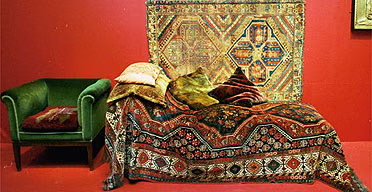
I’d like to introduce you to a nice Jewish boy who lives in Hampstead. He doesn’t care much for shul, but he likes studying some of our texts, and he’s had some good ideas. His name is Sigmund Freud. 

He had this fantastic idea that, if a person spoke freely about all that was worrying them, they might feel a little better. 

He found trends that showed that some of what makes us angry or sad or anxious can be connected to our childhood. Now, being honest, some of his theories have lost their appeal. He put a lot of stock in a couple of Greek myths. But, in general, he understood that by re-telling our internal narratives, we can live in ways that are calmer and more fulfilling. 

During his lifetime, Freud had to deny that his techniques were a “Jewish science,” but later his daughter Anna was able to reclaim the label as a “badge of honour.” 

I think it probably is something of a Jewish science, and I wish more Jews would try it.

I look at some of the characters in our Torah and think how much they might have benefited from a trip to a therapist’s couch. 

Would Isaac have pitted his sons Jacob and Esau against each other so callously if he’d been able to cope with the betrayal he felt when his father Abraham tried to kill him?

Could Moses have kept his temper in check a little if he’d had space to talk through the displacement of discovering he had been adopted?

Maybe Rachel and Leah could have done with some family therapy to process their jealousy and build better relationships.

Of course, they wouldn’t have given us such compelling stories if they’d been better adjusted, and we wouldn’t have the Torah we do. 

It’s too late now for the biblical protagonists, but it’s not too late for us. We actually can go to therapy, and learn to like others and ourselves a little better.

As a community, one of our great highlights is Sandra Webber’s Shabbat Island Discs, where members share their life stories alongside their favourite tunes.

Believe it or not, the idea didn’t begin at KLS, but originated on BBC Radio 4, where it is called Desert Island Discs. On 4 August 1989, the show welcomed on a castaway by the name of Rabbi Lionel Blue. You can still listen now on iPlayer, as he speaks with such gentle warmth, and offers up a song about his Yiddishe Momme. 

But there is a really profound moment when Rabbi Lionel describes the benefits of therapy to us all. He had learnt about himself through a self-taught psychotherapist who took him on for free. His first session took 10 hours! 

He says his reason for promoting the benefits of therapy is that “you can only love God as much as you love yourself.”

This approach, that we ought to get to like ourselves better through therapy, positively impacted on how rabbis were trained at Leo Baeck College. For several decades, it has been actively encouraged as part of rabbinic training.

On and off, in various forms, I’ve been going to therapy for about 15 years. And I swear by it. It has helped me know myself better and love myself more. It has made me a better pastor, partner, and friend. 

And I think Lionel was right: it has made me love God more.

With the lengthy commute between Essex and Surrey, I wasn’t able to go so often. But now, with space and time for it, I find myself back on the couch. It’s doing me a world of good.

As Jews, we don’t evangelise, but if I were asked to give a rabbinic endorsement to anything, it would be psychotherapy. If you’re not already bought in, I encourage you to give it a try. 

Spend just under an hour talking to a trained listener, and see how much better you feel.

Shabbat shalom.

sermon · social justice · torah

After war

There is a particular kind of sadness that comes from remembering war. It is not only the needless loss of life, nor those who come home traumatised. There is something specific in the discomfort that comes after furious build-up, tragic participation, and ultimate reconciliation. 

In this week’s haftarah, Ovadiah promises a glorious war against Edom. The Edomites will be defeated and humiliated. Israel will be victorious and avenged. 

Ovadiah addresses Israel’s neighbouring nation of Edom: “For the violence against your brother Jacob, disgrace will surround you. You will be cut off for all eternity.”

He tells these nations: “The house of Jacob shall be fire, and the house of Esau shall be straw. They will set fire to it and consume it.”

In these bellicose proclamations, we get the feeling of the build-up to war. We realise, too, that Jacob and Esau are not just the names of characters in a story: they are representatives of nations.

Jacob is Israel. Esau is Edom. They are the respective countries on either side of the River Jordan. Their inhabitants imagine themselves as twin brothers, yet constantly in conflict.

This helps us make sense of the story in Torah this week. Jacob heads over to the river to make amends with Esau. He has been wrestling with his conscience and wants to make amends, but fears that if he puts forth an olive branch, Esau may kill him.

Jacob separates his clan into divisions to approach from different sides, like military battalions. He sends forward gifts and apologies with every single one. As he approaches his brother, he prostrated himself many times, bowing down in peaceful submission. Finally, they reach each other, hug, and cry. They are reconciled.

When we understand that these brothers are representatives of neighbouring nations, this is not just a story of family strife, or conflict between competing characters. It is the biblical redactors’ fantasy of what peace could mean. These countries could be united. Their bitter violence could be set aside. After years of fighting, people might once again embrace each other and cry with relief.

The special sadness of remembrance comes with contemplation after the war. What was it for? Whose interests did it serve? And how do we resolve to prevent it happening again?

After World War 1, poppies bloomed in Flanders Field, where some of the worst battles had been fought. Out of the trenches where so many had died, these scarlet flowers sprouted from the ground. They became a symbol. 

“Never again,” they said. 

Around 40 million people had died. Once it was over, many could no longer remember what they had been fighting for. The motivations of Empire and nationalism no longer seemed so compelling in the wreckage of war. Countries pledged to end the impetus to war with diplomacy, increased international cooperation and greater understanding between peoples.

After World War 2, the politicians once again pledged never again. Never again would fascism be able to rear its ugly head. They would combat, too, the root causes that had allowed Hitler to look appealing. No more would they allow such poverty and inequality to persist, giving way to racist scapegoats. 

The countries of Europe built social democracies, with universal healthcare systems and progressive welfare states. They said they would not repeat old mistakes. They formed alliances and international bodies that, they said, would prevent war.

For as long as I have been alive, Britain has been at war. Earlier this year, NATO troops finally withdrew from their twenty-year conflict in Afghanistan. It had begun when I was starting secondary school. Some of my friends enlisted to fight. 

At the time, we were told the war would avenge the World Trade Centre attacks; find Osama bin Laden; and defeat the Taliban. In the end, Osama bin Laden had never been Afghanistan and the Taliban emerged more powerful than ever. I doubt many of the victims of 9/11 feel much joy in seeing the war that has been carried out in their name.

When the war was declared, it was popular. Today, it is hard to find anyone who says they agreed with it.

Politicians declare war full of nationalist fervour and triumphant spirit, only to return defeated and bereft. Even the victors feel no glory once a war is won. They leave too much devastation in their wake.

Families are torn apart. Cities are destroyed. Lived are lost. Entire ways of life are destroyed. And, at the end of it all, the only thing to do is reflect on what went wrong. We promise once more to make peace.

The Torah’s narrative of Jacob and Esau offers us a glimpse of what peace might look like. It encourages us to look beyond the narrow excitement for violence proclaimed by Ovadiah and the promises of national glory. It reminds us to think of how much greater it would be to have peace.

Like the Prophets of old, we pray for the day when nation no longer lifts up sword against nation, and no more no peoples learn war.

May God grant us, and all the world, peace. 

Shabbat shalom.

I gave this sermon for Remembrance Shabbat, Parashat Vayishlach on Saturday 20th November at South West Essex and Settlement Reform Synagogue

interfaith · sermon · torah

Who gets to be Jacob?

I am told that, as a toddler, whenever it came to game-playing, I had to be Postman Pat. No matter what the game was, I insisted on playing that friendly gentleman with a black and white cat. As I grew up, I had to compete with other children for different parts in our roleplay. We couldn’t all be the robbers, somebody would have to be the cops. Not everyone can be the Yellow Power Ranger and we can’t all be Ginger Spice.

Those were, at least, the parts we competed for in the 1990s. It was fairly low stakes, but it seemed quite important at the time.

But it’s nothing compared to the fight for roles that went on in the 5th Century CE. This big broigus was not just between two individuals, but between two whole religious groups: the Jews and the Christians. That battle was played out in two foundational texts of our traditions: a sermon by St Augustine of Hippo on the Christian side and the midrash, Bereishit Rabbah, for the Jews. Both were determined that they were Jacob, and the other side was Esau.

Which one would get to be Jacob?

At stake in this question is an ancient prophecy, told to Rebecca while she was pregnant: “Two nations are in your womb, and two peoples will emerge from your body. One shall be stronger than the other; and the older shall serve the younger.”

When Rebecca gave birth to Jacob and Esau, she was not just birthing twins, but rival nations. A strong one and a weak one. An older one that would serve the younger.

We have Esau: the hairy, ruddy hunter. We have Jacob: the smart, younger upstart.

The contest over Isaac’s blessing and birthright laid out in our parashah was more than a competition between siblings. It was a war between peoples.

So which one is the Jews? And which one is the Christians?

As far as the Jewish texts are considered, Jacob must be the Jewish nation. Meak and smart? That’s us. Gentle but witty? Sounds Jewish. He even changed his name to Israel. Bnei Yisrael, the children of Israel, klal Yisrael, the community of Israel, daat Yisrael, the laws of the Jews. Surely Jacob must be us!

And meanwhile Esau… well, he’s Rome. He changed his name to Edom, which, granted, is on the other side of the River Jordan in Mount Seir, but was the birthplace of Rome’s most wicked emperor and Temple-destroyer, Hadrian. And look at those Romans. They’re the hairy, barbarous, fighting ones. They’ve got their swords and their empires, just as Esau had his bow and his field.

Bereishit Rabbah, our classical midrash on Genesis, spells it out for us.

Two proud nations are in your womb, one is proud of his world and one is proud of his kingdom. Two prides of their nations are in your womb – Hadrian amongst the gentiles and Solomon amongst the Israelites.

We’re Jacob. We’re the one that God has chosen. We are the descendants of Solomon, proud of the world of Torah and obligation. They’re Esau. They’re the other brother. They’re the descendants of Hadrian, proud of their ill-gotten Empire.

Except, of course, for one obvious problem. Jacob is supposed to be the younger brother. Aren’t we, the Jews, clearly the older sibling? Our revelation is much older than the Christian one and the kingdom of David long predates the Caesarian Empire.

This fact was not missed by our Christian interlocutors.

Foremost among these Christians was St Augustine of Hippo. Augustine was a Father of the Christian Church, a theologian living in North Africa. His ideas were definitive in Christianity for many centuries, and people of all religious stripes still reverentially refer back to his writings. As far as Augustine was concerned, Jacob had to be Christendom. Israel, God’s treasured child, was the Church.

True, says Augustine, the Jewish nation sprang from Jacob, but since then, they have gone on to become Esau. They’re the elder people whom God has rejected. Esau was born shaggy and hairy, which means full of sins. Just look at the Jews – that’s clearly them!

Augustine continues: the prophecy promised that the elder would serve the younger, but that never happens in the biblical text. Esau goes on to become very rich and both wind up blessed in their lifetimes. Clearly, this refers to events that had not yet transpired: that the real Jacob would go on to have the upper hand. Now look at the world of Augustine, where the Christian Empire spans the globe and the Jews are a fractured diaspora in their lands. Surely this is the proof that the Jews are now Esau, serving their younger brother, the Christian Jacob.[1]

This battle of biblical exegesis probably sounds quite twee today. After all, why should it matter which of our religions gets to be Jacob? But this battle for religious identity and purpose shaped interfaith relations in medieval Europe.

If the Jews were Esau, then the Christians had replaced them as Jacob. Judaism was superseded, no longer necessary, and its practitioners were hairy remnants of an outdated doctrine. As Esau, the Jews were a savage menace who needed to be tamed by the genteel, pious Christians in their role as Jacob. This Christian doctrine was the theological basis for Jewish subjugation in Europe.

Faced with such hostility and oppression, it was only natural that medieval Jews felt the need to double down and insist that they were still Jacob. They imagined that Christian dominion would only last so long but that the Jews would ultimately triumph. They could still be Israel, despite what was said about them.

The modern era has seen reconciliation between Jews and Christians. Over time, theologians and historians on both sides have come to emphasise their kinship over rivalry. Perhaps, in the conflict over who got to be Jacob, these twin religions forgot that they were, in fact, siblings. Perhaps, still stuck in childhood contests, our communities had ignored the way the story ends.

By the time of the story’s completion, Jacob and Esau are no longer warring for the same birthright. They have both struggled, and lost, and achieved their own blessing. In maturity, Jacob and Esau meet again and wrap their arms around each other. They weep as they realise that God’s blessing is not finite. They never needed to fight over it.

After 2000 years of struggle, perhaps we Jews and Christians can reach the same intellectual adulthood. The campaign for who is the favourite brother can be put aside as we realise that we are on twin paths. We are both children of the same Divine Parent.

Perhaps we cannot all be Postman Pat, or Ginger Spice, or the same Power Ranger. But everyone can be Jacob.

I will give this sermon at Edgware and Hendon Reform Synagogue on Shabbat 21st November 2020 for Parashat Toldot.


[1] ‘Sermon on Jacob and Esau’, Jacob Rader Marcus and Marc Saperstein, The Jews in Christian Europe, pp. 33-34

judaism · sermon · theology

The importance of not respecting different opinions

This is Interfaith Week, and many of my religious buildings across the country are holding similar services to this one. In most places, I suspect people will talk about the importance of respecting differences of opinion. You have your views, I have mine, but we can all get along. All religions have their own truths. It might be customary to say it, but I can’t bring myself to do it. Not all ideas have the same value. Some ideas are wrong. Some ideas are dangerous. Some ideas must be challenged as soon as we encounter them.

This week, we read a passage in the Torah with a violent history. In it, Jacob and Esau fight over who gets their father Isaac’s birth right. Jacob, the younger brother, tricks his dad into giving him his blessing. He dresses in his brother’s clothes, puts hair on his arms so that he’ll feel rougher, and puts flour on his tongue so that his voice will sound deeper. With the help of his mother, Rebekka, he kills an animal, makes some sweet meats and cons his father into giving him a blessing that was meant for his brother. When Esau comes in, Isaac is distraught to realise that he has given the blessing to the wrong son. Esau begs him to bless him, but Isaac insists that he can’t retract his blessing from Jacob. Instead, he gives him a new blessing: “You will live by the sword and you will serve your brother. But when you grow restless, you will throw his yoke from off your neck.”[1]

This story became more than a tale of sibling rivalry. It became the basis of bloodshed lasting centuries. Jacob took another name: Israel. As a person, he stood in for the whole of the Jewish people. Esau had another name: Edom. As a person, he became a symbol of Christianity and Rome. For centuries, that was the optic through which Jewish-Christian relations were viewed: as a struggle between two brothers for a blessing that could only be held by one of them. The Jews, Israel, insisted that they were the sole bearers of the blessing from God. Christians insisted that they had broken off the yoke of Torah when their Messiah came, and that they had replaced Jews as God’s chosen people.

This had real consequences for people’s lives. If Christians had replaced Jews, then Jews were a stubborn remnant of a bygone age; a people destined to be destroyed. St Augustine of Hippo, one of the Founders of the Church, argued that Jews should be allowed to live only as evidence, in their degraded state, of the superiority of Christianity. This story of Esau replacing Jacob was so influential on European thinking that, some argue, it helped to legitimate the Nazi genocide.

This month saw the five hundredth anniversary of the day that Martin Luther nailed his ninety-five these to the church door, demanding reformation of the Catholic Church. His ideas were so important. Luther was somebody who realised that ideas are powerful. He was responding to a time when the established Church used people’s fear of death to pay for a better place in the afterlife. The abuse of religion was creating a deeply hierarchical and unequal society. Luther wanted to challenge that. He realised that not every religious idea had to be respected. Sometimes they need to be resisted.

Luther was also a notorious antisemite. In his later life, he used his power as an academic to incite race riots against Jews. His ideas were adopted for centuries in justifying racist violence. When the movement he founded, Protestantism, gained the upper hand in Western Europe, his ideas were used to attack Catholics. Unfairly caricatured as automatons doing the bidding of the Pope, Catholics were denied access to citizenship, and imprisoned as foreign infiltrators, in many countries. Luther’s great idea – that religion should not be used to wield power – became subverted to serve its opposite purpose: of entrenching power.

Still, his ideas gave birth to our own religious movements. The Unitarians here draw their roots from Protestantism, wanting to take Luther’s best ideas to their radical conclusion of a religion grounded in equality and acceptance. Liberal Judaism, too, was inspired by Protestant reformation. Our forbearers wanted to create a Judaism without sexism or nationalism. Since then, we’ve tried to also create Judaism that embraces LGBT people and champions just causes like the rights of migrants and workers. I know that many of our Christian friends here share that ambition.

This leaves us with a question: how do we know if an idea is any good or not? If we’re not going to automatically respect differences of opinions, what grounds can we have for disagreeing without creating exactly the kind of competition between Jacob and Esau, that caused so many generations of suffering? I’d like to propose a test for conversations in interfaith dialogue: do our ideas support existing power structures, or do they resist them? Do they bolster the powerful or diminish them? There are questions on which we can agree to disagree – none of us knows for certain what God really is, or what the afterlife is like. But we can challenge our ideas about this world: do they make our world more just, more equal, more compassionate, and more peaceful? If not, can we really sanction them?

This, I would hope, could be the basis of a better model of interfaith. Rather than accepting differences, let’s challenge each other to live up to the best of the values we share. In the spirit of the prophetic tradition that has inspired us, let’s push each other to speak truth to power. The reformation brought about the idea that religion should not be wedded to power. Let’s take it to the next stage, and insist that religion be used as a weapon against power. Let’s work together to fulfil a religious mission of eradicating inequality, championing the cause of the oppressed, eliminating hunger and poverty, bringing about a world where all people are treated with the dignity they deserve. That would be a world that truly respects difference.

[1] Gen 27:40

ipswich church
Ipswich Unitarian Meeting House

This sermon was given as part of an interfaith service organised by Suffolk Liberal Jewish Community, and held in the town’s beautiful Unitarian Meeting House. After the service, an Anglican minister pointed out that I had not made clear that current Christian doctrine had tried to rid itself of its supersessionist ideology. I think it is important to note that much of the work challenging offensive ideas in Christianity has been done by Christians themselves, especially by Catholics at Vatican II. I am grateful to him for this constructive feedback.