high holy days · story

How the ancestors tamed their shadows

Some stories only make sense in the light of day. When the morning lights shine on your tent and the campfire no longer illuminates the storyteller in orange, the ghost stories from the night before lose their shimmer. When the puppets have been put away and no longer parade before backlights, the characters that once seemed so real disappear to wherever fictions go when they are finished.

Such is the story of how our ancestors tamed their shadows. 

If you can trust your shadow to do as you do and move as you move, you can thank your ancestors for taming it. Today, you know that when you turn out the light, your shadow will disappear, but that was not always the case.

Once, a shadow was a feral thing that strutted and fretted after every human step until it walked no more, then stapled itself to some other form.

If you tried to write by candlelight, the shadows flew across the pages and distorted every word. If you wanted to read the time from a sundial, the shadows danced in circles to disrupt what you could see. So, when the shadows were unruly, there was no recorded time.

Since the first rays of light beamed down millions of miles and crashed into the first mountains, the shadows had lived on earth. They were older than life – and just as frightening. 

When a tree stood perfectly still on a summer’s day, its shadow performed the forest’s rotting, decaying destruction. If a bush sat contentedly in a field, its shadow depicted it expanding outwards and throttling every other plant.

Shadows followed people. They lurked behind every being, showing human beings their dark side. 

A woman could happily walk through an orchard without touching a thing, but her shadow snatched the apple shadows from every branch, gobbled them up, snapped the branches, chopped down the trunks, and threw salt on the soil. 

When you looked back at the solid world, nothing had really changed. The shadows were just animations of people’s worst fears about themselves.

When human beings created the earliest civilisations, the shadows mocked up their own. The shadows of towns were burnt out ruins turned into snake pits with buzzards circling overhead. From atop a hill overlooking a community like this one, you would see the shadows of smoke and ash rising from a destroyed city.

If you were bold enough to listen, you could even hear the screams.

Yes, the shadows had voices.

When Cain committed the first murder, his shadow crouched, waiting for him in the doorway, like a bailiff to collect debts. The shadow walked behind his every step, reminding him of who he was and what he had done.

When two friends reached out to hug each other, the shadows made a puppet show of them attacking one another with fists and weapons. They hissed insults, dredging up every past slight, and insisted on each other’s worst traits.

The darkness was a terrifying thing and the shadows were a menace. So our ancestors worshipped the light. They praised the sun and hated the moon. They saw goodness in all that shone, and feared anything that cast a shadow. 

They called the god of light Adonai: the Commander; the Sovereign. They prayed: 

ברוך אתה יהוה עשה את האור

Blessed is the Sovereign, creator of light.

They called the god of darkness El: the Spirit; the Power. They prayed:

ארור את אל בורא את החושך

Cursed is the Spirit, maker of darkness.

A black silhouette sculpture depicting an angel with large, feathery wings embracing a man in a hat, showcasing intricate patterns and a dynamic pose.
The Wrestle in Steel, Grisha Bruskin

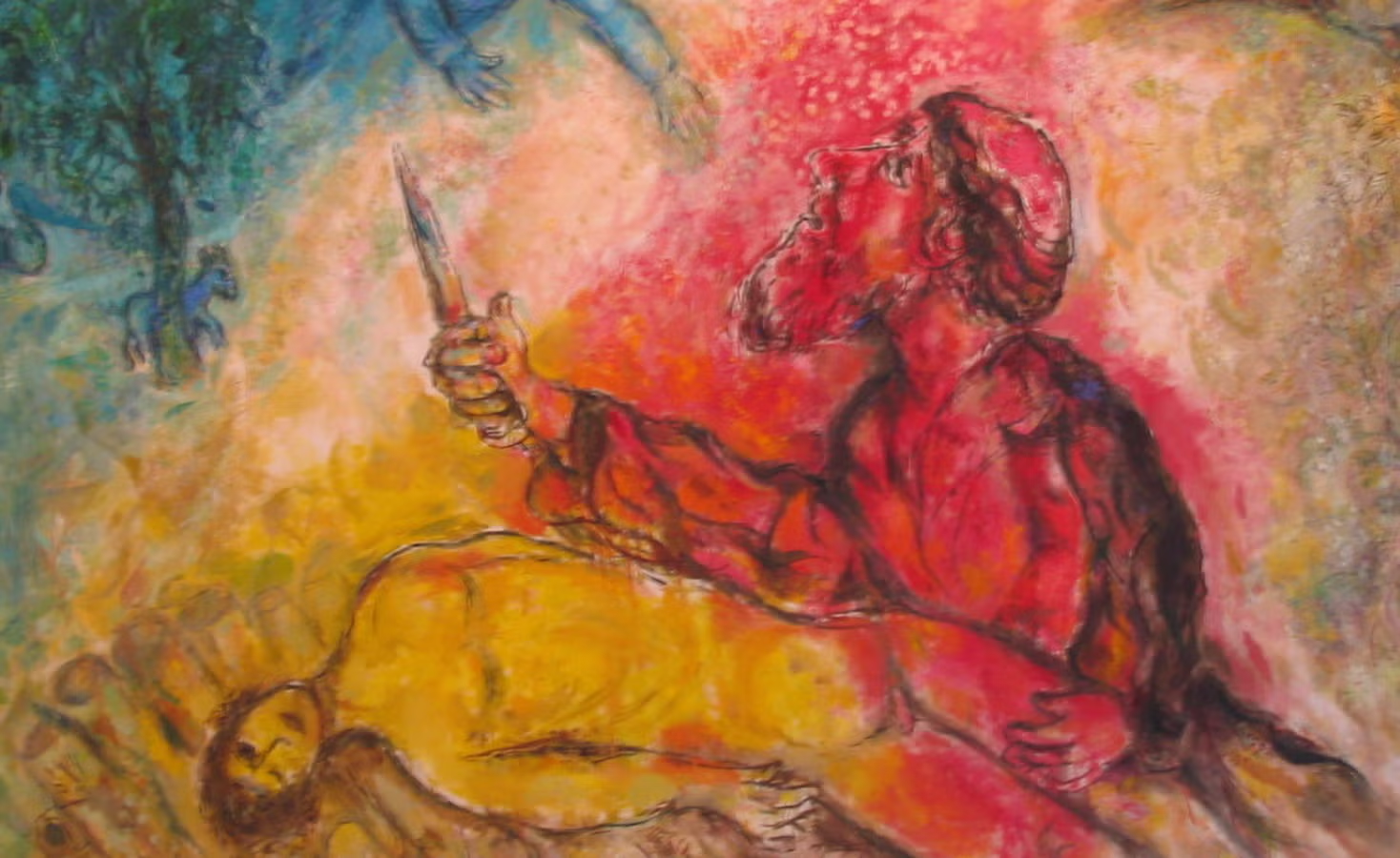
After Jacob betrayed his brother, Esau, and stole everything from him, Jacob’s shadow trailed behind him. Everywhere he went, Jacob’s shadow re-enacted his deception. It whispered to him that he was cruel, callous, untrustworthy; and, because of this, that he was unworthy, unlovable, unsalvageable. 

One night, exhausted by his shadow’s relentless attacks on his character, Jacob leapt at his own dark form and tried to strangle it. 

But the shadow fought back. The man and his shadow wrestled until morning came, when the shadow dislocated his hip from its socket. As the sun rose, the shadow gave Jacob a new name: Yisra-El; the spirit-wrestler; the one who fights with dark powers.

From then on, the ancestors knew that they could fight with the shadows. They also knew that they could not win. They called themselves the people of Yisrael: the nation that struggles with shadow-spirits.

The shadow is the closest thing to a human being at every moment. It dogs you, even when you think there is scarcely a source of light. So, what can you do when your shadow chases you, accuses you, and torments you? What can you do with something that attacks you when you cannot hope to gain victory over it?

You ignore it. 

Our ancestors pretended their shadows were not there. However grotesquely violent they made their shapes or malevolently cruel they made their whispers, they took no notice.

In the time of the untamed shadows, people were polite and kind and spoke with quiet voices and rarely displayed anything that looked like anger, pain, or fear. Meanwhile, their shadows acted out the most tumultuous scenes and displayed every possible hostility. This was how our ancestors lived for generations.

Until they could no longer.

One morning, the children poured out into the central square of their town to play, in the way that children so often do, while their parents made breakfast.

Already there in the plaza was a quiet girl who rarely joined the others’ games and often wasn’t invited. She was doing something with her shadow that nobody had seen before. 

She was playing. 

She hopscotched along the cat’s cradle court, then her shadow did the dance on after her. 

And the shadow was doing something they’d never seen before either.

The shadow was laughing. 

No, giggling.

The girl and the shadow acted out the game like friends. 

For a while, the children stopped and stared at the strange unfolding game. 

Had a grown-up entertained such a risky activity, their peers would have quickly put a stop to the behaviour. But children are less aware of social rules, so don’t always enforce them. Nobody dragged her from the danger of her game. The kids just gawked. 

And, after a while, they realised something. The shadows were gawking, too.

Eventually, a couple of kids ventured over and asked if they could join in playing. The little girl cheerfully assented. As did her shadow.

The children’s shadows whispered: “Let us play too.”

So the young and their shadows played together.

This is not to say it was all smiles. The shadows pushed each other, cheated, cut queues, and grabbed each other’s hair. But they kept playing. The children blurred the lines between body and shadow; between fun and fight; between propriety and play.

By the time that grown-ups came out to call the children in for breakfast, it was already too late. Everyone under a certain age was engaged in hopscotch or jump-rope or chase, and their shadows were playing too. 

Upon the sight, the adults’ shadows flew into murderous rages. The dark forms of parents grew into monsters with gnashing teeth and scythe-like claws and hissed at the infants. 

In their solid forms, the parents crouched gently beside their young ones, doing all they could to keep their eyes from the violent puppetry being played out on the ground. They whispered: “what are you doing? Why are you playing with these monsters?”

The children’s shadows recoiled into small balls like startled hedgehogs and cowered from their raging carers.

But in the visible world, the children stood firm. They placed their hands on their hips and spoke with indignation. They described to their parents exactly what had happened. 

And the girl who had initiated this entire transgression asked: “why have you never played with your shadows before?”

A table with various objects illuminated by lights casting playful shadows on a wall, showcasing a whimsical scene.
Hans-Peter Feldman, Shadowplay

“You can’t ignore your shadow,” she insisted. “You have to ask it questions. When she’s angry, you need to ask her what she’s feeling. When she’s frightened, you need to ask her what she needs.”

When they came to tell of this day many years later, it was a final and outright undoing of years of suspicion, after which everything fell into order. In reality, everything took more time, and included many setbacks. After all, they were undoing conventions that went back to the dawn of civilisation. 

But let us tell the story in its truncated folklore form. On that day, every ancestor turned to every shadow and started a conversation. From that moment on, they stopped ignoring the dark alter-egos that haunted them.

They saw that when these apparitions enacted violence, they were acting out their anger. They came to understand that when their shadows cowered, they were showing they were afraid. And that, when they snatched and grabbed from others, they were just exhibiting jealousy. 

They learned that shadows could offer them shelter, protection, and shade. They learned that anger, fear, and envy could help them live better lives. They learned that they could not run from their shadows.

They were their partners. They were their playmates.

The shadows could not be separated from their bodies. The ancestors themselves were their shadows, and their shadows were them. 

How wrong the ancestors had been about their God! There were not two powers in Heaven. The Sovereign and the Spirit were not separate deities: they were the same divinity in different guises. 

Just as the shadow was an answer to the body and the moon was a mirror of the sun, the god of daytime and the god of night were one. 

They ceased to talk about יהוה the Sovereign and אל the Spirit. Now they called their God by one name: יהוה אלהינו – our Spirit the Sovereign.

How wrong the ancestors had been to shun shade and revile darkness! Now they recited a new prayer:

ברוך אתה יהוה אלוהינו מלך העולם עשה האור ובורא את החושך

Blessed is the Sovereign, our Spirit, who rules the world, creator of light, and maker of darkness. 

Yes, Blessed is God, who brings on all.

You would imagine that it was the shadows who changed and became the static fixtures we recognise today. But, no, it was our ancestors who changed first. 

They became more curious about their own needs. They became more open about their desires. 

And, as it turns out, they didn’t kill each other or rob each other or hurt each other when they engaged with their shadows. In fact, all those things happened far less often. 

They were, however, more coarse and more abrupt. They were far more honest and far less polite. They had more conflict. They cried more, blushed more, and told each other they were angry more.

And they got on better with each other, and with themselves.

And then… well, the shadows did not need to come up with their aggressive dramatisations any more. And they started to look just like the bodies they were following. The shadows and the bodies merged to share the same borders, side-by-side.

Never again would they be deceived into dismissing any part of themselves. Never again would they imagine that anything did not come from the same single God.

So they taught themselves a new mantra, which they passed on to their children, and they to theirs, until many generations had passed. They told their descendants to say it three times every day and recite it whenever we prayed. They were to repeat it on waking and lying down; at home and on the way; at every moment of the day.

This was what we had to say:

שמע ישראל יהוה אלהינו יהוה אחד

Remember, O nation who struggles with shadow-spirits, the Sovereign is the Spirit. All aspects of God are One.

Such is the story of how the ancestors tamed their shadows. 

Now, hear this, all you who have come to synagogue on Kol Nidrei. You are the spirit-wrestlers. You are the descendants of those ancient people who used to fight with shadows. 

Know that you still have a shadow. We all still have dark parts of ourselves: those silhouettes shaped just like us that follow us around feeling angry and scared; greedy and sinful; violent and cruel. There are, perhaps, still high-pitched whispers dogging us, that tell us the worst versions of ourselves and everyone else are true. 

You cannot ignore your shadow all the time. And Yom Kippur is a pretty good time to face it.

Your shadow is not a foreign enemy to be destroyed. It is a part of you. It generates the feelings you would rather ignore, like jealousy, rage, lust, and fear. But all those feelings are part of you. You can’t fight them away.

Nor can you let your shadow conquer you. You can’t let your anger or envy control you. You must engage with the parts of yourself you most despise in order that the version of you you like best can thrive.

Instead, when you meet your shadow, as you are likely to do during today’s solemn fast, be gentle with it, and kind. Ask it questions, and see what it can teach you. Play with it, and see if it can bring something to your life. Tame it, like a friendly pet.

In Judaism, there is only one Source. God has no opposite, no partner, and no comparative. All that exists comes from the same God, and all is balanced towards the good. Everything that exists in you – your greatest virtues and your darkest impulses – come from God. All of it needs to be seen for what it truly is.

If this story has offended, remember that you can shake off these shadows as soon as you leave here, and it will disappear to wherever fictions go when they are finished. 

But if this parable is useful to you, tomorrow morning, when we return to our prayers, let us try to make friends with our shadows. 

After all, some stories only make sense in the light of day. 

The Shadow, Omer Davidov

high holy days · sermon

The power of naming

Each of us has a name
given by God
and given by our parents

Each of us has a name
given by our stature and our smile
and given by what we wear

Each of us has a name
given by the mountains
and given by our walls

Each of us has a name
given by the stars
and given by our neighbours

Each of us has a name
given by our sins
and given by our longing

Each of us has a name
given by our enemies
and given by our love

Each of us has a name
given by our celebrations
and given by our work

Each of us has a name
given by the seasons
and given by our blindness

Each of us has a name
given by the sea
and given by
our death.

This poem was written by Zelda, an Israeli poet, born in Ukraine, and translated into English by her friend, the American Marcia Falk. Although written as recently as the 20th Century, these words have achieved iconic status. “Each of us has a name” has become part of the Jewish liturgy for funerals, stonesettings, and Holocaust Memorial Day.

Zelda


It speaks to something we know: the power of names.

When Adam, the first human being, named the animals, he gave life to their souls.

Knowing somebody’s name tells you about them. We hear a name and, in it, hear language, history, culture, connection.

You know, when you hear your own name, the power it holds. Your full name. Your government name. Your nickname. A secret name only someone you love deeply ever calls you. In hearing your name, you know your relationship to the one who says it.

Speaking someone’s name can summon them, invite their presence; or can scold them, cast them away. When we speak a name, we exert our own power.

We give names at birth through baby blessings. We call up somebody by their Hebrew name when they come to Torah. We change names with marriages, after life-changing experiences, and as a way of affirming gender. We etch names on tombstones and recite names during El Malei Rachamim.

When we understand the power of names, we can understand the significance of the rituals of Yom Kippur.

Long before there was a synagogue in Kingston, or Jews in Europe, or an academy in Babylon, or a Temple in Jerusalem, there was a Tabernacle in Shiloh.

It was a great tented structure on a great hill north of Bethel, whose songs could be heard deep in the Jordan valley and whose burning incense could be smelt as far away as Jericho.

This fabric sanctuary had many layers. Everyone could stand around the edges. Then, past the first gate, only the true believers could enter. Then, into the inner sanctum, only the priests from the ancient tribal hierarchy would go. And then, right at the centre of the mishkan, behind many curtains, hidden away from all view, was the Holy of Holies.

Only one man could enter there: the High Priest. And he could only enter once a year: on Yom Kippur. And he could only say one word, a secret word: the name of God.

We do not know what that name was or how it was pronounced.

Even Moses did not know it. While tending Jethro’s flocks in Midian, a great burning bush appeared before Moses and demanded he return to Egypt and free the people.

Then Moses asked for God’s name. God roared in reply “ehyeh asher ehyeh”: I will be what I will be. “Tell the people that ‘I will be’ is the one who sent you.”

God did not share the name with Moses in that moment. Maybe Moses never heard it at all. Indeed, maybe Moses could not have known it, because to know someone’s name is to know their inner essence, and God’s is beyond our comprehension.

But, we are told, God did let someone in on the secret of the Name: an initiate; one in every generation: the High Priest. He is a semi-mythic figure in our Torah, who, in legend, was beholden to the secrets of the Universe. But, insofar as God’s Name was ever knowable, the High Priest knew it.

We do not know how he said the name. Perhaps he shut his eyes and whispered it into the empty space behind all the drapery. Or maybe he cocked his head back and cried it aloud up to the Heavens. We know he said it ten times.

And, by saying God’s ineffable name, some great magic happened. In this pre-rational time of mystics and miracles, God’s holy presence descended on the Israelites, and granted them all forgiveness.

Yes, a name grants connection across the veils of reality. In ancient times, to say God’s unspeakable name breached God’s innermost essence. Saying the name summoned God from behind the veil of reality. The name ruptured through the boundaries of real and spiritual; finite and eternal.

You have seen this name written down. Above our ark here are the words in Hebrew ‘ivdu et Hashem besimchah- “serve God with joy” but the word is not written as it sounds.

Scholars call it the Tetragrammaton, meaning “four letter word” because it is inscribed with four Hebrew characters. Yod-heh-vav-heh.

But these letters are unpronounceable themselves. Even with vowels added, the letters struggle to make a discernible word. Protestant Christians in Germany tried to render it as Jehovah, which we know is impossible in Hebrew.

According to the Talmud, the name the High Priest may actually have said in the Holy of Holies was forty-two letters long. The High Priest intoned it quietly under the sweet melodies of the priests so that nobody could hear it.

Legend says that perhaps this name was passed on through generations but only to those who lived a life of absolute discretion, never once got angry, never tasted alcohol, and never insisted on anything. If such people exist, they are too modest to reveal their knowledge. If they ever existed, they probably no longer do.

So we read it as “Adonai,” literally meaning “my ruler,” even though we know that is not really God’s name.

In common speech, we just call God “HaShem”: literally, the name. Baruch HaShem: thank God; b’ezrat HaShem, please God. God is the Name; the Name of all Names; the Name beyond Names.

We come to the Yizkor ceremony. In the space-time of Yom Kippur, this service of remembrance is our holy of holies. Now, we say names.

In the build-up to this ritual, members send in the names of all those they remember, so that they can be read aloud. Some names, too, remain unspoken, but rest silently on lips, or stay gently placed on grieving hearts. Here, the names of our dead are called out.

Just as when the High Priest entered the Tabernacle at Shiloh so many centuries ago, something intangible happens with the naming.

Just as Adam once named the animals and animated their spirits, we name our loved ones and breathe new life into their memories.

We breach past death and touch an essence of the person that cannot be reduced or destroyed. We rupture the boundaries of real and spiritual, and see that something of our loved one has never left us.

Through saying the names of our loved ones, we bring their presence into our lives. They bring us comfort, and the pain of their loss. They bring us forgiveness, and the opportunity to forgive. They bring us the past, and point us to the future.

David Eagleman is a neuroscientist at the University of Stanford. He wrote a small book called Sum, which imagines forty different possible afterlives. In the eighth possible ending to our time on earth, Eagleman writes:

There are three deaths. The first is when the body ceases to function. The second is when the body is consigned to the grave. The third is that moment, sometime in the future, when your name is spoken for the last time.

This popular imagining of the afterlife is, in some ways, anticipated by our rituals of remembering.

Today, we say the names of our loved ones, and, if only for a moment, we give them life with us here once more. In a way we cannot explain, that is beyond reason, their names stand in for their whole being.

We know that, in our naming, and in our remembering, we keep something important of the dead with us. Just as they were once called in from playing in the street, or called up to read from Torah, or called out to in a crowded room, we call them again to come and pray with us.

May their names be remembered for a blessing.

Adam naming the animals

Yizkor 5787, Kingston Liberal Synagogue

judaism · sermon · theology

God is here, and I did not know it

One of the loveliest parts of synagogue life, which many of you will have experienced here, is getting to teach our religion to visiting schools. It’s such a joy to pull out things we normally leave aside, and point to things we often take for granted.

By teaching others about our ritual objects, things that are familiar become foreign. We have to reconsider what they are, and why we have them.

Take, for example, the tallit. Of course, these prayer shawls have existed in some form since biblical times. But, showing them to non-Jewish children, we need to come up with an explanation for why we continue to use them here and now.

I tell the school kids: these four corners remind me that God is everywhere, and the knots on them tell me all of the good deeds I can do in my life.

I do, indeed, feel that way when I wrap myself in the tzitzit. I feel enveloped by God’s mantle. I see the strings and think of all the mitzvot- not, in the Orthodox sense of listing out food rules, but of all that God has asked me to do in this world.

It’s nice to have a visible reminder of God’s presence.

That’s just what Jacob gets in this week’s Torah portion. Jacob lies down while travelling on a certain mountain and has the profound dream of a ladder ascending to heaven, with angels going up and down.

In his dream, the Eternal One appears to promise Jacob many descendants, spreading out like dust across the desert, and that God will forever accompany Jacob on his travels.

When he awakes, Jacob exclaims: “Wow, God is in this place and I did not know it!”

How could Jacob not realise that God was on that mountain? Surely he already knows that God is everywhere?

Perhaps Jacob did not realise already that God is everywhere. For some commentators, this is the beginning of Jacob’s prophecy. Only now does he really understand who God is and that this God is with him.

There is a deeper meaning in the language, too. Before the revelation, God is called Elohim. For the ancients, Elohim was universal- the God that permeates all places and things.

Then, in the dream, God is announced by the ineffable Name, Hashem, which we often render as Adonai. This name of God, in Torah, is specific. It is the personal God, who communicates directly with human beings.

When Jacob awakes, he says: “Behold, Hashem is in this place, and I did not know it.”

Jacob knew that God in general was there, because God is generally everywhere, but only at this moment does Jacob realise that the personal God who cares about him is also present.

Now we can understand why God says to Jacob: “I will not leave you until I have done with you what I promised.” God is helping Jacob understand that he is never truly alone. Not only is the world full of God, but so is Jacob’s own life.

In fact, in the moment before Jacob falls asleep, a miracle happens that is so subtle it can’t be noticed until after he wakes up.

When Jacob lays down his head, the Torah says there are many stones in the place, and he takes one of them as a pillow. When he wakes up, there is only one under his head.

Our Talmud says that this is a divine act. According to Rabbi Yitzḥak, all the stones on the mountain argued with each other about who would lie under Jacob’s head. Unable to decide, they merged together into a single rock. That rock, in turn, became an altar to God.

This is a wonderful view of the world, where God is not only in all places and with human beings personally, but acts in every part of nature. Even stones are agents of miracles and servants of God.

If we take seriously this idea that God is everywhere and personally connected with all that exists, there are real consequences for our lives. It means that everything is sacred. It suggests that we need to treat this world as an arena for revealing divinity.

For Progressive Jews, this is one way we might think of commandments. Rather than just a list of dos and don’ts, they’re an attitude towards reality. They see everything as an opportunity to do good, and to make the world better. We are blessed with the chance to show how God is everywhere, including in our own actions.

The same section of the Talmud says that this is why God loves humanity so much. Angels can only praise God when they are told to. Rocks can only move by miracle. But we, endowed with freedom and reason, can perform miracles and make things sacred whenever we want.

That’s what I see when I look at the tzitzit of my tallit. That God is in every place and that every moment is a chance to do right.

You don’t need to wear a tallit to do that. This is my suggestion to you for this week. Try and shift, ever so slightly, how you see the world.

Look around, for a moment, and imagine that everything permeates God’s presence. See God in the bricks of your home and the slabs of the street. At some point this week, try to picture the space where you are as a massive canvas that you can paint with good deeds.

Let us all try to be like Jacob and say: “Wow, God was here, and I did not even know it.”

Shabbat shalom.


high holy days · judaism · sermon

If God can change, why can’t you?

Everyone changes. People change all the time.

In our Scriptures, the changes are often dramatic. 

Avram is an idol worshipper who lives in Mesopotamia, then undergoes complete conversion to monotheism and sets out on foot to a new country. With that, he gets a new name: Abraham.

Sarai is barren then, miraculously, in her old age, conceives a son. God gives her a new name: Sarah.

Jacob is a lying trickster who wrestles with an angel in the wilderness. When his heart has truly changed, he gets a new name: Yisrael. 

In fact, in each biblical story, a change of direction, outlook, and often name, are the key points of the narrative.

So, what about our Rosh Hashanah reading? Who is it that changes there?

In the Aqeidah, our Torah reading for the new year, Abraham is called upon to climb a mountain and sacrifice his son.

We know nothing about Sarah, who is largely kept out of the story. We don’t know anything of how Isaac feels about this, since he stops talking once he realises what his dad could do to him. 

Abraham is remarkably unchanged. At the bottom of the mountain, he is willing to do whatever God says. At the top, God says Abraham is no longer required to sacrifice his son, and to sacrifice the ram instead. At the top of the mountain, Abraham still just does whatever God says.

But there is a character who really changes in this story: God. 

God begins the narrative as zealous and demanding of human sacrifice. God ends the story compassionate and eager to enter into meaningful relationships. God begins by effectively threatening to blot out all of Abraham’s children, then ends by promising Abraham as many descendants as stars in the sky.

And, yes, God undergoes a change of name. Through the whole of the story, God is called Elohim, a name associated with strict justice and universal truth. At the very end, God is revealed by a new name – יהוה – Adonai, a name associated with the close personal relationship God has with every human being. 

In this story, the character who undergoes the greatest change is God.

Even God, the Creator of the world, the Almighty and All-Powerful, can transform. The Holy One, who by nature is completely eternal, can shift from being strict and distant to close and loving.

So, if even God can change, why can’t you?

In our Talmud, the rabbis introduce us to the idea that we are supposed to imitate God.

Rabbi Hama baRabbi Hanina teaches: be like God. Just as God clothed Adam, you will care for the poor. Just as God visited Abraham when he was unwell, you will visit the sick in your community. Just as God consoled Isaac over the death of his father Abraham, you will comfort the mourners. Just as God buried Moses, you will inter the dead.

God shows us a model of how we ought to live. Like God, we are supposed to be compassionate, loving, kind, morally clear, and doing justice in the world.

But more than that. Like God, we are supposed to change.

Here, at Rosh Hashanah, we learn: just as God can change, so can we.

We are made in God’s image. At the start of each year, we read a story where our Creator transforms. So we know that we can change too.

We can face our fast-shifting world. We can rise to the challenge of our changing community. We can look inside ourselves and love our own souls a little more.

Blessed are You, Eternal One our God, who gives us the power to change.