judaism · sermon

Have you considered therapy?

Isaiah stood up on his soap box and preached to the people:

‘Listen to this, you wasters who sit in a drunken stupor, though not from drinking wine. This is what the Sovereign, your God and Defender, says: “See, I have taken the terrible cup from your hands. You will drink no more of my fury. Instead, I will hand that cup to your tormentors, those who trampled you into the dust and walked all over your backs!”’

The people stood and watched his prophecy, then replied: “Isaiah, have you considered therapy?”

Isaiah, you should go to therapy.

Isaiah, beloved prophet, seer of justice, speaker of truth, visionary of God, I do think you would have benefited from a bit of counselling. I read your words, so filled with passion, as you swing between abject rage against all humanity’s follies and then salivating at the possibility of God’s vengeance against your enemies. And I love your words, these are such beautiful Torah, but I also just want to give you a hug.

Isaiah, my friend, my favourite prophet of them all, do you need someone to talk to? Are you going through something just now? When was the last time you were able to open up and be vulnerable? Because this… these speeches… they’re beautiful, they really are, and I think you might need some help processing all of this.

There are tools available. There are ways you can access your feelings and address some of the root causes of your pain. 

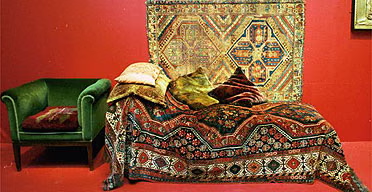
I’d like to introduce you to a nice Jewish boy who lives in Hampstead. He doesn’t care much for shul, but he likes studying some of our texts, and he’s had some good ideas. His name is Sigmund Freud. 

He had this fantastic idea that, if a person spoke freely about all that was worrying them, they might feel a little better. 

He found trends that showed that some of what makes us angry or sad or anxious can be connected to our childhood. Now, being honest, some of his theories have lost their appeal. He put a lot of stock in a couple of Greek myths. But, in general, he understood that by re-telling our internal narratives, we can live in ways that are calmer and more fulfilling. 

During his lifetime, Freud had to deny that his techniques were a “Jewish science,” but later his daughter Anna was able to reclaim the label as a “badge of honour.” 

I think it probably is something of a Jewish science, and I wish more Jews would try it.

I look at some of the characters in our Torah and think how much they might have benefited from a trip to a therapist’s couch. 

Would Isaac have pitted his sons Jacob and Esau against each other so callously if he’d been able to cope with the betrayal he felt when his father Abraham tried to kill him?

Could Moses have kept his temper in check a little if he’d had space to talk through the displacement of discovering he had been adopted?

Maybe Rachel and Leah could have done with some family therapy to process their jealousy and build better relationships.

Of course, they wouldn’t have given us such compelling stories if they’d been better adjusted, and we wouldn’t have the Torah we do. 

It’s too late now for the biblical protagonists, but it’s not too late for us. We actually can go to therapy, and learn to like others and ourselves a little better.

As a community, one of our great highlights is Sandra Webber’s Shabbat Island Discs, where members share their life stories alongside their favourite tunes.

Believe it or not, the idea didn’t begin at KLS, but originated on BBC Radio 4, where it is called Desert Island Discs. On 4 August 1989, the show welcomed on a castaway by the name of Rabbi Lionel Blue. You can still listen now on iPlayer, as he speaks with such gentle warmth, and offers up a song about his Yiddishe Momme. 

But there is a really profound moment when Rabbi Lionel describes the benefits of therapy to us all. He had learnt about himself through a self-taught psychotherapist who took him on for free. His first session took 10 hours! 

He says his reason for promoting the benefits of therapy is that “you can only love God as much as you love yourself.”

This approach, that we ought to get to like ourselves better through therapy, positively impacted on how rabbis were trained at Leo Baeck College. For several decades, it has been actively encouraged as part of rabbinic training.

On and off, in various forms, I’ve been going to therapy for about 15 years. And I swear by it. It has helped me know myself better and love myself more. It has made me a better pastor, partner, and friend. 

And I think Lionel was right: it has made me love God more.

With the lengthy commute between Essex and Surrey, I wasn’t able to go so often. But now, with space and time for it, I find myself back on the couch. It’s doing me a world of good.

As Jews, we don’t evangelise, but if I were asked to give a rabbinic endorsement to anything, it would be psychotherapy. If you’re not already bought in, I encourage you to give it a try. 

Spend just under an hour talking to a trained listener, and see how much better you feel.

Shabbat shalom.
sermon · social justice

Why do people hate Jews?


A joke from darker times in history.

Two Jews sit on a park bench in 1930s Germany. One sees that his friend is reading Der Sturmer, the mouthpiece of the Nazi Party. Horrified, he asks: “what on earth are you doing reading that rag?”

His friend replies: “This newspaper says Jews control the banks, the media, and the governments of every country. These days, that’s the only good news I get!”

I try, where I can, to pay attention to the questions people in this community are asking, and make my sermons answer them. The question I have heard most frequently in the past few weeks is: “why do people hate Jews?”

I’ve heard it from young and old, Jew and non-Jew, left and right. It’s a heartbreaking question, because it shows how anxious people are. It is a serious question, so it deserves serious answers.

Why do people hate Jews?

My first answer is: they don’t.

Look at our neighbours, friends and coworkers. We are surrounded by love.

Whenever the Jewish community faces attacks, this synagogue is inundated with messages of support. (You will remember that, for a while, we kept all our letters of solidarity on a board.)

When Finchley Reform Synagogue was threatened last week, their local community came to uplift them. Mosques, churches and community centres. The Lebanese community brought doughnuts. The councillors, politicians and emergency service workers filled up the shul until it was standing-room only.

These people don’t hate us: they stand with us.

But that doesn’t mean no people hate Jews. Clearly, some do.

On Monday night, the BBC ran a Panorama called “Why are British Jews afraid?” It brought the wider British public’s attention to the reasons for fear of which we are already aware.

The attack on Heaton Park Synagogue on Yom Kippur. The murderous gunman on Bondi Beach at Chanukah.

In the last month, terrorists set fire to Hatzola ambulances and attempted arson against multiple Jewish gathering points in north west London. Recently, an Iranian operative was arrested for plotting to attack the site where I trained to be a rabbi, the Sternberg Centre.

Reports once distant are coming closer to home, affecting my own friends and colleagues.

It is because of these abhorrent acts that the question is even asked: why do people hate Jews?

Yet, even in these cases, I don’t think the perpetrators actually hate Jews, because I don’t think they even know who we are. Had the teenagers from Leyton who set fire to Hatzola ambulances ever met a Jew?

They were not even thinking about Chabad of Golders Green. Presumably, they were responding to news from the Middle East, but that doesn’t mean their violence is just misdirected anger against Israel.

I find it quite perverse to entertain the idea that, if only Israel would behave itself, British Jews wouldn’t warrant terror threats. I think most of us have expressed great anguish over Gaza, but that doesn’t prompt us to attack ambulances. The same is true of the rest of Britain.

As Dave Rich of the Community Security Trust said on the BBC documentary: the vast majority of people attending pro-Palestinian protests in London are motivated by a sincere concern for human rights. It is a minority of interlopers that are the cause for concern.

The primary groups who radicalise against British Jews are white nationalists and Islamists. Neither group particularly cares about Palestinians or Israelis, but only makes a pretence of it to serve their own supremacist agendas.

People were attacking Jews and Jewish institutions for many centuries before Israel was founded. They don’t need Israel to commit war crimes to justify burning synagogues.

Antisemitism is not really about Jews. Not real, living Jewish people. It is about a fantasy boogeyman who causes all the world’s problems.

The people who commit crimes against Jews are generally boys whose lives lack meaning. They know that something is wrong with the world, but they have no words to say what. So they invent an enemy, and their fabricated villain is a Jew.

The problem is not that they don’t like Jews but that they don’t like themselves.

Still, you can’t get from feeling dissatisfied with life to chucking petrol bombs at a synagogue without encouragement.

Antisemitism, like all forms of bigotry, is created from the top down.

April Rosenblum’s pamphlet The Past Didn’t Go Anywhere is a fantastic introduction to what antisemitism is and how to fight it.

Medieval antisemitism, she says, worked by having a group to sit in between the masses and the ruling class. Unlike other forms of racism, which are about making sure the boot is always on some minority’s neck, antisemitism worked by creating a buffer class so the people in charge could blame someone when things went wrong.

So, England on the brink of bankruptcy from Crusades banished the Jews; the Tsar’s supporters in decaying Russia invented The Protocols of the Elders of Zion; and in the 1930s Nazis gained power in impoverished, humiliated Germany by promising to deal with the Jews.

Judaism has changed much in the last thousand years, but antisemitism hasn’t. When Donald Trump says “the Jews don’t like me because they can’t buy me” or Elon Musk says Jews push hatred against whites, they’re standing in a long tradition of elites pointing at Jews for problems they created.

When Iranian leaders say that terrorist attacks are false flags launched by Jeffrey Epstein’s cabal to undermine Europe, they’re not even trying to hide their conspiracies behind innuendos.

These people don’t hate Jews. Jews are just convenient fodder for their smokescreens. What they hate is that they might lose some of their wealth or power. What they can’t stand is the thought that people might see past the lies and blame the real enemy: them!

Whether in America, Iran, or Britain, demagogues want people to hate Jews so that they won’t ask questions about what really causes social problems.

If only people did just hate Jews, it would be easier to defeat antisemitism. We could find every one of our enemies and bash them down like an anti-racist game of whack-a-mole.

But antisemitism runs deeper than that. It is a system of distraction and confusion, baked into the world’s contradictions over hundreds of years. It may draw on myths from religious texts or items from the news, but its core object of hate is not a real Jew.

Its Jew is a pantomime villain, created by corrupt elites to give desperate people someone to blame. The Jew they hate is a phantom, who vanishes on contact with reality.

So, to all those in this community asking why people hate Jews, let me say with surety: there is nothing in you that deserves hatred.

There is nothing you have done that made terrorists mad. There is nothing you could have done differently to stop fools attacking synagogues. Their hatred is not for you.

But the love is real. The relationships we have with our neighbours are based on genuine connections. The friendships we have built across faiths are sincere. The good work we do in our community has a real impact.

May we never let anybody’s hatred diminish that. May we only love harder.

Let us love our neighbours more. Let us love each other more. Let us love, ever more, our synagogue, our Torah, and our God.

So let us love Jews.

Shabbat shalom.