“Nobody understands me!”
It’s the rallying cry of adolescence.
I would never want to be a teenager again.
What a difficult time. Do you remember how lonely and anxious it all felt? Do you remember how much you felt like nobody understood?
As adults, we now often put down this pubescent behaviour to hormones, or, worse, to the kid just being annoying.
But what young adults are going through is really important. All that sadness and angst is a healthy part of their development.
They are realising that the world is a much meaner and more confusing place than they had thought in infancy.
And the truth is they are right: very few people understand them. And they understand very few others. That takes real adjustment.
But once teens can accept how little understood they are, that can make them much more functional adults.
They can embrace their individuality and celebrate it. They can appreciate difference, without feeling a need to change others. And, when they find people who are like them, and who do understand, they can appreciate the connection so much more.
Understanding how little understood we can be helps us to truly value loving and being loved.
So, it’s true, nobody understands me. Isn’t that wonderful?
What kind of world would it be if everyone automatically understood everyone else! We would lose our humanity. We would just be cattle, following along, without the possibility of freedom or growth.
That’s what it was like at the Tower of Babel.
This story in Genesis l tells of humanity’s own coming of age.
At some point, in mythic time, we all spoke the same language. Like robots, we all set about making a massive tower.
God saw us and said “who knows what they’ll do next!” So God confounded us, gave us all different languages, and dispersed us throughout the world.
That is God’s message at Babel. Diversity is the foundation of society. Humanity needs to mature. You need to be different and know that you are different. It is a good thing not to understand and not to be understood.
The ancient Israelites knew the value of not being understood all too well. To them, Babel was not just an ancient city. It was the capital of the major empire that colonised them.
Babylon took over the entirety of the ancient Near East. Wherever they went, they imposed their laws, their government, their military, and their taxes.
They also imposed their language. They spread their alphabet to all of their colonies. What we now call the Hebrew alphabet is, in fact, the script of the Babylonian empire. The original Paleo-Hebrew script is now lost to stone blocks in museums.
The Babylonians carved up and named the territories. That naming, that fact of telling everyone who they were, and where their borders were, was their way of exerting control. It was the basis in words for all that would follow: all the military and economic violence they would enforce.
During Jehoiakim’s reign, the Babylonians took hold of Judah and tried to turn it into a vassal state.
The ancient Judeans rebelled, fighting for their homeland and their dignity.
The Babylonians took all of the Jewish leaders and imprisoned them. They forced thousands of them into a tiny strip of land, hoping to militarily crush the rebellion.
Of course, no people forced into subjugation will just concede. When rebels are backed into a corner, they usually fight back even harder.
That’s exactly what happened with the Judeans. Less than a decade later, those left in the country launched another assault on Babylon.
In response, the Babylonians completely flattened Judea. They ripped down its cities, destroyed Jerusalem, and killed anyone who stood in their way. They installed their own puppet dictator, Gedalia.
As you would expect, the Judeans killed Gedalia and kept on resisting.
We must, therefore, understand the story of the Tower of Babel in the context of what Babylon meant to the Jews. To them, the Babylonians were the people who wanted to destroy and persecute them. They were the empire that wanted to steal their money and their land.
While warriors fought with swords, storytellers fought back with this literary protest.
They said: “Look at the Babylonians: they want to force everyone to have one language and want to bend everyone to their will.”
Our ancestors told the story of Babel as a warning. Look at what happens when you force a language on people. You end up like Babylonians. You become monsters. Once you impose your words on others, there is nothing to stop you imposing your will.
We must have diversity. We must be incomprehensible. We must be as unlike each other as possible, so that nobody can be subjugated to another.
The true story of the history of the world is not that it went from a single language to many, but that it began with many languages and had fewer and fewer.
As empires rose, they enforced their own words and worldviews, and suppressed the heterogeneity of all they conquered.
The reason that so many people of the mediaeval world spoke Greek, Latin, Arabic, or Chinese was because those were the biggest empires. The reason that so many people today speak English, French or Spanish, is because our small European countries colonised over half the globe.
Their primary purpose may have been to take the land and resources of those countries. But as part of doing that, they also needed to impose languages on people. They needed to force people to conform to words they had previously not known.
They said: this is now Christendom, and that is the Uma. This is the Old World, and that is the New. This is Europe, and that is Barbary. This is civilisation, and those are savages. This is white, and that is black.
They took the world under one language, and forced it to conform to their understanding. They understood the world, for the sake of controlling and conquering it.
With each century of imperial conquest, hundreds of languages are rendered extinct. When languages die, we lose not only a way of speaking, but can witness an entire culture being eliminated.
This is why the definition of genocide does not only encompass killing people, but can include destroying ways of life.
So, let us suggest, understanding each other might not be such a good thing. If anything, we might aspire to understand each other less.
Our Torah wants us to look for something better than understanding. It tells us this story not just because they are angry about their subjugation as the oppressed, but also because they are worried for the souls of their oppressors.
To the ancient Judeans, the Babylonians were stuck in a spiritual adolescence. Like immature children, who just want to manipulate the world, the Babylonians had not yet achieved the wisdom of accepting what they cannot know.
They taught an alternative theology to the conquering power of Empire. Not knowledge. Love.
Love is the Torah’s answer.
When you love someone, you do not want to control them. Quite on the contrary, you want them to be free.
When you love someone, you don’t want to change them.
When you love someone, you don’t want to categorise them.
And yes, you may want to understand them, but in the sense of being infinitely curious about them, wondering who they are, and how they think. But always knowing that you cannot reduce them or ever comprehend their essence.
So, it is time to stop trying to understand people. It is time to stop trying to be understood.
We need to understand each other less and love each more.
Nobody understands me. Thank God.
Shabbat shalom.

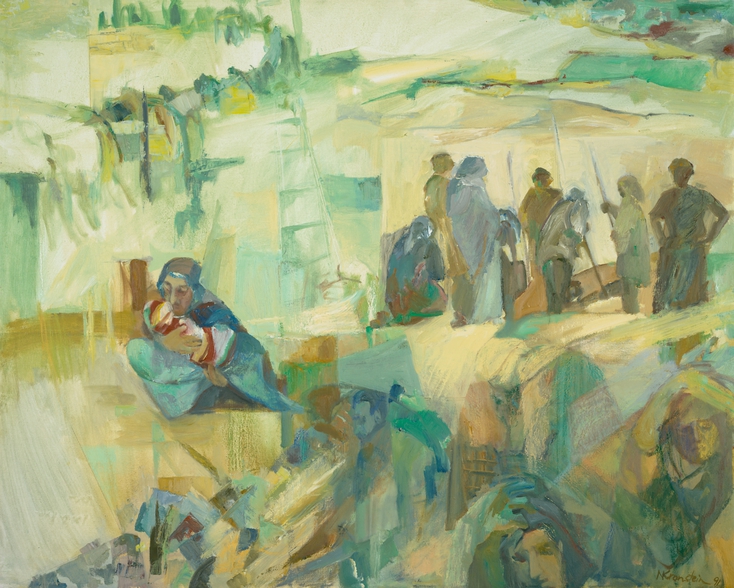
 Sim Lev