judaism · sermon · story · Uncategorized

Nadav and Abihu are dead

Nadav and Abihu are dead. Consumed in fire. Burned alive. And nobody knows why.

They were two of Aaron’s four sons, Temple priests. They went into the Sanctuary to offer a sacrifice, but something went wrong. The fire came out strange somehow and blazed everywhere. They died instantly.

Moses, their uncle, told Aaron that it was God’s intention. “Through those near to Me I show Myself holy, And gain glory before all the people.” Aaron was silent.[1]

For centuries, commentators would speculate what they’d done wrong to deserve death. Perhaps they’d been over-zealous and churned out too much fire. Maybe they hadn’t followed the commandments to the letter. They might have been drunk.

But nobody questioned that it was their own fault. God is just. The world is reasonable. And if a bad thing happens, the people who suffer must be to blame. All we can do is silently accept it.

Under any scrutiny, it’s an indefensible theological position. In a world so full of inexplicable suffering, it is not possible to tell people who are hurting that God intended for them to feel that way. Death cannot be explained away. We cannot justify people burned alive. We cannot silently accept it.

But what if we have been interpreting this parasha all wrong? What if this text isn’t encouraging us into silent acceptance, but to question injustice? What if this isn’t about blaming victims but about challenging oppression?

There is a suggestion in the way the story is laid out that there may be more to this story than meets the eye. Our narrative does not begin with the death of Nadav and Abihu, but with sacrifices. Burnt sacrifices of animals. Moses and Aaron go about slaughtering goats, rams and oxen and offering them up to God in fire and incense.

In the next section, Nadav and Abihu die. Already these two events seem connected. The burnt sacrifices of animals may well have some correlation to the burning of Aaron’s sons. In case the parallel is not clear enough, the aliyot are divided up so that the two stories run into each other. The third aliyah of Shmini begins:

Fire went out from before God and consumed the burnt offering and the fat parts on the altar. And all the people saw, and shouted, and fell on their faces.[2]

The language used to describe Nadav’s and Abihu’s death mirrors this too closely to be coincidental:

Fire went out from before God and consumed them; and they died at the instance of God.[3]

The Torah is urging is to see some similarity between the burnt sacrifices of the animals and the death by fire of Aaron’s sons. The people shouting and falling on their faces stands in direct contrast to Aaron’s silence.

Other commentaries have begun from the premise that Aaron’s sons’ deaths were justified. Other commentaries have assumed that animal sacrifice and human death were logically separate. Both, they assume, form part of a cosmological worldview that sees God as just, explicable, and hungry for death.

Yet the whole narrative might make more sense if we assume that the reverse is the case. Nadav and Abihu did not deserve to die. Their deaths were senseless and unjust. They died without explanation and their father was expected to cope with it. Their sudden and dramatic death arrests all talk of animal sacrifice. It interrupts our assumptions that there are correct ways to kill creatures and that sins can be expiated with blood. In the moment that Nadav and Abihu die, Aaron gets an insight into what sacrifice is like for the animals. When his own kids are slaughtered, he doesn’t shout and fall on his face, but retreats into stunned silence.

This interpretation makes sense of Moses’ cryptic comment to Aaron: “Through those near to Me I show Myself holy, and gain glory before all the people.”[4] The word for ‘draw near’ – קרב – is the same as the word for ‘sacrifice’. The line may be interpreted as saying that God is made holy through sacrifices. If animal sacrifice is holy, why not human? If animal sacrifice makes God appear glorious, why not human?

Instead of trying to justify human death, this parasha may be calling us to question animal death. Although this interpretation may seem modern, there is precedent for it. According to 13th Century Spanish philosopher Nachmanides, “Living creatures possess a moving soul and a certain spiritual superiority which in this respect make them similar to those who possess intellect (people) and they have the power of affecting their welfare and their food and they flee from pain and death.”[5]

Scholars including Maimonides, Albo and Rav Kook all argued that, ideally, people should be vegetarian. They saw animals as possessing reason and emotions like people.[6] Today, their ideas have new relevance. We live in an era when animals are bred in captivity, kept in cages and killed without thought. When the rules governing kashrut were constructed, they put a firm limit on what violence could be done to animals. Compared to neighbouring cultures where animals could be torn apart limb by limb while they were still alive, the requirement that they should be kept in good conditions and killed as quickly as possible was remarkably humane.

Yet, today, as Progressive Jews, we might rightly question whether those rules go far enough. If we accept that senseless death is unjust and that the Torah is more concerned with calling us to action than silent passivity, it may be time for us, as a movement, to consider adopting vegetarianism.

I do not want to moralise to people or be accused of hypocrisy. I am not a vegetarian and I’ve struggled to reduce my own use of animal products.  But I want to try. One of the biggest barriers is that it’s expensive and time-consuming. That’s because our society is built around meat and using animal products. That should not, however, stop us from trying. As a religious movement, we could lead the way by changing our own relationship to food and encouraging others to do the same.

nadav and avihu

I originally wrote this for Leo Baeck College’s newsletter on Parashat Shmini.

[1] Lev 10:3

[2] Lev 9:24

[3] Lev 10:2

[4] Lev 10:3

[5] Nachmanides, commentary on Genesis 1:29, quoted in https://www.jewishveg.org/schwartz/view-torah.html

[6] http://www.jewishvirtuallibrary.org/rabbinic-teachings-on-vegetarianism#4

judaism · sermon · social justice · Uncategorized

We build the Temple when we learn its dimensions.

We begin to build the Temple when we learn its dimensions.

Midrash Tanchuma tells us that we begin to build the Temple when we learn its dimensions, and it is in this week’s parasha that we learn about the first Temple’s dimensions.

The Temple it describes sounds gorgeous: gold, silver and brass; blue, purple and scarlet; skins and threads and wood and onyx stones. The parasha lays out what the ark should look like, surrounded by cherubim. Even the smell – that deep rich smell of incense – it describes.

The Temple sounds beautiful, but it is not my Temple.

That Temple is for a world divided up into castes – where cohanim take precedence over Levites, Levites over Israelites, Israelites over low-caste Jews and low-caste Jews over foreigners. The Temple I want to build is one where all hierarchies of race and class are abolished.

That Temple is for a place where women are kept in their own quarters, separate from men and participation in services. My Temple is one where patriarchy is finished.

That Temple is one where countless animals are burnt on furnaces, day and night. In my Temple, humanity and nature work in harmony.

Their Temple is for a centralised cult in Jerusalem – mine is a decentralised, Diasporic, dispersed Temple where people can find God wherever they are.

Like the Sages, who took this parasha and inferred from it the laws of Shabbat, my Temple is not a place, but a time. It is a time for justice, peace and tranquillity.

That Temple is not our Temple, but this week we learn its dimensions. And when we learn the dimensions of the Temple we begin to build it. This idea, that you can create change just by imagining something different, has been central to many revolutionary movements. Last week, we celebrated 100 years since women got the vote, and it is worth reflecting that every major change for democracy was brought about people fighting to change their circumstances and every battle was brought about by a change in consciousness. Through that consciousness, through contemplating a world of women’s liberation, the earliest feminists began to create that world.

Abdullah Ocalan, also known as Apo, the incarcerated leader of the Kurdish resistance in Turkey, pledged in his Prison Writings that weapons should go silent and ideas speak. His idea – of democratic confederalism, where peoples were brought together by collectives that transcended boundaries – he hoped, could be brought about by persuasion rather than violence. He imagines that the Kurdish people might have national liberation without resorting to the authoritarianism and division of their own state, and has made it his task from prison to advocate for a different kind of society. The Kurdish liberation movement has been profoundly different to most other nationalist movements that preceded it, in that it has focused on building greater equality and community while fighting against persecution on all sides, rather than deferring this necessary work until ‘after the revolution’.

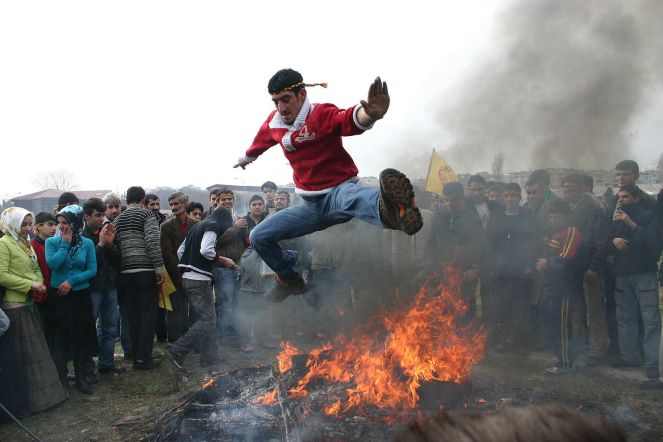
During my time in Turkey, I was lucky enough to see some of these ideas in action. In the year I lived in Istanbul, the Turkish government made a rare allowance for the Kurds to celebrate their spring welcoming festival, Newruz. A friend took me out to a giant field in the centre of town where people were selling garlands. Fires burned and people jumped through them. There were a few stages, on which folk musicians performed. The people around me took my pinkies in theirs and danced in a circle in a style similar to the hora.

What was perhaps most remarkable was how politicised this festival was. The very fact that it was taking place at all was a shock to the system. For decades, people had not dared to speak Kurdish openly on the streets. Journalists who reported on the persecution Kurds faced had been imprisoned. But here they were, in their tens of thousands, proudly celebrating their own traditions. After every few songs, a speaker came out. The speaker would spell out a vision for national liberation and international solidarity. I don’t speak Kurdish, but I’ve been to enough Marxist rallies to recognise “down with the capitalist system” when I hear it.

At the same time, a revolution was taking place within the Kurdish community. The national liberation struggle had empowered women, ethnic minorities and queer people to start campaigning for their own rights. HDP, the democratic wing of the resistance movement, had, by far, the most comprehensive policy for gendered liberation, including paid housework, gay adoption rights and closing the pay gap. The party’s candidate for mayor of Kadikoy, a fancy district of Istanbul, was a trans woman sex worker, Asya Elmas, who came close second on a platform of combatting exploitation.

Over the last few years, I have watched with great intensity as that movement for Kurdish freedom has unfolded. In a way, I have done so despairingly. The Syrian civil war has continued and escalated, causing devastation on unprecedented levels, and turning out more and more refugees. In that time, ISIS has spread across the Middle East, destroying Kurdish communities and threatening to destroy every remnant of hope with their own brand of reactionary, fundamentalist dogma.

But, as well as despairing, I’ve watched on with hope. The conflict has, unexpectedly, given Kurdish militants the opportunity to try out the least of their dreams. The Kurdish groups banded together in response to the war and, in 2012, they captured the cities of Efrin, Amuda and Kobani in the northern Syrian territory of Rojava. Having taken control, they tried to implement the ideas of Apo I described earlier. They governed by direct, grassroots democracy. They instituted a constitution that pledged religious, cultural and political freedoms, as well as a bill of human rights in line with the UN’s Declaration.

For the last few years, they have been one of the driving forces in pushing back ISIS. They have now almost completely defeated ISIS in all the areas neighbouring them, despite little support from the international community and active hostility from Turkey and Iran. Turkey, which has so far barely intervened in the Syrian conflict, even to support humanitarian efforts, has in recent weeks got involved only with the intention of destroying Rojava and, with it, Kurdish hopes for their own self-government.

I hope you will understand that I am not frivolously cheering on a side in a war whose outcome will not affect me, but I do believe that the struggle in Rojave is the Spanish Civil War of our generation. It is not a struggle over which ethnic group will govern, but over which ideas will be allowed to dominate. Rojava represents the possibility of a set of ideas that have otherwise been called unrealisable – of a borderless, classless world. They are defending more than a territory; they are defending a dream of a different kind of Middle East.

I don’t want to paint an overly rosy picture of the Kurdish resistance. There are big problems that have been widely acknowledged, including mistreatment of minorities like Yezidis and the egalitarian values I described are not uniformly shared. I also do not want to give off the impression of glamourising war. I only recognise that the need for violence has come out of necessity, and I find it hard to criticise anyone for using those methods when faced with such violent opponents on all sides.

It is worth knowing that those ideals – of liberty, equality and justice – are being fought for, right now. It is worth supporting the people who are fighting for them, however imperfectly.

Learning about their struggle for a just world, I realise that my Temple may not be as distant as I thought. Knowing that people are struggling against far worse conditions that I can imagine, I feel empowered to fight for the same ideals here.

You may not share my ideals, but I still want to hear yours. I want to have a real conversation about what kind of world we want to build.

We begin to build the Temple whenever we study its dimensions, so let’s look at each other’s blueprints. What is our Judaism really for? Are we just preserving a tradition; just using our religion to serve people’s individual needs now; or are we serious about building a Messianic Age?

We begin to build the Temple whenever we learn its dimensions. Let’s get building.


Newroz_Istanbul4

I delivered this sermon on 15th February 2018 for Parashat Terumah at Leo Baeck College.

judaism · sermon · Uncategorized

This burden is too heavy for you to bear alone

One of the things I love about our prophets is that they’re not perfect people. If they were perfect, what could we learn from them? Moses is a profoundly imperfect person. In Egypt, he gets so angry with a slaver that he murders him and runs away. In the desert, Moses gets angry again and smashes a rock to get water from it, rather than talking to it as God asked. Moses is somebody who gets angry, impatient and struggles with everything he has to do.

In this week’s parasha, Moses is no longer angry or impatient – he is just burnt out. His father-in-law, Yitro, comes to visit him in the desert. Yitro is a Midianite priest who gave Moses work when he was on the run after the killing the slaver. While Moses was there, Yitro’s daughter, Zipporah, fell in love with him and started a family with him.

As soon as Yitro arrives, Moses prostrates himself and offers him food. Yitro looks at him. Moses is growing old. When they left Egypt, Moses was already eighty. His body is aching. He’s had enough. But he’s persisting. From dawn until dusk, Moses sorts out people’s problems. He listens to their concerns and solves them.

Moses has been trying to deal with everything on his own. Rashbam, a medieval commentator, points out that Moses has been trying to do so much he’s been left doing nothing. Instead of empowering people to solve their own problems, he’s left them standing in the desert, waiting for his judgement. He is on the verge of burning out.

Yitro sees all this. Yitro puts a hand on his shoulder. He gently cajoles him: “What are you doing to the people? Why do you act alone, while all the people stand about you from morning until evening?”

Moses tells him: “The people need me, I have to do this.”

“No, you don’t,” says Yitro. “This is not good for you. It’s too heavy for you.”

Moses, known for his anger and impatience, just gives in. “You’re right,” he says.

Yitro comes up with a plan for him to delegate tasks. He spreads out the work so that Moses just supports a few people, and in the smallest groups, Moses assigns responsibility so that people can look after themselves.

For me, this is a beautiful moment. Moses realises that he can no longer carry a burden – and he shares it. First, he shares it with Yitro, acknowledging that he’s vulnerable. Then, he shares it with the whole community, recognising that power and responsibility need to be shared with everyone.

In their groups of tens, the community will share their problems. They will talk about their worries and solve them together.

This has such a profound message for us. In our society, we are so often discouraged from sharing our problems. Chin up. Stay strong. Keep calm and carry on. We are conditioned to think that our emotions are better kept to ourselves; that being vulnerable means being weak.

The expectation that we should always be happy, or always be calm, and shoulder our burdens ourselves, is not reasonable or realistic. We’re real people, living in a broken world, who feel the full range of human emotions – of sadness, frustration, anger, ecstasy, bliss and joy. There is no reason why we shouldn’t sometimes need to unload.

Our society is beginning to initiate conversations about mental health. Those conversations are not easy. For decades, we have been taught that our mental wellbeing is something that needs to be dealt with privately. But how can it be? Human beings are social creatures. Our individual lives are deeply locked in to the lives of everyone else around us. How everyone else is feeling intimately affects how we are.

This is especially important here in the Jewish community. Many of our members have endured a great deal and need to be able to process that in a healthy and compassionate way. Often, there are few other places to go with our problems but our religious communities. Plenty of us would understandably struggle to open up about our feelings with regular friends. If we decide to seek out counselling, we might find NHS waiting lists inordinately long. Even if we do get counselling, it can only take us so far – it is not a substitute for a loving community where people talk to each other and support each other.

The synagogue is a place where we can talk about our feelings in a supportive environment on our own terms. Creating a supportive environment doesn’t mean wallowing in misery or forcing conversations that aren’t comfortable – it just means creating a space where people can be themselves and connect with their traditions.

In this community, we’re going to try and do much more of that. Andrew has very kindly agreed to hold services once a month, so that between us we will have regular shabbats every two weeks. These services and study sessions will give everyone opportunities to connect with their religion on their own terms.

Just as Moses delegated out responsibility, the engine of Manchester Liberal Jewish Community is in its members. We work together to take on the tasks that keep this community going, so that this inclusive and empowering Jewish community can exist in Manchester. Every one of us puts effort into ensuring that the community continues to run – whether that’s by cooking food, doing admin, advertising events on social media or just turning up.

Whether you’re a regular or a newcomer, this community is here for you and will welcome you. We need you to help us create a supportive, inclusive, Jewish space in Manchester, where everyone can participate and everyone can benefit.

Moses accepted that the burden he was carrying was too heavy to bear alone, so he shared it. Come share your burden. Come be part of a community. Come and find peace.

manchester dusk skyline

I gave a slimmed-down version of this sermon at Manchester Liberal Jewish Community on 2nd February 2018. If you are Jewish and living in Manchester, do consider joining our community. If you are living elsewhere in the UK and want to find an inclusive Jewish community near you, look on these listings from Liberal Judaism and the Movement for Reform Judaism.

judaism · sermon · theology

The importance of not respecting different opinions

This is Interfaith Week, and many of my religious buildings across the country are holding similar services to this one. In most places, I suspect people will talk about the importance of respecting differences of opinion. You have your views, I have mine, but we can all get along. All religions have their own truths. It might be customary to say it, but I can’t bring myself to do it. Not all ideas have the same value. Some ideas are wrong. Some ideas are dangerous. Some ideas must be challenged as soon as we encounter them.

This week, we read a passage in the Torah with a violent history. In it, Jacob and Esau fight over who gets their father Isaac’s birth right. Jacob, the younger brother, tricks his dad into giving him his blessing. He dresses in his brother’s clothes, puts hair on his arms so that he’ll feel rougher, and puts flour on his tongue so that his voice will sound deeper. With the help of his mother, Rebekka, he kills an animal, makes some sweet meats and cons his father into giving him a blessing that was meant for his brother. When Esau comes in, Isaac is distraught to realise that he has given the blessing to the wrong son. Esau begs him to bless him, but Isaac insists that he can’t retract his blessing from Jacob. Instead, he gives him a new blessing: “You will live by the sword and you will serve your brother. But when you grow restless, you will throw his yoke from off your neck.”[1]

This story became more than a tale of sibling rivalry. It became the basis of bloodshed lasting centuries. Jacob took another name: Israel. As a person, he stood in for the whole of the Jewish people. Esau had another name: Edom. As a person, he became a symbol of Christianity and Rome. For centuries, that was the optic through which Jewish-Christian relations were viewed: as a struggle between two brothers for a blessing that could only be held by one of them. The Jews, Israel, insisted that they were the sole bearers of the blessing from God. Christians insisted that they had broken off the yoke of Torah when their Messiah came, and that they had replaced Jews as God’s chosen people.

This had real consequences for people’s lives. If Christians had replaced Jews, then Jews were a stubborn remnant of a bygone age; a people destined to be destroyed. St Augustine of Hippo, one of the Founders of the Church, argued that Jews should be allowed to live only as evidence, in their degraded state, of the superiority of Christianity. This story of Esau replacing Jacob was so influential on European thinking that, some argue, it helped to legitimate the Nazi genocide.

This month saw the five hundredth anniversary of the day that Martin Luther nailed his ninety-five these to the church door, demanding reformation of the Catholic Church. His ideas were so important. Luther was somebody who realised that ideas are powerful. He was responding to a time when the established Church used people’s fear of death to pay for a better place in the afterlife. The abuse of religion was creating a deeply hierarchical and unequal society. Luther wanted to challenge that. He realised that not every religious idea had to be respected. Sometimes they need to be resisted.

Luther was also a notorious antisemite. In his later life, he used his power as an academic to incite race riots against Jews. His ideas were adopted for centuries in justifying racist violence. When the movement he founded, Protestantism, gained the upper hand in Western Europe, his ideas were used to attack Catholics. Unfairly caricatured as automatons doing the bidding of the Pope, Catholics were denied access to citizenship, and imprisoned as foreign infiltrators, in many countries. Luther’s great idea – that religion should not be used to wield power – became subverted to serve its opposite purpose: of entrenching power.

Still, his ideas gave birth to our own religious movements. The Unitarians here draw their roots from Protestantism, wanting to take Luther’s best ideas to their radical conclusion of a religion grounded in equality and acceptance. Liberal Judaism, too, was inspired by Protestant reformation. Our forbearers wanted to create a Judaism without sexism or nationalism. Since then, we’ve tried to also create Judaism that embraces LGBT people and champions just causes like the rights of migrants and workers. I know that many of our Christian friends here share that ambition.

This leaves us with a question: how do we know if an idea is any good or not? If we’re not going to automatically respect differences of opinions, what grounds can we have for disagreeing without creating exactly the kind of competition between Jacob and Esau, that caused so many generations of suffering? I’d like to propose a test for conversations in interfaith dialogue: do our ideas support existing power structures, or do they resist them? Do they bolster the powerful or diminish them? There are questions on which we can agree to disagree – none of us knows for certain what God really is, or what the afterlife is like. But we can challenge our ideas about this world: do they make our world more just, more equal, more compassionate, and more peaceful? If not, can we really sanction them?

This, I would hope, could be the basis of a better model of interfaith. Rather than accepting differences, let’s challenge each other to live up to the best of the values we share. In the spirit of the prophetic tradition that has inspired us, let’s push each other to speak truth to power. The reformation brought about the idea that religion should not be wedded to power. Let’s take it to the next stage, and insist that religion be used as a weapon against power. Let’s work together to fulfil a religious mission of eradicating inequality, championing the cause of the oppressed, eliminating hunger and poverty, bringing about a world where all people are treated with the dignity they deserve. That would be a world that truly respects difference.

[1] Gen 27:40

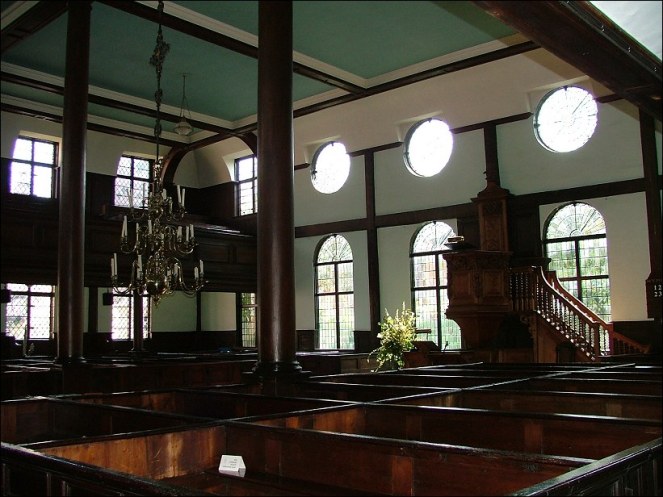
ipswich church
Ipswich Unitarian Meeting House

This sermon was given as part of an interfaith service organised by Suffolk Liberal Jewish Community, and held in the town’s beautiful Unitarian Meeting House. After the service, an Anglican minister pointed out that I had not made clear that current Christian doctrine had tried to rid itself of its supersessionist ideology. I think it is important to note that much of the work challenging offensive ideas in Christianity has been done by Christians themselves, especially by Catholics at Vatican II. I am grateful to him for this constructive feedback.

judaism · sermon · torah

Being hospitable

It was a dark night in an Eastern European shtetl. Shabbat was just about to come in. The Baal Shem Tov sat at the dinner table, surrounded by friends and family. Every spare inch of space had somebody sitting in it. The Baal Shem Tov was not a rich man, although many of the acolytes of the movement he founded later would be, and he would have to make a thin chicken soup stretch to feed everyone. Suddenly, there was a knock at the door. Standing in the doorway was a vagabond. He smelt bad, his beard was unkempt, his clothes were untidy. He asked: “can I come in? Can I eat?” The Baal Shem Tov looked back at the full house, looked over at the steaming pot of thin chicken soup, looked back to the man, then up to Heaven and said: “If God has made enough room for him on this planet, then surely I have enough a room at my table.”

The Baal Shem Tov was a model of hospitality. In this week’s parshah, we read about Abraham, who was, too, a model of hospitality. Two strangers come to approach Abraham, and he cannot do enough for them. The Torah is usually noticeably scarce on detail, but on this occasion, we hear everything he did. He bowed, he welcomed them, he gave them water and bread-cakes, he washed their feet, he offered them shade. He even killed a calf for them, and in those days meat was far more expensive than it is today.

Abraham doesn’t even know who these people are yet. As it turns out, they are messengers of God. But they could have been anyone. Nevertheless, from the outset Abraham addresses them as if they are angels. Perhaps it was that Abraham could sense something in them. Perhaps he had been expecting God. But I think, most likely, Abraham simply saw the face of God in everyone.

Rashi tells us that Abraham always used to sit at the entrance to his house, so that he could invite anybody in who walked past. The midrash tells us that Sarah always had a listening ear. She was known everywhere for how tirelessly she worked to cultivate a garden for visitors to sit. Their tent was open on all sides, so that they could welcome people coming from every direction. And from this story, the rabbis derive a mitzvah, perhaps the most important commandment of all: the duty to be hospitable.

The next story in Genesis is a parallel. Two angels turn up in Sodom. Lot invites them to stay the night. Before they had gone to bed, all the men from every part of the city of Sodom—both young and old—surround the house. They threaten to assault their visitors. When Lot objects, they deride him for being a foreigner and try to break down the door. Lot offers his daughters up to the baying mob.

Although there is a modern Christian interpretation that the story of Sodom is in some way about homosexuality, the rabbis did not have such a tradition.  For them, this was a story about hospitality denied. This, they said, was a city so wicked that they would not even allow their residents to show any hospitality or compassion to strangers. This, they said, was a city where even neighbours were not kind to each other; where a dog-eat-dog ideology took root so that nobody worked together. This was a city so wicked that even people like Lot, who should have been righteous, ended up turning against their own daughters and denying them the childhood they deserved. That is why the angels destroyed Sodom.

Which city do we live in? Which house do we inhabit? I often wonder what the two angels would make of our neighbourhoods and homes if they came to visit. While we have more technology and medicine and infrastructure than the prophets and tsaddikim could ever have anticipated, we have just as many people in need of hospitality. Our society seems more isolated than ever.

Manchester is known for its hospitality, but even here we can see the isolation. We already know older people who live in loneliness. We already know younger people who are desperately reaching out for a community, only to find nothing. We have seen newcomers turn up in this city only to encounter racism, hostility and closed doors. We have all seen the number of rough sleepers on our streets rocket over recent years.

In that situation, we have the same choice that was facing Lot and Abraham. Will we throw open our doors to let people in, or will we take the cruelty we experience in society and turn it on the people in our own homes? Will we increase the love or increase the isolation? This is a societal problem, but it will only change if people welcome each other, get to know each other and build solidarity with each other.

So, we must start with ourselves and our own homes. Jewish life is not something that happens in the synagogue. The synagogue is just a place we come to get respite and reenergised as we live a Jewish life. Jewish life happens in what we do the rest of the time. If we spend the rest of our week building communities, showing hospitality and modelling loving-compassion, that is when we’re living Jewish lives. Hospitality is one of the most important mitzvahs because it affects how we interact with everything. Being welcoming to people helps to break down isolation. It helps to create a sense of community. And it makes better, kinder people of ourselves.

Let’s all make the effort to be better hosts and to give more time to each other. Choose to be like Abraham and Sarah. Choose to be like the Baal Shem Tov. As Jews, let’s be the people who decide not to let an isolating and inhospitable society last. The struggle for community begins here, with us.

besht

This sermon was first delivered Shabbat Vayeira, 3rd December, at Manchester Liberal Jewish Community

judaism · sermon · torah · Uncategorized

The most boring part of the Torah

Genesis 10 is the most boring part of the Torah. Gandhi said it sent him to sleep. Militant atheists hold it up as a paragon of inane irrelevances. Although it is very clearly part of this week’s section of the Torah, everybody skips over it. You won’t hear any Liberal or Reform synagogues read it out this weekend. Even Chabad’s lectionary, known for keeping in even the driest sections for the sake of tradition, skips over Genesis 10 as though it’s not there.

It’s the genealogies. The lists of all the people who begat other people from Noah to Jobab. All the sons of Shem, Ham and Japheth roll off the tongue and over the heads of the readers. We can see why people would want to cut it out. In the rest of this section of the Torah, God floods the planet, Noah builds an ark, saves Noah, along with his family and favourite animals, then dramatically hangs a rainbow in the sky to symbolise a promise never to destroy the world again. At the end, after we’ve skipped over Genesis 10, the people attempt to build a tower so tall it can reach Heaven, only to be struck down and separated into many nations with many languages. By comparison with everything else, Genesis 10 is boring.

But that doesn’t mean we shouldn’t read it. The Torah is a carefully crafted text. Nothing gets in there by accident. The genealogies aren’t just a list of names that break up two well-known stories; they’re integral to the Genesis narrative. They tell us something deep about what kind of book the Torah is, who it’s for, and what makes it different from every other book that’s gone before. I find that in the boring bits, whether in a book or a relationship or a friendship, you find out the most important stuff. You find out who somebody really is.

It might help to put this text into the context of other Ancient Near Eastern prologues. It was common, in the civilisations of the Eastern Mediterranean, to begin with a list of people. These were the kings and their years leading up to the present day. For people in these societies, years were marked by the reign of their rulers and stories were told in relation to kingdoms. The Torah begins differently. The ancient Israelites were suspicious of monarchy and authority. They only managed a brief spell under a united kingdom, preferring instead to unite by their loyalty to God rather than to a person. For them, authority comes not from might but from history and tradition. So their story does not begin with a list of kings. It begins with a seemingly innocuous list of ancestors.

On closer inspection, these ancestors are not really people at all. Look, for example, at the descendants of Ham: Cush, Mitzrayim, Put and Canaan. These names are familiar. We know Mitzrayim as Egypt, the place our ancestors left in the Exodus. We know Canaan as Palestine, the place they entered. Put, according to Josephus, was the founder of Libya. Cush is commonly identified with Sudan. These are the nations of north-east Africa.

We see too the names Babel (Babylon), Accad (Akkadia) and Ashur (Assyria). These are the names of nations in the Near East. Later, scholars will come to identify Ashkenaz with Germany and Tarshish with Spain. The point is clear: this is a universal text. It is a story not of one great empire and its kings but of everybody. In this, the most boring bit of Torah, we find its most essential message: universalism. We are, all of us, part of this planet, sharing in its fortunes. We are, all of us, the children of Noah, descended from one common ancestor, connected by a universal God.

It encourages us to value unity in diversity – we may all come from a common ancestor, but we have gone in many different directions, all of which are to be celebrated. I think that’s the reason why it’s sandwiched between the stories of Noah and Babel. In Noah, people are violent and angry, so God floods the whole world. We realise that if the world floods, we all drown together. Our fates are so deeply intertwined that whatever we do to the world will affect all of us. In Babel, everybody speaks the same language and tries to build a tower together. But they are so single-minded that they subject everybody to the same conditions. They have no respect for difference or the unique dignity of each other, so God must separate them and diversify their languages. They needed difference.

Genesis 10, the history of all the nations of the world, combines the two messages of universalism and diversity. Yes, we all come from Noah and yes, we are all different. Yes, we share in this world, and yes, we are all part of different and exciting nations. Yes, we are all the same. And, yes, we are all different. This is a message that we can all share in what’s good in the world if we can all see what’s good and different in each other.

The nations of the world will, inevitably, look different in a decade to how they look now. The UK will most likely leave the European Union. Catalonia may or not become independent. Perhaps our Scotland will hold another referendum; Ireland and Northern Ireland might re-examine their borders. We will probably see new movements to restructure states all over the world. New nations will unite, new nations will split.

Separating or uniting need not be inherently good or bad things. What matters is the spirit in which they are done. If people split based on malice and anger, as did the generation before the flood, they won’t succeed. If people join out of a desire to be homogenous and to force everyone to conform, as did the generation at Babel, they will fail. Only if they can respect difference, uniting in a spirit of diversity, will people succeed.

tower of babel


high holy days · judaism · sermon · story · torah

The binding of Isaac… and Ishmael

Life is sacred. It is not just meaningful, though it is that. Nor is it simply beautiful, although it can be. Life is sacred. Given by God, uniquely to everyone in existence, with a specific purpose. Our lives – the lives of everyone in this room, and everyone we know, and everyone we don’t – are loving gifts from our Creator. With them, we can either repair or destroy the world.

I hope that we’ll be able to come out of this Holy Day season more aware of the sanctity of our own lives and of everyone else’s. spiritual ideals to the fore. But whose lives are sacred? Whose lives do we truly value, and whose lives do we treat as disposable? It can be harder to see the sanctity in some lives than it is in others. It is harder – perhaps hardest – to see sanctity in the lives of people we don’t know. There are people we forget and erase before we’ve even had the chance to see God’s spirit in them.

The Torah portion for this week, the Aqedah, is an example of such a problem. One line sticks out for me in this parashah. In this story of the patriarch Abraham preparing to sacrifice his son on the altar, it is perhaps the most troubling. It seems innocuous at first. But I keep coming back to it, and the more I come back to it, the more it bothers me. The text says:

Take your son, your only one, whom you love, Isaac, and go to the land of Moriah.[1]

Take your son, your only one… The text says that same phrase three times. When the angel intervenes and speaks to Abraham, we hear:

Do not raise your hand against the boy, or do anything to him. For I now know that you fear God, since you have not withheld your son, your only one, from Me.[2]

Your only son…

After Abraham sacrifices a ram in the place of Isaac, the angel speaks again:

Since you have not withheld your son, your only one, from Me, I will bestow My blessing upon you and make your descendants as numerous as the stars of heaven and the sands on the seashore…[3]

Again and again, ‘your only son.’ But that’s impossible! Abraham does not have only one son. Isaac is the younger of two children. Abraham has an older son, Ishmael. In only the immediately preceding parashah, Abraham sent away Ishmael and his mother Hagar. Has he forgotten them already?

This problem has bothered rabbinic commentators too. Rashi, the medieval French commentator, offers up a story:

“But I have two sons,” Abraham said.

“Your only one,” was the reply.

“But each is the only one of his mother!”

“Whom you love,” he was told.

“But I love both!”

“Even Isaac.”[4]

The conversation he puts in Abraham’s mouth is really the conversation of the reader with the text: doesn’t Abraham have another son whom he loves? How can Ishmael be erased so flippantly and insensitively from the text? Rashi suggests a number of solutions:

Perhaps lest Abraham’s mind reeled under the sudden shock. Further, to make his command more precious to him. And finally, that he might receive a reward for every word spoken.[5]

Yes, God is speaking like this to calm Abraham down. If he just blurted out: “Go and kill Isaac!”, Abraham might not have had the strength to do it. So God breaks the commandment down, gently feeding him each bit. But Rashi’s answer doesn’t tell us the most important detail: what on earth has happened to Ishmael?

Some rabbinic commentators have tried other approaches. Some suggest that we could translate יְחִֽידְךָ֤ not as your only one, but as your favourite one.[6] But the root of the word יְחִֽידְךָ֤ is אחד – one, and it doesn’t mean favourite in any other context. We can only really translate it that way if that’s what we want it to mean. And is that what we want it to mean? Do we want to think of Abraham, the father of all nations, as choosing a favourite between the children that will create Judaism and Islam? Does it actually make the text that much better?

Not only is God asking Abraham to kill Isaac, but God has already erased Ishmael. Can that really be true? Is that the God we believe in and worship?

It bothered me so much I went for lunch with a Muslim friend to ask him what he made of it. How did his tradition, that holds Ishmael in such high regard, deal with this troubling passage? I asked: “what does your tradition say about the binding of Isaac?”

“You mean Ishmael?” he said.

“No, no,” I said, “Isaac, who Abraham takes up Mount Moriah to sacrifice.”

“Ishmael,” he countered, “who Abraham takes up Al-Haram…” He grinned at me. “I know your tradition says something different…”

It was so funny. It hadn’t even occurred to me that the Islamic story might be different. We took out a Quran and read the story as it appears:

Abraham said, “Indeed, I will go to where I am ordered by my God; Who will guide me. My God, grant me a child from among the righteous.”

So We gave him good tidings of a forbearing boy. And when he reached the age of exertion, he said, “O my son, indeed I have seen in a dream that I must sacrifice you, so see what you think.” He said, “O my father, do as you are commanded. You will find me, if Allah wills, of the steadfast.”

And when they had both submitted and he put him down upon his forehead, We called to him, “O Abraham, You have fulfilled the vision.” Indeed, We thus reward the doers of good. Indeed, this was the clear trial. And We ransomed him with a great sacrifice, And We left for him favourable mention among later generations: “Peace upon Abraham.”[7]

It’s quite beautiful, isn’t it? But there’s a new problem: this text doesn’t mention Ishmael either. It doesn’t mention Isaac, but it doesn’t mention Ishmael. In fact, it turns out that in the early days of Islamic jurisprudence, the interpreters were undecided. 135 authoritative readings said it was Isaac; 113 said it was Ishmael. But gradually the weight shifted, and by the 10th Century, everyone agreed that it was Ishmael.[8]

So here we have two contradictory traditions: a Jewish tradition that erases Ishmael and an Islamic one that erases Isaac. What do we do with this? How can we reconcile these stories?

I think the Tosefta, that first text of rabbinic commentary, offers a compelling answer. The sages were dealing with a problem of two contradictory schools of thought – the House of Shammai said that a room was unclean and the House of Hillel said a room was clean. The Tosefta reaches this conclusion:

Make yourself a heart of many rooms and bring into it the words of the House of Shammai and the words of the House of Hillel, the words of those who declare unclean and the words of those who declare clean.[9]

David Hartman, a rabbi from the Bronx in New York, suggests this means we need to be able to hold multiple contradictory ideas at once. Whereas Western philosophy tries to drive everyone to one conclusion at the expense of all others, Jewish thought teaches that all words about God are words of God. Judaism teaches us to sustain and embrace contradiction.[10] We learn to build a heart big enough that it can include all voices, especially the voices that we might want to drown out.

So perhaps that’s an answer to my problem. We need to reconcile these two contradictory stories: Isaac was offered up as a sacrifice, and so was Ishmael. Isaac was Abraham’s favourite son, and so was Ishmael. Both a source of blessing, both blessed, both their lives sacred, both our traditions sacred, all stemming from one God.

The Torah says that Isaac was Abraham’s only son because, in a way, there only ever was one son. That one son was both Isaac and Ishmael. Some Christians say that the sacrifice of Isaac prefigured the crucifixion of Jesus, or represented it.[11] Yes, let us include that truth too. Rather than try to erase difference, let’s embrace the tension of contradiction and recognise what is sacred in every story. The message is the same in all of them: a rejection of violence, opposition to the sacrifice of human life, reverence for the God who created us all.

I think this religious analysis has some important political implications. Two years ago, the former Orthodox Chief Rabbi, Lord Sacks, published a book called ‘Not in God’s Name’. The theology of it was subtle and beautiful. He used stories like those of Isaac and Ishmael to suggest that all people were meant for their own blessings. He extrapolated this to thinking about religion: that nobody should make an exclusive claim to truth – that Jews, Muslims and Christians should all be able to respect one another.[12]

But from this solid foundation, Jonathan Sacks went in a troubling direction. He said that people should not try to make exclusive claims to truth, and then focused most of his book on criticising Muslim terrorists for doing that. Of course, I agree with his opposition to such terrorism. But given that his book was inevitably going to be read almost entirely by Jews, shouldn’t he have said more to challenge his own community? In the way he set it out, it felt very much like he was accusing everyone else of carrying out violence, without acknowledging that we, too, are imperfect. Such rhetoric only encourages division and continues the cycle of hate.

It turns out that Jonathan Sacks did not just make a rhetorical error. Earlier in the year, he recorded a film for Mizrachi Olami, a far-right religious nationalist party in Israel, where he encouraged Jews all over the world to join the organisation on a march through Jerusalem.[13] This is an annual march, drawing thousands of people, who run through the Palestinian part of the city in the east, intimidating residents and shouting racist slogans. On this day, shops close and streets clear as people prepare for violence.[14] Under pressure, Jonathan Sacks eventually agreed that he would not actually march with the group, but continued to produce promotional material for them.[15] I have to seriously question what this does to suggest that different religions can be blessed, or that all lives deserve respect.

I think that if we are going to build a heart of many rooms, it must at least be big enough to accommodate the grievances and frustrations of Palestinians. We must be able to see how we can be oppressors, as well as victims. We must confront all the contradictions that living in this modern world involves.

I spent August studying Hebrew in Jerusalem. It is a place that really confronts you to deal with contradictory truths. I spent my days in a university where I learnt so much and met so many exciting people. On my breaks, I’d stare out over the garden. That university overlooks a refugee camp, full of high-rise buildings, crowded with people who have been stateless since the War of 1948, and surrounded by a concrete separation wall.

I found myself feeling safer wearing a kippah than ever before, and at the same time so much more uncomfortable. I quite like wearing the kippah in England, where it feels like a symbol of difference, personal piety and a reminder to live up to the best expectations of others. In Jerusalem, where the religious-right are in power and wield religious symbols to trample on the rights of various people, my clothes took on a new meaning I didn’t like. I know of one rosh yeshiva, a rabbi heading up a study-house in Jerusalem, who wore only half a kippah, to reflect the conflicted place he felt, torn between the religious and secular worlds, externalising his inner turmoil.

I want to be able to live with these tensions, but it is not an easy feeling. Maybe that’s necessary. Dealing with contradictions means being uncomfortable. There is something frightening about truly believing that life is sacred. It means knowing that we are special, unique and placed here by God. But it also means acknowledging that this is true of everyone, including of people whose stories might contradict ours.

This year, may we build hearts large enough to include those stories, and all stories of struggle. May we learn to see the sanctity in all lives and, above all, may we find a way to peace.

Shana tovah.

ram

[1] Gen 22:2

[2] Gen 22:12

[3] Gen 22:16-17

[4] Soncino 108

[5] Soncino 108

[6] Sefaria; JPS

[7] Qur’an Surah As-Saffat 37:99-111

[8] Reuven Firestone, ‘Journeys in Holy Lands’, pp. 153-151

[9] Tosefta Sotah 7:7

[10] David Hartman, ‘A Heart of Many Rooms’

[11] e.g. Jung, ‘Answer to Job’

[12] Jonathan Sacks, Not in God’s Name

[13] https://www.youtube.com/watch?v=RZr_lsT6vkE

[14] http://www.haaretz.com/israel-news/.premium-1.791549

[15] http://www.haaretz.com/opinion/1.789728

high holy days · liturgy · sermon · Uncategorized

Is the Kol Nidrei prayer angry enough?

There are two versions of the Kol Nidre prayer. One in Hebrew; one in Aramaic. One ancient; one more modern. One looking forward; one looking backwards.

The original, older prayer in Aramaic, has these words:

All vows, oaths and promises which we make to God from this Yom Kippur to the next and are not able to fulfil – may all such vows between ourselves and God be annulled. May they be void and of no effect. May we be absolved of them and released from them. May these vows no longer be considered vows, these oaths no longer be considered oaths, and these promises no longer be considered promises.

The reformers decided to substitute it for a Hebrew alternative, and you can probably see why. Before we have made any promises, we announce our intention to annul them. We cancel every vow in advance. This was deeply worrying to many rabbis throughout history. The prayer was used as fodder by antisemites to accuse Jews of being duplicitous and untrustworthy.

Many Jews worried that it gave off the wrong impression. More than that, they were worried for their own integrity. One of the most important principles for the earliest reformers was that they would not say with their mouths what they did not believe in their hearts. So they scrapped prayers that talked about their expectations for the Messiah or their desire to build a Temple. They got rid of prayers cursing their enemies or extolling the greatness of one nation over another.

It was inevitable, then, that they would have to remove the Aramaic Kol Nidre prayer. Not only did they not believe in it, the prayer was actually about not believing the words they were saying. So they substituted it for a new version in Hebrew: “Source of Our Being, accept the vows of the children that they will turn away from evil, and walk in the ways of your Law of righteousness and justice.” Our siddur includes a reading from the American Conservative rabbi Harold Kushner to drive home the point about keeping promises:

All vows, promises, and commitments made in Your presence –

May we be given the strength to keep them

[…]

We meant them when we made them,

But distractions were many, and our wills were weak.

This time may we be strong enough;

May our better selves prevail

I want to ask: what do we gain and what do we lose by changing the prayer in this way? I think it is evident what we do gain. These words are so much more comfortable to say. It is so much more credible that we want to keep our promises than that we want to annul them.

But perhaps this very gain is also our loss. I recently ran a retreat for Jewish activists, including some members of this congregation and many from elsewhere. One participant had grown up Orthodox but found she no longer had a home there. She had turned away from Judaism and was now, tentatively making her way back. At the end of a morning prayer service, she said to me: “The trouble is, you’re making Judaism too easy! Liberal Judaism cuts out all the anger and the edge.”

I have a lot of sympathy with this argument. Prayer should be comforting and uplifting, but if it is only those things it is incomplete. If our prayers are going to speak to real life, they need to speak to every emotion we experience. They should encapsulate our sadness, our anger and our frustrations, as well as our happiness and joy. This year, I realised how inadequate my prayers were when I looked up at the burnt-out shell of Grenfell Tower and realised that I did not have the words to mourn such callous loss of life. We need prayers that reflect our anger.

The original Aramaic prayer has something edgy about it. Tonight, we are told, God’s face comes closest to the earth. God’s presence is with us more than any other night. And what do we do, faced with our maker? We set out a list of demands: that every promise we make should be annulled and every vow irrelevant. Not the mistakes we’ve made with other people, but specifically we annul our promises to God. Worse than that, we say we want them all forgiven in advance. We haven’t made a single promise and already we want to annul it. That is a pretty audacious prayer.

The Hebrew alternative, though more honest to the best of what we mean, might be less honest to how we feel. Coming to synagogue on Kol Nidre can feel like a big deal. For many of the people who attend synagogues across the country this evening, this will be only the time they come all year. That’s great, because this prayer was written expressly so that people who had fallen out of participation could join in again. In Eastern Europe, it helped Jews who had fallen out with their friends and family to reconnect with the community. In medieval Spain, it helped Jews who had been forced to convert to Christianity to keep up a sense of commitment, even if they were too afraid the rest of the year. For those people coming, isn’t there something more honest, more empowering, about annulling vows and expressing that anger than about resolving to be a more faithful person? Don’t we all, no matter our piety, come to prayer with a little bit of frustration and anxiety, especially as we enter Yom Kippur?

As well as a difference in tone, I think there’s a difference in timing. I find the idea of time in the two prayers really interesting. In the Aramaic prayer, we annul the promises that we’re going to make in the future. In the Hebrew one, we repent for our sins and we resolve to be better in the present. But the language was changed to Hebrew by the reformers because they thought that the more ancient language was the more authentic. They reached deeper into the past in order to be better in the present. Between these two prayers, I feel like there is a conflict not just over what we want to say, but over where we are and in what direction we are going. On this most holy night, with God closest to us, where do we really stand in time? Who really are we?

These prayers seem to stand in conflict, but they don’t have to. There are good reasons for the Hebrew prayer and good reasons for the Aramaic one. Perhaps the answer is we need both. We need to be humble and we need to be angry. We need to be faithful and we need to be honest. We need to repent of the sins of the past and annul the vows of the future because, when we do so, we can stand in that Infinite Space where all sins are forgiven and all promises are forgotten. We can greet God with our whole selves, complete with all our emotions, ready to say: I’m sorry. I’ll do better again next year.

Gmar chatima tovah.

kol nidrei

This sermon was originally given for Manchester Liberal Jewish Community on Friday 29th September (Erev Yom Kippur 5778) and originally published by Leo Baeck College