Here’s the deal. Let’s see who will take it.
Today, you get a million pounds. But the catch is, tomorrow you die.
Any takers?
I didn’t think so.
You value living more than you value money.
In fact, when you put death into the equation, you realise how much living matters to you. It matters more than any amount of wealth or status you could accrue.
Knowing we will die helps us understand what we value from life.
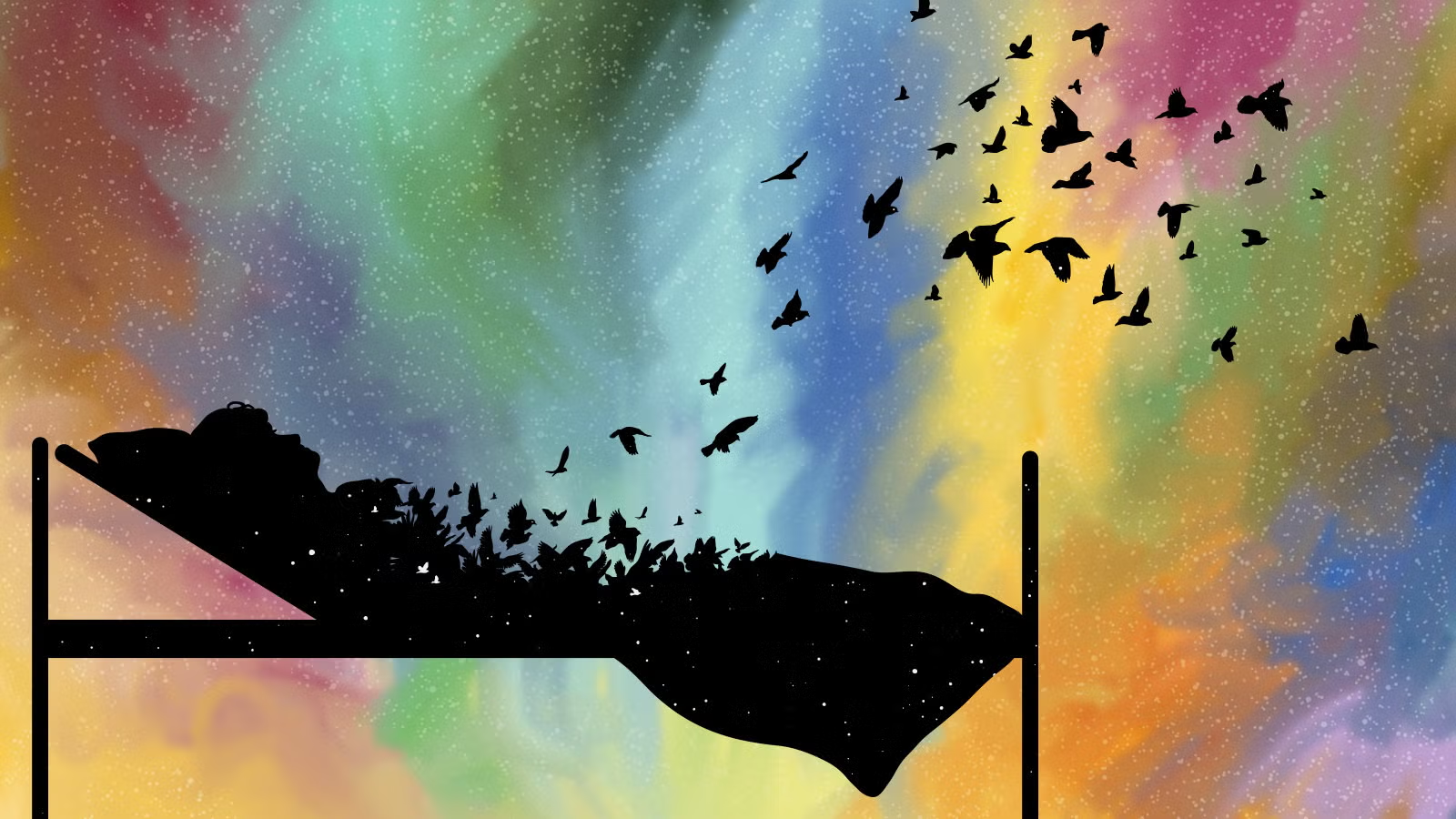
In many ways, Yom Kippur is a death rehearsal.
We act out today as if these were the last moments we would be alive.
Like the dying, we refrain from food and water.
We turn up in modest clothes, without jewellery. Some wear white, the colour of the funeral shroud. Some wear kittels, the gowns in which we will be buried. Some wear tallits all day, from evening to evening – a unique point in the year when we do so – just as the dead are traditionally buried wearing their tallits.
Over the course of this fast, we repeatedly recite vidui, the prayer of deathbed confession. We say psalms and chant petitions that are associated with death and funerals.
All of this serves as a ritual memento mori: a reminder that we will die.
Then, as we approach the end, we erupt into songs. We joyfully recite the neilah prayers. For many of us, there is a great rush of relief and joy as we realise we have made it through this marathon day.
Yes, today is a reminder of our death, and it is one that affirms life.
On this day, our Torah instructs us: “choose life.” Only by recognising that death is inevitable can we do so.
By really considering the finite amount of time we have on this earth, we are able to celebrate the days we have and live them to the fullest.
So much of modern Western society shies away from death.
For previous generations, death was a sacred process undertaken among family and community.
Today, it is sanitised: dealt with in hospitals and hospices by qualified experts.
There are great advantages to this. The professionalisation of death means that the sick can receive high quality care and pain relief right up to the last moments of their life. It takes a great deal of pressure off of family and friends, because the care for the dying does indeed require constant work.
But one downside to our compartmentalisation of death is that it means it is kept out of sight and taboo.
When we do have to face death, it is often a shock, and can cause great trauma to living loved ones. Intellectually, all of us know we are mortal, but facing death as a lived and embodied experience can feel like a real rupture.
Having the Yom Kippur experience – which draws our attention to our mortality and makes us reflect on the quality of our lives – can be a powerful way to help us face death. In these rituals and fasts, we can prepare for our mortality.
This real confrontation with death isn’t morbid. It’s a direction to truly embrace life.
Knowing we will die helps us consider what we want to do with life.
In Progressive Judaism, we have a tendency to downplay some of the more explicit symbolism of death and mortality in our services. It is there in the machzor – in our silent confessions, themed readings, and traditional prayers. But our services often tiptoe over death’s undercurrents in the prayers.
This year, I have tried to reintroduce some of those themes to the service.
Last night, at Kol Nidrei, we joined the rest of the Jewish world in holding the scrolls out of the ark, leaving it bare. The great American Reform liturgist, Rabbi Larry Hoffman, points out that the open ark is supposed to evoke a coffin. We stare into the empty space, which usually includes our Book of Life, and lay witness to our own tomb.
This morning, during shacharit prayers, we reintroduced the prayer “who by fire,” a traditional part of Unetaneh Tokef, which recounts the many ways in which a person might die. It is painful to consider life’s fragility, and all the vulnerabilities we face in life.
But, by facing up to the possibility we will die, we get better at deciding how we will live.
We realise that we value life, and we take stock of what it is we love about it.
Marie de Hennezel is a French therapist focused on end-of-life care. In the early 90s, she was among the first staffers at a palliative care unit for people dying of HIV/AIDS. At this time, there was no cure – the deaths of HIV patients often involved rapid deterioration and great suffering.
In 1995, de Hennezel wrote up her experiences of accompanying the dying into a memoir, entitled Intimate Death: How the Dying Teach Us to Live. The book even carried a foreword by French president Francois Mitterand.
She recounts stories of individual patients, as well as their carers, doctors, and nurses. In each vignette, she tenderly lays out how important it is to be with the dying.
From her support, the patients often learn to live through challenging ordeals. Those who feel like giving up or who contemplate suicide decide that they will indeed live until their last moments on earth. By helping them face their death, the patients gain the strength to embrace their life.
This work, it seems, also transforms the carer. De Hennezel writes that she has learnt so much about living from the dying.
She writes poignantly:
Life has taught me three things: The first is that I cannot escape my own death or the deaths of the people I love.
The second is that no human being can be reduced to what we see, or what we think we see. Any person is infinitely larger and deeper than our narrow judgments can discern.
And third: one can never be considered to have uttered the final word on anything, is always developing, always has the power of self-fulfilment, and a capacity through all the crises and trials of life.
Let us take this as our message from Yom Kippur today.
Our lives are not over. We can affirm them. We can do so much with them.
And, though we do not always realise it, we love our lives more than any amount of wealth or status.
By facing up to the fact that we will die, we can live the days we have to the fullest.
Gmar chatimah tovah – may you be inscribed in the Book of Life for good.
Yom Kippur Yizkor 5786
 Sim Lev