debate · israel

We are not going to agree about Israel.

It is a blessing in synagogue life when rabbis really get on with each other, and I am so lucky that Rabbi Jordan and I do. We drop in and out of each other’s offices, check in on how the other is doing, and always look for ways to support each other.

And we don’t agree about Israel.

We don’t agree, and we’re not going to. That’s OK. That’s good. It means we can have real conversations. It means when we need to make decisions or work out our thoughts, we can bounce ideas off each other as critical friends. 

Last week, after a discussion on Zionism, he did what he often does, and left an earmarked book on my desk. The book, edited by Rabbi Larry Englander, is called ‘The Fragile Dialogue.’ It includes various reflections on Israel. 

The chapter Jordan highlighted was by a self-proclaimed TwentySomething Congregant. In a heartfelt letter to her rabbi, she pleads not be excluded from her synagogue because of her views on Israel. She speaks on behalf of her generation, which opposes occupation and supports boycotts. She begs that she, and the rest of the Jews of her generation, will not be cut off from their own communities.

The letter highlights something many of us already know but struggle to articulate: the debates around Israel and Zionism are largely generational. 

These differences were visibly lived out last week at a funeral. The great Israeli singer and poet, Yehonatan Geffen, died. He had been a cultural icon, associated with the songs of Israeli childhood. 

In three generations of his family, you can see the wildly different approaches to Israel. 

Yehonatan Geffen’s uncle was Moshe Dayan, a fierce Israeli military chief famed for his eyepatch and hard right attitudes. He had been a combatant in Haganah, the guerilla army that founded Israel, led the IDF, and gone on to become a politician. 

As far as he was concerned, the Holocaust left only one imperative: to conquer and settle the land and become so strong that Jews could never be hurt again. He pledged to blot out Palestine, and respond to hate with greater hate. He was a true hawk.

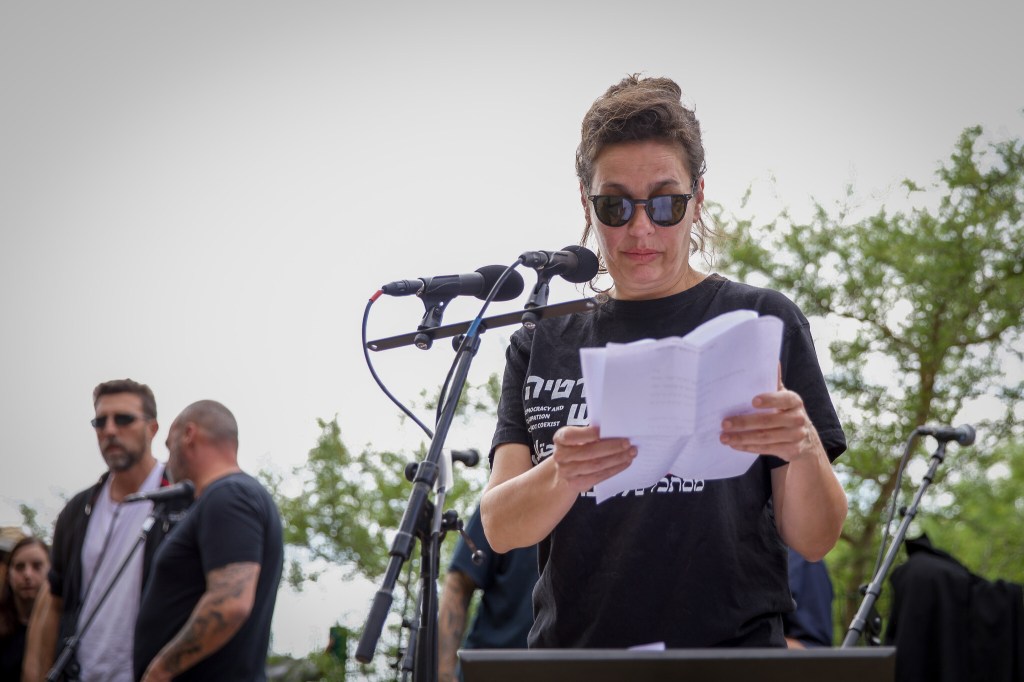
Fast forward to the funeral of his nephew. The mourners arrived wearing shirts that carried the slogan: אין דמוקרטיה עם כבוש – there is no democracy with occupation.

Yehonatan’s daughter, Shira Geffen, wore this slogan as she gave the hesped. 

This slogan argues that Israelis cannot protest Netanyahu’s anti-democratic measures while ignoring the millions of Palestinians denied basic democratic rights to vote, freely assemble, and even walk to their homes without facing checkpoints and guns. 

The t-shirts are produced by מסתכלים לכבוש בעיניים – an Israeli left organisation who insist on looking the occupation in the eye. They speak out about what they call “the power relations between the coloniser and the colonised,” urging the public to see how the occupation is destroying the dignity of Palestinians and the humanity of Israelis.

Sandwiched in the middle between these generations was the man they mourned, Yehonatan Geffen. He had been part of Israel’s cultural establishment, and a true icon. He was associated with what many Israelis saw as the best in their culture. One of his eulogisers was the centre-right politician Yair Lapid.

Geffen was also an outspoken peace campaigner. He wrote extensive criticisms of the army. In 2018, he wrote lyrics in praise of the Palestinian child protester, Ahed Tamimi, resulting in him being cancelled on Israeli military radio and censured by government officials. 

Within one family, within one century, you can see such a huge diversity of Jewish views.

They do not agree about Israel. They will not agree. But they prayed together. They came together to say kaddish and mourning prayers. They joined each other as a family.

Of course, these differences of opinion on Israel are not just generations-based. I know anti-occupation activists in their 80s and I know pro-settlement campaigners in their teens. Nevertheless, what we have seen of Israel in our formative years is decisive.

I belong to Shira’s generation, and one of my most formative memories of Israel was witnessing the inexcusable assault on Gaza in 2009: Operation Cast Lead.

During the commemorations of Yom HaAtzmaut last week, I could not hide my discomfort. I find prayers for a state tantamount to idolatry, and when I hear blessings for troops, I can only think of those priests who poured holy water onto bombs. I do not see how one can pray for peace while praising the instruments of war.

Yet I understand why, for many in this community, honouring Israeli independence and those who fought for it feels like an important undertaking. 

Some of you belong to the generation that came just after the Shoah. The memories of genocide and antisemitism still loom, and it is understandable that you should want to know there is some security against that. For you, defending Israel matters.

Others of you came up in the generation of Peace Now. You believed in Israel and its mission, and held onto its constitutional claims of what it would be: a safe haven for all its peoples. You hoped, even campaigned, for an Israel where Jewish culture could thrive while Palestinian minorities received justice and human rights. For you, holding on to that dream of what Israel could be matters.

My generation came after. I was born not long before the signing of the Oslo Accords, and came of age as they failed. During my 34 years on this planet, Netanyahu has been Israeli Prime Minister for nearly half of them. I have never known Israel as anything but the aggressor and the occupying power. 

Based on our ages and experiences, we will have different views. If we cannot have disagreements about Israel, we cannot have an intergenerational community.

We will not agree about Israel. And that’s fine. That’s good.

Rabbinic literature prizes disagreement. One of my heroes in the Talmud is Rabbi Eliezer. He stood solidly by his principles, no matter how unpopular they were. It’s not that I agree with Eliezer’s principles: he was a conservative surrounded by liberals and radicals. It’s the fact that he held fast to what he believed.

He was so strict in his adherence to religious law that the other rabbis eventually excommunicated him. They wouldn’t talk to him unless he recanted his views, and he never did. Only at the end of his life did his students and colleagues realise what an error they had made by cutting him out. 

They placed him in the Mishnah, the foundational Jewish text, as one of its most-cited rabbis. Even though they completely disagreed with him, you can find his opinions everywhere.

The Maharasha says the reason for this is for future generations. While one position may be minority at one time, it may become majority, and those who follow will need to know what they rest on. Even if they never agree with it, they need to see how the conclusions they support were reached.

This is why we welcome disagreements: for the sake of intergenerational conversation. 

For those growing up now, they are entering a polarised and febrile environment. 

Future generations will develop their own politics, and find their own relationships to Israel, Zionism, and the occupation. 

And I hope they can do so within the synagogue. 

I hope they will find an environment that embraces Zionists, non-Zionists and anti-Zionists. I hope they will find communities that do not impose red lines that keep them out.  I worry that the TwentySomething writing to her rabbi will be proven right, and synagogues will become platforms for single positions on Israel.

What then? Will we split into Zionist and anti-Zionist shuls? Will we keep splitting further, based on varying different policy proposals for what should happen in the Middle East? Those aren’t synagogues – those are political parties!

Such divisions have pulled apart Reform communities before. In the period prior to World War II, Zionists were forbidden from studying at Hebrew Union College, the Reform Rabbinical school in America. This meant that for nearly a century you could not be a Zionist and become a Reform rabbi. One early Reform Zionist, Maurice Perlzweig, said that professing his views in polite Jewish company was like admitting to being a member of the Flat Earth Society.

At the turn of the century, the Reform Movement completely reversed its position. The 1997 Miami Platform declared that Reform Judaism was unequivocally Zionist. It said that Jews were a people; that we should all move to Israel and build it up. Ensuing from that came a programme parallel to the early push to exclude Zionists from the Jewish community, but this time, flipped: to exclude critical voices from the Jewish community and maintain only a pro-Israel consensus.

Is this really what we want? Do we want to keep going back and forth drawing new lines depending on which position has the upper hand? Do we want to enforce conformity of political views in Reform congregations?

Surely what we stand for is bigger than that! Surely our Judaism, our God, our people is bigger than that! 

The joy of a synagogue is that it brings together so many different people. Where else are you going to find people of different backgrounds, classes, genders, abilities, beliefs, and ethnicities, all under one roof, bound together by something greater than themselves? Only the synagogue – greek for beit knesset  – the House of Gathering – can achieve that. 

We are not going to convince each other of our political opinions, and that’s fine. That’s good. If we have a space filled with diverse views, we have a community. If you have uniformity, you have an echo chamber.

We are Reform because we understand that the Jews of tomorrow will not look like the Jews of yesterday. The Judaism of tomorrow will not look like the Judaism of yesterday. Reform Judaism is an ongoing commitment to learn and struggle and grow, always adapting to new ideas and developments. That is what makes it Reform.

And what makes it Jewish is that we do it together. We hold on to belief in the same God, the same cause, the same traditions. We hold all the manifold opinions of the congregation in a single setting.

So, let us answer the question posed in Larry Englander’s book: will this TwentySomething be excluded from her synagogue? 

More pressingly, will she have a home in ours

The answer depends on how we act. If we draw red lines and kick people out based on their views; if we define our Judaism solely by its relationship to Israel; if we make public policies about the synagogue’s stance, then, no. She probably will not.

On the other hand, we can model an alternative Jewish future. A better Jewish future. A Jewish future where we don’t repeat the mistakes and have the same regrets as the framers of the Mishnah. A Jewish future based on plurality and discussion.  We can demonstrate through our relationships with each other and the synagogue that Judaism is diverse, creative and engaging across divisions. 

We can show that we do not have to agree. Even about Israel. 

Shabbat shalom.

israel · protest · sermon

Not in our name

This week, Israel went to the polls, electing its most far right government yet. Netanyahu is set to return to power, and take control of the legislature to stop them prosecuting him on corruption charges.

To secure power, he has allied himself with extremist religious nationalists, Bezalel Smotrich and Itamar Ben Gvir. They are unabashed racists, who are explicitly opposed to Reform Judaism.

Their whole ideology is about securing an ethnically Jewish majority, by deploying military means against the Palestinians, preventing mixed marriages, and expanding the borders as far as they will go.

They want to make sure all Jews are reproducing to win their demographic war, so promote institutionalised sexism and homophobia. In particular, Smotrich wants to ban abortions, bring back conversion therapy, stop trans access to healthcare, and ban gay men from donating blood.

In the preceding weeks, Jewish News warned that this was not an Israel British Jews would want to see. Many quarters have expressed great alarm at the election results.

In fact, this is not so new or surprising. There was a time when Naftali Bennet, also a religious nationalist, was considered the most far right voice in Israel. He has now spent the last year as Prime Minister, ruling on a supposedly moderate ticket, mostly because of how far right the rest of the religious nationalist movement has become.

It is not simply that they are bigots. It is not just that they loathe me and everything I stand for. On that front, the feeling is very much mutual. It is that they have twisted Judaism into a bellicose hate cult.

You can find them rioting through East Jerusalem, terrorising the Palestinians to scare them out of their homes.

You can see them expanding into new settlements, throwing people out of their family homes.

You can hear them singing at the Western Wall that they will violently wreak vengeance on the Palestinians.

And, of course, you can find them in the Knesset, the Israeli Parliament, passing laws. Their most recent triumphs are declaring that Israel is only a state for the Jews and that Arabic is not a recognised language; and defending settler violence in the West Bank.

All this, they say, is to defend the Jewish people.

Perhaps, we might concede that they and their friends are stronger because they have the full might of a large army behind them. If that is their definition of Jewish defence, fine.

But it has nothing to do with defending Judaism. Their so-called Judaism is based on perverse, anti-rabbinical readings of religious texts. They see the whole of the Jewish tradition and history as a summons to colonise the entirety of David’s historic kingdom and annihilate anyone who stands in their way.

They do so in our name. And in the name of our Torah.

While the general thrust of our religious text is towards peace and justice, there is more war in the Torah than you might expect. The Torah is, after all, an ancient Near Eastern text, from a time when emergent states and nascent empires were locked in near-constant battles for territories and resources.

This week’s parashah is a prime example. Lech Lecha dedicates an entire chapter to a fantastical description of war.

Abraham enters a military pact to defeat the armies led by Kedorlaomer. Often called “The War of the Nine Kings,” the chapter includes descriptions of alliances, rebellions, military campaigns, and looting the spoils of war.

If you are hearing this story for the first time, you are not alone. We often skirt over it in favour of the more elevating sections of this week’s reading.

It’s not just our very polite sensibilities as British Reform Jews. In general, the rabbinic tradition as we know it, has downplayed the Torah’s violence, or reinterpreted it to be about more moral topics.

Judaism as we know it was born out of abortive wars and failed uprisings, so our rabbinic progenitors went to great lengths to caution against war and violence. In practice, Judaism has been pacifist, if only out of pragmatism, rather than principle.

The preceding periods, in which pre-rabbinic Jews did have military power, were pretty horrific. The Second Temple period, under the Hasmonean Dynasty, saw brutal repression of any deviation from official state religion. Its leaders were corrupt, seeking to control every part of legislative and economic life. They were tyrannical.

When our rabbis rebuilt Judaism out of the ashes of the destruction of the Temple, they wanted to introduce necessary correctives to historic fundamentalism. They sought to create a Judaism that would be ethical, based in the grassroots, committed to diversity, and, above all, peaceful.

So, our tradition opted to understand the Torah’s violent exhortations differently. The rabbis understood the calls to massacre entire nations as personal struggles to blot out the violent parts of ourselves.

In our parashah, they understood the text not as a summons to war, but to faith. They read Abraham’s conquests as a moral message about the importance of trusting in God. When the King of Sodom offers Abraham spoils of war and he refuses, our rabbis interpret this not as a rebuttal of a future military alliance, but as Abraham saying that real riches come from God in the form of blessings.

This moral and peaceful hermeneutic became the foundation of Judaism.

All that changed in the 19th Century, with the emergence of the religious nationalists. For them, the Torah was not a moral handbook, but a military one.

They were inspired by Christian fundamentalists who wanted to see a world-ending war. Still now, those evangelicals are their primary financial backers.

When they read our parashah, they treat it as a call to arms. “Lech lecha” is not, for them, a moral command to follow God, but a political one to move to Israel. The wars are not stories of an ancient civilisation, but justifications for military violence today.

When they read biblical mandates to massacre nations, they take them literally. They imagine that they are divinely mandated to enact genocide.

This is not a fringe group on the margins of Israeli politics. This is the Israeli government, and it has been for decades.

This is not an aberration in Israeli politics. It is the trajectory the country has been on at least since I was born. The far right have continually dominated, show no sign of abating, and hold every possible government to ransom.

Liberal leaders keep saying that, at some point, when the racism gets too much, they will withdraw their support for Israel, but the day never comes.

At this point, it has to be asked: how far is too far? If Ben Gvir and Smotrich are not too much, what will be? Will there ever be a point at which people are finally willing to draw a line? When will we say that enough is enough? When will we cry out: not in our name?

We do not like to look at the verses in Torah that glamourise war and nationalism. We do not like to look at the news from Israel that does the same.

But, right now, we have to look at it. Because these facts are staring at us. And we can no longer presume to turn away.

When this government imposes its reactionary plans, they will be doing so in our name. In the name of our Torah. We have to stand up and assert that they do not.

The so-called Judaism of the religious nationalists is not ours. We repudiate their racism, their fundamentalism, and their militarism.

We affirm the Judaism of the rabbis and the Reformers – based on ethics, dignity, piety and peace.

We will do everything we can to resist this government’s perversion of Judaism.

Not in our name. Not in the name of our Torah. Not in the name of our God.

Shabbat shalom.

fast · high holy days · sermon

Creating cultures of repentance

We are, apparently, in the grips of a culture war. 

It must be an especially intense one, because the newspapers seem to report on it more than the wars in Syria, the Central African Republic, or Yemen, combined. 

According to the Telegraph, this war is our generation’s great fight. It was even the foremost topic in the leadership battle for who would be our next Prime Minister, far above the economy, climate change, or Coronavirus recovery.

Just this last month, its belligerents have included Disney, Buckingham Palace, the British Medical Journal, cyclists in Surrey, alien library mascots, and rural museums.

But which side should I choose? One side is called “the woke mob.” That seems like it should be my team. After all, they are the successor organisation to the Political Correctness Brigade, of which I was a card-carrying member when that was all the rage.

The so-called “woke mob” are drawing attention to many historic and present injustices. From acknowledging that much of Britain was built on the back of the slave trade to criticising comedians who say that Hitler did a good thing by murdering Gypsies, they are shining a light on wrongs in society.

The trouble is, I hate to be on the losing side. For all the noise and bluster, this campaign hasn’t managed to get anyone who deserves it. The most virulent racists, misogynists, abusers, and profiteers remain largely unabated. 

Even if they were successful, I find the underlying ideas troubling. It seems to assume that people’s wrong actions put them outside of rehabilitation into decent society. Some people are just too bad

This strikes as puritanical. While the claims that so-called “cancel culture” is ruining civilisation are wildly overstated, it is right to be concerned by a philosophy that excludes and punishes.

So, will I throw my lot in with the conservatives? Perhaps it’s time I joined this fightback against the woke mob. 

On this side, proponents say that they are combatting cancel culture. How are they doing this? By deliberately upsetting people. They actively endeavour to elicit a reaction by saying the most hurtful thing they can.

When, inevitably, these public figures receive the condemnation they deserve, they go on tour to lament how sensitive and censorious their opponents are. As a result, they get book deals, newspaper columns, and increased ticket sales. 

Ultimately, this reaction to “cancel culture” is a mirror of what it opposes. It agrees that people cannot heal or do wrong. It celebrates the idea that people are bad, and provides a foil that allows people to prop up their worst selves.

If this is the culture war, I want no part in it. Neither side is interested in the hard work of repentance, apologies, and forgiveness. It offers only two possible cultures: one in which nobody can do right and one in which nobody can do wrong.

This is the antithesis of the Jewish approach to harm. 

Our religion has never tried to divide up the world into good and bad people. We have no interest in flaunting our cruelty, nor in banishing people.

Instead, the Jewish approach is to accept that we are all broken people in a broken world. We are all doing wrong. We all hurt others, and have been hurt ourselves. The Jewish approach is to listen to the yetzer hatov within us: that force of conscience, willing us to do better.

The culture we want to create is one of teshuvah: one in which people acknowledge they have done wrong, seek to make amends, apologise, and earn forgiveness. 

A few weeks ago, just in time for Yom Kippur, Rabbi Danya Rutenberg released a new book, called Repentance and Repair: Making Amends in an Unapologetic World.

Rabbi Rutenberg argues that Jewish approaches to repentance and repair can help resolve the troubled society we live in.

She locates some of the issues in America’s lack of repentance culture in its history. After the Civil War, preachers and pundits encouraged the people of the now United States of America to forgive, forget and move on. It doesn’t matter now, they said, who owned slaves or campaigned for racism, now they were all Americans. 

The Civil War veterans established a social basis in which there was no need for repentance or reparations, but that forgiveness had to be offered unconditionally. Without investing the work in true teshuvah, they created an unapologetic society that refused to acknowledge harm.

We, in Britain, also have an unapologetic and unforgiving culture, but our history is different. 

True, we also failed to properly address our history of slavery. When the slave trade was abolished at the start of the 19th Century, former slave traders and slave owners were given substantial compensation. The former slaves themselves were not offered so much as an apology.

But we have not been through a conscious process of nation-building the way the United States has. 

In fact, Britain has not really gone through any process of cultural rebuild since the collapse of its Empire. In 1960, the then Prime Minister Harold Macmillan gave his famous speech, in which he acknowledged “the wind of change” driving decolonisation. Whether Brits liked it or not, he said, the national liberation of former colonies was a political fact. 

At that time, he warned “what is now on trial is much more than our military strength or our diplomatic and administrative skill. It is our way of life.” Britain would need to work out who it was and what its values were before it could move forward and expect the family of nations to work with it.

More than 60 years later, it seems we still have not done that. As a nation, we are simply not clear on who we are. We do not know what makes us good, where we have gone wrong, or what we could do to be better.

So, we are caught in shame and denial. Shame that, if we admitted to having caused harm, we would have to accept being irredeemably evil. Denial that we could be bad, and so could ever have done wrong.

The two sides of the so-called “cancel culture” debate represent those two responses to our uncertainty. Those who are so ashamed of Britain’s history of racism and sexism that they have no idea how to move forward. And those who are so in denial of history that they refuse to accept it ever happened, or that it really represented the great moral injury that its victims perceived.

This creates a toxic national culture, stultified by its past and incapable of looking toward its future. 

So, Rabbi Rutenberg suggests, we need to build an alternative culture, one built on teshuvah. We need a culture where people feel guilty about what they have done wrong and try to repair it. For those who have been hurt, that means centering their needs as victims. For those who have done wrong, that means offering them the love and support to become better people. 

Rutenberg draws on the teachings of the Rambam to suggest how that might happen.  The Rambam outlined five steps people could take towards atonement, in his major law code, Mishneh Torah. 

First, you must admit to having done wrong. Ideally, you should stand up publicly, with witnesses, and declare your errors. 

Next, you must try to become a better person. 

Then, you must make amends, however possible. 

Then, and only then, can you make an apology. 

Finally, you will be faced with a similar opportunity to do wrong again. If you have taken the preceding steps seriously, you will not repeat your past mistakes.

For me, the crucial thing about Ruttenberg’s reframing of Rambam, is that it puts apologies nearly last. It centres the more difficult part: becoming the kind of person that does not repeat offences. It asks us to cultivate virtue, looking for what is best in us and trying to improve it.

You must investigate why you did what you did, and understand better the harm you caused. You must read and reflect and listen so that you can empathise with the wronged party. And, through this process, you must cultivate the personality of one who does not hurt again.

That is what Yom Kippur is really about. It is not about beating ourselves up for things we cannot change, nor about stubbornly holding onto our worst habits. It is not about shrugging off past injustices, nor is it about asking others to forget our faults.

It’s about the real effort needed to look at who we are, examine ourselves, and become a better version of that.

If there is a culture war going on, that is the culture I want to see. 

I want us to live in a society where people think about their actions and seek to do good. I want us to see a world where nobody is excluded – not because they are wrong or because they have been wronged. One where we are all included, together, in improving ourselves and our cultural life.

To build such a system, we need to start small. We cannot change Britain overnight. 

We have to begin with the smallest pieces first. Tonight, we begin doing that work on ourselves.

Gmar chatimah tovah – may you be sealed for good.

sermon · social justice · torah

After war

There is a particular kind of sadness that comes from remembering war. It is not only the needless loss of life, nor those who come home traumatised. There is something specific in the discomfort that comes after furious build-up, tragic participation, and ultimate reconciliation. 

In this week’s haftarah, Ovadiah promises a glorious war against Edom. The Edomites will be defeated and humiliated. Israel will be victorious and avenged. 

Ovadiah addresses Israel’s neighbouring nation of Edom: “For the violence against your brother Jacob, disgrace will surround you. You will be cut off for all eternity.”

He tells these nations: “The house of Jacob shall be fire, and the house of Esau shall be straw. They will set fire to it and consume it.”

In these bellicose proclamations, we get the feeling of the build-up to war. We realise, too, that Jacob and Esau are not just the names of characters in a story: they are representatives of nations.

Jacob is Israel. Esau is Edom. They are the respective countries on either side of the River Jordan. Their inhabitants imagine themselves as twin brothers, yet constantly in conflict.

This helps us make sense of the story in Torah this week. Jacob heads over to the river to make amends with Esau. He has been wrestling with his conscience and wants to make amends, but fears that if he puts forth an olive branch, Esau may kill him.

Jacob separates his clan into divisions to approach from different sides, like military battalions. He sends forward gifts and apologies with every single one. As he approaches his brother, he prostrated himself many times, bowing down in peaceful submission. Finally, they reach each other, hug, and cry. They are reconciled.

When we understand that these brothers are representatives of neighbouring nations, this is not just a story of family strife, or conflict between competing characters. It is the biblical redactors’ fantasy of what peace could mean. These countries could be united. Their bitter violence could be set aside. After years of fighting, people might once again embrace each other and cry with relief.

The special sadness of remembrance comes with contemplation after the war. What was it for? Whose interests did it serve? And how do we resolve to prevent it happening again?

After World War 1, poppies bloomed in Flanders Field, where some of the worst battles had been fought. Out of the trenches where so many had died, these scarlet flowers sprouted from the ground. They became a symbol. 

“Never again,” they said. 

Around 40 million people had died. Once it was over, many could no longer remember what they had been fighting for. The motivations of Empire and nationalism no longer seemed so compelling in the wreckage of war. Countries pledged to end the impetus to war with diplomacy, increased international cooperation and greater understanding between peoples.

After World War 2, the politicians once again pledged never again. Never again would fascism be able to rear its ugly head. They would combat, too, the root causes that had allowed Hitler to look appealing. No more would they allow such poverty and inequality to persist, giving way to racist scapegoats. 

The countries of Europe built social democracies, with universal healthcare systems and progressive welfare states. They said they would not repeat old mistakes. They formed alliances and international bodies that, they said, would prevent war.

For as long as I have been alive, Britain has been at war. Earlier this year, NATO troops finally withdrew from their twenty-year conflict in Afghanistan. It had begun when I was starting secondary school. Some of my friends enlisted to fight. 

At the time, we were told the war would avenge the World Trade Centre attacks; find Osama bin Laden; and defeat the Taliban. In the end, Osama bin Laden had never been Afghanistan and the Taliban emerged more powerful than ever. I doubt many of the victims of 9/11 feel much joy in seeing the war that has been carried out in their name.

When the war was declared, it was popular. Today, it is hard to find anyone who says they agreed with it.

Politicians declare war full of nationalist fervour and triumphant spirit, only to return defeated and bereft. Even the victors feel no glory once a war is won. They leave too much devastation in their wake.

Families are torn apart. Cities are destroyed. Lived are lost. Entire ways of life are destroyed. And, at the end of it all, the only thing to do is reflect on what went wrong. We promise once more to make peace.

The Torah’s narrative of Jacob and Esau offers us a glimpse of what peace might look like. It encourages us to look beyond the narrow excitement for violence proclaimed by Ovadiah and the promises of national glory. It reminds us to think of how much greater it would be to have peace.

Like the Prophets of old, we pray for the day when nation no longer lifts up sword against nation, and no more no peoples learn war.

May God grant us, and all the world, peace. 

Shabbat shalom.

I gave this sermon for Remembrance Shabbat, Parashat Vayishlach on Saturday 20th November at South West Essex and Settlement Reform Synagogue