high holy days · sermon · theology

What if death comes as a kiss?

Moses said to the Israelites: “I am one hundred and twenty years old. I cannot go on. God has already told me that I will not cross over the Jordan River. Now, do not be afraid. God is going with you. You will do marvellous things.”

Moses was not afraid of death. He asked the Israelites not to fear either. Instead, carry on and keep living.

How could Moses not fear?

If I asked you to depict death, you would likely draw a ferocious figure. For centuries, the Western imagination has presented death as a cruel and frightening creature.

To the Ancient Greeks, death was the merciless deity Thanatos, who came into the world with his siblings, Blame, Suffering, Deceit, Strife, and Doom. Thanatos, the despised god with wings, wrested the souls of the living and dragged them down to the Underworld, where they were handed over to Charon, the Ferryman who took the dead across the Acheron and the River Styx.
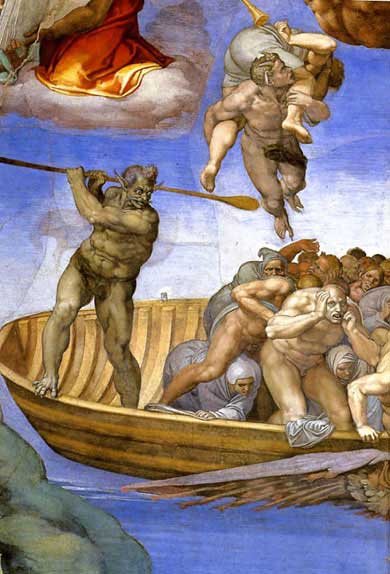
Michelangelo, Charon, The Sistine Chapel

On the ceiling of the Sistine Chapel, Michelangelo depicts Charon, the chaperone of the dead, as a terrifying monster. Charon has clawed talons for feet and grotesquely bulging eyes. He hoists his oar over his shoulder, ready to transport the unfortunate souls.

From the time of the Bubonic Plague in Europe, death was often depicted as a morbid skeleton. In The Triumph of Death, a great oil panel painting by Dutch master Pieter Bruegel the Elder, Death is an enormous skeleton upon an emaciated red horse, slaying all in sight. He brings with him an entire army of macabre skeleton figures, all of them razing the mortals from the earth. 

Today, we know this figure as the Grim Reaper, who reached his full form in the short stories of Edgar Allan Poe. You can thank that 19th Century American novelist for the popular image of death today: the skeleton in a cloak holding an hourglass and scythe.

With such frightening depictions of death, how could Moses not fear?

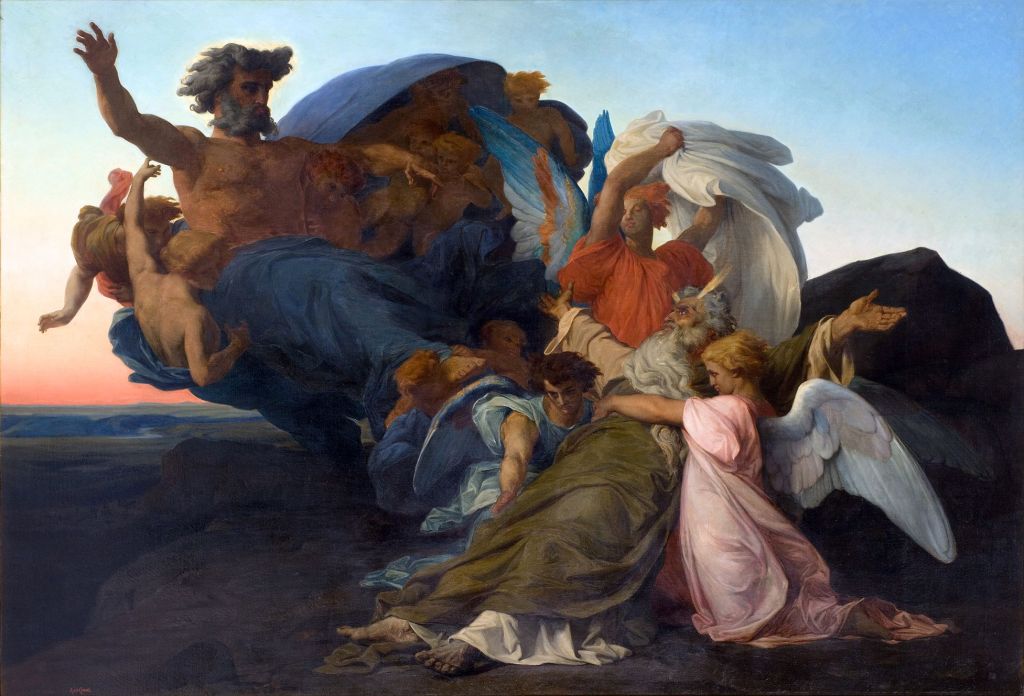
Moses was lucky. He did not inherit the Western artistic tradition. The ancient Israelite attitude was remarkably different. The Jewish view of death was one far more tender.

At the end of Moses’s life, we read: “Moses the servant of the Eternal One died in the land of Moab, by the mouth of God. God buried him there in the valley, and nobody knows Moses’s grave to this day.”

In the Jewish imagination, it is God who comes personally, and takes care of the treasured people. In our Torah’s description of Moses’s burial, it sounds almost like a parent tucking in a child to sleep. The sand covers Moses’s body like a blanket, and he can finally rest.

Pieter Bruegel, section, The Triumph of Death

Our rabbis noticed an interesting choice of words from the Torah. Here, it says that Moses died by the mouth of God. 

This language is also applied to the deaths of Aaron and Miriam. They, too, die by the mouth of God.

Literally, this might mean that Moses and his siblings died at God’s command.

In the Talmud, the rabbis say instead that this means they died by a kiss. 

There are many ways that we might imagine this. We might picture a personal God pressing lips against our prophets to remove their last breath.

I like to picture a parent, gently kissing our legendary figures on the forehead. When Moses dies, God wraps him up in the blankets of the desert sand, embraces him, and pecks him on the forehead, to send him off into his eternal sleep.

Moses, the last of his siblings to die, would also have seen Miriam’s and Aaron’s deaths. He would know that death was not a fearsome monster, but the gentle caress of sleep at the end of a long day.

Indeed, the Roman Jewish historian, Flavius Josephus, when he tried to explain the Jewish attitude to life to a Western audience, asked: “why should we fear death, when we embrace the repose of sleep?”

Of course, to we who are still living, death does not always feel so gentle. It can be painful and fear-inducing to witness the ones we love waste away, or be suddenly snatched from our world. 

Our Torah is aware of this. Sometimes, death is indeed depicted as a menacing spirit, as when the Angel of Death slays the first-born during the Exodus. Sometimes, death is indeed an all-consuming monster, as when the ground opens up on the supporters of Korach, to wrench them down to the netherworld of Sheol.

To us, who have to see death while we live, it can indeed feel frightening, and we should not shy away from that terror.

But, perhaps, for those who die, it does not feel so horrifying.

Sebastian Junger is a conflict journalist from New York. In 2020, he suddenly had a near-death experience. While awaiting surgery and bleeding out on an operating table, Junger suddenly had a vision of his father, hovering above him. 

Junger said his father appeared as a comforting mass of energy. In that moment, he thought he understood that there was a life beyond this one.

A devout atheist and rationalist, he went on a journey to discover how this vision was possible. He turned his voyage of enquiry into a book, published last year, called In My Time of Dying.

Tracking shamans and religious leaders from across the globe, he discovered how common his experience of approaching death was. 

This led him to wonder what his own father, a Jewish physicist, would have made of his experience. There is a poignant moment, towards the end of the text, where Junger sits down with his father’s physicist friends, and asks them for an explanation.

One of the scientists tells Junger that he thinks his father would indeed have believed it, because he was romantic like that. He explains that our understanding of physics is constantly evolving, and we know so little about it. He posits, even, that one day the presence of a reality beyond death might be the foundation of physics, or indeed its absence might be. 

Of course, Junger does not rule out the possibility that this is simply the brain’s way of protecting us, and our body’s way of making the inevitable feel less frightening. Yet, even though he is a firm rationalist, he cannot rule out the possibility that his father really was with him in his moments of near-death. He concludes feeling a deeper connection, both to the living and the dead.

None of us know what happens when we die. Nobody can see beyond the grave. Nobody has ever come back to tell us what exists in the world beyond. 

The Western imagination has conditioned us to find this uncertainty terrifying.

But what if Moses is right? What if neither this world nor the next have anything to be feared?

Maybe death does just arrive as a loving parent, tucking you into an eternal rest.

Would it change the way you lived today, if you believed, as our Torah says, that death comes as a kiss?

Jaume Barba, sculpture, The Kiss of Death

story · torah

A letter to Joshua, from Moses

Dear Joshua,

It’s me, Moses.

Please forgive my shaky handwriting. It has been many years since I wrote anything down.

Can you believe it has already been forty years since we came to that great desert mountain and came into contact with the One God? Twice, I carried those miraculous tablets, etched with the Laws of Life, down from that mountain peak.

I could not carry them now. I would not have the strength. And I do not just mean that because of the way my hands tremble when I lift my food or the staggered steps I take when I wake in the morning. I do not have the zeal I once did. I cannot go on much longer.

Joshua, I am dying, and I will soon be dead.

I wish desperately that I could walk with you across that Jordan. All I have ever wanted was to arrive with you at that great destination to which we have journeyed.

But the Eternal One has told me that I will not go on much longer. I will die here, in the desert, and be buried in the wilderness sands.

At first, I was affronted. I cried out to my Maker. ‘Why, God? Why can I not pass over to finally see the freedom for which I have longed?’

God, who has given me so many words, remained silent.

I think I have an answer, though.

The truth is I was free the moment I first left Egypt. Before I returned with my staff and my message. Before any of those miracles and signs and visions. Before I even knew the God of Israel watched over us.

I was free as soon as I took my life into my own hands and refused to be part of the Egyptian system any longer. Once I decided not to be a slaver; not to subjugate others, nor to be subjugated, I was already then mentally emancipated.

These years we have spent in the desert were a way to work out what to do with that freedom. We have been reciting these laws and developing these rituals to find ways of living that keep us from ever going back to the oppressive ways of Egypt.

Joshua, this is what I need to tell you. Do not go back there. Not even in your mind. Do not try to own and control people. Do not allow others to own or control you. Let your soul be free, so that you can dedicate it to the God who led you here.

I am writing this down so that you can refer back to it, and remember what the point of it all was. Why we left Egypt. Why we spent all this time trudging thirsty through shrubland. Why we said we would go to that country from which our ancestors came many mythical centuries ago.

The point was not the land. The point was what we might do there. That we might be free. That we might finally see every human being as a living representation of their Creator. That we might cease using each other as means to an end but as ends in themselves. That we might truly know the Oneness of God and the deep mysteries underlying our universe.

That’s why I’m writing this now, as a reminder.

I know, I have said this all many times before. Call this my mishneh torah, my deutero-nominon; the repetition of everything I said before. It needs to be repeated, over and again, because freedom is hard to achieve and subjugation is such an easy default.

Please, read it out loud. Read it many times. Read it all the time. Even when the words feel trite and you feel like you have repeated the same phrases all your life, keep coming back to it. Remind yourself why you are here. Remind yourself what is at stake in this brief life we have been given.

I will say it again. Do not become like them. Do not worship the work of your hands. Do not think that work is the goal. Do not seek to own and control. Do not kill or oppress or endanger. Choose life. Seek God. Find holiness in everything that lives.

Joshua, I worry, even as I write these words, that you will not heed them. I know you want to. Ever since you were a boy, you used to sit at my feet and lap up every word. You were desperate to be closer to Divinity, to reach for higher things.

When I said we could conquer Canaan, only you and your friend Caleb believed me. You saw giants and were certain you could slay them. You had more faith than any of us. You had more faith than I did.

Joshua, there have been times when you carried me. Literally. In the war against the Amalekites, you put your shoulders under my arms and kept me upright. You are so, so faithful.

But where will all that zealotry go, once you are charged with leading people in the land? When you no longer have giants and Amalekites left to fight, what will you do with all your conviction?

I am asking too much of you. I am asking you to remember a life you have not lived.

You never knew Egypt. You were born here, in the wasteland, after we had already fled. You don’t remember what it was like to be owned. You cannot know what it meant to be a subject of a system that meant to destroy you.

In some ways, this means you have always been free, because you were not born a slave. In other ways, it means you have never been free, because you have never had to fight for it. You do not know what it feels like to start moving, then notice you are shackled, and to keep moving still, and to never stop moving, and to keep going with nothing but faith to carry you.

And you cannot know it. Just as I cannot follow you over the Jordan River, you cannot follow me out of Egypt. Some lessons can only be learned by life’s journey, and some journeys can only be made once.

Perhaps, when you go into that new country, you will make the place I dreamed about. Maybe it will flow with milk and honey. It might become a light unto the nations, where everyone lives with equality and dignity, where everyone can walk in the ways of God.

Or perhaps you will make a new Egypt. You, who never knew Egypt, will find new ways to conquer and subjugate and destroy. Maybe you will crown kings and build empires and wage wars.

Then what will the point have been?

I am asking too much of you. I am asking you to build a world I could not, and to do it all without my help. I am asking to you to know things you have not learnt, and to be perfect in ways I was not. I am sorry to put so much pressure on you. It is not fair.

You may not be able to do what I am asking. But at least you can remember. Tell your children where we came from. Teach them where we were trying to go.

And, then, perhaps, when they see new Egypts emerging, or they see that new Zions are possible, they will find paths through the wilderness that you and I could not see. Keep the story alive, so that the dream may continue.

Joshua, I am going to die here.

These words are all you will inherit from me.

I love you, Joshua.

Your friend,

Moses