sermon · story · theology · torah

How can you condone slavery?

Around this time last year, I overheard a conversation.

Two women met each other early in the morning on a frosty hill overlooking the city. One had arrived slightly earlier than the other, draped in a long, white scarf. She was old but full of life in a way that made her impossible to place. The other joined her not long after. Her blue velvet dress and jewellery would have looked gaudy on somebody else, but somehow on her they were elegant. They sat down on a bench, facing downhill.

At first, they sat in silence, watching the sun rise higher in the sky. Then the lady in blue velvet turned to her friend and said: “You know, I believe in slavery.”

Her friend let out an exhausted sigh. Even though I couldn’t see her face, I could feel her roll her eyes. “Yes,” she said, “you’ve told me before.”

“Not cruel slavery,” she insisted. “I’d put limits on it. Seven years. Seven years is enough and then the slave goes free. And the masters have to take care of them properly.”

“I wish you wouldn’t say that.”

“I know you do, but I’m old. I’m set in my ways and I can’t change.”

“I’m not asking you to change. I just wish you’d realise that times have moved on. You can’t say things like that anymore.”

“Why not? If I thought it once, why should I be forced to change my mind?”

“Because you’re respected. People care what you have to say. They want you to say loving, hopeful things. If you tell everyone you believe in slavery, people will think that it’s OK.”

“But most of the time I do say nice things. And I’m coming from a good place. I want slaves to be treated well. I want them to have good lives.”

“But you still believe in slavery.”

“Yes, I still believe in slavery.”

“You know,” her friend nudged her, “I want to reinterpret what you’re saying. I want to think you’re speaking in a spiritual sense. I want to hear what you’re saying as that we should all be slaves to God. After all, God is our creator and provides for all our needs, and in turn we do God’s work on earth.”

The old lady laughed. “I like that, I like that a lot,” she chuckled… “But, you know, that’s not what I said.”

“No, it’s not what you said.”

“And you can interpret me any way you like, and I’ll accept what you’ve got to say, but nothing I say can depart from its original meaning.”

“Even now?” Her friend was exasperated. “Centuries after the abolition of slavery? Centuries after my ancestors fled Egypt? Even now, knowing everything you do about human history and human dignity, you can’t change just a bit?”

“Sure, I change, in my own way. But the core of me is still there. Like it or not, you’re stuck with me.”

They sat in silence a while longer. I could feel them both seething. A flock of birds murmured in the winter sky. I felt almost rude for eavesdropping, but couldn’t pull myself away.

This time, it was the woman in velvet’s turn to get frustrated: “You knew I would say this. You knew that if you came here, on this morning, at this time, you would hear me say these words. I believe in slavery. I say them at exactly this time every year. If you don’t want to hear me say it, then why do you even come?”

“Because I love you, Torah!” She threw her arms up in the air.

“I love you too, Kehillah,” Torah whispered back.

At once, I realised that I was not listening to any ordinary conversation between two people but the endless dialogue between the Jews and Torah. Torah, on the one hand, was fixed. She had been inscribed centuries ago and would continue to speak the words she always had. The Jews, on the other hand, had grown with history. Their thoughts had developed as God had revealed to them new insights about how to treat people.

They were locked in dialogue. One would always change and the other would always stay the same. But neither could leave each other. Sure, the Jews could get up and leave Torah at any time. Torah could even abandon the Jews. But if either of them walked away from the relationship, Torah would cease to be Torah and the Jews would cease to be Jews. Through their discussions, they drew out all of God’s contradictions: the contradiction between the past and present, between love and justice, between the world as it is and the world as it ought to be.

I felt myself transfixed by their conversation. I wanted to be part of it. I wanted to insist that, of course, slavery was wrong. I wanted to quote everything else back at Torah that she’d ever said to show how that one section in this week’s parashah was completely at odds with the rest of her message. But I realised that, even if I did, Torah would still say the same thing, and I would still have to wrestle with it. We, the Jewish people, would still have to wrestle with it.

Kehillah got ready to leave. Torah gently held her wrist. “You will come back and visit me, won’t you?” she asked. “I know I’m old and sometimes I say offensive things, but I still want to talk with you. You don’t have to do everything I say. Just sit with me and listen. I’m lonely without you.”

Kehillah sat back down. “Of course I will, Torah, I’ll be here every week. I love you and I need you. I’m lonely without you too. If I don’t come here and have these conversations with you, I’ll forget what my purpose is. I’ll forget that I have work on this earth to do. You ground me.”

“Thank you,” said Torah. “I’ll always be here.”

sunrisehampstead

I wrote this sermon for Parashat Mishpatim for the Leo Baeck College newsletter. I will deliver it on Shabbat for Manchester Liberal Jewish Community.

judaism · sermon · theology · torah

Who wrote the Torah?

I realise that, this week, people will have a great deal on their minds. We are living in uncertain times. If we knew each other well, this week’s events would very likely be the topic of this morning’s sermon. As it’s my first time here, however, I don’t want to risk offending anyone, or opening up uncomfortable conversations. So I think it best if I focus on talking about something far less contentious: the question of who wrote the Torah.

Once, in my early teens, I sat with my rabbi, helping her to organise some books. As I picked up a chumash, a question occurred to me. “Rabbi,” I asked “who wrote the Torah?”

“God,” she answered, without skipping a beat.

I thought that perhaps I had phrased the question wrong. “But… who published it?” I asked.

“Hmm… if you look in the inside cover of that one, it should tell you. I think that was Soncino.”

Her answer reflected a familiar and tradition of Torah authorship. As we raise the Torah for hagbah before reading it, we sing to each other: “this is the Torah that Moses put before the children of Israel – from the mouth of God, by the hand of Moses.”

It was an answer, but it wasn’t the answer I was looking for. The trouble was that I wasn’t sure what question I was trying to ask.

A few years ago, I sat in a university seminar and did get the answer I’d been seeking out as a teenager. The Torah, my lecturer explained, was written by four main schools over a period of several centuries. Each one represented a different theology and interest group. Their traditions were later redacted into a single document.

It was a revelation. A profoundly disappointing revelation. I felt a bit disillusioned. By explaining the Torah historically, my lecturer had robbed the text of something of its mystery. Part of me wanted to go back to the answer of my rabbi: the Torah was written by God, and that was that.

And yet the conclusions of the historical approach were very hard to ignore. In this week’s parasha, for example, we read the list of “the kings who reigned in the land of Edom before any king reigned over the Israelites.”[1] Yet our text speaks to a time centuries before the Israelites got their first king. The idea of an Israelite kingdom is, seemingly, completely unknown to the Torah and doesn’t appear in Tanach until the book of Samuel. How could Moses know that there would one day be an Israelite king?

Asking questions like these is, indeed, the basis for the entire enterprise of working out the historical authorship of the Torah. The book of Deuteronomy, for example, legislates for the possibility of monarchy and sets out a series of reforms for the Israelites that match quite closely with the laws set down by King Josiah. As a result, early historians of the text suggested that the two likely came from the same era – the 6th Century BCE, several hundred years after the Torah was said to have been revealed at Mount Sinai.

When the theory that the Torah had multiple authors was first advanced by Protestants in 19th Century Germany, it was embraced by many of the early Reform Jews. Part of the impetus behind the Jewish reformation was a feeling that the tools of science and history were fundamentally challenging old beliefs about the nature of religious truth. Our Reform ancestors felt that they had to adapt to this new knowledge or lose their own integrity.

Understanding the Torah in its historical context can also help us today. There is no getting round the reality that some verses are quite objectionable to modern ears. In our parashah this week, too, we read about Jacob having two wives (Rachel and Leah) and two concubines (Bilhah and Zilpah). The idea that our founding prophet had two women as low-status mistresses in addition to his wives doesn’t do much to elevate his moral status in our eyes. Putting the Torah in its historical context doesn’t necessarily absolve him of our moral concerns, but it does help justify why we would never allow such practices today.

This week, I told a group of adult students who grew up secular and are connecting with their heritage that the question of who wrote the Torah is a denominational difference. One woman was really disappointed. Her reaction was the same as mine when I first heard about historical criticism: “how can you be Jewish and not think the Torah was given to Moses at Sinai?”

It’s understandable to be deflated by hearing that the Torah may not have come directly from God. If it doesn’t come from the Divine Author, what makes it holy? Why is it worth reading at all? Why do we come here each week to hear these words?

There are some good answers that help keep the holiness of the Torah intact. One of these is to challenge the assumptions of the historical critical method itself. How can anyone definitely assert that this text came from multiple authors? If you are willing to accept that an omniscient God is present in the text, there’s no reason why that God couldn’t foresee the future of Israelite kings or anticipate the needs of future societies. Any form of faith involves some suspension of judgement – why can’t we extend that to the authorship of the Torah?

Yet it is hard to deny that human hands were involved in the transmission of our text. In this very portion, there are already dots above certain words, which traditional Judaism teaches were put in by Ezra the Scribe over words he believed might be spelling errors. Even on the most Orthodox reading of the text, there is more going on here than simply God handing down a pristine document.

Perhaps we could say, as some do, that the texts were divinely inspired but written by human beings. God revealed different messages to different people for their own times, knowing that God would continue to work with humanity to help us better understand truth. Just as God spoke to the Israelites at  Sinai, God engages with us today, and helps us to find spiritual meaning for our times. Yet this answer has its own problem: isn’t there an arrogance in us claiming to know more about moral truth than our prophets like Moses did?

Personally, the answer I like best is that what makes the Torah holy isn’t its author but its readership. We, the  Jewish people, through centuries of transmission, questioning, storytelling and interpreting based on this book, have turned it into a holy book. When we engage with it today, God is not waiting in the text to be found, but is with us as an active participant in the conversations we have with Torah. God is in the space where two people pore over this ancient text.

The Torah, then, is not so much a destination for divine revelation, as a mode of transport for getting there. Difficult, challenging, confusing and strange. But it’s a wonderful ride. It’s a journey worth making. Let’s continue to join each other on this voyage of discovery, to uncover the deepest truths we can today.

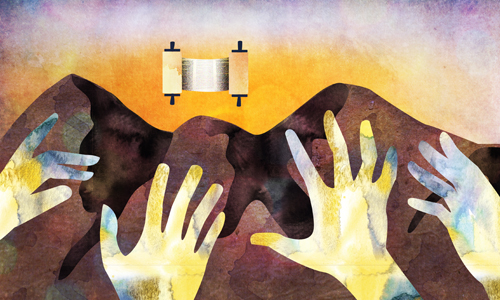
sinai

[1] Gen 36:31

I gave this sermon for Parashat Vayishlach on Saturday 24th November at Newcastle Reform Synagogue.

judaism · sermon · torah

Shavuot 5778

Chag Shavuot sameach.

Thank you so much for inviting me to speak here.

I have come here, first of all, to represent Leo Baeck College, where I am going into my second year of studying to be a rabbi. But there is a special reason why I’ve been invited to this specific synagogue on this specific day. Today, for the first time ever, my friend Rokhl leyned from the Torah. Her teacher, my teacher, and a figure well-known in this community, Chani Smith, suggested it might be appropriate if I come and join in today’s celebrations by preaching. It is an honour to be able to do so.

With that in mind, I hope everyone will excuse me if I indulge in kvelling a little bit before I start. Rokhl, watching you leyn Torah was an incredible experience. Growing up as a girl in the Orthodox world, I know that you were denied the chance to engage with Torah in the way you wanted. You told me of how intense it was, earlier this year, when you held a Torah for the first time. You have done so much to bring Jewish life to people who might otherwise feel excluded from it – as a singer here, through your Yiddish song classes and in the way you have reached out to people to create Judaism with you, especially women.

It is fitting, then, that your occasion to read Torah should fall on Shavuot. Shavuot is a multi-faceted festival: it is a time when we stay up all night, studying and praying. It is a time when everybody tries their hand at baking cheesecakes. It is a celebration of our receiving the Torah at Sinai. But, most of all, it is a time when we read that most beautiful megillah, the story of Ruth.

Ruth stands out in the biblical canon for its poetry, its gorgeous narrative structure, and its deep theological exploration of difference. It stands out, too, because it is one of very few stories that speaks of women as religious leaders. In today’s megillah, Naomi’s two sons die, leaving behind her two Moabite daughters-in-law, Ruth and Orpah. Naomi begs her daughters-in-law to leave her. Orpah weeps as she leaves Naomi behind, but Ruth insists on staying.

Ruth utters these powerful lines: “Please do not ask me to leave you. Wherever you go, I will go. Wherever you lodge, I will lodge. Your people will be my people. Your God will be my God.”[1] Thus begins a unique story, where women are the only active agents, and where their relationship to each other and to Judaism is the centrepiece.

True, men appear occasionally. Boaz appears as an Israelite man, and Naomi encourages Ruth into a relationship with him. But, according to the rabbis’ commentaries, Boaz died on his wedding day. He existed in this story to fulfil a function, of providing Ruth with a child. He appears only briefly, after which Naomi and Ruth go on to raise their child together.[2] David, king of Israel, is listed as a descendant of Naomi, not of Boaz.[3]

The rabbis took this story a step further. From these lines, they interpret that Naomi was instructing Ruth in halachah. She was informing her of the mitzvot, telling her of all the difficulties that could be involved in becoming Jewish. Naomi tells Ruth that Jews spend their time in study houses, not circuses, and Ruth answers “Wherever you go, I will go.” Naomi tells Ruth that Jews affix mezuzot to their homes and Ruth answers: “Wherever you lodge, I will lodge.” Naomi tells Ruth that Jews rise and fall together, so Ruth answers: “Your people will be my people.” Naomi tells Ruth that God is One. Ruth answers: “Your God will be my God.”[4]

Ruth hears all this, and she insists on staying. In the rabbis’ interpretations, then, we have a woman knowledgeable in Torah and teaching it to another. We have a woman who insists, despite all the obstacles presented to her, that she wants to have a relationship with Torah.

That, indeed, is the message of Shavuot. The story of Sinai teaches us that divine revelation was a collective experience of the whole Jewish people. It was not only men or the educated who received Torah, but everyone. The story of Ruth teaches us that divine revelation is a deeply personal and ongoing experience. The study of Torah is the birthright of all Jews, and this story is well-exemplified by the case of Ruth, a foreign woman who joins the Jewish people.

Last week, the UK gained its first Orthodox woman rabbi. Dina Brawer flew out to New York to receive semicha, and pledged her hope to be a role model for women. She joins a long line of women religious leaders, including Ruth and Naomi, but we in the progressive Jewish communities should be exceptionally proud of our role in paving the way for this success. It was the forerunner to Leo Baeck College, the Hochschule in Germany, that ordained Europe’s first woman rabbi, Regina Jonas, in 1935. Jackie Tabick, the head of the Reform Beit Din, became the country’s first woman rabbi, in 1975. Rabbi Laura Janner-Klausner is one of the only women to head up a major religious movement, not just in the UK, but worldwide. We have pioneered gender equality, and will continue to do so.

There is a reason I say all this. I have come here to represent Leo Baeck College.  Leo Baeck College is the heartland of the best of Judaism in Europe. It trains rabbis from the UK, France, the Netherlands, Russia, Poland and Italy. It is, of course, the institution that ordained every rabbi in this synagogue. Without the College, our Judaism could cease to exist. Our Judaism – that insists on the importance of women in leadership. Our Judaism – that maintains our ancient heritage of leyning in a style totally unique to these islands. Our Judaism – that creates space for all those who want to study Torah. We need the College in order to give this, living Judaism, a future.

I therefore urge everyone here to support the College in whatever way they can.

And I wish you all – a chag sameach.

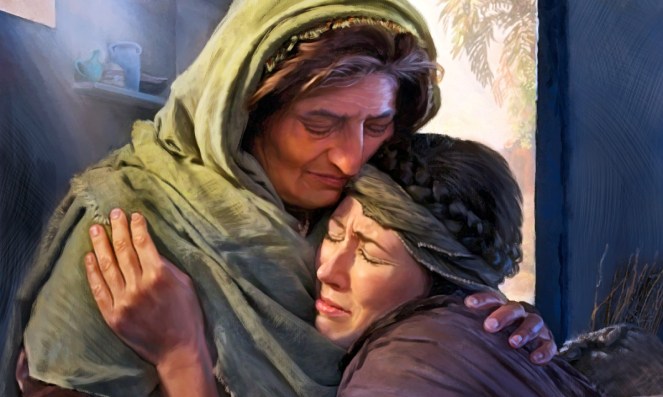
ruth and naomi

I gave this sermon at Edgware and Hendon Reform Synagogue on Shavuot morning to promote Leo Baeck College.

[1] Ruth 1:16-18

[2] Midrash Zutta

[3] Ruth 4:17

[4] Ruth Rabba 2