At home, my fiance paces back and forth, preparing for his exams in anaesthetics. In a week, he will be tested orally to see if he can become a consultant. He recites definitions of key medical terms, revises laws of physics, gives diagnoses of uncommon diseases.
One definition he has repeated so many times it is now imprinted in my mind too.
Death is the irreversible loss of capacity for consciousness and loss of capacity for breathing.
At times, we have pondered over such terms together. On long walks, we have discussed medical ethics through Jewish lenses. We have debated whether and how modern medicine aligns with ancient wisdom.
Now is not the moment to challenge him on the medical definition of death. But the definition sticks with me, because this is an area where I do not think science and religion align.
While Laurence prepares for his exams, you will have to listen to my thoughts on what Judaism teaches about mortality.
Death is the irreversible loss of capacity for consciousness and loss of capacity for breathing.
Is it? Is that what it means to die?
If it were, then would living simply be brain activity and breathing? Is that all we are?
Chayyei Sarah – the life of Sarah – is our portion. It opens with her death. By telling us about her life from her death, the Torah is telling us something about how life and death interact.
The parashah is a recounting of Sarah’s burial. It is a terse text, where the primary narrative concerns Abraham’s attempt to purchase a lot for internment.
So much is left unsaid. So many emotions are not expressed. In the silences and interstices, we are left to reconstruct our own imaginings of what Abraham was thinking. Let us try.
Abraham proceeded to cry and eulogise Sarah.
He held her hands, once so strong and firm. Those hands had kneaded bread for strangers at a moment’s notice. They had sewn garments for whole families. They had, at times, pointed accusations, separated children, raised objections… Strong hands. Determined hands. Strong, determined hands, that were now drained of all their vigour, and sat coldly in his own palms.
Abraham rose from beside his dead, and spoke to the Hittites.
Abraham sprang into action. Sarah had not died in the land of her own family in Egypt, nor of Abraham’s in Chaldea. They were in a strange place, far from their own homes, among Hittites in the hill-country of Canaan.
Abraham said: “Here I am, a stranger and a foreigner among you. Please sell me a piece of land so I can give my wife a proper burial.”
Sarah had left her father’s home in the palaces of Egypt, where she lived as a princess. She was an aristocrat in a great empire who gave it up to travel with a wandering man. Abraham claimed to have spoken with the One True God, and Sarah just followed him. She forsook luxury for a life on the road. Now, she lay dead on the road, and there would be no fine processions to pyramids to entomb her.
The Hittites replied to Abraham, “Listen, my lord, you are an honoured prince among us. Choose the finest of our tombs and bury her there. No one here will refuse to help you in this way.”
Sarah used to laugh with her whole belly. Her shoulders bounced up and down. She can find humour where nobody else could. Even when she struggled with infertility, she found ways of making jokes. Abraham would not hear her laugh again.
So Abraham bowed low before the Hittites and said, “Since you are willing to help me in this way, be so kind as to ask Ephron son of Zohar to let me buy his cave at Machpelah, down at the end of his field. I will pay the full price in the presence of witnesses, so I will have a permanent burial place for my family.”
Sarah had been so beautiful people tripped over themselves staring at her. On their wanders, every prince desired her. Sarah was as beautiful at 127 as she had been when they had first met. She was still just as honourable and God-fearing. Nobody would be as good and beautiful and true again.
Ephron was sitting there among the others, and he answered Abraham as the others listened, speaking publicly before all the Hittite elders of the town.
Sarah received no ennoblement or reward for marrying Abraham. Yet so much honour came to Abraham through her. She could see visions and speak with God.
“No, my lord,” he said to Abraham, “please listen to me. I will give you the field and the cave. Here in the presence of my people, I give it to you. Go and bury your dead.”
Abraham had bargained over everything. He had struck a deal with Avimelech to share water sources. He had even negotiated with God over the destruction of a city. This was a bargain he could not accept.
Abraham again bowed low before the citizens of the land, and he replied to Ephron as everyone listened.
“No, listen to me. I will buy it from you. Let me pay the full price for the field so I can bury my dead there.”
Abraham was ageing too. Who would bury him? He had cast out one son and tried to murder another.
Ephron answered Abraham, “My lord, please listen to me. The land is worth 400 pieces of silver, but what is that between friends?”
What is four hundred shekels between strangers? What is a price on the life of Sarah? What sort of burial could ever be enough for her?
Ephron said: “Go ahead and bury your dead.”
These are some words we may complete into the silences. They come from the other biblical stories and midrash, and they paint a fuller picture. In the spaces, we see that this is not a negotiation over a burial plot, but a negotiation over the nature of death.
Death is the irreversible loss of capacity for consciousness and loss of capacity for breathing.
Is it? Is that what it means to die?
If it were, then would living simply be brain activity and breathing? Is that all we are?
Medically, scientifically… maybe.
Spiritually, Jewishly… no.
Death is as much a journey as life is.
For seven days, we eulogise, as the last imprint of a person leaves us. For thirty days, we mourn, as the shock and grief harrow us. For eleven months, we pray, as some part of the soul heads on its journey to Heaven.
Then, every year, we say the names of the dead, and some part of our loved ones returns to us. Their soul breaks through the gaps in Aramaic words and we feel them with us once more.
Thousands of years later, we still say Sarah’s name, and some part of her keeps living long after breath and consciousness.
We are more than what we exhale: we are the laughter and joy we bring to others. We are more than our own thoughts: we are the memories living on in others.
In memory, in prayer, in faith, we grasp something greater than the material world.
Trusting in You, Eternal God, we see life beyond death.
When they lived in Eden, Adam and Eve did not have to labour for their food. Yet, in the moment that they were expelled from paradise, God gave them stern instructions on what they would have to do.
God warned: “Through painful toil you will eat food from it all the days of your life. By the sweat of your brow you will eat your food until you return to the ground, since from it you were taken; for dust you are and to dust you will return.”
Where once they had a homeland, the original people were cast out into a state of permanent exile, to live in the world with all its struggles.
This fable, though mythic, tells us something true about how human beings came to have the life we do. While there was probably never really an original idyll where people lived without work, there was a moment, millennia ago, when humanity’s ancestors shifted how they lived.
For most of our history, we had wandered. All people were nomadic. They hunted and gathered, migrating between caves and carrying temporary shelters all over the neolithic continents.
Then, as the last Ice Age ended, around 11,000 years ago, people discovered that they could store seeds from one year to the next. They developed agricultural systems, with plots of land dedicated to growing crops. Having once roamed the earth, they could stay put in a single place, which would be their land.
Cain and Abel are archetypal characters who tell us about this great change. Abel was a nomad, who herded flocks and grazed them over the hills. His name means “breath” or “waif” – for, like a cloud that drifts across valleys, he wafted without leaving a trace. He was a symbol of the old way of constant movement.
Cain, his brother, had a name which meant “acquire” or “possess.” Just as God had warned his parents when they were cast out from Eden, he worked by the sweat of his brow. He laboured on the soil, where he sowed, grew, and harvested plants for food.
At the dawn of civilisation, these were the two types of people: those who cultivated the land in fixed places; and those who travelled with no fixed abode. Everything that was movable, like herds and clothes, was held by the nomads, the Abels. Everything immovable – like allotments and orchards – was owned by those who settled, the Cains.
Our Torah says that God favoured Abel over Cain, and it probably felt that way. While agriculture can keep people settled and build lasting cultures, it is unpredictable. One bad year of too much rain, or not enough, or bad seeds or infertile soil, can leave an entire community famished and ruined.
A pastoralist, on the other hand, has a tough but durable existence. The life of a shepherd means much moving, but that is part of what makes their life sustainable. Sheep can be moved to wherever water is healthy and available. A goat can graze on thistles and other crops that people find inedible.
So, yes, to the ancient mind, it may have seemed like God looked more kindly on the one who wandered than the one who farmed.
Cain killed Abel.
The one who tilled the land and made it his home sought to destroy that wandering waif. Perhaps, indeed, he did. Perhaps the founders of the earliest civilisations enforced their new way of life with violence and coercion.
But not successfully. As soon as Cain commits the first murder, God tells him what he will become. Cain cries out at his punishment: “Today you are driving me from the land, and I will be hidden from your presence; I will be a restless wanderer on the earth, and whoever finds me will kill me.”
For killing Abel, Cain would become Abel. Having been the acquirer, he would take his place as a nomad. Having been so sure in his farmland, Cain would return to the ancient ways of roaming.
God said to Cain: “Abel had no homeland. Now neither do you. Abel was forced to wander. Now you will wander too.”
Generations passed, but the draw of homeland was irresistible. In ancient Mesopotamia, Abraham was called “ha-ivri” – border-crosser; the one who passed between places.
He heard the voice call out: “Go, get going, to a land that I will show you,” and Abraham traversed to Canaan, to a new land where he hoped he would settle.
He took his family, and his possessions, his movable goods that had sustained him in all his wanderings, and went in search of home.
But, having reached the land that God would show him, he saw it and he left. He pitched his tent and built an altar, then carried on to Egypt. When he returned, he did so as a nomad, travelling with his flocks, threatened by the Canaanites and Perizites who had acquired the land, as Cain had once done.
Abraham sought a home, and found one, but it was never a permanent space. He had wandered to be in one place, but in that one place, he found he had to keep on wandering.
Abel, Cain, and Abraham all wandered. So did the Israelites in the desert. Deep in our ancient stories, there is an idea that, while a settled home may be desirable, migration is part of the human experience. We may dream of Edens, but life is unpredictable, and fortune may force us to move.
In Torah stories, we learn the survival of migrants, passed down from generations who knew what it meant to move with the seasons.
It is a deep knowledge, from before we were Israelites or even Jews, stretching back to our history as neanderthals.
Please do not imagine that I am romanticising exile. Travelling breeds resilience and creativity, but it is far from idyllic.
Instead, wandering is an inevitability.
In every community and in every family, if you go back far enough, you will find a traveller. In the stories of our Torah, you learn that it could be you.
Abel was a restless nomad, and we may wander too.
Shabbat shalom.
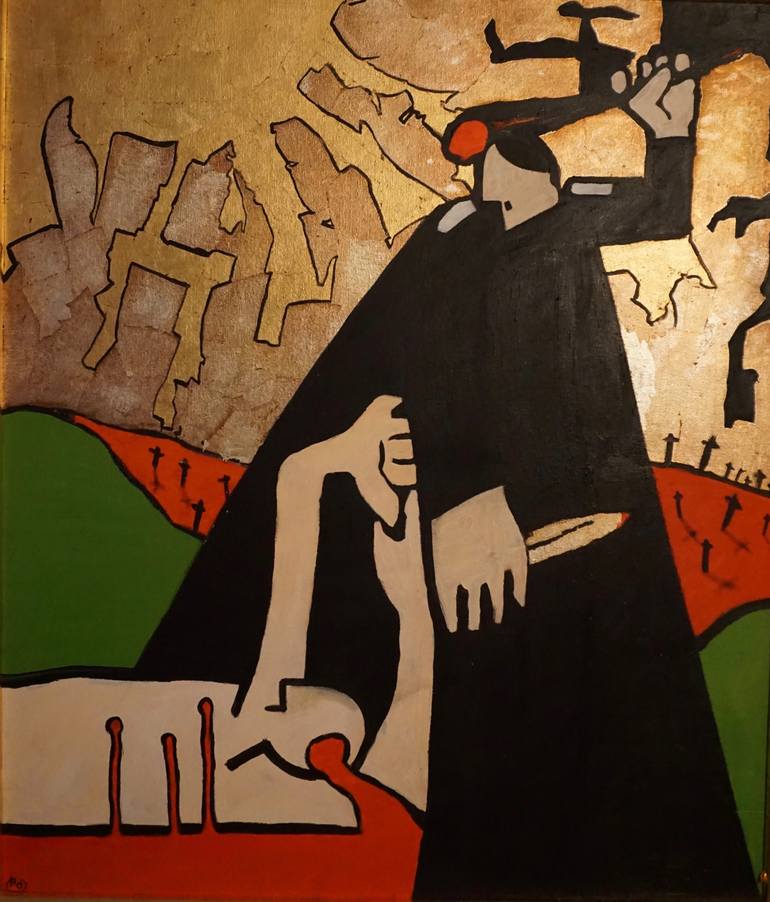
Cain and Abel, by Frank Hoesel
I learnt this Torah from Rabbi Joel Levy at the Conservative Yeshiva in Jerusalem.
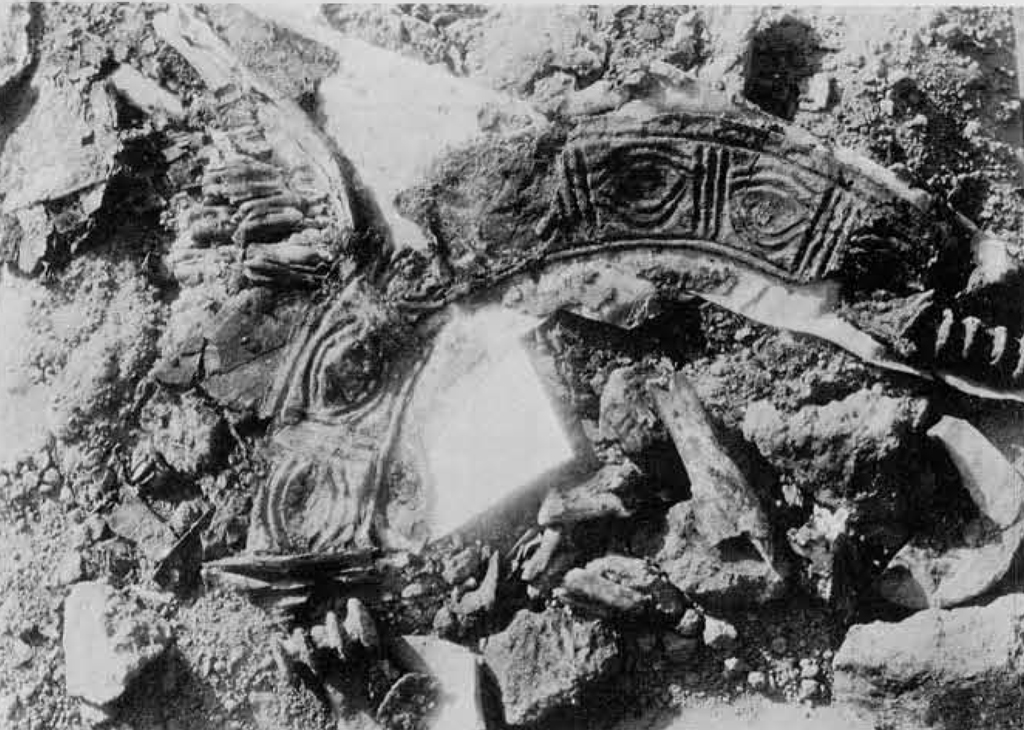
In 1922, archaeologists dug up a site in modern-day southern Iraq. There, they found incredible spans of gold and sophisticated armour, and Iron Age Sumerian artefacts, encased within stone walls. They dubbed this place “the Royal Cemetery of Ur,” an ancient Babylonian mausoleum.
On that site, they also discovered evidence of hundreds of human sacrifices. Among the human sacrifices, a considerable number were children.
Nearly all of the skeletons were killed to accompany an aristocrat or member of the royal family into the afterlife. Some had drunk poison. Some had been bashed over the head with blunt objects. After their death, many were exposed to mercury vapour, so that they would not decompose, but would remain in a lifelike posture, available for public display.
Excavations from the Royal Cemetery at Ur
This site dates to sometime around 2,500 BCE in the ancient city of Ur. According to our legends, another figure came from the ancient city of Ur sometime around 2,500 BCE.
His name was Abraham.
In the biblical narrative, Abraham wandered from Ur to ancient Canaan, where he began to worship the One God, and founded Judaism.
The world in which Abraham purportedly lived was rife with child sacrifice. Across the Ancient Near East, archaeologists have uncovered remains of children on slaughtering altars. They have found steles describing when and why they sacrificed children. They have found stories of child sacrifice from the Egyptian, Greek, Sumerian, and Assyrian civilisations.
So problematic was child sacrifice in the ancient world that our Scripture repeatedly condemns it. The book of Leviticus warns: “Do not permit any of your children to be offered as a sacrifice to Molech, for you must not bring shame on the name of your God.” The prophet Jeremiah describes disparagingly how the Pagans “have built the high places to burn their children in the fire as offerings to Baal.” In the Book of Kings, King Josiah tears down the altars where people are sacrificing their children.
Abraham put a stop to the practice of child sacrifice. It seems to happen suddenly, and without warning, and with even less explanation. No reason is given why he abruptly ended all the cultural deference that had gone before and opposed an entrenched religious practice.
The question we now must ask is: why?
One reason that comes to mind is that it is so obviously immoral. Surely it should be self-evident that you don’t kill kids! But that wasn’t obvious to all the people around Abraham. And that wasn’t obvious to traditional commentators, either. In their world, the morally right thing was always to obey God.
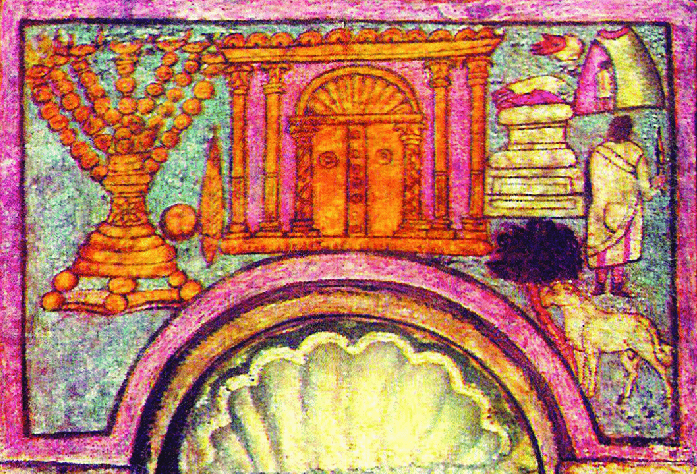
Fresco of the Binding of Isaac at the 3rd Century Duro Europos Synagogue, Syria
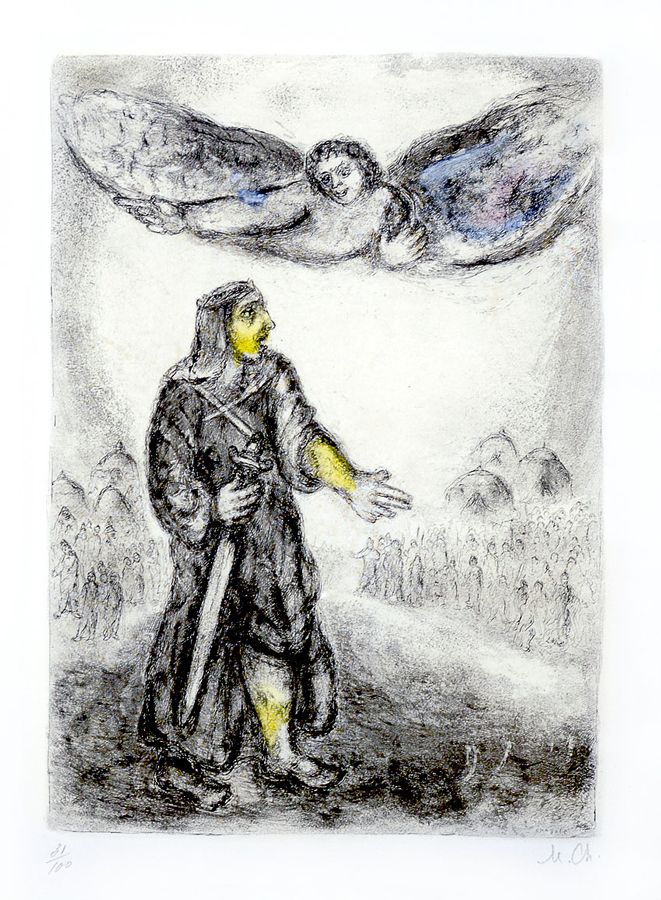
A traditional reading says that Abraham stopped child sacrifice in obedience to God. In the story we read today, Abraham is called upon by God to go up on Mount Moriah and slay his son. Only at the summit, when he holds up his arm to murder Isaac, does God stop him, telling Abraham that he has proved his devotion to God by not withholding his son, and that he does not have to kill Isaac.
Yet there are several problems with this story. If we adhere to the traditional reading, God still wanted child sacrifice, and felt that doing so would prove Abraham’s devotion. In fact, nearly all traditionalist readers interpret it this way,saying that obedience before God should be a sacred virtue. A conservative reader of the Bible says that the moral of the story is that we should be subservient to God, and do what we are told.
God said not to perform child sacrifices, so we no longer do. That would mean, then, that if God had said child sacrifice was permitted, we would still be doing it.
In 2007, the Israeli philosopher Omri Boehm offered a radical reinterpretation of the story of the binding of Isaac. The story, Dr Boehm argues, is not about Abraham’s fealty to God, but his disobedience. Dr Boehm shows how, reading against the grain of traditional interpretation, this is not a story where God changes tact and decides not to ask for child sacrifices anymore, but where Abraham rebels against authority and refuses to commit murder.
For Boehm, what was truly radical about the Binding of Isaac was that it set out a new set of values, completely at odds with those of the Ancient Near East. Where other cultures practised child sacrifice because it was part of their established culture, Abraham resisted and put life above law. Where others encouraged obedience to authority, so much that poor people could be killed in the palaces of Ur to serve their masters in the afterlife, Abraham made a virtue of rebellion. For our ancestor Abraham, refusing to follow orders, even God’s, was the true measure of faith. By not killing, even if God seemingly tells you to, you show where your values really lie.
This is not a story about obedience, but rebellion. And that message – of resistance against authority in defence of human life – has much to teach us today.
Boehm reconstructs what the archetypal story of child sacrifice was in the Ancient Near East. Across many cultures and time periods, there was a familiar refrain to how the story went. The community is faced with a crisis: some kind of famine, natural disaster, or war. The community realises that its gods are angry. To placate the gods, the community leader brings his most treasured child and sacrifices him on an altar following the traditional rites. Then, the gods are pleased and the disaster is averted.
We can see that the biblical narrative clearly subverts the storytelling tradition that was around it. In other cultures, the community leader really did sacrifice his special child, and that really did please their Pagan god. In our story, the community leader does not sacrifice his special child, and the national God proclaims no longer to desire human sacrifice. This is already then, a bold message to the rest of the world: you might sacrifice children, but we will not.
Boehm takes this a step further and looks at source criticism for the text. Most scholars of Scripture accept that Torah is the work of human hands over several centuries. One of the ways we try to work out who wrote which bits is by looking at what names for God they use. Whenever we see the name “Elohim” used for God, we tend to think this source is earlier. Whenever we see the name “YHVH” used for God, we tend to assume the source is a later edit by Temple priests.
The story of the binding of Isaac is odd because it uses the name “Elohim” almost the entire way through, until the very end, when the angel of God appears and tells Abraham not to kill Isaac. That means that most of the text is from the early tradition and only the very end part, where the angel of God tells Abraham not to kill Isaac, comes from the later priests.
So, Boehm asks, what was the earlier version of the text? If you take out the verses where God is YHVH and have only the version where God is Elohim, what story remains?
Well, in the version that we know, where both stories are combined, an angel of God calls out and tells Abraham not to sacrifice Isaac. That’s the bit where God is YHVH. If you take that out, and have only God as Elohim, Abraham makes the decision himself. No angel comes to tell him what to do. Next, if we cut out the parts where God is YHVH, there is no praise from the angel, telling Abraham he made the right choice. Instead, you get a story where Abraham deliberately disobeys his God because he loves the life of his son more.
Adi Nes, ‘Abraham and Isaac’, 2004
The earliest version of the text, before the Torah was edited and a later gloss was added, is one in which Abraham is commanded by God to sacrifice Isaac, goes all the way up Mount Moriah, and then refuses. Without prompt or praise from God, Abraham decides to sacrifice a ram instead of his son. In the earliest version of the biblical narrative, when source critics have stripped away priestly edits, God tells Abraham to sacrifice his son and Abraham rebels.
The earliest version, then, is an even more radical counter-narrative to the other stories of the Ancient Near East. Not only do we not sacrifice children. We also recognise that sometimes you have to say no to your god. In this version, rebellion is more important than obedience, especially when it comes to human life.
This isn’t just a modern Bible scholar being provocative and trying to sell books. In fact, Boehm shows, this was also the view of respected Torah scholars like Maimonides and ibn Caspi. These great mediaeval thinkers didn’t think of the Torah as having multiple authors, but they could see that multiple stories were going on in one narrative. One, they thought, was the simple tale of obedience, intended for the masses. But hiding between the lines was another one, for the truly enlightened, that tells the story of Abraham’s refusal.
Boehm terms this “a religious model of disobedience.” By the end of the book, you go away with the unshakable impression that Boehm is right. True faith, he says, is not always doing what you think God is telling you. Sometimes it is reaching deep within your own soul to find moral truth. Sometimes you really show your values by how you defy orders.
In his conclusion, Boehm takes aim at Rabbi Shlomo Riskin, an American religious leader, who lives in the West Bank settlement of Efrat. Rabbi Riskin had said, in his analysis of the binding of Isaac, that Abraham was a model of faith by his willingness to kill his son. Riskin insisted that he was willing to sacrifice his own children in service of the state of Israel.
This, says Boehm, is precisely the opposite of the message of the binding of Isaac. The point was not to let your children die. The point was to bring a final end to child sacrifice. The point was not to submit to unjust authority, but to rebel in defence of life.
Rabbi Riskin does not realise it, but by offering child sacrifice, he is really advocating for the Pagan god. He is describing the explicitly forbidden ritual of allowing your children to die.
Abraham thoroughly opposed these false gods who demanded ritual murder. They were idols; and child sacrifice a monstrous practice that we were supposed to banish to the past. The very essence and origin of Jewish monotheism is its thorough rejection of killing children.
Boehm could not have known how pertinent his words would become. This year has been one of the worst that those of us connected to Israel can remember. Beginning on October 7th, with Hamas’s horrendous massacres and kidnappings, the last Jewish year has seen us rapt in a horrific and seemingly never-ending war.
This year, thousands of Israelis were killed. This is the first time in a generation that more Israeli youth have died in war than in car crashes. Reading through the list of names, it is remarkable how many of the soldiers were teenagers.
That is not to even mention the 40,000 Palestinians whom the IDF have killed. According to Netanyahu’s own statements, well over half were civilians. Around a third were children. As famine and food insecurity rises, the risk of deaths will only accelerate. It has been agonising to witness, and I cannot imagine how painful it has been to live through.
Yet, during my month in Jerusalem, I saw that the voice of Abraham has not been extinguished. There are few groups I hold in higher esteem than the Israeli peace movement. Against untold threats and coercion, in a society that can be intensely hostile to their message, they uphold Abraham’s injunction against killing.
One of the leaders of the cause against war was Rachel Goldberg-Polin. On October 7th, her 19-year-old son, Hersh, was kidnapped by Hamas. His arm was blown off and he was taken hostage in Gaza. From the very outset, Mrs. Golderg-Polin argued fervently for a ceasefire and a hostage deal that would bring her son home. She warned that the only way her son would come home alive would be as part of political negotiations.
At the end of August, as Israeli forces neared to capture Hersh as part of a military operation, Hamas shot her son, Hersh, in the head.
Rachel Goldberg-Polin’s refusal to give up hope, refusal to sacrifice her son, and steadfast insistence on peaceful alternatives is a true model of Abraham’s faith.
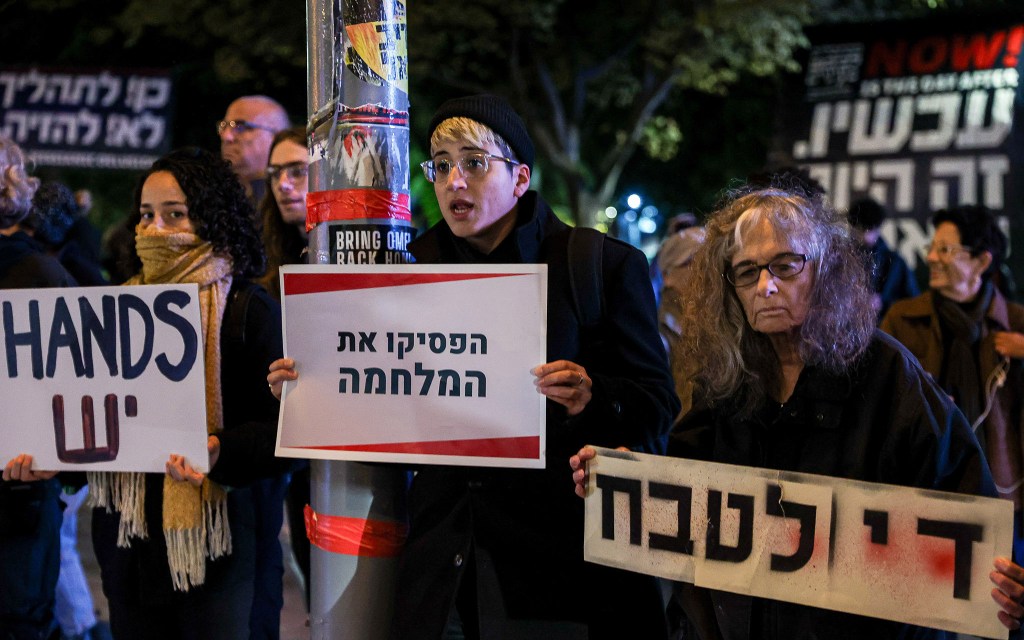
Israeli peace protestors
And it involves serious rebellion too. When I met with hostage families in Jerusalem, I was shocked to hear how, for protesting against the war to bring their families home, they had been beaten up by Ben Gvir’s police. I saw this with my own eyes when I marched alongside them. People shouted and jeered at them, and the police came at them with truncheons.
In July, when I went with Rabbis for Human Rights to defend a village in the West Bank against settler violence, we were joined in our car full of nerdy Talmud scholars by a surprising first-timer. A strapping 18-year-old got in to volunteer in supporting the Palestinian village. What was most remarkable was that he himself lived in a West Bank settlement.
He explained that he had refused to serve in the military. He did not know that others had done it before, or that there were organisations to support Israeli military refusers. Instead, he said, he thought to himself: “if I don’t go, they won’t kill me; if I do go, I might kill someone.” What could be a truer expression of Abraham’s message: no to death! No to death, no matter the cost.
He really had to rebel. For refusing to serve in the war, the conscientious objector I met spent seven months in jail. Still now, there are dozens of Israeli teenagers in prison because they would not support the war.
Throughout my time in Jerusalem, I attended every protest against the war and for hostage release that I could. One of the most profound groups I witnessed was the Women in White, a feminist anti-war group going back decades. One of these women, with grey hair and the look of a veteran campaigner, held a placard that read in Hebrew: “we do not have spare children for pointless wars.”
Is this not exactly what Abraham would say? We will not sacrifice our children on the altar of war!
Theirs is truly the voice of Abraham, the true voice of Judaism. It is the voice that opposes child sacrifice. Theirs is the voice that upholds the God who chooses life.
Talmud tells us that, when we blast the shofar one hundred times on Rosh Hashanah, we are repeating the one hundred wails of Sisera’s mother when she heard her son had died. Sisera was, in fact, an enemy of the Israelites, who waged war on Deborah’s armies, and was killed by the Jewish heroine, Yael. Still, at this holy time of year, we place the grief of Sisera’s mother at the forefront of our prayers.
We take the cry of every mother who has lost a child and we make it our cry.
Thousands of years after the Sumerian Empire had ceased existing, archaeologists dug up its remains, and saw a society that practised child sacrifice. From the very fact of how they carried out murder and permitted death, the excavators could tell a great deal about what kind of society this was. One that killed people to serve their wealthy and their gods.
One day, thousands of years from now, historians may look upon us too, and ask questions about what our society was like, and what we valued. May we take upon ourselves the mantle of Abraham.
May they look back and say that we chose to value life. May they look back and see that our people despised death and war. May they look back on us and see a society that practised faithful disobedience.
The counting of numbers, verses and spaces actually has a great importance in the Jewish tradition. The word in Hebrew for a scribe is the same as for one who counts (sofer). The Talmud says this is because the original sages spent their time counting the numbers and letters of scrolls.
Now, sometimes, the Talmud is making stuff up, or telling a joke that has been lost to the ages, but in this case, they are almost certainly right.
Counting words, numbers and verses was a great way to ensure that the Torah was standardised, so there could be no differences between the authoritative versions of God’s Word.
Counting words helps us to work out important things about Torah. For example, the Talmud tells us, you can count from the beginning to the end and find the word that is slap bang in the middle of the scroll.
If you do it by letter, says the Babylonian Talmud, you get the word “belly” – gachon. Yes, right in the middle of our Torah is a big tummy, just like on a human being. It fits, doesn’t it? How much of Jewish culture is about food?
If you do it word by word, then the middle two words of the whole Torah are “darosh darash” – search and search; diligently enquire. The middle words of the Torah are all about asking and questioning. How fitting! We love asking, and searching for answers. Aren’t we always questioning, adding questions to our questions? (Well, are we?)
And, if you do it by verse, then you get to the central verse of the whole Torah, Leviticus 13:33. Here it is, the great lesson our Scripture has been trying to tell us: “then the man or woman must shave themselves, except for the affected area, and the priest is to keep them isolated for another seven days.”
I’ve got nothing.
Now, the Babylonian Talmud has given us some good answers about the middle of the Torah. But none of them are quite what we’re looking for.
Because if you hold the Torah in your hands, if you physically roll the Torah looking for a midpoint, you’d think it would be here, in this week’s parasha.
Spatially, the centre of the Torah is here, at the start of Kedoshim. Here, at the beginning of Leviticus 19, God tells the Israelites: “you shall be a holy people, for I, God, am holy.”
And if you follow this bit of Torah down to its centre, right to the middle here, you get the central commandment of the Holiness Code: “love your neighbour as yourself.”
That, says the Palestinian Talmud, is the real heart of the Torah. Never mind all the numbers and counting. If what you are looking for is what the Torah is all about, follow your heart, and get to its intuitive core.
There, in the Yerushalmi, Rabbi Akiva says: “the greatest principle of the Torah is to love your neighbour as yourself.” He says, if someone is going astray, this is the only thing you have to remind them of to get them back on track.
You may have heard this before. In the Christian Gospel of Mark, Jesus says that the greatest principle of Torah is to love your neighbour as yourself. He might have got more famous than Rabbi Akiva, but he certainly wasn’t the saying’s originator. That’s just a nice Jewish boy, repeating a good rabbinic tradition.
In fact, anyone who spends more than a minute with our religious tradition will understand that to be so. Love is at the heart of the Torah. That is all any of it is about.
Yes, the belly matters, of course it does. But it’s not just because we need food to keep ourselves sustained. It’s not even because food is a way of transmitting culture. It’s because through feeding and being fed we can show how much we love each other. These kiddishes, these Friday night dinners, the old recipes handed down, the food bank drives, the seder meals, the cakes we bake… they are all simply different ways of demonstrating love.
And yes, the searching and inquiring matters too. But it’s not just because we’re a learned and inquisitive people. It’s not just because we put such high value on education and on our Scriptures. It’s because it is a beautiful way of showing each other how much we love each other. You sit with a child to tell them a Bible story. You sit with a friend to study some text together. You sit with an elder to ask them for their wisdom. Sure, on some level, you’re just trying to get information. But, at core, these are ways of showing love.
Hold that in mind, then, as we return to the central verse of Torah, in the purity laws given to priests: “they must shave themselves, except for the infected area…”
No, sorry, I’ve still got nothing.
A few weeks ago, I sat down here with the Council to talk about what it would look like to come here as a rabbi, and whether we might be a match. One of your leaders asked: “what do you think are the core functions of the synagogue?” I gave my honest answer: “The synagogue only really serves one purpose, and that is to get people to love each other more.”
We come together, in these Jewish communities, to show that we love others as we love ourselves. We will eat together and learn together and pray together because we love each other.
We will love each other enough to be with each other in our most trying moments of death, disease and disaster. We will love each other enough to celebrate together through our joys of life, and build each other up.
This synagogue already has a wonderful reputation. Rene, your outgoing rabbi, has told me how much he loves you. Charley, your former rabbi, and now movement head, has shared the same. Danny, your rabbi emeritus, has told me how lucky I am to be coming here.
I meet adults who grew up here, friends of Laurence, and they share what a warm and wonderful place this is. In just the few meetings I have had with members, I can already see why.
The love that people speak of you all with is because of the love that you put out and create in your community.
I cannot wait to start here, and to love you as much as everyone else does.
A few weeks back, I attended a retreat with Christian colleagues. At some point, surprisingly enough, we got onto talking about God. I asked one of the priests a question: “do you believe God speaks to you?”
He looked slightly bewildered by the question. “Literally?” he asked. “No, not really.” He shook his head.
The answer seemed obvious. After all, we were liberals, at an interfaith event. That kind of talk is for fundamentalists. We’re all too rational for that.
“Why?” he asked, turning back to me, “do you?”
“No,” I said, sheepishly. I don’t know why I felt so embarrassed. Of course, many believers see the voice of God mostly as a metaphor, or as a way of giving expression to moral intuition. I’m just not one of them.
I do believe in a personal God, who has a loving relationship with every human being on earth. And I do talk to God. It’s not that I expect answers in any sense, but I do believe some One is listening: that prayers are more than idle words I recite to myself.
Perhaps my Christian colleague would have agreed with me if I’d put it in these terms, because finding vocabulary to talk about God is hard. Words like ‘literally’ and ‘metaphorically’ start to evaporate when you are dealing with faith.
I think, perhaps, the reason I gave a sheepish no – maybe even that I asked the question at all – was that I was having a mini-crisis of faith of my own. Ever since the war broke out, I have been praying differently, more fervently, desperately begging the Universe for peace. I have been hurling questions and recriminations into the void. I have been wondering… do I still believe in this God?
My personal relationship with God has carried me through some of the toughest times. When I have felt most lonely, God has been like a best friend. When I have hated myself, God has been like a lover. When I have needed direction, God has been a wise counsellor. I have looked to God in every time of disaster, and always found comfort in a loving Presence that reaches out and caresses from across a boundary of unknowability.
But now I listen for God’s voice. And all I can hear is screaming.
As long as there have been people who believed in religious meaning, there have been those who questioned it. Usually, they were the same people. Abraham, Moses, Hannah, Kohelet, Job: they all had faith, and they all questioned it. They asked questions so that they could challenge their beliefs, and refine them. Lately, although less adequately than those prophets, I have been forced to do the same thing.
The first question we usually ask when confronted with crises of faith is “do I believe in God?” Fairly regularly, people come to me with conclusions one way or the other: “you should know, rabbi, I don’t believe…” or “you should know, I have a strong sense of belief…” My follow-up is always the same “… and what is it that you do (or don’t) believe in?”
For me, the answer is moral truth. When I talk about believing in God, what I am saying is that moral statements are not just opinions. When we say “murder is wrong” we are not just expressing a preference, like “my favourite flavour of ice cream is tutti-frutti.” We are describing a reality, no different to the claim that there are 24 hours in a day. We are describing something literally true.
I think that’s what God is. When we want to know why our feet are firmly on the ground, we give the shorthand answer of “gravity.” When we want to explain why objects in space interact with each other as they do, we use words like “attraction.” And when we want to express how we know that murder is wrong, we use the word “God.”
So, in feeling the great sense of angst I have had since the war began at the end of the High Holy Days, I am forced to return to the old questions. I am forced to ask whether I still think moral statements are true. I am forced to ask whether I still believe murder is wrong.
I do.
And that is why I believe that God is screaming.
What we talk about when we describe God is obviously more complicated: it is something infinite, and greater than we can put into words. That’s why words like “metaphor” and “literal” are so inadequate – because we are describing something more real than reality. So we have to find shortcuts. We have to find ways of talking about God in human language, to make sense of God on human terms. God is then “a tender parent”; “a loving shepherd”; “a righteous judge”; “a generous creator.” All of these are good descriptors, and all of them are incomplete.
I have been relying on a version of God that has worked for me for a while. I have imagined a sweet aunty or a gentle older friend. In times of loneliness, desperation and heartache, that image of a loving God has helped me get through the day. But that image doesn’t serve me now. I think if I used God for comfort in a time like this, I would be retreating from responsibility. God does not need me to feel safe now, but to shake me from illusions and complacency.
If God is the moral voice of the universe, that voice must be crying out in desperation.
In the last few months, 23,000 Palestinians in Gaza have been killed by Israeli bombs. I am kept awake at night thinking about that. I imagine God, smothered by the rubble of obliterated hospitals, calling out. Like Abel, stricken by Cain, the voice of the blood is calling out from the ground (Gen 4:10). I imagine God, pulled from the wreckage, crying: “Thou shalt not kill. (Ex 20:13) Thou shalt not kill. (Deut 5:17)”
Those were the commandments given to the Jews, above all others. In some variations, it is the very first commandment, the one that holds the most power. And as Israel stands in the dock at the Hague, it is not only South Africa that places it on trial, but God too, who comes with the accusation: “did I not tell you: thou shalt not kill.”
Since the war began, Israeli settlers, with governmental support, have seized around 20 villages in the West Bank, displacing thousands of people, so that Jewish Israelis can expand their territory and claim others’ homes. I imagine God calling out from deserted towns, on the trail with refugee families, wailing “thou shalt not steal” (Ex 20:15), “thou shalt not steal” (Deut 5:19).
Netanyahu says, unabashedly, that he will push the Palestinians from Gaza and create a new border with Egypt. The Torah answers, in desperation: “thou shalt not move thy neighbour’s boundary” (Deut 19:14). Land theft is a sin.
Israeli soldiers enter Gaza and use Jewish symbols as weapons. They recite the Shema from the pulpits of mosques and place mezuzahs on Palestinian homes. They desecrate our religion. They destroy our faith. From the depths of history, God cries out “honour thy mother and thy father (Ex 20:12); honour thy mother and thy father (Deut 5:16).” Do not profane the faith of your ancestors with war crimes.
Worse still, the politicians claim that God gave them the right. That this is what the Torah intended. Can you not hear the scream of revulsion as God decries: “thou shalt not take My name in vain (Ex 20:7); thou shalt not take My name in vain (Deut 5:11).” This is what was intended: do not abuse God’s name for worthless pursuits like war, but elevate it for the purposes of peace.
I believe that God is screaming.
The commandments may once have been given as words of instruction or even as a love letter, but now they are a desperate plea.
God says “I am the Eternal One thy God, which brought thee out of the land of Egypt, from the house of bondage. Thou shalt have none other gods before me.”
No other gods. No state, no flag, no military, no leader, no ideology, no grudge, no border, nothing. None of these can ever be placed before God. None of them have any trump over God’s words.
God’s word says: “You shall not pollute the land in which you live; for blood pollutes the land, and no expiation can be made for the land, for the blood that is shed in it.” (Num 35:33)
So I believe I can hear God screaming: thou shalt not kill.
And I do not want to silence that voice. I want to amplify it. I want the Holy Torah to be heard now, more than ever. I hear God screaming, and I want to join in.
Fifteen years ago, the Nigerian author Chimamanda Ngozi Adichie gave a powerful speech, in which she warned about “the danger of the single story.” This, she says, is how you create a single story: “show a people as one thing, as only one thing, over and over again, and that is what they become.”
Because of the single story told about Africa, Westerners knew it only as backwards, poor, and disease-ridden. They did not know how diverse, interesting and resilient Africans were. They did not know that Africans were not, in fact, one people with one story, but billions of people with billions of stories.
She warns her listeners: “The consequence of the single story is this: It robs people of dignity. It makes our recognition of our equal humanity difficult. It emphasises how we are different rather than how we are similar.”
In the book of Joshua, we are presented with a single story about the Israelites and their enemies. In our haftarah, Joshua gathers the tribes of Israel at Shchem and presents his account of the conquest of Canaan. He declares:
You crossed the Jordan and came to Jericho. The citizens of Jericho fought against you, as did also the Amorites, Perizzites, Canaanites, Hittites, Girgashites, Hivites and Jebusites, but I gave them into your hands. I sent the hornet ahead of you, which drove them out before you—also the two Amorite kings. You did not do it with your own sword and bow. So I gave you a land on which you did not toil and cities you did not build; and you live in them and eat from vineyards and olive groves that you did not plant.
In Joshua’s single story, the Israelites are a nation united at war. They all came over at once and went to conquer the land of Canaan. Their enemies were diverse in name but unified in mission. In the list of warring tribes that came up against the Israelites, there is no distinction. Every one of them fought the Israelites. Every one of them lost. By God’s miraculous deeds, the Israelites took over the entire country, and now they have a whole land, ready-made, for them to inhabit.
But wait. There is a flaw with this single story. Just as Joshua decrees that the entirety of these foreign nations has been wiped out, he also warns the Israelites not to mix with them.
All of these other tribes have been completely driven out of the land of Israel; all of them have been vanquished; now the only people left are the Israelites.
But even though the Israelites are the only people remaining, you must not marry the others; or get involved in their cultural practices; or go to their shrines with them and worship their gods.
The Jewish bible scholar, Rachel Havrelock, has written a book looking at why this contradiction is so stark. She suggests that, while the Book of Joshua would love to tell a single story of unanimous military victory, it cannot get away from what the people see with their own eyes.
In reality, all the nations that the Israelites “drove out” are still there. The Israelites are still meeting them, marrying them, striking deals with them, and fraternising with them.
Joshua is putting together the war story as a national myth to bring the people together. In his story, the Israelites must be one people and so must all their enemies. Victory must be total and war must be the only way.
In fact, Havrelock finds that there are lots of contradictions in the book of Joshua. It says that the nation was united in war, while also describing all the internal tribal disagreements and all the rebellions against Joshua.
It says that they took over the whole land, but when it lists places, you can clearly see that plenty of the space is contested, and that the borders are shifting all the time. It says they took over Jerusalem, and also says that it remains a divided city to this day.
So what is the reality? Archaeological digs suggest it is very unlikely that the conquest of Canaan ever happened in the way the Book of Joshua describes. The land was not vanquished in one lifetime by a united army. Instead, more likely, the Israelites gradually merged with, struck deals with, and collaborated with, lots of disparate tribes.
They were never really an ethnically homogenous group. They were never really a disciplined military. They were a group of people who gathered together other groups of people over many centuries to unite around a story. Ancient Israel was the product of cooperation and collaboration.
Our Torah takes all the different stories of lots of different tribes and combines them into a single narrative. That is why the Torah reads more like a library of hundreds of folktales than a single spiel.
But a government at war needs a single story. It needs to tell the story that there is only one nation, which has no internal division. It needs to tell the story that there is only one enemy, and that the whole of the enemy is a murderous, barbarous bloc. It needs to insist that the enemy must be destroyed in its entirety. It needs to tell the story that war is the only way.
Reality, however, rarely lives up to the single story that war propaganda would like us to believe.
Over the last few months, we have been bombarded with a single story of war. We are all at war. Not only Israel, but the whole Jewish people. We are all at war until every hostage is freed from Gaza. We are all at war until Hamas is destroyed. We are all at war and there is no other way.
But hidden underneath that story are other stories. Suppressed stories. Stories that suggest Israel may not be united in war.
There is the single story that Gaza must be bombed to release the remaining hostages.
There is another story. Avihai Brodutch was with his family on Kibbutz Kfar Aza on October 7th. He survived. His wife, Hagar, was taken hostage, along with their three children, aged 10, 8 and 4. His whole family and his neighbours were taken hostage.
Only a week later, at 3am, Avihai took a plastic chair and his family dog, and went to launch a one-man protest outside the Israeli military offices. He insisted that blood was on Bibi’s hands for refusing to negotiate. He said that Netanyahu was treating his family as collateral damage in his war. He initiated a rallying cry: “prisoner exchange.”
This has become a demand of Israeli civil society. They will swap Palestinian prisoners for the Israeli hostages. This was achieved, when 240 Palestinian prisoners were swapped in return for 80 Israelis and 30 non-Israelis captive in Gaza.
There are still over 100 hostages in Gaza. There are still around 4,000 Palestinian political prisoners in Israeli jails. Around 1,000 are detained indefinitely without charge. Around 160 are children.
It is simply the right thing that Hamas should release the hostages. It is also simply the right thing that Netanyahu should release the Palestinian prisoners. If they did agree, everyone would be able to return safely to their families. Doesn’t that sound more worth fighting for than war?
There is a single story, promoted by Netanyahu, that Israel must fight until it has destroyed Hamas.
There is another story. Maoz Inon’s parents were both murdered by Hamas on October 7th. As soon as he had finished sitting shiva, he took up his call for peace. All he wanted was an end to the war.
Speaking to American news this week, he said: “A military invasion into Gaza will just make things worse, will just keep this cycle of blood, the cycle of death, the cycle of violence that’s been going for a century.”
His call for peace is echoed by other families of those who lost loved ones on October 7th. They have lobbied, produced videos, and sent letters to Netanyahu, begging to be heard.
Some are desperate for the government to recognise that further death is not what they want. Now, as Netanyahu has killed more than 20,000 Palestinians, their call has still not been heard.
And after all those dead, is Hamas any closer to being destroyed? Of course not. All this bombing does is ensure that a new generation of Palestinians trapped in Gaza will grow up to hate Israel.
This war is how you get more terrorists. It’s how you ensure that war never ends. Wouldn’t it be better to fight for a ceasefire than to fight for a war?
There is a single story that the nation is united in war.
There is another story. This week, 18-year-old Tal Mitnik was sent to military prison in Israel for refusing to fight in the war. Although this news has barely made it into English-language media, many Israelis have expressed their support.
Writing to Haaretz, one refusenik wrote: “I was inside. We were so brainwashed there. I refused and I’m not the only one. I have a family and this is not a war with a clear purpose. […] My children will have a father and I hope yours will too.” Another parent wrote: “My son is also refusing. I will not sacrifice him for Bibi.”
There is another story: that this is Netanyahu’s war, not ours.
There is another story: that war is not the answer.
There is another story: that every captive must go free.
There is another story: that all bombs and rockets must end.
There is another story: that we will not give licence to any more bloodshed.
There is a story that the nation is at war. In times of war, the government must tell that as the only story, to blot out alternative stories, to ensure that war is the only way.
But there are other stories. And, if we tell those other stories, there will be other ways.
What a difficult time. Do you remember how lonely and anxious it all felt? Do you remember how much you felt like nobody understood?
As adults, we now often put down this pubescent behaviour to hormones, or, worse, to the kid just being annoying.
But what young adults are going through is really important. All that sadness and angst is a healthy part of their development.
They are realising that the world is a much meaner and more confusing place than they had thought in infancy.
And the truth is they are right: very few people understand them. And they understand very few others. That takes real adjustment.
But once teens can accept how little understood they are, that can make them much more functional adults.
They can embrace their individuality and celebrate it. They can appreciate difference, without feeling a need to change others. And, when they find people who are like them, and who do understand, they can appreciate the connection so much more.
Understanding how little understood we can be helps us to truly value loving and being loved.
So, it’s true, nobody understands me. Isn’t that wonderful?
What kind of world would it be if everyone automatically understood everyone else! We would lose our humanity. We would just be cattle, following along, without the possibility of freedom or growth.
That’s what it was like at the Tower of Babel.
This story in Genesis l tells of humanity’s own coming of age.
At some point, in mythic time, we all spoke the same language. Like robots, we all set about making a massive tower.
God saw us and said “who knows what they’ll do next!” So God confounded us, gave us all different languages, and dispersed us throughout the world.
That is God’s message at Babel. Diversity is the foundation of society. Humanity needs to mature. You need to be different and know that you are different. It is a good thing not to understand and not to be understood.
The ancient Israelites knew the value of not being understood all too well. To them, Babel was not just an ancient city. It was the capital of the major empire that colonised them.
Babylon took over the entirety of the ancient Near East. Wherever they went, they imposed their laws, their government, their military, and their taxes.
They also imposed their language. They spread their alphabet to all of their colonies. What we now call the Hebrew alphabet is, in fact, the script of the Babylonian empire. The original Paleo-Hebrew script is now lost to stone blocks in museums.
The Babylonians carved up and named the territories. That naming, that fact of telling everyone who they were, and where their borders were, was their way of exerting control. It was the basis in words for all that would follow: all the military and economic violence they would enforce.
During Jehoiakim’s reign, the Babylonians took hold of Judah and tried to turn it into a vassal state.
The ancient Judeans rebelled, fighting for their homeland and their dignity.
The Babylonians took all of the Jewish leaders and imprisoned them. They forced thousands of them into a tiny strip of land, hoping to militarily crush the rebellion.
Of course, no people forced into subjugation will just concede. When rebels are backed into a corner, they usually fight back even harder.
That’s exactly what happened with the Judeans. Less than a decade later, those left in the country launched another assault on Babylon.
In response, the Babylonians completely flattened Judea. They ripped down its cities, destroyed Jerusalem, and killed anyone who stood in their way. They installed their own puppet dictator, Gedalia.
As you would expect, the Judeans killed Gedalia and kept on resisting.
We must, therefore, understand the story of the Tower of Babel in the context of what Babylon meant to the Jews. To them, the Babylonians were the people who wanted to destroy and persecute them. They were the empire that wanted to steal their money and their land.
While warriors fought with swords, storytellers fought back with this literary protest.
They said: “Look at the Babylonians: they want to force everyone to have one language and want to bend everyone to their will.”
Our ancestors told the story of Babel as a warning. Look at what happens when you force a language on people. You end up like Babylonians. You become monsters. Once you impose your words on others, there is nothing to stop you imposing your will.
We must have diversity. We must be incomprehensible. We must be as unlike each other as possible, so that nobody can be subjugated to another.
The true story of the history of the world is not that it went from a single language to many, but that it began with many languages and had fewer and fewer.
As empires rose, they enforced their own words and worldviews, and suppressed the heterogeneity of all they conquered.
The reason that so many people of the mediaeval world spoke Greek, Latin, Arabic, or Chinese was because those were the biggest empires. The reason that so many people today speak English, French or Spanish, is because our small European countries colonised over half the globe.
Their primary purpose may have been to take the land and resources of those countries. But as part of doing that, they also needed to impose languages on people. They needed to force people to conform to words they had previously not known.
They said: this is now Christendom, and that is the Uma. This is the Old World, and that is the New. This is Europe, and that is Barbary. This is civilisation, and those are savages. This is white, and that is black.
They took the world under one language, and forced it to conform to their understanding. They understood the world, for the sake of controlling and conquering it.
With each century of imperial conquest, hundreds of languages are rendered extinct. When languages die, we lose not only a way of speaking, but can witness an entire culture being eliminated.
This is why the definition of genocide does not only encompass killing people, but can include destroying ways of life.
So, let us suggest, understanding each other might not be such a good thing. If anything, we might aspire to understand each other less.
Our Torah wants us to look for something better than understanding. It tells us this story not just because they are angry about their subjugation as the oppressed, but also because they are worried for the souls of their oppressors.
To the ancient Judeans, the Babylonians were stuck in a spiritual adolescence. Like immature children, who just want to manipulate the world, the Babylonians had not yet achieved the wisdom of accepting what they cannot know.
They taught an alternative theology to the conquering power of Empire. Not knowledge. Love.
Love is the Torah’s answer.
When you love someone, you do not want to control them. Quite on the contrary, you want them to be free.
When you love someone, you don’t want to change them.
When you love someone, you don’t want to categorise them.
And yes, you may want to understand them, but in the sense of being infinitely curious about them, wondering who they are, and how they think. But always knowing that you cannot reduce them or ever comprehend their essence.
So, it is time to stop trying to understand people. It is time to stop trying to be understood.
We need to understand each other less and love each more.
You may not hear that often, and you probably think about it even less, but you truly are.
The British-Indian poet Nikita Gill has written about just how unlikely is the fact of your existence:
“The very idea that you exist considering those extremely low odds is a miracle on its own. You see, the exact DNA that comes from your parents to create you could have only happened when your parents met, which is 1 chance in 20,000. That alone should be enough, but when you add up the fact that it has taken 5-10 million years of human evolution for you to exist at this time, in this moment, you begin to recognise just how much of an impossibility you are.”
– Nikita Gill
Add to that, and remember that you are a Jew. Remember that in those 10 million years of evolution, Judaism has existed for only 3,000 of them, and is still one of the world’s oldest continuously existing cultures. You are the product of a long line of ancestors, dating back to desert nomads, who, at one time, heard the voice of an invisible God, and kept that story alive for hundreds of generations. That is a miracle.
In the last century, the ancestors who held onto that story fled from countries all over the world, and migrated to farthest corners of the earth, and faced down war and genocide, and survived extermination. Faced with such experiences, many turned away from their heritage and disappeared from Jewish life.
But you are here, in the 21st Century, alive, and Jewish, and living out that story. You are the product of billions of years of matter interacting and millions of years of human evolution and thousands of years of cultural transmission. You are here. And that is an incredible, awe-inspiring miracle.
One of the prevailing themes of Rosh Hashanah is the miracle of human life. It is everywhere: in our liturgy, in our Torah portions, and in our haftarah. All of them are bound together by a sense of wonder at our existence.
Three weeks ago, we read the prophet Isaiah, who expressed joy at the wonder of childbirth. His great prophecy opens:
“Sing for joy, infertile woman, you who never bore a child! Sing for joy and laugh aloud, you who never felt a stomach cramp. Because the children of the barren are more numerous than those who suckled infants.”
But who is this talking about? Who is the sterile woman giving birth to the miracle child?
In the 9th Century, the great collection of rabbinic stories, Midrash Pesikta Rabbati, offered us three answers: Sarah, Hannah, and Jerusalem. At Rosh Hashanah, we read the stories of all three.
In the Torah portion, we read of Sarah’s miraculous labour. Sarah was elderly and post-menopausal. When three angels told her she would give birth in a year, she laughed. For years, she had yearned for a child, but, in her old age, she had given up. How would her withered husband and her empty womb bear a child?
A year later, Sarah gave birth. She ate her words and called her baby boy Yitzhak, meaning ‘laughter.’ She said: “God has brought me laughter, and everyone who hears about this will laugh with me.”
A miracle. An impossible birth. So that infertile woman who had never had a child rejoiced, just as Isaiah described.
In our haftarah, we read, too, of Hannah’s wondrous labour. She was infertile. Her husband Elkanah’s other wife, Peninah, had plenty of children. Peninah became her rival, and relentlessly mocked her, saying that God had closed her womb.
In the depths of her despair, Hannah prayed to God. She whispered fervent promises to God that, if she was allowed a baby, he would be dedicated forever to religious service.
As Hannah prayed, she was so full of silent anguish and tears, that the High Priest Eli thought she was drunk. He heckled her to sober up. But when she explained that her behaviour was the product of deep distress, Eli prayed with her that her wish be granted.
A year later, Hannah gave birth, and called her baby “Shmuel,” meaning “I asked God for this.”
Another miracle. A barren woman who bore no children rejoiced, just as Isaiah described.
Pesikta Rabbati offers a third infertile woman to whom Isaiah’s proclamation might refer: the city of Jerusalem.
At the last major event in the Jewish calendar, Tisha BeAv, we commemorated Jerusalem’s destruction. We fasted, wept and prayed, remembering how the holy city was razed to the ground. Following the destructions by Assyria and Rome, that city was left stripped of its inhabitants. Its most sacred spaces were desecrated and burned. The whole town was abandoned like an empty womb.
And out of that barren place came Judaism. At the time when it most seemed like the Jews had been destroyed, the rabbis came forward and gave them life previously unknown. They developed tefillah, Mishnah, midrash, and Talmud.
They spread the message of ethical monotheism throughout the entire globe. Judaism, from its point of near-destruction, became one of the world’s most notable religions, and influenced civilisations everywhere.
Jerusalem was an infertile womb, out of which came more children than could ever have been imagined.
Sarah yearned for a child and was blessed. Hannah yearned for a child and was blessed. Jerusalem yearned for children, and now has millions.
But there is another impossible birth that we must celebrate. An unbridled miracle. A human being created by God out of nothing, who had the potential to be the saviour of all humanity.
Whose birth was that?
Yours.
What, did you think I was going to say somebody else?
For the Christians, that person was Jesus. In their story, their Messiah was born by immaculate conception to a virgin mother. For them, Jesus’ birth fulfilled the prophecy related by Isaiah.
In the 9th Century CE, when this midrash was composed, Christianity had become a full-fledged international religion. It was the official doctrine of the Roman Empire, and was spreading throughout Europe through the Carolingian Empire. Christian polemicists criticised Jews for denying the truth of their Testament, and insisted that their story completed our Torah.
Part of the motivation for the compiler of Pesikta Rabbati must have been to show that Isaiah could easily be proven from texts within the Jewish canon. But, more than a difference of interpretation, this midrash speaks to a fundamental difference between how Jews and Christians have seen the world. For us, Jesus is not the beloved child of God born by miracle. You are.
As Lily Montagu, the great religious reformer and East End social worker, put it:
“We have the belief that man can directly commune with his God, that he needs no intercessor […] The Christian feels himself brought into contact with God by means of Jesus, his Saviour. Jesus is conceived as, in a special sense, the son of God, and as able to direct all seekers to the divine sanctuary. We Jews hold that every man is the son of God, and that all His children have access to Him when they try to live righteously.”
– Lily Montagu
So, all humanity is God’s miraculous creation. All humanity is in direct relationship with our Divine Creator. And all humanity has the potential to bring this world closer to its salvation.
Rosh Hashanah, as a festival, marks the sixth day of the world’s creation, on which the first ever human being was made. It celebrates the miraculous creation of Adam HaRishon, the original person, sculpted from clay and breathed alive with the sacred air from God’s nostrils.
Consider what a wonder this is. Knowing all that we do about the history of the universe, how many billions of years must God have spent yearning to create the first ever person.
How impossibly beautiful is it, that, after the creations of thousands of galaxies and multitudes of planets, the Universe somehow put together the exact elements that would support life. And that life became social and conscious and able to reflect on its own existence. And, conscious of its own selfhood, that being was able to reach beyond itself and worship the Eternal Mystery that created it.
Who knows what the chances are? But it is certainly a miracle.
The cosmos was, at one point, an insignificant speck, devoid even of matter, and now it includes human beings. And now it includes you.
You are the impossible child God yearned for. You are a miracle.
However much you wish to connect with your Creator, just think how much your Creator wants to connect with you. Whenever you feel like you can’t quite find God, just take a second to contemplate how many billions of years God spent trying to find you.
Your existence is a miracle, and I am so glad you are here.
Of course, I am Jewish, but I also consider myself very English. I am English in the very parochial sense that I love canal boats, think provincial churches are beautiful, will definitely barbecue on the only day of summer, and put mayonnaise with everything. But, last autumn, I did the most English thing I have ever done.
I wrote a disapproving letter of correction.
I had never done it before. I’ve never written in to the BBC or a newspaper. To the best of my knowledge, I’ve never sent a letter of complaint about anything. But this one was too important to simply ignore.
Someone in a play had misrepresented a complex point of Jewish law.
Now, this may seem trivial. But, six months later, I am still so incensed about this common misconception of halachah, that I feel the need to preach on it.
In September, last year, I got a real treat: to go see one of our members perform at the Royal Court Theatre. Rachel Hosker, who will be getting married under our auspices in the summer, was performing in a play called ‘Jews. In their Own Words.’ Written by Jonathan Freedland, the play interviews famous Jews, including Tracy-Ann Oberman, Luciana Berger, Margaret Hodge, and Howard Jacobson, trying to give a sense of antisemitism, past and present.
I’m not a theatre critic, but let me tell you: Rachel acted fantastically. She and the rest of the cast did a fantastic job of bringing the characters to life.
But there was a line, really a throwaway comment, that stuck with me. The play was attempting to explain the trope of the money-hungry Jew, and how Jews had come to be associated with money-lending. An actor representing CST’s Dave Rich said: “the rulings of the church forbade lending money at interest, which was considered usury, whereas Jewish law allowed it.”
This, to me, is alarmingly inaccurate. It shows not only a misunderstanding of Jewish law, but also of antisemitism, and how it works. It places the responsibility for Jews as medieval money-lenders onto Jews, and our religion. Nothing could be further from the truth.
If it was the case that Jewish law allowed money-lending at interest, you would be hard-pressed to explain the commandment in this week’s Torah portion: “You may not act as a creditor to your people. You may not exact interest from them.” You would also have to reckon with the same commandment, given in the Holiness Code: “Do not exact advance or accrued interest, but fear your God… Do not lend your money at interest, and do not give your food at interest.” The same commandment is repeated again in Deuteronomy: “do not deduct interest from loans to your kindred.”
Of course, you might say, the Torah is not the only source of Jewish law. Perhaps these commandments are amended in the Mishnah, or the Talmud, or the Codes. No, no, and no. The Mishnah says charging interest is so reprehensible that it involves breaking six commandments. The Talmud says that even scribes and witnesses who participate in such contracts are guilty.
In the defining law code for most of the Jewish world, the Mishneh Torah, Rambam looks at the word for interest – neshech – which is the same as the word for a snakebite, and says it is called as such “because it bites, it causes pain to a fellow human being, and consumes a person.” He repudiates it completely.
Be in no doubt: Jewish law does not permit money-lending at interest.
So, how did it happen that Jews nevertheless ended up associated with money-lending, despite its very explicit prohibition?
In the 4th Century CE, Church Father Augustine of Hippo declared that Jews would be permitted to survive as “living witnesses” to the truth of the Bible, but must be kept in a degraded state, with the mark of Cain, for their refusal to accept Jesus. This became the official policy of Christian Europe’s primary institutions: its churches and monarchies.
Jews were allowed to live in England neither as citizens nor serfs. They could not own land or participate in the nation. They were excluded from universities, and cut out of the professions. They were only allowed to live in the country on condition that they did the dirty work of the ruling class: tax collecting and money-lending.
Now, most Jews did not do such jobs. They did the work that was needed for their community, as bakers, vintners, stonemasons, and millers. But, as long as some Jews fulfilled these functions for the monarchy, all Jews could live in European countries as “treasured subjects” – effectively pets of the king.
This had a profound impact on the lives of medieval European Jews. They were forced to wear humiliating clothes to mark them out. Associated with tax collecting and money-lending, many of the local peasants associated the Jews with all the financial problems they faced.
The local lords actively exploited this division. They drummed up hatred against Jews, and treated them as a pressure valve, so that, in times of economic crisis, peasants would attack their local Jews rather than turn their ire on the landowner class.
That is why the worst pogroms that we have recorded came in times when the monarchy was in financial straits. In England, these came when the country was bankrupted by its military Crusades to capture Jerusalem. Jews, the perceived cause of money problems, and naturally associated with the Holy Land, had all the anger and resentment of impoverished people poured out on them.
If the monarchy or the Church were struggling with their own debts, they had an easy way out: they could simply expel the Jews and confiscate all their property. In 1290, Edward I expelled the Jews from England to cancel his debts and win back the support of the knights and lords in parliament, who were also heavily indebted.
This put the rabbis, the arbiters of Jewish law, in a very difficult position. If they permitted lending at interest, they would turn their backs on their entire religious inheritance. If they insisted that Judaism forbade money-lending at interest, they would effectively force their community to leave where they were. And, since all of Christian Europe had adopted the same policy, they would have nowhere to go.
So, the rabbis had to find a way. They looked at the laws, which said such lending was only prohibited to their kin. Rabbi David Kimchi, writing in medieval France during pogroms and expulsions, said that Jews were not permitted to lend at interest to people who respect Jews. The corollary was that if people would not treat the Jews as full human beings, then they, in turn, could lend to them at interest. In England, the Christians had estranged them and made them explicitly not their kin.
This is why correcting this point on the understanding of Jewish law is so important. It is not just because we are sticklers for getting the halachah right. It is so that we understand what antisemitism is and how it works.
We Jews did not create this system. We did not allow it, nor have the power to stop it. For over a millennium, European powers embedded and promoted antisemitism to prop up their system. As Rabbi Lionel Blue, of blessed memory, so pithily wrote: “The problem of the Jews in Europe was never the Jews. It was Europe.”
Now, we are citizens in this country. With Emancipation, we might have hoped that it would bring an end to cultures of debt and division. True, most of the banks and money-lenders are now not owned by Jews, and very few Jews today engage in such work.
But that is not because we are living closer to the laws of the Torah or our rabbis. It is because the whole of our society is caught up in loans. All of us are more indebted and more divided than we ever were. We are pitted against each other by a media eager to see us all fighting.
Combating antisemitism does not only mean counteracting myths and biases against Jews. It is also about dismantling the material realities that created antisemitism. The hatred of Jews erupts when we are scapegoated for economic problems in society. We must not only contradict the myth that we are responsible, but also fight to ensure that the problems people face of economic hardship and drowning in debts no longer exist.
When we realise that the world has enough for all of us, and distribute it so that everyone can prosper, we will be far closer to a world without prejudice and fear.
We are nearing the end of Sukkot and entering Simchat Torah.
We move from fragility to strength, from an open roof to a closed scroll, from the impermanence of life to the eternal truth of God.
What makes a sukkah kosher is its frailty. With its open walls and starlit roof, it stands in for all our wanderings and confusion. It is makeshift and temporary.
In its fragile state, it teaches us about the human condition: that we are vulnerable, at the whim of forces beyond our control. Into this transient home, we bring guests, both living and ancestral, who teach us that we only live by community.
The sukkah teaches us about the human heart: that it must be open and porous, welcoming to strangers, able to let others in and accept our own emotional helplessness.
But the sukkah also has another feature of what makes it kosher. It must be able to stand for eight days. It must be strong enough to withstand the weather. It cannot be drowned by rain or upended by windstorms.
This, too, teaches us about the spirit. We must be resilient. We must be confident enough to know our boundaries. We must be strong enough not to let others wave or topple us.
This is the tension we hold in the transition between Sukkot and Simchat Torah: between fragility and strength.
There is a story that Abraham’s tent was open on all sides.
Wherever Abraham looked, he could see whether strangers were coming to visit him.
If he looked out and saw them coming, he would run to meet them. Abraham was the model of generosity, so full of love for the wayfarer that he would do anything to let them in.
This explains why he greeted the angels who came to visit him at Mamre so enthusiastically, even though he thought they were just human beings. It explains how he was righteous enough to receive God’s blessing, and to become the progenitor of monotheism.
This is the version of the story that we find in Bereishit Rabbah, and you will find it printed in all sorts of commentaries. It is a beautiful myth that captures our imaginations and features heavily in sermons preaching charity. It teaches us about the importance of welcoming.
But it is not the only version of the story in rabbinic literature. A few centuries later, Avot deRabbi Natan, a commentary on the same text, explains it slightly differently. Instead of the example of Abraham, this midrash says we should be like Job.
It teaches:
Your house should have a spacious entrance on the north, south, east, and west, like Job’s, who made four openings to his house. Job opened up every side so that the poor would not be troubled to go all around the house: no matter what direction a stranger came from, they could enter in their stride.
At a glance, it tells the same story, just with a different prophet named. Job was also described as righteous and upright, a man who feared God and turned away from evil.
But there is a difference. Unlike Abraham’s, Job’s house is actually mentioned as having four sides. How do we know? Because, at the very start of Job’s story a messenger comes to tell Job that his house has blown down. “Amighty wind swept in from the desert and struck the four corners of the house. It collapsed on the young people and they are dead.”
Job’s house was so open that it was destroyed and killed everyone in it.
Job’s house was open on all sides. No wonder it fell down!
This later midrash is satirising the earlier one. Sure, openness is good, but too much openness leaves you exposed.
We have to exist, instead, in the tension between fragility and strength; between vulnerability and boundaries.
It may seem strange to preach boundaries from the bimah. Admittedly, it feels strange to me.
I used to believe that openness was the ultimate religious value. That being hospitable and welcoming were the most important spiritual attributes. And I do still hold them in high regard.
But I am increasingly learning that it is equally important to have structural integrity, and borders, and lines that cannot be crossed. Without them, the entire structure collapses, and the people the structure was established to protect can be destroyed with it.
Sukkot teaches us to live with utmost susceptibility, but only for a short time. We must eat and sleep and live in this shaky fruity shack, exposed to all elements and strangers. It teaches us to put ourselves in harm’s way.
But not forever.
At some point, the sukkah must come down. At some point, we must return to our own beds and kitchen tables and modern comforts. At some point, we have to hold on to something firm.
As we enter Simchat Torah, we turn to that certainty. That is our Torah, our faith, our belief in God-given moral truths. We grasp it steadfastly, and refuse to waiver from it.
Torah is our foundation. It is our immovable structure. There is some truth that we must hold on to tightly, never allowing it to be permeated or eroded. For us, that is our moral conviction.
The Mishnah instructs us to build a fence around the Torah. This commandment has been abused by some in Orthodoxy to justify always taking the most conservative approach, defending every law against the slightest leniency or adaptation. As such, Reform Jews have often poured scorn on the assertion, seeing it always as a reactionary threat.
But a fence is not the same as a wall. In fact, the word used in the Mishnah is siyag, which is closer to hedge. It is a boundary. It is a line that keeps some things in and some things out. It is a way of protecting the essence.
That does not mean it has no ways in and no ways out. It just means that some things must be shielded.
We are nearing the end of Sukkot and entering Simchat Torah.
We move from fragility to strength, from an open roof to a closed scroll, from the impermanence of life to the eternal truth of God.
We have learnt to be vulnerable and precarious. Now, we must learn to protect what we love.