judaism · sermon · theology

God is here, and I did not know it

One of the loveliest parts of synagogue life, which many of you will have experienced here, is getting to teach our religion to visiting schools. It’s such a joy to pull out things we normally leave aside, and point to things we often take for granted.

By teaching others about our ritual objects, things that are familiar become foreign. We have to reconsider what they are, and why we have them.

Take, for example, the tallit. Of course, these prayer shawls have existed in some form since biblical times. But, showing them to non-Jewish children, we need to come up with an explanation for why we continue to use them here and now.

I tell the school kids: these four corners remind me that God is everywhere, and the knots on them tell me all of the good deeds I can do in my life.

I do, indeed, feel that way when I wrap myself in the tzitzit. I feel enveloped by God’s mantle. I see the strings and think of all the mitzvot- not, in the Orthodox sense of listing out food rules, but of all that God has asked me to do in this world.

It’s nice to have a visible reminder of God’s presence.

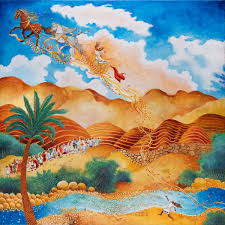
That’s just what Jacob gets in this week’s Torah portion. Jacob lies down while travelling on a certain mountain and has the profound dream of a ladder ascending to heaven, with angels going up and down.

In his dream, the Eternal One appears to promise Jacob many descendants, spreading out like dust across the desert, and that God will forever accompany Jacob on his travels.

When he awakes, Jacob exclaims: “Wow, God is in this place and I did not know it!”

How could Jacob not realise that God was on that mountain? Surely he already knows that God is everywhere?

Perhaps Jacob did not realise already that God is everywhere. For some commentators, this is the beginning of Jacob’s prophecy. Only now does he really understand who God is and that this God is with him.

There is a deeper meaning in the language, too. Before the revelation, God is called Elohim. For the ancients, Elohim was universal- the God that permeates all places and things.

Then, in the dream, God is announced by the ineffable Name, Hashem, which we often render as Adonai. This name of God, in Torah, is specific. It is the personal God, who communicates directly with human beings.

When Jacob awakes, he says: “Behold, Hashem is in this place, and I did not know it.”

Jacob knew that God in general was there, because God is generally everywhere, but only at this moment does Jacob realise that the personal God who cares about him is also present.

Now we can understand why God says to Jacob: “I will not leave you until I have done with you what I promised.” God is helping Jacob understand that he is never truly alone. Not only is the world full of God, but so is Jacob’s own life.

In fact, in the moment before Jacob falls asleep, a miracle happens that is so subtle it can’t be noticed until after he wakes up.

When Jacob lays down his head, the Torah says there are many stones in the place, and he takes one of them as a pillow. When he wakes up, there is only one under his head.

Our Talmud says that this is a divine act. According to Rabbi Yitzḥak, all the stones on the mountain argued with each other about who would lie under Jacob’s head. Unable to decide, they merged together into a single rock. That rock, in turn, became an altar to God.

This is a wonderful view of the world, where God is not only in all places and with human beings personally, but acts in every part of nature. Even stones are agents of miracles and servants of God.

If we take seriously this idea that God is everywhere and personally connected with all that exists, there are real consequences for our lives. It means that everything is sacred. It suggests that we need to treat this world as an arena for revealing divinity.

For Progressive Jews, this is one way we might think of commandments. Rather than just a list of dos and don’ts, they’re an attitude towards reality. They see everything as an opportunity to do good, and to make the world better. We are blessed with the chance to show how God is everywhere, including in our own actions.

The same section of the Talmud says that this is why God loves humanity so much. Angels can only praise God when they are told to. Rocks can only move by miracle. But we, endowed with freedom and reason, can perform miracles and make things sacred whenever we want.

That’s what I see when I look at the tzitzit of my tallit. That God is in every place and that every moment is a chance to do right.

You don’t need to wear a tallit to do that. This is my suggestion to you for this week. Try and shift, ever so slightly, how you see the world.

Look around, for a moment, and imagine that everything permeates God’s presence. See God in the bricks of your home and the slabs of the street. At some point this week, try to picture the space where you are as a massive canvas that you can paint with good deeds.

Let us all try to be like Jacob and say: “Wow, God was here, and I did not even know it.”

Shabbat shalom.


judaism · theology

A Theological Platform for a Judaism that Does Not Yet Exist

1. We are living in apocalyptic times. War, climate disaster, and neoliberal capitalism are plunging us into ongoing and worsening crisis. Apocalyptic times call for apocalyptic theologies.

2. When we survey how Jewish people rebuilt their communities in the face of devastation, we see that Jews have stubbornly held onto hope. From the destructions of the Temples, through Crusades and Expulsions, to colonialism and genocide, our greatest leaders have never wallowed in despair. They always reaffirmed their faith in God and humanity.

3. The task of building the Messianic age is more pressing than ever. Like our forebears, we affirm that the Messiah will not be a man, but a time, in which all will understand the Oneness that lies beneath all superficial differences. The Messianic Age will be defined by equality between people, peace between nations, and harmony with nature. Our task is to build it.

4. Because of faith in God, we understand that our desire for a transformed world is sacred and just. With an outstretched arm and wondrous deeds, God liberated the slaves from Egypt. God hears the cries of all who suffer and shares their pain. God continues to defend the dignity of all who are subjugated.

5. In every age, our people have sought to understand the will of God. In their hardship, they communed with their Creator. Out of their struggles, they developed theologies. These are our inheritance: Torah; Prophets; Writings; rabbinic literature; Jewish philosophies. We claim them for our own time.

6. Our texts are central to our worldview. They are incomplete and polyvocal. We will never make idols of them by treating them as unquestionable authorities. Rather, they are our dialogue partners to understand our God, our world, and ourselves. We uphold the tradition of questioning, reconsidering, and retelling. Every answer is open to interrogation.

7. We affirm belief in the pure monotheism to which our ancestors aspired. We seek to connect with God, who is singular and infinite; immaterial and transcendent; eminent and imminent. Our God is nevertheless directly part of our lives. As the source of ultimate truth, God seeks to impart to us truth as we can understand it.

8. Life has meaning. Its meaning is intrinsic. Everything that lives on this earth was placed here deliberately by a loving Creator to serve a purpose. All that affirms life affirms God.

9. Jews are called upon specifically and by name. We feel that the task of healing the world has been entrusted to us, personally and collectively. This is what it means to be chosen. The task of Jews is to speak God’s truth and to fulfill God’s dominion on earth. A world ruled by God will be one in which no human being can subjugate another.

10. God created all people, replete with diversity, deliberately. We do not wish to make others like us. We reject any uniformity. We accept that people inhabit multiple, contradictory, and overlapping spiritual realities.

11. We bring our spiritual reality to life through our rituals. Our laws, practices and customs are all articulations of our moral purpose. Even where they carry no obvious moral instruction, they instill within us discipline, wonder at creation, and hold us together in community.

12. Our ancestors call to us from history. As refugees and outcasts, they knew what it was to live on the margins. Their memories demand vindication.

13. We have witnessed the progress of humanity. Scientists have developed incredible medicines. Engineers have shown how to harness natural resources to power the entire planet. Activists have shown how collective strength can transform history. We believe that it is our duty to sustain that progress.

14. In the hands of oppressors, progress is a dangerous force. Warmongers have found ever more efficient ways to kill. Capitalists have found increasingly profitable ways to exploit. We have seen how human ingenuity can be employed for systemic violence. We must wrest the tools of progress from those who worship the false god of wealth.

15. Nationalism is a sickness that is plaguing the world. We repudiate all xenophobia and chauvinism. We will not worship the false idols of states and their symbols. We reject all efforts to politically divide humanity.

16. Until all of humanity is fully redeemed, we remain in exile. Only when everyone has achieved full political, economic and spiritual freedom can we say we have reached our Jerusalem. The earthly Jerusalem is as much a part of exile as any other city, until the day when it becomes the heartland for peace and brings all humanity into unity with God. As such, we align ourselves with all those who seek to bring about an earthly Jerusalem based on the prophets’ visions of dignity, human rights, and liberation.

17. Individualism is killing us. Human beings have survived by being social creatures. The ideas of autonomy and personal choice do not serve us in this age. We need to resist the atomisation of people and create community, which necessitates sharing norms, ideals, and practices.

18. We see the Jewish family as expansive and interconnected. We are all responsible for one another, and want to live as if we are one family. This includes a commitment to loving rebuke where necessary.

19. We return to halachah. We see it not as the binding decisions of previous generations but as the creative forum of the present, in which we find new ways to live by our shared values.

20. We commit to Jewish time, which is shaped like a snail shell: always progressing, and always returning to the same points. We return constantly to our shabbats, our fasts, and our festivals. Every time we return to them, we learn more of what God requires of us, and we urge ourselves on to the next stage of our development.

21. The end of time is coming. It does not have to be disastrous. It could be wondrous. Our telos is a perfected world. We will never reach it. We will always fight for it.

Rabbi Lev Saul

protest · sermon · theology

We are guests in God’s mansion


Suppose you woke up one morning and discovered, to your surprise, that you had inherited an enormous mansion.

The lord of the manor has welcomed you as a guest to his entire estate. You have no need to pay rent.

This country villa has plush places to sleep, wonderful waters to swim in, and endless entertainment.

More than that, this house is magical. It provides for your every need. Its luscious garden grows your favourite fruit and vegetables. There is plenty of space to graze and raise whatever animals you desire.

It belongs to you and your descendants forever.

What if I told you that you had indeed been bequeathed such a home, and that you were already living in it?

It is this Earth.

That is how Moses understood the planet on which we live when he instructed the Israelites in Deuteronomy. Moses wanted to impart to the people what a miracle it was to be alive, and to get to live in this abundant and fertile world.

So, says Moses, “the Eternal One your God is bringing you into a good land – with brooks, streams, and deep springs gushing out into the valleys and hills; a land with wheat and barley, vines and fig trees, pomegranates, olive oil and honey; a land where you can eat bread and never run out, where you will lack nothing; a land where the rocks are iron and you can dig copper out of the hills.”

This is the biblical mindset. You are guests in God’s mansion.

You have inherited a paradise and it is the whole world. The seas, the ice caps, the deserts, the mountains, and the forests. They are all yours. And they are all everyone else’s too.

Every human being was granted this world as a gift. Every living creature was placed here by their loving Creator.

Now, if you inherited a mansion like that, you wouldn’t trash it on the first day. You’d want to look after it and make sure your children and theirs got to enjoy it the way you did. You’d want to make sure the grass stayed green and the water kept flowing and the fruit trees kept producing. You’d want to know that everybody would be able to dwell in it for all time.

So, says Moses: “Keep faithfully every commandment I am giving to you this day, so that you can thrive and increase and come and inherit this land which was promised to your ancestors.”

Yes, this land requires no rent, but it does have conditions attached. You have to tend to it. You cannot be violent or greedy or deceitful. You must regularly redistribute the land, and make sure that everyone who lives in it gets their fill, and make sure everyone gets plenty of time for rest.

Well, these are small stipulations, given how wonderful my portion is. I get to live on this earth, which is so abundant, and all I have to do is look after it and share it? It sounds like a fantastic deal.

It is, but there is a trap. You see, you might get used to how great this mansion is. You might forget who gave it to you.

You might commit the gravest sin: you might think that this is yours, and yours alone.

This, says Moses, is a terrible error. “You may say to yourself, “My power and the strength of my hands have produced this wealth for me.” Instead, remember the Eternal One your God, for it is God who gives you the power to produce wealth.”

You might think that you earned the mansion, and you built it, and you can do with it as you please. Well, then, you would become a threat. A threat to the mansion and everyone that lives there. A threat to its babbling brooks and fig trees.

If you fool yourself into thinking this is yours, warns Moses, then “your heart will become proud and you will forget the Eternal One, your God, who brought you out of Egypt, out of the land of slavery.”

Yes, you have a dark past. A history of slaves and masters. There was a time when people claimed ownership over everything. They declared that the Nile River and the rainwater belonged to them. They hoarded the grain and took possession over the vineyards. They owned the animals. They even owned you.

Do you want to go back there?

Now, look around at our home, here in Surrey. This place truly is wonderful. Working here, I have had the chance to paddleboard down the River Wey, walk on the Surrey Downs, and watch others swim in Divers Cove. I can really believe this county was a gift from God.

And yet this county is certainly not treated as a common treasury.

How did it happen that God’s creation became so gated?

You see, Moses’s description of the world as a common heritage bequeathed by God wasn’t just an idle fantasy. That was how many people saw the world throughout a large part of history.

Until the start of the 17th Century, large swathes of English land were held in common by all people. This meant that everyone could graze the land together. They could rotate crops together; care for the land together; and make sure everyone got fed.

It’s not that England was one great egalitarian utopia. Far from it. There had been kings, paupers, lords, peasants, and landless workers, for centuries. But, at least a part of it was treated as a shared inheritance.

Then, in 1605, the government began a process called Inclosure. They took all that had been previously common and handed it over to the already wealthy. They stripped the poor from their land and forced them into the cities to work in factories. They destroyed whole ways of life.

This mansion, already divided, became the possession of just a few. Just as Moses had warned, the wealthy imagined that their power had come about by their own hands. They thought of themselves as more than lords; more than pharaohs: as gods.

Now, right here in Surrey, a group of people tried to resist them. In 1649, on St George’s Hill, and at Little Heath near Cobham, a group of religious dissidents got together, and decided that they would take the land back from the lords. They were called The Diggers.

Their leader, Gerard Winstanley, has a memorial plaque near Weybridge Station, and there is a tour you can take with historic placards, showing where the Diggers went.

The Diggers wanted a return to the Law of Moses and the biblical attitude.

In the Levellers’ Standard, Gerard Winstanley wrote: “The Earth (which was made to be a Common Treasury of relief for all, both Beasts and Men) was hedged in to In-closures by the teachers and rulers, and the others were made Servants and Slaves: And that Earth that is within this Creation made a Common Store-house for all, is bought and sold, and kept in the hands of a few, whereby the great Creator is mightily dishonoured, as if he were a respector of persons, delighting in the comfortable Livelihoods of some, and rejoycing in the miserable povertie and straits of others.”

Like Moses before him, Winstanley was adamant that God was not a propertarian but a generous host, and human beings simply welcome guests. How, then, could some divide up the land and force others off of it?

The Diggers lost their battle for the land, and the world we inherit is made according to the laws of those who enacted Inclosure.

But there is a message, that rings out through time, from the era of Moses through the 17th Century, and right up to today.

That message is that this world is a paradise, bequeathed to us all. And we need to act like it is so.

Shabbat shalom.

judaism · theology

Be humble about what we can know


Before the Enlightenment, the world was governed by unknowable spirits and invisible entities.

There was so much we did not know.

If your farm didn’t produce any crops or the skies did not give you enough rain, you did not have modern technology to inform you about drought predictions for the next three years. You would have no way to know that the water coming from your clouds was directly connected to oceans miles away.

But you had your priests, and your rituals, and your superstitions. You had small gods in the hill country to which you offered libations. And, so far, when you had upheld your traditions, the rain came as it was supposed to.

When you got sick with a skin infection, you could not see a GP who would consult a modern medicine manual and give you a cream that would clear it up in just a few days. You would not have knowledge about germs, allergies, and viruses.

But you had your priests, and your rituals, and your superstitions. You had your rules governing sin and repentance. You had reliable experience that bodily suffering could be healed by atonement. And, so far, when you had upheld your traditions, the rain came as it was supposed to.

Please hold this in mind as we read this week’s Torah portion.

It may be easy for a modern mind, after the Enlightenment, to scoff at the strange priests, rituals, and superstitions that govern these chapters in the Book of Leviticus.

You might feel slightly embarrassed to imagine the rites our ancestors slit open goats, threw their entrails around and burned them for days until they stunk out a tent as expiation for their sins.

You might squirm at the vivid descriptions of cotton-clad priests flailing around the limbs of slaughtered cattle to win the favour of their god.

It may even seem primitive how they delight at the animal fat creating explosive fire, which they see as evidence of their god’s approval.

But they were doing what they could with what they knew. And they were engaging earnestly with what they did not know. Beyond the world they experienced was an unfathomable mystery, and they wanted to draw closer to it.

Indeed, only verses later, we get an insight into their own feelings of inadequacy. We get a real sense that they knew how much they did not know.

Nadav and Abihu do absolutely everything right. They follow the priests, carry out the rituals, and trust in the superstitions. They are formally inducted into all the correct practices by their father, Aaron the High Priest.

They do everything right. And then they die.

The burning animal fat explodes in a blaze that kills them both.

How can our ancestors make sense of this?

Our Torah gives two answers. The first is from Moses. Moses recalls a prophecy when God said: “Among those who approach me I will be proved holy; in the sight of all the people I will be honored.’”

We may interpret this as a way of Moses defending God. Moses is saying: while this may feel like a violation of our belief system, it is in fact proof of it. Holiness is a very dangerous quality.

God has demonstrated how sacred it is to engage in the rituals. God has shown what honour and risk are involved in holy service. 

So, for Moses, this sudden death of their priests does not undermine their belief system. It’s just evidence of how little they understand about their sacred rituals. In the fire, they have reached the limits of their knowledge.

Aaron, too, offers an answer. Silence.

We may interpret Aaron’s unspoken response variously. We may read into it horror, resignation, anger, acceptance, or solemnity.

But regardless of what he was feeling, we see that Aaron has no intellectual answer to the problem. He neither agrees nor disagrees with Moses. Aaron finds the limits of speech. He finds the boundaries of what he can even express.

Moses and Aaron lived in a world of unknowable spirits, governed by superstition. They made sense of their confusing world through priests and sacrifices. And no matter how well they constructed their rituals, they still found their limits.

There were things they did not know.

But we live in an era after such theologies. From the 17th Century onwards, Western Europe was gripped by a profound truth.

As the people challenged the unlimited power of the established church, philosophers pulled apart the stories religions had told.

This was the Enlightenment.

No more would they be hoodwinked by magical thinking or damned by promises of divine retribution. Everything, every idea, would be subjected to ruthless scrutiny. The greats of these generations would challenge the tenets of even science itself.

We live now in a world formed by their ideas. While our ancestors were beholden to talismans, omens, and sacrificial fire, we have evolved to hold modern ideals of truth and rational enquiry.

So, why hasn’t religion disappeared?

Isn’t that the obvious next question?

We have rid ourselves of superstitions, but synagogues are stronger than ever. Most of the world is still deeply religious. Despite constant predictions of its demise, faith remains stronger than ever.

For those who wish to understand God’s persistence after the Enlightenment, they may want to look to Immanuel Kant.

Kant was the last of the Enlightenment thinkers. His impact on this period of intellectual history was so great that some even date its end to his death.

Kant was a profound writer on truth, ethics, the scientific method, and what we can really know. He was also a devout Christian.

Kant was animated by the same questions that bothered our ancestors who witnessed Nadav and Abihu die.

He was not confused about why burning fat could cause a blaze, or why religious rituals didn’t always yield the same results. Those were the questions of the past.

The question still lingered, however: why does it seem like there is no justice in the world? Why do bad things happen to good people, and why do the wicked seem to get away with it? Why, no matter what happens, does evil seem to persist?

In his essay, The Miscarriage of All, Kant says he will put God’s justice before the trial of reason. Kant contemplates all the possible answers.

Maybe what we think is evil isn’t really. Maybe the world works in ways we don’t understand so that evil has to be permitted. Maybe there are other forces in the world beyond God’s goodness.

And Kant gives us an answer, which is… we don’t know.

All of these explanations only expose the limits of our understanding.

None of the answers anybody has come up with is satisfactory.

We are finite beings trying to understand Infinite Truth.

And still, says Kant, we retain our faith.

For Kant, none of these questions undermine the existence of God’s justice. They just show what we do not know.

So, perhaps we need to approach these stories with more humility and less contempt.

The ancient priests may well have splashed ox blood around an altar to ward off sin, but we are no closer to answering the questions that motivated their rituals.

We are barely separated from them by any time at all.

We are still just animals, scrambling in the dark, trying to make sense of our world.

And we still need each other, with all our beliefs and rituals, to get through this life that can seem so unjust.

We are each other’s guides through a mystery we may never resolve.

We need to be humble about what we do not know.

social justice · theology · torah

We are waiting for a different Messiah

Some years ago, an Orthodox friend asked me: “what would you do if the Messiah came and it turned out we’d been right about everything? What would you say to the Messiah?”

What would I do if the End of Days came, and Elijah literally came storming out of the whirlwind in a chariot made of fire and declared that the Son of David had arrived to cast judgement? And that we were to be judged on how strictly we had separated men and women; how well we had obeyed family purity laws; how stringently we had adhered to traditional authorities?

What would I say to this Messiah?

I have thought about it for a good few years and I think I now have my answer.

I would say: “F@£& off.”

I would tell that messenger: “You are not my Messiah and you’re not my king. Now go back where you came from.”

In this week’s haftarah, we read the prophet Ezekiel’s vision of the valley of the dry bones. For centuries, Orthodox Judaism has based its understanding of Messianism on these verses.

Ezekiel finds himself in a desert surrounded by skeletons. God tells Ezekiel to prophesy to the bones, and he does so, covering them in sinew, breathing life back into their lungs, and reviving their bodies, so that they stand up as a skeleton army.

These, says God, are representative of the people of Israel.

So, Orthodox Jewish tradition teaches, a day will come when the dead are literally physically resurrected. The corpses of pious Jews throughout the ages will be brought back to life; the exiles gathered to Jerusalem; and all judged by a righteous king descended from the biblical King David.

For this reason, many Orthodox Jews eschew cremation, and insist on being buried intact, so that their bodies can be resurrected at the End of Days. They vie for graves on the Mount of Olives, so that they can have front row seats when the Messiah arrives at the walls of Jerusalem and summons up the dead from their tombs.  

In recent decades, religious fanatics have come to espouse an even more intense version of this apocalyptic vision. 

There are Orthodox Jewish extremists, funded by American evangelical Christians, who are trying to destroy the Al Aqsa Mosque on the Temple Mount; build a Third Temple; and restore animal sacrifice and priestly leadership.  They seek to expand Israel’s borders to restore the ancient Kingdom of King David.

This week, Rabbi Charley Baginsky was quoted powerfully in The Times, saying: “We are afraid — not just for Israel’s future, but for Judaism itself. What becomes of our tradition if it is captured by messianic extremism, by racism disguised as religion, by power without principle? If the current trajectory continues, if Jewish supremacy becomes policy, then Judaism itself may become synonymous with oppression.”

In this context, you might be forgiven for thinking that messianism itself is the problem. Surely a religious zeal that drives people to commit such crimes is itself dangerous. For some, witnessing this fervour makes them question the foundations of Judaism itself.

The Israeli religious scholar, Avraham Uriah Kalman, warns against this way of thinking. His article earlier this year, entitled Another Messianism, addresses a tendency in Israeli secular society to dismiss all religion as varying stripes of nationalist fanaticism.

Yet, he claims, precisely because of the strength with which racist extremists have captured Judaism, we must return with equal zeal in our reclamation of Judaism. We, who believe in justice, democracy, and human rights must just as vigorously defend our corner.

If we do not have an equally powerful vision for what society could be, we will always be on the back foot, compromising with monstrous ideologies that want to blow up buildings and raze down villages.

Our ethics are grounded in the Jewish tradition. They are derived from the Jewish texts. They are sourced from the Living God. 

We cannot allow the far right to take exclusive hold over any part of Jewish life, or we surrender it to them. That includes Messianism – the grand utopian visions of ideal societies promoted in every book of the Prophets. 

The Prophets, whose mission of speaking truth to power and uplifting the lowly, are far more in line with our Progressive visions of the world than they are with the soulless dreams of those who want to oppress women and gays as part of their supremacist agenda. 

In the Prophets, we see clear visions of a perfected world. Their writings testify to a world of peace; where all resources are shared; where everyone lives in dignity; and where all are free.

Outside of specific esoteric texts like this week’s mystical imaginings from Ezekiel, it is hard to see any of the far right’s fantasies reflected in our Prophetic texts.

Messianism is really supposed to represent a rupture in the established order, but that is not really what the far right offers. War, racism, and misogyny are already the norm. At core, they don’t really want to change anything except to make existing tendencies more violent and oppressive.

So, says Dr Kalman, progressives must embrace messianism. We must turn to the Prophets as our source of hope, rather than buckling under the weight of despair. From our own utopian visions, we can develop ethics that speak to our daily lives and help us practically realise a better religious vision.

Kalman draws on a whole range of Jewish religious traditions, including Talmud, Kabbalah, Musar, and 17th Century Tzfat mystics. 

Yet, curiously, he seems not to be aware that this project, of developing a Progressive Messianism, has already been deeply thought through. The early Reform movement in Germany, from which Liberal Judaism descends, was animated by looking to the Prophets to rethink Jewish eschatology.

The early Reformers taught that the Messiah would not be a man, but an Age. 

It would not be characterised by Temple and Kingdom revival, but through the realisation of the values of the Prophets. It would be a world of peace and justice, achieved through the moral advancement of all humanity.

Explaining this theology, Rabbi Sybil Sheridan writes: 

“Though the end goal is world peace, the ideal is not pacifism, nor is it the peace of treaties at the end of war that are based on winners and losers. That notion continues the imbalance of power among peoples and nurtures the resentment that leads to dreams of revenge. The peace of the Messianic Age is a peace forged in complete mutuality. No one should be afraid that people may covet their vine or fig tree, no one will fear the loss of land or resources, no one will be humiliated. The world provides enough for everyone and sufficiency will take away the desire for war.”

While we Progressives do not accept the Orthodox doctrine of bodily resurrection and rebuilt Temples, that does not mean we should reject Messianic thinking. Times of despair and horror are when we most need to cling onto our hopes for a better world.

Progressive Messianism takes the task of perfecting the world away from mythical figures like Elijah and King David, and places it directly in our own hands. It says: we will not wait for someone else to bring about redemption; we are going to do it ourselves.

So, if Elijah came down from the Heavens and declared that the Orthodox had been correct all along, I would tell him he was wrong. 

For thousands of years, we have sought to create a better world. We have learnt through struggle about the dignity of women; the importance of justice; and the shame of racism. We now have a much better idea of how the world can be.

We can see a future in which every human being lives in harmony with each other and their planet. We can see a world where all live in freedom and peace. We are sure now that we can live in love and equality. 

We are going to realise our Messianic age.

And nobody- not even a prophet descending from the skies – is going to stand in our way.

israel · sermon · theology · torah

Why does God not just stop the war?

“How many more signs do you need that God is not there?”

This was the question one congregant asked last week when I went round for a cup of tea. In fact, a few of you have asked similar things recently.

None of you was asking out of arrogance or triviality, but expressing a real despair at the state of the world.  The ongoing war, which has claimed far too many lives, is enough to incite a crisis of faith in even the most devout believers.

Why will God not just stop the war? It is a serious question, and one that deserves a serious answer.

How desperate are we all to see a ceasefire, to see Gaza rebuilt, to see the hostages returned home, to know that the Israelis will no longer hide in bomb shelters, to know that no more people will be rushed to hospitals, to see an end to all the violence and bloodshed?

And it goes deeper than that. How much do we all wish that none of this had ever happened; that there was no war for us to wish to end?

In our anguish at the cruelty, we cry out to the Heavens. There is no answer from On High, so we wonder if there is Anyone there listening at all.

I will not be so presumptuous as to imagine I have the answers. I do not know the nature of God and can give no convincing proof of how our Creator lives in this world. In fact, if I found anyone who thought they did, I would consider them a charlatan.

The great 15th Century Sephardi rabbi, Yosef Albo, said: “If I knew God, I would be God.” We are, all of us, animals scrambling in the dark, as we try to make sense of the mystery.

But we come to synagogue so that we can scramble in the dark together, feeling that if we unpick the mystery in community, we will get further, and develop better ideas. Allow me, then, to share some of my own thinking, so that we can be in that conversation together.

How many more signs do you need that God is not there?

In our Torah, there were times when God did indeed show signs of presence. In the early chapters of Genesis, God walks through the Garden of Eden in the cool of day. At the exodus from Egypt, God came with signs and wonders and an outstretched arm. As the Israelites wandered in the desert, God appeared as a pillar of cloud by day and a pillar of fire by night.

This is the kind of sign that we might want from God now, then.

At a hostel in Jerusalem, I met an evangelical Christian who was absolutely convinced that everything happening in the Middle East was already foretold by the Bible and that God was about to rain down hell on the Palestinians and then all the Jews would finally accept Jesus.

Suffice to say I do not think such a God would be worthy of worship.

And I highly doubt this is the kind of divine intervention any of us would embrace.

Is there an alternative way we could wish for a sign?

Some great indication that Someone greater than us is involved in the story and cares about human suffering. Perhaps just a gentle hand to reassure us everything will be OK.

Deep down, most of us know that no such sign will come.

God did, however, send another sign in the Torah. A sign, perhaps, not to look for signs. A sign that God was not going to get involved, no matter how desperate it all seemed.

The rainbow.

At the start of the story of Noah, the world was filled with violence. Everyone had turned to war – nation against nation – all against all. The entire planet was rife with destruction.

God slammed down on the reset button. God sent a flood so catastrophic that it killed everyone bar one family. The flood was like a thorough system cleanse, designed to strip the earth back to its original state and allow Noah to rebuild.

Then, as soon as the rains had stopped and the land had returned, God looked at the devastation, and swore: “never again.”

God promised Noah: “I will maintain My covenant with you: never again shall all flesh be cut off by the waters of a flood, and never again shall there be a flood to destroy the earth.”

God hung a rainbow in the sky, and told Noah it was a symbol that there would be no more divine interventions:

“When I bring clouds over the earth, and the bow appears in the clouds, I will remember My covenant between Me and you and every living creature among all flesh, so that the waters shall never again become a flood to destroy all flesh.”


The rainbow, then, is a sign that God is there, and a sign that God will not get involved. Even if humanity goes back to being as violent as it was in the Generation of the Flood, God is not going to step in and destroy as at the start.

If the rainbow is a sign that God will not come and strike people down when the world is in crisis, it is also a sign of the other half of the covenant. Human beings must now be God’s hands on earth. We have to be the ones to do what we wish God would.

For Jews in the rabbinic period, every rainbow was a reminder to them that God would not act, so they had to take the initiative. They would look up at the sky and say “blessed is God, who remembers the covenant.”

According to the Jerusalem Talmud, no rainbow was seen during the entire lifetime of Rabbi Shimeon bar Yochai. He was so righteous and brought so many others to do good deeds that there was no need to be reminded any more of the covenant. Bar Yochai was one who acted so much like he was God’s actor on earth that even God did not need to send reminders.

The idea that human beings had to be God’s hands became even more important in the post-Holocaust world. Rabbi Eliezer Berkovits escaped from Germany in 1939 and went on to become one of the leading Orthodox rabbis of the 20th Century. For him, a traditional religious Jew, grappling with the enormity of the Shoah, he had to find a way to deal with God’s seeming absence at Auschwitz.

So, Rabbi Berkovits said, the problem lay not with God’s inaction, but with humanity’s. In his book, Faith After the Holocaust, Berkovits wrote:


“Since history is man’s responsibility, one would, in fact, expect [God] to hide, to be silent, while man is going about his God-given task. Responsibility requires freedom, but God’s convincing presence would undermine the freedom of human decision. God hides in human responsibility and human freedom.”

What Berkovits is saying is that it might be in God’s nature to prevent catastrophe, but it would undermine human nature if God did. In order that people can realise our freedom and our full potential, God has to stand back.

It seems that, in almost every generation, Jews are asking why God does not intervene to stop violence.

In each generation, we find an answer: God does not intervene, because that’s our job.

It’s not that any of these classical sources doubt God’s existence or question God’s presence. They just don’t think it is God’s responsibility to act. It is ours.

There is no flood coming to wipe out war or lightning bolt coming from the sky to strike down the wrongdoers.

We began with a question.

How many more signs do you need that God is not there?

Perhaps we can now reframe it positively.

How many more signs do you need that you must act?

God is not going to stop war. So we have to do our bit to bring it to an end.

Even in our small corner of the world, we have to do all we can to push for peace and justice.

So, on the days when you find yourself looking for the sign, you be the sign.

You need to be the sign to somebody else that there is hope in this world.

You need to be the sign that peace is possible.

You need to be the rainbow.

Shabbat shalom.

sermon · story · torah

Abel was a nomad, and you may wander too

When they lived in Eden, Adam and Eve did not have to labour for their food. Yet, in the moment that they were expelled from paradise, God gave them stern instructions on what they would have to do.

God warned: “Through painful toil you will eat food from it all the days of your life. By the sweat of your brow you will eat your food until you return to the ground, since from it you were taken; for dust you are and to dust you will return.”

Where once they had a homeland, the original people were cast out into a state of permanent exile, to live in the world with all its struggles.

This fable, though mythic, tells us something true about how human beings came to have the life we do. While there was probably never really an original idyll where people lived without work, there was a moment, millennia ago, when humanity’s ancestors shifted how they lived. 

For most of our history, we had wandered. All people were nomadic. They hunted and gathered, migrating between caves and carrying temporary shelters all over the neolithic continents.

Then, as the last Ice Age ended, around 11,000 years ago, people discovered that they could store seeds from one year to the next. They developed agricultural systems, with plots of land dedicated to growing crops. Having once roamed the earth, they could stay put in a single place, which would be their land. 

Cain and Abel are archetypal characters who tell us about this great change. Abel was a nomad, who herded flocks and grazed them over the hills. His name means “breath” or “waif” – for, like a cloud that drifts across valleys, he wafted without leaving a trace. He was a symbol of the old way of constant movement. 

Cain, his brother, had a name which meant “acquire” or “possess.” Just as God had warned his parents when they were cast out from Eden, he worked by the sweat of his brow. He laboured on the soil, where he sowed, grew, and harvested plants for food.

At the dawn of civilisation, these were the two types of people: those who cultivated the land in fixed places; and those who travelled with no fixed abode. Everything that was movable, like herds and clothes, was held by the nomads, the Abels. Everything immovable – like allotments and orchards – was owned by those who settled, the Cains.

Our Torah says that God favoured Abel over Cain, and it probably felt that way. While agriculture can keep people settled and build lasting cultures, it is unpredictable. One bad year of too much rain, or not enough, or bad seeds or infertile soil, can leave an entire community famished and ruined. 

A pastoralist, on the other hand, has a tough but durable existence. The life of a shepherd means much moving, but that is part of what makes their life sustainable. Sheep can be moved to wherever water is healthy and available. A goat can graze on thistles and other crops that people find inedible.

So, yes, to the ancient mind, it may have seemed like God looked more kindly on the one who wandered than the one who farmed. 

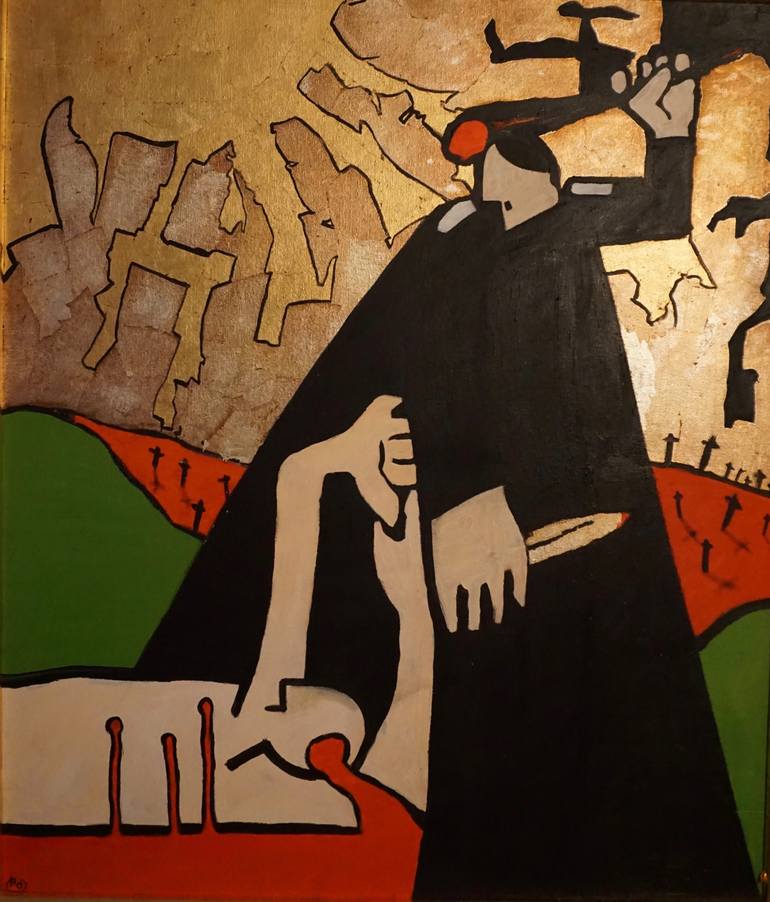
Cain killed Abel. 

The one who tilled the land and made it his home sought to destroy that wandering waif. Perhaps, indeed, he did. Perhaps the founders of the earliest civilisations enforced their new way of life with violence and coercion. 

But not successfully. As soon as Cain commits the first murder, God tells him what he will become. Cain cries out at his punishment: “Today you are driving me from the land, and I will be hidden from your presence; I will be a restless wanderer on the earth, and whoever finds me will kill me.”

For killing Abel, Cain would become Abel. Having been the acquirer, he would take his place as a nomad. Having been so sure in his farmland, Cain would return to the ancient ways of roaming. 

God said to Cain: “Abel had no homeland. Now neither do you. Abel was forced to wander. Now you will wander too.”

Generations passed, but the draw of homeland was irresistible. In ancient Mesopotamia, Abraham was called “ha-ivri” – border-crosser; the one who passed between places. 

He heard the voice call out: “Go, get going, to a land that I will show you,” and Abraham traversed to Canaan, to a new land where he hoped he would settle. 

He took his family, and his possessions, his movable goods that had sustained him in all his wanderings, and went in search of home. 

But, having reached the land that God would show him, he saw it and he left. He pitched his tent and built an altar, then carried on to Egypt. When he returned, he did so as a nomad, travelling with his flocks, threatened by the Canaanites and Perizites who had acquired the land, as Cain had once done.

Abraham sought a home, and found one, but it was never a permanent space. He had wandered to be in one place, but in that one place, he found he had to keep on wandering. 

Abel, Cain, and Abraham all wandered. So did the Israelites in the desert. Deep in our ancient stories, there is an idea that, while a settled home may be desirable, migration is part of the human experience. We may dream of Edens, but life is unpredictable, and fortune may force us to move. 

In Torah stories, we learn the survival of migrants, passed down from generations who knew what it meant to move with the seasons. 

It is a deep knowledge, from before we were Israelites or even Jews, stretching back to our history as neanderthals. 

Please do not imagine that I am romanticising exile. Travelling breeds resilience and creativity, but it is far from idyllic.

Instead, wandering is an inevitability. 

In every community and in every family, if you go back far enough, you will find a traveller. In the stories of our Torah, you learn that it could be you.

Abel was a restless nomad, and we may wander too.

Shabbat shalom.

Cain and Abel, by Frank Hoesel

I learnt this Torah from Rabbi Joel Levy at the Conservative Yeshiva in Jerusalem.

israel · theology · torah

I believe that God is screaming.

A few weeks back, I attended a retreat with Christian colleagues. At some point, surprisingly enough, we got onto talking about God. I asked one of the priests a question: “do you believe God speaks to you?”

He looked slightly bewildered by the question. “Literally?” he asked. “No, not really.” He shook his head.

The answer seemed obvious. After all, we were liberals, at an interfaith event. That kind of talk is for fundamentalists. We’re all too rational for that. 

“Why?” he asked, turning back to me, “do you?”

“No,” I said, sheepishly. I don’t know why I felt so embarrassed. Of course, many believers see the voice of God mostly as a metaphor, or as a way of giving expression to moral intuition. I’m just not one of them. 

I do believe in a personal God, who has a loving relationship with every human being on earth. And I do talk to God. It’s not that I expect answers in any sense, but I do believe some One is listening: that prayers are more than idle words I recite to myself.

Perhaps my Christian colleague would have agreed with me if I’d put it in these terms, because finding vocabulary to talk about God is hard. Words like ‘literally’ and ‘metaphorically’ start to evaporate when you are dealing with faith.

I think, perhaps, the reason I gave a sheepish no – maybe even that I asked the question at all – was that I was having a mini-crisis of faith of my own. Ever since the war broke out, I have been praying differently, more fervently, desperately begging the Universe for peace. I have been hurling questions and recriminations into the void. I have been wondering… do I still believe in this God?

My personal relationship with God has carried me through some of the toughest times. When I have felt most lonely, God has been like a best friend. When I have hated myself, God has been like a lover. When I have needed direction, God has been a wise counsellor. I have looked to God in every time of disaster, and always found comfort in a loving Presence that reaches out and caresses from across a boundary of unknowability.

But now I listen for God’s voice. And all I can hear is screaming. 

As long as there have been people who believed in religious meaning, there have been those who questioned it. Usually, they were the same people. Abraham, Moses, Hannah, Kohelet, Job: they all had faith, and they all questioned it. They asked questions so that they could challenge their beliefs, and refine them. Lately, although less adequately than those prophets, I have been forced to do the same thing.

The first question we usually ask when confronted with crises of faith is “do I believe in God?” Fairly regularly, people come to me with conclusions one way or the other: “you should know, rabbi, I don’t believe…” or “you should know, I have a strong sense of belief…” My follow-up is always the same “… and what is it that you do (or don’t) believe in?”

For me, the answer is moral truth. When I talk about believing in God, what I am saying is that moral statements are not just opinions. When we say “murder is wrong” we are not just expressing a preference, like “my favourite flavour of ice cream is tutti-frutti.” We are describing a reality, no different to the claim that there are 24 hours in a day. We are describing something literally true.

I think that’s what God is. When we want to know why our feet are firmly on the ground, we give the shorthand answer of “gravity.” When we want to explain why objects in space interact with each other as they do, we use words like “attraction.” And when we want to express how we know that murder is wrong, we use the word “God.”

So, in feeling the great sense of angst I have had since the war began at the end of the High Holy Days, I am forced to return to the old questions. I am forced to ask whether I still think moral statements are true. I am forced to ask whether I still believe murder is wrong.

I do.

And that is why I believe that God is screaming.

What we talk about when we describe God is obviously more complicated: it is something infinite, and greater than we can put into words. That’s why words like “metaphor” and “literal” are so inadequate – because we are describing something more real than reality. So we have to find shortcuts. We have to find ways of talking about God in human language, to make sense of God on human terms. God is then “a tender parent”; “a loving shepherd”; “a righteous judge”; “a generous creator.” All of these are good descriptors, and all of them are incomplete.

I have been relying on a version of God that has worked for me for a while. I have imagined a sweet aunty or a gentle older friend. In times of loneliness, desperation and heartache, that image of a loving God has helped me get through the day. But that image doesn’t serve me now. I think if I used God for comfort in a time like this, I would be retreating from responsibility. God does not need me to feel safe now, but to shake me from illusions and complacency.

If God is the moral voice of the universe, that voice must be crying out in desperation.

In the last few months, 23,000 Palestinians in Gaza have been killed by Israeli bombs. I am kept awake at night thinking about that. I imagine God, smothered by the rubble of obliterated hospitals, calling out. Like Abel, stricken by Cain, the voice of the blood is calling out from the ground (Gen 4:10). I imagine God, pulled from the wreckage, crying: “Thou shalt not kill. (Ex 20:13) Thou shalt not kill. (Deut 5:17)”

Those were the commandments given to the Jews, above all others. In some variations, it is the very first commandment, the one that holds the most power. And as Israel stands in the dock at the Hague, it is not only South Africa that places it on trial, but God too, who comes with the accusation: “did I not tell you: thou shalt not kill.”

Since the war began, Israeli settlers, with governmental support, have seized around 20 villages in the West Bank, displacing thousands of people, so that Jewish Israelis can expand their territory and claim others’ homes. I imagine God calling out from deserted towns, on the trail with refugee families, wailing “thou shalt not steal” (Ex 20:15), “thou shalt not steal” (Deut 5:19).

Netanyahu says, unabashedly, that he will push the Palestinians from Gaza and create a new border with Egypt. The Torah answers, in desperation: “thou shalt not move thy neighbour’s boundary” (Deut 19:14). Land theft is a sin.

Israeli soldiers enter Gaza and use Jewish symbols as weapons. They recite the Shema from the pulpits of mosques and place mezuzahs on Palestinian homes. They desecrate our religion. They destroy our faith. From the depths of history, God cries out “honour thy mother and thy father (Ex 20:12); honour thy mother and thy father (Deut 5:16).” Do not profane the faith of your ancestors with war crimes.

Worse still, the politicians claim that God gave them the right. That this is what the Torah intended. Can you not hear the scream of revulsion as God decries: “thou shalt not take My name in vain (Ex 20:7); thou shalt not take My name in vain (Deut 5:11).” This is what was intended: do not abuse God’s name for worthless pursuits like war, but elevate it for the purposes of peace. 

I believe that God is screaming. 

The commandments may once have been given as words of instruction or even as a love letter, but now they are a desperate plea. 

God says “I am the Eternal One thy God, which brought thee out of the land of Egypt, from the house of bondage. Thou shalt have none other gods before me.”

No other gods. No state, no flag, no military, no leader, no ideology, no grudge, no border, nothing. None of these can ever be placed before God. None of them have any trump over God’s words.

God’s word says: “You shall not pollute the land in which you live; for blood pollutes the land, and no expiation can be made for the land, for the blood that is shed in it.” (Num 35:33)

So I believe I can hear God screaming: thou shalt not kill.

And I do not want to silence that voice. I want to amplify it. I want the Holy Torah to be heard now, more than ever. I hear God screaming, and I want to join in.

Thou shalt not kill.

Thou shalt not kill.

Thou shalt not kill.

sermon · theology

A grown-up God for grown-up Jews


When we are children, we have a child’s view of God. A big bearded man in the sky with a benevolent smile, a beard and sandals. Maybe a maternal godhead, embracing us.

We imagine God as our idealised parent, fulfilling all our needs, giving punishments and rewards, guiding us to do right. We see the world as children because we have no other reference point.

Then, we become teenagers, and our worldview shifts. Suddenly, we are able to question authority, push boundaries, and assert our own independence.

We go through growth spurts, physically and emotionally. We close the gap in height with our parents so that we can see over their shoulders. They are no longer demigods, but imperfect human beings that we can challenge.

At this point, many of us give up on God. The childlike view we once had cannot hold, because the view we had of our parents has altered too. We realise that, if we can challenge authority, we can push back against the ultimate force we had imagined too.

I fulfilled the stereotype of a rebellious teenage atheist. I rejected the sky-daddy and all the nonsense of religion. This was a pretty lacklustre rebellion to my parents, who were themselves Marxist atheists.

I don’t remember the moment I stopped believing, or when I started again. But when I came back to faith, the beliefs I held were not the same as when I had been a child. I had to reconstruct God.

I took snippets from Jewish tradition. I listened attentively to my friends who were Quaker, Baptist, Muslim, Sikh, and Catholic, finding the parts that resonated. I reimagined what it would mean to believe in God if the Divine Parent surrounded by clouds no longer existed.

I realised that many others had engaged in the same thoughts too. All the while, when grown-ups had been talking about God, they hadn’t believed in the primary school version either. They had also gone through that process of maturing, and their ideas had developed with them.

It turns out that the God that atheists don’t believe in, the religious don’t believe in either.

This week is the Israelites’ coming of age.

Throughout Genesis, we only knew the God of stories. God created the world; God made people and gave them special purpose; God gave out punishments for wrongdoing and rewarded the good.

Now, we find ourselves in a situation in which we must rebel. We enter the Book of Exodus, where the Israelites are enslaved and forced to do hard labour. They are beaten and abused. Meanwhile, all around them, the Egyptian empire and the social order on which it is built are crumbling. We cannot believe in their gods, and we cannot find our own.

Our hero, Moses, sees through the nonsense. He stands up against his father’s power in the royal palace. He beats a slaver to death. He breaks away from the only regime he has known and runs into exile.

In the years that Moses ran away, he had to give up on all his old beliefs. The fantasies he’d held about his family. The dreams he’d had about what his own life meant.

He married a woman of a different tribe, Tzipporah, and worked for her father, Yitro. They were Kenites, and Yitro was a Midianite priest. Perhaps Moses could just have substituted his old beliefs for the Midianite ways. He would have simply worshipped a new pantheon of gods and taken on different customs.

Instead, Moses is forced to reimagine God altogether.

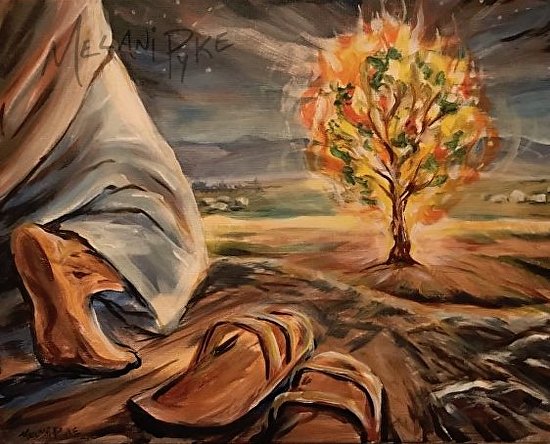
While tending his flocks, Moses meets his Creator in a thicket on a mountain. He sees a bush on fire, but not burning, that calls out to him and demands he remove his shoes.

Could this be one of the gods of Midian or Egypt? Could it be one of the spirits that inhabited the ancient world?

Moses must know. He asks “who are you?”

The voice from the burning bush replies: “אהיה אשר אהיה.” I will be what I will be.

This God does not have a name. It is not one of the idols that the nations worship. It is not something that can be held or controlled. This God will be what it will be. This God is the sum total of all that will ever exist.

When I teach bnei mitzvah children portions, I try to get them to understand what they are saying, so I teach them the roots of Hebrew words. They learn what is going on in each word of their parashah.

In Hebrew, every word has a root: three letters that hold all the possible meanings. Words like kaddish (the prayer for the dead), kiddush (blessing the sabbath), and kiddushin (getting married) all have the same root: kaf-dalet-shin. The root gives us all the words to do with holiness and making things special.

In nearly every parashah, we get to the unpronounceable name of God. The students nearly always try to pronounce it, but find it quite impossible.

We don’t say the word as it appears, but substitute it with “Adonai” (my Ruler) or “Hashem” (the name). That way the name stays sacred, or kadosh.

And then I teach them the root of this ineffable name. Hashem is a composite of three words: היה (what was); הוה (what is) and יהיה (what will be). God’s root is existence. God is the thing that always exists, and from which all existence comes.

When God says “I will be what I will be,” it means that God is everything. God is existence itself. God is whatever it means for something to actually exist.

This is the mature view of God. It is not a fairytale or a Santa Claus. It is a way of understanding all of reality.

This God will not do what it is told, or sort out your problems for you.

That’s why this God comes with a demand. “Go back to Egypt. Get over there and bring the people out of that land. Do whatever you can, bring everyone with you, and get yourselves free.”

When we are children, we have a child’s view of God. One who gives out punishments and rewards. One like an ideal parent.

Now, we are faced with the good of adulthood. The one who is the foundation of all existence. The one who gives all life meaning. The one who says: “I am not going to free you by magic. You will have to start freeing yourself.”

Shabbat shalom.

protest · sermon · social justice

God died last month

God died last month.

The newspapers barely reported it. No politician offered a eulogy. There was no radio broadcast of a moment’s silence. The subject did not come up over dinner. God died last month and we barely noticed.

How is it possible that God could die? Who could kill God so callously and get away with it? To understand what happened to God last month, you need to know everything that happened to God since the beginning. You need to hear about God’s life.

It was after the Exodus that the Israelites began to see how vulnerable God was. They had been redeemed from Egypt. They had crossed the Sea of Reeds. They had received the Ten Commandments from a thunderstorm. 

Moses, Aaron, and seventy elders ascended the mountain once more to ratify their covenant with that God Almighty. When they reached the summit, they were shocked by what they saw. 

Under God’s feet were building bricks like sapphire, as blue as the sky itself. Those feet were trapped. Those beautiful bricks bound them. The elders asked what had happened. God replied: “As long as you were enslaved, I was enslaved too. As long as you built bricks from clay, I built bricks from clouds. As long as you were in pain, I was suffering too.” 

Of course, not all of God could be imprisoned. The infinite God transcends all space. But there is a part of God that lives with us and in us. A part of God labours when we toil. Cries when we cry. Hurts when we hurt.

The Israelites continued to catch glimpses of God’s frailty throughout their relationship. God had promised Jacob at the outset: “I will go myself with you to Egypt, and I myself will bring you back.”

It wasn’t just a promise of solidarity. It was a sad admission that, when the Israelites were refugees, God would be in exile too. When the Babylonia came to displace them and hold them in captivity, God travelled with the Israelites to Babylon. God sat with them in the synagogues. God was weeping by the river banks too. 

Of course, not all of God could be exiled. The infinite God transcends all space. But there is a part of God that lives with us and in us. A part of God leaves when we leave. Cries when we cry. Hurts when we hurt.

God’s sympathy was not confined to the biblical age of miracles and prophecies. God stayed with us through history, even when we thought we had been abandoned. Yes, even in the concentration camps. God was there. 

Elie Wiesel survived the Nazis and came to tell us what he had seen. He saw a child strung up by the guards, dangling. The child was left there for hours, dying in slow agony. The camp inmates had to stare him in the face with his still-red tongue and eyes not yet glazed.

“Where is God now? Where is He?” someone behind him asked. “Where is God now?”

And Wiesel whispered inside his heart: “Where is He? Here He is—He is hanging here on these gallows…”

God died there in Auschwitz. Of course, not all of God could be killed. The infinite God transcends all time. But there is a part of God that lives with us and in us. A part of God leaves when we leave. Cries when we cry. Hurts when we hurt. Dies when we die.

God has died with us many times. One hundred thousand sacred sparks have been extinguished in the UK this year alone. But God does not die in statistics on spreadsheets. God dies with one person at a time when one story is snubbed out too early in an unspeakable injustice. That is how God dies.

And now you know how it was possible for God to die last month. And now you need to ask why. 

God died on 9th January at his home in Cardiff. He was 24 years old. He had been in police custody because someone suspected he had breached the peace. We are still not sure what that means. He was released without charge.

When his aunt picked up from the police station, he was covered in wounds and bruises. She says he didn’t have them when he was taken to jail. 

52 police officers had contact with him in the 24 hours that he was held in Cardiff police station. None of them saw anything suspicious. The police are running toxicology reports and investigating themselves. They are looking at the CCTV footage but so far they have found no misconduct by officers and no use of excessive force. 

The police have refused to release the footage. They say we will never see it.

We may never know how God died or why. But we know that God died last month. 

And he was a black man named Mohamud Hassan. And he had a life that was worth living. And he should not be dead now.

And now you know how it was possible for God to die last month.

And now that you know that God has died, you are a witness to the crime.

And now that you are a witness, you will have to testify.

You are summoned before the Only Judge to give your testimony about why he died.

Black lives matter. 

Shabbat shalom.

The white fire says “Black Lives Matter.” The black fire contains Exodus 20’s commandment: “Thou shalt not murder” in Hebrew. Artwork by Rachel Stone.