Hi, my name is Lev, and I’m a rabbi. I’m here because I need your help.
I’m looking for a Jewish community. I’ve been trying to build one on my own, but it’s been so difficult.
Last week, I put on my best clothes, and sat in my living room alone saying “amen.” Honestly, it wore off after only five minutes. So I went into my kitchen, where I lay out a lovely spread of bridge rolls and fish balls. I stood around awkwardly with crisps on a paper plate, but there was nobody to make small-talk with.
It was worse during the Holidays. At Purim, I played every character in the spiel, and acted it out to myself. At Pesach, I had the Afikoman in a place I thought my guests would never find it, but then, I was the only guest, and I found it straight away. At Simchat Torah. I danced around fervently to klezmer, but there were no musicians, and the hora doesn’t work solo.
All I wanted to do was go to a bat mitzvah, find a friend, and kvetch about the rabbi. But there was no bat mitzvah. There was no friend. And I was the rabbi!
So I’m looking for your help. Can you tell me what I’ve been doing wrong?
It seems like in order to do anything Jewish, you need a community.
Apparently I’m not alone in coming up against this problem. In fact, the Talmud relates that even back in Babylon, rabbis needed communities in order to be Jews.
Once, according to the very beginning of Berachot – the tractate on blessings – Rav Nahman had not been to the synagogue for a little while.
Rav Yitzhak came to see him, and said: “where have you been? Why haven’t you been at shul?”
Rav Nahman answered: “I’ve been sick.”
So Rav Yitzhak suggested: “Gather ten of your students, and we’ll hold services in your house.”
Rav Nahman said: “I don’t want to impose on anyone.”
So Rav Yitzhak suggested: “Why not get a messenger who will come and tell you when we’re doing prayers, so you can join in?”
Rav Nahman went to protest, and then Rav Yitzhak finally asked: “what’s really going on here?”
And Rav Nahman finally answered: “You have told me many things the community could do for me, but nothing that I can do for the community. I need to feel like God won’t hear your prayers unless I’m there.”*
What do we learn from this story?
First, we learn that it really is important to come to synagogue.
Second, we learn that if you can’t come to synagogue, the synagogue can still come to you.
And, third, we learn that people need to feel needed.
A synagogue is not a subscription service. It’s a membership organisation. You only get out of it what you put into it. And people only come when they have something to put in.
It is the definition of community: we are all in it together, building it together, with a shared stake in its future.
Sometimes, in previous synagogues, Jews said to me: “I’m a member, but I don’t want to be involved.” And I used to say: “don’t worry, Judaism will still be here when you need it.”
But that’s not necessarily true, is it? Judaism needs people who believe in it; who turn up, week in, week out, to keep it living. There is no Judaism without Jews, and Judaism needs every single Jew.
In our Torah portion this week, Moses teaches that if you have an extra sheaf of corn, you need to set it aside for others. When you have olives left on your trees, leave them so that people wandering by can eat them. Got leftover grapes? Share them round.
The point is, in the economy of the Torah, you don’t just feed yourself. You feed everyone. Yes, you make sure you have enough to eat, and then you give away the rest.
The same is true with our religious selves. Yes, we all need the spiritual sustenance we get from coming to synagogue. We all need the companionship; the moments of the serenity; and the support through tough times.
But, when you feel full up on Judaism, that’s when it’s time to share what you have. If your cup overflows, make sure you give the other synagogue goers a sip.
Everyone in this community needs you here. You have skills, strengths, time, and energy that are completely unique to you.
We need you.
I need you. I’m here because I’m a rabbi and I can’t build a Jewish community alone.
This synagogue is in an important moment of transition. Just a couple of weeks ago, you said goodbye to your beloved rabbi of seven years, Rene. In the next few weeks, you will spend Rosh Hashanah and Yom Kippur with our wonderful colleague, Daniel. And then, at Sukkot, I’ll be starting with you.
I am really hoping that this will be a long term partnership, where we will grow together. For that to happen, I really do need your help. I need you to turn up to synagogue, do mitzvot here, and make all our Shabbats and festivals meaningful. I need you to offer up your time and skills, wherever you can, to make this community run successfully.
Above all, I am asking you to make room for me.
In this week’s haftarah, the prophet Isaiah says: “Enlarge the site of your tent, extend the size of your dwelling.”
So that’s my request to you. I’m a Jew looking for a community. Can you make your dwelling a bit bigger to let me in? Can I come and be part of your tent?
I can’t be a Jew alone. And I’d like to be a Jew with you.
Shabbat shalom.
*Not exactly what he says, but it’s a sermon, and I’m taking license.
The counting of numbers, verses and spaces actually has a great importance in the Jewish tradition. The word in Hebrew for a scribe is the same as for one who counts (sofer). The Talmud says this is because the original sages spent their time counting the numbers and letters of scrolls.
Now, sometimes, the Talmud is making stuff up, or telling a joke that has been lost to the ages, but in this case, they are almost certainly right.
Counting words, numbers and verses was a great way to ensure that the Torah was standardised, so there could be no differences between the authoritative versions of God’s Word.
Counting words helps us to work out important things about Torah. For example, the Talmud tells us, you can count from the beginning to the end and find the word that is slap bang in the middle of the scroll.
If you do it by letter, says the Babylonian Talmud, you get the word “belly” – gachon. Yes, right in the middle of our Torah is a big tummy, just like on a human being. It fits, doesn’t it? How much of Jewish culture is about food?
If you do it word by word, then the middle two words of the whole Torah are “darosh darash” – search and search; diligently enquire. The middle words of the Torah are all about asking and questioning. How fitting! We love asking, and searching for answers. Aren’t we always questioning, adding questions to our questions? (Well, are we?)
And, if you do it by verse, then you get to the central verse of the whole Torah, Leviticus 13:33. Here it is, the great lesson our Scripture has been trying to tell us: “then the man or woman must shave themselves, except for the affected area, and the priest is to keep them isolated for another seven days.”
I’ve got nothing.
Now, the Babylonian Talmud has given us some good answers about the middle of the Torah. But none of them are quite what we’re looking for.
Because if you hold the Torah in your hands, if you physically roll the Torah looking for a midpoint, you’d think it would be here, in this week’s parasha.
Spatially, the centre of the Torah is here, at the start of Kedoshim. Here, at the beginning of Leviticus 19, God tells the Israelites: “you shall be a holy people, for I, God, am holy.”
And if you follow this bit of Torah down to its centre, right to the middle here, you get the central commandment of the Holiness Code: “love your neighbour as yourself.”
That, says the Palestinian Talmud, is the real heart of the Torah. Never mind all the numbers and counting. If what you are looking for is what the Torah is all about, follow your heart, and get to its intuitive core.
There, in the Yerushalmi, Rabbi Akiva says: “the greatest principle of the Torah is to love your neighbour as yourself.” He says, if someone is going astray, this is the only thing you have to remind them of to get them back on track.
You may have heard this before. In the Christian Gospel of Mark, Jesus says that the greatest principle of Torah is to love your neighbour as yourself. He might have got more famous than Rabbi Akiva, but he certainly wasn’t the saying’s originator. That’s just a nice Jewish boy, repeating a good rabbinic tradition.
In fact, anyone who spends more than a minute with our religious tradition will understand that to be so. Love is at the heart of the Torah. That is all any of it is about.
Yes, the belly matters, of course it does. But it’s not just because we need food to keep ourselves sustained. It’s not even because food is a way of transmitting culture. It’s because through feeding and being fed we can show how much we love each other. These kiddishes, these Friday night dinners, the old recipes handed down, the food bank drives, the seder meals, the cakes we bake… they are all simply different ways of demonstrating love.
And yes, the searching and inquiring matters too. But it’s not just because we’re a learned and inquisitive people. It’s not just because we put such high value on education and on our Scriptures. It’s because it is a beautiful way of showing each other how much we love each other. You sit with a child to tell them a Bible story. You sit with a friend to study some text together. You sit with an elder to ask them for their wisdom. Sure, on some level, you’re just trying to get information. But, at core, these are ways of showing love.
Hold that in mind, then, as we return to the central verse of Torah, in the purity laws given to priests: “they must shave themselves, except for the infected area…”
No, sorry, I’ve still got nothing.
A few weeks ago, I sat down here with the Council to talk about what it would look like to come here as a rabbi, and whether we might be a match. One of your leaders asked: “what do you think are the core functions of the synagogue?” I gave my honest answer: “The synagogue only really serves one purpose, and that is to get people to love each other more.”
We come together, in these Jewish communities, to show that we love others as we love ourselves. We will eat together and learn together and pray together because we love each other.
We will love each other enough to be with each other in our most trying moments of death, disease and disaster. We will love each other enough to celebrate together through our joys of life, and build each other up.
This synagogue already has a wonderful reputation. Rene, your outgoing rabbi, has told me how much he loves you. Charley, your former rabbi, and now movement head, has shared the same. Danny, your rabbi emeritus, has told me how lucky I am to be coming here.
I meet adults who grew up here, friends of Laurence, and they share what a warm and wonderful place this is. In just the few meetings I have had with members, I can already see why.
The love that people speak of you all with is because of the love that you put out and create in your community.
I cannot wait to start here, and to love you as much as everyone else does.
Over the last few months, I have packed away my books and cleared my office.
On Wednesday, I will hand back my keys to the synagogue building.
Today is the last time I will stand up here and address you.
We are approaching the end of Pesach. In two days from now, we will carry out our final service of this festival. In the evening, we will start eating leaven again, and bring back out our toasters and bread machines.
We are also approaching the end of the rainy season. In ancient Israel, this time of year marked the transition from when they hoped for life-giving downpours to the dry heat of summer when they prayed for morning dew.
The rabbis could not agree on exactly when the change took place. The Mishnah asked when we should stop praying for the rain and switch to asking for dew.
Rabbi Yehudah said: “We should keep our prayers going until the festival of Pesach has ended.”
Rabbi Meir disagreed: “We should keep our prayers going until the end of the month of Nissan.”
Centuries later, in Babylon, Rav Hisda came along and said: “this is not difficult.”
Now, this is the Talmud. If I’ve learnt one thing from studying the Talmud, it’s that, when a rabbi comes along and says something isn’t difficult, what follows will be really confusing.
Rav Hisda says these rabbis do not actually disagree at all! They’re just talking about different things. There’s a difference, he says, between praying for rain, and mentioning rain in your prayers.
Clear? As muck.
You can see why this question made the rabbis feel anxious. Endings are hard. And knowing when one thing ends and another begins is important.
Don’t worry. Another rabbi, Ulla, comes in. He says the problem isn’t that Rabbi Meir and Rabbi Yehudah disagree with each other. It’s that there are two different ways of reading Rabbi Yehudah.
We are going to have to agree with Rabbi Yehuda, says Ulla. We’re just not sure what he means.
Rabbi Yehuda says that prayers for rain end when Pesach ends. And we agree with him.
But hang on a minute! When does Pesach end?
A whole new raft of rabbis enter the discussion, each with conflicting opinions.
Personally, I would have thought Pesach would end at evening on the eighth day. The rabbis do not even consider this as an option.
No – their first suggestion is that Pesach is the first day, so that is when we should shift our prayers.
But we don’t put requests into our prayers at festivals. They’re like Shabbat – they’re God’s days off from being bothered by us. So that can’t possibly be the day we stop asking for rain. We weren’t going to ask for anything then anyway.
So maybe, instead, after Pesach means after the need for slaughtering a paschal lamb has passed. In Temple times, the paschal lamb was killed just before the Pesach festival started.
So the prayers for rain end when we would have slaughtered the paschal lamb.
But that would mean Pesach ends before Pesach starts!
And the Talmud is even more confused now, because we no longer have a Temple and we live in the Diaspora and we are still nowhere closer to knowing when one prayer for rain stops and another one starts.
Clear? But Rav Hisda said it wasn’t difficult!
OK I have chosen a really complicated bit of Talmud to hang this sermon on. I still don’t understand it myself. Maybe that’s just because the changes of seasons really are confusing.
Perhaps the Talmud doesn’t quite want to resolve the question. They want to leave us hanging, so that there is always a slight liminal time when one season is ending and another is beginning.
Transitions are hard. In fact, this sugya of Talmud keeps coming back to the same stock phrase: this isn’t difficult. It seems to say it so often because it knows that it is.
This obviously matters to me, because I am standing here in liminal time, in the gap between having been a rabbi here and not being one anymore. It is important to say, with surety, that there is an end date. I won’t be preaching here again.
But I think we can learn something from the Talmud too. The Talmud knows that sometimes dew comes in winter and sometimes there are heavy downpours when it’s dry. All water is part of a bigger cycle of seasons.
The rain teaches us how transitions carry within them all that has gone before and all that is yet to come.
Seasons and rainfalls are strange, transitory moments. We can read great meaning into them.
Having a clear sense of when one passes into another matters. So let’s make this our moment of acknowledging a shift.
This is our last time praying on Shabbat together. It is my last time preaching from here.
You will continue to grow in this community, and I will go and minister elsewhere.
And, just like the passing between the winter and the summer rains, we will always be part of the same water cycle. Our rains will be part of each other forever.
I will hold onto and cherish the droplets I carry from Oaks Lane. Your piety, your care for the sick, your love of music, your attention to detail, your Yiddish soul.
I pray that some of the best of the waters I poured here will stay, and that you will find some use in them too, after I have gone.
I have a horrible, on-off relationship with the news. I wouldn’t call it a love-hate relationship so much as a hate-hate relationship.
There are days when I can do nothing but stare at it, soaking in every detail: climate collapse; species extinction; earthquakes: natural disasters; social breakdown; cost of living; refugees in detention centres; wars, wars, wars…
And then there are days when I switch off entirely. I become so overwhelmed I refuse to hear the radio or see current events on TV. I don’t look at any of the news apps or social media for fear that I’ll be reminded of all that is wrong in the world.
Whether endlessly scrolling through the horrors or studiously avoiding admitting they are there, I think I’ve become trapped in a cycle of feeling powerless. It’s all so big, and so frightening.
But what can I do? I’m one person, seeing the world collapse, and all I can do is observe.
If this feels at all relatable to you, perhaps you’ll find some comfort in this week’s Torah portion, as I did.
After all, didn’t Moses feel too small and powerless too, at the beginning? He tried to change things, and look where that got him. Stuck in exile, looking after sheep. Moses looked at all that was wrong in his world, found it far too much to bear, and retreated into the wilderness.
And he would have stayed there too. He could have lived out the rest of his life with a lovely family tending flocks in Midian.
But God had other ideas. God heard the cry of the Israelites in bondage and decided it was time to set them free.
So God reached out to Moses from a thornbush. God set a small thicket in the wilderness ablaze and called Moses on his mission.
A thornbush, of all things. Why would God decide to speak from such a lowly and despised place? The thornbush is, at best, a plant to be ignored and, at worst, an annoyance that scratches against bare legs. It’s the desert equivalent of stinging nettles.
In our Talmud, Rav Yosef says: not because the thornbush is the greatest of plants did God choose to speak from it, but because it is the least of the creatures. God disregarded all the most beautiful trees of the desert in order to be with the lowliest.
Similarly, God chose to give the Torah from Mount Sinai not because it was the highest or most magnificent of desert peaks, but because it was small and covered in unremarkable roughage.
In the natural world, God singles out the powerless and unimportant. That’s where God works the real miracles.
That’s why God chose Moses too. Moses had no idea of his miraculous birth or impressive destiny. As far as he was concerned, he was a loner in the desert.
When Moses gets the call, it’s not God that he doubts. He doubts himself.
His first question is: “Who am I that I should go to Pharaoh and bring the Israelites out of Egypt?”
God doesn’t build Moses up or tell him how he wonderful he is. He says: just trust. Have faith.
We don’t get to decide what times we live in or what role we have to play in them. God decided that Moses was going to take the Israelites from Egypt and that was what was going to happen.
But Moses still can’t see how he can make a difference. He doesn’t doubt God’s power, he doubts his own. He says: “what if nobody believes me? What if they don’t listen to me? What if they don’t trust that I spoke with God?”
At this point, God shows Moses some miracles. We might think these miracles are about God flexing Divine might, showing Moses all the wonders. In fact, a bush burning in the desert without being consumed by flames would be quite enough to achieve that.
These miracles aren’t about showing God’s power: they’re about showing Moses his own.
First, God turns Moses’s shepherd’s crook into a venomous snake. Moses recoils in fear. Then God turns it back again.
Next, God afflicts Moses with a deadly skin disease. Moses thinks his life is over. Then God heals him.
Both miracles make Moses face his greatest fears. They are exposure therapy. The worst thing that Moses could imagine is death. God shows him that he can stare it in the eye. Moses thinks he is not brave enough. God shows him that he is.
It’s not that Moses ever doubted God’s power. What he doubted was his own. Now God shows him he does indeed have power. He is stronger and more resilient than he realised.
It’s not that Moses ever doubted God’s importance. What he doubted was his own. Why would anyone care what a stammering wreck like him had to say?
When God performs miracles through Moses, the message is clear: “I, the Eternal One, care. I care enough to work wonders on you. I care enough to meet you in the desert. I care enough to save you from death.”
And, if God can care about Moses that much, why can’t the Israelites? Why can’t Moses care about Moses that much?
Still, Moses is not ready to own his power. He protests to God: “I can’t speak. I’m slow of speech and stammer constantly.”
God gives the perfect answer: “And who made you that way?”
God made Moses that way. God decided that Moses would be who he was. His speaking ability is not a flaw – it’s the characteristic God gave him that makes him exactly the right man for the moment.
What a message this brings for us, who feel so powerless and insignificant.
What are we but matter in the void, and yet the Creator of the Universe has chosen for us to be alive at this time?
Who are we with all our foibles and imperfections? But God has made us exactly as we are.
So why don’t we trust in ourselves, and recognise our own power?
Don’t ask why God made a world with so many problems and sent no solution. The solution is here: God made us.
So I think I need to stop the cycle of doomscrolling and avoiding. Life isn’t just something that happens to me – it’s something I make, too. Society doesn’t just exist apart from me, I’m an active player in making it. And the news isn’t just something that lives on TVs and in devices – it’s something that we can create, every day, if we so choose.
In the Mishnah, Ben Azzai teaches: “Hate nobody, because everyone has their time and everything has its place.”
We did not choose to be born here and now, but God saw fit that we should be alive at this place and time. God wants us here, in this moment.
We are like that weedy thornbush in the desert. We might seem insignificant. But God has chosen for us to be here. And, because of that, we can burn brightly enough to change everything.
It is a blessing in synagogue life when rabbis really get on with each other, and I am so lucky that Rabbi Jordan and I do. We drop in and out of each other’s offices, check in on how the other is doing, and always look for ways to support each other.
And we don’t agree about Israel.
We don’t agree, and we’re not going to. That’s OK. That’s good. It means we can have real conversations. It means when we need to make decisions or work out our thoughts, we can bounce ideas off each other as critical friends.
Last week, after a discussion on Zionism, he did what he often does, and left an earmarked book on my desk. The book, edited by Rabbi Larry Englander, is called ‘The Fragile Dialogue.’ It includes various reflections on Israel.
The chapter Jordan highlighted was by a self-proclaimed TwentySomething Congregant. In a heartfelt letter to her rabbi, she pleads not be excluded from her synagogue because of her views on Israel. She speaks on behalf of her generation, which opposes occupation and supports boycotts. She begs that she, and the rest of the Jews of her generation, will not be cut off from their own communities.
The letter highlights something many of us already know but struggle to articulate: the debates around Israel and Zionism are largely generational.
These differences were visibly lived out last week at a funeral. The great Israeli singer and poet, Yehonatan Geffen, died. He had been a cultural icon, associated with the songs of Israeli childhood.
In three generations of his family, you can see the wildly different approaches to Israel.
Yehonatan Geffen’s uncle was Moshe Dayan, a fierce Israeli military chief famed for his eyepatch and hard right attitudes. He had been a combatant in Haganah, the guerilla army that founded Israel, led the IDF, and gone on to become a politician.
As far as he was concerned, the Holocaust left only one imperative: to conquer and settle the land and become so strong that Jews could never be hurt again. He pledged to blot out Palestine, and respond to hate with greater hate. He was a true hawk.
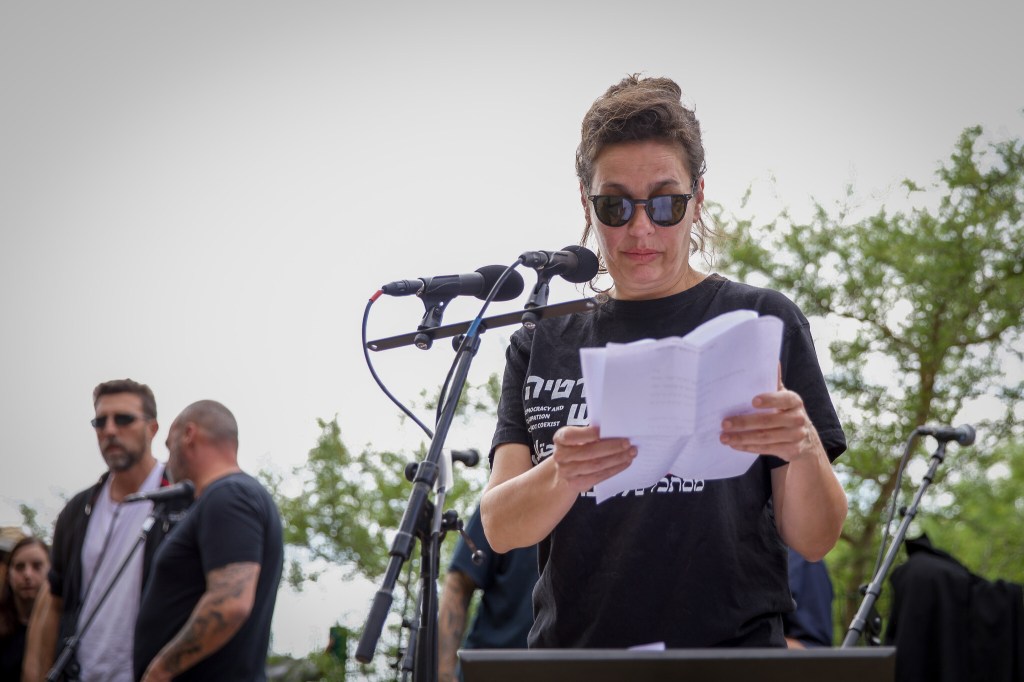
Fast forward to the funeral of his nephew. The mourners arrived wearing shirts that carried the slogan: אין דמוקרטיה עם כבוש – there is no democracy with occupation.
Yehonatan’s daughter, Shira Geffen, wore this slogan as she gave the hesped.
This slogan argues that Israelis cannot protest Netanyahu’s anti-democratic measures while ignoring the millions of Palestinians denied basic democratic rights to vote, freely assemble, and even walk to their homes without facing checkpoints and guns.
The t-shirts are produced by מסתכלים לכבוש בעיניים – an Israeli left organisation who insist on looking the occupation in the eye. They speak out about what they call “the power relations between the coloniser and the colonised,” urging the public to see how the occupation is destroying the dignity of Palestinians and the humanity of Israelis.
Sandwiched in the middle between these generations was the man they mourned, Yehonatan Geffen. He had been part of Israel’s cultural establishment, and a true icon. He was associated with what many Israelis saw as the best in their culture. One of his eulogisers was the centre-right politician Yair Lapid.
Geffen was also an outspoken peace campaigner. He wrote extensive criticisms of the army. In 2018, he wrote lyrics in praise of the Palestinian child protester, Ahed Tamimi, resulting in him being cancelled on Israeli military radio and censured by government officials.
Within one family, within one century, you can see such a huge diversity of Jewish views.
They do not agree about Israel. They will not agree. But they prayed together. They came together to say kaddish and mourning prayers. They joined each other as a family.
Of course, these differences of opinion on Israel are not just generations-based. I know anti-occupation activists in their 80s and I know pro-settlement campaigners in their teens. Nevertheless, what we have seen of Israel in our formative years is decisive.
I belong to Shira’s generation, and one of my most formative memories of Israel was witnessing the inexcusable assault on Gaza in 2009: Operation Cast Lead.
During the commemorations of Yom HaAtzmaut last week, I could not hide my discomfort. I find prayers for a state tantamount to idolatry, and when I hear blessings for troops, I can only think of those priests who poured holy water onto bombs. I do not see how one can pray for peace while praising the instruments of war.
Yet I understand why, for many in this community, honouring Israeli independence and those who fought for it feels like an important undertaking.
Some of you belong to the generation that came just after the Shoah. The memories of genocide and antisemitism still loom, and it is understandable that you should want to know there is some security against that. For you, defending Israel matters.
Others of you came up in the generation of Peace Now. You believed in Israel and its mission, and held onto its constitutional claims of what it would be: a safe haven for all its peoples. You hoped, even campaigned, for an Israel where Jewish culture could thrive while Palestinian minorities received justice and human rights. For you, holding on to that dream of what Israel could be matters.
My generation came after. I was born not long before the signing of the Oslo Accords, and came of age as they failed. During my 34 years on this planet, Netanyahu has been Israeli Prime Minister for nearly half of them. I have never known Israel as anything but the aggressor and the occupying power.
Based on our ages and experiences, we will have different views. If we cannot have disagreements about Israel, we cannot have an intergenerational community.
We will not agree about Israel. And that’s fine. That’s good.
Rabbinic literature prizes disagreement. One of my heroes in the Talmud is Rabbi Eliezer. He stood solidly by his principles, no matter how unpopular they were. It’s not that I agree with Eliezer’s principles: he was a conservative surrounded by liberals and radicals. It’s the fact that he held fast to what he believed.
He was so strict in his adherence to religious law that the other rabbis eventually excommunicated him. They wouldn’t talk to him unless he recanted his views, and he never did. Only at the end of his life did his students and colleagues realise what an error they had made by cutting him out.
They placed him in the Mishnah, the foundational Jewish text, as one of its most-cited rabbis. Even though they completely disagreed with him, you can find his opinions everywhere.
The Maharasha says the reason for this is for future generations. While one position may be minority at one time, it may become majority, and those who follow will need to know what they rest on. Even if they never agree with it, they need to see how the conclusions they support were reached.
This is why we welcome disagreements: for the sake of intergenerational conversation.
For those growing up now, they are entering a polarised and febrile environment.
Future generations will develop their own politics, and find their own relationships to Israel, Zionism, and the occupation.
And I hope they can do so within the synagogue.
I hope they will find an environment that embraces Zionists, non-Zionists and anti-Zionists. I hope they will find communities that do not impose red lines that keep them out. I worry that the TwentySomething writing to her rabbi will be proven right, and synagogues will become platforms for single positions on Israel.
What then? Will we split into Zionist and anti-Zionist shuls? Will we keep splitting further, based on varying different policy proposals for what should happen in the Middle East? Those aren’t synagogues – those are political parties!
Such divisions have pulled apart Reform communities before. In the period prior to World War II, Zionists were forbidden from studying at Hebrew Union College, the Reform Rabbinical school in America. This meant that for nearly a century you could not be a Zionist and become a Reform rabbi. One early Reform Zionist, Maurice Perlzweig, said that professing his views in polite Jewish company was like admitting to being a member of the Flat Earth Society.
At the turn of the century, the Reform Movement completely reversed its position. The 1997 Miami Platform declared that Reform Judaism was unequivocally Zionist. It said that Jews were a people; that we should all move to Israel and build it up. Ensuing from that came a programme parallel to the early push to exclude Zionists from the Jewish community, but this time, flipped: to exclude critical voices from the Jewish community and maintain only a pro-Israel consensus.
Is this really what we want? Do we want to keep going back and forth drawing new lines depending on which position has the upper hand? Do we want to enforce conformity of political views in Reform congregations?
Surely what we stand for is bigger than that! Surely our Judaism, our God, our people is bigger than that!
The joy of a synagogue is that it brings together so many different people. Where else are you going to find people of different backgrounds, classes, genders, abilities, beliefs, and ethnicities, all under one roof, bound together by something greater than themselves? Only the synagogue – greek for beit knesset – the House of Gathering – can achieve that.
We are not going to convince each other of our political opinions, and that’s fine. That’s good. If we have a space filled with diverse views, we have a community. If you have uniformity, you have an echo chamber.
We are Reform because we understand that the Jews of tomorrow will not look like the Jews of yesterday. The Judaism of tomorrow will not look like the Judaism of yesterday. Reform Judaism is an ongoing commitment to learn and struggle and grow, always adapting to new ideas and developments. That is what makes it Reform.
And what makes it Jewish is that we do it together. We hold on to belief in the same God, the same cause, the same traditions. We hold all the manifold opinions of the congregation in a single setting.
So, let us answer the question posed in Larry Englander’s book: will this TwentySomething be excluded from her synagogue?
More pressingly, will she have a home in ours?
The answer depends on how we act. If we draw red lines and kick people out based on their views; if we define our Judaism solely by its relationship to Israel; if we make public policies about the synagogue’s stance, then, no. She probably will not.
On the other hand, we can model an alternative Jewish future. A better Jewish future. A Jewish future where we don’t repeat the mistakes and have the same regrets as the framers of the Mishnah. A Jewish future based on plurality and discussion. We can demonstrate through our relationships with each other and the synagogue that Judaism is diverse, creative and engaging across divisions.
We can show that we do not have to agree. Even about Israel.
When I was a teenager, I went on some kind of away day with other Progressive Jewish youth.
The rabbi – I can’t remember who – told a story.
A woman dies and enters the afterlife. There, the angels greet her and offer her a tour of the two possible residencies: Heaven and Hell.
First, she enters Hell. It is just one long table, filled with delicious foods. The only problem is that they all have splinted arms. Their limbs are fixed in such positions that they could not possibly feed themselves. They struggle, thrusting their hands against the table and the bowl. Even if they successfully get some food, they cannot retract their arms back to their mouths. They are eternally starving, crying out in anguish. That was Hell.
Next, she enters Heaven. Well, it’s exactly the same place! There is a long table, filled with delicious foods, and all the people sitting at it have splinted arms. But here, there is banqueting and merriment; everyone is eating and singing and chatting. The difference is simply that, while in Hell, people only tried to feed themselves, here in Heaven they feed each other.
She ran back to Hell to share this solution with the poor souls trapped there. She whispered in the ear of one starving man, “You do not have to go hungry. Use your spoon to feed your neighbor, and he will surely return the favour and feed you.”
“‘You expect me to feed the detestable man sitting across the table?’ said the man angrily. ‘I would rather starve than give him the pleasure of eating!’
The difference between Heaven and Hell isn’t the setting, but how people treat each other.
At the conclusion of this story, one of the other teenagers – I can’t remember who, but I promise it wasn’t me – put his hand up and said: “But I thought Jews don’t believe in Hell?”
The rabbi shrugged and said: “True. It’s just a story.”
Years later, though, the story, and the resultant question, have stuck with me.
Was it just a story? Do Jews really have no concept of Hell?
The truth is complicated.
Among most Jews, you will find very little assent to the idea of punishment in the afterlife.
In part, that is simply because most of Judaism does not have a clear systematic theology. There is no Jewish version of the catechism, affirming a set of views about the nature of God, the point of this life, and the outcomes in the next.
Rather, Judaism holds multiple and conflicting ideas. On almost every issue, you can find rabbinic voices in tension, holding opposite views that are part of the Truth of a greater whole. We don’t mandate ideas, we entertain them.
So, a better question would be: does Judaism entertain the idea of Hell?
And the answer is still: it’s complicated.
Yes, it does. The story that rabbi told of the people with the splinted arms comes from the Lithuanian-Jewish musar tradition. It is attributed to Rabbi Haim of Romshishok.
The idea of pious Jews going on tours of Heaven and Hell has a long history. In the Palestinian Talmud, a pious Jew sees, to his horror, his devoted and charitable friend die but go unmourned. On the same day, a tax collector, a collaborator with the Roman Empire, dies and the entire city stops to attend his funeral.
To comfort the pious man, God grants him a dream-vision of what happened to each of them in the afterlife. His righteous friend enjoys a life of happiness and plenty in Heaven, surrounded by gardens and orchards. The tax collector, on the other hand, sits by waters, desperately thirsty, with his tongue stretched out, but unable to drink. Where one gave in this life, he received in the next. Where the other took in this life, he was famished in the next.
This is a revenge fantasy. The story comes from oppressed people coming to terms with the success of their conquerors and the humiliation of the good in their generation.
The fantasy is powerful, and the motifs repeat throughout Jewish history. In almost every generation, you can find people pondering about how bad people will be punished and good people will be rewarded when this life is over.
But, with equal frequency, you can find Jewish scepticism about this view of the world. The Babylonian rabbis warn us not to speculate on what lies in the hereafter, for God alone knows such secrets. Our greatest philosophers like Rambam and Gersonides strenuously deny any concept of post-mortem torture.
These debates have persisted even into the modern era. During the Enlightenment, there were those who claimed that a rational religion could have no place for the primitive nonsense of Hell. Equally, there were those who said belief in divine retribution was the hallmark of a civilised belief system.
So where did the idea come from, asserted so confidently by that teenager on a day trip, that Jews have no concept of Hell?
The truth is it is very recent.
In surveys of attitudes, Jewish belief in Hell plummeted after the Second World War.
In all the revenge fantasies and horror stories that people could concoct about Hell, not one of them sounded as bad as Auschwitz.
There is no conceivable God who is cruel enough to do what the Nazis did. No such God would be worthy of worship.
We have no need to fantasise about freezing cold places filled with trapped souls, or raging furnaces. We need not imagine a world after this one where people are starved and tortured and brutalised. We know that world has already existed here on earth.
Isn’t Hell already here still? Doesn’t it still exist right here in this world for all those mothers putting their toddlers in dinghies hoping the sea will take them away from the war? Don’t those horrors already exist in for people working in Congolese gold mines or Bangladeshi sweat shops?
Hell is already here. It is war and occupation and famine and drought and slavery and trafficking. There is no need for nightmares of brimstone when people are living these things every day.
That was the point of the story that rabbi was telling us.
The difference between Heaven and Hell isn’t the setting, but how people treat each other.
We already live in a world of plenty. We have the flowing streams and gardens and orchards our sages imagine. But, like the inhabitants of Hell, we are pumping sewage into the streams, turning the gardens into car parks, and logging the orchards for things we do not need.
We are sat before a fine banquet where there is enough for everyone, but half the population are not eating while a tiny minority are engorged with more than they need. We are living the vision laid out in the parable.
Yes, this world is a Hell, but it could be a Heaven too.
The difference between Heaven and Hell isn’t the setting, but how people treat each other.
Look at all that we have. Look at the support we can give each other. We may have splinted arms but all we need do is outstretch them.
We have the capacity to annihilate all hunger, poverty, and war. We really could end all prejudice and oppression. This planet could be a paradise!
And, if we know that we can make this world a Heaven, why would we wait until we die?
Yosef, the son of Rabbi Yehoshua, had a near-death experience. Yehoshua asked him: “what did you see?” He said: “I saw a world turned upside down, where the poor were rich and the rich were poor.” His father answered: “You saw a world turned right way up.”
For a long time, this was my favourite passage from all of Gemara. Recently, I’ve started to feel more conflicted about it.
This brief story is an interlude in Masechet Bava Batra of the Babylonian Talmud. The chapter is all about economic redistribution, charity, the rights of the poor, and fiscal justice. It encapsulates a beautiful idea. The poor should know what it is to be rich and the rich should know what it is to be poor.
Six years ago, the then-26-year-old duke, Hugh Grosvenor, became the world’s richest man under 30. Upon his father’s death, he inherited £10 billion, a title, and some of London’s most profitable land deeds. He remains Britain’s fourth richest person.
According to a recent report by the Joseph Rowntree Foundation, 1 in 5 households in this country are in poverty. 7.2 million households are going without essentials, like heating, food, showers, toiletries and adequate clothing.
It’s hard to picture statistics, so let’s take a story. Heather is a mum of two girls, aged 10 and 4, in Camborne, Cornwall. Her family is one of those millions in poverty. They opted to tell their story to ITV. Cameras followed her round as she worked multiple shifts, round the clock, and fed her family from food banks.
What would it be like if, as in Yosef ben Rabbi Yehoshua’s vision, the two swapped places?
How would the duke fare if he woke up as a social renter on a council estate in Cornwall, with no money, and unpaid debts, and needed to get his children to school but couldn’t afford the bus fare?
How would it be for Heather if she suddenly found herself a duchess, living on a 300 acre estate in Lancashire, waited on for every meal, never having to clean, and able to indulge in boozy parties costing upwards of £5 million? She wouldn’t need to go shopping. She would own the shopping centre.
It is a tempting fantasy. Seeing this world, so clearly turned upside down, I, too, take pleasure in imagining seeing the day.
We can see why it would have appealed to the authors of the Talmud, too. Rabbi Yehoshua was a poor tailor living under Roman persecution. Yehoshua saw the incredible wealth of Emperor Hadrian, which he had extracted from colonising and impoverishing the people of Eretz Yisrael, among many other territories of his Empire. Why wouldn’t Yehoshua, a pious scholar, want to switch places with that brutish tyrant?
But is it really motivated by righteousness, or is it just a desire for revenge? As we approach Purim, I remember what can happen when a world is turned upside down like that. How easily the oppressed can become the oppressors. How quickly hurt people can hurt people.
Our story begins in a world where one man has a ludicrously bloated empire and spends all his time flaunting his wealth on extravagant banquets. Achashverosh has a harem of women at his beck and call, who live in fear of death and exile.
This is a system already ripe for abuse, and, when Haman is appointed as chief vizier, we see just how far that society can go in its cruelty. Haman insists that everyone bow down to him. He took an ethnic disliking to Mordechai and the Jews, who, in turn, refused to accept his authority. So Haman plans a genocide, with full indulgence from the king and his court. He erects a stake on which to impale Mordechai.
In the end, the world is turned upside down. Mordechai is put in Haman’s position. He is given royal robes and the signet ring. He gallops through town on a horse and everyone bows down to him. Haman is impaled on the stake he planted for Mordechai.
Then, the Jews enact a genocide. In one day, they kill three hundred men. On the next, they kill seven thousand. They massacre and exterminate all who stand in their way, including women and children, with royal permission to plunder their possessions.
Look, a complete inversion of events! The poor are rich and the rich are poor. The strong are weak and the weak are strong.
But, is this justice?
In Progressive movements, we are so embarrassed by this chapter of the Megillah that we often omit it from our readings. In Orthodoxy, the goal is to get so drunk you don’t know what’s happening. By the end, you’re supposed to be unsure whether you are booing or cheering for Mordechai. That’s not a surprise: if we hears it sober, we’d probably jeer everyone.
The problem the story highlights is not that some people are good and others are wicked, but that broken systems make good people do wicked things.
The same system that permitted egregious exploitation and violence remains intact, with different people doing the killing. Everything is turned upside down, but, somehow everything is just the same.
This story is just a fantasy. There was no historical massacre by Jews in ancient Persia. In reality, they never got the upper hand during their exile. This is just their dream of what they might do if that world was turned upside down.
That doesn’t mean the fantasy is harmless. While Jewish history includes many times when we have been oppressed, it also includes occasions when we have been the oppressors.
There is nothing in our history to indicate we are any less capable of cruelty and malice. In fact, we know too well that oppressed people, when handed power, can act in ways that would make their persecutors blush. Revenge is a powerful drug.
That doesn’t mean we should never try to turn the world upside down. We are still right to take umbrage at the outrageous wealth of Hugh Grosvenor while most live in poverty. It is still correct to hiss Haman as he uses his powers for ethnic persecution.
But a world where the rich are poor and the weak are mighty is not a world turned upside down. It is the same world with people in different positions.
The problem is not Yosef ben Yehoshua’s dream. It’s his lack of imagination.
When we dream of the inversion of this world, we need to think of more than just switching who gets to be in charge.
We, too, must have a vision of a world turned upside down. Where there are no rich and there are no poor because everyone has enough. Where there are no persecutors and there are no oppressed because power is shared evenly and democratically. Where racism and abuse are unfathomable because communities strive towards accountability and progress.
Spider season seems to have begun early this year.
It’s that time of the year when we start seeing spiders, climbing up walls, hanging out in sheds, and getting comically stuck in bathtubs. Of course, they live all year round, but in early autumn they are visible everywhere.
I love spiders. I think they’re quite cute. We don’t have any dangerous ones in this country, as far as I know, and they eat the ticks that we really don’t want in our houses.
But I get why other people are creeped out by them. They’ve got eight legs, which is far too many, and they scurry around like they’re up to no good. We’ve been fed media images of terrifying tarantulas and it’s understandable that people would associate them.
The Torah has a word for these beasties. Sheretz. It’s root is resh-vav-tzadi, to do with running around, so most translations render sheretz as ‘creepy-crawly,’ or ‘creeping thing.’ It applies, first and foremost, to mice and lizards, but extends to any scuttling insect or racing rodent. There are also the sheretz bamayim – the creepy-crawlies underwater, like jellyfish, octopus and lobster you might find scampering on ocean floors.
They were created by God on the fifth day. They are mentioned by name. For some reason, God decided that spiders were supposed to exist. God made room for them in the world and dedicated a verse of Torah to celebrating their creation. God made mosquitoes and shrews and chameleons and God saw that they were good. So, if you’re in the camp that loves spiders, you get a point.
God has also banned them. We are prohibited from eating them. They are described as disgusting and as abominations. On some level, we are supposed to revile them. So, if you’re in the camp of people who can’t stand spiders, you get a point too.
(I promise you, this is going somewhere.)
I’ve spent the last week thinking about the sheretz. From Monday to Thursday, this synagogue hosted the Queer Yeshiva. It was a momentous occasion. Never before in Progressive British history have so many people come together to study the Talmud in such an intense way. Everybody talked about how wonderful this synagogue is, and I want to thank you all for opening this space to a bunch of LGBT people to study Torah.
Over the week, we read a sugya of Talmud from Sanhedrin, a tractate that deals with capital crimes. It asks questions about who gets to condemn somebody for the death penalty, and on what grounds.
It contains a list of characteristics expected of Jewish high court judges: tall; wise; handsome; elderly; fluent in at least seventy languages; and, of course, familiar with sorcery.
So, who is eligible? Do we have any candidates for the Sanhedrin in this congregation? I won’t be putting my hat in the ring. It’s tricky to find someone, but I’m sure such people exist.
Then it adds another requirement. Anyone who wants to sit on a Sanhedrin has to find grounds for declaring clean the sheretz. You want to put somebody to death? You’ve got to be able to make lobsters kosher. You have to be able to purify a spider.
Who can make unclean things clean? Who can make what’s treif kosher? If anyone in this room can do it, you will be welcomed with open arms to the Jewish law courts of Babylonia.
But it seems unlikely that will fall within any of our skill sets. It sets an impossibly high standard.
Perhaps that’s the point. You have to be so good at thinking and reasoning that only the highest standards of scholars can join. You have to be of such excellent calibre that you know Torah inside out and can interpret it, even against itself.
Many have understood this edict that way. In fact, elsewhere in the Talmud, we learn that there are as many as 150 ways to make shrimp kosher. There’s not just one secret method of purifying a sheretz – there are a whole bunch of them – and you should be able to work them out.
But the Talmud doesn’t give any convincing explanations as to how this is possible. Even where rabbis have a stab at it, they are soon shot down. Nice try, but no. That’s not how you make mice edible.
As a result, plenty of rabbis throughout the ages have tried to show that they can purify the sheretz. Great thinkers who knew the Torah inside out have tried to show that they are eligible for sitting on the Sanhedrin.
But here’s the thing. You can do all the reasoning you like. A spider will still be a spider. A lizard will still be a sheretz. And a sheretz will still be unclean. You can’t actually change what the Torah says.
So the rabbis have made sitting on the Sanhedrin impossible. It is so restricted that we will never find people capable of achieving it. De facto, the rabbis have abolished the death penalty.
This is a tremendous achievement. Subtly, and without saying so, they have done exactly what they say needs to be done: they have turned the Torah against itself. Except, instead of turning the Torah against itself so that they can kill people, they turn the Torah against itself so nobody can!
Suppose somebody were to come along and actually give convincing proof that spiders are really kosher. OK, then we would have a problem. My hunch is that the rabbis have already thought of this. Anybody who could do so would, by their nature, refuse to implement the death penalty.
A person who can see the kosher in a lobster can see the goodness in a convict.
A person who could cleanse the body of a mouse could cleanse the soul of a criminal.
You have to be able to see people, and creepy-crawlies, the way that God sees them: as good.
This is the rabbis’ genius way of telling us who is allowed to judge others. The only person we would permit the authority to judge others is the one who would judge them favourably.
The spiders are out and about in our houses. We might love them or hate them or greet them with indifference. But who gave any of us the right to kill them? God, for whatever reason, has determined that they have a place on this earth and it is not our job to decide they don’t.
The world is full of people we don’t like. Some of them do detestable things. And we might feel fear and hatred and anger towards them. And sometimes those feelings are justified.
But we don’t have the right to kill them.
We are not worthy to judge them.
Unless you can purify a spider, you have to live in this world with everyone else.
God has made enough room for them in this world and we have to make enough room in our hearts.
My name is Lev. I’m one of the teachers here, with Jo, Hava and Daniel.
A month ago, I was ordained as a rabbi. One of the things that most made me want to be a rabbi was bring gay. I wanted to be part of a religious life that made being queer feel as empowering and magical as it really is.
I love being queer. I love queer people. One of the things I love most about us is that no matter what life throws at us, we always rebuild.
I think about the lives of queer people. Everyone I know has had to struggle with who they are, face down violence, and out of adversity, rebuild themselves as someone stronger than anyone could have imagined.
When I was a kid, I was already too fabulous to be contained. All I wanted in life was to wear dresses and do Spice Girls dance routines. I knew I was different and I didn’t care.
But the rest of the world did. I grew up in a small town with few opportunities. For most of my teens, I was beaten up on a near daily basis. I was attacked at school, walking home, in the shops, and outside my front door. That was only the other kids. The adults were worse: at best they ignored it; at worst they encouraged it. At the school leavers’ assembly, the teachers gave me an award for “most likely to have a sex change.”
But I’m not bitter. I’m proud. I came out of all that knowing who I was and willing to fight for others. That’s why we have parades. That’s why we stand up celebrate our community, because we have withstood discrimination and violence and built out of it fantastic cultures. All that queer art, queer music, and queer innovation- that came out of queer struggle. We are who we are because of who we were.
And that’s not limited just to us here. That’s something queer people have to do in every generation. Think how many times we have been destroyed, and think how many times we have rebuilt.
Consider only the last century. At the beginning of the 1900s, our people were dealing with criminalisation, as many had been imprisoned. Against that backdrop, Magnus Hirschfield created the Institut for Sexualwissenschaft, pioneering the understanding of queer people.
His work was burned by the Nazis. Queers were turned into pariahs and murdered in te death camps. Even once the Second World War was over, many homosexuals were forced to stay in prison to complete their sentences.
In the aftermath, our ancestors picked themselves up again. They built the Gay Power movement. They formed the Lavender Menace. They created the ballroom scene in the nightclubs of New York.
Once again, they were decimated by the AIDS crisis. Government indifference and vengeful homophobia killed a generation of queers.
And still, we could not be destroyed. We came back stronger, demanding legislative changes and pushing for a transformed world. We recreated community to fight for our liberation.
In every generation, people have tried to destroy us. In every generation, they have failed. We will always rebuild. We will always imagine a greater future. We will always reappear.
We are indestructible.
In that sense, we are the heirs to the rabbinic tradition.
Judaism, as we know it, is the product of people who saw their world crash around them repeatedly and, every time, rebuilt it.
Our Judaism was born out of a time of fundamental crisis. At the start of the last millennium, the Jews were a nation. They had their country, the land of Israel. They had their capital, Jerusalem. They had their cultic centre, the Temple. They had their religious leadership, the priests. And they had their religious practices, sacrifices.
Then, they faced catastrophe. The Romans came and waged an aggressive war, killing off the leadership, and starving the people of Jerusalem. They destroyed the Temple and abolished its customs.
Yesterday was the fast of Tish BAv. It was, for many religious Jews, a day of weeping and despair. We recalled the genocide, the disruption, the pain. We remembered the destruction of the Temple in the context of all the times that Jews have been destroyed.
But, in that act of ritualised remembering, we also remember that we have survived. Jews and Judaism have kept going, even two thousand years later.
Let us remember why.
Faced with annihilation, the Jews had three choices. One: they could dig their heels and pretend nothing happened. They could decide that they were going to carry on with the Temple and the priesthood, even though they were gone.
Two: they could abandon their old religion altogether. That was what normally happened to ancient peoples when they were conquered: they gave up their old traditions and gave in to colonisation.
Three, the third option: they could retell their story for the sake of their contemporary situation. They could look at everything they had been, and use their history to reimagine their future.
Our rabbis chose option three.
Put yourself in their position.
Imagine you were there, not just in the aftermath but right in the thick of it. Jerusalem is under seige. Your family are starving. Your people are fighting the Romans, but mostly they’re fighting each other. You can see your world on fire. You don’t even know if you will survive.
What would you do?
That’s how it was for Rabban Yohanan Ben Zakai. He was alive then. That was what he saw.
He told his students to put him in a coffin, pretend he was dead, and smuggle him out of Jerusalem. Once out of the besieged city gates, he got out and demanded to speak to the Roman emperor, Vaspasian.
As it happened, Vaspasian was willing to compromise. He said: “OK, tell me you want.”
Rabban Yochanan Ben Zakai said: “Give me Yavne and students of Torah.”
What was Yavne? It was a refugee camp in the middle of nowhere. It was filled with displaced people. Who were the students of Torah? Just a bunch of people who remembered what the old religion used to be like.
Why? Why would you ask for such a thing? If the commander of the imperial Roman army is willing to negotiate, why not find a way to get the troops to leave?
Because a people that knows who they are cannot be destroyed.
Sure, the colonisers might go, and the Jews might live, but Judaism could end. The only way for anyone to live on after facing near annihilation is to look at where they’ve been. They have to take a long look at their story and reimagine it for a new era.
Rabban Yochanan Ben Zakai and his students learnt everything. They committed to memory their whole history so that they could recite it by heart.
Then, they revolutionised it. They said: we don’t need the land of Israel or Jerusalem any more. From now on, we’re going to be spread across the whole world. We’re going to make our religion portable so that it can be sustained in any nation.
They looked at their Temple and its sacrifices and said: we’re not going back to that. We’re going to reinvent our practices. We will replace them with prayer and study. As long as people keep our words alive, we won’t need for animals to die.
They looked at the priesthood and said: that’s done. From now on, we have no hierarchy. From hereon out, we are equals. The measure of Jewishness won’t be who your father was but how imaginative you can be in reexamine your tradition.
They looked over their old systems of justice, and interrogated them. Who is included here, and who is left out? What is justice going to look like for us now? They were so radical that they tried to work out how they could turn the Torah against the Torah.
And that instantly transformed Judaism. Rabbi Yochanan’s disciples weren’t from the elites. They were blacksmiths and peasant farmers and outsiders. They saw, from that vantage point, how their people could creatively rebuild. And that is why we have our Judaism today.
And here’s the thing. Rabbi Yochanan had, maybe, ten students. There were fewer people in his beit midrash than there are in this room.
You only need a handful of visionaries to spark a revolution.
Be in no doubt, that is what could happen here this week.
We are, as always, facing catastrophe. Queer people are under attack once more. The planet is burning. Capitalism is in crisis. The old ways of doing Judaism are floundering.
Do you think that the future of Judaism is going to be secured by happy people in their comfortable homes? No way. They have nothing to lose from the current situation. They don’t have the imagination to see how things could be different.
The future of our people lies with those on its margins. Its the queers. It’s the weirdos. It’s the radicals. It’s you.
That’s why we’re here. We’re going to do what queers and Jews have always done. We’re going to rebuild while our world is on fire.
We’re going to learn everything we can, internalising the words of our ancestors so fully thar they will travel with us everywhere. We’re going to re-analyse them in light of our own circumstances, seeing how these traditions bear on our own lives and struggles. And, out of that, We’re going to completely retell our story.
This is where the future of Judaism starts again.
I love being queer. I love queer people. And I can’t wait to see what we achieve.
A young Talmud scholar moves from Lithuania to London. Years later he returns home to visit his family.
His mother asks: “Yossele but where is your beard?”
“Oh, mama, in London, nobody wears a beard.”
“But do you at least keep Shabbat?”
“No, mama, in London people work all the time. We have to make money.”
“Oy vey. But do you still keep kosher?”
“Mum, I’m sorry, kosher food is expensive and hard to find.”
“Yossele…” she says. “Are you still circumcised?”
Thus joke points to a perennial Jewish anxiety: will people stay Jews? Will Judaism continue?
In every generation, a study is published, fearfully proclaiming that Jewishness is declining, which will be swiftly followed by rabbinic pronouncements about how to save it, philanthropists putting money into projects that engage young Jews, and various pundits proclaiming that this proves exactly what they had always said.
Why, when this problem has been repeatedly highlighted, has Judaism nevertheless continued, and Jewishness never seen the burial it was foretold?
For starters, it turns out that many of the things that people assured us would mark the end of Judaism were not that threatening after all. At the start of the Enlightenment, Orthodox leaders agonised that, if Jews went to universities, they would be needlessly subjected to heretical ideas and turn their backs on religion. In the end, Judaism and academic study proved more than compatible.
The fear about Jews losing their beards turned out not to be so troubling either. After all, half the Jewish people had never been able to grow them! In the 90s, the great moral panic centred on mixed marriages, which, experience has shown, only grew the Jewish population, rather than diminishing it.
So, why all the worry? In fact, these concerns undoubtedly go back to the beginnings of Jewishness. In the book of Ruth, we read a story of a young woman faced with the choice of whether to remain with the Jewish people. Either she could stay with her mother-in-law and run the risk of never marrying; or she could return to her original village and begin her life again.
Being Jewish was the harder option. Being Jewish was riskier and unknown. Ruth’s sister, Orpah, chose to leave the Jews and rebuild. Ruth chose Judaism.
She must have seen something in it that made her want to stay. Perhaps it was the God, or Naomi, or the people, or the way they lived. Judging by what she said, it was a combination of all of these. She chose the harder option, because it was the more beautiful one.
That has always been the way with Judaism. High risk. High reward. Hard to maintain. Worth maintaining.
That is why we feel anxiety about Jewish continuity. We know that it is not the easy option. It takes work. So we look around for people who will do it.
Our rabbis understood this feeling well. They told a story of the revelation at Sinai: that, on the day when God gave the Israelites the commandments, God raised Mount Sinai over their heads and told them to accept them. If they took them on, they would live. If not, the mountain would come crashing down on their heads and make the desert their grave.
“Choose life” wasn’t advice. It was a threat. Of course, they accepted.
But, said the rabbis, there were other times when they took on the commandments too. When there were no threats from God but plenty from the ruling powers. They point to the story of Esther, when the Jews lived under Persian imperial rule and could have been slaughtered for practising their religion. God did not appear to make promises or offer consolation. But they chose Judaism anyway.
This is a narrative of how Judaism has been continued. On an individual level, this is what happens to many of us. As children, we go to synagogue because our parents tell us to. We live their ways and eat their food because we have no other choice. Now, as adults, we turn up because we want to. There is no compulsion to attend. We do it because we have found in it something beautiful and worthwhile.
This is true, too, of our history as a community. There was a time when we had no choice but to be Jewish. Think of the periods when Jewishness was stamped on our passports and our job application papers; when being Jewish determined what jobs we could do and where we could live. We kept up Judaism because we had no other choice.
But now we have reached a time when it is a choice. Nobody is making us be Jewish. We sustain it because we want to. You who have turned up this morning could have gone anywhere. You could have done anything. But you chose to come here. Like Ruth and Esther, you decided that something in Judaism was beautiful and worthwhile.
You decided that this religion and these festivals have meaning. That is why I’m not really worried about Jewish continuity. I know that you are keeping it alive. I know that, in every generation, as long as there are a good few people who think Judaism is worthwhile, it will be.
On Shavuot, we renew our covenant with God. We take on the Torah once more. We decide to keep the flame of Jewish truth burning.





 Sim Lev