This sermon will be addressed to two girls who are having baby blessings at Kingston Liberal Synagogue. Their names are redacted from this online version.
Girls, welcome to your synagogue.
I will address this sermon to you, but you will not remember it, and that’s OK, because I am really speaking to all Jewish children when I give this address. And you should know that all adults, no matter how big they get, never stop being children. So I am speaking to you, but really I am speaking to everybody gathered here today.
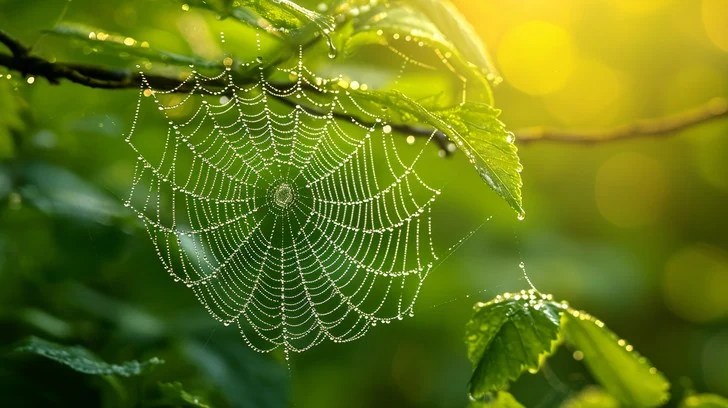
My message for you, girls, and for all Jews is: learn to be like a spider.
You see, from the moment a spider is born, she already carries everything inside herself to make a home. The silk with which she will construct her web is built into her body. Without ever learning from a parent or attending a school, the spider already knows how to build her home, wherever she goes.
In this way, the spider is the perfect Jew. Jews, wherever we are, carry in us all we need to make our home. Our home can be woven absolutely anywhere. Whether in a desert, an ocean, or an Arctic tundra, Jews will always find ways of creating our sacred spaces.
Our home is not made of silk, like a spider’s. Our home is made of the bonds we build with each other. Between every community member, there is an invisible thread. If you look around this room and squint in exactly the right light, you will see how one thread connects to each other, and every thread interlocks somewhere. That is the web of our community.
Our home is also made of rituals. In Hebrew, the word for a tractate of Talmud is masechet. The masechet is the page of our religious texts that tells us how to mark every moment and celebrate every festival. Do you know what masechet also means, dear girls? It means a weaving; a web.
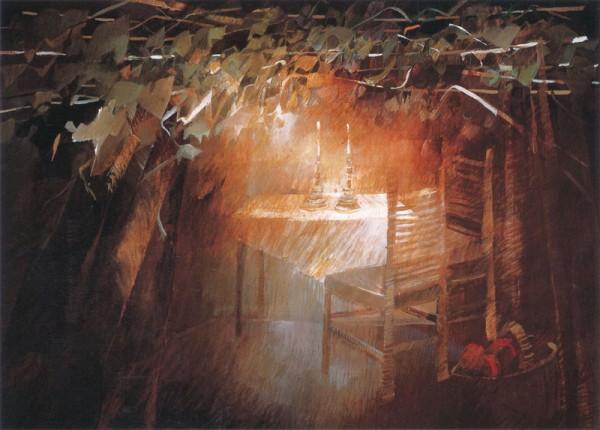
Because our home is made of rituals, you can find yourself anywhere in the world, and if somebody starts a prayer, or lights a candle, or cooks a food, you will realise that you are suddenly back in your Jewish home.
Our home is made of stories. Yes, we sew together patchworks from ancient traditions and family tales and our life experiences and all of it comes together in this great big web, so that Jews are all brought together by these stories.
Now, some religious knowledge may be innate. Girls, there is a story that before a baby is born, her soul has already been to the Garden of Eden and heard the revelation at Mount Sinai. Perhaps you are sitting there, knowing far more about the secrets of the universe than any of us.
But the truth is, we are not like spiders. We can’t just weave the Jewish home from the moment we are born. We need to learn how to do it. We need teachers and elders who have learned to build the web from the generations before them. The thread we spin with comes from a yarn thousands of years old, and you need people who will pass on the tools to you.
That’s why, here, in your synagogue, you will be able to come to Kinderlach when you are small, and join Beiteinu as you grow, and come to many family services, and go on adventures with your youth movement. All of this exists to help you learn how to make your web, so that it is strong and beautiful and unique, like you.
Children, a moment ago, you came and were held underneath the tallit to receive a blessing. We call the tallit a “sukkah” – a tent, a tabernacle. It represents the Jewish home. “Sukkah” has the same root in Hebrew as “masechet” – the weaving we mentioned earlier. You see, the Jewish home is a portable prayer shawl, made by people skilled with textiles, and we can pull it out at any moment.
In the Torah portion we read today, on this day of your Simchat Bat, God tells us how to build a mishkan – a sacred place where God can live. I’ll give you one guess what it’s made of.
The tabernacle where God lives is made of wool and cloth and thread and yarn. Oh, it comes in so many colours! Blues and purples and crimsons all finely interlocking on a great stretched canvas made of animal hides.
That is where God lived with the Jews for the years we wandered in the desert. After slavery, the Jews had to learn how to be truly free. We needed to be independent of the great demands of Egyptian slaveowners and even the comforts of their homes. We needed to know how to live transiently.
Yes, we needed to learn to be more like spiders. We needed to build a home wherever we went.
And you, dear girls, need to learn to make a home too.
Girls, I have been to your house, and I know how lovely it is. Somehow your dads manage to keep it such a calm and clean place at all times. I don’t know how they do it. I hope they can manage some semblance of the same order when you both start crawling.
But even if you ransack the living room, and draw all over the walls, and leave your toys strewn across the stairs, they will still love you, and it will still be your home. You may move many times, or you may stay in one place, but your home will be the people you come back to. It will be the stories you tell, and the songs you sing, and the rituals you make up. Home will be your own private language that only makes sense between you.
You come today into this synagogue, and know that it will be your home. Around you, you have your whole community, who have come here to show that they will love and support you. They will teach you how to weave webs, and you will soon start wrapping your own silky strands into the patchwork of this community.
When I welcome you to your synagogue, I am not talking about the building. That’s not our home – it’s just the frame we use to make it in.
Our home is the web we weave together – the invisible threads that connect everyone in this community.
We are like the ancient Israelites who carried their home through the desert.
We are like the spiders who carry their homes in their bodies.
We build our home through connection and song and story.
May you build this home with us.
Shabbat shalom.
 Sim Lev