high holy days · sermon

Can you pass the human test?

This is the human test, a test to see if you are a human.

These questions were posed by the American comedian, Ze Frank, to see whether his audience was human. I will ask you some of them, and you can see if they apply.

  • Have you ever made a small, weird sound when you remembered something embarrassing?
  •  Have you ever seemed to lose your aeroplane ticket a thousand times as you walked from the check-in to the gate?
  • Have you ever laughed or smiled when someone said something mean to you and then spent the rest of the day wondering why you reacted that way?
  • Have you ever had a nagging feeling that one day you will be discovered as a fraud?
  • Have you ever stared at your phone smiling like an idiot while texting with someone?

Well, congratulations you are human.

With these questions, Ze Frank taps into the parts of being human we so rarely discuss. Our deep anxieties, our senseless irrationalities, our abilities to love people completely. 

Perhaps we laugh because they are embarrassing. It feels awkward to acknowledge that we feel all these things.

But we do. They are, truly, what makes us human.

In 1950, the English mathematician Alan Turing developed a series of tests to distinguish between robots and people. The questions, called ‘The Turing Test,’ can be used with some accuracy to ascertain whether, when speaking to a character online, they are a real human being or a highly intelligent software programme.

This year, those questions gained an entirely new relevance. An AI Language Model, called ChatGTP, became a viral sensation. You can pose the most fascinating questions to this robot, and it will answer them as if you were speaking to a real human being. It can have conversations and play word games and share thoughts on current events. It can even write a half-decent sermon.

But there were some questions it couldn’t answer. It still cannot pass the Turing Test. Tech experts promise that, very soon, it might. But, for now, there are certain things it cannot find adequate responses for.

The questions the Turing Test poses of robots to distinguish them from humans ask them to think critically about their inner lives. You might ask them:

  • “What event from your life changed the way you think?”  
  • “How do you feel when you remember your childhood?”
  • “Can you describe your emotions in only shapes and colours?”

What makes us human, provably so, is that we feel. We rejoice by laughing from our bellies. We hurt by letting tears fall from our eyes. We rage by clenching our fists. We cringe by curling our toes in our shoes. We fall in love by feeling butterflies in our stomachs. 

No algorithm can do that. An algorithm cannot pass that test.

Although machines cannot pass human tests, humans are nevertheless often tested by machines, and measured according to standards set by software.

From the moment children first enter schooling, they are subjected to rigorous examination. Can they multiply figures? Can they recall important historical events and their dates? Can they identify adjectives, verbs, and nouns in sentences? 

Of course, it is impressive when children can do these things. But it also measures them by the kinds of things machines can do much better. Often, these exams are even marked by machines.

By the time we finish schooling, we may have spent most of our formative years revising for, sitting, or fretting about the results of exams.

This process doesn’t stop once you enter adulthood. Throughout our working lives, many of us find ourselves undertaking tests to prove we are competent in our jobs. 

It’s not entirely a bad thing.

We’d all be quite worried if doctors weren’t checked for their abilities to carry out surgeries or bus drivers didn’t prove they could drive without crashing. Food hygiene certificates and accountancy qualifications are an important part of life.

But they are not all of life. They are not what makes us human.

And, sometimes, they detract from our humanity. 

I am going to talk briefly about suicide, and how dehumanising tests can drive people to take their own lives. If you are not in a place where you can hear that right now, I do welcome you to take a break, without judgement, because it is a difficult topic. And if this discussion brings up anything for you, please know that me and Rabbi Jordan are always on-hand for pastoral support and a listening ear.

Earlier this year, a headteacher at a primary school in my hometown, named Ruth Perry, killed herself after receiving a poor Ofsted report.

A study in 2017 found that teen suicides peaked around exam season, as the pressures to do well affronted young people’s mental health. 

There are data spreadsheets that recommend redundancies, crashing people’s entire working lives. Disabled people in Britain have to prove to computers that they are sufficiently unwell, or they will have all their benefits cut.

We live in a world full of judgements. You must prove your competence. Or you must flagellate yourself to prove your incompetence. You must prove that you are who you say you are. You must prove you can be somebody else. You must prove your worth.

But, here, you are in God’s house. Your value is not determined by what you can do. You are valuable in this space because God has chosen to make you human.

On Yom Kippur, we are summoned to face a test. But, this time, it’s the human test. The only question you have to answer today is “are you human?”

During the course of this year, have you breathed? Has your heart beat? Has your blood pumped through your veins?

Have you felt sadness and grief and elation and worry and love? 

Have you been moved by events in the lives of others, and have you formed new memories of your own?

Congratulations. You have passed the human test.

This is the task that God set for you. That you would be alive. And you are. You are here with us.

God has set you the task of being human, which means feeling, in all its complexity. 

Even if you can only remember feeling one thing this year. Even if you only felt bored or exhausted or impatient or in pain, you still felt. You succeeded at doing everything God wanted of you just by being human.

We cannot take it for granted. You might have given up. But if you felt like giving up, well, that was also a success, because that was a feeling. You were being human, just the way God wanted for you.

On Yom Kippur, we read “Kedoshim,” a glorious compilation of the Torah’s greatest laws from the Holiness Code. The first dictum of this parsha from Leviticus is “you will be holy people because the Eternal your God is holy.” It is less a commandment than a statement of fact. You are sacred by the virtue of being human. Your life is blessed because your God is blessed.

There may have been moments this year when you felt like you were being treated as less than human. On Yom Kippur, you are reminded of your humanity. You were never supposed to be a cog in a machine. You were supposed to hunger, and thirst, and tire, and mourn, and reminisce, and sing, and connect, and pray.

Once you have passed the test of being human, all you need to do is extend that humanity to others. Kedoshim continues by reminding you of how to treat others with maximum humanity. 

It is a summons to empathy. You will be human and you will treat others as human. You will not only laugh, but you will laugh with others. You will not only hurt, but you will share the hurt of others. When you feel, others will feel with you. And when others feel, you will feel with them. 

Torah gives specific examples.

You will feed the poor and house the foreigner. You will be honest with people who do not know if you are lying. You will pay workers straight away. 

You will never insult the deaf or lead the blind astray. You will not defer to the powerful, no matter how wealthy they are. You will not take advantage of people who work for you.

All of these laws refer to moments when human beings are at their most vulnerable. They refer to people experiencing poverty, disability, homelessness, and exile. These are people experiencing the greatest possible despair, terror, and misery. 

And because they are experiencing these emotions, this is when they are most mortal. This is a picture of humanity at its most human.

Confronted with others in this susceptible state, your Torah commands you to remember that you are human and so are they. You will see the most vulnerable people as if God is shining out through them, and treat them as you would the greatest among yourself.

You will see yourself as fully human, and set aside that robotic urge to calculate kindness or run profit assessments on your mitzvot. You will feel with them instead. You will experience empathy. 

If you can feel, you are human. And, if you are human, you have passed God’s test.

That is the human test. The test to see if you are human.

Congratulations. You have passed.
high holy days · judaism · story · theology · torah

Jonah is a story about suicide

We know that life is sacred. I have mentioned it a few times over these Holy Days and we hear it all the time in our religion. Yet there is one question on which it seems almost silent. It is one that I’ve been thinking about a lot this year. Throughout the Tanakh, suicide is not mentioned. No tractates are written against it, no stories are written about it. Where could I turn to provide an answer? It seemed like a glaring oversight, and one that needed an answer more than ever for a generation where issues of anxiety and depression have never been so pronounced. And then, as I turned to the Yom Kippur readings, I realised that the answer had been staring me in the face.

The story of Jonah ends on an anti-climax. After hauling Jonah out of his home, sending him miles away into the heart of empire, drowning him, having a giant sea-monster swallow him, made him chastise his foreign enemy to give up on evil and actually convinced them to do so, God tells Jonah: “And should not I care about Nineveh, that great city, in which there are more than a hundred and twenty thousand persons who do not yet know their right hand from their left, and many beasts as well!”

Put yourself in Jonah’s shoes for a moment. All that, that whole mission, only to tell him that he cared about ignorant people and cattle. All that, when Jonah had thought he’d watch a city, ten times bigger than Manchester, burn to the ground, only to be told that God likes the animals in the city just like Jonah cares for a plant. What a disappointment.

It’s the kind of ending that leaves you scrambling back over everything you’ve read, wondering what the point of it all was. Did I miss something?

And here’s the real kicker: when God tells Jonah that he’s not going to destroy Niniveh, he’s also telling him that he’s not a prophet. In Deuteronomy we learn: “When a prophet speaks in the name of God, if the word does not come to pass or come true, that is a word that God has not spoken; the prophet has spoken it presumptuously. You need not be afraid of him.”[1]

Jonah has prophesied and he’s gone big. He’s told everyone in the capital city of the biggest empire on earth that they’re all doomed to die because they’re sinners. It’s a bit like getting on a boat from Southport, journeying to New York, pitching up in Time Square and announcing to everyone there that they’re about to die. In fact, it’s worse than that, because in this scenario, Jonah’s people and the Americans are sworn enemies. He’s gone through all of that, only to find that his prophesy did not come true. He was wrong. He was not a prophet.

But what was it that God actually told Jonah to prophesy? Was he told that Niniveh was going to be overthrown in forty days? No. At the very beginning, God says: “Go at once to Nineveh, that great city, and proclaim judgment upon it; for their wickedness has come before Me.”[2] Not tell them they’re going to be destroyed. Not tell them they’re all going to die. Not tell them to fast and weep. Just – tell them they’re going wrong.

Here’s what I want to suggest. That anti-climactic ending is much more profound than we might initially realise. The message given to Jonah was so much bigger than that. That prophecy was not about the wrongdoing of a city – it was about suicide. The story of Jonah is a story about a man contemplating suicide, rebutted over and over again by God’s message: choose life.

Today’s Torah portion announces that message. Moses stands on the edge of the Promised Land, knowing he will not be allowed to enter it, and gives the Israelites his final words: “This day I call the heavens and the earth as witnesses against you that I have set before you life and death, blessings and curses. Now choose life, so that you and your children may live.”[3] This message is so profound. Life, it says, is not an accident. It is a choice, and it is a choice we must make. We must decide whether to truly participate in this world.

The prophet Ezekiel says: “Turn ye, turn ye from your evil ways; for why will ye die, O house of Israel?”[4] This is God’s message to Jonah: choose life, for why would you die? Let’s read the story again, this time assuming the prophecy is different. We’ll realise that the story was not about whether the people of Niniveh should die, but about whether Jonah should live.

Several times throughout the story, Jonah threatens suicide. Sometimes those threats were so imperceptible you might not notice them. At the very beginning, when Jonah flees from Jaffa to Tarshish, he pays the fare before he gets on the boat. That might seem a reasonable enough thing to do now. But in the Ancient Near East, you didn’t pay your fare before travelling, you paid it afterwards. You paid it afterwards because otherwise you’d be at the mercy of sailors, who’d already have everything they needed from you, and could chuck you overboard so they wouldn’t have another mouth to feed. Paying your fare upfront is tantamount to a death-wish.

It doesn’t stop there. Once on the ship, God sends a mighty storm over the seas. Jonah could pray to have his life saved, but instead he curls up in the bowls of the ship, falls asleep and waits for the end. God has other plans, and Jonah will not die yet.

The captain of the ship and the rest of the sailors find him, realise that he’s the cause of the storm and ask him what they should do. Jonah could say: “take me to Niniveh so that I can do what God asked me.” He could say: “help me convince evil-doers to repent from what they’re doing.” Instead he says: “Heave me overboard!”[5] That’s right. Once again, Jonah tries to die. The sailors, who already have his money, who have never met Jonah before, who have a different religion and tribe to Jonah, beg God that they won’t have to kill Jonah. Jonah is insistent.

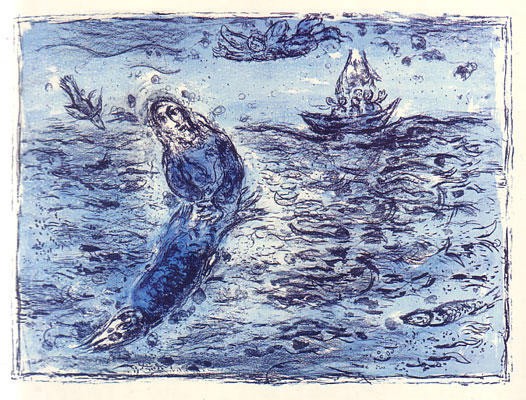
So the sailors heave Jonah overboard and it’ll take all but a miracle for him not to die. Thankfully, God is in the business of providing such things. God sends a giant fish, which swallows Jonah whole, leaving him able to survive. Jonah sits in the belly of the fish and sings: “I sank to the base of the mountains; The bars of the earth closed upon me forever. Yet You brought my life up from the pit, Eternal One, my God! When my life was ebbing away, I called God to mind; And my prayer came before You.”[6] Finally, it seems like Jonah’s getting it. Finally, brought to the very brink of death, it seems like Jonah is ready to choose life. God commands the fish to spit out Jonah on the land.

This time, Jonah does what God tells him. He heads out to Niniveh, that great city, to prophesy against them. Are his enemies, the overlords of the world’s biggest empire, rife with sin and iniquity, angry at him? Do they try and kill him? No, they’re horrified. It’s as if they’d never even considered what they were doing was immoral. They throw on sackcloth and ashes and prepare themselves for death. They even put sackcloth on the animals, so ready they are for utter annihilation. But God’s intention is not for them to die. As Ezekiel reminds us, God takes no pleasure in the death of them that die, but that they turn from their ways and live.[7]

Jonah is disappointed. He scolds God: “Please, Eternal One, take my life, for I would rather die than live.”[8] Has Jonah learned nothing? Close to death in the belly of the big fish, it seemed like Jonah was finally getting it that all God wanted was for him to live. Yet here he is again, begging to be allowed to die, threatening suicide once more.

God tries a different tactic. Instead of heavy-handed miracles and big displays in Niniveh, God tries out a gentle parable. God allows a gourd to grow over Jonah’s head, then allows it to die. Perhaps this will teach Jonah the precious, fragile sanctity of life. Quite the opposite. Jonah begs for death, saying: “I would rather die than live.” God asks Jonah: “Are you so deeply grieved about the plant?” “Yes,” he replied, “so deeply that I want to die.”[9]

Finally, we get to the prophecy that had been meant for Jonah all along. God says: “You cared about the plant, which you did not work for and which you did not grow, which appeared overnight and perished overnight. And should not I care about Nineveh, that great city, in which there are more than a hundred and twenty thousand persons who do not yet know their right hand from their left, and many beasts as well!”[10]

That’s why the story finishes by telling us about all the animals. God is saying: “Don’t you realise how much I care about you? I care even about the cattle in this city. I care even about a single plant in the desert. I love even your enemies, who are persecuting you, who do not worship me, who don’t follow my laws. How much do you think I care about you? Can’t you see how important you are? Choose life, Jonah. I’m begging you, stop with these thoughts of suicide. Give up on all that anger and hate you’ve been bottling up. Choose life, Jonah, why would you choose death?”

That’s what this whole story has been about. It was never about sin and death and punishment. It was so much simpler than that. It was about life. “Look Jonah,” says God. “I know you don’t think your life is worth living, but I do. To me, your life has meaning. To me, you are worth everything. Yes, even you. You with your stubbornness, your bitterness, your rage. You with all your unhappiness, your imperfections and mistakes. You mean so much to me that I will perform miracles. I will turn the world on its head to keep you alive. I will send you to the ends of the earth just to tell you I love you. Choose life, Jonah.”

That’s what this whole day has been about. Sometimes in prayer, especially deep in the fast of Yom Kippur, we can get so caught up in recounting our sins and holding onto our guilt, that we forget the whole point of the day. This day is not for wallowing in misery, it is to be thankful for life. We have been called here because our lives have meaning. By dint of being human, we are not just special, we are holy. To be a Jew means to affirm that life matters. It means to be willing to live a life that shows the best of what humanity can achieve. Of course, we may not succeed, but don’t we owe it to ourselves to try? Don’t we owe it to ourselves to choose life?

On the question of suicide, I think that Judaism has an answer. Judaism has only one answer, in fact, to every question, which is that life is holy. We are here to manifest the sacredness of life in everything we do. So today, let’s ask ourselves: are we doing that? Are we holding on to sadness and rage or are we thankful for another day? Are we dwelling on all that we’ve done wrong, or will we embrace the chance to get it right? Won’t we remember today that God wants for us to live?

Today God has put before you two choices: blessing and curse, life and death. Choose life, for why would you choose death?

jonah whale

This sermon was originally delivered on Yom Kippur 5778 at Manchester Liberal Jewish Community.

[1] Deut 18:22

[2] Jonah 1:2

[3] Deut 30:19

[4] Ezek 33:11

[5] Jonah 1:12

[6] Jonah 2:7-8

[7] Ezek 33:11

[8] Jonah 4:3

[9] Jonah 4:8-9

[10] Jonah 4:10-11