judaism · sermon · theology

If you don’t fancy killing pigeons, you’re probably a Progressive Jew


Have you ever done something wrong, completely accidentally, with all the best intentions, and, feeling ashamed and repentant, thought to yourself: “that’s it, I better go kill a pigeon.”

Of course you haven’t. Because as an astute reader of Torah knows, if you have committed a sin, you need to sacrifice at least two pigeons. A goat for serious misbehaviour. A bull, if you really messed up.

This week, we enter the Book of Leviticus, an impressive catalogue of sins and sacrifices. This third book in the Torah cycle, called in Hebrew Vayikra, acts as a directory for priests.

Here, you can match up any misdeed or lifecycle event with the appropriate sacrificial animal, and it comes with a handy recipe book for how to make the meat smell nice enough that God forgives you.

(Bit of oil… bit of incense… bake for three days in a smoke oven…)

We leave behind the great moral myths of Genesis. We leave behind the inspiring liberatory narrative of Exodus. And this, too, is where we leave behind Orthodox Judaism.

If you are an Orthodox Jew, the only problem you can see with killing a pigeon to atone for your mistakes is that you don’t have a Temple to do it in.

In the Koren Sacks Siddur, the Orthodox daily prayer book, you will find petitions to be recited every day that God rebuilds the Temple in Jerusalem, brings back the hereditary priesthood, and restores the sacrificial cult.

Finally, if I make an accidental mistake, I will be able to fulfil the Torah’s command that I should splatter a bull’s blood and entrails all over a table.

Frankly, I don’t know how our friends further up the Thames have managed to go so long without enacting this sacred duty.

At its best, the rebuilt Temple of Orthodox Judaism involves some kind of mystical descent of a palace from the clouds at the end of time. At its worst, there are Jews currently hoping to blow up the Al Aqsa Mosque on the Temple Mount and replace it with a gaudy pillared Roman-style shrine.

I’m not going to get into the geopolitics of why that would be a terrible idea. My area is theology, and I can tell you now, that from a religious, moral, spiritual, and ethical perspective, bringing back any kind of Temple would be a terrible idea.

Even as a metaphor, the yearning for Temple Judaism is an abrogation of responsibility, a refusal to engage in the real world, and a fantasy that blood can avenge wrongdoing. We cannot tolerate this idea on any level, whether real or abstract.

It is hard to overstate what a fundamental difference this is between Progressive and Orthodox Judaism. Opposition to rebuilding the Temple is central to Progressive theology.

In 1885, American Jews came together at the Rodef Shalom Synagogue in Pennsylvania and signed up to their foundational document: the Pittsburgh Platform. This decree has influenced how Progressive Jews see our religion ever since.

In it, they declare: “we expect no sacrificial worship under the sons of Aaron.” From the outset, we have believed that the synagogue has permanently replaced the Temple.

The author of the Pittsburgh Platform was an inspiring rabbi, named Kaufmann Kohler. Born in Germany, he became America’s preeminent Reform scholar. If you’ve ever dipped into the Jewish Encyclopedia, you’ve probably read something written by him.

Kohler wrote an introduction to Jewish theology that dealt thoroughly with how we Progressive Jews should understand these Temple texts. They were, for their time, a tool to help Jews gain moral understanding. The rituals and sacrifices showed us how to take responsibility for our thoughts, and even our conduct.

But, over time, we outgrew pigeon slaughter. We moved on to the world of rules and structures created by the early rabbis. And now, in our modern age, we are still moving forwards: so that we will do the right thing without being bound by old laws.

That’s what the progress in Progressive Judaism means: progressing from the age of slaughter through the age of laws towards the age of morals.

It’s not that we should discard the laws, or even the stories of slaughter. We should be like students who learn more through our schooling- at each stage, we retain what we learnt earlier, but we refine it, and we realise that some of our earlier ideas were too simplistic. Wanting to rebuild the Temple is like wanting to go back to the crayons of nursery school.

Throughout the moral education of humanity, we received hints that this was where we were going all along. In the Book of Proverbs, written when cattle murder was the normal way of dealing with guilt, it says: “To do what is right and just is more desired by the Eternal One than sacrifice.”

Throughout the books of the prophets we are repeatedly assured that God is far more interested in our moral conduct than in how much fat we can burn off the bones of a lamb.

Centuries later, when the early rabbis were busy codifying all their laws, the midrash explained why the Torah would say this. Sacrifices could only happen in the Temple, but you can do good deeds anywhere. Sacrifices can only atone for mistakes, but with good deeds you can repent for what you did wrong on purpose. Sacrifices only last a short while, but righteousness can endure forever.

At every stage of its development, says Rabbi Kohler, we Jews were a priestly people. Even in the days of animal sacrifice, we were always trying to demonstrate how to live with knowledge of God and concern for morality.

So, says Kohler, our mission on earth is to constantly be a beacon of moral behaviour. If we forfeit that, even for a moment, we will cease to be worthy of being called God’s people.

The idea of rebuilding a Temple isn’t just a dead end: it is a reversal of history. It takes us backwards from reason to superstition. It is the most retrograde step from our understanding of animal suffering to treating God’s creatures as subjects for abuse. It is abhorrent.

And I think most people know that. I honestly believe that, if we asked the vast majority of our friends and family who attend United or Federation synagogues if they think we would be better off with a cult of butchery based in Jerusalem, they would be repulsed by the concept.

In that case, they do not believe in Orthodox Judaism. Mazel tov, they’re Progressives already! Come through our doors, come celebrate with us, come pray with us!

You can leave your fantasies of pigeon massacres at the door. Come and be God’s priestly people.

Come and be a Progressive Jew.

Shabbat shalom.

halachah · sermon

What makes food kosher today?

Not long ago, after a near-lifetime of vegetarianism, I decided to try treif. And not just any treif, but the real deal: pork.

I knew I wanted to give it a go but I was afraid of being seen by other Jews. So I went on holiday to Gran Canaria, sat down in a fancy restaurant, and ordered a full-blown roast pork.

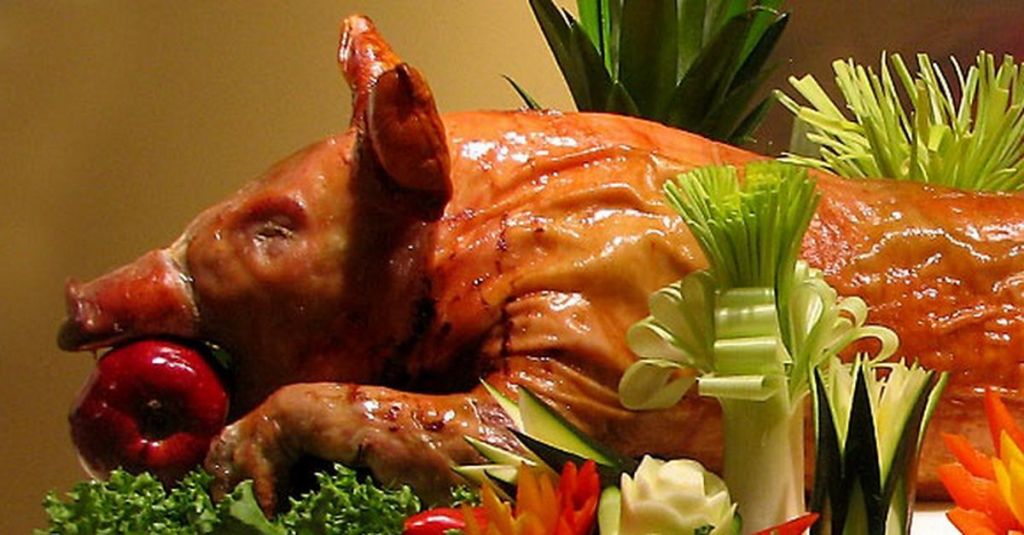
As I was waiting, however, a couple from my old congregation walked into the same restaurant. They instantly recognised me and came up to say hello. Just as we greeted each other, my pork came out from the kitchen: a giant pig on a massive platter with a big red apple in its mouth.

Flummoxed, I exclaimed: “My goodness… so this is how they serve apples here!”

OK, so that last part didn’t happen, but I really did decide to try treif about a decade ago. I’ll be honest with you, some of it tastes pretty good, but they’re not worth giving up Judaism for.

I hadn’t eaten pork since childhood. Aged 6, I had precociously insisted to my parents that I wanted to be religious and go to synagogue. My mum had told me that if I was going to force her to go to synagogue, I’d have to give up sausages. I wanted to be Jewish and I wasn’t allowed to do it half-heartedly.

I think all of us know that food laws play some role in our Judaism. Some of you here keep kosher kitchens. Some of you guiltily sneak a steak when you think you won’t get caught. Some of you, like my brother, eat extra bacon ‘to make up for all the ancestors who missed out on it.’

Whatever your choices, being a Reform Jew means to get to make those decisions for yourself. Our movement believes in informed choice.

Making the choice is your responsibility. But making sure you are informed is mine. So it’s my responsibility to share with you that there are lively debates happening in the Reform rabbinate about what kosher should mean today.

I recently attended my first Assembly of Reform Rabbis, where learned colleagues were discussing kashrut for the first time since the 1970s. It says something interesting that the topic hasn’t been addressed in such a long time.

The reason we are discussing kashrut again today is that the government is contemplating whether to ban traditional ritual slaughter – shechita. For many centuries, Jewish butchers have used the same methods for killing animals. That is: they slit their throats, puncturing the trachea, oesophagus and arteries with one rapid incision.

Throughout our history, Jews have considered this to be the cleanest and most humane method of killing animals. It comes out of a desire to show respect for the animals and to minimise risk of diseases.

Today, however, there is a new movement to favour stun slaughter. In this method, animals are electrocuted before they are killed. For cattle, this means putting a charged bolt through their heads. For chickens, it means electrifying them as a group. Proponents argue that this is more humane, since it renders animals insensitive to pain in their final moments.

There are two other factors that have made stun slaughter so popular, neither of which should be ignored. One is that industrial meat production means that factories produce far more meat. They want to be able to slaughter as efficiently as possible to maximise profit from the animals. Industrial stun slaughter certainly helps here.

Another factor is antisemitism. Across Europe, the movements to ban traditional slaughter have largely been led by white supremacists. Their primary target is Muslims, whose customs around halal slaughter are very similar to our own methods of shechita. Jews are really collateral damage in cultural wars about trying to retain Europe’s status as a Christian continent.

These factors make addressing this issue exceptionally complex. Proponents of stun slaughter ask us to set aside questions about racism and capitalism, just to focus on the issue at hand. I find that very hard to do. Rabbinic law is never about making moral decisions in the abstract. We make our ethical choices as real people living in the real world.

I think it is highly doubtful we will ever be able to prove that taking an animal’s life is better served by electrocution than through throat slitting. It may well be true that these new methods of industrial killing cause less pain, but shechita requires butchers to actually look animals in the eye before taking their lives. I’m not convinced either is more humane.

But, even if one were, we cannot escape the horrific systems that underpin animal consumption. Right now, the insatiable demand for meat is one of the leading causes of global warming. This week, we saw record-breaking temperatures. We can expect such heat waves to take place more regularly and more ferociously as runaway climate change unfolds.

The meat industry is an enormous enterprise that involves destroying natural habitats, depleting the oceans, battery-farming animals, deplorable working conditions, and unspeakable cruelty.

In every generation, Reform Jews have to work out anew what the most ethical way of living is. Today, it is hard to make the case that this includes participating in such an unjust system.

Rather than engaging in debates about specific methods of killing, I feel the appropriate response should be to question whether we should keep eating meat at all.

Indeed, this synagogue has long been an exclusively vegetarian site. This is partly because of convenience: it means we can host anyone and we can avoid messy arguments about separating meat from milk. But it also comes from the moral courage of previous leaders in this community, like Rabbi Henry, who felt that was the best way to live our values.

Please do not think me preachy. Quite on the contrary, I want to be open about my own hypocrisy. I still do eat meat on occasion, especially fish and chicken. I eat eggs and cheese. But, deep down, I know that the ethical vegans have already won the argument.

I once expressed my sadness about this to a frum vegan friend. She advised me: don’t let perfect be the enemy of the good. If you wish you could be vegan but can’t give up cheese, be vegan except for cheese! If you wish you could be vegetarian but like fish too much, be pesacatarian! We must all find ways to reduce our meat intake and limit our negative impacts on the planet.

The Reform rabbinate is still in open conversation about how we redefine kosher for our age. We did not settle the matter at the Assembly, and I don’t want to leave this sermon as if I have reached a definite conclusion. Instead, I want to bring you into the conversation. I want to hear how you think we should best live our values today.

Let us engage in open discussion. Let us talk with each other about our own practices and our own driving values. And let us fashion together a new future for what an ethical Jewish life looks like.

Shabbat shalom.