high holy days · sermon

The world is governed by compassion

“Hineni he’ani mi-ma’as – behold, I am poor in deeds and lacking in merit. Nevertheless, I come trembling in the presence of You, O God, to plead on behalf of Your people Israel who sent me, although I am neither fit nor worthy of the task. You who examine hearts, be my guide, and accept my prayer. Treat these words as if they were spoken by one more righteous than me. For you listen to prayers and delight in repentance. Blessed are You, O God, who hears our prayers.”

In the synagogues of medieval Europe, the service leader used to begin with this public prayer of atonement, openly acknowledging their own inadequacy. 

In the Liberal world, we have been shaped by the Victorian attitude that eschewed public vulnerability. So, instead, this prayer is given out to rabbis to read privately to themselves. 

The days when we had to pretend to be perfectly put-together are over. In our age, we recognise that openly sharing our insecurities builds a more emotionally authentic culture, where people are better at handling their feelings.

So, this year, I not only quietly recite this prayer in my office, but share it with you openly.

This year, these words feel more profound than usual. 

This is a sensitive time, and I know how fragile so many hearts are. 

In the build-up to these Days of Repentance, an American Masorti rabbi, Joshua Gruenberg, wrote:

“Rabbis stand before their congregations with trembling hearts. We know that every word matters. We know that words can wound and words can heal. And we know that in a climate like this one, the margin for error feels impossibly thin. […] The only way we will find wholeness is if we grant each other the space to be imperfect, the courage to be vulnerable, and the grace to be human.”

As this year came to an end, I thought back on the conversations I’d had with you over my time here. I thought back over some of the pain and worry you had felt, and realised just how much stress some members of the community were feeling. 

Words can, indeed, hurt and heal. They matter. I want to honour that, by reflecting on the pain some of you have expressed.

We come here because we want to be together, in our fullness, with all our wounds and trauma, so that we can move towards healing. 

To that end, let’s consider how we can approach anxious and hurting people with compassion. That is, after all, what we all need from each other.

The world has changed greatly in the last few years. So much feels more precarious. 

Ten thousand people rallied at Tommy Robinson’s far right march in London to a speech by Elon Musk telling the crowds to get ready for violence against immigrants. The news from Israel and Gaza, and Russia and Ukraine, and Sudan and Ethiopia, keeps rolling in, feeling ever worse. 

For me – and I know for some of you – the horrors of October 7th and the ensuing assault on Gaza marked a major turning point. In many of us, these events have brought up trauma responses we didn’t even know we had.

Since then, so much has unfolded that is out of our hands. This can feel painful when your instinct is to find solutions and assume control.

We have to accept our own limitations. I sometimes recite to myself the Serenity Prayer: “God, grant me the serenity to accept the things I cannot change, the courage to change the things I can, and the wisdom to know the difference.”

Those of us within this room do not have the power to bring about peace between the Israelis and the Palestinians. We cannot get the hostages back or stop the starvation of Gaza.

That feels hard. If it were up to the members of this synagogue I have no doubt that the whole world could live in peace. 

I am certain that we could indeed solve the country’s problems and fix our hurting planet. But nobody seems to be letting us do that, outside of setting the world to rights over kiddush.

But that does not mean we have no power at all. 

The one area where we have real power is in our own homes and our own community. 

And, there, we have the power to decide how much compassion we feel.

Even in the face of our own trauma and fear, we can choose to feel compassion for others.

Perhaps you can relate: in the immediate aftermath of October 7th, I felt intensely isolated. I felt a void where compassion ought to be.

I felt, among Jews, my own people, that I struggled to find many people who felt compassion for the people in Gaza. 

On the left, as much my natural home as the synagogue, I struggled to find many people who felt compassion for Israelis. 

Initially, I narrowed my circle to a small niche of Progressive Jews with left-wing opinions. It was comfortable and reassuring, when what I needed was to feel safe. 

But if I was looking for compassion in the world, I needed to bring it into the world. I needed to model it. 

Not just with the people who I knew felt like I did, but also with those whom I assumed were miles away from me. 

It is easy to love humanity in general, and fine to pity people on TV. It is much harder to love the people nearest you when you feel so distant, or to understand them when it feels like they are living in a different world. 

How could I look for compassion elsewhere if it wasn’t in my own heart? 

How can we look for compassion if we do not feel it?

You can’t expect others to extend compassion to strangers when you can’t even have conversations with the people you already know.

I felt then – I still feel – that, perhaps, if we can feel compassion in our synagogues, and extend it out towards the world, and that others could extend their compassion too, then it might cause something to shift.  

And, ultimately, that shift might make this world, which is harsh and unkind, a little better than it has been.

The message of compassion is already explicit in the liturgy of our Yom Kippur service. 

God’s name is Compassion. 

We read the refrain that repeats throughout the High Holy Days: “Adonai, adonai, el rachum vechanun… a God compassionate and gracious, slow to anger, abounding in compassion and faithfulness…”

It is a beautiful invocation of God’s qualities to help us through Yom Kippur. 

The verses come from Moses’s second acsent of Mount Sinai, when he takes the new set of the Ten Commandments in his hand. As Moses walks down the mountain, God comes with him.

As Moses chants out these declarations of God’s mercy, it is as if Moses has truly understood what kind of God he is dealing with.

He learns how the world really works. He sees that it is governed by compassion.

Just before coming to get the new tablets of the law, Moses had seen the Israelites worshipping a golden calf, and smashed up the first set of the Ten Commandments. 

These are great sins: idol worship and wanton destruction are strictly prohibited. The Israelites have been wayward. Moses has been angry. 

Still, God, abounding in compassion and faithfulness, says: “Try it again. Have another go.”

In the Talmud, Rabbi Yohanan teaches that whenever the Jewish people sin, they should think back to this verse.

In the repetition of “Adonai, Adonai,” the Jews should understand that God is their Loving Creator before a person sins, and God is their Loving Creator after a person sins and performs repentance.

God is always willing to give people another chance.

In the same section of Talmud, we learn that, in the moment when Moses recited those words, God made a covenant based on thirteen attributes of mercy. It was a promise that God would always hear our prayers.

Later, in the Middle Ages, the French commentator Rashi elucidated what these thirteen attributes were.

In each word, says Rashi, is a reflection of the type of compassion God feels. 

God is slow to anger to give you a chance to repent.

God is abundant in mercy, even with those who don’t deserve it.

God remembers good deeds even for a thousand years.

Even when we hear that God holds grudges for three and four generations, Rashi says that this only refers to people who maintain the evil ways of their ancestors. If they repent, all can be forgiven of them too.

This is how one truly maximises compassion.

So, let us be compassionate.

Let us maximise how much compassion we feel.

Our own community and our own homes are small places where we can truly practise compassion in a world where it seems so sorely lacking.

Last week, in her Rosh Hashanah address, Rabbi Angela Buchdahl, of the American Reform movement’s flagship synagogue in New York, reflected on how the division in the world was creating strife even within her synagogue.

She urged her congregation to practise compassion, saying:

“It now seems that any expression of compassion for “the other side” is regarded with suspicion – as disloyal, or even threatening. Is our capacity for empathy so finite? Are our hearts so small, that if we increase our empathy for certain people, that we need to reduce it for others — until one day, we conclude: that ‘other side’ is not deserving of any compassion?”

Here, the “other side” could be so many different groups in this increasingly polarised and hostile world. 

We all want to feel like people understand our own side, but struggle to extend our understanding the other way.

You don’t have to agree with people to love them. You just have to be curious, and try to understand them.

Some days, we may be capable of less compassion than others. On those days, let’s give ourselves grace, take time out, and remember how flawed we all are.

Even on our worst days, we can always try to understand each other. We can hold our own hearts while making them permeable enough to feel others’ pain too.

When people challenge us, let’s look for the best in them. Imagine their best intentions, and try to consider what problems they might be facing.

We are, all of us, flawed and temperamental. We all ask good grace of others, and we can all give it in return.

This year, let’s try to feel compassion for the people in our own families and homes.

Let’s try to find compassion for the people in our neighbourhoods. Perhaps we will shift something in them.

Let’s find compassion for the people in our community, so that we can hold each other, in our diversity, through these trying times. 

And, as much as we can, let’s try to find compassion for everyone. 

It won’t change the news cycle, but it might change you. And you might change others. 

It is a small contribution to this world, but it is a mighty one. 

It is the best that we can do.

Behold, I am poor in deeds and lacking in merit. Nevertheless, I come trembling in the presence of the One who hears the prayers of Israel. O God, You listen to prayers and delight in repentance. Blessed are You, O God, who hears our prayers.

Amen.
Kol Nidrei 5786, Kingston Liberal Synagogue
festivals · judaism · torah

What happened at Mount Sinai?


We are days away from Shavuot, the Feast of Weeks, when we celebrate having received the Torah. At this festival, we affirm we have received God’s word and that it is unfailing.

This is what we think we know: these words are not only God’s.


They have human origins, and they were written over many centuries. The Torah is not a single, unaltered revelation. It is a book with a history.

What happened at Mount Sinai matters immensely. It is the foundation of our faith. It is the basis not only of Judaism but of every monotheism that followed it.

The story has been told so many times. Hordes of Hebrews fled from Egypt, gathered around the foot of a desert peak, and heard the voice of the One True God.

What they experienced, they told to their children, and they to theirs, until – after generations – the vision was written down into a collection of stories and laws we call the Torah.

We have to know what really happened at Sinai; so much hinges on this indecipherable point of history.

We have to believe in the real world, where history is something made by human beings, who work, and struggle over resources, and build societies.

We have to believe in the God of Judaism, who is revealed through history.

We must synthesise the two. We cannot split the material and the spiritual. We need to know what the material reality was that lay underneath this spiritual truth. We need to know what happened at Sinai.

We cannot truly know, but we have to try and work it out. A group of human beings felt so inspired that they wrote down ten commandments and passed them on for thousands of generations. Why?

A group of human beings, who surely worked and slept and ate and drank and dreamed, proclaimed that they had seen God.

Something marvellous must have happened at that time. Something awe inspiring – to give us this treasury of ancient wisdom. Who committed these words to paper, what happened to them, and what made these commandments feel so important to them?

What really happened at Mount Sinai? The biblical historian pores over our texts, strips them back, digs out inconsistencies, looks for parallels in ancient cultures, and analyses the language in which the stories are told. The biblical historian discards impossibilities, looks for likelihoods, and reconstructs the best possible version of events.

We cannot know for certain, but we can do our best to do the same – to discard, seek and reconstruct. And, when we do, the truth of/ Mount Sinai that we are left with is far more radical than we might imagine.

For the historian, Mount Sinai may not have been Mount Sinai at all. It may be, as the Samaritans claim, Mount Gerizim, near Nablus, since that is also one of the mountains the Torah names as a site of revelation. It may have been Mount Pisgah or Mount Nebo, on the eastern side of the Jordan River, since our Torah names those locations too.

We do not know at which mountain the important revelation happened. But there was a mountain.


This is what we think we know: there was a mountain.

Some people went there. They may not have been Jews, since that word did not exist yet. They may not even have been Israelites, since the story teaches that they only became Israelites through the process of what happened at that mountain.

They were, says the Torah, a mixed multitude. They were drawn from all the nations of the Ancient Near East: from Ethiopia and Yemen; through Egypt and Sudan; to Lebanon and Syria.

They were, by their own self-description, border-crossing nomads. They had no land or title. There are no records to suggest they owned any weapons, let alone that they had military strength.

If we are to trust how they wrote about themselves, they were menial workers. Water drawers; grain carriers; tenant farmers; shepherds. They had been slaves. They were a ragtag of the ancient world’s lowest classes.

We do not know who these people were. But they were poor and transient.

This is what we think we know:
the poorest people of many ethnicities came together at a mountain.


We are not sure when it happened. It may have been any time from the 15th Century BCE. The latest it could have been is the 5th Century BCE, when the Torah was edited into its final form. That is a difference of nearly a thousand years.

We do not know what brought them to that mountain. We cannot prove that the exodus took place exactly as it was described in the Torah.

But we do know that, in the 12th Century BCE, there was a massive societal collapse in all the nations of the Mediterranean basin. In the broad period when our Torah tells us that our ancestors received the Ten Commandments, the Egyptian empire was crumbling.

We also know this. When Egypt was collapsing in the late Bronze Age, a Pharaoh wrote a stele, complaining of slave uprisings by a group of nomads on the fringes of his empire. He calls those people Habiru. The biblical historian notes the linguistic similarity between these people and the Hebrews.


This is what we think we know: the poorest people of many ethnicities rebelled together against a decaying empire some time around the late Bronze Age.
They met at a mountain.

The stories they tell of their experiences at that mountain are fantastical. Fire descended from heaven. Thunder crashed and lightning roared. Thick smoke descended over the peak. The earth trembled violently. The Creator of Heaven and Earth became manifest before them.

How can we know if any of this happened? Nobody else could have testified to what they saw. There are no contemporary meteorological records. There are only two possibilities: either the authors of our Torah really believed that was what they experienced, or they made it up.

If they made it up, so many others were convinced that they had been part of that experience at the mountain, that they faithfully transmitted the story for hundreds of years to their children and grandchildren. Which is more likely: that these people lied, or that they genuinely believed they had a transcendent experience?

This is what we think we know: the poorest people of many ethnicities rebelled together against a decaying empire some time around the late Bronze Age.
At a mountain, they had an experience so profound that they felt as if they saw God manifest, and it changed their lives and the lives of their descendants forever.

The God they thought they heard told them: “Although the whole earth is Mine, you will be for Me a dominion of priests and a holy nation.”

The poorest people in the world affirmed belief in a God who knew no borders and rejected all hierarchies. Every one of these ancient landless waifs would be holy.

According to our Torah, those people entered into a covenant.

Until this point in history, contracts of these kind were predominantly made between empires and vassal states. They took the form: “you will pay me tribute, and I will be your landlord.”

This was a covenant of a new kind. It said:
“you will do justly by one another, and I will be your God.”

They ratified this new agreement and remade what a covenant was. They swore an oath, committing themselves to an entirely new society. They bound themselves to a Law that knew no Sovereign save for a universal God.

They promised that their society would have no more killing; no more trafficking in human beings; no more greed. They declared fealty to each other, to their God; and to their sacred days of rest.

Take our texts. Strip them back. Dig out inconsistencies. Look for parallels in ancient cultures. Pay close attention to language. Discard impossibilities.

From what remains, you can reconstruct the best possible version of events.

This is where we have arrived.
This is what we think we know.

Thousands of years ago, poor people from many ethnicities got together in common rebellion against a decaying empire. They had an experience so profound that they felt as if they saw God manifest.
At a mountain, they made a covenant to create a society based on dignity.

Many hands have since re-written and interpreted that event – but, deep at its core, buried under years of transmission and analysis, was one moment.

This, is what we think we know:

Somewhere in history, there was a slave rebellion by a mountain.

And it was marvellous.

Originally published in Vashti.

festivals · sermon

Will there still be Jews?

A young Talmud scholar moves from Lithuania to London. Years later he returns home to visit his family.

His mother asks: “Yossele but where is your beard?”

“Oh, mama, in London, nobody wears a beard.”

“But do you at least keep Shabbat?”

“No, mama, in London people work all the time. We have to make money.”

“Oy vey. But do you still keep kosher?”

“Mum, I’m sorry, kosher food is expensive and hard to find.”

“Yossele…” she says. “Are you still circumcised?”

Thus joke points to a perennial Jewish anxiety: will people stay Jews? Will Judaism continue?

In every generation, a study is published, fearfully proclaiming that Jewishness is declining, which will be swiftly followed by rabbinic pronouncements about how to save it, philanthropists putting money into projects that engage young Jews, and various pundits proclaiming that this proves exactly what they had always said.

Why, when this problem has been repeatedly highlighted, has Judaism nevertheless continued, and Jewishness never seen the burial it was foretold?

For starters, it turns out that many of the things that people assured us would mark the end of Judaism were not that threatening after all. At the start of the Enlightenment, Orthodox leaders agonised that, if Jews went to universities, they would be needlessly subjected to heretical ideas and turn their backs on religion. In the end, Judaism and academic study proved more than compatible.

The fear about Jews losing their beards turned out not to be so troubling either. After all, half the Jewish people had never been able to grow them! In the 90s, the great moral panic centred on mixed marriages, which, experience has shown, only grew the Jewish population, rather than diminishing it.

So, why all the worry? In fact, these concerns undoubtedly go back to the beginnings of Jewishness. In the book of Ruth, we read a story of a young woman faced with the choice of whether to remain with the Jewish people. Either she could stay with her mother-in-law and run the risk of never marrying; or she could return to her original village and begin her life again.

Being Jewish was the harder option. Being Jewish was riskier and unknown. Ruth’s sister, Orpah, chose to leave the Jews and rebuild. Ruth chose Judaism.

She must have seen something in it that made her want to stay. Perhaps it was the God, or Naomi, or the people, or the way they lived. Judging by what she said, it was a combination of all of these. She chose the harder option, because it was the more beautiful one.

That has always been the way with Judaism. High risk. High reward. Hard to maintain. Worth maintaining.

That is why we feel anxiety about Jewish continuity. We know that it is not the easy option. It takes work. So we look around for people who will do it.

Our rabbis understood this feeling well. They told a story of the revelation at Sinai: that, on the day when God gave the Israelites the commandments, God raised Mount Sinai over their heads and told them to accept them. If they took them on, they would live. If not, the mountain would come crashing down on their heads and make the desert their grave.

“Choose life” wasn’t advice. It was a threat. Of course, they accepted.

But, said the rabbis, there were other times when they took on the commandments too. When there were no threats from God but plenty from the ruling powers. They point to the story of Esther, when the Jews lived under Persian imperial rule and could have been slaughtered for practising their religion. God did not appear to make promises or offer consolation. But they chose Judaism anyway.

This is a narrative of how Judaism has been continued. On an individual level, this is what happens to many of us. As children, we go to synagogue because our parents tell us to. We live their ways and eat their food because we have no other choice. Now, as adults, we turn up because we want to. There is no compulsion to attend. We do it because we have found in it something beautiful and worthwhile.

This is true, too, of our history as a community. There was a time when we had no choice but to be Jewish. Think of the periods when Jewishness was stamped on our passports and our job application papers; when being Jewish determined what jobs we could do and where we could live. We kept up Judaism because we had no other choice.

But now we have reached a time when it is a choice. Nobody is making us be Jewish. We sustain it because we want to. You who have turned up this morning could have gone anywhere. You could have done anything. But you chose to come here. Like Ruth and Esther, you decided that something in Judaism was beautiful and worthwhile.

You decided that this religion and these festivals have meaning. That is why I’m not really worried about Jewish continuity. I know that you are keeping it alive. I know that, in every generation, as long as there are a good few people who think Judaism is worthwhile, it will be.

On Shavuot, we renew our covenant with God. We take on the Torah once more. We decide to keep the flame of Jewish truth burning.

And, because of that, Judaism lives on.

judaism · sermon

Moses kept wearing a mask

This year has changed us forever.

When Moses came down Mount Sinai, his face was radiant. He had horns of light emanating from his head. 

He had, in fact, been on the precipice for 40 days and 40 nights. During that time, he did not eat food or drink water. Some say he did not sleep. What was it like for him up there? What did he see and feel during that intense period at God’s side?

The Torah only records snippets. A moment where God passed in front of his face. The midrash suggests vignettes: that Moses watched God placing crowns on the letters of the Torah and saw Jewish future. Maimonides imagines Moses acquiring true knowledge, suddenly enlightened by philosophical and scientific truth about how the world was kept in order.

But we have to speculate. It is not just because the Torah is sparse, but because whatever happened on Sinai must have defied explanation. A period of complete solitude. A time when nobody else was there to corroborate events. A time of deep spiritual introspection. Moses saw something he could not fully communicate.

So the only real evidence of Moses’s experience was how it transformed him. Set aside the commandments and the miracles, Moses himself was internally and externally changed by the experience at Sinai. Everyone could see that, from now on, Moses’s face shone with rays of light.

In Jewish terms, it has been a year since lockdown began. A year ago, I attended Leo Baeck College’s Purim party. At the start of our revelry, Principal Rabbi Dr Deborah Kahn-Harris warned that we should enjoy ourselves because it might be the last time we met for a while. I remember thinking how unnecessarily pessimistic she was being. A week and a bit later, around Shabbat Parah, the government instructed everyone to stay home except for essential travel.

Today is, once more, Shabbat Parah. Happy anniversary. 

It will be hard to explain afterwards what happened in this year. Perhaps we will remember echoes of the rituals that sustained us. Clapping for carers. Zoom services. Calls with family. But if future generations ask me what this year was like, I will struggle to give a coherent answer.

Our experiences over this last year have not been uniform. Some have shielded at home for the full year, only seeing a small circle of people, if that. Others have gone to work in essential services but nevertheless been unable to visit family. Some have had to learn how to homeschool children. Others have been prevented from meeting grandchildren. 

When we doing emerge, I suspect we will struggle to explain even to each other what this year was like. The only proof that we ever went through it will be in how we are changed.

After Sinai, Moses kept on wearing a mask. Now that Moses’ face had those shiny horns, his appearance frightened people. Even his closest relatives found it difficult to look at him. He kept hold of a special veil, which he wore at all times, and only removed to communicate with God.

I suspect we will probably do the same. We will keep wearing masks on public transport now for years to come. We will probably also maintain some of the technology to which we have become accustomed. I’m sure many synagogues will still stream services and do online study sessions long after the pandemic is over as a way to include more vulnerable members. 

But the real evidence of what we went through will be in how we are changed. And that is something we will have to decide for ourselves. 

When the lockdown began, I imagined the great societal changes that might come about as a result. Greater respect for key workers. A commitment to tackling climate change. New rights and protections for the vulnerable.

I still have hopes that those dreams will be realised. But when Moses came down the mountain, he did not only carry with him the moral law. He also brought his own metamorphosis. His shining face and altered insides. 

As the end of lockdown is in sight, I wonder how we will be different as individuals. Will be more focused on family, or more keen to befriend strangers? Will we live carefree, or with more caution? Will we focus more on community or on individuality? And now, after this year, will we feel closer to God, or further away?

Those aren’t questions anyone can answer for anyone else. They are the product of soul-searching. 

We now have a road map out of lockdown. If everything goes well, we could be back to having large gatherings again in the summer. But that doesn’t mean we will go back to being the people we were before. This year has transformed us forever.

Who we will now be we have to decide.

Only we can determine how our faces will shine.

Shabbat shalom.

This sermon is for Edgware and Hendon and Reform Synagogue on Saturday 6th March 2021, Parashat Ki Tisa.

theology · torah

Stop doubting. Start doing.

Job was a man of complete integrity. According to his eponymous book of the Tanach, no matter what happened, Job was the epitome of Jewish righteousness. Then hardship fell, and Job began to doubt God’s justice.

This was hardly surprising. God had stripped him of everything, ridden him with disease, killed his children and destroyed his livelihood to test whether or not Job would remain faithful.[1]

As it turned out, Job could only endure so much. His friends comforted him with explanations of how God must be righteous after all, but they were insufficient. Finally, Job began to snap. What if God was not just?

Just then, God burst out through the clouds. “Who are you to question Me?” demanded God.[2]

After a lengthy excursus from Job’s inadequate interlocutors, we might expect a more thorough explanation. God has arrived and will explain the nature of justice.

Instead, God goes off on one about mythical beings. God talks about the Behemoth, an enormous bull-like monster that can rampage fields. God describes Livyathan, a fire-breathing dragon that cannot be killed.[3]

And this, apparently, satisfies Job.[4] Well, I’m not satisfied. I don’t know about you, but if I’m having doubts about my faith, “have you heard about the monsters God tamed?” won’t really cut it for me. You can’t respond to rational concerns by piling on ever more improbable legends. Now I’m filled with even more doubts.

But perhaps that’s the point. The author of Job, arguably the most philosophically complex text in our Tanakh, probably knew that these myths weren’t really an answer to the question posed.

The real answer, hidden within these poetic arguments, is that we don’t know. Whatever God is, it is beyond our comprehension.[5] Whatever justice is, we cannot fully reason it enough to grasp it. ‘You don’t need to understand,’ is what God is really saying.

Similarly, our parashah this week concerns Moses’s doubts. We have come to the book of Exodus, and Moses has already run away into the wilderness. Out of a flaming thicket, God summons Moses to rescue the Israelites from their slavery in Egypt.[6]

Just as God answered Job from the clouds, so too does God answer Moses. But the answer Moses receives is no more comforting. ‘You don’t need to understand,’ says God, ‘you need to get going.’

“What if I’m not good enough?” asks Moses. “You will be,” says God.[7]

“Who even are you?” asks Moses. “I will be whatever I will be,” God roars back. “Tell the Israelites ‘I will be’ sent you.”[8]

“What if nobody believes me?” asks Moses. “They will,” says God.[9]

“But what if I can’t find the words?” asks Moses. At this point, God loses patience. “I gave you your mouth, I will give you the words! Now get yourself down to Egypt and set those slaves free!”[10]

Miracles might be convincing to some. Logic and reason might work some of the time. But, ultimately, you have to act. When faced with injustice, there is little time to contemplate the nature of sin and perfection and God’s role in it. You have to get out and do.

Rabbi Abraham Joshua Heschel was a Conservative theologian and civil rights activist, famously pictured alongside Martin Luther King Jr at the march on Selma. He said that Judaism does not require a leap of faith, but a leap of action. We are called upon, first and foremost, to act. Whatever we think about it can come later.

This might sound strange to us, educated in a Western thought system that teaches us to calculate and reason before making choices. But it was not strange to the Israelites. When God called on them at Mount Sinai, they replied “we will do and we will hear.”[11]

According to the Talmud, a heretic accused Rava using this verse. Rava was sitting, so engrossed in study, that he didn’t notice he had trapped his finger in a chair leg and it was spurting blood everywhere. “You impulsive people!” the heretic said. “You still bear your impulsiveness of acting before you think. Listen first, work out what you can do, then act.”[12]

Rava responded with the verse from Proverbs:[13] “The integrity of the upright will guide them.”[14] We trust in our integrity. We trust in our conscience. We can be moved by our faith that we know right from wrong.

I think, over the last few years, progressives have done a great deal of doubting. We have been introspective and thoughtful. We have wondered, internally and out loud, whether we are right after all. Perhaps, as nationalist ideas return and religious conservatism gains strength, we might be able to make compromises on our ideals and find a middle-ground with others.

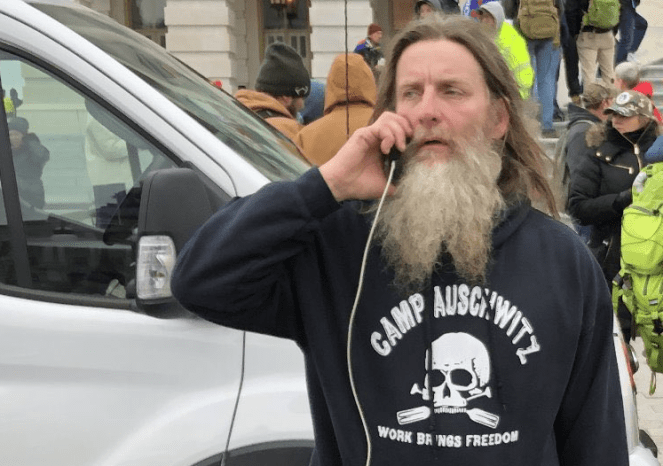
This week, fascists marched on the White House. They carried Confederate flags into Congress. A Nazi showed up among the rioters wearing a shirt that said: “Camp Auschwitz” on the front, and “staff” on the back, as if taking credit for the mass murder of Jews. They proudly displayed nooses, the symbol of anti-Black lynchings. Every brand of far-right conspiracy theorist and white supremacist descended on Washington, and video evidence shows that the police not only tolerated them but let them in.

Where has all our doubt and consideration left us? In our desire to find common ground and engage in reasoned discourse, we now come across as morally ambiguous and uncertain in our principles. We have left an ethical vacuum, and fascists have stormed into it. Intellectual curiosity is little use against the blunt force of white supremacists seeking to violently cease power.

Rabbi Professor Tony Bayfield has pointed out that our uncertainty is what differentiates us from fascists. Fascists are, by definition, absolutists. They do not interrogate their views or consider other perspectives. Our advantage over fascists comes from the fact that we give arguments due consideration and approach our own convictions with humility.

He may be right. Doubt might separate us intellectually from fascists. But it is action that separates fascists politically from power. There is no joy to be had in feeling superior if white supremacists gain power in government.

This week’s events may have been a terrifying climax to Trump’s presidency. But it is equally likely that they are a prelude to worse events. American white nationalists are emboldened and convinced that they can seize power through either ballots or bullets, depending on whichever method suits them. The situation in Britain is scarcely different, where racists have not felt so confident in decades.

Whether Trump now recedes into the background or his racist ideas come to dominate the world will depend on how we act. It will not depend on what we think, but on what we do. Events are calling us to action. If we want to eradicate fascism, we must be willing to fight it.

By all means, have doubts. Moses doubted. Moses was unsure. But God said to him, ‘go anyway. Get down to Egypt and free those people.’

We must be willing to face the Pharaohs of our time with the same vigour. We must be able to say: “I have come to act because God sent me. I am standing for justice because I know it to be right and true. I am standing against racism because I know it to be wrong. I will free these people. I will uproot tyrants. I will defend democracy and advance the cause of the oppressed.”

The integrity of the upright will guide us.

Although we may not fully understand these monsters before us, we will slay them.

And we will vanquish fascism for good.

Shabbat shalom.


I am giving this sermon on 9th January 2021 at Newcastle Reform Synagogue for Parashat Shmot.

[1] Job 1

[2] Job 40

[3] Job 41

[4] Job 42

[5] Job 11

[6] Ex 3

[7] Ex 3:11-12

[8] Ex 3:14

[9] Ex 4:1-9

[10] Ex 4:11-12

[11] Ex 24:7

[12] BT Shabbat 88a

[13] Prov 11:3

[14] BT Shabbat 88b

festivals · sermon · theology

Falling in Love is a Choice

Lately, I’ve been thinking a lot about falling in love. Maybe it’s the spring heat of May. Maybe it’s the newborn baby delighting me with his first smiles. Maybe it’s my boyfriend moving down from Manchester. Or, perhaps, it’s because it’s Shavuot.

The model of a loving relationship in Tanach is of Ruth and Naomi. It may sound strange to think that two women could be such an example even in Orthodox Judaism, but Ruth’s words are used in wedding liturgies to this day, as well as recited by proselytes upon their conversion to Judaism. Why is it that this text connects falling in love, joining a faith and receiving the Torah at Shavuot?

After Ruth’s husband dies, her mother-in-law, Naomi, begs her to leave. But Ruth responds:

Entreat me not to leave you, nor to turn back from following you. Wherever you go, I will go. Wherever you lodge, I will lodge. Your people shall be my people, and your God, my God. Where you die, I will die, and there I will be buried. May God do so to me, and more, if anything but death parts you from me.

When Ruth tells Naomi she will never leave her, Naomi puts up every possible objection. It would leave her without a husband or income. Her sister has gone. Anybody would leave her. Be sensible. Go. 

But Ruth refuses to see sense. Her choice to stay with Naomi is irrational. She could never explain it in a way that makes sense to anyone else. Something more powerful than reason must have gripped Ruth’s heart. Surely it was love. Messy, confusing, irrational love.

Is that not how falling in love really feels? For anyone who has felt it, is love not completely illogical and nonsensical? Nobody could reason it. It runs not just contrary to reason but is almost its opposite.

And yet, somehow, love is also a choice. Ruth stayed with Naomi because she wanted to. She could have stopped up her heart, grieved and left her mother-in-law. But she stayed. Because love is nothing if it isn’t freely given.

At first it feels like the lapping of an emotion at your insides. And then the waves of longing seem to get bigger as they ask to be allowed to grow. And then you make a choice. If you are not ready to fall in love, you can walk away from its shores. But if it feels right, you will dive in and let its waters subsume you. 

Whether with a first partner or a best friend or a newborn baby or a brother or a mother or a spouse to whom you have been married for years. Love, when it comes, is a choice. But it is a choice we cannot help but make.

I think the same is true of faith. It is not something that can be reasoned or explained, but only felt. Religious belief starts as a nagging feeling of suspicion that there might be something greater than what our senses perceive. After that, we have to make a choice. As Einstein put it, either everything is a miracle or nothing is. 

And so, faced with a latent sense of wonder, the faithful make a choice about how to see the world. For those who believe, God is manifest in everything that exists. Every facet of nature is a revelation of God’s truth and a calling to accept it.

This, to me, was the true miracle of Sinai. It is that, like those who fall in love, the Israelites made an irrational choice that changed their lives and stuck with it. Shavuot is the celebration of the receiving of the Torah. It is the renewal of our wedding vows with God. Whereas anniversaries between human beings celebrate the date of falling in love, Shavuot is the anniversary of our falling in faith.

We are told so much about the fanfare that greeted the Israelites when Moses received the Torah. Thousands of people gathered round and all witnessed exactly the same thing. Thunder and lightning. A giant cloud descended over the mountain. A horn blast sounded loudly from the air. The whole mountain became cloaked in smoke and shook on its foundations.

But a cynic could have looked at all this and said: these are just natural phenomena. Thunder and lightning on the desert are rare, but they happen. It wasn’t really a shofar blasting from the sky, but the sound of sonic shock waves from the lightning. The mountain didn’t really move, it just felt like it from all the noise.

And that would be the rational position. But the Israelites were not interested in reason. They were falling in faith.

When Moses came down the mountain, his face was radiant and shining out beams from his cheeks. He carried with him two tablets, inscribed with the laws that would govern the nation for generations. The Ten Commandments. 

Some say that, as he descended, the desert mountain erupted in blossoming flowers. Some say the Commandments were written in black fire on white fire. Some say the mountain was upended and suspended over the Israelites’ heads.

And, of course, any sceptic could have said: this is trickery. God did not write those laws, but Moses made them himself while he was hiding up that mountain. These flowers and fires are just sleight of hand by an adept magician. 

And that would be the rational position. But the Israelites had made a choice to accept faith over reason. Thousands of them, huddled together in a strange place, made the decision to accept a beautiful belief over a plausible one. And nobody objected. Out of the many hordes assembled, nobody suggested that it was all a lie or a collective delusion. They let faith dictate to them.

And what did that faith say? That God is personally interested in the lives of people, even in those of refugees and runaway slaves! That the moral fate of the universe rested in the hands of a persecuted people, who were singled out to be light unto the nations. That love, truth and justice mattered more than could be calculated.

As Liberal Jews, we place a great deal of emphasis on reason, and rightly so. Reason keeps us from blind submission to antiquated and offensive ideas. It helps us keep Judaism alive in our own time. But we must also celebrate faith. Sometimes we hold beliefs that cannot be pinned down by logic, but can only be felt. Sometimes our irrational choices are so compelling that we live our lives by them.

Like having faith. Like seeing beauty. Like believing in miracles. Like falling in love.

Chag Shavuot sameach. Shabbat shalom.

love in the mountains

I gave this sermon for Shavuot on 29th May 2020 over Zoom for Three Counties Liberal Judaism.