Occasionally, I hear Jews complain that everyone is obsessed with Israel. It’s true: this country gets way more coverage than pretty much any other. The coverage of the war on Gaza greatly eclipses anything broadcast about Yemen, Congo, or Sudan.
But can we really be surprised? More than a third of the world considers this land to be holy. Jews pray in this direction three times a day. Muslims believe their prophet ascended to Heaven here. Christians believe their god was born here. For the Bahai, their founder died here.
I do not think it is controversial to say that this land is, in some sense, sacred.
It is not that this country has any more God in it than anywhere else. Religious Jews hold that the Divine Presence departed from here with the destruction of the Temple, and that God’s place is now as dispersed as Jews are throughout the world.
But for at least the last 2,500 years, religious believers have invested their hopes and directed their prayers here. That decision to imbue the land with holiness surely has an impact.
Since the late medieval period, Jews have held that there are four holy cities in the land: Jerusalem; Tiberias; Hebron; and Tzfat. As a result, people have decided to be buried in them, retire to them, have their remains moved to them, pray to them, and study in them.
Having finished my volunteering in Jerusalem, I did what a good religious Jewish boy does. I went with my boyfriend on a pilgrimage to the sacred city of Tzfat.
We took a long bus ride through the hillsides, past the holy Mount Meron and along the Sea of Galilee into this beautiful blue city.
For centuries, this town has been considered an important religious site for Jews. Almost everything a worshipper would recognise from Friday night prayers began on these ramshackle cobbled streets. Mysticism was born here.
The Shulchan Aruch, the most important law code for observant Jews, was written here. That was what I was really excited to see: the synagogue where its author, Rabbi Yosef Karo, composed his authoritative work of religious law.
This law code holds a deeply special place in my heart (as it does for most religious Jews). My copy was gifted to me by my mentor, Rabbi Laura Janner-Klausner. She studied the codes with my grandfather, who loved halachah more than any Liberal Jew of his era (or since, probably.)
It also holds a deep connection for my partner, Laurence. He is a direct descendant of Rabbi Moses Isserles, who wrote a gloss to the Shulchan Aruch, called the ‘Mapa’, which turned it into the definitive law code for Ashkenazi Jews, especially his Lithuanian ancestors.
Laurence’s ancestry is a source of great pride to me, although he still has really no idea what the significance is.
Nevertheless, I think our backgrounds have contributed to why we connect so well. Because of our upbringings in the Liberal movement, and our ancestors who cared so much about Jewish law, we both see our Judaism in ethical terms. We regularly have moral conversations about what to eat, how to handle workplace difficulties, where to give charitable donations, and how to run our home.
When we first started dating, we had long conversations on our hikes over questions of Jewish medical ethics, like euthanasia, organ donation, and brain-death. In all of these, we refer back to our principles as religious Jews, and to the great writers on these ethical questions, like Rabbi Karo.
When we arrived at the Rabbi Yosef Karo Synagogue in Tzfat, it was shut. It hadn’t been open all day. It hadn’t been open for months. It would not be opening again any time soon.
In fact, everything was shut. Not a single art gallery, synagogue, or museum was open. We were lucky enough that one coffee shop was open in the Old City, where we got a drink, and found out what was happening. Nothing was open because there was nobody to open it for.
The northern towns have been entirely evacuated for fear of rockets from Hizbullah. No pilgrims have come for a long time, fearing for their safety. There are no tourists stopping by to look at the shops.
From the perspective of the locals, the central government has abandoned them. While the military successfully intercept nearly all the missiles from Lebanon, there has been no material support for the pious Jews who live and pray here, completely dependent on tourism.
When we first got here to the north, we felt like we could barely tell there was a war on. There were so few guns and next to no propaganda posters. It turns out we were looking for the wrong thing.
What we had not noticed were all the absences. All the missing shops, traders, youth trips, international tourist groups. There was nobody speaking English, Chinese, French, or Russian. Now the absences are the most gapingly obvious things here.
For many years, critics of Israeli nationalism have warned that arrogant militarism offered no hope for the Jewish people. For this, we have been accused of being traitors, bleeding heart liberals, communists, terrorist-enablers, and doe-eyed dreamers (usually by exactly the same people.)
I wonder if they will begin to see that it is precisely their hubris and warmongering that is destroying them.
This war is bankrupting them; their economy is in tatters; they are isolated and facing criminal charges in the Hague. Many Jews now look to this land with horror and fear.
Before the founding of the state, the mainstream religious position was one of opposition to Zionism. At that time, Orthodox leaders warned that building a military state would strip the land of its holiness. For them, this was an existential and mythical claim, borne partly out of their objections to secular modernity.
Today, however, it takes on a new meaning. The land is imbued with holiness because people have decided it is so.
Without pilgrims, even the shrines of great rabbis lose their significance. In the shadow of constant war, the place is stripped of its sanctity.
I am left wondering: what happens to the Holy Land if people can’t see anything holy here?
Noah knew that the Garden of Eden was the Holy of Holies, and the dwelling-place of God; and Mount Sinai was the centre of the desert; and Mount Zion was the centre of the navel of the earth. These three were created as holy places facing each other. – Jubilees 8:30
Tag: shulchan aruch
My objections to euthanasia
I try not to broadcast disagreement with the rabbinate, especially when many colleagues are very senior, and I am still a student. It is even more cavalier, then, to express opposition to something advocated by the two Progressive movements, both Liberal and Reform Judaism. This issue, however, has been brewing for some time, and I feel compelled to speak out on it.
I do not agree with the current responsa coming from the movements on euthanasia. In fact, they make me deeply uncomfortable. I know that wading into such a morally complex discussion will undoubtedly upset people. Please know that my position is, almost certainly, a minority one. Please also understand that it is very sincerely and deeply held.
In June of this year, Liberal Judaism became a founding member of the Religious Alliance for Dignity in Dying, a collection of multi-faith groups that campaigns for the rights of terminally ill people to determine how, when and where they die.
This signaled the movement’s support for euthanasia, or assisted dying: when patients with incurable diseases are legally killed by their doctors. At the time, the decision caused some consternation in the Liberal rabbinate. Only a handful of people had made the decision with very little consultation. Dissidents objected that this was not a morally cut-and-dry decision, but one that needed much more careful thought than had been given.
Nevertheless, the movement celebrated the media coverage they had received. They proudly displayed their reporting in The Sunday Times, Politics Home, and The Jewish News. Bold stances certainly grab headlines, and this was as bold as they could get.
This week, Reform Judaism took a more measured approach. After a great deal of consultation and discussion, the movement effectively arrived at the decision not to pick a side. Their responsum, published on the front page of the Jewish Chronicle this week, says we “will not campaign either in favour or against efforts to change the law on the issue.”
Nevertheless, the decision garnered media attention because, for the first time, Reform Judaism promised it would provide pastoral care to patients who did choose to end their lives. In itself, that might not have been newsworthy. Since our founding, we have endeavoured to provide compassionate care to everyone who sought it, regardless of beliefs or life choices.
It is uncontroversially the right choice that we should support individuals, regardless of our personal beliefs, and stay neutral on the law, when we are so patently divided. It would have been far more surprising if Reform Judaism had announced it was not going to provide pastoral care to terminally ill people. That would have resulted in much greater outrage.
Clearly, the “landmark” decision received the attention it did because it sent a subtle message of support for euthanasia. It suggested, while of course doing everything possible to argue to the contrary, that the movement endorsed such decisions. This responsum was consequently followed up by much media coverage, including an opinion leader in The Times.
The two movements are certainly leading a conversation in this country on assisted dying, but are they leading it in the right direction? I think not.
This is not because I am in any way a conservative on this issue. In general, Jewish religious law up to this point has stood against the principle of assisted dying. The traditional Jewish response has been that life comes from God, belongs to God, and only God can take it away.
As such, the Mishnah rules that even closing the eyes of a dying person is tantamount to murder. The Shulchan Aruch says that a dying person must be given all the rights of a living one, and the Mapa adds that it is forbidden to do anything to hasten death.
These halachic rulings form the backbone of Orthodox objection to euthanasia. Most Progressive Jews share the Orthodox belief in the sanctity of life. Since at least the 1980s, however, we have had internal debates about what that means and how it should be implemented. Some have argued that, with necessary safeguards, relief of pain should be prioritised over unnecessary prolongation of life.
As Progressive Jews, we are not bound by the decisions of the past, but seek to draw on them in conjunction with the best medical and moral reasoning of our age. We move with the times.
My objection is not to the abstract principle of euthanasia, but to the political context in which these decisions are being made. We never legislate in a vacuum, but have to consider what we advocate in the context of what is happening in the context of society at large.
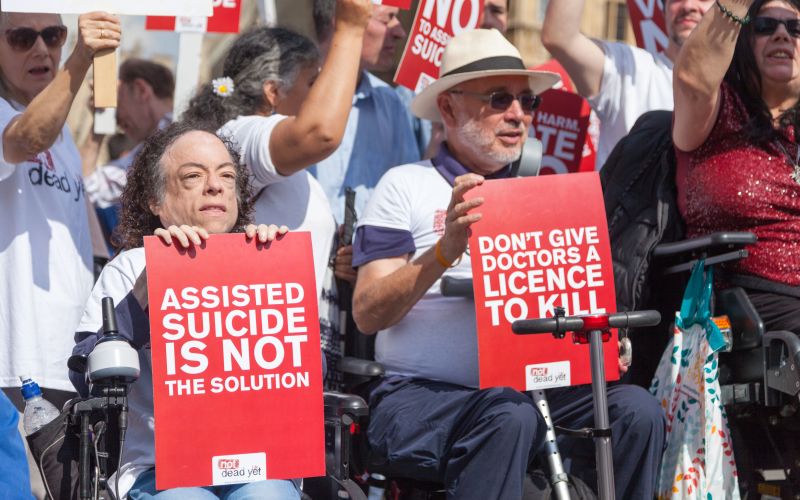
Yes, we can move with the times, but let’s look at where our times are heading. Right now, there is a wholesale assault on the rights and dignity of disabled people. Successive governments going back many decades have vilified disabled people as scroungers, leeching off the state, taking more from society than they give to it.
With the introduction of fiscal austerity in Britain, the greatest burden fell on disabled people, who had their services, welfare, and jobs cut. Since the beginning of the pandemic, many ministers have made it clear that they see the lives of clinically vulnerable people as disposable. They have shown that they would prefer to prioritise the economy over the lives of people in hospitals and care homes. It is little wonder that some disabled people want to die, when they have been deprived of so much in life.
What message does it send out now if we say that we support assisted suicide? We may have been silent on the great attacks on disabled people’s lives, but, don’t worry, we are liberals, we will let you die. Just to show how caring we are, we’ll let you commit suicide, with support from the very state that has made your life so difficult.
If we are moving with the times, we are moving very much in the wrong direction. Coming out as pro-euthanasia now puts us on the side of those who are currently dehumanising the elderly and disabled. Publicly championing euthanasia is not defending the vulnerable, but attacking them.
Yes, as Progressive Jews, we do advocate choice and personal autonomy. But not all choices should have our enthusiastic support. The actor and disabled rights activist, Liz Carr, has rightly said that, if someone is going to kill themselves, it is hard to stop them, but “that does not mean when a fellow human being – disabled or abled – expresses the wish to die because their life is shit, that we should agree with them.”
Some disabled people already feel that they are too great a burden on others. This is because we live in a system that reinforces that message: focusing on a person’s ability to be “economically productive” as their sole source of value, rather than loving them unconditionally for the fact of being alive.
That system, and the ideological apparatus around it, tells disabled people that their lives are not worth living. If we join in as cheerleaders for assisted dying, we are sharing the message that we agree with them. No wonder every disabled rights charity in the country opposes euthanasia liberalisation.
If we want to send out the right messages, I suggest we need to go in a different direction entirely. Rather than campaigning on people’s right to die, we should put the weight of our movements on campaigning for the right to live.
That means channelling our energy in campaigning for jobs for disabled people; proper welfare provision; decent and accessible social housing; the restructuring of our cities and public transport networks so that everyone can access them; investment in clubs and societies people can actually reach.
Yes, all of these things cost money. But the way we are going now costs lives.
I want you to know that, whatever you decide to do in life, I will absolutely support you and be there with you. But I will do that because I believe, on a fundamental religious level, that your life is precious and worth living. I believe in making that it is the duty of religious people, and of the government, to make people’s lives on earth as good and fulfilling as they can be.
We should absolutely support people at every stage of their lives, but the build up to someone wanting to die matters far more than enabling them to do it. We ought to assist people to live, not to die.
Shabbat shalom.
Being holy
These are the short sermons I am giving at Glasgow Reform Synagogue for Yom Kippur afternoon 5781.
Being holy
This afternoon’s Torah service instructs us: “You shall be holy, for I, the Eternal One your God, am holy.” But how do we live holiness? An answer to this comes from the great tradition of mussar. This was a movement that emerged in 19th Century Vilna for promoting Judaism as an ethical movement. The musarnikes, or moralists, argued that study alone was not enough, but that it had to be directed towards making Jews into better people.
The heir to that movement is the Mussar Institute in the USA. Earlier in the year, its leader, Alan Morinis, gave a four-day virtual conference at Edgware Reform Synagogue, advocating its ideas. In the musar system, people have attributes, called middot, that we must cultivate in order to be a holy people. Qualities like faith, modesty, willingness, and joy. In these short divrei Torah for the afternoon, I will give stories and quotations from the mussar tradition that reinforce our liturgical readings.
At every stage of this Torah reading, the reason for each commandment is “because I am the Eternal One your God.” It is repeated at the end of almost every verse. Rabbi Yisrael Salanter, the founder of the mussar movement, taught: “Do all you can to internalise faith and live with it daily.”
I know faith will mean many different things. For some, it is in God. For others, it is in our fellow human beings. And for others still it is in the possibilities the future holds. Wherever your faith lies, cling to it, strengthen it, and build it into every decision you make.
Being simple
Our next Torah reading comes from Deuteronomy. It tells us: “These teachings are not too baffling for you, nor are they beyond your reach. It is not in the Heavens […] nor is it over the sea.” The Torah, we understand, is a simple text with a simple message. That message is summarised by Micah in the dictum: “do justice, love mercy, and walk humbly with God.”
This simple message is reinforced by the mussar tradition. Rabbi Eliyahu Dessler, a leader of the Orthodox community in 20th Century Britain, taught: “Human beings pursue worldly pleasures because they have a subconscious urge to still the pangs of spiritual hunger. Everyone has this nameless inner yearning: the longing of the soul for its state of perfection. Earthly indulgence is only an illusory substitute for this.”
In these trying times, we have to enjoy the simplicity of what we have. We may not be able to enjoy the luxuries of previous years, and even many essentials may seem out of reach. But this provides us with an opportunity to get in touch with what really matters. With our souls, with ourselves, with each other. To walk humbly with our God.
Being willing
Jonah ran away from everything he was supposed to do. He ran away to Tarshish to get away from Nineveh. He hid in the boat rather than face the other sailors. He sat in the belly of a giant fish before he accepted his responsibility.
On Yom Kippur, we pray about the sins we have committed willingly and unwillingly. I think this year, we might also reflect on the good deeds we have done willingly and unwillingly. What has been a challenge to us to do right?
Sometimes, for many, even getting out of bed in the morning feels difficult. The first line of the first part of the major law code, Shulchan Aruch, teaches: “One should strengthen herself like a lion to get up in the morning to serve her Creator, so that it is she who awakens the dawn.”
The greatest challenge facing us this year is not to give in to futility. Whatever we can do, we must be full of enthusiasm. Rabbi Moshe Chaim Luzzatto of 18th Century Italy taught that we have to be self-motivated and not abandon ourselves to heaviness so that we come to merit divine service.
Even when the days can take their toll, may we approach winter’s tasks with willingness. May we pursue the needs of our community with enthusiasm, and hurry to do more for our loved ones.
Being joyous
We must be joyous. Of all the attributes to strive towards, joy might seem the strangest to mention in between the death bed confession and the recitation of sins. But it is, by far, the most important.
Rabbi Dovid Bliacher taught: “when faced with trouble, do not see it as a punishment for a past lapse, and do not be filled with guilt and despair. Rather, rejoice in this new opportunity to rise up by the medium of the test you now face.”
Even in the hardest times, we have to approach them with joy. Yes, we live in a crisis, but this is also an opportunity. Out of the rubble of Coronavirus, we can build back a better society, where people care for each other, where intergenerational communities support each other’s health and happiness, and where the needs of every human being on the planet are met.
Let us not delay for a moment in seeking to achieve that. And, as we go, let’s take joy in all that we have. This community. These friends. These bodies. This earth. This one precious life, in which every moment is a gift from God. Let us greet every day with joy.
 Sim Lev