judaism · sermon · social justice

What good is remembering?

Jews do not have history, we have memory. Whereas the rest of the world commits itself to dates, names and figures, our engagement with the past consists in rituals and symbols. At Pesach, we are not interested in the historical facts of the exodus from Egypt, but in reenacting its moral meaning. At Shavuot, as has just passed, we do not care so much about the geography of the Sinai peninsula as the words that were spoken on its mountain.

Memory is, in many ways, more powerful than history. Whereas history is focused on clinical facts, memory calls on raw emotion. Whereas history cares about leaders, memory looks at ordinary people’s lives. And although history looks only at the past, memory wonders what its events mean for the future.

Even when it comes to recent history, we are less interested in the architects and perpetrators of the Nazi genocide than we are in the diary of a 15 year old girl. Anne Frank has become a symbol. As one girl, she stands in for the memory of millions. In classrooms and homes around the world, Anne Frank is the way for people to remember the evils perpetrated in the Third Reich.

It is a great act of kindness to the Jewish community here, especially its Holocaust survivors and their descendants, that you have all chosen to join us in remembering. To the Council, for planting this tree in memory of Anne Frank, growing in the Herefordshire soil as a symbol to remember a symbol. To the dignitaries who join is in this service today, and who have been friends to our community, for joining us, please accept our thanks.

Memory turns death into meaning. When we remember our martyrs, we remember what they stood for. We remember Rabbi Akiva, flailed to death by the Romans, and we revive his vision for a Judaism that is creative and rich in interpretation. We remember the decapitated Rabbi Ishmael, and relive his conviction that Judaism must be principled and action-based. Their lives and deaths represent the values they inhabited.

Of course, Anne Frank was no martyr. Martyrs are those who die in the service of a cause, consciously choosing to affirm God’s truth rather than compromise. She did not choose her death. She did not pursue it in search of a cause. She was a teenage girl who wanted to ride her bicycle. Nevertheless, she has left behind a legacy of words, hopeful that something of her life could be recalled. And we have translated those words into a commitment to remember cruelty and have cause for hope.

Yes, memory is supposed to prevent evil being repeated. We recall a teenage girl who had to hide in a room in an attic before she was dragged away by soldiers to die of typhus in a concentration camp. And we commit to prevent bringing about a situation when any child has to live and die like that. 

May this tree call out to people with Anne Frank’s moral lesson. May they be the ones who would hide people who have been declared illegal aliens to stop their deportation. May they be the ones who would protest against the encroachment of civil liberties. May they be the ones who would stand up to resist fascism before there was nobody left to speak out for them.

May that memory of Anne Frank speak loud enough that even our world leaders can hear it. The memory of genocide in Europe was supposed to prevent it happening again, but we know that mass slaughter has not ended. We know that there are still children dying of typhus in concentration camps. We know that there are still forced labour prisons surrounded by barbed wire. We know that the nations of the world have only developed crueller and more effective ways to torture and kill people. May this tree and this service and that diary speak loud enough for that evil to be blotted out.

Many of our prayers this week are turned to the evil perpetrated in the United States. Black Americans, who endured centuries of slavery followed by segregation now face the injustice of police brutality. The world watches as they protest once more for their rights and we hope that they will see the justice for which they have longed.

I do not intend to engage in comparisons. Any attempts at equivalence are facile and destined to turn into competitions nobody wants to win. But the horrors endured in Nazi Germany and for Black people in America are united by the common fact of memory. Both call on their dead as symbols, martyrs and aspirations for a better future.

So George Floyd has become an international symbol. The man who could not breathe under the weight of a police boot is now the spark that has reignited a movement. And we should not underestimate the importance of that memory. Without it, our humanity is compromised. Memory makes people human.

Memorialisation gives people a dignity in their death that they were not afforded in life. By saying their names and recounting who they were, the dead are allowed to be people instead of statistics.

We remember George Floyd, and he is once again a gentle giant who said hello to everyone and was trying to look after his six-year-old daughter. Instead of a man in Minneapolis who was strangled to death by police.

We remember Tamir Rice, and he is once again a twelve year old boy playing games outside his home. Instead of a child who was shot dead by police on the street.

We remember Belly Mujinga, and she is a wife and mother working as a ticket inspector on the London Underground. Instead of a woman who died of Coronavirus after somebody spat in her face.

We remember Joy Gardener, and she is a mature student from Jamaica living in Crouch End. Instead of a woman who died from asphyxiation after she was gagged with adhesive tape by police. 

We remember victims of racial violence and they cease to be only victims, but can be full human beings with histories and dreams and potential.

And because we gather today in remembrance, Anne Frank is not a Jew who died of typhus in a Nazi concentration camp. If only for a moment, Anne Frank can be a teenage girl who wants to ride her bike. 

Thank you. Shabbat shalom. 
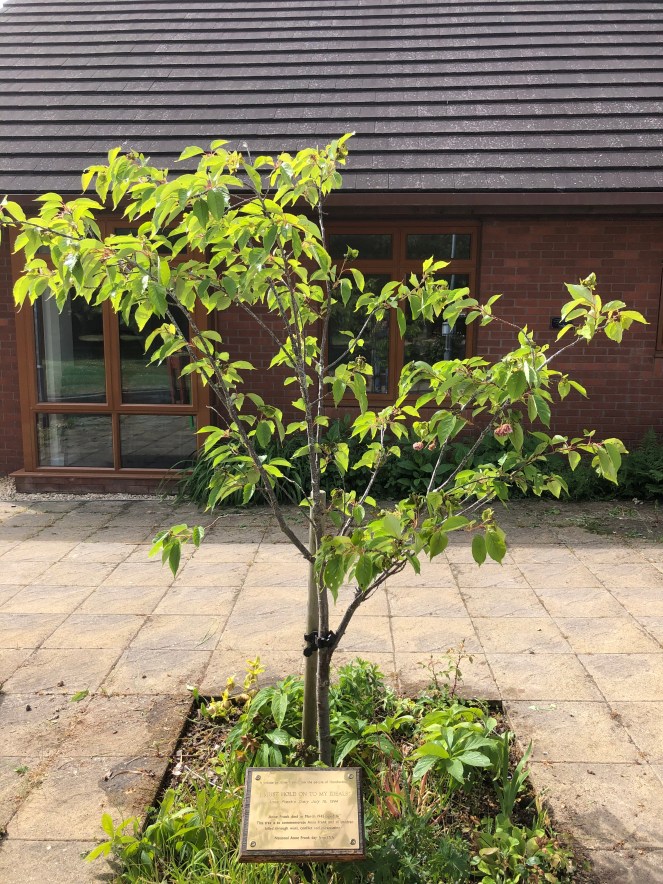
Anne Frank tree Saxon Hall 26 May 2020 (1)

I gave this sermon for Three Counties Liberal Judaism in honour of Anne Frank’s birthday on Saturday 13th June 2020. The picture is of the Anne Frank tree in Hereford.

article · theology

A Tale of Two Gods

In the time of the First Temple, in the world of the Hebrew Bible, the ancient Israelites brought sacrifices to the cultic centre in Jerusalem. One of these was the korban o’la – an offering of burnt animal fat. Every part of the sacrificed animal was burnt on the altar, except for its skin. The Hebrew word o’la, meaning rising up, referred to the pungent smoke released twice daily when the sacrifice was made.

Many centuries after the destruction of the First Temple, in the time of the Second, a group of pious believers came to translate the text into Greek. This early translation of the Bible became known as the Septuagint. Greek had no direct translation for the term o’la, so the editors chose a word meaning ‘completely burnt’ – holo kauston. Holocaust.

That is the word that has come to represent the ritual slaughter of 17 million people, 6 million of whom were Jewish, in the middle of the 20th century. Like the animals of many millennia before, the people in the concentration camps were burnt throughout the day so that nothing remained of them.

It is perhaps for this reason that many of the victims were reluctant to use the term Holocaust. Jews called it by the Hebrew word shoah, meaning ‘disaster’ or churban – ‘destruction’. Roma people called it Porajmos – ‘the devouring’. For historians it was simply called by its Latin name ‘genocide’ – the killing of a people.

Something sinister lurks behind the very word ‘Holocaust’. The Jews, forever seen as relics of the Christian Old Testament, were murdered in the manner described by their book as a tool for expiating sin.

The word calls us to ask: to whom were these Jews sacrificed? On whose behalf? For what sin were they intended to atone? And was the God that received these offerings satisfied?

In the time of the First Temple, minor transgressions were deemed to pollute the land. The o’la served as a way to ritually cleanse ancient Israel of its impurities. Priests appealed to the national god for mercy and knew their petitions had been answered by the arrival of regular rainfall.

In the world of the Third Reich, ethnic impurities and social deviations polluted Europe. Germany and its empire was in breach of its duty to be thoroughly white, Christian, patriarchal and heterosexual. Isolating the minorities was not enough to recompense for their transgressions. The minorities had to be destroyed in their entirety. Devout Nazis played their part to remove and destroy every blemish in their land.

Of course, such blemishes can never be fully removed. The sin of non-whiteness is too volatile and its terms too expansive. The god of nationalism is thoroughly empty, so no amount of flesh will ever fill him. He is insatiable. Modern fascists remind us that the nationalist god is still hungry for blood.

The God of the ancient Temple, by contrast, no longer requires burnt meat. That Temple was destroyed and its people forced into exile. God fled with the refugees and, with them, became transnational. Prayers replaced sacrifices. The God of Israel became the God of the Jews, who wanted good deeds, social justice and piety. It mutated into the God of Love and could be found on every continent.

The god of nationalism, paradoxically, is now no less international. He permeated borders through colonialism and found a home on every soil. In every country, he can be seen represented by each flag. His priests can be found adorned in military uniforms of every stripe. His followers proclaim his word from pulpits the old preachers could never have imagined, reaching millions.

And he still requires blood. His altars are the lynch ropes for Muslims in India. His followers ritually parade through Charlottesville, Belfast, Rangoon, London and Sao Paulo. And, yes, the god of nationalism is worshipped in Israel too. The very land that birthed the universal God now hosts nationalism in its gates. In every place, his offerings are returned in coffins. And, no matter how many die, it will never be enough.

As the god to whom fascists make their sacrifices ascends, the universal God of the Jews withers. In Auschwitz, our God stood trial. The pious Jews who prayed in the camps convened a court and charged God with breach of covenant. God had abandoned them. Or forgotten them. Our rabbis had no choice but to pronounce: God is guilty. And when they knew that divine help was not coming, they did the only thing they could. They prayed.

After the camps were liberated, the remnant survivors had to face a new reality. They wondered whether their God was dead. A bitter irony. For centuries, the Jews had been accused of deicide against Jesus. Now they witnessed their own God burned in the flames of fascism’s altars. Only later did the quiet Christian witnesses realise that their God had been the same one, and was dying too. Their doctrine of goodwill and universal love was no less weakened. And only then did they realise they had killed the wrong God.

Is it too late? Can the old religion of truth and humanity be revived? Certainly, its followers are rebuilding. Synagogues are emerging anew in places where sceptics imagined that God was buried: in Córdoba, Warsaw and York. True believers congregate in mosques, chapels, gurdwaras and living rooms. Those who hold the greatest hope are unafraid to protest in God’s name against violence. They refuse to sacrifice to the new gods. They are the source of my faith.

As we mark Holocaust Memorial Day, we must remember not only the millions of human sacrifices, but the deity for whom they were killed. We must rededicate ourselves to destroying its idols and exposing them for the false gods that they are. In memory of the murdered, we must destroy fascism today.

Yet just because we oppose one god does not mean we must give up the One God. The Force of hope, solidarity and justice cannot be abandoned, even if we feel as if it has abandoned us. So, in memory of all those who were martyred professing a faith in that religion, I ask you to do something normally unthinkable in a radical publication like Novara Media – and pray.

burning smoke columns

I wrote this article for Novara Media for Holocaust Memorial Day on Monday 27 January 2020.