judaism · theology

Be humble about what we can know


Before the Enlightenment, the world was governed by unknowable spirits and invisible entities.

There was so much we did not know.

If your farm didn’t produce any crops or the skies did not give you enough rain, you did not have modern technology to inform you about drought predictions for the next three years. You would have no way to know that the water coming from your clouds was directly connected to oceans miles away.

But you had your priests, and your rituals, and your superstitions. You had small gods in the hill country to which you offered libations. And, so far, when you had upheld your traditions, the rain came as it was supposed to.

When you got sick with a skin infection, you could not see a GP who would consult a modern medicine manual and give you a cream that would clear it up in just a few days. You would not have knowledge about germs, allergies, and viruses.

But you had your priests, and your rituals, and your superstitions. You had your rules governing sin and repentance. You had reliable experience that bodily suffering could be healed by atonement. And, so far, when you had upheld your traditions, the rain came as it was supposed to.

Please hold this in mind as we read this week’s Torah portion.

It may be easy for a modern mind, after the Enlightenment, to scoff at the strange priests, rituals, and superstitions that govern these chapters in the Book of Leviticus.

You might feel slightly embarrassed to imagine the rites our ancestors slit open goats, threw their entrails around and burned them for days until they stunk out a tent as expiation for their sins.

You might squirm at the vivid descriptions of cotton-clad priests flailing around the limbs of slaughtered cattle to win the favour of their god.

It may even seem primitive how they delight at the animal fat creating explosive fire, which they see as evidence of their god’s approval.

But they were doing what they could with what they knew. And they were engaging earnestly with what they did not know. Beyond the world they experienced was an unfathomable mystery, and they wanted to draw closer to it.

Indeed, only verses later, we get an insight into their own feelings of inadequacy. We get a real sense that they knew how much they did not know.

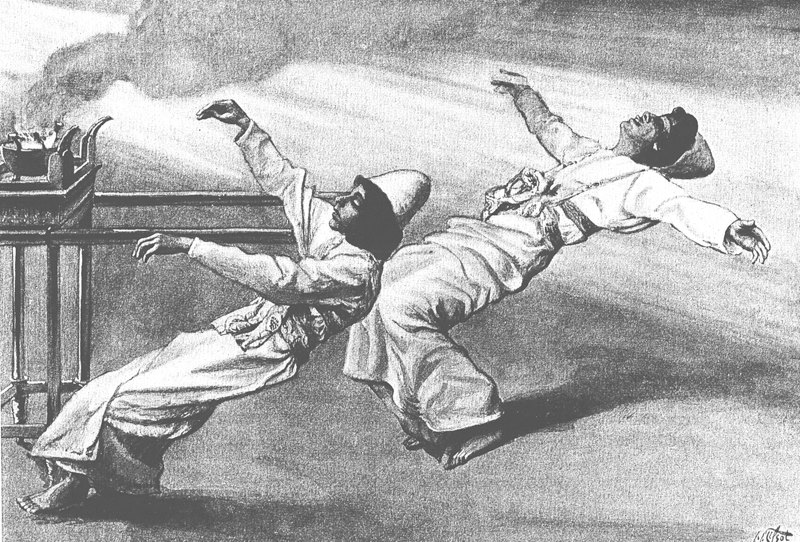
Nadav and Abihu do absolutely everything right. They follow the priests, carry out the rituals, and trust in the superstitions. They are formally inducted into all the correct practices by their father, Aaron the High Priest.

They do everything right. And then they die.

The burning animal fat explodes in a blaze that kills them both.

How can our ancestors make sense of this?

Our Torah gives two answers. The first is from Moses. Moses recalls a prophecy when God said: “Among those who approach me I will be proved holy; in the sight of all the people I will be honored.’”

We may interpret this as a way of Moses defending God. Moses is saying: while this may feel like a violation of our belief system, it is in fact proof of it. Holiness is a very dangerous quality.

God has demonstrated how sacred it is to engage in the rituals. God has shown what honour and risk are involved in holy service. 

So, for Moses, this sudden death of their priests does not undermine their belief system. It’s just evidence of how little they understand about their sacred rituals. In the fire, they have reached the limits of their knowledge.

Aaron, too, offers an answer. Silence.

We may interpret Aaron’s unspoken response variously. We may read into it horror, resignation, anger, acceptance, or solemnity.

But regardless of what he was feeling, we see that Aaron has no intellectual answer to the problem. He neither agrees nor disagrees with Moses. Aaron finds the limits of speech. He finds the boundaries of what he can even express.

Moses and Aaron lived in a world of unknowable spirits, governed by superstition. They made sense of their confusing world through priests and sacrifices. And no matter how well they constructed their rituals, they still found their limits.

There were things they did not know.

But we live in an era after such theologies. From the 17th Century onwards, Western Europe was gripped by a profound truth.

As the people challenged the unlimited power of the established church, philosophers pulled apart the stories religions had told.

This was the Enlightenment.

No more would they be hoodwinked by magical thinking or damned by promises of divine retribution. Everything, every idea, would be subjected to ruthless scrutiny. The greats of these generations would challenge the tenets of even science itself.

We live now in a world formed by their ideas. While our ancestors were beholden to talismans, omens, and sacrificial fire, we have evolved to hold modern ideals of truth and rational enquiry.

So, why hasn’t religion disappeared?

Isn’t that the obvious next question?

We have rid ourselves of superstitions, but synagogues are stronger than ever. Most of the world is still deeply religious. Despite constant predictions of its demise, faith remains stronger than ever.

For those who wish to understand God’s persistence after the Enlightenment, they may want to look to Immanuel Kant.

Kant was the last of the Enlightenment thinkers. His impact on this period of intellectual history was so great that some even date its end to his death.

Kant was a profound writer on truth, ethics, the scientific method, and what we can really know. He was also a devout Christian.

Kant was animated by the same questions that bothered our ancestors who witnessed Nadav and Abihu die.

He was not confused about why burning fat could cause a blaze, or why religious rituals didn’t always yield the same results. Those were the questions of the past.

The question still lingered, however: why does it seem like there is no justice in the world? Why do bad things happen to good people, and why do the wicked seem to get away with it? Why, no matter what happens, does evil seem to persist?

In his essay, The Miscarriage of All, Kant says he will put God’s justice before the trial of reason. Kant contemplates all the possible answers.

Maybe what we think is evil isn’t really. Maybe the world works in ways we don’t understand so that evil has to be permitted. Maybe there are other forces in the world beyond God’s goodness.

And Kant gives us an answer, which is… we don’t know.

All of these explanations only expose the limits of our understanding.

None of the answers anybody has come up with is satisfactory.

We are finite beings trying to understand Infinite Truth.

And still, says Kant, we retain our faith.

For Kant, none of these questions undermine the existence of God’s justice. They just show what we do not know.

So, perhaps we need to approach these stories with more humility and less contempt.

The ancient priests may well have splashed ox blood around an altar to ward off sin, but we are no closer to answering the questions that motivated their rituals.

We are barely separated from them by any time at all.

We are still just animals, scrambling in the dark, trying to make sense of our world.

And we still need each other, with all our beliefs and rituals, to get through this life that can seem so unjust.

We are each other’s guides through a mystery we may never resolve.

We need to be humble about what we do not know.

judaism · sermon

My DNA test results

When I sent the sealed tube back to a laboratory in America, I had high hopes for what would come back. My parents were mixed – Scottish Presbyterian and Anglo-Jewish. I had grandparents and great-grandparents from Poland, Portugal, Peru and Prussia. (By Prussia, I mean Germany, but that doesn’t begin with P). Family legends trace our roots to Italy, Spain and North Africa.

I was excited. I hope my DNA results would come back like a scratch map of the entire world. I would proudly proclaim myself a global citizen. I would research my relatives in Tanzania, the Philippines and even more exotic locations like Scunthorpe.

After weeks of waiting, I opened the results with trepidation. Here they were. European: 99.7%.

Breakdown: 47.8% British and Irish. 48.4% Ashkenazi Jewish. Trace amounts of other ancestries: 1.9% ‘Broadly European’. 0.7% French and German.

I was so disappointed. Where was my globe lit up with dots on every continent? Where were my secret ancestors from places I’d never heard of? And what was I going to do with all my ‘We Are the World’ t-shirts? Perhaps all the family narratives were unreliable.

Maybe I’d need to rethink my entire identity. I wondered if I should perhaps just accept my Ashkenazi heritage and start pronouncing tafs as samechs, mumbling my prayers to myself, even letting my sideburns grow into locks. Or perhaps I should celebrate my connection to the British Isles by listening to Gaelic folk music and trying to revive Welsh as a language.

I confessed my confusion to a friend, who is a geneticist. He reassured me: “these tests are 92% nonsense.”

“But what about the other 8%!” I exclaimed, “surely that counts for something.”

He laughed “That 92% is just as arbitrary as all the percentages on your DNA results. DNA testing is like getting your fortune read at a funfair. They pick 100 genes out of a sequence of thousands, run them up against trends they’ve already found, and act like they’ve given you a whole picture. Treat it as a science-based game, not as a guide to your whole history.”

Well, now I felt even more confused. My family history might be unreliable, and the science was probably pretty suspicious too. The pillars I thought I could rely on for my identity were toppling around me.

I thought about this week’s parashah. Here, in Shmini, as part of all the levitical rules on sacrifice and cultic life, were the rules on which foods we could and couldn’t eat.

Although historians once understood these rules to be about health and cleanliness, biblical critics are now less sure. They point to the fact that any of these meats could cause diseases, and raise the issue that almost every neighbouring nation of the Ancient Near East had its own proscribed foods. Rather than taking a rational, medical approach, they suggest that the original purpose of these rules may have been to develop a sense of national unity. When people knew they had to eat the same foods as each other, they bonded as a community, creating an in-group. Kashrut rules were really there to form a sense of national identity.

I wondered if I could apply this to my own life. Perhaps what made me Jewish was my engagement with its food and ritual life. I seek out beigel bakeries, love challah, won’t eat pork or shellfish, and make cholent on Friday nights.

Maybe that was what made me British too. I think the slightest glimpse of sunlight is an excuse for a barbeque. Nothing makes me feel more at home than a pint of cider in a beer garden. I even like marmite.

I lived out my internationalism, too, in all the curries, sushi and pizza I could eat as a Londoner. My internationalism was bound up in important rituals like voting in the most important decisions facing our continent, like who should win Eurovision.

But this answer wasn’t that satisfying either. Rituals and foods can help build communal identities, but they don’t tell us that much about who we really are. These forms of banal nationalism might well create a sense of in-group, but the flipside is they create exclusions. In the wrong hand, any sense of nationhood based on these traits can be turned to nationalism, chauvinism and xenophobia. By comparison, DNA results and family legends felt relatively benign.

I came to realise what the founders of Liberal Judaism understood long ago. All ideas of nationhood are myths. Whether we route them in science, history or culture, they’re just stories we tell ourselves to make sense of the world. They don’t really help us know how to act, and in the globalised world of the 21st Century, they can even be harmful to facing our challenges. What we should really ask ourselves isn’t “who are we?” but “what do we need to do?”

In 1917, in the midst of the First World War, Lily Montagu delivered an address to the West Central Club. In it, she gave a scathing critique of Jewish nationalism, challenging its very foundations. She insisted that her citizenship was British, but her primary allegiance was to the religious goals of Judaism. At its inclusion, she declared: “the Jewish ideals, the ideals of peace and unity and love and righteousness, are for all times and all places. We are to express them to the world. That is our life’s task.”

Reading this again now, I realise that the reason why Liberal Judaism is so embracing of mixed families, of converts and of diversity, is not just a matter of pragmatism or a weak sense of tolerance. It is born out of the firmly held conviction that what makes life matter is what we do with it. What makes a Jewish life matter is how ethically we live, and how hard we strive to apply these values of social justice in our world today.

When Judaism is defined not by nationhood, but by ethical principles, it is open to everyone who shares them. What is at stake in conversations about who belongs is a fundamental question about what being Jewish really is.

Our founders had it right when they proclaimed Judaism’s emphasis to be in its prophetic vision. Today, what makes us who we are isn’t who our ancestors were but what world we create for our descendants. That is our life’s task.

Shabbat shalom.

dna-illustration

I delivered this sermon on Shabbat 30th March for Parashat Shmini at Finchley Progressive Synagogue. I’m still disappointed by my DNA results.

judaism · sermon · story · Uncategorized

Nadav and Abihu are dead

Nadav and Abihu are dead. Consumed in fire. Burned alive. And nobody knows why.

They were two of Aaron’s four sons, Temple priests. They went into the Sanctuary to offer a sacrifice, but something went wrong. The fire came out strange somehow and blazed everywhere. They died instantly.

Moses, their uncle, told Aaron that it was God’s intention. “Through those near to Me I show Myself holy, And gain glory before all the people.” Aaron was silent.[1]

For centuries, commentators would speculate what they’d done wrong to deserve death. Perhaps they’d been over-zealous and churned out too much fire. Maybe they hadn’t followed the commandments to the letter. They might have been drunk.

But nobody questioned that it was their own fault. God is just. The world is reasonable. And if a bad thing happens, the people who suffer must be to blame. All we can do is silently accept it.

Under any scrutiny, it’s an indefensible theological position. In a world so full of inexplicable suffering, it is not possible to tell people who are hurting that God intended for them to feel that way. Death cannot be explained away. We cannot justify people burned alive. We cannot silently accept it.

But what if we have been interpreting this parasha all wrong? What if this text isn’t encouraging us into silent acceptance, but to question injustice? What if this isn’t about blaming victims but about challenging oppression?

There is a suggestion in the way the story is laid out that there may be more to this story than meets the eye. Our narrative does not begin with the death of Nadav and Abihu, but with sacrifices. Burnt sacrifices of animals. Moses and Aaron go about slaughtering goats, rams and oxen and offering them up to God in fire and incense.

In the next section, Nadav and Abihu die. Already these two events seem connected. The burnt sacrifices of animals may well have some correlation to the burning of Aaron’s sons. In case the parallel is not clear enough, the aliyot are divided up so that the two stories run into each other. The third aliyah of Shmini begins:

Fire went out from before God and consumed the burnt offering and the fat parts on the altar. And all the people saw, and shouted, and fell on their faces.[2]

The language used to describe Nadav’s and Abihu’s death mirrors this too closely to be coincidental:

Fire went out from before God and consumed them; and they died at the instance of God.[3]

The Torah is urging is to see some similarity between the burnt sacrifices of the animals and the death by fire of Aaron’s sons. The people shouting and falling on their faces stands in direct contrast to Aaron’s silence.

Other commentaries have begun from the premise that Aaron’s sons’ deaths were justified. Other commentaries have assumed that animal sacrifice and human death were logically separate. Both, they assume, form part of a cosmological worldview that sees God as just, explicable, and hungry for death.

Yet the whole narrative might make more sense if we assume that the reverse is the case. Nadav and Abihu did not deserve to die. Their deaths were senseless and unjust. They died without explanation and their father was expected to cope with it. Their sudden and dramatic death arrests all talk of animal sacrifice. It interrupts our assumptions that there are correct ways to kill creatures and that sins can be expiated with blood. In the moment that Nadav and Abihu die, Aaron gets an insight into what sacrifice is like for the animals. When his own kids are slaughtered, he doesn’t shout and fall on his face, but retreats into stunned silence.

This interpretation makes sense of Moses’ cryptic comment to Aaron: “Through those near to Me I show Myself holy, and gain glory before all the people.”[4] The word for ‘draw near’ – קרב – is the same as the word for ‘sacrifice’. The line may be interpreted as saying that God is made holy through sacrifices. If animal sacrifice is holy, why not human? If animal sacrifice makes God appear glorious, why not human?

Instead of trying to justify human death, this parasha may be calling us to question animal death. Although this interpretation may seem modern, there is precedent for it. According to 13th Century Spanish philosopher Nachmanides, “Living creatures possess a moving soul and a certain spiritual superiority which in this respect make them similar to those who possess intellect (people) and they have the power of affecting their welfare and their food and they flee from pain and death.”[5]

Scholars including Maimonides, Albo and Rav Kook all argued that, ideally, people should be vegetarian. They saw animals as possessing reason and emotions like people.[6] Today, their ideas have new relevance. We live in an era when animals are bred in captivity, kept in cages and killed without thought. When the rules governing kashrut were constructed, they put a firm limit on what violence could be done to animals. Compared to neighbouring cultures where animals could be torn apart limb by limb while they were still alive, the requirement that they should be kept in good conditions and killed as quickly as possible was remarkably humane.

Yet, today, as Progressive Jews, we might rightly question whether those rules go far enough. If we accept that senseless death is unjust and that the Torah is more concerned with calling us to action than silent passivity, it may be time for us, as a movement, to consider adopting vegetarianism.

I do not want to moralise to people or be accused of hypocrisy. I am not a vegetarian and I’ve struggled to reduce my own use of animal products.  But I want to try. One of the biggest barriers is that it’s expensive and time-consuming. That’s because our society is built around meat and using animal products. That should not, however, stop us from trying. As a religious movement, we could lead the way by changing our own relationship to food and encouraging others to do the same.

nadav and avihu

I originally wrote this for Leo Baeck College’s newsletter on Parashat Shmini.

[1] Lev 10:3

[2] Lev 9:24

[3] Lev 10:2

[4] Lev 10:3

[5] Nachmanides, commentary on Genesis 1:29, quoted in https://www.jewishveg.org/schwartz/view-torah.html

[6] http://www.jewishvirtuallibrary.org/rabbinic-teachings-on-vegetarianism#4