social justice · theology · torah

We are waiting for a different Messiah

Some years ago, an Orthodox friend asked me: “what would you do if the Messiah came and it turned out we’d been right about everything? What would you say to the Messiah?”

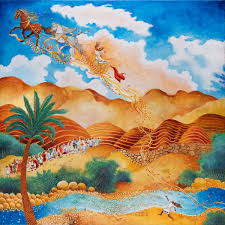
What would I do if the End of Days came, and Elijah literally came storming out of the whirlwind in a chariot made of fire and declared that the Son of David had arrived to cast judgement? And that we were to be judged on how strictly we had separated men and women; how well we had obeyed family purity laws; how stringently we had adhered to traditional authorities?

What would I say to this Messiah?

I have thought about it for a good few years and I think I now have my answer.

I would say: “F@£& off.”

I would tell that messenger: “You are not my Messiah and you’re not my king. Now go back where you came from.”

In this week’s haftarah, we read the prophet Ezekiel’s vision of the valley of the dry bones. For centuries, Orthodox Judaism has based its understanding of Messianism on these verses.

Ezekiel finds himself in a desert surrounded by skeletons. God tells Ezekiel to prophesy to the bones, and he does so, covering them in sinew, breathing life back into their lungs, and reviving their bodies, so that they stand up as a skeleton army.

These, says God, are representative of the people of Israel.

So, Orthodox Jewish tradition teaches, a day will come when the dead are literally physically resurrected. The corpses of pious Jews throughout the ages will be brought back to life; the exiles gathered to Jerusalem; and all judged by a righteous king descended from the biblical King David.

For this reason, many Orthodox Jews eschew cremation, and insist on being buried intact, so that their bodies can be resurrected at the End of Days. They vie for graves on the Mount of Olives, so that they can have front row seats when the Messiah arrives at the walls of Jerusalem and summons up the dead from their tombs.  

In recent decades, religious fanatics have come to espouse an even more intense version of this apocalyptic vision. 

There are Orthodox Jewish extremists, funded by American evangelical Christians, who are trying to destroy the Al Aqsa Mosque on the Temple Mount; build a Third Temple; and restore animal sacrifice and priestly leadership.  They seek to expand Israel’s borders to restore the ancient Kingdom of King David.

This week, Rabbi Charley Baginsky was quoted powerfully in The Times, saying: “We are afraid — not just for Israel’s future, but for Judaism itself. What becomes of our tradition if it is captured by messianic extremism, by racism disguised as religion, by power without principle? If the current trajectory continues, if Jewish supremacy becomes policy, then Judaism itself may become synonymous with oppression.”

In this context, you might be forgiven for thinking that messianism itself is the problem. Surely a religious zeal that drives people to commit such crimes is itself dangerous. For some, witnessing this fervour makes them question the foundations of Judaism itself.

The Israeli religious scholar, Avraham Uriah Kalman, warns against this way of thinking. His article earlier this year, entitled Another Messianism, addresses a tendency in Israeli secular society to dismiss all religion as varying stripes of nationalist fanaticism.

Yet, he claims, precisely because of the strength with which racist extremists have captured Judaism, we must return with equal zeal in our reclamation of Judaism. We, who believe in justice, democracy, and human rights must just as vigorously defend our corner.

If we do not have an equally powerful vision for what society could be, we will always be on the back foot, compromising with monstrous ideologies that want to blow up buildings and raze down villages.

Our ethics are grounded in the Jewish tradition. They are derived from the Jewish texts. They are sourced from the Living God. 

We cannot allow the far right to take exclusive hold over any part of Jewish life, or we surrender it to them. That includes Messianism – the grand utopian visions of ideal societies promoted in every book of the Prophets. 

The Prophets, whose mission of speaking truth to power and uplifting the lowly, are far more in line with our Progressive visions of the world than they are with the soulless dreams of those who want to oppress women and gays as part of their supremacist agenda. 

In the Prophets, we see clear visions of a perfected world. Their writings testify to a world of peace; where all resources are shared; where everyone lives in dignity; and where all are free.

Outside of specific esoteric texts like this week’s mystical imaginings from Ezekiel, it is hard to see any of the far right’s fantasies reflected in our Prophetic texts.

Messianism is really supposed to represent a rupture in the established order, but that is not really what the far right offers. War, racism, and misogyny are already the norm. At core, they don’t really want to change anything except to make existing tendencies more violent and oppressive.

So, says Dr Kalman, progressives must embrace messianism. We must turn to the Prophets as our source of hope, rather than buckling under the weight of despair. From our own utopian visions, we can develop ethics that speak to our daily lives and help us practically realise a better religious vision.

Kalman draws on a whole range of Jewish religious traditions, including Talmud, Kabbalah, Musar, and 17th Century Tzfat mystics. 

Yet, curiously, he seems not to be aware that this project, of developing a Progressive Messianism, has already been deeply thought through. The early Reform movement in Germany, from which Liberal Judaism descends, was animated by looking to the Prophets to rethink Jewish eschatology.

The early Reformers taught that the Messiah would not be a man, but an Age. 

It would not be characterised by Temple and Kingdom revival, but through the realisation of the values of the Prophets. It would be a world of peace and justice, achieved through the moral advancement of all humanity.

Explaining this theology, Rabbi Sybil Sheridan writes: 

“Though the end goal is world peace, the ideal is not pacifism, nor is it the peace of treaties at the end of war that are based on winners and losers. That notion continues the imbalance of power among peoples and nurtures the resentment that leads to dreams of revenge. The peace of the Messianic Age is a peace forged in complete mutuality. No one should be afraid that people may covet their vine or fig tree, no one will fear the loss of land or resources, no one will be humiliated. The world provides enough for everyone and sufficiency will take away the desire for war.”

While we Progressives do not accept the Orthodox doctrine of bodily resurrection and rebuilt Temples, that does not mean we should reject Messianic thinking. Times of despair and horror are when we most need to cling onto our hopes for a better world.

Progressive Messianism takes the task of perfecting the world away from mythical figures like Elijah and King David, and places it directly in our own hands. It says: we will not wait for someone else to bring about redemption; we are going to do it ourselves.

So, if Elijah came down from the Heavens and declared that the Orthodox had been correct all along, I would tell him he was wrong. 

For thousands of years, we have sought to create a better world. We have learnt through struggle about the dignity of women; the importance of justice; and the shame of racism. We now have a much better idea of how the world can be.

We can see a future in which every human being lives in harmony with each other and their planet. We can see a world where all live in freedom and peace. We are sure now that we can live in love and equality. 

We are going to realise our Messianic age.

And nobody- not even a prophet descending from the skies – is going to stand in our way.
judaism · sermon

Are Jews a religion or a race?

At present, Reform and Liberal Judaism are deciding whether to become a single movement. You will be able to vote on this, and I encourage you to do so. 

As the procedural questions unfold, it is hard to imagine how strongly felt the ideological divisions were between the two movements, even forty years ago. I believe, however, that those differences are now almost entirely within the movements, rather than between them. 

On some fronts, we will find unity, and on others, differences will remain.

There is one point, however, which, to me, is so intrinsic to Liberal thought that I could not stand it to see it lost. That is: there is no such thing as a Jewish race.

There is no such thing as Jewish blood, as a Jewish womb, as Jewish DNA, or as Jewish features.

It is precisely because our Liberal tradition teaches that there is no Jewish race that we have been able to fully embrace converts and, from the very beginning, accepted patrilineal Jews. 

These ideas were critical stumbling-blocks to merger attempts in previous decades. Reform Judaism would not accept patrilineal Jews, and insisted that converts went and were reborn from the “Jewish womb” of a mikvah.

In the past few years, Reform Judaism has come to accept patrilineal Jews, and Liberal Judaism has come to accept that the mikvah can be a meaningful ritual.

Yet not everyone has come to accept the underlying ideology that made these matters so central to Liberal Judaism. The originators of our movement saw Judaism as a religious community, where Jewishness was communicated socially, not “biologically.”

That is no longer a sectarian issue. There are Reform rabbis who ardently agree on this point; and there are Liberals who, instead of denying any racial Jewishness, focus on being “inclusive” about who belongs.

Rejecting the idea of a Jewish race was absolutely foundational to early Liberal thinkers. Regardless of whatever new ideas emerge as rabbis come together, I intend to hold doggedly to their understanding of Jewishness.

Israel Mattuck was the first Liberal rabbi in the UK. In 1911, he was recruited by Lily Montagu and Claude Montefiore from America to lead the Liberal Jewish Synagogue in St John’s Wood. He was a prolific preacher, ideologue, and scholar.

At the LJS, Dr Mattuck taught a Confirmation class, for 16-year-olds affirming their faith. He later took his notes and turned them into a book, entitled Essentials of Liberal Judaism so that everyone would know what he thought it meant to be a Jew.

Jews, he insisted, were not a race, but spanned the globe. What made people  Jewish was that they held Jewish ideas, followed a Jewish way of life, and kept Jewish observances. 

He wrote: “In spite of all the differences among them, the Jews of the world constitute a people; but they are a people in a different sense from any other people. Their unity is based on religion and history.”

Editing in 1947, Mattuck was eager to avoid any misconceptions. He insisted that this history was not an unbroken tale of misery and persecution, but one of great spiritual achievements. We were, he said, the first witnesses to God’s unity through the revelation at Sinai. Our history was that of the prophets, the priests, the scholars, the mystics, and all those who sought to reach closer to religious truth. 

Mattuck was clear that you could not be Jewish in anything more than name if you rested on race. You want to be a Jew? Walk humbly with God, taught Rabbi Mattuck from the prophet Micah. 

There is no race – only a demand to live right.

Now, you may be thinking, this all sounds a lot like the Critical Race Theory that Mr Trump so zealously warned us about. Indeed it is! And the American President has good reason to fear people taking a critical approach to race.

In the USA, races were invented to divide and rule people so that the wealthy whites could maintain their plantation economy. Poor whites were incentivised to enforce and uphold slavery by being given some privileges on the basis of their skin colour.

As a result, they felt they could identify with the rich whites, even though they had very little in common with them socially or economically. Using racism, they demeaned and humiliated the stolen Africans so that they would not have the confidence to challenge their own condition.

That is why race-critical scholars in America have the slogan: “race exists because of racism, not the other way round.”

In Race: A Theological Account, the African-American scholar of religion J. Kameron Carter shows how racist ideology had earlier roots – in how European Christians treated Jews. 

To create a system where Jews were second-class citizens, they needed an ideology where Jews were defective human beings. So they made up stories about Jewish bodies, Jewish blood, Jewish noses and hair – even Jewish horns – to justify their system of oppression. It was a nasty division for the purposes of exploitation.

This was exactly why Mattuck was so resistant to talk of Jews as a race, and so adamant about our religion.

In 1939, Mattuck wrote his first major work, What are the Jews?, which was a harsh rebuttal, not only to Jewish racial nationalism, but to racial nationalism as such.

We belong everywhere, he asserted. In the Age of Enlightenment, all citizenship should be communicated on civic grounds, never on ethnic or religious ones. 

A Jew, he felt, could be a nationalist, but they must first adhere to the religious calling. That is: they could be Jewish and happen to have nationalist leanings, but it could not define them as Jewish. 

Nevertheless, he thought that, by properly conceiving of ourselves as a religion, we would be more likely drawn to universal ethics. We would measure our Jewishness by our conduct towards others and our connection with our God, rather than by the supposed quality of our genetic make-up. We could pull apart the stories that separated people and build common bonds.

Racial thinking, thought Mattuck, must be resisted.

Race is a horrible and divisive lie. Religion is a beautiful and unifying truth.

I want to be open about why this idea is hard for others to hold.

It is more demanding. It says that nobody can take their Jewishness for granted, and must work for it. It means that you cannot be “born” Jewish, but have to live Jewish. It sets high ethical and practical demands on anyone who claims Jewishness.

When we say that there is no Jewish race, we also mean that somebody with an unbroken chain of matrilineal descent but without any Jewish upbringing or identity must also learn how to be Jewish, in the same way as a patrilineal Jew would. Everyone has to properly engage with the traditions and practices. Contrary to the doctrine of inclusion, this makes us more exclusive than the Orthodox.

Denying the existence of a Jewish race also has profound implications for how we engage with Israel. If we are a religious community, the demand to achieve a Jewish ethnic majority – still less racial supremacy – is not just grotesque. It is absurd. The measure of whether the state was sufficiently Jewish would not be by how many Jews there were, but by how well it upheld Jewish moral values.

Yet it is precisely because of this more demanding approach to Jewishness that I will keep holding onto it. The call that we be moral in our dealings, conscientious in our practices, and connected with our traditions is a far better one than the narrow pull of racial nationalism. 

Through such a religion, we may connect to every other Jew in a spirit of solidarity.

Through religion, we may connect to all of humanity, by recognising our shared Creator.

Through religion, we may draw nearer to the mystery that is our God.

Through religion, we may live out the words of our haftarah: “For you who revere My Name, the sunbeams of righteousness will rise, with healing in their wings. Then you will go forth and skip about like calves from the stall.”

Shabbat shalom.

sermon · theology · torah

Purity or justice

Let’s start with a question.

An adult couple accidentally runs over their pet dog. Instead of burying their dog in the garden, they take it home, cook it in the oven, and eat it. 

Here’s the question: have they done something immoral? 

Most of us will have an instinctive reaction: what that couple did was disgusting. We will feel some revulsion.

But whether you think it was morally wrong will depend on how you see the world. It will depend on your moral palate. 

This was what was demonstrated by the Jewish-American psychologist, Jonathan Haidt, in his popular book, The Righteous Mind.

Haidt sought to find out why it was that caring, rational people could disagree so profoundly on moral issues. Why was it that America was so polarised? There, people fight furiously about issues like abortion, guns, and marriage, as if they have no common moral basis.

Haidt argues that we do have shared moral bases, but our morality is more like the palate on our tongue. “We humans all have the same five taste receptors, but we don’t all like the same foods,” he says. “It’s the same for moral judgments.”

We have, he says, five main taste receptors: care, fairness, loyalty, authority, and sanctity. 

If you are an educated person who lives in an urban area of a Western capitalist country, you are likely to feel that the couple who ate their dog did not do anything morally wrong. You’ll be disgusted, sure, but you might not think that they violated any kind of moral rule.

That’s because, in these cultures, people have a moral palate that puts a big emphasis on ethics of care and harm. If nobody was hurt, then there’s nothing immoral.

If, however, you live in a close-knit community of farmers, you are far more likely to say that the couple who ate their dog did do something morally wrong. That’s because those cultures have a strong sense of sanctity and taboo.

Both of these systems are ways to help people get on with each other. In a busy metropolis like London, you need to be able to live and let live, because if you can’t tolerate diversity, society will fall apart. In a tribal farming community, like ancient Israel, you need to have strong social norms to protect people.

Both these impulses – care and sanctity – come from a deep, ancient social need. 

Since humanity’s beginning, our survival has depended on our ability to care for our most vulnerable members. How would we have lasted a single generation if not for looking after the young, the old, and the vulnerable?

From the start of civilisation, we have also needed to be able to express disgust. It comes down to the most basic distinction between excrement and edibles. We need to tell each other: “this food is poisonous; this disease is contagious; this behaviour is dangerous…” Without clearly agreed boundaries and taboos, we would quickly perish.

It is worth holding these two tendencies in mind – care and sanctity; purity and justice – as we approach our readings for this week.

Our Torah portion goes into minute detail about how to do proper sacrifices, how to lay out the Temple, and who is supposed to do what in religious services. To us, the attention to detail might seem absurd.

But remember that this is part of a group of people’s moral palate. This is their sense of the sacred. Messing it up, from their point of view, would be ethically disastrous. It would be similar to eating the family pet. 

No wonder, then, that the prophet Ezekiel opens the haftarah by telling the Israelites “if they are ashamed of all they have done, make known to them the design of the temple.” Failure to get it right, says Ezekiel, is a serious sin.

There are two great moral impulses in Torah: justice and purity. This trend appears throughout the whole Scripture: contradictory, competing moral voices speak through our books.

The voice of justice tells us about care and compassion. It tells us about fairness and redistribution. The voice of justice charges us towards more equality and more freedom. Justice says that a society is only as strong as its weakest members.

The voice of purity tells us about how to keep holy things sacred. It tells us what the boundaries are on sex, so that we do not cross them. The voice of purity tells us not to eat octopus and not to mix linens. Purity makes sure everything is kept in its proper place, so that society can function, and people feel safe.

The voice of purity might feel less relevant to us today. We celebrate the prophets for their concern for the most vulnerable, because it fits so well with our ethics of care. We see ourselves in the narratives of the exodus because they chime with our moral intuitions about freedom from slavery. Laws on architecture… feel less like big moral issues.

That’s because what the big taboos and boundaries are can change a lot between time periods. 

When I was growing up, one of the big focuses of popular disgust was gay men. There was a long period when the media was seemingly obsessed over sex between men, especially in public toilets. This was the full gambit of taboos: waste and excrement; sex between the wrong sorts of people; and blurring the boundaries between public and private.

I think that is why some of the things that cause people moral disgust today just don’t bother me. I have had to push through a society telling me I was disgusting, and unlearn that contempt towards gay people. Now, the other sources of disgust just seem like passing fads. 

Knowing that has helped me understand where others are coming from.

I find Haidt’s ideas about moral palates really helpful for thinking through why sometimes it’s hard for people to agree. My ethical taste buds are highly attuned to care and fairness, but I don’t get much flavour from sanctity, and I can barely taste authority. 

Please do not think that one of these is left-wing and the other is right-wing. There are plenty of conservatives deeply motivated by wanting to make sure people are cared for and that distribution is just. There are just as many socialists who want to ensure the purity of the Marxist tradition, and to live in a world without contaminating ideas or contaminating people. 

What we morally feel is not just about ideology, but about all the factors in our cultures and upbringing that make us need to focus on certain values.

So, this is my advice. The next time you encounter someone that you really disagree with, try not to assume they are evil or weird. Think back, instead, to this Torah portion. Maybe what is just a building to you is somebody else’s Temple. Maybe what really triggers one person just doesn’t impact you.

Haidt’s goal, when he did this study, was to make it possible for people to talk to each other across divides. I don’t want us to become like America, where some issues cause massive wedges between neighbours. 

So let’s try listening to each other, and hearing each other’s worldviews.

Shabbat shalom.

high holy days · sermon

It’s time to go home

At the end of a holiday, you pack your bags the same way as you did when you were heading out. Only now, your clothes are covered in sand. Your swimwear is salty and smells of chlorine. You put them in black bin bags, and tie them up. Some of the books you brought with you are battered on the spine because you lay them flat on your subbed while you were reading. And some of the books you brought haven’t been opened – why did you think you needed so many?

Maybe you took a photo or two. Maybe there’s a group shot of everyone who was there. Maybe you’ll go back with a postcard from the gift shop, or a keyring, or a fridge magnet, or one of those novelty pencils that you’ll never use.

But ultimately, all you’ll have is your memories. The clothes you wore will get washed and go back in the drawers. The photos you took might get put in a scrapbook, or saved online somewhere, or posted to social media, and then they’ll fade. But it doesn’t matter, because the goal wasn’t to get souvenirs. It was to experience it, and be on the holiday, and enjoy it.

So it is with life. Our mortal bodies are only here for a short stay. Our souls come on a brief holiday. And when we have to go back where we came, everything is a little more worn and broken and used than when we first got it. But that’s only because we’ve used it the way we were meant to. Our faces are a little bit more wrinkled and our hearts are a bit more tired. And we’re ready to go home.

Today is Shabbat Shuva, the Sabbath of Return. It sits at the cusp of Yom Kippur, today, only a day before. Tomorrow evening, we will gather for judgement day, a dress rehearsal for our deaths. Tradition asks us to wear the clothes in which we will be buried and deprive ourselves of food and drink and recite the deathbed confessions and last rites over our own bodies.

Today, Shabbat Shuva, is more muted. It is a day of preparation for that funereal enactment. It is a time when we reflect on the end that is coming, and on what was the point of our lives.

In this week’s Torah portion, we read the final words of Moses and his preparation to depart the mortal world.

God instructs Moses: “Go, climb Mount Nebo, and survey the land. Look over the plains of Moab and the country of Canaan. That is where the others are going.”

“But,” says God. “You can’t go with them. You are mortal just like everyone else. You were only here in this life for a short stay, and now you have to come home. Now, it’s time to come back to Me.”

Moses went up from the steppes of Moab to the summit of Pisgah and looked over absolutely everything, from the western sea to the city of palm trees, and breathed in the life he had lived. Moses was mortal, just like you and me.

He had lived, and he had been great, and he will be remembered longer than any of us will. But, in the end, he was just a man. He had tried and failed and worked just like anybody else. He came to an end and was buried in a plot on the mountain.

Moses returned his soul back to its Sender, now second-hand and a bit more battered than when it had first arrived. He died, as we all know we will.

If you believe the rabbinic tradition, the scroll which recounts the death of Moses was discovered by King Josiah, hidden under a layer of stones in the First Temple. When builders were carrying out renovations on the Temple, they discovered a new text there. That parchment, it is said, was the Book of Deuteronomy, containing all of Moses’ last words and relaying his final hours.

Josiah sent that book by messengers to the prophetess, Huldah, the keeper of the sacred wardrobe. Huldah was then an elderly woman, and one of the sagest prophets to be found throughout Israel. She gingerly inspected the scroll and confirmed that it was indeed the word of God.

Huldah said to the messengers “Go tell the man that you sent you that everything he read in this Book will come true, including the disasters it warns of for Israel.”

The rabbis, reading these words from the prophetess, are horrified. Why does she say “go tell that man” and not “Please inform the King…?” Isn’t this haughty arrogance on her part? Quite on the contrary, because through her gift of prophecy, Huldah could see that Josiah, although King, was still just a man. She knew that he must be, because she had just read in the Torah that even Moses was just a man.

A folktale says that, when Josiah died, there was an enormous procession. Thousands of mourners came out, grieving, and crying, and beating their chests, and lamenting songs in distress.

They carried the King’s casket all the way from Megiddo to Jerusalem, surrounded by crying subjects. They walked with the coffin up to Mount Zion, to the sepulchre of the House of David.

There, at the gates to the tomb where all the great kings had been buried, Huldah, the keeper of the sacred wardrobe, was waiting, keys in her hands. She was ready to begin the final prayers.

At the head of the procession, the High Priest called out: “The Great King Josiah demands admittance to his temple to be laid to rest alongside his ancestors.”

Huldah the prophetess shook her head. “I do not know him.”

The High Priest ruffled with consternation. “King Josiah, son of Amon and Yedidah, descendant of the House of David, Ruler of Judah, insists on being interred according to the Laws of the God of Israel.

Huldah shook her head. “I do not know him.”

Again, the High Priest issued a proclamation. “This is the King, Josiah, restorer of the true faith, protector of the Torah of Moses, rebuilder of God’s Temple, opponent of idolaters and destroyer of the altars of Baal. He must receive burial.”

Again, Huldah shook her head. “I do not know him.”

Now the priest approached Huldah directly and whispered: “A penitent sinner humbly requests to lie down in the ground.”

“Ah yes,” smiled Huldah. “I know him. He can come home.” And she opened the gates.

On Shabbat Shuva, we remember that, no matter who we were in life, we all become the same in death. We were just mortals, offered a split second of existence, permitted to take a short stay on this beautiful planet. We are just holidaymakers here, required only to enjoy this life, and leave this place a little better than when we came. But, eventually, our bodies will go back like battered suitcases from a week away.

On this Shabbat Shuvah, we are called on to return. We remember that we only ever had one true place we belong, and that is with God.

And, soon, it will be time to go home.

Shabbat shalom.

climate change · sermon

This world could just as easily be wonderful


In the time that we are alive on this earth, it could burn in front of us. There could be droughts and famines and wildfires and pandemics of deadly diseases.

But. In the time that we are alive on this earth, it could be transformed into a paradise. The planet could become run entirely on renewable energy, with enough food for everyone, where everything that lives could have all its needs met.

Within our lifetimes, we could once more see a resurgence of fascism, racist nationalism, and global war. We might see once more the increased subjugation of women and the rise of bigoted intolerance.

But. Within our lifetimes, we might be the first generation to witness world peace. We might see a new flourishing of tolerance and inclusion. We might live in a society without inequality, where the rights of all are respected.

Why is it so much easier to imagine disaster than success? Why do we allow our imaginations to deprive us of the possibilities of a better world?

Sure, this world could be horrible. But it could just as easily be wonderful.

What world will our children inherit?

Will it be the burning dystopia that feels so present, or the perfected society that seems so distant?

The Prophet Isaiah was not sure either.

In the build-up to the High Holy Days, we read haftarot from the Prophet Isaiah. The lectionary cycle offered us three readings of warnings and six of comfort. That great leader of ancient Israel struck fear into our hearts with threats of how horrible the future might be. Then he promised us solace with visions of how wonderful life could be. Which should we believe?

In one of his prophecies, Isaiah warns that the coming world will be “a cruel day, with wrath and fierce anger—to make the land desolate and destroy the sinners within it.” He forewarns of unending darkness and exile and terror. He offers no remedy. He tells us that everyone will go to war against each other, that every neighbour will become the other’s oppressor, and nobody will win.

Yet elsewhere, Isaiah envisions a redeemed world, in which the poor see justice, and wolves lie with lambs, and refugees find home, and people beat their swords into ploughshares and no nation goes to war any more.

Isaiah holds two visions in the balance. One of hope and one of fear.

Perhaps we might say that this is the same vision seen from different perspectives: that what would be wondrous for some would seem disastrous for others. That justice for the poor would feel like tragedy to the rich. That the end of war for its victims would be calamity for its profiteers.

But that doesn’t seem plausible. Surely, there will either be outright war or there will be none? Justice may be subjective, but conflict over resources is a fact. Either everyone will have all they need or all humanity will battle fir scraps.

You might say: perhaps these prophecies were given at different points in Isaiah’s life? The historical critics argue that the book of Isaiah in fact had three different authors, all writing in different periods.

But this still doesn’t explain the discrepancy. Within even the same chapter and verse, Isaiah oscillates between dream and nightmare, holding both possibilities in contrast.

The contradiction only exists if you imagine prophets as fore-tellers of a pre-ordained history. The Jewish tradition has tended to see them instead as forth-tellers: bringing God’s word to show what might be possible.

In this week’s haftarah, Isaiah promises both together. Isaiah talks about vengeance and redemption.

Isaiah is showing us the two ways in which humanity might go, and leaving open both options. This world might be brought to its end by disaster. But it could be wonderful too.

The fear of what this world might be can sometimes keep me up at night. I think of unfolding climate catastrophes, with floods and wildfires already engulfing parts of the globe. I see escalating wars between major powers in multiple countries. I hear the rhetoric from political leaders, ramping up racism, xenophobia, sexism and transphobia. And Isaiah’s nightmares do not seem so distant.

But I am trying to rejig my perspective. There is nothing radical or interesting about pessimism. Misery is easy. It is the default for minds accustomed to defeat, prone to anticipate worst case scenarios.

But hope. Hope is harder. Hope demands far more imagination as we expand our horizons of the possible. If we have hope, we cannot give in to how things are. Hope demands of us action.

Recently, I have found reason to hope in fiction. There is a wealth of writing by Jewish eco-futurists, who create worlds set in the not-too-distant future. Instead of the dystopias imagined by 20th Century writers like Orwell and Huxley, they ask a much bolder question: what if we made it right? What would the world look like if, instead of accepting the inevitability of defeat, we projected winning?

A few years ago, TV star and beloved Essex Jew, Simon Amstell, made a film imagining a world fifty years in the future. In it, the whole world is engaged in a truth and reconciliation process, as elders try to explain to the young where they went wrong and how they rebuilt. The new world is idyllic, and all that had to happen, says Amstell, is that everyone stopped eating meat.

The film, called Carnage, is clearly satirical, and takes a self-referential jibe at preachy vegans. But it also posits something intuitively true and beautiful: a better world than this one could be possible with very small changes.

Over the summer, I have been reading the solar-punk fiction of author Sim Kern. Their works imagine alternative worlds to this one. In their major book, ‘Depart Depart’ a dybbuk haunts a Jewish youth as he makes his way through a world ravaged by climate catastrophe. Yet, in more recent works, Kern imagines alternative worlds in which humanity made steps towards addressing these disasters. Imperfect, true, and still full of tension – otherwise there would be no story – but they still pitch another reality. And inhabiting those fictional worlds has helped me realise how real they could be.

Enough with pessimism.

Sure, this world could be horrible. But it could just as easily be wonderful.

Let’s make it so.

sermon · social justice

Were our prophets crazy?

There was once a magician, a wicked magician, who constructed a mirror whose purpose was that everything good and beautiful, when reflected in it, shrank up almost to nothing, whilst those things that were ugly and useless were magnified, and made to appear ten times worse than before. The loveliest landscapes reflected in this mirror looked like boiled spinach; and the handsomest persons appeared odious, so distorted that their friends could never have recognised them. 

This is the opening of Hans Christian Andersen’s fairy tale, The Snow Queen. I begin with this story because there was a time when this was how the world looked to me. I once saw the world as full of threats, violence and despair. 

I received a diagnosis of anxiety and was placed on medication. I began talking therapy, which I have now done on and off for many years. I changed my diet and began regular exercise. For what felt like the first time, beautiful landscapes looked like beautiful landscapes, instead of boiled spinach. Friends looked like friends instead of enemies. The world looked… normal. I felt like I could finally think.

Today is Mental Health Shabbat. Across the Jewish community, we are encouraged to spend this day reflecting on our own mental health and that of those around us. 

Sometimes, today, preachers will come up with prescriptions, about how everyone can just sort themselves out. Like how everyone needs to talk more, or we could all do with being kinder, or perhaps we just need more walks in the woods. I find these sermons quite patronising, oblivious to people’s individual circumstances, and insensitive to the realities of psychosis and personality disorders. Not everything can be so easily solved. 

One of the problems with advocating for everyone to be more well-adjusted is, well, adjusted to what? Do we not live in a world that really does pose depressing realities? Do we not see around us a society gripped by isolation and defeat? 

If we want to seriously think about mental health, we need to ask much more probing questions. I want us to think about what sanity and madness really means. I want us to ask real questions about how anyone can be sane in a society gone so wrong. 

That, I think, is part of the question our Prophets were trying to answer. Since the dawn of biblical criticism, scholars have asked whether our prophets were crazy. These great men and women of ancient times saw visions nobody else could see; wept in the street when everyone else went about their daily lives; shouted angrily at a deity that nobody else believed would listen. If they were alive today, they would surely be committed, imprisoned, or put on some very strong drugs.

The greatest of these crazy prophets was Jeremiah, whose haftarah we read today. He is so associated with depression that, as a noun, the word ‘jeremiad’ means “ a writing or speech in a strain of grief or distress.” His very name conjures images of sadness and despair; of a tortured soul who saw unfolding doom and was ignored in his predictions.

He was, in his time, treated like a madman. For the crime of speaking his prophecies, Jeremiah was placed in stocks and ridiculed. When his visions came true and Babylon besieged Jerusalem, he was imprisoned by the Judean King in the courthouse. Rulers even tried to kill him. Mocked, assaulted, tortured and imprisoned, Jeremiah was treated as a crazy menace throughout his life, and ended it weeping over the destruction of his city.

We should not be surprised that others saw him as mad. From the moment he received his first prophecy, Jeremiah was assaulted by visions of mundane objects revealing hidden messages to him. In the branch of an almond tree, Jeremiah saw the fulfilment of God’s promises. In a steaming kettle, he envisioned warmongering enemies descending from the north. Modern psychologists might interpret these as paranoid hallucinations, and perhaps it is only the holiness of the ancient text that stops us from agreeing with them.

To meet in public, Jeremiah would have been a frightening sight. He stood at the gates of the city. He ranted at the perceived sinners of the city, telling them that their carcasses would be eaten by birds; that their graves would be dug up and desecrated; and their wives handed over to their enemies.  If you heard such things from someone standing outside a train station, you, too, would likely conclude that the speaker was mad. 

But, perhaps, Jeremiah saw his society more clearly than the sane people who surrounded him. Jeremiah saw widows and orphans attacked; the wealthy hoarding all the resources; the privileged living in luxury while refusing to support those in need. 

If Jeremiah had looked upon such a society and accepted it, or tried only to tinker with it and reason with it, who would he be? We might well accuse him of being callously indifferent.

Yet that is how most of us get by. The way most of us function in this sick society, surrounded by exploitation and greed, is to ignore it. If we truly reflected on all the injustice in the world and saw how complicit we were in its continuity, we would all join Jeremiah in going mad.

So, where does this leave us? I know I’m not going to give up my medication or all the tools I have found to live a better life. I actually want to participate in society, and love that I am no longer gripped by anxiety. 

But I also don’t want to impose a world where everyone sees the same reality. People with mental health issues are often detained and restrained, rather than understood. 

The message of Mental Health Shabbat cannot only be talking more, but also listening more, especially to people who have been labelled as insane. 

I want us to hear people in their depression, in their anxiety, and in their psychosis. I want us to truly listen to what everyone has to say, even if it doesn’t conform to the worldview we know.

That doesn’t mean agreeing with everything others say, or never challenging it. It just means taking it seriously. Just as when we approach sacred texts, we can oppose them while recognising their holiness, so we can do with people. 

So, on this Mental Health Shabbat, I urge you: if you can listen to the Prophets, you can listen to your neighbours in their distress too.

Shabbat shalom. 

interfaith · sermon

Where Abraham came from

Once there was, and once there wasn’t. In the long-distant days of yore, when haystacks winnowed sieves, when genies played jereed in the old bathhouse, fleas were barbers, camels were town criers, I softly rocked my baby grandmother to sleep in her creaking cradle…

So begin Turkish folk stories. And this is a folk story, although whether it is Turkish, you will have to decide.

This is the story of our common ancestor, Abraham. For as long as there have been followers of his mission, there have been people telling his story. Across trade routes and migratory passages, Jews, Muslims, Christians, Samaritans and Druze exchanged legends of the man who made monotheism. 

These stories could be more valuable than coinage because they allowed people to connect across boundaries of language, ethnicity and religion. He could be called Avraham, Ibrahim, and everyone would know who you were talking about. There weren’t right or wrong versions of the story – only different iterations of the same truth.

That story, as we know it, begins today. It starts when a man named Avram sat in his ancestral home in Ur. He heard a God he did not know call to him and say: “Lech lecha! Go! Get out.”

“Go forth from your native land and from your father’s house to the land that I will show you. I will make of you a great nation, and I will bless you. I will make your name great, and you shall be a blessing. I will bless those who bless you and curse those that curse you; and all the families of the earth shall bless themselves by you.”

Avram pilgrimages from there to many places: through Canaan, Jordan, and Egypt. He meets many people: friends, enemies, family, and angels. To mark his changed status, Avram receives a new name: Avraham. The father of many nations. God promised him that he would have as many descendants as there are stars in the sky. He would have as many children as there are grains of sand on the shore.

And, indeed, just as God had promised, Avraham’s spiritual descendants now comprise over a third of the globe. Those who affirm monotheism and lay a claim to this spiritual tradition started in his name call themselves “Abrahamic faiths.” Their stories and beliefs, although disparate, fall under the banner of a single prophet who taught of a single God, revealed through history, known by good deeds.

Because of his great international fame, many places claim to be his hometown. There are various cities in Iraq, Syria and Lebanon named “Ur,” or with variant names, that say they are Abraham’s father’s house, from which he went out on his mission. 

One such city is named Urfa. It is located in the modern-day state of Turkey, in a southeastern corner inhabited largely by Kurds, and bordering Syria. It has been Akkadian, Armenian, Byzantine, Arab and Ottoman. About seven years ago, I was lucky enough to visit the place.

It is stunning. The entire city is built around a cave where, the locals say, Abraham was born. According to their legends, Abraham was birthed there in secret to avoid the wrath of the wicked king Nimrod. 

Around the cave, there is an incredible mosque complex. Beautiful off-white stones form curving arches, high ceilings, and expansive courtyards.

There are carved streams with carp in them. A local told me that these had been there since the time of Abraham. The Pagans had attempted to burn our prophet alive, but God intervened. As they set alight a bonfire with Abraham at the centre, the flames became water and the logs became fish. Today, if you eat any of the fish in the surrounding streams, you will instantly go blind.

I was certainly not going to test this superstition.

I went during the month of Ramadan, as pilgrims wandered around the site. It remains one of the most blissfully spiritual places I have ever been. I went through the mosque and into the cave. 

Around me, some men were doing the raqqas of Muslim prayer. I prayed as a Jew, mumbling Hebrew verses as I faced the spot where our patriarch was allegedly born.

Nobody batted an eyelid. We were all praying to the same God at the site of a shared prophet. I felt on some level that Abraham himself would have approved. This was the movement he had spawned. Uniting people in love of their One Creator. 

That unity, however, is threatened. Overhanging my time in Turkey was the heavy weight of nationalism. Over the last century, Turkish authorities have attempted to homogenise the country – transferring their Christian population to Greece; imposing taxes specifically on Jews to push them to move to Israel.

The country today has a virulently ethno-nationalist government that only briefly allowed the Kurdish minority some relative freedom to speak their language and live their culture. When Erdoğan launched counter attacks against ISIS, part of his goal was to crush Kurdish rebellion and extend Turkish military control.

Turkey is not unique. Nationalism has defined the politics of Europe and the Middle East for over a century. Entire groups seem increasingly set on defining themselves by ever narrower criteria, and enforcing the boundaries of who belongs with greater violence. 

This nationalist tendency permeates religious thought too. There are those who want to claim Abraham only as their own. There are those who try to say that they, and only they, have access to the true religion. There are people who want to pretend they are exceptional, and that with their difference comes claims to land, wealth and military might.

What could be more antithetical to the message of Abraham! This prophet sought to unify. His mission was one of going beyond borders, defying the lies of national gods and bringing people together under the truth of something beautiful and transcendent. 

There are many stories about Abraham. These stories can place him all over the world and ascribe to him all kinds of miracles. These stories can be used to bridge divisions and form common purpose. And they can be used to foster conflict and hatred.

We must be careful with which stories we tell.

Shabbat shalom.