debate · judaism · spirituality

The spiritual possibilities for our new Jewish movement 

“The history of a community, like the history of an individual, is marked by the recurrence of periods of self-consciousness and self-analysis. At such times its members consider their aggregate achievements and failures, and mark the tendencies of their corporation.” 

These are the opening words of an essay that gave birth to our Jewish movement. 

In 1898, a social worker named Lily Montagu published an essay in the Jewish Quarterly Review, entitled “The Spiritual Possibilities of Judaism Today.” 

What this pioneering thinker asked of Jewish London was that it take stock of what it had achieved and what it wished to be.  Only by giving an honest and sober account of where we were, could we imagine a better future for our Jewish life.

This is the perfect time to revisit that essay. We are forming a new movement, which will be far bigger and broader than Miss Lily could have anticipated, and may even soon make up the majority of British Jews. Is that not summons enough to the period of introspection Montagu required of us? 

But, more than that, when you look at her essay from over 120 years ago, you can see that the issues Montagu wanted to address had much in common with the challenges facing us today. 

Montagu was scathing in her perception of Anglo-Jewry. She accused it of “materialism and spiritual lethargy” and charged “that Judaism has been allowed by the timid and the indifferent to lose much of its inspiring force.”

Judaism, she felt, was supposed to be a great and inspiring system that would draw Jews closer to God and motivate its adherents to face the real-world challenges of the day. Instead, it had been captured by a lazy spirit that wanted nothing more than to assimilate, appease the establishment, and provide a lackluster imitation of religious rituals. Does that sound familiar?

Montagu assessed how London’s Jews actually lived. She called them “East End Jews” and “West End Jews,” but was clear that this was not just a geographical phenomenon. She was talking about class, culture, and background. 

The “East End Jews” of her day were working class, poor, Ashkenazi immigrants. They were highly observant, but obedient to a fault. They followed along with the old words they already knew, but rarely spent much time thinking about what any of those prayers might mean for their soul. Their main motivation for practising Judaism was a combination of superstition and fear.

“West End Jews,” by contrast, were from higher classes and mixed ethnic backgrounds. They were materialistic, obsessed with status, and only attended synagogue because they thought it was more respectable to be Jewish than to have no religion at all. Yet, she said, by replacing real religion with possessions and status, they ultimately still had a vacuum where religion ought to be.

These types of Jews, as Montagu described them, don’t exist in the same way today as they did then. However much one might nostalgise the factory-working Jews of the Whitechapel shtetl or the days when Jewish aristocrats held drawing room parties in Maida Vale, that world is gone. Economic disparities persist, but far less visibly, and without entire Jewish cultures built around location and class.

She warned that, although the Jews of her age might be economically divided, they still had the same thing in common: their religion was vapid and empty. It was about having an identity rather than having a relationship with God. For both sets of Jews, Montagu argued, Judaism needed a complete spiritual revival.

Apparently, a great number of people agreed with her, because over the years and decades that followed, many came together to form congregations for exactly this purpose. Together, they made the Jewish Religious Union, which then became Liberal Judaism, and is now becoming part of Progressive Judaism. 

Our Judaism has, indeed, been reinvigorated. We have opened up new approaches to liturgy, prayer, and worship. Synagogue teams come together to make sure that every Shabbat and festival is meaningful.

Montagu warned a previous generation that they would have to actually live Jewishly, or they would not be Jewish at all. Her prediction has come true, as some generations have just shaken off their roots, while others have decided to commit to Jewish life entirely. 

One happy surprise is that, through the Liberals’ embrace of converts, we have Jews who are committed and educated in ways previously unknown in earlier generations. The dedication of converts has also inspired those who might have taken their Jewishness for granted to step up their game, learn more, and embrace their heritage.

Miss Lily did not just advocate for spiritual revival, but wanted to see Jews play a full role in the life of Britain. Full citizenship had only been granted to Jews a few decades previously, and Montagu wanted Jews to rise to the challenge. 

Other communal bodies felt that the best thing for Jews to do was toe the establishment line, tell the government how wonderful they were, and hope that they would let us stay in the country without impeding on our religious practices. Our founders wanted us to embrace a more expansive sense of citizenship. 

They wanted us to say: we live here, this is our home, and we have the right to change it. They wanted us not to grovel before power, but to make demands of it. They wanted us to ask ourselves “what does God require of our country?” and go about pushing for it. 

This wasn’t something that belonged to one political persuasion. The intellectual leader, Montefiore was a capital C Conservative. The first Liberal rabbi, Mattuck, was a socialist who wanted the religious institutions to unite with the unions for revolution.

Montagu herself was a political Liberal. She was a suffragist and social reformer. She believed that the pursuit of peace and human rights were sacred commandments. She dedicated herself to alleviating poverty.

While politically diverse, our founders held in common a conviction that Jews could, in conversation with our God, make demands.

We could change the world. The world, too, could change us, and we should not be afraid of it or hide away in ghettos.

Montagu asserted that the youth were crying out for a Judaism that made moral demands and had something to say to their society. If their elders did not rise to the challenge, the next generation of Jews would vanish away into nothingness.

Montagu knew such Jews because her daily life was taken up as a social worker in London’s youth clubs. 

I believe we are facing such a challenge today. Many Jewish young adults are looking at us, including in the movement she founded, and see a Judaism that is reluctant to take stands for fear of rocking the boat. They see a Jewish life where God is, at best, a nice accessory tacked onto a cultural centre. If we look honestly at our own institutions, can we deny their aspersions?

Throughout my twenties, I was one of these disaffected young people, bewildered by why my institutions were so ambivalent on the moral issues of the day, from massive inequality through catastrophic climate change to ongoing Israeli military occupation. 

I felt acutely the absence of religious conviction in the establishment and in the institutions. There were pioneering rabbis who led the way on some issues, like gay rights, women’s equality, and refugees, but they were often marginal, and their impact could be felt only dimly in most synagogues. There was a gap.

In terms of our spiritual life, there were peer-led groups that tried to engage in serious prayer and text study, but you’d struggle to find any evidence for their existence in most synagogues.

I do not know how many young Jews fell by the wayside, but I stuck around. I had a strong sense, at least from my peers, that a better Judaism was possible. That we could speak out on social issues and we could have meaningful spirituality. That the Judaism of tomorrow might be more meaningful. 

Now, in my thirties, I am a part of the establishment I railed against, and I feel that the issues facing Jewish youth are even worse. The moral and spiritual vacuum has only grown wider, and it looks even harder to fill.

I worry that the demands of our age for renewed spirituality and moral meaning are being quietly subsumed under a banner of “inclusivity.”

Inclusion is a positive and noble goal, but it must be inclusion in something. It must have real substance, if it isn’t just trying to market synagogue membership to the lowest common denominator while offering nothing and standing for nothing. 

The challenge facing our movement is, I think, not so much to be broader, but to go deeper. We need to have a deeper relationship with God. We need to ask ourselves searching questions about what God demands of us. We need, as they did over a century ago, a thorough moral and spiritual revival.

In her essay, Montagu warned: “no fresh discovery can be made exactly on the lines of the past; the temperament of one generation differs from that of another.” We cannot apply Montagu’s methods in the same way today. 

But we can ask the same questions that she did, and go through a serious process of reflection, as she suggested.

We can look together for new ways of revitalising our spiritual life, and put God at the centre of our synagogue.

We can work together to provide bold answers to the moral questions of our age. We can ask ourselves what God demands of Britain and hold up those prophetic clarions to our leaders.

These are the spiritual possibilities for Judaism today.

That is the spiritual challenge facing our new movement. 

If we can rise to it, Progressive Judaism may yet last another century and beyond.

debate · sermon · torah

Did the God of the Bible have a body?


After our wedding, everyone was excitedly sharing photos and videos. Laurence pored over them and made albums.

I liked them, but the pictures felt a bit flat. What I was craving was words.

I wanted to re-read everything everyone had said. I went about collecting the speeches people had given, and recounted them again. On honeymoon, Laurence and I re-read our vows to each other, this time pausing and discussing them.

I discovered anew how much more I loved words than pictures or videos. Pictures are static. Even videos, because they only caption one moment from one perspective, feel too final.

To me, words feel so much more alive. Stories are such a great way to engage with events and ideas, because they can be retold so many times and in different ways.

Isn’t this, after all, what religion is: storytelling to access something sublime and unfathomable; a collaboration by people sharing their best narratives and ideas?

We have inherited a literary tradition, our Torah, which is an exercise in storytelling:  a process of openly wondering at the world through poetic sagas and emotion-filled songs.

For some, however, these stories fall flat. They see the words the way that I see pictures.

Fundamentalists will look at our story of a donkey talking to a prophet about an angel and think: that must be the historical truth of what happened.

Similarly, the New Atheists look at this beautiful poetic piece about the prophet Balaam and think: how stupid must religious people be to believe this nonsense?

This is not just a misunderstanding of Scripture. It’s a misunderstanding of storytelling itself.

Seemingly, it does not occur to them that this might be an invitation into conversation. They can’t comprehend that this might be a poem, crying out to be read aloud, sung, chanted, interpreted, and retold to make sense of all the wonders of the world.

Perhaps these talking animals and sword-wielding celestial beings aren’t part of history textbooks but reveal a different kind of truth altogether.

In Britain, we are mercifully spared from most of these types of fundamentalist reading. We don’t have to deal with as many evangelical Christians as our American cousins do.

But we have our own local brand of biblical literalists. They are the radical atheists who have got to know our sacred texts solely for the purpose of showing how irrational they are. The most famous of them is Professor Francesca Stavrakopoulou, a biblical scholar at the University of Exeter.

In 2021, Stavrakopoulou brought out her most recent work, God: An Anatomy. The book’s objective is to show that the God of the Bible was an embodied being. He was a gargantuan man with a big beard who sat on his throne in the Jerusalem Temple, gobbling up the sacrifices priests burned for Him.

The God of the Bible, Stavrakopoulou argues, was just like any other ancient god: basically a massive person with all the associated wants and desires. She collapses about 4,000 years of history and three continents into one culture and seeks to show that the biblical god was just like all the others.

And, like all the others, the biblical god had a body.

Sometimes, her evidence for this scant. There are entire pages dedicated to making quite wild claims about the biblical god, appended with just one footnote that points to an obscure translation of a verse from the Psalms.

But, overall, there is plenty of material to go off. If you open up any page of Tanach, you will probably find God described in anthropomorphic terms.

Take our haftarah.

This week’s reading comes from the book of Habakkuk, a 6th Century BCE Prophet in Judah. The book is a vivid war fantasy, where the prophet describes the Judahites crushing the invading armies, some time in the mythic past, and hopes that it will happen again.

Throughout the text, God comes alive as a warrior. He (and I’m going to use the masculine pronoun advisedly here) is an embodied fighter on behalf of the people.

God’s hand lights up with radiance; God’s feet trample over mountains; God’s piercing eyes make the nations trembled with fear. 

God has all the equipment of an ancient military commander. He rides in on a chariot  with His horses and shoots out arrows from His archer’s bow. God rips the spear from the opposing general’s arm and stabs it into his head.

How are we supposed to read this?

Well, for a biblical literalist, you have to take it at face value. That’s exactly what Stavrakopoulou does. She makes the case that this was precisely how the ancient biblical authors and audience understood their god.

Their god was a big bloke with some massive weapons and blood lust.

Stavrakopoulou draws on other ancient gods, whose worshippers also describe them in embodied terms. The Canaanite high god El also had radiant arms. The Akkadian god Enki also trampled over mountains. The Assyrian god Ashur also fought with a bow.

The Israelites, then, were just riffing on old themes. Like the Pagans around them, they were silly enough to believe in all that religious nonsense of big beings. The biblical god was no different to Zeus or Jupiter.

Overall, reading Stavrakopoulou, you get the impression of someone listening to a concerto who can identify every note from every instrument but cannot hear the music. Her entire objective is to show that the tune isn’t even that good because other songs have been written before.

All the way through, it seems like a strange motivation for going to all the effort of learning Scripture and Ancient Near Eastern texts. Then, we get to the final chapter, entitled “Autopsy,” and we understand her true objectives.

She concludes: “the God of the Bible looks nothing like the deity disected and dismissed by modern atheism. […] Their dead deity is a post-biblical hybrid being, a disembodied, science-free Artificial Intelligence, assembled over two thousand years from selected scraps of ancient Jewish mysticism, Greek philosophy, Christian doctrine, Protestant iconoclasm and European colonialism. In the contemporary age, this composite being has become a god who forgot to create dinosaurs and failed to account for evolution; a god who allows cancer to kill children but hates abortion…”

Stavrakopoulou despises religious belief. So, if she can demonstrate that the biblical god was just like the Egyptian pantheon, and that this embodied god could be killed, then she can also strip the modern god of His powers and kill Him too.

This is the worst of Enlightenment hubris. 19th-century anti-religionists imagined that all religion was just silly superstition, which would eventually be washed away by the cold science of reason.

Our movement, like all progressive religions, has consistently argued for an alternative approach. We see all of history as an evolving effort to understand the sacred mystery beyond our comprehension.

It almost certainly is true that, before Ezra led the exiles back from Babylonian captivity in the 4th Century BCE, most Israelites did worship a small pantheon of Canaanite deities. The Prophets from before this time regularly condemn them for it.

But, while they may have been idolaters, they were not idiots.

If you told one of them that you’d just seen the fertility goddess Asherah out for a stroll in the marketplace, or that the storm god Baal came to your house this morning for a cup of tea, they would think something was wrong with you.

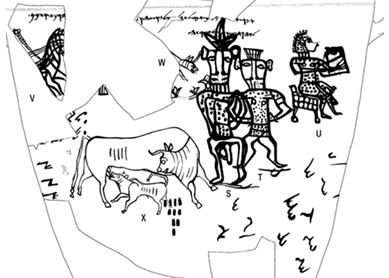
Another scholar of ancient religion, Iraqi Assyriologist Zainab Bahrani, helps us make sense of the ancient worldview. For the Mesopotamians, images were not reproductions of originals like portraits and photographs are for us today.

Instead, they saw their icons as ways of writing existence into being. They were in an active process with their gods of creating reality.

In matters of religion, literal interpretations are dead-ends. Words like metaphor don’t do it justice. Symbols like clay deities stand in for whole cosmologies. They are ways that human beings have tried to understand something that, by definition, is beyond our comprehension.

Perhaps most importantly, Stavrakopoulou misses what a massive departure it was that ancient Israelites abandoned all images in favour of a predominantly literary culture.

In a society where you cannot depict God, but can only engage in description and storytelling, you have to be more imaginative when you try to make sense of infinity.

Poems, sagas, and speeches, like those from our Tanach, are never fixed in their meaning. They are openings that invite listeners to think with them, talk back to them, and struggle for deeper understandings.

When someone reads a text too literally, they strip it of its vitality. Atheists and fundamentalists, both literalists of different kinds, strip the soul from the search for divine truth.

Tell stories, make poems, create art, look for that great truth beyond our reach… and don’t take any of it too seriously.

social justice · theology · torah

We are waiting for a different Messiah

Some years ago, an Orthodox friend asked me: “what would you do if the Messiah came and it turned out we’d been right about everything? What would you say to the Messiah?”

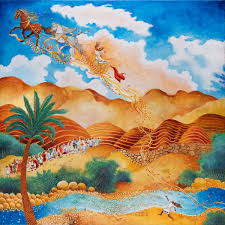
What would I do if the End of Days came, and Elijah literally came storming out of the whirlwind in a chariot made of fire and declared that the Son of David had arrived to cast judgement? And that we were to be judged on how strictly we had separated men and women; how well we had obeyed family purity laws; how stringently we had adhered to traditional authorities?

What would I say to this Messiah?

I have thought about it for a good few years and I think I now have my answer.

I would say: “F@£& off.”

I would tell that messenger: “You are not my Messiah and you’re not my king. Now go back where you came from.”

In this week’s haftarah, we read the prophet Ezekiel’s vision of the valley of the dry bones. For centuries, Orthodox Judaism has based its understanding of Messianism on these verses.

Ezekiel finds himself in a desert surrounded by skeletons. God tells Ezekiel to prophesy to the bones, and he does so, covering them in sinew, breathing life back into their lungs, and reviving their bodies, so that they stand up as a skeleton army.

These, says God, are representative of the people of Israel.

So, Orthodox Jewish tradition teaches, a day will come when the dead are literally physically resurrected. The corpses of pious Jews throughout the ages will be brought back to life; the exiles gathered to Jerusalem; and all judged by a righteous king descended from the biblical King David.

For this reason, many Orthodox Jews eschew cremation, and insist on being buried intact, so that their bodies can be resurrected at the End of Days. They vie for graves on the Mount of Olives, so that they can have front row seats when the Messiah arrives at the walls of Jerusalem and summons up the dead from their tombs.  

In recent decades, religious fanatics have come to espouse an even more intense version of this apocalyptic vision. 

There are Orthodox Jewish extremists, funded by American evangelical Christians, who are trying to destroy the Al Aqsa Mosque on the Temple Mount; build a Third Temple; and restore animal sacrifice and priestly leadership.  They seek to expand Israel’s borders to restore the ancient Kingdom of King David.

This week, Rabbi Charley Baginsky was quoted powerfully in The Times, saying: “We are afraid — not just for Israel’s future, but for Judaism itself. What becomes of our tradition if it is captured by messianic extremism, by racism disguised as religion, by power without principle? If the current trajectory continues, if Jewish supremacy becomes policy, then Judaism itself may become synonymous with oppression.”

In this context, you might be forgiven for thinking that messianism itself is the problem. Surely a religious zeal that drives people to commit such crimes is itself dangerous. For some, witnessing this fervour makes them question the foundations of Judaism itself.

The Israeli religious scholar, Avraham Uriah Kalman, warns against this way of thinking. His article earlier this year, entitled Another Messianism, addresses a tendency in Israeli secular society to dismiss all religion as varying stripes of nationalist fanaticism.

Yet, he claims, precisely because of the strength with which racist extremists have captured Judaism, we must return with equal zeal in our reclamation of Judaism. We, who believe in justice, democracy, and human rights must just as vigorously defend our corner.

If we do not have an equally powerful vision for what society could be, we will always be on the back foot, compromising with monstrous ideologies that want to blow up buildings and raze down villages.

Our ethics are grounded in the Jewish tradition. They are derived from the Jewish texts. They are sourced from the Living God. 

We cannot allow the far right to take exclusive hold over any part of Jewish life, or we surrender it to them. That includes Messianism – the grand utopian visions of ideal societies promoted in every book of the Prophets. 

The Prophets, whose mission of speaking truth to power and uplifting the lowly, are far more in line with our Progressive visions of the world than they are with the soulless dreams of those who want to oppress women and gays as part of their supremacist agenda. 

In the Prophets, we see clear visions of a perfected world. Their writings testify to a world of peace; where all resources are shared; where everyone lives in dignity; and where all are free.

Outside of specific esoteric texts like this week’s mystical imaginings from Ezekiel, it is hard to see any of the far right’s fantasies reflected in our Prophetic texts.

Messianism is really supposed to represent a rupture in the established order, but that is not really what the far right offers. War, racism, and misogyny are already the norm. At core, they don’t really want to change anything except to make existing tendencies more violent and oppressive.

So, says Dr Kalman, progressives must embrace messianism. We must turn to the Prophets as our source of hope, rather than buckling under the weight of despair. From our own utopian visions, we can develop ethics that speak to our daily lives and help us practically realise a better religious vision.

Kalman draws on a whole range of Jewish religious traditions, including Talmud, Kabbalah, Musar, and 17th Century Tzfat mystics. 

Yet, curiously, he seems not to be aware that this project, of developing a Progressive Messianism, has already been deeply thought through. The early Reform movement in Germany, from which Liberal Judaism descends, was animated by looking to the Prophets to rethink Jewish eschatology.

The early Reformers taught that the Messiah would not be a man, but an Age. 

It would not be characterised by Temple and Kingdom revival, but through the realisation of the values of the Prophets. It would be a world of peace and justice, achieved through the moral advancement of all humanity.

Explaining this theology, Rabbi Sybil Sheridan writes: 

“Though the end goal is world peace, the ideal is not pacifism, nor is it the peace of treaties at the end of war that are based on winners and losers. That notion continues the imbalance of power among peoples and nurtures the resentment that leads to dreams of revenge. The peace of the Messianic Age is a peace forged in complete mutuality. No one should be afraid that people may covet their vine or fig tree, no one will fear the loss of land or resources, no one will be humiliated. The world provides enough for everyone and sufficiency will take away the desire for war.”

While we Progressives do not accept the Orthodox doctrine of bodily resurrection and rebuilt Temples, that does not mean we should reject Messianic thinking. Times of despair and horror are when we most need to cling onto our hopes for a better world.

Progressive Messianism takes the task of perfecting the world away from mythical figures like Elijah and King David, and places it directly in our own hands. It says: we will not wait for someone else to bring about redemption; we are going to do it ourselves.

So, if Elijah came down from the Heavens and declared that the Orthodox had been correct all along, I would tell him he was wrong. 

For thousands of years, we have sought to create a better world. We have learnt through struggle about the dignity of women; the importance of justice; and the shame of racism. We now have a much better idea of how the world can be.

We can see a future in which every human being lives in harmony with each other and their planet. We can see a world where all live in freedom and peace. We are sure now that we can live in love and equality. 

We are going to realise our Messianic age.

And nobody- not even a prophet descending from the skies – is going to stand in our way.

festivals · sermon

Do not leave any part of yourself in Egypt


Several years ago, at a seder, I was introduced to a new custom.

When it came time to sing Dayyenu, a Persian-Jewish friend passed us all a spring onion each.

“In my family,” she said, “we hit each other over the heads with spring onions while we are singing this song.”

“It’s supposed to get out of our heads any feeling that we might want to remain in Egypt. So we remind each other by hitting our heads that we do not want to go back there.”

I instantly fell in love with it, and have adopted it into my own family seders. In fact, in my home, it can turn into a bit of a food fight, as we chuck the spring onions around the room.

One year, a Muslim friend came, and was quite baffled by the proceedings. I put quite a unique twist on my seders, and try to make them fun. That year, I had people dress up as the Ten Plagues from bits of fabric around the house, and do a lip-synching competition to the Prince of Egypt soundtrack. As he left, he said: “I can believe all of it is normal Judaism, apart from that bit with the spring onions.” I said: “That’s the only bit that was a real tradition!”

Maybe you might not bash your dinner guests with greenery, but you do sing Dayyenu, don’t you? It’s such a highlight.

I worry that some of our families’ seders don’t get there. The food’s coming out of the oven, everything has already gone on far too long, you’re anxious to eat, maybe you skip this important bit. I hope you don’t.

How about afterwards, when you’ve finished eating: who does the whole thing? Who carries on and sings hallel afterwards, and does the benching, and drinks the next two glasses of wine?

I hope you do. In fact, if this sermon has a message, it’s this: do the whole seder.

As you will see, this is not just me being a stickler for making sure people treat liturgy seriously, or insisting on the importance of halachah. This is about how we live our lives.

Our story begins with slavery and ends with freedom.

So, when you come to have your Pesach meals, make sure you don’t just tell the story of slavery. Make sure you talk a good deal about the freedom that comes afterwards.

The haggadah is actually split into two parts. In the first half, we are supposed to see ourselves as slaves in Egypt, weighed down by the yoke of bondage. Then, we eat. After dinner, we are free. We cross the Sea of Reeds and sing praises to our God. We raise a glass of wine to our redemption. We raise another glass to our future. We keep back a fifth glass for Elijah, who will come and bring about the final redemption, when everyone everywhere will finally know freedom.

Now, which of those two halves of the meal is more important?

Of course, it’s the second one. We don’t get together with our families and communities to dwell on how miserable it was to be stuck in Egypt. We get together to rejoice that we are free. How wonderful is this festival, the season of our liberation, that reminds us of that miraculous exodus out of oppression.

We sing Dayyenu (and bash each other with spring onions) immediately before we eat. That moment comes on the cusp between staying in slavery and leaving for liberty.

Dayyenu comes at the point where we are leaving slavery for freedom. By bashing each other’s heads with the spring onions, we say: “don’t leave any part of your head there! Don’t go back there, not even in your mind! Don’t dwell on those narrow places that kept you oppressed!”

Come on, we’re about to be free. We’re about to eat. Let’s look now to the future, where we will never have to think about those things again.

There’s a good reason why we might use spring onions in particular for the hitting. When the Israelites do get free, and start wandering in the desert, they start moaning about how much they miss slavery. They whinge about how much better being oppressed was. And what do they say they missed eating? The onions.

Those Israelites understood something. Being oppressed can feel easier than getting free. Sure, Egypt might have involved great persecution, but you always knew where you stood. Getting free, or at least trying, is tough. It’s unpredictable. It combines dizzying excitement with a terror of the unknown.

So we have to remind ourselves, over and over again, that however difficult freedom feels, it is better than oppression. However easy it might be to wallow in misery or stay in a victim mentality, there is so much more to be gained from shaking off our chains.

The first part of the seder says: we were slaves in Egypt. The second reminds us: but God helped us get free.

In the 19th Century, the Progressive Jew Israel Abrahams wrote about exactly this optimism for the Jewish Chronicle. He began his article by saying how wonderful it was that even persecuted medieval Jews insisted on keeping their doors open for Elijah on seder night, adamant that God would protect them. He said: “truly there is no danger to Judaism while such eternal hope prevails over despair.”

Israel Abrahams goes on to talk about the messianic hope that Jews hold at Pesach. Look at the bigger picture of history, he says, and you can see that it is not a delusion. “Persecutions come and go, but the Jews go on.” Away with all pessimism,” he says, “away with all pessimism.”

Can you believe that such words appeared in the Jewish Chronicle? How much can change in just over a century! Today, there is no way our communal organs would say how great it is that Jews would keep their doors open. They’d tell us to keep them locked. They’d sell us a more advanced security system. They’d put in a fundraising pitch for CST while they were at it.

Can you imagine any of our great and noble communal representatives sharing a positive view of Jewish history and an even more positive view of our future? No, their message is always the same: we are terrified; we have always been persecuted; we always will be persecuted. All we can do is build up bigger defences, hire tougher security guards, buy more effective security cameras; and keep our bags packed to run away just in case.

Sometimes I think Anglo-Jewry is stuck in the first half of the seder. It is as if many of us believe that we ourselves were slaves in Egypt, but nobody can believe that we were redeemed.

Do any of us really believe we are worse off than Jews were in the time of Israel Abrahams? Do we have more reason to cower than did medieval Jews? And, if we did, is cowering behind even greater security really our best answer?

The point of the seder isn’t that we were slaves. It’s that we got free.

Think of the wonderful things Jews are doing, and that British Jews have done. We are stars of stage and screen, fully represented at every level of politics, working in every strata of society, innovating, building, and living happy lives among our neighbours.

Sure, you can talk about the bad bits. Whenever I talk about the good, someone is eager to remind me of some proof of how much they all hate us. Some people leap to lecture on antisemitism and misery at even the suggestion that things might sometimes be good. That is a mentality that keeps your head in Egypt.

It’s not that everything is miserable and it’s not that everything is fine. It’s always a bit of both, no matter who you are.

The point is that everything could be wonderful. We could build a future so much better than this one.

Many times, with God’s help, we have achieved wonderful things.

When you take up the third cup at your seders, remember all the incredible things you and your ancestors have achieved.

When you take up the final cup, look towards the great utopia you can build here on earth.

And when you leave your Pesach seders this year, don’t carry around with you the slavery and misery of the first part of the meal. Bring out into the world Judaism’s message of hope.

Keep your eyes always on the best of what may be to come.

Beat out of your head any desire to wallow in misery.

Do not leave any part of yourself in Egypt.

Shabbat shalom.

judaism · sermon

Whose quarantine?

By this stage in quarantine, you have probably broken down, cried, experimented with an unusual haircut, argued with your partner or room mate, attempted to pick up a new skill, laughed, watched a movie, read all the Corona-related news items, avoided reading all the Corona-related news items, lost your mind, twice, and finally accepted the new reality. Now, it’s time to have breakfast and go through the whole process all over again.

It’s hard to put into words what is happening for us in lockdown right now. Whenever I talk to friends or family about how they’re experiencing this unprecedented life event, we revert to discussing the latest rules or the political ramifications or what they understand of the emerging medical news. We can only really sum up how we’re dealing with the situation in odd phrases, like “getting by”, “finding new meanings”, “struggling” or, “drinking before midday.”

That’s probably why I have trouble finding out what quarantine was like for our ancient ancestors. This week’s parashah is Tazria-Metzora. It is the Torah reading about quarantine. Rabbis rejoice! For so long the processes and rituals around self-isolating for infectious diseases seemed so irrelevant to our lives. Suddenly a pandemic comes along and we can join the ranks of overnight experts with a niche specialism in ancient Israel.

Except, strangely, Leviticus doesn’t really tell me what I want to know. It describes in graphic detail the infectious skin disease our forebearers were trying to prevent – called tzara’at, it resulted in white flaky peeling of the skin and made its sufferers look like the walking dead. It would start as a small patch and gradually expand across the body.1

It also tells me exactly how the priests would deal with it. Anybody with the affliction would have to isolate themselves outside of the camp for 7 days. At the end of these, a priest would come out to inspect the patient. If the patient had been healed, the priest would make ritual offerings of birds to spiritually cleanse him.2 They would be shaved, washed and then readmitted to the community.3 If not, back into quarantine he would go.

Yet for all this detail spread out over chapters of the Torah, it doesn’t answer the question I really want to ask: what were their lives like? How did it feel to have the scaly skin disease in ancient Israel? What did they do when they were isolated from their communities? The Torah provides scarce little information about these questions, and biblical scholars seem surprisingly unconcerned. In fact, the main trend among academics has been to question how much we can even know about the biblical world, shedding great doubt on the texts that have reached us.4

We are told that the isolators were kept outside the camp, or outside the city walls. I wonder whether they had dedicated centres. The harsh desert sun of the Negev must have made simply staying outside longterm impossible. I wonder how they got food. Did people deliver it to them in designated places? Were they expected to scavenge for themselves?

All I can gather from the text is how people were managed, punished, ritualised and redeemed. I cannot work out how the ancient people keep themselves entertained when they had no access to other human beings, nor to Netflix, WiFi, or books to read. I do not know how they loved, supported each other, struggled, found things difficult and ultimately survived. Those positive stories of endurance are hidden between the lines of the text. I do not know how they felt.

But, in this community, I don’t need to just wonder how people feel and how they are managing. Our welfare committee has done an incredible job of checking in on everyone. Our healthy members are going out of their way to ensure that the others get the food and supplies they need. I know that, across this community, people are checking in on each other to find out how they are. This community should be an inspiration to others across the country.

Much is made in the media about people’s acts of selfishness and inconsideration, but for my part I have only seen the reverse. I have been overwhelmed by the kindness of people reaching out to share in feelings, offering support with shopping and errands, and generally being as supportive as they can in these exceptional times.

When our biblical forbearers wrote about quarantine, they wrote about its rituals. When the scholars wrote about it, they took interest in its medical diagnoses. When the media write about it, they write about everything that goes wrong. These stories of rituals, rules and wrongdoing might make for compelling reading, but they don’t reflect people’s lived reality.

Meanwhile, we are quietly writing a different story through our deeds. We are writing stories of generosity, kindness and self-sacrifice. We are showing every day in little ways how much we care about ourselves, each other and our communities.

One of the surprising facts about crises is that they do not engender selfishness, but altruism. At the time of the last financial crash, I was working in the charity sector, and we were all perplexed when we discovered that, in times of economic hardship, poorer people’s charitable donations went up. This week, a German science journal reported on a significant uptick in people’s compassion in their attitude to others since the crisis began. We see the results of that: thousands of people volunteering for mutual aid groups and the NHS supporters. The more people struggle, the more they care about the struggles of others.

Priests and politicians may want to write one kind of story, but ordinary people write much better ones. May we continue to write those stories, and may they be the ones we pass on to later generations.

Shabbat shalom.

coronavirus-volunteers-list

I delivered this sermon over Zoom on 25th April 2020 for Three Counties Liberal Judaism.

1Milgrom on Leviticus 1-16, pp. 816-824

2Lev 14:1-6

3Lev 14:9-10

4Watts, Ritual and Rhetoric, pp. 27-32

judaism · sermon

The Tabernacle or The Temple

When Israel Mattuck, Britain’s first Liberal rabbi, went on holiday, he used to spend hours visiting the churches and cathedrals wherever he was. His biographer, Pam Fox, writes endearingly about how much it used to annoy his family.1

I really relate to this. There is something quite wonderful about seeing how others pray. From the mosques in Turkey and southern Spain to the cathedrals in France and Italy, I’ve never found a holiday partner I couldn’t frustrate by dragging them into every little religious building I see.

These buildings communicate messages about what believers make of their religions. The last time I was here in the Three Counties, I sat with my boyfriend in Gloucester Cathedral and we listened to Saturday night evensong. The organ roared through the cavernous building, as if to remind us how terrifying God could be. I went away from the service feeling stirred in a way synagogue services rarely make me feel, and I wondered what parallels there were in our practice.

Perhaps part of the appeal of these spaces is that we have no Jewish equivalent. There is, after all, no such thing as Jewish architecture. What does a “Jewish building” look like? What are its features? Beyond a mezuzah on the doorpost, very little ever identifies a space as Jewish.

In part, that is because of history. Forever a transient people, we have rarely invested in plush buildings, knowing well that our communities were so wont to move and change. In the medieval synagogue in Barcelona’s Calle, the only distinguishing feature is that the wall protrudes slightly onto the cobbled street so that worshippers can face east. It has had no problem being repurposed variously as a home, a factory, a cafe and a museum. The site of the synagogue in Lincoln, dating back over a millennium, was only recently repurposed by its Liberal Jewish community. And, still now, it’s really just a very old room.

Yet even today in modern Britain and the USA, where Jews have lived comfortably for some time, there is little that can be identified as Jewish architecture. The Liberal Jewish Synagogue in St John’s Wood is identifiable by its Greek columns. Temple Emanu-El in New York looks indistinguishable from a Cathedral. Even modern Israel has developed no architectural style for its religious buildings. The places where I have prayed in Jerusalem seem no different to shop front shtiebels. For some reason, we have an aversion to creating Jewish buildings.

This casts an interesting light on this week’s parashah. Here, we read about the Israelites’ instructions for building a Tabernacle. This was a giant portable tent in the desert, where the freed slaves would come to offer sacrifices and experience their God. What a space it must have been! Every precious metal is enumerated; the finest kinds of wood; fabrics dyed in the hardest-to-find colours of crimson, purple and blue; goats’ hair and dolphins’ skins. We read about the incenses and it’s as if we can smell them wafting through the sacred space.2

This Tabernacle in some way must have mirrored the First Temple. In our haftarah, we read of King Solomon’s building of the Jerusalem Temple.3 About 30 metres long and described in glorious detail, this was the central focus of the Israelite cult for around 400 years.4

One of the great debates between Liberal and Orthodox Jews in the last century was which one preceded the other: did the Temple come first, or the Tabernacle? For Orthodox Jews, who treated the Bible as a historical account of the journeys of the Israelites, the Tabernacle must have come first, and been a blueprint for the Temple that would later follow. For Liberal Jews, who accepted the conclusions of the historians of the time, the myth of the Tabernacle was constructed later, when the Temple already stood, as a way to justify the religious centralisation brought about under Solomon.

As it turns out, we might both have been wrong. It is unclear whether Solomon’s Temple ever really existed. We have no archaeological evidence for it.5 There have been attempts to prove that such a space existed, but these have all been exposed as hoaxes. That doesn’t mean it definitely didn’t exist – lack of evidence is not evidence of lack, and Jerusalem is a notoriously difficult place to do archaeological digs. But we can reasonably suspect that Solomon’s Temple may have been a myth.

One of the things that was most missing from these heated debates in the last century was that the Tabernacle and the Temple were fundamentally different places. The Temple had attributes that would have been impossible for the Tabernacle to have: fixed foundations, windows, stone quarries and multiple rooms. The Tabernacle, by contrast, was a mobile, portable space, that had to be lifted and reassembled regularly as the Israelites went about their journeying.

Through their different architectural styles, the two spaces communicated fundamentally different messages about the nature of God. The God of the Tabernacle was transient, travelling with the people as they came out of slavery and wandered in the desert. It had no fixed home and could speak to people wherever they were. The God of the Temple was fixed in one place. It had a home and its worshippers needed to travel from all the surrounding towns to pray there.6 One God was national; the other universal.

At the heart of these debates between Liberal and Orthodox Jews was an issue that was far more theological than it was historical. Orthodox Jews needed to believe that God had pre-ordained the Temple because they wanted to see a Messianic Age in which it was rebuilt. They maintained that our God was still a national God who would one day return to live in Jerusalem. Liberal Jews needed to exercise doubt because, for them, God was transcendental and Judaism had no central home.

This brings me back to the question with which I first began: why is there no such thing as Jewish architecture? Perhaps it is about much more than historical circumstance or artistic predilections. Perhaps it tells us something deeper about how we see God. Our God, like us, is rootless and unchainable. Our God, like us, reveals its nature more through loving deeds than through material accomplishments.

As a community, we move regularly from one place to the next. We spend our services variously in Ledbury, Ross, Up Hatherley, Gloucester and across the Three Counties in each others’ homes. Let us rejoice in this fact. We are, like our forebearers in this parashah, wandering Jews. We are, as our Liberal rabbis would have hoped, physically demonstrating God’s transcendent mobility. Every house and community centre we enter becomes full of the richness of tradition and, for the time that we are there, is transformed.

There is no such thing as a Jewish space because every space where you find Jews is Jewish.

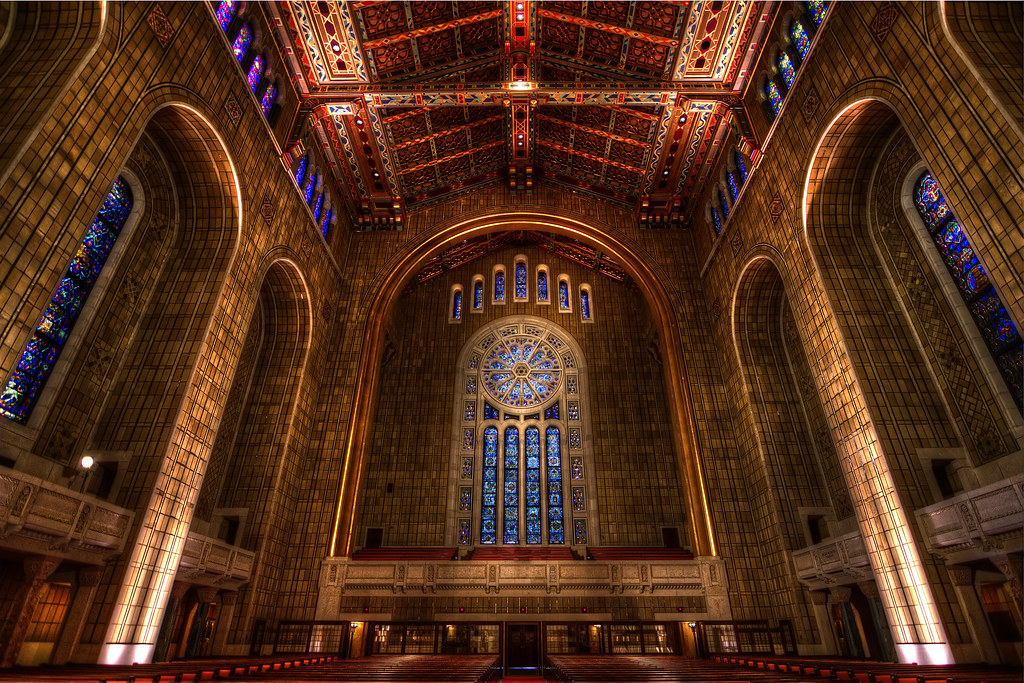
temple emanu el
Temple Emanu-El in New York


I gave this sermon on Saturday 29th February 2020 at Three Counties Liberal Judaism for Parashat Trumah

1 Pam Fox, Israel Mattuck: Architect of Liberal Judaism

2 Ex 25

3 1 Kings 6

4 BT Bava Batra 3a

5 Finklestein and Lieberman, The Bible Unearthed

6 Mishnah Sukkah 4

sermon · social justice · theology · torah

The Fragility of Progress

When the news came in, I was sitting on the sofa watching the TV with my mum. I was in my late teens, back home from my first term at university.

The government had just legalised IVF for lesbians. It was the crowning glory of a raft of legislation passed by a Parliament that permitted gay adoption, created civil partnerships, and outlawed discrimination. Each law had been loudly and publicly debated, and there was no guarantee that any of the laws would pass.

I was overwhelmed with joy. “This is it,” I turned to my mum. “We’ve won so much. They can never take it away from us now.”

“Yes they can.” She said. “They can take it away whenever they want.”

She wasn’t gloating. She wasn’t sad. She was just stating a fact she’d learnt from bitter experience. She had joined the labour movement in its heyday, before workers’ organising rights had been curtailed and union membership had started its slow decline. She had given herself to the women’s movement and successfully fought for domestic violence shelters, women’s representation committees and helplines, only to see them all shut down.

She knew, in a way that I was too naive to understand, that what the powerless took a century to win, the powerful could take away in a day.

A fortnight ago, we read the story of the Daughters of Zelophehad. Five women from the tribe of Manasseh brought a petition before Moses and the elders, requesting that they be able to inherit their father’s estate. They argue that their father was loyal to Moses and, having no brothers, they are his proper heirs.

Moses agrees. He says their cause is just. He sets a precedent and introduces a new law: that whenever a man dies leaving daughters but no sons, his daughters will inherit him.

It is a favourite story of progressive Jews. In pulpits across the world, rabbis will have given sermons arguing that this text shows that we are right. Halachah can change. We can advance the rights of women. Judaism can progress.

This week, we are less triumphant. Cushioned at the end of the book of Numbers are the terms and conditions imposed on the daughters of Zelophehad. The men who head up the tribe of Manasseh ask Moses to revisit the case. If these women marry whoever they like, the tribe’s portion will be smaller.

Moses agrees with them. The daughters of Zelophehad must marry men from the tribe of Manasseh. The estate they inherited must become part of their husbands’ wealth. That will be the law. All women who inherit their father’s estates must marry men from the same tribe and hand over their wealth. What they won one week, they lost the next.

What does it mean for progressive Jews? The clue is, after all in the name: progressive Jews are supposed to believe in progress. Judaism can progress. We can change to become more inclusive and equal.

Our faith in progress is a response to Enlightenment and emancipation. Jews were granted citizenship. Science advanced and the age of reason prevailed. Mendelssohn called us out of the ghettos, promising the Jews of Germany that the world was waiting for them. The Jews would enter into history. If humanity was going to advance, we would lead the charge. Progress was unstoppable.

History had other plans. What rights we won, we lost in greater measure. After citizenship came the death camps. Progress could be stopped after all.

How can we possibly continue to have faith in progress after the horrors of the Shoah? How can we hold onto our hopes when we know how easily they can be dashed?

The answer is simply that we must. We hold onto our values because they are right. To be a progressive today does not mean believing that the victory of the oppressed is inevitable, but that it is necessary. We do not know whether justice can win, but only that it must.

The moments of victory are not just short-lived achievements. When we win the right of women to inherit, or lesbians to have IVF, or gays to adopt, we do not just win a legal right. We are glimpsing what is possible. We gain strength as we realise that progress we once thought impossible can be achieved. The realisation of a dream only calls for more dreams.

Today, pundits warn us of the great fragility of progress. In a tear-filled speech to Parliament recently, Angela Eagle MP told the Commons: “We know that the motivations of some of those involved in this are reactionary, and they are to return us to an era where LGBT people should get back in the closet and hide and be ashamed of the way they are.”

The progress that gave us lesbian IVF, gay adoption and the Equality Act is proving vulnerable once more. Those who had never quite felt included in Britain are feeling more alienated than ever, and those who assumed Britain would always be their home are having doubts.

But we should not despair. Whatever progress we have made has not been given to us by an invisible hand of history that oscillates between liberalism and fascism, but by people making the choice that progress is worth fighting for. We win rights not because of the generosity of politicians but because of the insistence of those who believe in justice.

Recognising that progress is fragile, all we can do is ask ourselves whether it is worth fighting for. And because it is worth fighting for, we will fight. And if we fight hard enough, we may win.

hopeful sunrise

I wrote this sermon for the weekly newsletter of Leo Baeck College, for Parashat Masei, 3rd August 2019

judaism · sermon · social justice · theology

Yes, to heal the world

What is the point of Judaism?

Last night, I gave a defence of Judaism for the disengaged. I argued that religion gives us a sense of community, purpose and meaning. I talked about how Judaism is an antidote to many of the greatest problems we face in the 21st Century.

This morning, I want to talk about why progressive Judaism, specifically, ought to be our way forward. Progressive Judaism has, in recent years, come under attack. Last year, Jonathan Neumann released a book entitled ‘To Heal the World?’. Its subtitle – ‘How the Jewish Left Corrupts Judaism and Endangers Israel’ – probably tells you everything you need to know about this book.

In it, he argues that progressive Jews have distorted Judaism and created their own denomination, completely divorced from tradition. He pours scorn on one idea in particular, that of ‘tikkun olam’. The basic premise of this idea comes from Jewish mysticism. It argues that the world in which we live is broken, and that through the pursuit of social justice, we can begin to heal it.

For Neumann, this idea is an innovation. It is the ideology of the American New Left combined with some Jewish theology. In a way, he is certainly right. The idea of ‘tikkun olam’ was a new development. It was a rallying cry to bring together many of the issues on which the Jewish community in America was campaigning, particularly black civil rights, women’s liberation and international peace.

While he may be right about the nomenclature, he is completely wrong about the idea. This idea, that Judaism’s core is one of social justice, has been integral to progressive Judaism since its inception. Our founders, like Rabbi Abraham Geiger in 19th Century Germany, argued that the soul of Judaism was not in its laws but in its prophetic texts. The Reformers sought to reposition Judaism from its narrow focus on ritual to the universalist message of justice.

The prophets spoke in a language of justice that would be recognisable even today. In this week’s haftarah, we read of Elijah, arguably the greatest prophet post-Moses. His life was full of miracles: he could split rivers, heal the sick and bring on rainfall. At the end of his life, he was carried away to Heaven in a chariot of fire. All the wonder in Elijah’s life should not gloss over Elijah’s message.

He challenged kings, demanded an end to idol-worship and called on the Israelites to remember their covenant. For Jews the world over, he is the harbinger of messianic redemption. He is the first among our prophets to promise that a messianic age is coming. Subsequent prophets, such as Malachi, prophecy that, when Elijah returns, God “shall turn the heart of the parents to the children, and the heart of the children to their parents.”

For progressive Jews, this promise of liberation is built into our very understanding of what it means to live a Jewish life. We cannot just wait, passively, for a better age to come up to us, but must participate in building it. We do that through our pursuit of justice, by following our consciences, and by seeking to make the world a more loving place.

While the branding of this idea as ‘tikkun olam’ may be new in Judaism, its message can be found throughout the Tanakh, rabbinic literature, and our liturgy. It is at the core of what Judaism calls on us to do.

This authentic Jewish idea is what Neumann finds terrifying. He argues that this is a deviation from traditional Judaism. Of course, he never defines what precisely that is. In all likelihood, that is because he doesn’t know. In a review of the book in Tablet magazine, Shaul Magid argues that Neumann’s argument falls flat because he doesn’t have the requisite knowledge of Judaism to make his case. Neumann is, after all, not a Torah scholar, nor a Jewish historian. He is an opinion columnist. Magid shows very successfully how Neumann simply doesn’t understand how Judaism, whether Orthodox or progressive, actually works. There can be no more damning critique of a book than that it would have been better if it had been written by somebody who knew what they were talking about.

For Neumann, progressive Judaism must be contrasted with ‘traditional’ Judaism. He seems to have in mind an idea of bearded men in segregated synagogues keeping kosher, observing shabbat and keeping to a very strict set of rules. The first issue with this is that he seems not to understand that Orthodox Judaism is, itself, a modern innovation. It is a response to the modern world, that takes a conservative approach to life and a dogmatic approach to commandments.

It is deeply depressing that, even within our own ranks, many of our members imagine that the black hats have, in some sense, a more authentic version of Judaism than we do. When we look at other religions, we are fully aware that the most compassionate, charitable and honest version is the most authentic. We do not imagine that Christianity is at its most authentic in its belligerent form, nor that Islam is most authentic in its fundamentalist form. We know that they are both closest to God when they are humble, sincere and loving. Why are we so shy about expecting the same standards of our own religion? We are not at our most Jewish when we have the strictest food laws, but when we are sharing that food with others.

Most importantly, Neumann’s idea of traditional Judaism is so narrow and limiting. He never seeks to answer the question: what, then, is the point of Judaism? If our purpose on earth is not to heal the world, what is it? Should we just be slavishly obedient to some rules because we have a mythologised idea of how our ancestors were? Does Judaism have nothing to say to the modern world? If that is all we are, how can we be expected to survive? What would even make us worth preserving?

The truth is that, for we progressives, halachic observance and social justice are not competitors. They complement each other. Our food laws help us because they force us to think ethically about our consumption. Shabbat is a joy because it teaches us about the value of rest and the holiness of God. All our rules and rituals have value because they turn us into disciplined, conscientious people, who will seek out justice when it is necessary. Progressive Judaism sees very clearly that the point of Judaism is not the rules in themselves but the pursuit of a better world through them.

And, yes, all of this points us in a particular direction. You might call it the messianic age, as our prophets did. You might call it progressive Judaism, as our German founders did. You might call it tikkun olam, as the Americans in the ’70s did. Whatever name you give it, the message is clear. We have a short time on earth and we are here with a mission. As Jews, we have been tasked with a sacred purpose of perfecting the world, demanding justice and pursuing peace.

That is the point of Judaism. Let us work to heal the world together.

Shabbat shalom.

tikkun olam

I gave this sermon at Newcastle Reform Synagogue for Parashat Ki Tisa on Saturday 23rd February.