judaism · sermon · theology

If you don’t fancy killing pigeons, you’re probably a Progressive Jew


Have you ever done something wrong, completely accidentally, with all the best intentions, and, feeling ashamed and repentant, thought to yourself: “that’s it, I better go kill a pigeon.”

Of course you haven’t. Because as an astute reader of Torah knows, if you have committed a sin, you need to sacrifice at least two pigeons. A goat for serious misbehaviour. A bull, if you really messed up.

This week, we enter the Book of Leviticus, an impressive catalogue of sins and sacrifices. This third book in the Torah cycle, called in Hebrew Vayikra, acts as a directory for priests.

Here, you can match up any misdeed or lifecycle event with the appropriate sacrificial animal, and it comes with a handy recipe book for how to make the meat smell nice enough that God forgives you.

(Bit of oil… bit of incense… bake for three days in a smoke oven…)

We leave behind the great moral myths of Genesis. We leave behind the inspiring liberatory narrative of Exodus. And this, too, is where we leave behind Orthodox Judaism.

If you are an Orthodox Jew, the only problem you can see with killing a pigeon to atone for your mistakes is that you don’t have a Temple to do it in.

In the Koren Sacks Siddur, the Orthodox daily prayer book, you will find petitions to be recited every day that God rebuilds the Temple in Jerusalem, brings back the hereditary priesthood, and restores the sacrificial cult.

Finally, if I make an accidental mistake, I will be able to fulfil the Torah’s command that I should splatter a bull’s blood and entrails all over a table.

Frankly, I don’t know how our friends further up the Thames have managed to go so long without enacting this sacred duty.

At its best, the rebuilt Temple of Orthodox Judaism involves some kind of mystical descent of a palace from the clouds at the end of time. At its worst, there are Jews currently hoping to blow up the Al Aqsa Mosque on the Temple Mount and replace it with a gaudy pillared Roman-style shrine.

I’m not going to get into the geopolitics of why that would be a terrible idea. My area is theology, and I can tell you now, that from a religious, moral, spiritual, and ethical perspective, bringing back any kind of Temple would be a terrible idea.

Even as a metaphor, the yearning for Temple Judaism is an abrogation of responsibility, a refusal to engage in the real world, and a fantasy that blood can avenge wrongdoing. We cannot tolerate this idea on any level, whether real or abstract.

It is hard to overstate what a fundamental difference this is between Progressive and Orthodox Judaism. Opposition to rebuilding the Temple is central to Progressive theology.

In 1885, American Jews came together at the Rodef Shalom Synagogue in Pennsylvania and signed up to their foundational document: the Pittsburgh Platform. This decree has influenced how Progressive Jews see our religion ever since.

In it, they declare: “we expect no sacrificial worship under the sons of Aaron.” From the outset, we have believed that the synagogue has permanently replaced the Temple.

The author of the Pittsburgh Platform was an inspiring rabbi, named Kaufmann Kohler. Born in Germany, he became America’s preeminent Reform scholar. If you’ve ever dipped into the Jewish Encyclopedia, you’ve probably read something written by him.

Kohler wrote an introduction to Jewish theology that dealt thoroughly with how we Progressive Jews should understand these Temple texts. They were, for their time, a tool to help Jews gain moral understanding. The rituals and sacrifices showed us how to take responsibility for our thoughts, and even our conduct.

But, over time, we outgrew pigeon slaughter. We moved on to the world of rules and structures created by the early rabbis. And now, in our modern age, we are still moving forwards: so that we will do the right thing without being bound by old laws.

That’s what the progress in Progressive Judaism means: progressing from the age of slaughter through the age of laws towards the age of morals.

It’s not that we should discard the laws, or even the stories of slaughter. We should be like students who learn more through our schooling- at each stage, we retain what we learnt earlier, but we refine it, and we realise that some of our earlier ideas were too simplistic. Wanting to rebuild the Temple is like wanting to go back to the crayons of nursery school.

Throughout the moral education of humanity, we received hints that this was where we were going all along. In the Book of Proverbs, written when cattle murder was the normal way of dealing with guilt, it says: “To do what is right and just is more desired by the Eternal One than sacrifice.”

Throughout the books of the prophets we are repeatedly assured that God is far more interested in our moral conduct than in how much fat we can burn off the bones of a lamb.

Centuries later, when the early rabbis were busy codifying all their laws, the midrash explained why the Torah would say this. Sacrifices could only happen in the Temple, but you can do good deeds anywhere. Sacrifices can only atone for mistakes, but with good deeds you can repent for what you did wrong on purpose. Sacrifices only last a short while, but righteousness can endure forever.

At every stage of its development, says Rabbi Kohler, we Jews were a priestly people. Even in the days of animal sacrifice, we were always trying to demonstrate how to live with knowledge of God and concern for morality.

So, says Kohler, our mission on earth is to constantly be a beacon of moral behaviour. If we forfeit that, even for a moment, we will cease to be worthy of being called God’s people.

The idea of rebuilding a Temple isn’t just a dead end: it is a reversal of history. It takes us backwards from reason to superstition. It is the most retrograde step from our understanding of animal suffering to treating God’s creatures as subjects for abuse. It is abhorrent.

And I think most people know that. I honestly believe that, if we asked the vast majority of our friends and family who attend United or Federation synagogues if they think we would be better off with a cult of butchery based in Jerusalem, they would be repulsed by the concept.

In that case, they do not believe in Orthodox Judaism. Mazel tov, they’re Progressives already! Come through our doors, come celebrate with us, come pray with us!

You can leave your fantasies of pigeon massacres at the door. Come and be God’s priestly people.

Come and be a Progressive Jew.

Shabbat shalom.

sermon · social justice

A peasant farmer was my father

A peasant farmer was my father

When my mind wanders, I like to think about where I would go if I could travel in time. Have you ever considered this? When you would want to visit?

Personally, my first thought is Paris in the 1890s. In my higher moments, I project myself into medieval Andalus, the Golden Age of Hebrew poetry in Spain. 

And, of course, I’d love to go back to biblical times. Wouldn’t it be marvellous to see the First Temple in all its glory? What would it be like to inhabit that world of prophets and visionaries?

But this time travel thought experiment always comes with a corollary. I’d have to be a rich man. No matter what spot of history I got dropped in, the only way to enjoy it would be to be part of the elite.

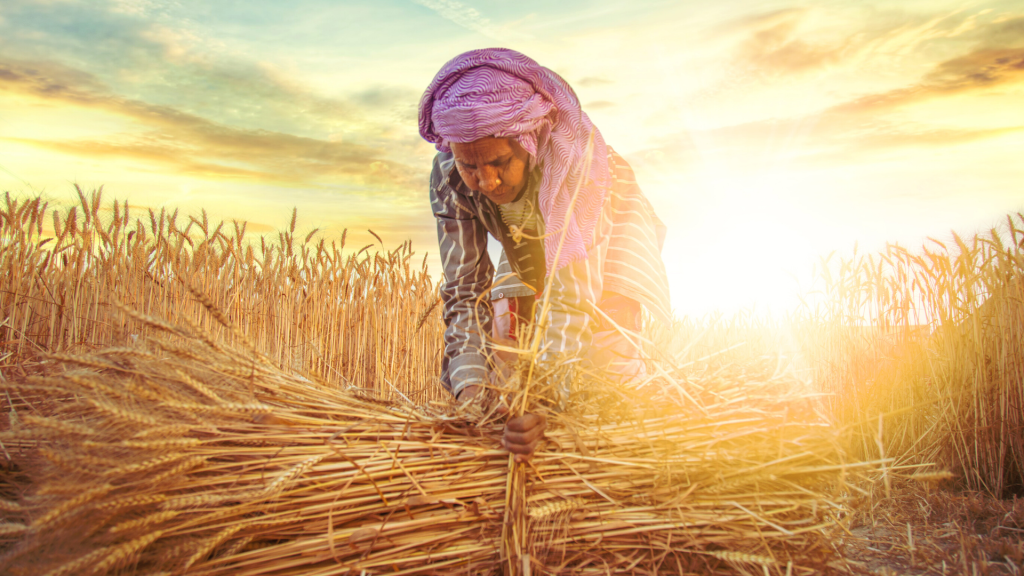
If I were sent back to biblical times without that condition, I’d probably be a peasant farmer. We like to imagine our ancestors as great kings and high priests. In reality, they were less than a small fraction of the ancient Israelite population.

95% of people in the biblical period worked the land. Dropped back to the time of David and Solomon, we probably wouldn’t be in their courts, but in the fields. 

I take a perverse pride in this knowledge.

Think how hard they must have worked to bring that ancient society into being!

As a peasant farmer in the ancient world, you would have about 3 acres, growing different crops, including grains, fruit trees, and olives. You would, almost certainly, have a chicken run and a small herd of goats. 

If you were really fancy, you might also have a cow.

Your home would be a collection of huts and tents, stretching out to include your extended family. Each would be a bustling, cramped place, with pots and pans and a fire stove. Your animals would potter in and out of your sleeping quarters. 

I am not trying to paint a romantic vision of any of this. Your life would be hard. You would pull a plough with your own hands and sow seeds with your back hunched over. You would cultivate and cut and glean your trees in the searing heat. 

You would spin your own wool, stitch your own clothes, bake your own bread, build your own dwellings, subsist on whatever you needed to survive.

Yes, all that is true for women, too, with an additional burden. You would give birth to ten children and breast feed all of them. You would count yourself incredibly lucky if all of them lived past the age of 5. If they did, they would likely be married off in their teens. 

No, there is nothing romantic about the lives of our real ancestors. 

But we should be proud of them. 

Peasants, labourers and serfs might not be the subject of great poetry and sagas, but without their efforts, nothing exists. There could be no food, no shelter, no community, and no culture, without their graft. That gruelling work made civilisation possible.

This week’s parashah tells us something of how they built ancient Israelite society.

If they had just stuck to their own homesteads, they would have had to survive on the paltry gains of subsistence farming. In a bad year – if rains failed to fall or crops failed to grow – they would simply perish.

So, our family, the farmers of the ancient world, signed up to participate in the agrarian state. 

The agrarian state was responsible for distributing food and creating common irrigation and transport systems. In ancient Israel, the centre of that state was the Jerusalem Temple. 

Our parashah explains the criteria for participating in its systems. You must not glean your fields right to their edges, so that you leave enough for travellers and strangers. You must donate a tenth of your grain and livestock to support those in the community who are most vulnerable, like widows and orphans. 

In some ways, this is the foundation of the earliest welfare state. 

But the poor are not the only beneficiaries of this redistribution. 

In fact, they were not even its primary targets. 

Our parashah begins with a ritual that Israelites must undertake each year. At each harvest of the year, you must collect your first and best fruits. You must bring these, the choicest of all the crops you worked so hard to create, and give them to the priests.

You must lift them above your head and say: “A wandering Aramean was my father. He was enslaved in Egypt, but God brought him out into this land of milk and honey. Now, I bring before you, the first fruits of the soil that God has given me.”

The priest will sacrifice it, perform closed rituals, and eat it in front of you.

That priest did not work to produce those fruits. He did not share in the exhausting work of raising children in a hovel, or run ploughs over the land. In fact, he wasn’t responsible for any land.

The priest’s sole job was to be the leader of the ancient cult. He was in charge. He profited from your work. 

That great Temple in Jerusalem, with all its priests and writings and rituals, only existed because the poor majority paid in and made it happen. That entire society functioned on the basis of our ancestors’ labour. How could they have done it without the work of the people who harvested the grain, built the bricks, and cared for the sick? 

I don’t resent the ancient priests. 

That work made possible great cultural developments. At that time, we couldn’t have had literary culture, organised society, music or scientific discovery without a class who had the leisure time to devote to such pursuits.

We then wouldn’t have benefited from the innovations in agriculture, technology, transport and trade that makes our lives today less horrible than they were in ancient times.

But, while resentment for ancient figures might not be productive, we should feel entitled to be critical.

After all, their world is our world. For all the social progress we have made, the divisions that defined civilisations millenia ago are only greater than they were then.

Far fewer people profit far more from the work of the majority than ever did in the biblical period. 

Almost all of us, I know, are worried about how energy price gouging, interest rate rises, and higher costs of living will affect us. Some are already feeling the effects of an economy where wages won’t rise but prices keep going up. 

Meanwhile, the energy companies and their shareholders are making record profits. These last few years, which have been so frightening for most people, have been a period of great abundance for the world’s richest. 

This is not accidental. The rich are not rich in spite of the poor. They are rich because of the poor.

Perhaps those inequalities were essential to create our current world. But how much greater would society be if we decided to eradicate them? Just imagine what we could accomplish if nobody had to worry about heating their home or feeding their family.

We could unleash the great talents of everyone, whether priest or pauper; shareholder or sharecropper; king or taxi driver. We could enjoy this world, with all its bounties, without the constant friction of struggle.

On reflection, if I could travel in time, I don’t think the past would be the place for me. I would prefer, instead, to make my way to the future.

I want to go to the time when technology is harnessed to benefit everyone in the world, regardless of who they are and where they live. An era in which it is not just a small minority that creams off the profits of the many, but when everything is redistributed between everyone. One in which the gains of civilisation are shared with all humanity. 

We can’t change the past. We can’t go back and rescue our ancestors from the harsh realities of peasantry. But we can build a different future for the next generation. We can make it so that the future is not defined by the same problems of the past.

Let us travel to that point in time together. 

Shabbat shalom.

Ki Tavo 5782, South West Essex and Settlement Reform Synagogue

judaism · sermon

What do Jews look like?

A woman on a train walked up to a man across the table. “Excuse me,” she said, “but are you Jewish?”

“No,” replied the man.

A few minutes later the woman returned. “Excuse me,” she said again, “are you sure you’re not Jewish?”

“I’m sure,” said the man.

But the woman was not convinced, and a few minutes later she approached him a third time. “Are you absolutely sure you’re not Jewish?” she asked.

“All right, all right,” the man said. “You win. I’m Jewish.”

“That’s funny,” said the woman.” You don’t look Jewish.”

This classic Jewish joke actually highlights a good question: what do Jews look like? I am often told either that I do look like one, or that I don’t, and when I ask what it is… nobody ever wants to tell me! Whatever the reason, people have in their minds a picture of a Jew.

As it turns out, this isn’t altogether a new thing. Indeed, this week, we read about the clothes for Aaron and his descendants of the priestly caste. They have a strict identifying uniform.

Linen headdress, sash and and robes. A metal encrusted breastplate. Ephod, urim, tumim, incense. Aaron looks holy. Aaron looks like he stands out. Aaron looks… Aaron looks a lot like the Tabernacle he serves.

Aaron is to dress in the same white linen that we are told covers the Holy of Holies. He is to wrap himself in yarns of crimson and turquoise, just like the sashes that decorate the sanctuary. He is framed in gold like the Tabernacle’s curtain rails. He must wear a breastplate encrusted with stones representing the twelve tribes, just as the stones were ritually placed at the major resting points of the Israelites. 

Aaron is the Tabernacle in miniature. He is a microcosmic representative of the function he serves. The clothes he wears even assist in atoning for the Israelites’ sins, just as a sacrificial altar would.

Aaron dresses like what he does. He says: I am going to do holy things, and I require holy garb to do it in.

What a contrast with the Megillah we read just yesterday. In the book of Esther, there is an initial threat to the Jews. Haman, their wicked adversary, stomps through the city and plots Jewish mass murder. But Esther, our triumphant hero, foils the plot and overturns the decision. Now, instead, her uncle Mordechai will stomp through the streets of Shushan.

The Book of Esther draws our attention especially to what Mordechai was wearing on his horseback gallivant. “Mordecai left the king’s presence in royal robes of blue and white, with a magnificent crown of gold and a mantle of fine linen and purple wool.”

What does Mordechai look like? He looks just like a Persian palace. He has the crown and clothes of a king. He has the horse of his vizier. He looks like the empire. He looks like his enemy.

Having adopted the outfit of the oppressor, Mordechai soon acts like one. Under his instruction, the Jews go off on their own rampage, killing Haman, his sons, and 75,500 of their supporters. What Haman had planned for Mordechai, Mordechai did to Haman.

In Reform Judaism, we often gloss over this awkward ending, but it is very important. Victims given power can become no different to their persecutors. Here, the Megillah wants to slap us in the face with that fact. Look, it says, Mordechai looks just like everything he set out to oppose!

There must be a lesson in this for us. If we can look holy and we can look like oppressors, we have to think carefully about how we appear. 

Perhaps, then, I am right in my decision to always wear a collared shirt and suit jacket when I come to preach on Shabbat. After all, these clothes show that I’m serious and taking the services seriously. 

Ah, but the trouble is, arms dealers, politicians and tobacco lobbyists also wear suits. Aren’t I just dressing up like them, mimicking the clothing of 21st Century professionals, and subconsciously siding with them?

Perhaps, then, I need to switch to jeans and a t shirt? Oh, those haven’t been subversive since Tony Blair got out a guitar and rebranded the country as “Cool Britannia.” Mark Zuckerberg goes to work in jeans and a t-shirt, I’d hardly be making a different point.

Maybe I should copy our friends in Gateshead. After all, if I wear a black hat, long coat and beard, nobody will doubt that I’m Jewish. The people who stumbled to tell me why I looked Jewish before will now have a very clear answer.

Only the trouble is Haredim just dress like Eastern Europeans did 300 years ago. Theirs might fit someone else’s stereotypes better, but there’s nothing more authentic about it. Besides, I’m not convinced I’d look any less oppressive to a great number of Progressive Jews.

So how do we stop ourselves looking like our oppressors? In honesty, I think a Jew only looks like our enemy when we are determining what Jews should look like. When we stereotype, we repeat prejudices. When we gatekeep people for their clothes, we play into classism and prejudice. When we set out an image of a Jew, we exclude and hurt others. Deciding who looks Jewish is the least Jewish thing we can do.

So, what does a Jew look like? Open arms. An open heart. A broad smile. Curious eyes. A face that says, welcome, you are welcome here. A Jew looks like someone who knows that Jews look like everyone. 

Shabbat shalom.