Moses said to the Israelites: “I am one hundred and twenty years old. I cannot go on. God has already told me that I will not cross over the Jordan River. Now, do not be afraid. God is going with you. You will do marvellous things.”
Moses was not afraid of death. He asked the Israelites not to fear either. Instead, carry on and keep living.
How could Moses not fear?
If I asked you to depict death, you would likely draw a ferocious figure. For centuries, the Western imagination has presented death as a cruel and frightening creature.
To the Ancient Greeks, death was the merciless deity Thanatos, who came into the world with his siblings, Blame, Suffering, Deceit, Strife, and Doom. Thanatos, the despised god with wings, wrested the souls of the living and dragged them down to the Underworld, where they were handed over to Charon, the Ferryman who took the dead across the Acheron and the River Styx.
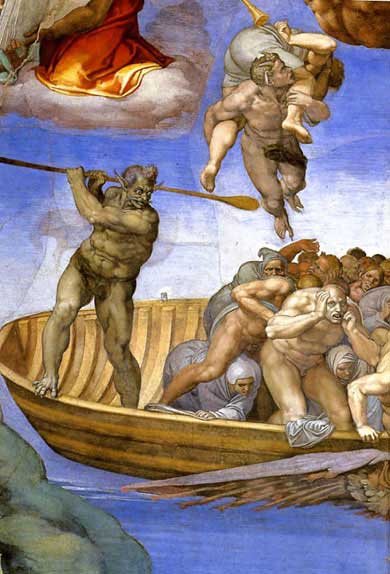
On the ceiling of the Sistine Chapel, Michelangelo depicts Charon, the chaperone of the dead, as a terrifying monster. Charon has clawed talons for feet and grotesquely bulging eyes. He hoists his oar over his shoulder, ready to transport the unfortunate souls.
From the time of the Bubonic Plague in Europe, death was often depicted as a morbid skeleton. In The Triumph of Death, a great oil panel painting by Dutch master Pieter Bruegel the Elder, Death is an enormous skeleton upon an emaciated red horse, slaying all in sight. He brings with him an entire army of macabre skeleton figures, all of them razing the mortals from the earth.
Today, we know this figure as the Grim Reaper, who reached his full form in the short stories of Edgar Allan Poe. You can thank that 19th Century American novelist for the popular image of death today: the skeleton in a cloak holding an hourglass and scythe.
With such frightening depictions of death, how could Moses not fear?
Moses was lucky. He did not inherit the Western artistic tradition. The ancient Israelite attitude was remarkably different. The Jewish view of death was one far more tender.
At the end of Moses’s life, we read: “Moses the servant of the Eternal One died in the land of Moab, by the mouth of God. God buried him there in the valley, and nobody knows Moses’s grave to this day.”
In the Jewish imagination, it is God who comes personally, and takes care of the treasured people. In our Torah’s description of Moses’s burial, it sounds almost like a parent tucking in a child to sleep. The sand covers Moses’s body like a blanket, and he can finally rest.

Our rabbis noticed an interesting choice of words from the Torah. Here, it says that Moses died by the mouth of God.
This language is also applied to the deaths of Aaron and Miriam. They, too, die by the mouth of God.
Literally, this might mean that Moses and his siblings died at God’s command.
In the Talmud, the rabbis say instead that this means they died by a kiss.
There are many ways that we might imagine this. We might picture a personal God pressing lips against our prophets to remove their last breath.
I like to picture a parent, gently kissing our legendary figures on the forehead. When Moses dies, God wraps him up in the blankets of the desert sand, embraces him, and pecks him on the forehead, to send him off into his eternal sleep.
Moses, the last of his siblings to die, would also have seen Miriam’s and Aaron’s deaths. He would know that death was not a fearsome monster, but the gentle caress of sleep at the end of a long day.
Indeed, the Roman Jewish historian, Flavius Josephus, when he tried to explain the Jewish attitude to life to a Western audience, asked: “why should we fear death, when we embrace the repose of sleep?”
Of course, to we who are still living, death does not always feel so gentle. It can be painful and fear-inducing to witness the ones we love waste away, or be suddenly snatched from our world.
Our Torah is aware of this. Sometimes, death is indeed depicted as a menacing spirit, as when the Angel of Death slays the first-born during the Exodus. Sometimes, death is indeed an all-consuming monster, as when the ground opens up on the supporters of Korach, to wrench them down to the netherworld of Sheol.
To us, who have to see death while we live, it can indeed feel frightening, and we should not shy away from that terror.
But, perhaps, for those who die, it does not feel so horrifying.
Sebastian Junger is a conflict journalist from New York. In 2020, he suddenly had a near-death experience. While awaiting surgery and bleeding out on an operating table, Junger suddenly had a vision of his father, hovering above him.
Junger said his father appeared as a comforting mass of energy. In that moment, he thought he understood that there was a life beyond this one.
A devout atheist and rationalist, he went on a journey to discover how this vision was possible. He turned his voyage of enquiry into a book, published last year, called In My Time of Dying.
Tracking shamans and religious leaders from across the globe, he discovered how common his experience of approaching death was.
This led him to wonder what his own father, a Jewish physicist, would have made of his experience. There is a poignant moment, towards the end of the text, where Junger sits down with his father’s physicist friends, and asks them for an explanation.
One of the scientists tells Junger that he thinks his father would indeed have believed it, because he was romantic like that. He explains that our understanding of physics is constantly evolving, and we know so little about it. He posits, even, that one day the presence of a reality beyond death might be the foundation of physics, or indeed its absence might be.
Of course, Junger does not rule out the possibility that this is simply the brain’s way of protecting us, and our body’s way of making the inevitable feel less frightening. Yet, even though he is a firm rationalist, he cannot rule out the possibility that his father really was with him in his moments of near-death. He concludes feeling a deeper connection, both to the living and the dead.
None of us know what happens when we die. Nobody can see beyond the grave. Nobody has ever come back to tell us what exists in the world beyond.
The Western imagination has conditioned us to find this uncertainty terrifying.
But what if Moses is right? What if neither this world nor the next have anything to be feared?
Maybe death does just arrive as a loving parent, tucking you into an eternal rest.
Would it change the way you lived today, if you believed, as our Torah says, that death comes as a kiss?

 Sim Lev