festivals · sermon

How seriously should Progressive Jews take Purim?


On Monday evening, we will do something in this synagogue that would have horrified earlier generations of Liberal Jews.

It’s not that we’ll be drinking alcohol in the sanctuary. They did that at Simchat Torah.

It’s not that we’ll be getting dressed up. After all, why not?

It’s not that we will be hosting a Burlesque act. The founders of our movement were great patrons of the arts, and hearing that this was an expression of feminism would make the show even more appealing.

No. What we will be doing is a far greater sin in the eyes of our Liberal forebearers. We will be celebrating Purim.

For true Liberals, Purim is the most-maligned festival.

One year, while at Leo Baeck College, I dressed up as Lily Montagu and chastised all my classmates for reading the Megillah.

My grandfather, Rabbi John Rayner, was opposed to Purim altogether. He called it “unhistorical, irreligious and unethical.”

So I can only imagine how disappointed he would have been, as I put on my heels and stuffed a packet of cigarettes into my push-up bra, to think I was celebrating such an illiberal occasion.

In 1960, my grandfather was invited to give a lecture about Purim at a Reform synagogue, called Alyth, in Hampstead Garden Suburb. He told them that, while he wasn’t too bothered about it, he would let the facts speak for themselves.

The story of Purim never happened, he began. The entire tale is a fantasy built on other such plays from antiquity.

In fact, it couldn’t possibly have happened. No empire has ever been as expensive as the one attributed to Ahasveros. No royal feast has ever lasted six months uninterrupted. Esther was supposed to have spent an entire year on beauty treatments, Haman was supposed to have been bribed with millions of pounds, and his eventual gallows are supposed to have been 83 feet tall. The whole thing is ludicrous.

On this point, every reader of history agrees. But why should that stop us celebrating a festival? After all, we can’t prove that the Ten Plagues ever happened, but we’re not about to give up Pesach any time soon. What matters is the moral message the narrative conveys.

On that point, I’m afraid, granddad has already anticipated me. The point of religious services is ethical instruction, but there is no positive message in Purim.

God is completely absent from the Megillah. While many generations later, rabbis made great interpretations about God’s presence through absence, there is very little trace of divinity in the text.

Everything in the story is about chance. There is no room for human agency, moral conduct, or God’s deliverance. A movement dedicated to service of the sacred has no business entertaining something so atheist.

The entire premise of the story is based on ethnic prejudice. Mordecai refuses to bow down to Haman, the standard greeting in Persia, because Haman is an Amalekite, and the Jews have a centuries-old grudge against his entire people. My grandfather writes, quite rightly, that this chauvanistic loyalty to race has no relation to religion.

And that doesn’t even get into how gruesome the entire story is. The climax is an outrageous bloodbath, wherein Jews go from town to town slaughtering Amalekites by their thousands and tens of thousands. The murdered line the streets and Haman’s ten sons have their heads impaled on pikes and paraded.

It is the most gratuitously violent festival imaginable. It smacks says, my grandfather, of secular nationalism, which everyone knows is the primary enemy of Judaism, and should be given no encouragement.

What lesson are we meant to take from this? The moral, if you can call it that, is that you must commit genocide against others before they get the chance to do it to you.

This is a horrendous position, and I am certain no Progressive Jew would ever endorse it.

For this reason, despite my best efforts, some members of this synagogue continue to boycott Purim altogether. They are “Classical Liberals”: Progressive Jews who hold on to our original mission, that Judaism should be rational, ethical, and God-focused.

In fact, in recent times, even Orthodox Jews like Peter Beinart have come to agree with all these criticisms of Purim.

This sermon is not really an effort to convince the Classical Liberals that they should don their frocks and come for the Cabaret. Honestly, if I did succeed in changing their minds, I’d be a little disappointed to see the diehards give in. But I do want to make the case for why I do celebrate Purim, and why other members should feel free to get out their gladrags and their graggers.

Like the diehards, I also uphold a version of classical liberalism. I agree that Judaism should be God-focused, and I sometimes worry about the secular drift of our synagogues towards becoming cultural centres. Like them, I feel that Judaism only makes sense as an ethical system, and its goal should be to turn us all into better human beings.

But where we disagree, I think, is on what makes a religion rational. Just because our worship should be rational doesn’t mean it needs to be serious. As Oscar Wilde assured us, we must treat all the serious things of life with sincere and studied triviality.

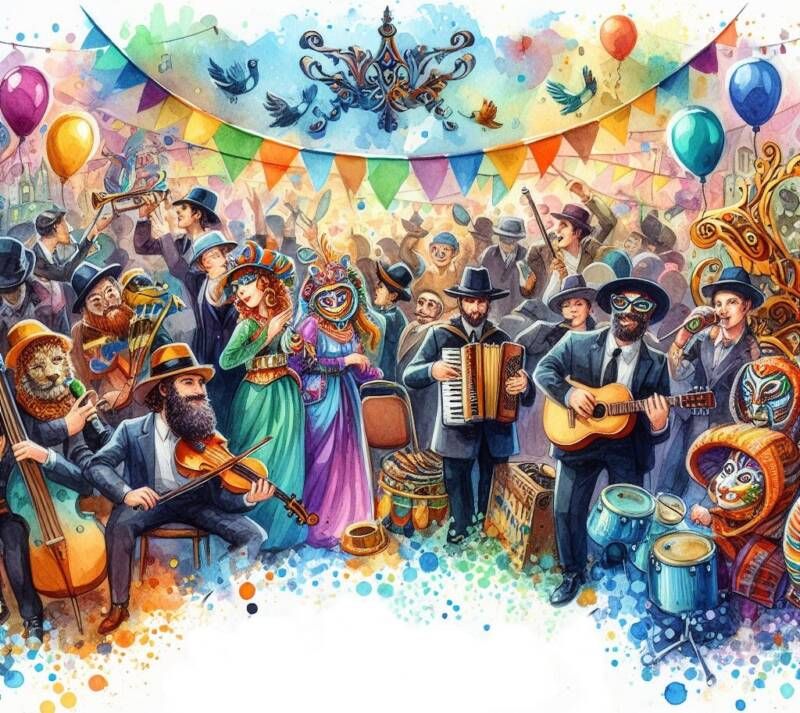
The point of Purim is it’s a joke. The Megillah, the story, the festival, its mitzvot, and its observances, are supposed to be funny.

The story is an old rehash, and we know that because it has all the same characters as the Commedia dellArte from medieval Italy, whose tradition goes back to the court jesters of the ancient empires.

And, no, the empire was not that big. The oversized empire with its outlandish feasts is supposed to be ridiculous.

The characters, the story, and the props are all supposed to be impossibly big. Like a pantomime, with its villains, heroes and dames, its magic comes precisely from how unbelievable it is.

And, yes, it is horribly racist. The whole thing promotes Jewish violence and prejudicial fear. But we have to think about it in its context. This play was written for a time when Jews lived under persecution. It is a revenge fantasy against their oppressors, not a real-world instruction manual for the modern age.

That’s how we ought to understand the gory violence at the end. We should imagine it in the same way as the climax to Tarantino’s movie Inglorious Basterds, when the heroine burns all the Nazis alive, or like in Taika Waititi’s Jojo Rabbit, when the little boy kicks Hitler out the window. The bloodshed is catharsis for a beleaguered people.

And that is Purim’s real moral lesson for us. It’s about how to survive when you feel most downtrodden. Purim is an answer to a question: what do you do when you are persecuted, exiled, and you feel like God has abandoned you?

It answers us: try laughing.

Try to find the funny side.

Find a way to ridicule it all and remember that this whole life is one big joke.

The trouble only comes when you take Purim seriously. If you imagine this festival is supposed to be morally instructive. If that were the case, any rational person would scrap the festival altogether.

But, put in its proper context, this festival can give us the relief we really need.

We’re coming to the end of a long grey winter, in which many of us have felt weighted down and miserable. We’re living through unpredictable times. I can’t tell you how much I long for a news day that was precedented.

We need a bit of ridiculousness, a bit of raucousness, and a chance to do something stupid.

My grandfather actually left us with a little permission in his lecture notes. He said, if you must celebrate Purim, just do as Americans do, expunge the ugly bits, and turn it out into a carnival.

In other words, if you’re going to do it, don’t take it too seriously.

Wise words indeed.

Shabbat shalom.
festivals · sermon

Do not leave any part of yourself in Egypt


Several years ago, at a seder, I was introduced to a new custom.

When it came time to sing Dayyenu, a Persian-Jewish friend passed us all a spring onion each.

“In my family,” she said, “we hit each other over the heads with spring onions while we are singing this song.”

“It’s supposed to get out of our heads any feeling that we might want to remain in Egypt. So we remind each other by hitting our heads that we do not want to go back there.”

I instantly fell in love with it, and have adopted it into my own family seders. In fact, in my home, it can turn into a bit of a food fight, as we chuck the spring onions around the room.

One year, a Muslim friend came, and was quite baffled by the proceedings. I put quite a unique twist on my seders, and try to make them fun. That year, I had people dress up as the Ten Plagues from bits of fabric around the house, and do a lip-synching competition to the Prince of Egypt soundtrack. As he left, he said: “I can believe all of it is normal Judaism, apart from that bit with the spring onions.” I said: “That’s the only bit that was a real tradition!”

Maybe you might not bash your dinner guests with greenery, but you do sing Dayyenu, don’t you? It’s such a highlight.

I worry that some of our families’ seders don’t get there. The food’s coming out of the oven, everything has already gone on far too long, you’re anxious to eat, maybe you skip this important bit. I hope you don’t.

How about afterwards, when you’ve finished eating: who does the whole thing? Who carries on and sings hallel afterwards, and does the benching, and drinks the next two glasses of wine?

I hope you do. In fact, if this sermon has a message, it’s this: do the whole seder.

As you will see, this is not just me being a stickler for making sure people treat liturgy seriously, or insisting on the importance of halachah. This is about how we live our lives.

Our story begins with slavery and ends with freedom.

So, when you come to have your Pesach meals, make sure you don’t just tell the story of slavery. Make sure you talk a good deal about the freedom that comes afterwards.

The haggadah is actually split into two parts. In the first half, we are supposed to see ourselves as slaves in Egypt, weighed down by the yoke of bondage. Then, we eat. After dinner, we are free. We cross the Sea of Reeds and sing praises to our God. We raise a glass of wine to our redemption. We raise another glass to our future. We keep back a fifth glass for Elijah, who will come and bring about the final redemption, when everyone everywhere will finally know freedom.

Now, which of those two halves of the meal is more important?

Of course, it’s the second one. We don’t get together with our families and communities to dwell on how miserable it was to be stuck in Egypt. We get together to rejoice that we are free. How wonderful is this festival, the season of our liberation, that reminds us of that miraculous exodus out of oppression.

We sing Dayyenu (and bash each other with spring onions) immediately before we eat. That moment comes on the cusp between staying in slavery and leaving for liberty.

Dayyenu comes at the point where we are leaving slavery for freedom. By bashing each other’s heads with the spring onions, we say: “don’t leave any part of your head there! Don’t go back there, not even in your mind! Don’t dwell on those narrow places that kept you oppressed!”

Come on, we’re about to be free. We’re about to eat. Let’s look now to the future, where we will never have to think about those things again.

There’s a good reason why we might use spring onions in particular for the hitting. When the Israelites do get free, and start wandering in the desert, they start moaning about how much they miss slavery. They whinge about how much better being oppressed was. And what do they say they missed eating? The onions.

Those Israelites understood something. Being oppressed can feel easier than getting free. Sure, Egypt might have involved great persecution, but you always knew where you stood. Getting free, or at least trying, is tough. It’s unpredictable. It combines dizzying excitement with a terror of the unknown.

So we have to remind ourselves, over and over again, that however difficult freedom feels, it is better than oppression. However easy it might be to wallow in misery or stay in a victim mentality, there is so much more to be gained from shaking off our chains.

The first part of the seder says: we were slaves in Egypt. The second reminds us: but God helped us get free.

In the 19th Century, the Progressive Jew Israel Abrahams wrote about exactly this optimism for the Jewish Chronicle. He began his article by saying how wonderful it was that even persecuted medieval Jews insisted on keeping their doors open for Elijah on seder night, adamant that God would protect them. He said: “truly there is no danger to Judaism while such eternal hope prevails over despair.”

Israel Abrahams goes on to talk about the messianic hope that Jews hold at Pesach. Look at the bigger picture of history, he says, and you can see that it is not a delusion. “Persecutions come and go, but the Jews go on.” Away with all pessimism,” he says, “away with all pessimism.”

Can you believe that such words appeared in the Jewish Chronicle? How much can change in just over a century! Today, there is no way our communal organs would say how great it is that Jews would keep their doors open. They’d tell us to keep them locked. They’d sell us a more advanced security system. They’d put in a fundraising pitch for CST while they were at it.

Can you imagine any of our great and noble communal representatives sharing a positive view of Jewish history and an even more positive view of our future? No, their message is always the same: we are terrified; we have always been persecuted; we always will be persecuted. All we can do is build up bigger defences, hire tougher security guards, buy more effective security cameras; and keep our bags packed to run away just in case.

Sometimes I think Anglo-Jewry is stuck in the first half of the seder. It is as if many of us believe that we ourselves were slaves in Egypt, but nobody can believe that we were redeemed.

Do any of us really believe we are worse off than Jews were in the time of Israel Abrahams? Do we have more reason to cower than did medieval Jews? And, if we did, is cowering behind even greater security really our best answer?

The point of the seder isn’t that we were slaves. It’s that we got free.

Think of the wonderful things Jews are doing, and that British Jews have done. We are stars of stage and screen, fully represented at every level of politics, working in every strata of society, innovating, building, and living happy lives among our neighbours.

Sure, you can talk about the bad bits. Whenever I talk about the good, someone is eager to remind me of some proof of how much they all hate us. Some people leap to lecture on antisemitism and misery at even the suggestion that things might sometimes be good. That is a mentality that keeps your head in Egypt.

It’s not that everything is miserable and it’s not that everything is fine. It’s always a bit of both, no matter who you are.

The point is that everything could be wonderful. We could build a future so much better than this one.

Many times, with God’s help, we have achieved wonderful things.

When you take up the third cup at your seders, remember all the incredible things you and your ancestors have achieved.

When you take up the final cup, look towards the great utopia you can build here on earth.

And when you leave your Pesach seders this year, don’t carry around with you the slavery and misery of the first part of the meal. Bring out into the world Judaism’s message of hope.

Keep your eyes always on the best of what may be to come.

Beat out of your head any desire to wallow in misery.

Do not leave any part of yourself in Egypt.

Shabbat shalom.

judaism · sermon

What do Jews look like?

A woman on a train walked up to a man across the table. “Excuse me,” she said, “but are you Jewish?”

“No,” replied the man.

A few minutes later the woman returned. “Excuse me,” she said again, “are you sure you’re not Jewish?”

“I’m sure,” said the man.

But the woman was not convinced, and a few minutes later she approached him a third time. “Are you absolutely sure you’re not Jewish?” she asked.

“All right, all right,” the man said. “You win. I’m Jewish.”

“That’s funny,” said the woman.” You don’t look Jewish.”

This classic Jewish joke actually highlights a good question: what do Jews look like? I am often told either that I do look like one, or that I don’t, and when I ask what it is… nobody ever wants to tell me! Whatever the reason, people have in their minds a picture of a Jew.

As it turns out, this isn’t altogether a new thing. Indeed, this week, we read about the clothes for Aaron and his descendants of the priestly caste. They have a strict identifying uniform.

Linen headdress, sash and and robes. A metal encrusted breastplate. Ephod, urim, tumim, incense. Aaron looks holy. Aaron looks like he stands out. Aaron looks… Aaron looks a lot like the Tabernacle he serves.

Aaron is to dress in the same white linen that we are told covers the Holy of Holies. He is to wrap himself in yarns of crimson and turquoise, just like the sashes that decorate the sanctuary. He is framed in gold like the Tabernacle’s curtain rails. He must wear a breastplate encrusted with stones representing the twelve tribes, just as the stones were ritually placed at the major resting points of the Israelites. 

Aaron is the Tabernacle in miniature. He is a microcosmic representative of the function he serves. The clothes he wears even assist in atoning for the Israelites’ sins, just as a sacrificial altar would.

Aaron dresses like what he does. He says: I am going to do holy things, and I require holy garb to do it in.

What a contrast with the Megillah we read just yesterday. In the book of Esther, there is an initial threat to the Jews. Haman, their wicked adversary, stomps through the city and plots Jewish mass murder. But Esther, our triumphant hero, foils the plot and overturns the decision. Now, instead, her uncle Mordechai will stomp through the streets of Shushan.

The Book of Esther draws our attention especially to what Mordechai was wearing on his horseback gallivant. “Mordecai left the king’s presence in royal robes of blue and white, with a magnificent crown of gold and a mantle of fine linen and purple wool.”

What does Mordechai look like? He looks just like a Persian palace. He has the crown and clothes of a king. He has the horse of his vizier. He looks like the empire. He looks like his enemy.

Having adopted the outfit of the oppressor, Mordechai soon acts like one. Under his instruction, the Jews go off on their own rampage, killing Haman, his sons, and 75,500 of their supporters. What Haman had planned for Mordechai, Mordechai did to Haman.

In Reform Judaism, we often gloss over this awkward ending, but it is very important. Victims given power can become no different to their persecutors. Here, the Megillah wants to slap us in the face with that fact. Look, it says, Mordechai looks just like everything he set out to oppose!

There must be a lesson in this for us. If we can look holy and we can look like oppressors, we have to think carefully about how we appear. 

Perhaps, then, I am right in my decision to always wear a collared shirt and suit jacket when I come to preach on Shabbat. After all, these clothes show that I’m serious and taking the services seriously. 

Ah, but the trouble is, arms dealers, politicians and tobacco lobbyists also wear suits. Aren’t I just dressing up like them, mimicking the clothing of 21st Century professionals, and subconsciously siding with them?

Perhaps, then, I need to switch to jeans and a t shirt? Oh, those haven’t been subversive since Tony Blair got out a guitar and rebranded the country as “Cool Britannia.” Mark Zuckerberg goes to work in jeans and a t-shirt, I’d hardly be making a different point.

Maybe I should copy our friends in Gateshead. After all, if I wear a black hat, long coat and beard, nobody will doubt that I’m Jewish. The people who stumbled to tell me why I looked Jewish before will now have a very clear answer.

Only the trouble is Haredim just dress like Eastern Europeans did 300 years ago. Theirs might fit someone else’s stereotypes better, but there’s nothing more authentic about it. Besides, I’m not convinced I’d look any less oppressive to a great number of Progressive Jews.

So how do we stop ourselves looking like our oppressors? In honesty, I think a Jew only looks like our enemy when we are determining what Jews should look like. When we stereotype, we repeat prejudices. When we gatekeep people for their clothes, we play into classism and prejudice. When we set out an image of a Jew, we exclude and hurt others. Deciding who looks Jewish is the least Jewish thing we can do.

So, what does a Jew look like? Open arms. An open heart. A broad smile. Curious eyes. A face that says, welcome, you are welcome here. A Jew looks like someone who knows that Jews look like everyone. 

Shabbat shalom.