israel · theology · torah

I believe that God is screaming.

A few weeks back, I attended a retreat with Christian colleagues. At some point, surprisingly enough, we got onto talking about God. I asked one of the priests a question: “do you believe God speaks to you?”

He looked slightly bewildered by the question. “Literally?” he asked. “No, not really.” He shook his head.

The answer seemed obvious. After all, we were liberals, at an interfaith event. That kind of talk is for fundamentalists. We’re all too rational for that. 

“Why?” he asked, turning back to me, “do you?”

“No,” I said, sheepishly. I don’t know why I felt so embarrassed. Of course, many believers see the voice of God mostly as a metaphor, or as a way of giving expression to moral intuition. I’m just not one of them. 

I do believe in a personal God, who has a loving relationship with every human being on earth. And I do talk to God. It’s not that I expect answers in any sense, but I do believe some One is listening: that prayers are more than idle words I recite to myself.

Perhaps my Christian colleague would have agreed with me if I’d put it in these terms, because finding vocabulary to talk about God is hard. Words like ‘literally’ and ‘metaphorically’ start to evaporate when you are dealing with faith.

I think, perhaps, the reason I gave a sheepish no – maybe even that I asked the question at all – was that I was having a mini-crisis of faith of my own. Ever since the war broke out, I have been praying differently, more fervently, desperately begging the Universe for peace. I have been hurling questions and recriminations into the void. I have been wondering… do I still believe in this God?

My personal relationship with God has carried me through some of the toughest times. When I have felt most lonely, God has been like a best friend. When I have hated myself, God has been like a lover. When I have needed direction, God has been a wise counsellor. I have looked to God in every time of disaster, and always found comfort in a loving Presence that reaches out and caresses from across a boundary of unknowability.

But now I listen for God’s voice. And all I can hear is screaming. 

As long as there have been people who believed in religious meaning, there have been those who questioned it. Usually, they were the same people. Abraham, Moses, Hannah, Kohelet, Job: they all had faith, and they all questioned it. They asked questions so that they could challenge their beliefs, and refine them. Lately, although less adequately than those prophets, I have been forced to do the same thing.

The first question we usually ask when confronted with crises of faith is “do I believe in God?” Fairly regularly, people come to me with conclusions one way or the other: “you should know, rabbi, I don’t believe…” or “you should know, I have a strong sense of belief…” My follow-up is always the same “… and what is it that you do (or don’t) believe in?”

For me, the answer is moral truth. When I talk about believing in God, what I am saying is that moral statements are not just opinions. When we say “murder is wrong” we are not just expressing a preference, like “my favourite flavour of ice cream is tutti-frutti.” We are describing a reality, no different to the claim that there are 24 hours in a day. We are describing something literally true.

I think that’s what God is. When we want to know why our feet are firmly on the ground, we give the shorthand answer of “gravity.” When we want to explain why objects in space interact with each other as they do, we use words like “attraction.” And when we want to express how we know that murder is wrong, we use the word “God.”

So, in feeling the great sense of angst I have had since the war began at the end of the High Holy Days, I am forced to return to the old questions. I am forced to ask whether I still think moral statements are true. I am forced to ask whether I still believe murder is wrong.

I do.

And that is why I believe that God is screaming.

What we talk about when we describe God is obviously more complicated: it is something infinite, and greater than we can put into words. That’s why words like “metaphor” and “literal” are so inadequate – because we are describing something more real than reality. So we have to find shortcuts. We have to find ways of talking about God in human language, to make sense of God on human terms. God is then “a tender parent”; “a loving shepherd”; “a righteous judge”; “a generous creator.” All of these are good descriptors, and all of them are incomplete.

I have been relying on a version of God that has worked for me for a while. I have imagined a sweet aunty or a gentle older friend. In times of loneliness, desperation and heartache, that image of a loving God has helped me get through the day. But that image doesn’t serve me now. I think if I used God for comfort in a time like this, I would be retreating from responsibility. God does not need me to feel safe now, but to shake me from illusions and complacency.

If God is the moral voice of the universe, that voice must be crying out in desperation.

In the last few months, 23,000 Palestinians in Gaza have been killed by Israeli bombs. I am kept awake at night thinking about that. I imagine God, smothered by the rubble of obliterated hospitals, calling out. Like Abel, stricken by Cain, the voice of the blood is calling out from the ground (Gen 4:10). I imagine God, pulled from the wreckage, crying: “Thou shalt not kill. (Ex 20:13) Thou shalt not kill. (Deut 5:17)”

Those were the commandments given to the Jews, above all others. In some variations, it is the very first commandment, the one that holds the most power. And as Israel stands in the dock at the Hague, it is not only South Africa that places it on trial, but God too, who comes with the accusation: “did I not tell you: thou shalt not kill.”

Since the war began, Israeli settlers, with governmental support, have seized around 20 villages in the West Bank, displacing thousands of people, so that Jewish Israelis can expand their territory and claim others’ homes. I imagine God calling out from deserted towns, on the trail with refugee families, wailing “thou shalt not steal” (Ex 20:15), “thou shalt not steal” (Deut 5:19).

Netanyahu says, unabashedly, that he will push the Palestinians from Gaza and create a new border with Egypt. The Torah answers, in desperation: “thou shalt not move thy neighbour’s boundary” (Deut 19:14). Land theft is a sin.

Israeli soldiers enter Gaza and use Jewish symbols as weapons. They recite the Shema from the pulpits of mosques and place mezuzahs on Palestinian homes. They desecrate our religion. They destroy our faith. From the depths of history, God cries out “honour thy mother and thy father (Ex 20:12); honour thy mother and thy father (Deut 5:16).” Do not profane the faith of your ancestors with war crimes.

Worse still, the politicians claim that God gave them the right. That this is what the Torah intended. Can you not hear the scream of revulsion as God decries: “thou shalt not take My name in vain (Ex 20:7); thou shalt not take My name in vain (Deut 5:11).” This is what was intended: do not abuse God’s name for worthless pursuits like war, but elevate it for the purposes of peace. 

I believe that God is screaming. 

The commandments may once have been given as words of instruction or even as a love letter, but now they are a desperate plea. 

God says “I am the Eternal One thy God, which brought thee out of the land of Egypt, from the house of bondage. Thou shalt have none other gods before me.”

No other gods. No state, no flag, no military, no leader, no ideology, no grudge, no border, nothing. None of these can ever be placed before God. None of them have any trump over God’s words.

God’s word says: “You shall not pollute the land in which you live; for blood pollutes the land, and no expiation can be made for the land, for the blood that is shed in it.” (Num 35:33)

So I believe I can hear God screaming: thou shalt not kill.

And I do not want to silence that voice. I want to amplify it. I want the Holy Torah to be heard now, more than ever. I hear God screaming, and I want to join in.

Thou shalt not kill.

Thou shalt not kill.

Thou shalt not kill.

debate · israel

We are not going to agree about Israel.

It is a blessing in synagogue life when rabbis really get on with each other, and I am so lucky that Rabbi Jordan and I do. We drop in and out of each other’s offices, check in on how the other is doing, and always look for ways to support each other.

And we don’t agree about Israel.

We don’t agree, and we’re not going to. That’s OK. That’s good. It means we can have real conversations. It means when we need to make decisions or work out our thoughts, we can bounce ideas off each other as critical friends. 

Last week, after a discussion on Zionism, he did what he often does, and left an earmarked book on my desk. The book, edited by Rabbi Larry Englander, is called ‘The Fragile Dialogue.’ It includes various reflections on Israel. 

The chapter Jordan highlighted was by a self-proclaimed TwentySomething Congregant. In a heartfelt letter to her rabbi, she pleads not be excluded from her synagogue because of her views on Israel. She speaks on behalf of her generation, which opposes occupation and supports boycotts. She begs that she, and the rest of the Jews of her generation, will not be cut off from their own communities.

The letter highlights something many of us already know but struggle to articulate: the debates around Israel and Zionism are largely generational. 

These differences were visibly lived out last week at a funeral. The great Israeli singer and poet, Yehonatan Geffen, died. He had been a cultural icon, associated with the songs of Israeli childhood. 

In three generations of his family, you can see the wildly different approaches to Israel. 

Yehonatan Geffen’s uncle was Moshe Dayan, a fierce Israeli military chief famed for his eyepatch and hard right attitudes. He had been a combatant in Haganah, the guerilla army that founded Israel, led the IDF, and gone on to become a politician. 

As far as he was concerned, the Holocaust left only one imperative: to conquer and settle the land and become so strong that Jews could never be hurt again. He pledged to blot out Palestine, and respond to hate with greater hate. He was a true hawk.

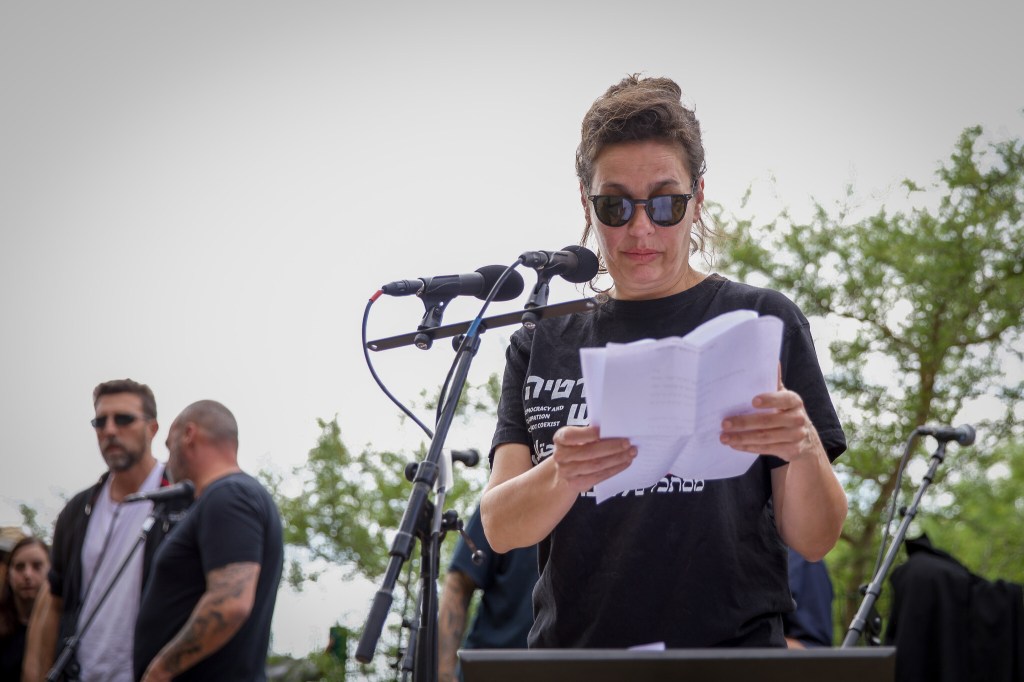
Fast forward to the funeral of his nephew. The mourners arrived wearing shirts that carried the slogan: אין דמוקרטיה עם כבוש – there is no democracy with occupation.

Yehonatan’s daughter, Shira Geffen, wore this slogan as she gave the hesped. 

This slogan argues that Israelis cannot protest Netanyahu’s anti-democratic measures while ignoring the millions of Palestinians denied basic democratic rights to vote, freely assemble, and even walk to their homes without facing checkpoints and guns. 

The t-shirts are produced by מסתכלים לכבוש בעיניים – an Israeli left organisation who insist on looking the occupation in the eye. They speak out about what they call “the power relations between the coloniser and the colonised,” urging the public to see how the occupation is destroying the dignity of Palestinians and the humanity of Israelis.

Sandwiched in the middle between these generations was the man they mourned, Yehonatan Geffen. He had been part of Israel’s cultural establishment, and a true icon. He was associated with what many Israelis saw as the best in their culture. One of his eulogisers was the centre-right politician Yair Lapid.

Geffen was also an outspoken peace campaigner. He wrote extensive criticisms of the army. In 2018, he wrote lyrics in praise of the Palestinian child protester, Ahed Tamimi, resulting in him being cancelled on Israeli military radio and censured by government officials. 

Within one family, within one century, you can see such a huge diversity of Jewish views.

They do not agree about Israel. They will not agree. But they prayed together. They came together to say kaddish and mourning prayers. They joined each other as a family.

Of course, these differences of opinion on Israel are not just generations-based. I know anti-occupation activists in their 80s and I know pro-settlement campaigners in their teens. Nevertheless, what we have seen of Israel in our formative years is decisive.

I belong to Shira’s generation, and one of my most formative memories of Israel was witnessing the inexcusable assault on Gaza in 2009: Operation Cast Lead.

During the commemorations of Yom HaAtzmaut last week, I could not hide my discomfort. I find prayers for a state tantamount to idolatry, and when I hear blessings for troops, I can only think of those priests who poured holy water onto bombs. I do not see how one can pray for peace while praising the instruments of war.

Yet I understand why, for many in this community, honouring Israeli independence and those who fought for it feels like an important undertaking. 

Some of you belong to the generation that came just after the Shoah. The memories of genocide and antisemitism still loom, and it is understandable that you should want to know there is some security against that. For you, defending Israel matters.

Others of you came up in the generation of Peace Now. You believed in Israel and its mission, and held onto its constitutional claims of what it would be: a safe haven for all its peoples. You hoped, even campaigned, for an Israel where Jewish culture could thrive while Palestinian minorities received justice and human rights. For you, holding on to that dream of what Israel could be matters.

My generation came after. I was born not long before the signing of the Oslo Accords, and came of age as they failed. During my 34 years on this planet, Netanyahu has been Israeli Prime Minister for nearly half of them. I have never known Israel as anything but the aggressor and the occupying power. 

Based on our ages and experiences, we will have different views. If we cannot have disagreements about Israel, we cannot have an intergenerational community.

We will not agree about Israel. And that’s fine. That’s good.

Rabbinic literature prizes disagreement. One of my heroes in the Talmud is Rabbi Eliezer. He stood solidly by his principles, no matter how unpopular they were. It’s not that I agree with Eliezer’s principles: he was a conservative surrounded by liberals and radicals. It’s the fact that he held fast to what he believed.

He was so strict in his adherence to religious law that the other rabbis eventually excommunicated him. They wouldn’t talk to him unless he recanted his views, and he never did. Only at the end of his life did his students and colleagues realise what an error they had made by cutting him out. 

They placed him in the Mishnah, the foundational Jewish text, as one of its most-cited rabbis. Even though they completely disagreed with him, you can find his opinions everywhere.

The Maharasha says the reason for this is for future generations. While one position may be minority at one time, it may become majority, and those who follow will need to know what they rest on. Even if they never agree with it, they need to see how the conclusions they support were reached.

This is why we welcome disagreements: for the sake of intergenerational conversation. 

For those growing up now, they are entering a polarised and febrile environment. 

Future generations will develop their own politics, and find their own relationships to Israel, Zionism, and the occupation. 

And I hope they can do so within the synagogue. 

I hope they will find an environment that embraces Zionists, non-Zionists and anti-Zionists. I hope they will find communities that do not impose red lines that keep them out.  I worry that the TwentySomething writing to her rabbi will be proven right, and synagogues will become platforms for single positions on Israel.

What then? Will we split into Zionist and anti-Zionist shuls? Will we keep splitting further, based on varying different policy proposals for what should happen in the Middle East? Those aren’t synagogues – those are political parties!

Such divisions have pulled apart Reform communities before. In the period prior to World War II, Zionists were forbidden from studying at Hebrew Union College, the Reform Rabbinical school in America. This meant that for nearly a century you could not be a Zionist and become a Reform rabbi. One early Reform Zionist, Maurice Perlzweig, said that professing his views in polite Jewish company was like admitting to being a member of the Flat Earth Society.

At the turn of the century, the Reform Movement completely reversed its position. The 1997 Miami Platform declared that Reform Judaism was unequivocally Zionist. It said that Jews were a people; that we should all move to Israel and build it up. Ensuing from that came a programme parallel to the early push to exclude Zionists from the Jewish community, but this time, flipped: to exclude critical voices from the Jewish community and maintain only a pro-Israel consensus.

Is this really what we want? Do we want to keep going back and forth drawing new lines depending on which position has the upper hand? Do we want to enforce conformity of political views in Reform congregations?

Surely what we stand for is bigger than that! Surely our Judaism, our God, our people is bigger than that! 

The joy of a synagogue is that it brings together so many different people. Where else are you going to find people of different backgrounds, classes, genders, abilities, beliefs, and ethnicities, all under one roof, bound together by something greater than themselves? Only the synagogue – greek for beit knesset  – the House of Gathering – can achieve that. 

We are not going to convince each other of our political opinions, and that’s fine. That’s good. If we have a space filled with diverse views, we have a community. If you have uniformity, you have an echo chamber.

We are Reform because we understand that the Jews of tomorrow will not look like the Jews of yesterday. The Judaism of tomorrow will not look like the Judaism of yesterday. Reform Judaism is an ongoing commitment to learn and struggle and grow, always adapting to new ideas and developments. That is what makes it Reform.

And what makes it Jewish is that we do it together. We hold on to belief in the same God, the same cause, the same traditions. We hold all the manifold opinions of the congregation in a single setting.

So, let us answer the question posed in Larry Englander’s book: will this TwentySomething be excluded from her synagogue? 

More pressingly, will she have a home in ours

The answer depends on how we act. If we draw red lines and kick people out based on their views; if we define our Judaism solely by its relationship to Israel; if we make public policies about the synagogue’s stance, then, no. She probably will not.

On the other hand, we can model an alternative Jewish future. A better Jewish future. A Jewish future where we don’t repeat the mistakes and have the same regrets as the framers of the Mishnah. A Jewish future based on plurality and discussion.  We can demonstrate through our relationships with each other and the synagogue that Judaism is diverse, creative and engaging across divisions. 

We can show that we do not have to agree. Even about Israel. 

Shabbat shalom.