debate · sermon · torah

Did the God of the Bible have a body?


After our wedding, everyone was excitedly sharing photos and videos. Laurence pored over them and made albums.

I liked them, but the pictures felt a bit flat. What I was craving was words.

I wanted to re-read everything everyone had said. I went about collecting the speeches people had given, and recounted them again. On honeymoon, Laurence and I re-read our vows to each other, this time pausing and discussing them.

I discovered anew how much more I loved words than pictures or videos. Pictures are static. Even videos, because they only caption one moment from one perspective, feel too final.

To me, words feel so much more alive. Stories are such a great way to engage with events and ideas, because they can be retold so many times and in different ways.

Isn’t this, after all, what religion is: storytelling to access something sublime and unfathomable; a collaboration by people sharing their best narratives and ideas?

We have inherited a literary tradition, our Torah, which is an exercise in storytelling:  a process of openly wondering at the world through poetic sagas and emotion-filled songs.

For some, however, these stories fall flat. They see the words the way that I see pictures.

Fundamentalists will look at our story of a donkey talking to a prophet about an angel and think: that must be the historical truth of what happened.

Similarly, the New Atheists look at this beautiful poetic piece about the prophet Balaam and think: how stupid must religious people be to believe this nonsense?

This is not just a misunderstanding of Scripture. It’s a misunderstanding of storytelling itself.

Seemingly, it does not occur to them that this might be an invitation into conversation. They can’t comprehend that this might be a poem, crying out to be read aloud, sung, chanted, interpreted, and retold to make sense of all the wonders of the world.

Perhaps these talking animals and sword-wielding celestial beings aren’t part of history textbooks but reveal a different kind of truth altogether.

In Britain, we are mercifully spared from most of these types of fundamentalist reading. We don’t have to deal with as many evangelical Christians as our American cousins do.

But we have our own local brand of biblical literalists. They are the radical atheists who have got to know our sacred texts solely for the purpose of showing how irrational they are. The most famous of them is Professor Francesca Stavrakopoulou, a biblical scholar at the University of Exeter.

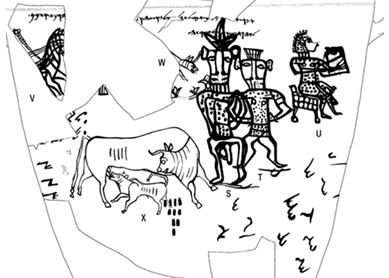
In 2021, Stavrakopoulou brought out her most recent work, God: An Anatomy. The book’s objective is to show that the God of the Bible was an embodied being. He was a gargantuan man with a big beard who sat on his throne in the Jerusalem Temple, gobbling up the sacrifices priests burned for Him.

The God of the Bible, Stavrakopoulou argues, was just like any other ancient god: basically a massive person with all the associated wants and desires. She collapses about 4,000 years of history and three continents into one culture and seeks to show that the biblical god was just like all the others.

And, like all the others, the biblical god had a body.

Sometimes, her evidence for this scant. There are entire pages dedicated to making quite wild claims about the biblical god, appended with just one footnote that points to an obscure translation of a verse from the Psalms.

But, overall, there is plenty of material to go off. If you open up any page of Tanach, you will probably find God described in anthropomorphic terms.

Take our haftarah.

This week’s reading comes from the book of Habakkuk, a 6th Century BCE Prophet in Judah. The book is a vivid war fantasy, where the prophet describes the Judahites crushing the invading armies, some time in the mythic past, and hopes that it will happen again.

Throughout the text, God comes alive as a warrior. He (and I’m going to use the masculine pronoun advisedly here) is an embodied fighter on behalf of the people.

God’s hand lights up with radiance; God’s feet trample over mountains; God’s piercing eyes make the nations trembled with fear. 

God has all the equipment of an ancient military commander. He rides in on a chariot  with His horses and shoots out arrows from His archer’s bow. God rips the spear from the opposing general’s arm and stabs it into his head.

How are we supposed to read this?

Well, for a biblical literalist, you have to take it at face value. That’s exactly what Stavrakopoulou does. She makes the case that this was precisely how the ancient biblical authors and audience understood their god.

Their god was a big bloke with some massive weapons and blood lust.

Stavrakopoulou draws on other ancient gods, whose worshippers also describe them in embodied terms. The Canaanite high god El also had radiant arms. The Akkadian god Enki also trampled over mountains. The Assyrian god Ashur also fought with a bow.

The Israelites, then, were just riffing on old themes. Like the Pagans around them, they were silly enough to believe in all that religious nonsense of big beings. The biblical god was no different to Zeus or Jupiter.

Overall, reading Stavrakopoulou, you get the impression of someone listening to a concerto who can identify every note from every instrument but cannot hear the music. Her entire objective is to show that the tune isn’t even that good because other songs have been written before.

All the way through, it seems like a strange motivation for going to all the effort of learning Scripture and Ancient Near Eastern texts. Then, we get to the final chapter, entitled “Autopsy,” and we understand her true objectives.

She concludes: “the God of the Bible looks nothing like the deity disected and dismissed by modern atheism. […] Their dead deity is a post-biblical hybrid being, a disembodied, science-free Artificial Intelligence, assembled over two thousand years from selected scraps of ancient Jewish mysticism, Greek philosophy, Christian doctrine, Protestant iconoclasm and European colonialism. In the contemporary age, this composite being has become a god who forgot to create dinosaurs and failed to account for evolution; a god who allows cancer to kill children but hates abortion…”

Stavrakopoulou despises religious belief. So, if she can demonstrate that the biblical god was just like the Egyptian pantheon, and that this embodied god could be killed, then she can also strip the modern god of His powers and kill Him too.

This is the worst of Enlightenment hubris. 19th-century anti-religionists imagined that all religion was just silly superstition, which would eventually be washed away by the cold science of reason.

Our movement, like all progressive religions, has consistently argued for an alternative approach. We see all of history as an evolving effort to understand the sacred mystery beyond our comprehension.

It almost certainly is true that, before Ezra led the exiles back from Babylonian captivity in the 4th Century BCE, most Israelites did worship a small pantheon of Canaanite deities. The Prophets from before this time regularly condemn them for it.

But, while they may have been idolaters, they were not idiots.

If you told one of them that you’d just seen the fertility goddess Asherah out for a stroll in the marketplace, or that the storm god Baal came to your house this morning for a cup of tea, they would think something was wrong with you.

Another scholar of ancient religion, Iraqi Assyriologist Zainab Bahrani, helps us make sense of the ancient worldview. For the Mesopotamians, images were not reproductions of originals like portraits and photographs are for us today.

Instead, they saw their icons as ways of writing existence into being. They were in an active process with their gods of creating reality.

In matters of religion, literal interpretations are dead-ends. Words like metaphor don’t do it justice. Symbols like clay deities stand in for whole cosmologies. They are ways that human beings have tried to understand something that, by definition, is beyond our comprehension.

Perhaps most importantly, Stavrakopoulou misses what a massive departure it was that ancient Israelites abandoned all images in favour of a predominantly literary culture.

In a society where you cannot depict God, but can only engage in description and storytelling, you have to be more imaginative when you try to make sense of infinity.

Poems, sagas, and speeches, like those from our Tanach, are never fixed in their meaning. They are openings that invite listeners to think with them, talk back to them, and struggle for deeper understandings.

When someone reads a text too literally, they strip it of its vitality. Atheists and fundamentalists, both literalists of different kinds, strip the soul from the search for divine truth.

Tell stories, make poems, create art, look for that great truth beyond our reach… and don’t take any of it too seriously.

sermon · torah

Love is at the heart of the Torah

Within the Torah, there are 5 books.

There are 54 parshiyot.

There are 5,888 verses.

There are 79,980 Hebrew words.

And there are 304,805 letters.

The counting of numbers, verses and spaces actually has a great importance in the Jewish tradition. The word in Hebrew for a scribe is the same as for one who counts (sofer). The Talmud says this is because the original sages spent their time counting the numbers and letters of scrolls.

Now, sometimes, the Talmud is making stuff up, or telling a joke that has been lost to the ages, but in this case, they are almost certainly right. 

Counting words, numbers and verses was a great way to ensure that the Torah was standardised, so there could be no differences between the authoritative versions of God’s Word.

Counting words helps us to work out important things about Torah. For example, the Talmud tells us, you can count from the beginning to the end and find the word that is slap bang in the middle of the scroll.

If you do it by letter, says the Babylonian Talmud, you get the word “belly” – gachon. Yes, right in the middle of our Torah is a big tummy, just like on a human being. It fits, doesn’t it? How much of Jewish culture is about food?

If you do it word by word, then the middle two words of the whole Torah are “darosh darash” – search and search; diligently enquire. The middle words of the Torah are all about asking and questioning. How fitting! We love asking, and searching for answers. Aren’t we always questioning, adding questions to our questions? (Well, are we?)

And, if you do it by verse, then you get to the central verse of the whole Torah, Leviticus 13:33. Here it is, the great lesson our Scripture has been trying to tell us: “then the man or woman must shave themselves, except for the affected area, and the priest is to keep them isolated for another seven days.”

I’ve got nothing. 

Now, the Babylonian Talmud has given us some good answers about the middle of the Torah. But none of them are quite what we’re looking for.

Because if you hold the Torah in your hands, if you physically roll the Torah looking for a midpoint, you’d think it would be here, in this week’s parasha. 

Spatially, the centre of the Torah is here, at the start of Kedoshim. Here, at the beginning of Leviticus 19, God tells the Israelites: “you shall be a holy people, for I, God, am holy.”

And if you follow this bit of Torah down to its centre, right to the middle here, you get the central commandment of the Holiness Code: “love your neighbour as yourself.”

That, says the Palestinian Talmud, is the real heart of the Torah. Never mind all the numbers and counting. If what you are looking for is what the Torah is all about, follow your heart, and get to its intuitive core.

There, in the Yerushalmi, Rabbi Akiva says: “the greatest principle of the Torah is to love your neighbour as yourself.” He says, if someone is going astray, this is the only thing you have to remind them of to get them back on track. 

You may have heard this before. In the Christian Gospel of Mark, Jesus says that the greatest principle of Torah is to love your neighbour as yourself. He might have got more famous than Rabbi Akiva, but he certainly wasn’t the saying’s originator. That’s just a nice Jewish boy, repeating a good rabbinic tradition. 

In fact, anyone who spends more than a minute with our religious tradition will understand that to be so. Love is at the heart of the Torah. That is all any of it is about. 

Yes, the belly matters, of course it does. But it’s not just because we need food to keep ourselves sustained. It’s not even because food is a way of transmitting culture. It’s because through feeding and being fed we can show how much we love each other. These kiddishes, these Friday night dinners, the old recipes handed down, the food bank drives, the seder meals, the cakes we bake… they are all simply different ways of demonstrating love.

And yes, the searching and inquiring matters too. But it’s not just because we’re a learned and inquisitive people. It’s not just because we put such high value on education and on our Scriptures. It’s because it is a beautiful way of showing each other how much we love each other. You sit with a child to tell them a Bible story. You sit with a friend to study some text together. You sit with an elder to ask them for their wisdom. Sure, on some level, you’re just trying to get information. But, at core, these are ways of showing love.

Hold that in mind, then, as we return to the central verse of Torah, in the purity laws given to priests: “they must shave themselves, except for the infected area…”

No, sorry, I’ve still got nothing.

A few weeks ago, I sat down here with the Council to talk about what it would look like to come here as a rabbi, and whether we might be a match. One of your leaders asked: “what do you think are the core functions of the synagogue?” I gave my honest answer: “The synagogue only really serves one purpose, and that is to get people to love each other more.”

We come together, in these Jewish communities, to show that we love others as we love ourselves. We will eat together and learn together and pray together because we love each other. 

We will love each other enough to be with each other in our most trying moments of death, disease and disaster. We will love each other enough to celebrate together through our joys of life, and build each other up.

This synagogue already has a wonderful reputation. Rene, your outgoing rabbi, has told me how much he loves you. Charley, your former rabbi, and now movement head, has shared the same. Danny, your rabbi emeritus, has told me how lucky I am to be coming here. 

I meet adults who grew up here, friends of Laurence, and they share what a warm and wonderful place this is. In just the few meetings I have had with members, I can already see why.

The love that people speak of you all with is because of the love that you put out and create in your community.

I cannot wait to start here, and to love you as much as everyone else does.

וְאָהַבְתָּ לְרֵעֲךָ כָּמוֹךָ

May you love your neighbour as you love yourself.

Shabbat shalom.

sermon · theology

Numbers don’t matter

In the last decade, the number of Jews in Redbridge decreased by 37%. Meanwhile, the number of Jews in Epping Forest increased by 18%, and in Havering they increased by 16%.

These are our numbers. And they don’t matter.

According to the last census, the East of England has now overtaken Yorkshire as having one of the largest Jewish populations, with over 42,000 individual Jews living in this area.

These are our numbers. And they don’t matter.

In 2022, SWESRS gained 43 new household members. In the first quarter of 2023, we continued the same trajectory, gaining 15 new household members.

These are our numbers. And they don’t matter.

None of these numbers matter.

But. There is one person sitting in the synagogue this morning, praying. That number matters. There is one person watching on Zoom, feeling connected to the community despite not being able to attend. That number matters. One of us is in hospital; another just had a baby; another is sitting shiva; another is preparing for a wedding. Yes, those numbers matter. Those ones. Those ones are the only numbers that really matter.

In general, our Scripture takes a pretty dim view of counting activities. In the Book of Samuel, when King David takes a census of the Israelites, he instantly feels guilty and repents before God. God is furious that David has done this, and sends instant punishment. A plague falls on the kingdom lasting three days and wipes out 70,000 people. 

At the time of the census, there had been 130,000 possible warriors. Now their numbers are significantly reduced. 

But why? What’s so bad about counting Jews?

Abravanel says it was a proud and haughty thing to do. David was impetuous, believing that he could control his fate by counting his people. God is saying: you like numbers? Tough. Have fewer. You think your strength comes from how many of you there are? Wrong. Have fewer.

Maybe. But that doesn’t explain the attitude to censuses elsewhere in Scripture.

In our Torah portion this week, Moses takes a census of the Israelites. Moses counted up every man of fighting age who might be able to bear arms. They counted them up by tribe: 46,500 for Reuben; 59,300 for Simeon; 45,650 for Gad… and on it went, until the census reached its total. There were 603,550 Israelites in the desert, ready to fight.

And, as it turned out, those numbers didn’t matter. They listed them all, got them into procession, and then… nothing happened. There was no war to be had. They never entered into combat. 

Instead, the entire narrative instantly pivots completely. Now, instead of talking about all the thousands of people that Moses has on command, the story shifts to talking about Aaron’s two sons, Nadav and Abihu, who died while making strange sacrifices to God. All those big numbers and none of them matter. The only ones that do matter, it turns out, are those two young priests, whom Aaron is still mourning many chapters after their deaths.

That’s right, we’re in the Book of Numbers, and the message of the Book of Numbers is… numbers don’t matter that much.

It’s individuals that matter.

The best explanation comes, I think, from the Jewish philosopher Emmanuel Levinas. Levinas had survived a prisoners’ camp in World War Two. He was one of the most eminent philosophers in the world, but was aghast at how educated people had been seduced by the disease of fascism. What was wrong with his intellectual colleagues and teachers, that they could become Nazis?

The problem, he felt, was that they did not understand the value of human life. 

Every human being, he taught, is infinitely valuable. Not in the mathematical sense. In a deeper spiritual sense. Every one of us is immeasurably, inconceivably sacred. 

We cannot be counted because we are already infinite. We are already part of God, who is beyond any number. People, like God, are unique and infinite. They cannot be divided in any way. 

None of us are supposed to be counted. We are not supposed to have a number assigned to us as individuals. 

This was precisely the sin of the Nazis: they thought that they could measure, quantify, and categorise people. They were so committed to this rationalisation that they tattooed the numbers of their prisoners on their arms. 

Counting people, then, is a detestable thing. No number can be put on our lives. We were created by God to serve a purpose so much higher than any number can describe.

This is why the Torah rebukes counting. Any effort is a complete miscalculation. If you think you can work out how many people there are to prepare for war, you are wildly underestimating what you have before you. In each human being is a living, breathing, spark of the Divine, far beyond calculation.

So, let’s go back to the census. I will be honest at my own sin. I have spent ages poring over it, thinking on how many Jews there are in different areas, and working out what they mean for our synagogue’s development. I have tried to keep track of how many members we have, and where they’re coming from, and where they live. And that is, at best, an error. At worst, it is a grave underestimation of who we already are.

Rabbi Jacob Rader Marcus, one of the leaders of the American Reform movement through the 20th Century, warned: “When you survey your congregation on a Friday night, don’t count bodies, count souls. These chosen few, this elect, has a job to do: these Jews are our future; they have to save us; even more they have something to tell the whole world, to distil for all humanity what the Jew has learned after 3,000 years of bitter experience […] They taught us to abhor hatred, violence, brutality, to avoid every aspect of any concept that manifests itself in contempt for fellow human beings.”

We must count souls, not bodies. We must reject the logic of quantifying people. We must love each other as irreducible, wonderful, infinite expressions of the ultimate Creator, our God.

judaism · sermon · torah

That land had neither milk nor honey


“There are no cats in America and the streets are made of cheese!”

In one of my favourite childhood movies, a gang of mice pranced about the film screen singing these words. There are no cats in America and the streets are made of cheese.

In An American Tail, the protagonist is a seven-year-old Jewish mouse named Fievel Mousekewitz. In his home country, the mice are terrorised by cats. They struggle to eat and sustain their traditions. His whole family dreams of making the journey across the Atlantic to a new country where they won’t face these problems any more.

In America, they imagine, the cats, which represent persecution or kossacks or fascists or pogroms, won’t exist any more. After years of not eating, America will provide them with every food they have imagined. Over the ocean, even the streets will be paved with cheese.

As the plot unfolds, the mice arrive in New York. Fievel discovers that America’s streets are no more cheesy than the old country’s, and that cats are just as prevalent. In their new land, they will also be hungry, and persecuted, and tired, just as they were in the old. Their dreams could not be realised by moving from one country to another.

In this week’s parashah, Moses sends out scouts to survey the land of Israel. He asks twelve envoys to go into the country they expect to possess and report back on its contents.

I imagine this must have been a moment of great trepidation. We today know what other countries look like. We are able to travel abroad; we meet migrants from foreign places; we have access to people anywhere in the world through media in the palms of our hands.

Not long ago, such journeys were rare. People did not know how expansive the globe was or how similar and different people around the world would be to them. Perhaps travelling merchants brought fantastical tales from places they had never been. Some maps were marked with warnings of sea monsters and dragons. For the Israelites making the journey to Canaan, it would have been their first time leaving their valley in Egypt. Anything could await them on the other side.

When they came back, ten gave their report. The land has fertile soil, with large grapes growing on vines. But the people who live there are numerous and giant. We looked like grasshoppers to them. The cities are walled, fortified, and guarded. We have no chance of taking that land, and, even if we could, it will swallow up everyone who inhabits it.

Caleb and Joshua disagreed. They offered a minority report. We can do it. We can take this land. It is a land flowing with milk and honey. As long as you obey God and Moses, you can capture that place and live the life you have fantasised about.

According to our story, the other ten scouts were struck down with plagues and punished for their transgression. How dare they give such a negative report?

Only Joshua and Caleb go on to enter the Promised Land. Rabbinic commentaries make much of how courageous and optimistic those men were. They had faith. They believed in God’s strength and their own.

But here’s the thing. Joshua and Caleb were lying. That land was not flowing with milk and honey. They really were outnumbered. They really were about to take on fortified cities. It really was unlikely that an exhausted band of runaway slaves were going to be able to conquer an entirely new country.

All Joshua and Caleb were offering were politicians’ promises. They were giving false hope to keep people in line and stop them rebelling against Moses.

They say, at this moment, God decided that this generation would not enter the Promised Land. They were too rebellious and stubborn. Only Joshua and Caleb, who actually believed in God, would be permitted admission. This was their punishment: they will not know what the Land of Israel looks like, and they will wander further.

But, if they had entered the land, the whole Israelite people would have seen that the first ten scouts were right. They would have realised that Joshua and Caleb had fleeced them. They would have seen that Moses promised them a land that did not exist.

Preachers often lament how sad it was that Moses never saw the Promised Land. But how much sadder would it have been if Moses had reached it? Imagine if Moses had travelled all those miles, given up everything, fought with everyone, and struggled endlessly, only to see that the much-vaunted land of his ancestors was just another desert.

The lands of Israel are no more fertile than the plains on the east side of the Jordan. They are filled with inhospitable desert. While the Israelites have had to fight with Amalekites and Moabites to reach their destination, in the new country they will battle Canaanites, Philistines and other tribes. For all the promises of peace, the war is not over.

Moses had brought the Israelites away from Egypt promising freedom. In the new country, there will still be slaves. There will still be priests and kings to subjugate them. There will still be debts to pay and unaffordable rents and famines and strife. They will still see death, sickness, and injustice.

How tragic would it have been for Moses to reach that land flowing with milk and honey, where he would find that it had neither. The Promised Land was not as promised.

There were still cats in America. The streets were not paved with cheese.

At the conclusion of An American Tail, the mice eventually band together to defeat the cats. Using their cunning, technology, and finding surprising friends, they build a contraption to scare away their evil persecutors. They learn that there will be cats, but that they have to work in solidarity if they want to defeat them. They discover that streets are not paved with cheese, but that, if they find some, they can share it, and in those moments they will feel sated and free.

None of the spies could really give a report on the land, because it wasn’t a place they were going. It was somewhere they imagined they might build by common endeavour.

They could have said: “That land does not flow with milk and honey. But it could. We could make it feel like it was.”

Maybe we don’t learn those things from speeches and scouts’ reports. We only learn how to work together by doing it. We only discover what we are capable of if we try.

Only by working together can we make a world that flows with milk and honey.

Together, we can free the world of cats and pave the streets with cheese.

Shabbat shalom.


festivals · sermon

But Ruth was a Moabite

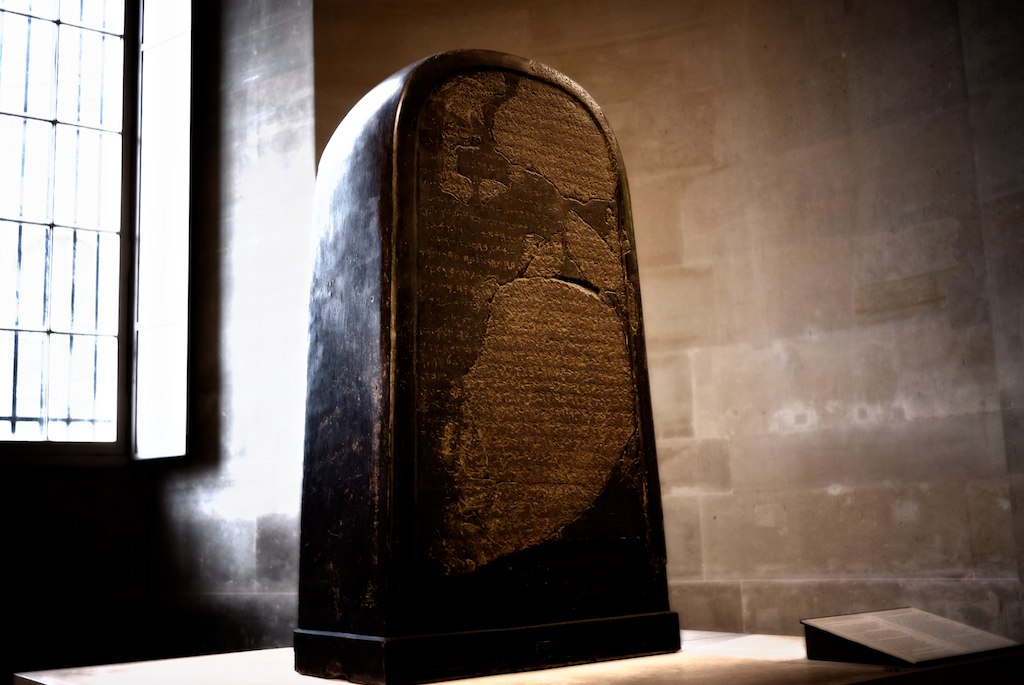
In the Louvre, there is a towering stele, engraved with glyphs in an ancient language. Cast into the stone are the words purported to come from King Mesha of Moab. It tells of how the kingdom of Israel waged war against the Moabites and subjugated them.

He tells how King Omri decided to destroy the house of Moab forever. How he occupied land and oppressed the people. How the Israelites demanded tribute from the Moabites and forced them to send hundreds of men as captive slaves.

And our sources? Our sources agree. The Bible tells the same story. In the book of Kings, Mesha, king of Moab, is described as a sheep breeder who had to hand over 100,000 lambs and the wool of 100,000 rams. He is treated as a despised servant, mocked for his weakness at being conquered. Our Bible groats that the Moabites were utterly destroyed.

But. But Ruth was a Moabite.

Ruth came from the plains of Moab where there was famine and joined herself to Naomi’s household. She joined with them and was a model of love and kindness. She was strong and noble. Ruth is still the model of decency. And she was a Moabite.

These weeks, we turn to the book of Numbers. Almost the entirety of this chapter is a polemic against the Moabites. It tells of never ending war. It talks about how the Moabites feared the Israelites strength and number; how the Israelites went and crushed them. It triumphantly promises that a scepter shall rise out of Israel and smash the forehead of Moab. Death to Moab. Death to the Moabites.

But… Ruth was a Moabite. Ruth was a Moabite. Could she be included in these celebrations of ethnic cleansing? How could anyone do that to Ruth?

In the Psalms, God jokes that Moab is a washpot. The basin in which God’s feet are cleaned. Ezra laments in disgust that Israelites would ever marry Moabites. Numbers calls the Israelites who married Moabites harlots. Deuteronomy treats this intermarriage as a sin.

But Ruth was a Moabite. And Ruth married Boaz. And their story is the one we turn to when we want to understand true love. Their union is how we imagine all marriages should be. For them, marriage wasn’t a problem. It was a joy. Who could forbid such a thing?

When King David took power in Israel, he set out to conquer and destroy the Moabites. He trapped them in the valley and allowed nobody to leave. He split the Moabite camp in two with a line. On one side, he massacred them. He killed them without exception. On the other side, he enslaved them, and kept them as degraded servants.

But Ruth was a Moabite. And Ruth married Boaz. And they has children. And grand-children and great-grandchildren. And one of those descendants was David. Yes, King David, too, was a Moabite by ancestry. He was a product of one of those forbidden unions.

In so many places, the Bible speaks of destroying and degrading the Moabites. Only a few verses in one solitary book speak of Ruth as a Moabite, and position her as a source of love and the originator of the Israelite nation.

The Bible is not so much a book, but a library in discussion with itself. It is a compendium of different contradicting voices.

Somewhere, at some time, some voice thought it was important to say that Ruth was a Moabite. And she was a model of love and kindness. And she took better care of her family than anyone could. And she was the pinnacle of loyalty and devotion. And she was the grandmother of King David. And she was a Moabite.

You might wonder why anyone would bother. The entire Bible is a torrent of hatred against Moabites. Every word is oppositional. All the history speaks of war and conquest. Why would one lone author put their head above the parapet to suggest something otherwise? Why would it be worthwhile to say that Ruth was a Moabite?

But think about it. There are countless verses of contempt for Moabites, and only one that suggests they are worthy of love. And which one do we remember? Does anyone today feel any animosity towards the ancient tribe east of the Jordan? Does anyone still take pride in Israel’s long-gone military victories against its neighbours?

No. But people remember that Ruth was a Moabite.

Empires rise and empires fall. Nations come in and out of being. The names of kings and warriors are lost to the ages. But one loving word can last a thousand lifetimes.

The voices of hatred and jingoism are fleeting. They cannot be sustained. But the voice of love – the voice of humanity – that speaks out across centuries and spans generations. It lasts long after the malaise has subsided.

Ancient Israel was a great kingdom. It was able to conquer lands and bring neighbouring nations to their knees. It could compel people to erect stone monuments to their own misery. And the thought of it makes us, at best, uncomfortable.

But, now, all we take pride in is love. The love our people have had for their God. The love our leaders have had for their Torah. The love they have had for each other. They love they have had for strangers.

Gentle words. Small memorandums of compassion. Fleeting acts of kindness.

A verse. Ruth was a Moabite. Remember that, Ruth was one of them.

Shabbat shalom. Chag sameach.

sermon · theology · torah

Make yourselves fringes

.

I started wearing a kippah full-time out of the house about six years ago. I was growing increasingly religiously observant and wanted to see how it felt to physically mark my faith. I have worn the kippah almost every day since, and feel naked if I greet guests or leave the house without one.

The results have surprised me. First of all, Britain is way more accepting than I anticipated. I have lived all over London and travelled all over the country and never had a negative reaction. 

I am often met with positivity and fascination. Non-Jews ask me questions and start conversations I’d never otherwise have had.

Meanwhile, Jews come up to me to see if my kippah offers them a sense of belonging. It is like a hat that McDonald’s workers wear saying “ask me about our special offers”, except mine says “ask me about our special task.”

I am very aware that how I conduct myself through life now reflects not only on me but on Jews and Judaism as well. I have become an ambassador for Judaism. I feel obligated to live a more ethical life, and I wonder if that is, perhaps, the point. 

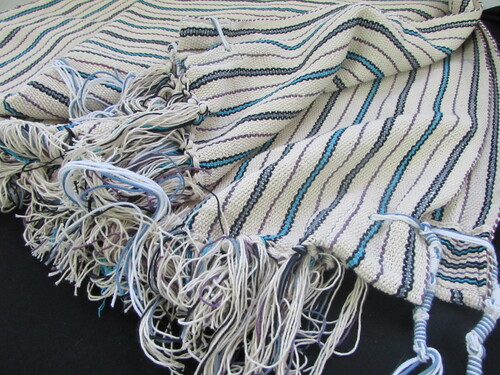
Religious clothing carries deep meanings for those who wear it, and has done throughout our history. The kippah itself is not mentioned in the Torah. It is a medieval innovation in Judaism. In the world of the Bible, the item of clothing that symbolised Jews’ distinctiveness and sacred purpose was the tzitzit. 

In this week’s parashah, Shlach, God tells Moses: “Speak to the children of Israel and say to them: make for themselves fringes upon the corners of their clothes for all generations, and put a blue thread among them.”

Now, says God, whenever you see them, you will remember what God has commanded of you. You will do what is right instead of what you like. And these fringes will make you holy before God.

But why? What is it about these fringes that should serve such a purpose? Are they simply visual aids? And, if they are, what is it about dangling threads at the corners of garments that should work to remind us of holiness and covenant?

Rashi suggests that the reason is not fringes themselves blue strand among them. This, he says, was once the colour of royalty, and an expensive dye to acquire. The thread is a reminder to the Israelites of their shared regal status – an affirmation both of their equality between each other and of their special status in the eyes of God. 

But the blue string that was once part of the tzitzit can no longer be seen. The dye that was once used no longer exists. Although efforts have been made to revive it, for most Jews, our fringes have no dye. 

I think the fringes have a meaning of their own. To me, these tzitzit are meaningful because of where they are.

They are situated on the margins. They are so often translated as being “fringes.” They are at the edges.

In this way, they are like Jews.

Every Jew, no matter how visible or assimilated, knows what it means to be on the fringes. It might be the ambivalence we feel as Christmas rolls around, or the unease we feel at a cultural reference that doesn’t include us. It might be a story in the news that we know we are reading differently precisely because we are a Jew.

Throughout history, we have used our marginal position to better understand both the non-Jewish world we inhabit and the Jewish one we inherit. Jewishness gives us a perspective not everyone has: a sense of how life can look from the edges.

When we see tzitzit, we see ourselves: the fringes.

The great 20th Century philosopher, Hannah Arendt, argued that this was no coincidence. We are not just on the margins because others have put us there, but because that is where we are supposed to be. 

Arendt says that, even after the Jews were given citizenship and turned into emancipated members of European states, most Jews continued to be “pariahs.” 

They were marginalised, never fully accepted into European society. As a refugee from Nazi Germany, Arendt knew this well.

From this position as pariahs, Jews could either consciously embrace who they were or pretend they were assimilated. Arendt says we should be conscious pariahs. We should embrace our marginality. We should use our special position as outsiders to see things the way nobody else can.

But tzitzit are more than just fringes. They are the sacred part on the border that give purpose to the centre. Without its fringes, a tallit is just a scarf. The fringes are the visibly different part that mark it out as holy.

Is this not the role of the Jew in the world? Is this not what it means to be ‘a light unto the nations’; that we are visible reminders to the world of who God is and what it requires of us? Isn’t it exactly our holy purpose to transform the world from the vantage point of our difference?

We who turn up to synagogue, who keep up our strange ways of living at the weekend, who sometimes have unusual dietary requirements. Yes, we who sometimes don kippot and dress in fringes. We have embraced our difference and turned it into a point of pride. We have chosen to live a life by Jewish ethics, transforming society and ourselves. 

That is where these tzitzit point us.

They tell us not only that we are sacred for our place on the margins, but that we need to look beyond our space to the further fringes. There are others more excluded than we are, whose difference has made them more vulnerable and excluded.

The fact that they are fringe makes them, like us, sacred. They have perspectives we cannot. Their difference is spiritually powerful. It is not that we should pity the people more marginalised than we are, but that we should seek to bring them from the borders to the centre.

This Torah portion concludes with reminding us why we wear these fringes: God brought you out of the land of Egypt.

With that special deliverance came a sacred purpose.

Countless times, the Torah implores us: you know the heart of a stranger, for you were strangers in the land of Egypt. 

If our holy purpose comes from being on the fringes, we need to look to those further out for where to go. Torah tells us about its most marginalised people: orphans, strangers, widows. These are the people that ancient Israelite society too often left out.

In ancestral times, these were the people without income or papers. Judaism calls on us to look to those most marginalised people. Unless we are centering them in our decision-making, we are failing in our religious duties.

The tzitzit at the edges of our tallits remind us where to look. They tell us that the margins are where things matter most.

So, make yourselves fringes. Now whenever you see them, you will remember what God has commanded of you. You will do what is right instead of what you like. And these fringes will make you holy before God.

Shabbat shalom.

This sermon was inspired by the political philosophies of bell hooks and Melanie Kaye/Kantrowitz. It is for Parashat Shlach at Edgware and Hendon Reform Synagogue, to be delivered Saturday 5th June.

sermon · theology

Why do people get sick?

Why do people get sick?

In a year when so many have experienced ill health, it is worth asking why this has happened. Throughout the pandemic, we have been reminded that some will get the virus with no symptoms; some will get the virus and recover; some will get the virus and will not recover. But what determines who gets sick and who gets better? Who decides who has to suffer and who will not?

There are plenty of medical professionals in this congregation who can answer part of that question much better than I can. Statistics, underlying factors, mitigating circumstances, health inequalities, access to medicine. All of these things certainly play a role. 

But they don’t answer the fundamental question that animates us: why? Why my loved one? Why me? That is not a medical question but an existential one. It is about whether there is a God, whether that God cares, and what a religious Jew might do to change their outcomes. 

For that, we look to the Jewish tradition. Let’s start with this week’s parashah. Here, we read one of the earliest examples of a supplicatory prayer. Moses sees his sister, Miriam, covered in scaly skin disease. He cries out: “El na rafa na la.” God, please, heal her, please. We hear the desperation in Moses’ voice as he twice begs: “please.” Don’t let her become like one of the walking dead. 

In this story, there is a clear explanation for why Miriam gets sick and why she gets better. Miriam’s skin disease is a punishment. She insulted Moses’ wife, talking about her behind her back with Aaron. 

When she gets healed, it is because she atones for her sins and Moses forgives her. She goes to great lengths of prayer and ritual to have her body restored. Sickness is a punishment and health is a reward.

In some frum communities, you might still hear this explanation. All kinds of maladies are offered as warnings for gossiping. When people get sick, they’re encouraged to check their mezuzot to make sure their protective amulets are in good working order. 

In some ways, these are harmless superstitions. When everything feels out of control, why not look for reasons and things you can do? But hanging your beliefs on this is dangerous. Plenty of righteous people get sick and plenty of wicked people lead long and healthy lives. 

If you follow the logic of this Torah story, you run the risk that, when your loved one’s health deteriorates, you might blame them for their ethical conduct, when really there is nothing they could do. It is a cruel theology that blames the victim for their sickness.

In the Talmud, the rabbis felt a similar discomfort. They decided that skin diseases were an altar for atonement. When people got sick, it was God’s way of testing the most beloved. The righteous would suffer greatly in this world so that they would suffer far less in the next.

When Rabbi Yohanan fell ill, Rabbi Hanina went to visit him at his sick bed. He asked him: “Do you want to reap the benefits of this suffering?” Rabbi Yohanan said he did not want the rewards for being sick, and was immediately healed. 

We hear these ideas today, too. People will say that God sends the toughest challenges to the strongest soldiers. But I don’t think this theology is any more tenable. How can anyone say to a child with cancer that their sickness is an act of God’s love? Who could justify such a belief?

No. The truth is that these theories of reward and punishment should leave us cold. We live in a world full of sickness and suffering, and it’s attribution is entirely random.

Maimonides, a 13th Century philosopher, saw that these explanations for sickness did not work. He was a doctor; the chief physician to the Sultan in Egypt. He had read every medical textbook and saw long queues of people with various ailments every day. How could he, with all his knowledge, think that sickness was a punishment or a reward?

Maimonides taught that God has providence over life in general but not over each life in particular. God has a plan for the world, but is not going to intervene in individual cases of recovery. He disparaged the idea that mezuzot were amulets or that people could impact their health outcomes with prayer. 

I feel compelled to agree with Maimonides’ rationalist Judaism. Sickness is random and inexplicable. So is health. The statistics and medical knowledge that I set aside at the start of this sermon have much better answers than I can muster.

So, what do we do? We, who are not healthcare professionals or clinicians seeking a cure? 

Like Moses, seeing the sickness of Miriam, we pray. We pray with our loved ones, not because we think it will make God any more favourable to them, but because it is a source of comfort to those who are sick. Praying with someone shows that you love them and care about their recovery. We do it for the sake of our loving relationships.

Like Rabbi Hanina, seeing the sickness of Rabbi Yohanan, we visit the sick. We attend to people, not because we imagine we can magically cure them with words, but because company is the greatest source of strength in trying times. We go to see people in hospital, not for their bodies, but for their souls.

And, like Maimonides, we approach the world with humility. We refuse to believe in superstitions that are false or harmful. We accept that we live in a mystery and there is much we do not know. 

In this time of sickness and difficulty, it is very Jewish to ask: “why do people get sick?” The Jewish response to questions is to ask more questions. And the most Jewish question we can ask here is: “when people are sick, how can I help?”

Shabbat shalom.

I gave this sermon at Newcastle Reform Synagogue for Parashat Behaalotchah on 29th May 2021.