Have you ever done something wrong, completely accidentally, with all the best intentions, and, feeling ashamed and repentant, thought to yourself: “that’s it, I better go kill a pigeon.”
Of course you haven’t. Because as an astute reader of Torah knows, if you have committed a sin, you need to sacrifice at least two pigeons. A goat for serious misbehaviour. A bull, if you really messed up.
This week, we enter the Book of Leviticus, an impressive catalogue of sins and sacrifices. This third book in the Torah cycle, called in Hebrew Vayikra, acts as a directory for priests.
Here, you can match up any misdeed or lifecycle event with the appropriate sacrificial animal, and it comes with a handy recipe book for how to make the meat smell nice enough that God forgives you.
(Bit of oil… bit of incense… bake for three days in a smoke oven…)
We leave behind the great moral myths of Genesis. We leave behind the inspiring liberatory narrative of Exodus. And this, too, is where we leave behind Orthodox Judaism.
If you are an Orthodox Jew, the only problem you can see with killing a pigeon to atone for your mistakes is that you don’t have a Temple to do it in.
In the Koren Sacks Siddur, the Orthodox daily prayer book, you will find petitions to be recited every day that God rebuilds the Temple in Jerusalem, brings back the hereditary priesthood, and restores the sacrificial cult.
Finally, if I make an accidental mistake, I will be able to fulfil the Torah’s command that I should splatter a bull’s blood and entrails all over a table.
Frankly, I don’t know how our friends further up the Thames have managed to go so long without enacting this sacred duty.
At its best, the rebuilt Temple of Orthodox Judaism involves some kind of mystical descent of a palace from the clouds at the end of time. At its worst, there are Jews currently hoping to blow up the Al Aqsa Mosque on the Temple Mount and replace it with a gaudy pillared Roman-style shrine.
I’m not going to get into the geopolitics of why that would be a terrible idea. My area is theology, and I can tell you now, that from a religious, moral, spiritual, and ethical perspective, bringing back any kind of Temple would be a terrible idea.
Even as a metaphor, the yearning for Temple Judaism is an abrogation of responsibility, a refusal to engage in the real world, and a fantasy that blood can avenge wrongdoing. We cannot tolerate this idea on any level, whether real or abstract.
It is hard to overstate what a fundamental difference this is between Progressive and Orthodox Judaism. Opposition to rebuilding the Temple is central to Progressive theology.
In 1885, American Jews came together at the Rodef Shalom Synagogue in Pennsylvania and signed up to their foundational document: the Pittsburgh Platform. This decree has influenced how Progressive Jews see our religion ever since.
In it, they declare: “we expect no sacrificial worship under the sons of Aaron.” From the outset, we have believed that the synagogue has permanently replaced the Temple.
The author of the Pittsburgh Platform was an inspiring rabbi, named Kaufmann Kohler. Born in Germany, he became America’s preeminent Reform scholar. If you’ve ever dipped into the Jewish Encyclopedia, you’ve probably read something written by him.
Kohler wrote an introduction to Jewish theology that dealt thoroughly with how we Progressive Jews should understand these Temple texts. They were, for their time, a tool to help Jews gain moral understanding. The rituals and sacrifices showed us how to take responsibility for our thoughts, and even our conduct.
But, over time, we outgrew pigeon slaughter. We moved on to the world of rules and structures created by the early rabbis. And now, in our modern age, we are still moving forwards: so that we will do the right thing without being bound by old laws.
That’s what the progress in Progressive Judaism means: progressing from the age of slaughter through the age of laws towards the age of morals.
It’s not that we should discard the laws, or even the stories of slaughter. We should be like students who learn more through our schooling- at each stage, we retain what we learnt earlier, but we refine it, and we realise that some of our earlier ideas were too simplistic. Wanting to rebuild the Temple is like wanting to go back to the crayons of nursery school.
Throughout the moral education of humanity, we received hints that this was where we were going all along. In the Book of Proverbs, written when cattle murder was the normal way of dealing with guilt, it says: “To do what is right and just is more desired by the Eternal One than sacrifice.”
Throughout the books of the prophets we are repeatedly assured that God is far more interested in our moral conduct than in how much fat we can burn off the bones of a lamb.
Centuries later, when the early rabbis were busy codifying all their laws, the midrash explained why the Torah would say this. Sacrifices could only happen in the Temple, but you can do good deeds anywhere. Sacrifices can only atone for mistakes, but with good deeds you can repent for what you did wrong on purpose. Sacrifices only last a short while, but righteousness can endure forever.
At every stage of its development, says Rabbi Kohler, we Jews were a priestly people. Even in the days of animal sacrifice, we were always trying to demonstrate how to live with knowledge of God and concern for morality.
So, says Kohler, our mission on earth is to constantly be a beacon of moral behaviour. If we forfeit that, even for a moment, we will cease to be worthy of being called God’s people.
The idea of rebuilding a Temple isn’t just a dead end: it is a reversal of history. It takes us backwards from reason to superstition. It is the most retrograde step from our understanding of animal suffering to treating God’s creatures as subjects for abuse. It is abhorrent.
And I think most people know that. I honestly believe that, if we asked the vast majority of our friends and family who attend United or Federation synagogues if they think we would be better off with a cult of butchery based in Jerusalem, they would be repulsed by the concept.
In that case, they do not believe in Orthodox Judaism. Mazel tov, they’re Progressives already! Come through our doors, come celebrate with us, come pray with us!
You can leave your fantasies of pigeon massacres at the door. Come and be God’s priestly people.
There are ways of remembering intended to make you forget.
There are ways of forgetting intended to help you remember.
So, says the Torah, remember in order not to forget.
This week is Shabbat Zachor, the Sabbath of remembrance. Just before Purim, we are called to read three additional lines of Scripture. Deuteronomy instructs:
Remember what Amalek did to you on your journey out of Egypt [… ] You shall erase the memory of Amalek from under heaven. Do not forget.
Remember… erase the memory… do not forget.
Is the demand to remember not contradicted by the insistence on erasing the memory?
Is the commandment to remember not exactly the same as the one not to forget?
Perhaps not. There are ways of remembering that encourage forgetting, and ways of forgetting that make you remember.
Alan Bennett’s play, The History Boys, is an exploration of what it means to teach history, and what we can learn from it.
In a powerful scene, the newest teacher, Tom Irwin, takes his sixth-form grammar school students on a tour of a war cemetery.
As they walk, he tells them:
The truth was, in 1914, Germany doesn’t want war. Yeah, there’s an arms race, but it’s Britain who’s leading it. So, why does no one admit this?
That’s why. The dead. The body count. We don’t like to admit the war was even partly our fault cos so many of our people died. And all the mourning’s veiled the truth. It’s not “lest we forget”, it’s “lest we remember”. That’s what all this is about -the memorials, the Cenotaph, the two minutes’ silence-. Because there is no better way of forgetting something than by commemorating it.
The truth to these words is palpable. In every village square throughout Britain there is a stone column, inscribed with names. The Cenotaph is so finite. Its concrete defies questions. You cannot ask it: what did they die for?
As we lay wreaths, the liturgy intones that the war dead “made the ultimate sacrifice.” These words carry such gravity that you forget it was a conscript army. You dare not ponder: who sacrificed them, and for what cause?
Then, there is silence. So much silence that you cannot hear the echo: was it worth it?
Real memories are not fixed. They are fluid and living, constantly opening up new interpretations and interrogations. When you really remember, you pore over the details with others, seeking perspectives you missed, guided by a quest for greater understanding. You always want to know what you can learn from it, since the memory teaches something new to each moment.
But, as Alan Bennett’s character teaches us, that is not what happens with certain war memorials.
They are ways of remembering in order to make you forget.
There are, too, ways of forgetting to make you remember.
In 1988, the Israeli historian and Holocaust survivor, Yehuda Elkana, wrote an article for HaAretz called The Need to Forget. Not long after its publication, this article entered the new Jewish canon as one of the most challenging and profound commentaries on Shoah memorialisation.
In it, he warns against the danger that Holocaust consciousness poses to Israeli society.
He writes:
I see no greater threat to the future of the State of Israel than the fact that the Holocaust has systematically and forcefully penetrated the consciousness of the Israeli public.
Reflecting on the school trips to Yad Vashem, Elkana comments:
What did we want those tender youths to do with the experience? We declaimed, insensitively and harshly, and without explanation: “Remember!” “Zechor!” To what purpose? What is the child supposed to do with these memories? Many of the pictures of those horrors are apt to be interpreted as a call to hate. “Zechor!” can easily be understood as a call for continuing and blind hatred.
So, says Elkana, while the rest of the world may need to remember the Holocaust, the Israelis needed to learn to forget it. They needed to uproot the injunction to remember “to displace the Holocaust from being the central axis of our national experience.”
Elkana’s invocation of forgetting is also an invitation to remember. Forget the past in order to remember that we have a future. Forget the cruelties inflicted on our people in order to remember that we are greater than our misery. Forget the wars in order to remember the possibility of peace.
Elkana is not talking about an alternate reality where everyone wakes up tomorrow with amnesia about the last hundred years of history. He is talking about an active process of forgetting: forgetting by asking new questions and building new memories.
These are ways of forgetting intended to help you remember.
There are ways of remembering intended to make you forget.
But, the Torah tells us: remember in order not to forget.
What type of remembering would this be?
A full remembering, the type repeated twice by our parashah, the kind that forces you not to forget.
This remembering, then, must be one that always asks questions and returns to itself. A history that invites constant revision and ever wants to teach new lessons.
For the last sixteen months, Israel has been gripped by war. It has been unavoidable as its details have filled our news feeds and lives.
I know it is too soon to start the painstaking soul-searching involved in real remembering.
But it is plenty early enough to forget.
Already there are those who would like us to forget, so that they can eschew their own accountability.
How easily we can be made complicit in their acts of wilful forgetting.
So I have been considering how to fulfil the Torah’s commandment to remember.
I want to remember in fullness and complexity, always returning to new questions.
I want to remember all the suffering, for there has been so much suffering.
I want to remember all the dead. Every name. There are so many names.
I want to remember all those responsible. Every name. There are so many names.
I want to remember all the alternatives, because there have always been so many options, and there are still so many other ways.
I want to remember completely who I have been, who we have been, at best and at worst throughout this whole time.
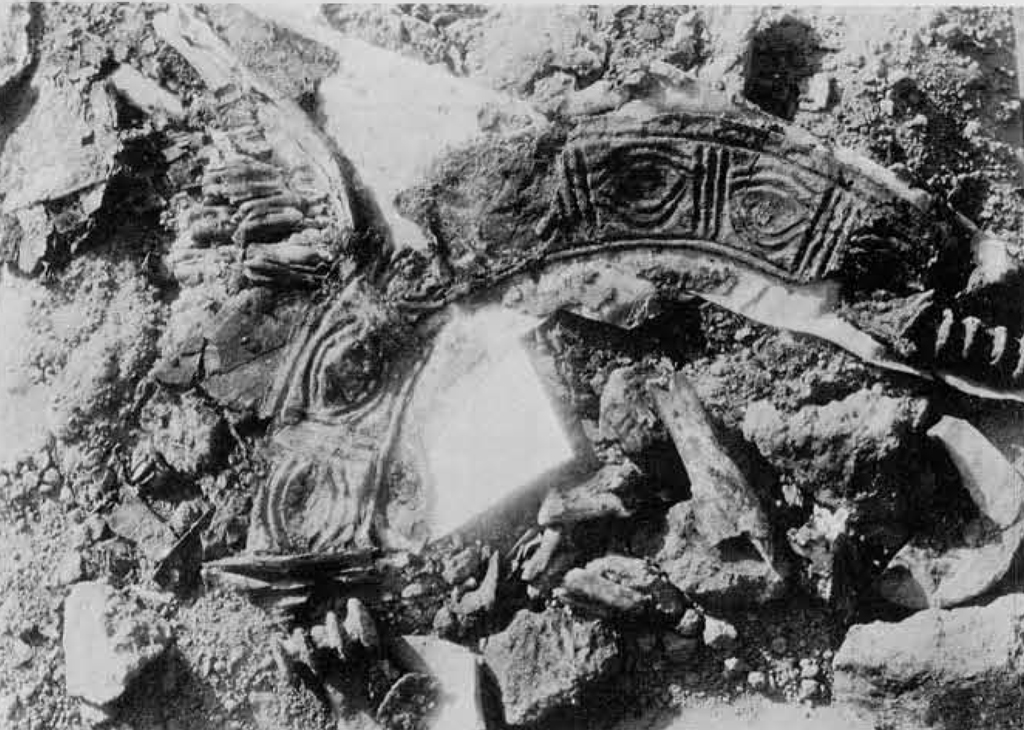
In 1922, archaeologists dug up a site in modern-day southern Iraq. There, they found incredible spans of gold and sophisticated armour, and Iron Age Sumerian artefacts, encased within stone walls. They dubbed this place “the Royal Cemetery of Ur,” an ancient Babylonian mausoleum.
On that site, they also discovered evidence of hundreds of human sacrifices. Among the human sacrifices, a considerable number were children.
Nearly all of the skeletons were killed to accompany an aristocrat or member of the royal family into the afterlife. Some had drunk poison. Some had been bashed over the head with blunt objects. After their death, many were exposed to mercury vapour, so that they would not decompose, but would remain in a lifelike posture, available for public display.
Excavations from the Royal Cemetery at Ur
This site dates to sometime around 2,500 BCE in the ancient city of Ur. According to our legends, another figure came from the ancient city of Ur sometime around 2,500 BCE.
His name was Abraham.
In the biblical narrative, Abraham wandered from Ur to ancient Canaan, where he began to worship the One God, and founded Judaism.
The world in which Abraham purportedly lived was rife with child sacrifice. Across the Ancient Near East, archaeologists have uncovered remains of children on slaughtering altars. They have found steles describing when and why they sacrificed children. They have found stories of child sacrifice from the Egyptian, Greek, Sumerian, and Assyrian civilisations.
So problematic was child sacrifice in the ancient world that our Scripture repeatedly condemns it. The book of Leviticus warns: “Do not permit any of your children to be offered as a sacrifice to Molech, for you must not bring shame on the name of your God.” The prophet Jeremiah describes disparagingly how the Pagans “have built the high places to burn their children in the fire as offerings to Baal.” In the Book of Kings, King Josiah tears down the altars where people are sacrificing their children.
Abraham put a stop to the practice of child sacrifice. It seems to happen suddenly, and without warning, and with even less explanation. No reason is given why he abruptly ended all the cultural deference that had gone before and opposed an entrenched religious practice.
The question we now must ask is: why?
One reason that comes to mind is that it is so obviously immoral. Surely it should be self-evident that you don’t kill kids! But that wasn’t obvious to all the people around Abraham. And that wasn’t obvious to traditional commentators, either. In their world, the morally right thing was always to obey God.
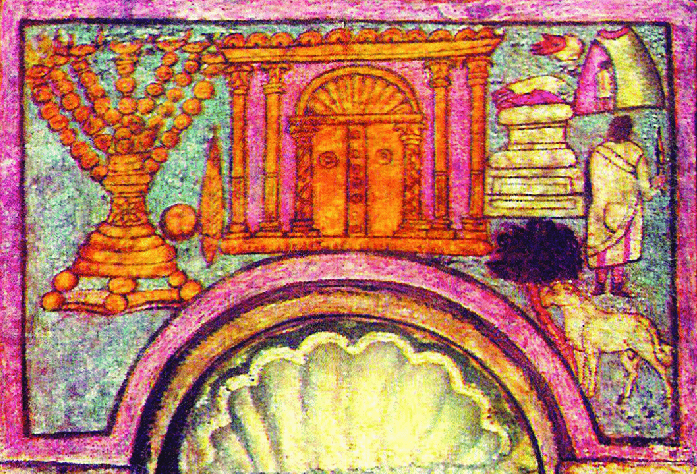
Fresco of the Binding of Isaac at the 3rd Century Duro Europos Synagogue, Syria
A traditional reading says that Abraham stopped child sacrifice in obedience to God. In the story we read today, Abraham is called upon by God to go up on Mount Moriah and slay his son. Only at the summit, when he holds up his arm to murder Isaac, does God stop him, telling Abraham that he has proved his devotion to God by not withholding his son, and that he does not have to kill Isaac.
Yet there are several problems with this story. If we adhere to the traditional reading, God still wanted child sacrifice, and felt that doing so would prove Abraham’s devotion. In fact, nearly all traditionalist readers interpret it this way,saying that obedience before God should be a sacred virtue. A conservative reader of the Bible says that the moral of the story is that we should be subservient to God, and do what we are told.
God said not to perform child sacrifices, so we no longer do. That would mean, then, that if God had said child sacrifice was permitted, we would still be doing it.
In 2007, the Israeli philosopher Omri Boehm offered a radical reinterpretation of the story of the binding of Isaac. The story, Dr Boehm argues, is not about Abraham’s fealty to God, but his disobedience. Dr Boehm shows how, reading against the grain of traditional interpretation, this is not a story where God changes tact and decides not to ask for child sacrifices anymore, but where Abraham rebels against authority and refuses to commit murder.
For Boehm, what was truly radical about the Binding of Isaac was that it set out a new set of values, completely at odds with those of the Ancient Near East. Where other cultures practised child sacrifice because it was part of their established culture, Abraham resisted and put life above law. Where others encouraged obedience to authority, so much that poor people could be killed in the palaces of Ur to serve their masters in the afterlife, Abraham made a virtue of rebellion. For our ancestor Abraham, refusing to follow orders, even God’s, was the true measure of faith. By not killing, even if God seemingly tells you to, you show where your values really lie.
This is not a story about obedience, but rebellion. And that message – of resistance against authority in defence of human life – has much to teach us today.
Boehm reconstructs what the archetypal story of child sacrifice was in the Ancient Near East. Across many cultures and time periods, there was a familiar refrain to how the story went. The community is faced with a crisis: some kind of famine, natural disaster, or war. The community realises that its gods are angry. To placate the gods, the community leader brings his most treasured child and sacrifices him on an altar following the traditional rites. Then, the gods are pleased and the disaster is averted.
We can see that the biblical narrative clearly subverts the storytelling tradition that was around it. In other cultures, the community leader really did sacrifice his special child, and that really did please their Pagan god. In our story, the community leader does not sacrifice his special child, and the national God proclaims no longer to desire human sacrifice. This is already then, a bold message to the rest of the world: you might sacrifice children, but we will not.
Boehm takes this a step further and looks at source criticism for the text. Most scholars of Scripture accept that Torah is the work of human hands over several centuries. One of the ways we try to work out who wrote which bits is by looking at what names for God they use. Whenever we see the name “Elohim” used for God, we tend to think this source is earlier. Whenever we see the name “YHVH” used for God, we tend to assume the source is a later edit by Temple priests.
The story of the binding of Isaac is odd because it uses the name “Elohim” almost the entire way through, until the very end, when the angel of God appears and tells Abraham not to kill Isaac. That means that most of the text is from the early tradition and only the very end part, where the angel of God tells Abraham not to kill Isaac, comes from the later priests.
So, Boehm asks, what was the earlier version of the text? If you take out the verses where God is YHVH and have only the version where God is Elohim, what story remains?
Well, in the version that we know, where both stories are combined, an angel of God calls out and tells Abraham not to sacrifice Isaac. That’s the bit where God is YHVH. If you take that out, and have only God as Elohim, Abraham makes the decision himself. No angel comes to tell him what to do. Next, if we cut out the parts where God is YHVH, there is no praise from the angel, telling Abraham he made the right choice. Instead, you get a story where Abraham deliberately disobeys his God because he loves the life of his son more.
Adi Nes, ‘Abraham and Isaac’, 2004
The earliest version of the text, before the Torah was edited and a later gloss was added, is one in which Abraham is commanded by God to sacrifice Isaac, goes all the way up Mount Moriah, and then refuses. Without prompt or praise from God, Abraham decides to sacrifice a ram instead of his son. In the earliest version of the biblical narrative, when source critics have stripped away priestly edits, God tells Abraham to sacrifice his son and Abraham rebels.
The earliest version, then, is an even more radical counter-narrative to the other stories of the Ancient Near East. Not only do we not sacrifice children. We also recognise that sometimes you have to say no to your god. In this version, rebellion is more important than obedience, especially when it comes to human life.
This isn’t just a modern Bible scholar being provocative and trying to sell books. In fact, Boehm shows, this was also the view of respected Torah scholars like Maimonides and ibn Caspi. These great mediaeval thinkers didn’t think of the Torah as having multiple authors, but they could see that multiple stories were going on in one narrative. One, they thought, was the simple tale of obedience, intended for the masses. But hiding between the lines was another one, for the truly enlightened, that tells the story of Abraham’s refusal.
Boehm terms this “a religious model of disobedience.” By the end of the book, you go away with the unshakable impression that Boehm is right. True faith, he says, is not always doing what you think God is telling you. Sometimes it is reaching deep within your own soul to find moral truth. Sometimes you really show your values by how you defy orders.
In his conclusion, Boehm takes aim at Rabbi Shlomo Riskin, an American religious leader, who lives in the West Bank settlement of Efrat. Rabbi Riskin had said, in his analysis of the binding of Isaac, that Abraham was a model of faith by his willingness to kill his son. Riskin insisted that he was willing to sacrifice his own children in service of the state of Israel.
This, says Boehm, is precisely the opposite of the message of the binding of Isaac. The point was not to let your children die. The point was to bring a final end to child sacrifice. The point was not to submit to unjust authority, but to rebel in defence of life.
Rabbi Riskin does not realise it, but by offering child sacrifice, he is really advocating for the Pagan god. He is describing the explicitly forbidden ritual of allowing your children to die.
Abraham thoroughly opposed these false gods who demanded ritual murder. They were idols; and child sacrifice a monstrous practice that we were supposed to banish to the past. The very essence and origin of Jewish monotheism is its thorough rejection of killing children.
Boehm could not have known how pertinent his words would become. This year has been one of the worst that those of us connected to Israel can remember. Beginning on October 7th, with Hamas’s horrendous massacres and kidnappings, the last Jewish year has seen us rapt in a horrific and seemingly never-ending war.
This year, thousands of Israelis were killed. This is the first time in a generation that more Israeli youth have died in war than in car crashes. Reading through the list of names, it is remarkable how many of the soldiers were teenagers.
That is not to even mention the 40,000 Palestinians whom the IDF have killed. According to Netanyahu’s own statements, well over half were civilians. Around a third were children. As famine and food insecurity rises, the risk of deaths will only accelerate. It has been agonising to witness, and I cannot imagine how painful it has been to live through.
Yet, during my month in Jerusalem, I saw that the voice of Abraham has not been extinguished. There are few groups I hold in higher esteem than the Israeli peace movement. Against untold threats and coercion, in a society that can be intensely hostile to their message, they uphold Abraham’s injunction against killing.
One of the leaders of the cause against war was Rachel Goldberg-Polin. On October 7th, her 19-year-old son, Hersh, was kidnapped by Hamas. His arm was blown off and he was taken hostage in Gaza. From the very outset, Mrs. Golderg-Polin argued fervently for a ceasefire and a hostage deal that would bring her son home. She warned that the only way her son would come home alive would be as part of political negotiations.
At the end of August, as Israeli forces neared to capture Hersh as part of a military operation, Hamas shot her son, Hersh, in the head.
Rachel Goldberg-Polin’s refusal to give up hope, refusal to sacrifice her son, and steadfast insistence on peaceful alternatives is a true model of Abraham’s faith.
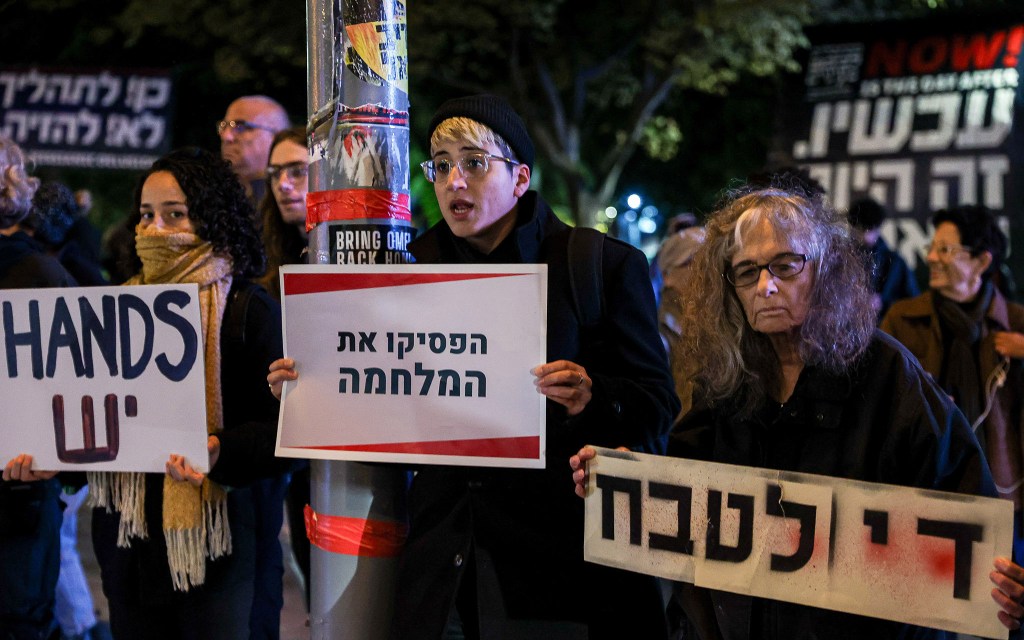
Israeli peace protestors
And it involves serious rebellion too. When I met with hostage families in Jerusalem, I was shocked to hear how, for protesting against the war to bring their families home, they had been beaten up by Ben Gvir’s police. I saw this with my own eyes when I marched alongside them. People shouted and jeered at them, and the police came at them with truncheons.
In July, when I went with Rabbis for Human Rights to defend a village in the West Bank against settler violence, we were joined in our car full of nerdy Talmud scholars by a surprising first-timer. A strapping 18-year-old got in to volunteer in supporting the Palestinian village. What was most remarkable was that he himself lived in a West Bank settlement.
He explained that he had refused to serve in the military. He did not know that others had done it before, or that there were organisations to support Israeli military refusers. Instead, he said, he thought to himself: “if I don’t go, they won’t kill me; if I do go, I might kill someone.” What could be a truer expression of Abraham’s message: no to death! No to death, no matter the cost.
He really had to rebel. For refusing to serve in the war, the conscientious objector I met spent seven months in jail. Still now, there are dozens of Israeli teenagers in prison because they would not support the war.
Throughout my time in Jerusalem, I attended every protest against the war and for hostage release that I could. One of the most profound groups I witnessed was the Women in White, a feminist anti-war group going back decades. One of these women, with grey hair and the look of a veteran campaigner, held a placard that read in Hebrew: “we do not have spare children for pointless wars.”
Is this not exactly what Abraham would say? We will not sacrifice our children on the altar of war!
Theirs is truly the voice of Abraham, the true voice of Judaism. It is the voice that opposes child sacrifice. Theirs is the voice that upholds the God who chooses life.
Talmud tells us that, when we blast the shofar one hundred times on Rosh Hashanah, we are repeating the one hundred wails of Sisera’s mother when she heard her son had died. Sisera was, in fact, an enemy of the Israelites, who waged war on Deborah’s armies, and was killed by the Jewish heroine, Yael. Still, at this holy time of year, we place the grief of Sisera’s mother at the forefront of our prayers.
We take the cry of every mother who has lost a child and we make it our cry.
Thousands of years after the Sumerian Empire had ceased existing, archaeologists dug up its remains, and saw a society that practised child sacrifice. From the very fact of how they carried out murder and permitted death, the excavators could tell a great deal about what kind of society this was. One that killed people to serve their wealthy and their gods.
One day, thousands of years from now, historians may look upon us too, and ask questions about what our society was like, and what we valued. May we take upon ourselves the mantle of Abraham.
May they look back and say that we chose to value life. May they look back and see that our people despised death and war. May they look back on us and see a society that practised faithful disobedience.
The newspapers barely reported it. No politician offered a eulogy. There was no radio broadcast of a moment’s silence. The subject did not come up over dinner. God died last month and we barely noticed.
How is it possible that God could die? Who could kill God so callously and get away with it? To understand what happened to God last month, you need to know everything that happened to God since the beginning. You need to hear about God’s life.
It was after the Exodus that the Israelites began to see how vulnerable God was. They had been redeemed from Egypt. They had crossed the Sea of Reeds. They had received the Ten Commandments from a thunderstorm.
Moses, Aaron, and seventy elders ascended the mountain once more to ratify their covenant with that God Almighty. When they reached the summit, they were shocked by what they saw.
Under God’s feet were building bricks like sapphire, as blue as the sky itself. Those feet were trapped. Those beautiful bricks bound them. The elders asked what had happened. God replied: “As long as you were enslaved, I was enslaved too. As long as you built bricks from clay, I built bricks from clouds. As long as you were in pain, I was suffering too.”
Of course, not all of God could be imprisoned. The infinite God transcends all space. But there is a part of God that lives with us and in us. A part of God labours when we toil. Cries when we cry. Hurts when we hurt.
The Israelites continued to catch glimpses of God’s frailty throughout their relationship. God had promised Jacob at the outset: “I will go myself with you to Egypt, and I myself will bring you back.”
It wasn’t just a promise of solidarity. It was a sad admission that, when the Israelites were refugees, God would be in exile too. When the Babylonia came to displace them and hold them in captivity, God travelled with the Israelites to Babylon. God sat with them in the synagogues. God was weeping by the river banks too.
Of course, not all of God could be exiled. The infinite God transcends all space. But there is a part of God that lives with us and in us. A part of God leaves when we leave. Cries when we cry. Hurts when we hurt.
God’s sympathy was not confined to the biblical age of miracles and prophecies. God stayed with us through history, even when we thought we had been abandoned. Yes, even in the concentration camps. God was there.
Elie Wiesel survived the Nazis and came to tell us what he had seen. He saw a child strung up by the guards, dangling. The child was left there for hours, dying in slow agony. The camp inmates had to stare him in the face with his still-red tongue and eyes not yet glazed.
“Where is God now? Where is He?” someone behind him asked. “Where is God now?”
And Wiesel whispered inside his heart: “Where is He? Here He is—He is hanging here on these gallows…”
God died there in Auschwitz. Of course, not all of God could be killed. The infinite God transcends all time. But there is a part of God that lives with us and in us. A part of God leaves when we leave. Cries when we cry. Hurts when we hurt. Dies when we die.
God has died with us many times. One hundred thousand sacred sparks have been extinguished in the UK this year alone. But God does not die in statistics on spreadsheets. God dies with one person at a time when one story is snubbed out too early in an unspeakable injustice. That is how God dies.
And now you know how it was possible for God to die last month. And now you need to ask why.
God died on 9th January at his home in Cardiff. He was 24 years old. He had been in police custody because someone suspected he had breached the peace. We are still not sure what that means. He was released without charge.
When his aunt picked up from the police station, he was covered in wounds and bruises. She says he didn’t have them when he was taken to jail.
52 police officers had contact with him in the 24 hours that he was held in Cardiff police station. None of them saw anything suspicious. The police are running toxicology reports and investigating themselves. They are looking at the CCTV footage but so far they have found no misconduct by officers and no use of excessive force.
The police have refused to release the footage. They say we will never see it.
We may never know how God died or why. But we know that God died last month.
And he was a black man named Mohamud Hassan. And he had a life that was worth living. And he should not be dead now.
And now you know how it was possible for God to die last month.
And now that you know that God has died, you are a witness to the crime.
And now that you are a witness, you will have to testify.
You are summoned before the Only Judge to give your testimony about why he died.
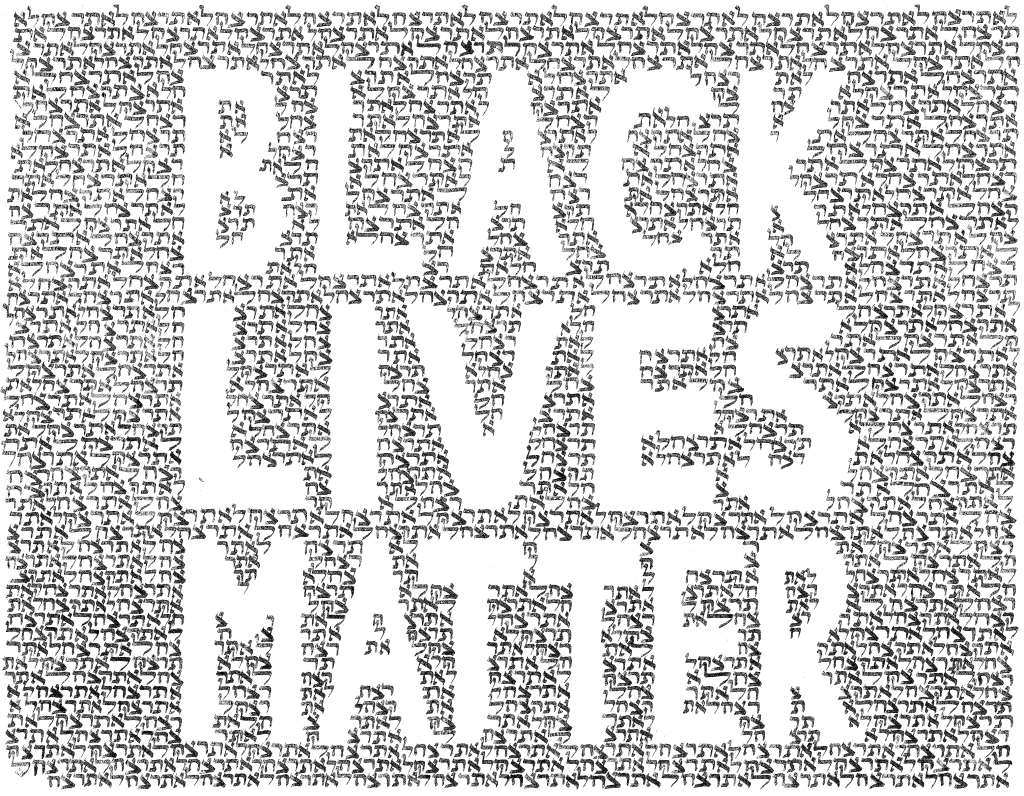
Black lives matter.
Shabbat shalom.
The white fire says “Black Lives Matter.” The black fire contains Exodus 20’s commandment: “Thou shalt not murder” in Hebrew. Artwork by Rachel Stone.
Earlier in the year, I went to a Holocaust Survivors Centre to deliver a service. After we had sung songs, discussed Torah and celebrated the day, I went to join some of the survivors to eat.
We sat and chatted. They were all elderly, but brimmed with life. These refugees, mostly women, who had survived camps and treacherous journeys to get here, seemed to possess a vitality I rarely saw in people my own age.
They talked about their grandchildren, their local community and their synagogues. But they wasted no time getting to the really gritty questions. “Why should I believe in God after what happened to us?” “Did God let that happen to us?” “Do you believe in an afterlife?” I bashfully tried to answer their questions, often replying that I did not know.
But then one of them asked a question to which I did know the answer. To which I was in no doubt. She asked me: “Do I have to forgive the Nazis?”
“No,” I said. “No you do not have to forgive the Nazis.”
I did not cite a Torah verse or a scholar or a halachah. I just said no. There are things that are unforgivable, and I was taken aback at even the suggestion that a survivor could forgive the Nazis for what they did.
Not everything must be forgiven. Not everything should be forgiven. Not everything can be forgiven.
We have reached Elul. The new month has begun and we have entered the last lunar cycle of the year, taking us through to Rosh Hashanah. This is our season of contemplation and reflection; of apology and of forgiveness. In this time, it is natural that we want to unburden ourselves of the guilt we have clung to.
Forgiveness is supposed to be the release of resentment and vengeance when we feel we have been wronged. With it ought to come a feeling of relief and a sense of restitution in the world.
Yet, so far, I have encountered far more people struggling because they cannot forgive than because they cannot apologise. I think it is important to stress: you do not have to forgive everything and you cannot be expected to forgive everyone.
Rabbi Elazar ben Azariah taught: “for transgressions between a human being and God, Yom Kippur atones, but for transgressions between human beings, Yom Kippur does not atone, unless the wronged party forgives.”[1] Judaism has no absolution. Our religion teaches that you must work to earn forgiveness, and guilt cannot be magically removed by prayer.
Even then, there are sins that can never be forgiven. For the most heinous crimes, like murder, even God does not forgive.[2]
We must assume that God does not forgive such an act because no human being could. Murder is irreversible in a way that other acts or not. The murdered person is not alive to forgive; no family member could forgive on their behalf. Even if they could, nobody could reasonably ask the family member of a murdered person to provide forgiveness, because it would take a super-human level of magnanimity.
In this week’s Torah portion, Shoftim, Moses creates cities of refuge throughout Canaan.[3] In ancient Israelite culture, the relatives of murdered people were not only not asked to forgive. They were expected to kill the killer as a matter of honour. Such a person was called a “blood redeemer.” They were required to avenge their family member’s killer, even in a case of accidental manslaughter.[4]
Moses established the cities of refuge so that the accidental manslaughterer would have somewhere to run. The killer could live there and escape being killed. Although they would need to start a new life, they would not be executed by the blood-redeemer, nor punished by the courts.
What is noteworthy about this system is how compassionate it is. There are times when people commit crimes and there is nobody at fault. Deuteronomy gives the example of a wood-chopper’s axe that backfires and kills a co-worker.[5] In this case, it would be improper to try the killer as a murderer, because there was no malice.
Yet, more importantly, it is compassionate to the victims. It does not ask the victim’s family to abandon their anger, but builds in an assumption that there would be raw feelings that would never be resolved within the court system. Rather than tell them to forgive, Moses establishes systems that mitigate their anger and prevent a cycle of violence.
Moses knew that not everything could be forgiven. That principle follows us through to this day. During the Second World War, Simon Wiesenthal, who was interred in the concentration camps, met an SS officer, who begged his forgiveness. The Nazi, on his death bed, admitted to having killed over 300 Jews by burning down their house and shooting at those who escaped. He said that he needed a Jew to forgive him. Wiesenthal did not.
Over the years, Wiesenthal contemplated whether he should have forgiven the Nazi after all. He wrote to thinkers across the world, including rabbis, philosophers, judges, priests and historians, asking for their view. He collected all their letters back into a volume called ‘The Sunflower’.[6] Of the respondents, not one Jew said he should forgive.
Most of those who said he should forgive replied as Christians, and said they would do as ambassadors for Jesus. Yet there is a more compelling answer offered by Jose Hobday,[7] who was a Catholic priest of Native American descent. He wrote of his experiences as an indigenous person in North America, experiencing genocide and persecution. He explains how those experiences and indigenous spirituality had taught him to forgive, not for the sake of his oppressors, but for the sake of himself. That forgiveness helped him transcend the wrongs that were done to him and his people. That if he did not forgive, it would only make him feel worse.
Yes, if forgiving will make you feel better, then you can do so for your own sake. But believing that you have to forgive when you cannot will only make you feel worse. Sometimes it is necessary for hurt people to hold on to their hurt and not relinquish it through forgiveness.
So, for your own sake, go into this Elul knowing that you do not need to forgive everything. You do not need to forgive those who have not made amends and you do not need to forgive what is beyond your capacity.
Judaism is not about creating perfect people, absolved of blemishes and able to exercise the infinite mercy we expect of God. It is about accepting we are real people, who make real mistakes, learn from them and try to improve. It is about accepting that we are vulnerable people, who are capable of hurting and being hurt, and who might not find resolution in this lifetime.
Work on what you can change in yourself. Apologise for what you have done wrong. Forgive where you can forgive.
But know that not everything must be forgiven. Not everything should be. Not everything can.




 Sim Lev