protest · sermon · theology

We are guests in God’s mansion


Suppose you woke up one morning and discovered, to your surprise, that you had inherited an enormous mansion.

The lord of the manor has welcomed you as a guest to his entire estate. You have no need to pay rent.

This country villa has plush places to sleep, wonderful waters to swim in, and endless entertainment.

More than that, this house is magical. It provides for your every need. Its luscious garden grows your favourite fruit and vegetables. There is plenty of space to graze and raise whatever animals you desire.

It belongs to you and your descendants forever.

What if I told you that you had indeed been bequeathed such a home, and that you were already living in it?

It is this Earth.

That is how Moses understood the planet on which we live when he instructed the Israelites in Deuteronomy. Moses wanted to impart to the people what a miracle it was to be alive, and to get to live in this abundant and fertile world.

So, says Moses, “the Eternal One your God is bringing you into a good land – with brooks, streams, and deep springs gushing out into the valleys and hills; a land with wheat and barley, vines and fig trees, pomegranates, olive oil and honey; a land where you can eat bread and never run out, where you will lack nothing; a land where the rocks are iron and you can dig copper out of the hills.”

This is the biblical mindset. You are guests in God’s mansion.

You have inherited a paradise and it is the whole world. The seas, the ice caps, the deserts, the mountains, and the forests. They are all yours. And they are all everyone else’s too.

Every human being was granted this world as a gift. Every living creature was placed here by their loving Creator.

Now, if you inherited a mansion like that, you wouldn’t trash it on the first day. You’d want to look after it and make sure your children and theirs got to enjoy it the way you did. You’d want to make sure the grass stayed green and the water kept flowing and the fruit trees kept producing. You’d want to know that everybody would be able to dwell in it for all time.

So, says Moses: “Keep faithfully every commandment I am giving to you this day, so that you can thrive and increase and come and inherit this land which was promised to your ancestors.”

Yes, this land requires no rent, but it does have conditions attached. You have to tend to it. You cannot be violent or greedy or deceitful. You must regularly redistribute the land, and make sure that everyone who lives in it gets their fill, and make sure everyone gets plenty of time for rest.

Well, these are small stipulations, given how wonderful my portion is. I get to live on this earth, which is so abundant, and all I have to do is look after it and share it? It sounds like a fantastic deal.

It is, but there is a trap. You see, you might get used to how great this mansion is. You might forget who gave it to you.

You might commit the gravest sin: you might think that this is yours, and yours alone.

This, says Moses, is a terrible error. “You may say to yourself, “My power and the strength of my hands have produced this wealth for me.” Instead, remember the Eternal One your God, for it is God who gives you the power to produce wealth.”

You might think that you earned the mansion, and you built it, and you can do with it as you please. Well, then, you would become a threat. A threat to the mansion and everyone that lives there. A threat to its babbling brooks and fig trees.

If you fool yourself into thinking this is yours, warns Moses, then “your heart will become proud and you will forget the Eternal One, your God, who brought you out of Egypt, out of the land of slavery.”

Yes, you have a dark past. A history of slaves and masters. There was a time when people claimed ownership over everything. They declared that the Nile River and the rainwater belonged to them. They hoarded the grain and took possession over the vineyards. They owned the animals. They even owned you.

Do you want to go back there?

Now, look around at our home, here in Surrey. This place truly is wonderful. Working here, I have had the chance to paddleboard down the River Wey, walk on the Surrey Downs, and watch others swim in Divers Cove. I can really believe this county was a gift from God.

And yet this county is certainly not treated as a common treasury.

How did it happen that God’s creation became so gated?

You see, Moses’s description of the world as a common heritage bequeathed by God wasn’t just an idle fantasy. That was how many people saw the world throughout a large part of history.

Until the start of the 17th Century, large swathes of English land were held in common by all people. This meant that everyone could graze the land together. They could rotate crops together; care for the land together; and make sure everyone got fed.

It’s not that England was one great egalitarian utopia. Far from it. There had been kings, paupers, lords, peasants, and landless workers, for centuries. But, at least a part of it was treated as a shared inheritance.

Then, in 1605, the government began a process called Inclosure. They took all that had been previously common and handed it over to the already wealthy. They stripped the poor from their land and forced them into the cities to work in factories. They destroyed whole ways of life.

This mansion, already divided, became the possession of just a few. Just as Moses had warned, the wealthy imagined that their power had come about by their own hands. They thought of themselves as more than lords; more than pharaohs: as gods.

Now, right here in Surrey, a group of people tried to resist them. In 1649, on St George’s Hill, and at Little Heath near Cobham, a group of religious dissidents got together, and decided that they would take the land back from the lords. They were called The Diggers.

Their leader, Gerard Winstanley, has a memorial plaque near Weybridge Station, and there is a tour you can take with historic placards, showing where the Diggers went.

The Diggers wanted a return to the Law of Moses and the biblical attitude.

In the Levellers’ Standard, Gerard Winstanley wrote: “The Earth (which was made to be a Common Treasury of relief for all, both Beasts and Men) was hedged in to In-closures by the teachers and rulers, and the others were made Servants and Slaves: And that Earth that is within this Creation made a Common Store-house for all, is bought and sold, and kept in the hands of a few, whereby the great Creator is mightily dishonoured, as if he were a respector of persons, delighting in the comfortable Livelihoods of some, and rejoycing in the miserable povertie and straits of others.”

Like Moses before him, Winstanley was adamant that God was not a propertarian but a generous host, and human beings simply welcome guests. How, then, could some divide up the land and force others off of it?

The Diggers lost their battle for the land, and the world we inherit is made according to the laws of those who enacted Inclosure.

But there is a message, that rings out through time, from the era of Moses through the 17th Century, and right up to today.

That message is that this world is a paradise, bequeathed to us all. And we need to act like it is so.

Shabbat shalom.

judaism · theology

Be humble about what we can know


Before the Enlightenment, the world was governed by unknowable spirits and invisible entities.

There was so much we did not know.

If your farm didn’t produce any crops or the skies did not give you enough rain, you did not have modern technology to inform you about drought predictions for the next three years. You would have no way to know that the water coming from your clouds was directly connected to oceans miles away.

But you had your priests, and your rituals, and your superstitions. You had small gods in the hill country to which you offered libations. And, so far, when you had upheld your traditions, the rain came as it was supposed to.

When you got sick with a skin infection, you could not see a GP who would consult a modern medicine manual and give you a cream that would clear it up in just a few days. You would not have knowledge about germs, allergies, and viruses.

But you had your priests, and your rituals, and your superstitions. You had your rules governing sin and repentance. You had reliable experience that bodily suffering could be healed by atonement. And, so far, when you had upheld your traditions, the rain came as it was supposed to.

Please hold this in mind as we read this week’s Torah portion.

It may be easy for a modern mind, after the Enlightenment, to scoff at the strange priests, rituals, and superstitions that govern these chapters in the Book of Leviticus.

You might feel slightly embarrassed to imagine the rites our ancestors slit open goats, threw their entrails around and burned them for days until they stunk out a tent as expiation for their sins.

You might squirm at the vivid descriptions of cotton-clad priests flailing around the limbs of slaughtered cattle to win the favour of their god.

It may even seem primitive how they delight at the animal fat creating explosive fire, which they see as evidence of their god’s approval.

But they were doing what they could with what they knew. And they were engaging earnestly with what they did not know. Beyond the world they experienced was an unfathomable mystery, and they wanted to draw closer to it.

Indeed, only verses later, we get an insight into their own feelings of inadequacy. We get a real sense that they knew how much they did not know.

Nadav and Abihu do absolutely everything right. They follow the priests, carry out the rituals, and trust in the superstitions. They are formally inducted into all the correct practices by their father, Aaron the High Priest.

They do everything right. And then they die.

The burning animal fat explodes in a blaze that kills them both.

How can our ancestors make sense of this?

Our Torah gives two answers. The first is from Moses. Moses recalls a prophecy when God said: “Among those who approach me I will be proved holy; in the sight of all the people I will be honored.’”

We may interpret this as a way of Moses defending God. Moses is saying: while this may feel like a violation of our belief system, it is in fact proof of it. Holiness is a very dangerous quality.

God has demonstrated how sacred it is to engage in the rituals. God has shown what honour and risk are involved in holy service. 

So, for Moses, this sudden death of their priests does not undermine their belief system. It’s just evidence of how little they understand about their sacred rituals. In the fire, they have reached the limits of their knowledge.

Aaron, too, offers an answer. Silence.

We may interpret Aaron’s unspoken response variously. We may read into it horror, resignation, anger, acceptance, or solemnity.

But regardless of what he was feeling, we see that Aaron has no intellectual answer to the problem. He neither agrees nor disagrees with Moses. Aaron finds the limits of speech. He finds the boundaries of what he can even express.

Moses and Aaron lived in a world of unknowable spirits, governed by superstition. They made sense of their confusing world through priests and sacrifices. And no matter how well they constructed their rituals, they still found their limits.

There were things they did not know.

But we live in an era after such theologies. From the 17th Century onwards, Western Europe was gripped by a profound truth.

As the people challenged the unlimited power of the established church, philosophers pulled apart the stories religions had told.

This was the Enlightenment.

No more would they be hoodwinked by magical thinking or damned by promises of divine retribution. Everything, every idea, would be subjected to ruthless scrutiny. The greats of these generations would challenge the tenets of even science itself.

We live now in a world formed by their ideas. While our ancestors were beholden to talismans, omens, and sacrificial fire, we have evolved to hold modern ideals of truth and rational enquiry.

So, why hasn’t religion disappeared?

Isn’t that the obvious next question?

We have rid ourselves of superstitions, but synagogues are stronger than ever. Most of the world is still deeply religious. Despite constant predictions of its demise, faith remains stronger than ever.

For those who wish to understand God’s persistence after the Enlightenment, they may want to look to Immanuel Kant.

Kant was the last of the Enlightenment thinkers. His impact on this period of intellectual history was so great that some even date its end to his death.

Kant was a profound writer on truth, ethics, the scientific method, and what we can really know. He was also a devout Christian.

Kant was animated by the same questions that bothered our ancestors who witnessed Nadav and Abihu die.

He was not confused about why burning fat could cause a blaze, or why religious rituals didn’t always yield the same results. Those were the questions of the past.

The question still lingered, however: why does it seem like there is no justice in the world? Why do bad things happen to good people, and why do the wicked seem to get away with it? Why, no matter what happens, does evil seem to persist?

In his essay, The Miscarriage of All, Kant says he will put God’s justice before the trial of reason. Kant contemplates all the possible answers.

Maybe what we think is evil isn’t really. Maybe the world works in ways we don’t understand so that evil has to be permitted. Maybe there are other forces in the world beyond God’s goodness.

And Kant gives us an answer, which is… we don’t know.

All of these explanations only expose the limits of our understanding.

None of the answers anybody has come up with is satisfactory.

We are finite beings trying to understand Infinite Truth.

And still, says Kant, we retain our faith.

For Kant, none of these questions undermine the existence of God’s justice. They just show what we do not know.

So, perhaps we need to approach these stories with more humility and less contempt.

The ancient priests may well have splashed ox blood around an altar to ward off sin, but we are no closer to answering the questions that motivated their rituals.

We are barely separated from them by any time at all.

We are still just animals, scrambling in the dark, trying to make sense of our world.

And we still need each other, with all our beliefs and rituals, to get through this life that can seem so unjust.

We are each other’s guides through a mystery we may never resolve.

We need to be humble about what we do not know.

judaism · sermon · torah

Perhaps we are not powerless

I have a horrible, on-off relationship with the news. I wouldn’t call it a love-hate relationship so much as a hate-hate relationship. 

There are days when I can do nothing but stare at it, soaking in every detail: climate collapse; species extinction; earthquakes: natural disasters; social breakdown; cost of living; refugees in detention centres; wars, wars, wars…

And then there are days when I switch off entirely. I become so overwhelmed I refuse to hear the radio or see current events on TV. I don’t look at any of the news apps or social media for fear that I’ll be reminded of all that is wrong in the world.

Whether endlessly scrolling through the horrors or studiously avoiding admitting they are there, I think I’ve become trapped in a cycle of feeling powerless. It’s all so big, and so frightening. 

But what can I do? I’m one person, seeing the world collapse, and all I can do is observe. 

If this feels at all relatable to you, perhaps you’ll find some comfort in this week’s Torah portion, as I did.

After all, didn’t Moses feel too small and powerless too, at the beginning? He tried to change things, and look where that got him. Stuck in exile, looking after sheep. Moses looked at all that was wrong in his world, found it far too much to bear, and retreated into the wilderness. 

And he would have stayed there too. He could have lived out the rest of his life with a lovely family tending flocks in Midian. 

But God had other ideas. God heard the cry of the Israelites in bondage and decided it was time to set them free. 

So God reached out to Moses from a thornbush. God set a small thicket in the wilderness ablaze and called Moses on his mission.

A thornbush, of all things. Why would God decide to speak from such a lowly and despised place? The thornbush is, at best, a plant to be ignored and, at worst, an annoyance that scratches against bare legs. It’s the desert equivalent of stinging nettles. 

In our Talmud, Rav Yosef says: not because the thornbush is the greatest of plants did God choose to speak from it, but because it is the least of the creatures. God disregarded all the most beautiful trees of the desert in order to be with the lowliest. 

Similarly, God chose to give the Torah from Mount Sinai not because it was the highest or most magnificent of desert peaks, but because it was small and covered in unremarkable roughage. 

In the natural world, God singles out the powerless and unimportant. That’s where God works the real miracles. 

That’s why God chose Moses too. Moses had no idea of his miraculous birth or impressive destiny. As far as he was concerned, he was a loner in the desert.

When Moses gets the call, it’s not God that he doubts. He doubts himself

His first question is: “Who am I that I should go to Pharaoh and bring the Israelites out of Egypt?”

God doesn’t build Moses up or tell him how he wonderful he is. He says: just trust. Have faith.

We don’t get to decide what times we live in or what role we have to play in them. God decided that Moses was going to take the Israelites from Egypt and that was what was going to happen.

But Moses still can’t see how he can make a difference. He doesn’t doubt God’s power, he doubts his own. He says: “what if nobody believes me? What if they don’t listen to me? What if they don’t trust that I spoke with God?”

At this point, God shows Moses some miracles. We might think these miracles are about God flexing Divine might, showing Moses all the wonders. In fact, a bush burning in the desert without being consumed by flames would be quite enough to achieve that.

These miracles aren’t about showing God’s power: they’re about showing Moses his own. 

First, God turns Moses’s shepherd’s crook into a venomous snake. Moses recoils in fear. Then God turns it back again.

Next, God afflicts Moses with a deadly skin disease. Moses thinks his life is over. Then God heals him.

Both miracles make Moses face his greatest fears. They are exposure therapy. The worst thing that Moses could imagine is death. God shows him that he can stare it in the eye. Moses thinks he is not brave enough. God shows him that he is.

It’s not that Moses ever doubted God’s power. What he doubted was his own. Now God shows him he does indeed have power. He is stronger and more resilient than he realised.

It’s not that Moses ever doubted God’s importance. What he doubted was his own. Why would anyone care what a stammering wreck like him had to say? 

When God performs miracles through Moses, the message is clear: “I, the Eternal One, care. I care enough to work wonders on you. I care enough to meet you in the desert. I care enough to save you from death.”

And, if God can care about Moses that much, why can’t the Israelites? Why can’t Moses care about Moses that much?

Still, Moses is not ready to own his power. He protests to God: “I can’t speak. I’m slow of speech and stammer constantly.”

God gives the perfect answer: “And who made you that way?”

God made Moses that way. God decided that Moses would be who he was. His speaking ability is not a flaw – it’s the characteristic God gave him that makes him exactly the right man for the moment.

What a message this brings for us, who feel so powerless and insignificant. 

What are we but matter in the void, and yet the Creator of the Universe has chosen for us to be alive at this time?

Who are we with all our foibles and imperfections? But God has made us exactly as we are.

So why don’t we trust in ourselves, and recognise our own power? 

Don’t ask why God made a world with so many problems and sent no solution. The solution is here: God made us.

So I think I need to stop the cycle of doomscrolling and avoiding. Life isn’t just something that happens to me – it’s something I make, too. Society doesn’t just exist apart from me, I’m an active player in making it. And the news isn’t just something that lives on TVs and in devices – it’s something that we can create, every day, if we so choose.

In the Mishnah, Ben Azzai teaches: “Hate nobody, because everyone has their time and everything has its place.” 

We did not choose to be born here and now, but God saw fit that we should be alive at this place and time. God wants us here, in this moment. 

We are like that weedy thornbush in the desert. We might seem insignificant. But God has chosen for us to be here. And, because of that, we can burn brightly enough to change everything.

Shabbat shalom.

judaism · sermon

How to be a Jewish man

וּבְמָקוֹם שֶׁאֵין אֲנָשִׁים הִשְׁתַּדֵּל לִהְיוֹת אִישׁ

Pirkei Avot 2:6

“In a place where there are no men, strive to be a man.”

This is one of the central teachings of the founder of rabbinic Judaism, Hillel. You may know him better from his famous aphorisms “treat others as you would be treated” and “if not now, when?” This one gets quoted a little less. Perhaps it is because we instinctively recoil at the expression. It brings to mind those horrible exhortations to “man up.” 

So uncomfortable are we with the idea that some have reinterpreted the verse as “in a place where there is no humanity, strive to be human.” We want to make it gender-neutral, so as not to exclude over half of the Jewish population. But it seems to me that the verse means what it says: “in a place where there are no men, strive to be a man.” 

This is a teaching about masculinity, and it comes with Hillel’s own manifesto of what it means to be a Jewish man:

A brute cannot fear sin; an ignorant person cannot be compassionate; a lazy person cannot learn; an angry person cannot teach; and a money-grabbing person cannot become wise. 

These are the qualities of masculinity Hillel is seeking to impart: be conscientious, not brutal. Be loving, not bigoted. Be studious, not idle. Be generous, not rash. Be sagely, not greedy.

This is a far cry from the image of manhood many of our boys are receiving. 

This week, I want to talk about manhood and masculinity. I must, therefore, apologise to the rest of the room, because, in many ways, this sermon is mostly for the men. I hope, however, that the women and non-binary people in this community will appreciate that this is coming from an urgent need to intervene in ongoing conversations directed at teenage boys in Britain. 

Every few years, a new figurehead emerges for an unfolding crisis of masculinity. Their goal is to bring back an imagined past of burly blokes who hunted animals, chopped wood and went to war. Right now, their leader is Andrew Tate – a man who looks like he stole the entire Russian Olympic swimming team’s supply of steroids. 

Tate is a famous YouTuber, determined to restore what he sees as masculinity lost to a war on men. He wants a return to men’s “natural instincts” as territorial, violent and unemotional. He advocates for men to adopt avarice and aggression to bend the world to their will. His advice to his subscribers is to control, manipulate and stake ownership over women. 

He has even forayed into the world of theology, saying: “Read the Bible, every single man had multiple wives, not a single woman had multiple husbands. It’s against the will of God.” This is his justification for having multiple “girlfriends” whose passports he has confiscated and made to work for him in scam call centres.

This misogyny is taking a sinister hold on our youth. A study carried out only a few months ago found that 8 in 10 British teens had watched his videos and nearly half had a positive view of what he had to say. Increasingly, schoolteachers are raising alarm bells about boys being radicalised into sexism.

We have to be honest. If boys are looking to answers like these, it is because they are confused about what their role is in our society. We have to be able to answer them with better values and better role models.

Let us look at the example of Moses. Early on in his story, Moses witnesses a slaver beating an elderly Israelite. According to our Torah, Moses looked this way and that, saw that there was no man, and beat the slaver back. Our tradition asks: what can mean that Moses saw no man? We know that everyone saw what Moses did. 

Rather, he saw no man in the sense that Hillel advocated. He saw nobody who cared enough to do anything. The rabbis rebuke Moses for his violence, but praise him for his motivations. What made him a man, in this setting, was that he burned with compassion, even for a complete stranger, and the lowliest in society. His masculinity is defined by his sense of love and justice.

Right now, Andrew Tate is going through the judicial courts in Romania for human trafficking, sexual exploitation, and violence against women. Tate is nothing like what Torah imagines to be a real man. He has literally taken on the role of the slaver. He is everything that God sees as contemptible and wrong.

In this week’s parashah, Moses warns the Israelites not to become like the other nations. He insists that Israelites must not be seduced into worshipping what others worship or valuing what they value. Their practices, Moses warns, burn their sons and their daughters. So it is with the misogyny we see here: it might look alluring to some, but are ultimately destructive.

According to Professor Daniel Boyarin, one of the world’s leading Talmud scholars, Jewish masculinity has always been articulated differently. In Eastern Ashkenaz, the ideal male was gentle and pale, buried in books, concerned with sensitivity and kindness. They imagined the non-Jews, by comparison, as brutes. Their boasts of success in domination of women, land, and resources were dismissed as “goyishe naches.”

For most of Jewish history, women have been the primary breadwinners in households. This is still the case, especially in the most traditional communities. Eastern European Jews prized many of the things that non-Jews saw as feminine traits. They were musicians, gardeners, candle-makers, tailors, and translators. Our Christian neighbours were so surprised by Jewish men’s commitment to housework and childcare that it was even a common rumour among gentiles that Jewish men menstruate. 

Think about this in the context of the bar mitzvah, and what we do to turn Jewish boys into men. They are set the task of learning a new language, and mastering a section of holy text. We get them to talk about how these words make them feel, and treat their ideas as if they matter. We send them on expeditions to do charity work, getting them to raise money, visit the sick and care for the elderly. We encourage them to lead the community in prayer. These are the values of traditional Jewish masculinity: scholarly, thoughtful, emotional, charitable, and caring.

Professor Boyarin is keen to be clear that this does not mean Jewish masculinity is unproblematic. After all, we, too, have operated a patriarchal society, and it is still an ongoing struggle, even in Reform synagogues, for us to produce gender-equal communities. 

Personally, much of my own journey over the last three years has been to learn that being a man is not just about self-sacrifice, but must also include self-care. I had imagined my only role was to provide, and didn’t know how to receive. I have had to learn to talk about feelings with trusted friends, include my own needs in important decisions, and strive towards open dialogue. This is hard, but I recognise that this is part of the work of becoming a good Jewish man.

I know that there are many men in this community who have been on similar journeys. I see the way you love your families; how you treat discussions with reasoned compassion; how you have spent your lives perfecting your professional crafts; how you seek to model your lives on Torah teachings of gentle wisdom.

That is why this is a heartfelt plea to the men in the community to talk with teenage boys in their lives about what being a man means. Teach them what you have learned about respect, tolerance, and sensitivity. Talk to the boys. Because somebody else is talking to them, and you would be horrified by what he is saying. 

And if his ideas infect the minds of our youth, we will lose our nice Jewish boys. And then there truly will be no more men. 

So, in a place where there are no men, strive to be a man. A loving, kind, generous, sensitive, and gentle man.

Shabbat shalom. 

sermon · social justice

When did Moses stop being Egyptian?

When did Moses stop being an Egyptian?

When Moses was born, he was decidedly Hebrew. This fact was dangerous. The Hebrews were living under oppressive rule, enslaved and oppressed by hard labour. Fearing the Hebrews’ strength in numbers, the Pharaoh had decreed that all first-born Hebrew boys were to be drowned in the Nile. Staying Hebrew would have meant certain death for Moses.

So, he was raised Egyptian. His mother put him in a basket and sent him down the river, where he was picked up by the Pharaoh’s daughter and raised in the central palace. He was given an Egyptian name and raised as if he was a member of the Egyptian aristocracy. 

But, at some point, Moses ceased being an Egyptian. One day, he saw a slavemaster beating a Hebrew. Seeing the Hebrew as his brother, and the Egyptian as his enemy, Moses struck back and beat the slaver. He killed the Egyptian. Moses fled into exile in the Midianite desert. He knew he was no longer Egyptian. 

There are varying accounts of how Moses ceased being Egyptian. In the classic Dreamworks film, Prince of Egypt, Miriam and Aaron bump into him in the street, reveal to Moses his history, and persuade him to join the slaves’ revolt. The film is so ubiquitous that many imagine this is the Torah’s version of events.

This version makes for fantastic cinema, but doesn’t quite fit with the narrative presented in Exodus. In our story, Moses’s mother, Yocheved, and his sister, Miriam, put themselves forward to care for Moses in the Pharaoh’s palace. Surely his own family, having stayed with him since birth, who look more like him than Pharaoh’s daughter, would have raised him to know his history, even if only secretly. 

As Rabbi Dr Jonathan Magonet astutely notes, the text suggests that Moses held onto both identities. In the same verse where Moses rises up against the slavemaster, he calls both the Egyptians and the Israelites his “brothers.” He goes out to join his brothers the Egyptians in surveying the building works, then beats the slaver in solidarity with his brothers the Hebrews.

Moses could have quite easily continued living as an Egyptian while knowing he was a Hebrew. Many people throughout history have held multiple nationalities without contradiction. The useful question is not when Moses became Hebrew, but when he stopped being an Egyptian. 

Perhaps, as some of our commentators have suggested, the key lies a few verses before. There, it says that Moses grew up. Rabbis of the past have wondered what this growing up could mean. Surely it can’t refer to weaning or early childhood, because he has the strength to hit back against a fully grown adult wielding a whip. It must refer to a deeper maturity: Moses reaches the age where he can question the lies of Egyptian society. He reaches the emotional maturity to put his heart with the oppressed and rebel against injustice.

Moses was always a Hebrew, but he stopped being an Egyptian once he refused to identify with their system. As soon as Moses was willing to rebel against Egypt, he not only lost his identification with his enemy, but he lost the protection of being part of the elite family. He had to flee into exile. The only circumstance in which he could return was to lead the mass exodus of his people, the Hebrews.

It may seem surprising that Egypt and brutal slavery were so entwined that Moses could not remain Egyptian while opposing the evils of its system. How can it be that this country was so repressive that the slightest opposition made him stateless? How can it be that even a member of the elite, raised in the palace of the most powerful man in the land, could be rendered an exile just by standing up against the cruelest possible thing one human can do to another?

Of course, today we live in more enlightened times. We now live in a society where citizenship is awarded as a birthright, not as a reward for good behaviour. We have systems of international law that guard against making people stateless. Our government in Britain would never behave as Pharaoh’s did. 

Or would they? Two weeks ago, the government passed a law through the House of Commons called ‘The Nationalities and Borders Bill.’ According to this new law, anyone who is entitled to claim another nationality can be stripped of British citizenship without warning. 

This builds on the hostile environment initiated by Theresa May, which makes it harder for immigrants to reach Britain and easier to deport them. Similar policies have already been used to send away Carribeans who have lived in Britain their whole lives and to make refugees in this country stateless.

This new law expands these powers. And it affects us. 

How many members of the Jewish community have held onto second passports in case antisemitism becomes destructive again? How many Jews do you know who are also dual nationals with Israel, South Africa, Canada, or a European country from which they were once exiled? 

My dad and brother claimed German citizenship as part of post-Holocaust reparations. Now, this very fact makes them vulnerable to have their British citizenship revoked at a moment’s notice, without them even being informed. 

Indeed, every one of us could be subjected to similar treatment. A study for the New Statesman indicates that 6 million Britons – a tenth of us – could now be deported by Priti Patel. 

This law may not have been intended for us, but it could easily be applied against us. There is plenty of historical precedent. When governments want to issue repressive measures, they begin by attacking foreigners. Anne Frank was a German until the Nazis decided she was a Jew. Moses was Egyptian until the slavers decided he was a Hebrew.

Our community should be deeply concerned by these draconian measures. Whether out of solidarity with those who have already been deported from this country, or for fear that we, too, could fall victim to these new powers, we must be willing to speak up against it.

But there is reason to be hopeful. Earlier this year, when a Home Office van came to remove two asylum seekers from their home in Glasgow, their neighbours fought back. Two hundred local people surrounded the van and refused to move until their friends were freed. The immigration authorities were forced to capitulate and let the refugees free.

Our parashah teaches that the Hebrews could not be contained by the Pharaoh’s repressive measures. “The more they oppressed them, the more they rebelled.” Like our ancestors, we must be willing to do the same. 

The more this government treats foreigners as enemies, we must be willing to accept them as friends. The more this government declares that people do not belong here, we must be willing to assert that they do. The more they say that people are illegal, we must be willing to loudly assert: nobody is.

No one is illegal. Everyone who is here belongs here. You cannot deport our neighbours and friends. You cannot take away our passports.

Shabbat shalom.

South West Essex and Settlement Reform Synagogue; Parashat Shmot; Saturday 25th December 2021

judaism · sermon

Moses kept wearing a mask

This year has changed us forever.

When Moses came down Mount Sinai, his face was radiant. He had horns of light emanating from his head. 

He had, in fact, been on the precipice for 40 days and 40 nights. During that time, he did not eat food or drink water. Some say he did not sleep. What was it like for him up there? What did he see and feel during that intense period at God’s side?

The Torah only records snippets. A moment where God passed in front of his face. The midrash suggests vignettes: that Moses watched God placing crowns on the letters of the Torah and saw Jewish future. Maimonides imagines Moses acquiring true knowledge, suddenly enlightened by philosophical and scientific truth about how the world was kept in order.

But we have to speculate. It is not just because the Torah is sparse, but because whatever happened on Sinai must have defied explanation. A period of complete solitude. A time when nobody else was there to corroborate events. A time of deep spiritual introspection. Moses saw something he could not fully communicate.

So the only real evidence of Moses’s experience was how it transformed him. Set aside the commandments and the miracles, Moses himself was internally and externally changed by the experience at Sinai. Everyone could see that, from now on, Moses’s face shone with rays of light.

In Jewish terms, it has been a year since lockdown began. A year ago, I attended Leo Baeck College’s Purim party. At the start of our revelry, Principal Rabbi Dr Deborah Kahn-Harris warned that we should enjoy ourselves because it might be the last time we met for a while. I remember thinking how unnecessarily pessimistic she was being. A week and a bit later, around Shabbat Parah, the government instructed everyone to stay home except for essential travel.

Today is, once more, Shabbat Parah. Happy anniversary. 

It will be hard to explain afterwards what happened in this year. Perhaps we will remember echoes of the rituals that sustained us. Clapping for carers. Zoom services. Calls with family. But if future generations ask me what this year was like, I will struggle to give a coherent answer.

Our experiences over this last year have not been uniform. Some have shielded at home for the full year, only seeing a small circle of people, if that. Others have gone to work in essential services but nevertheless been unable to visit family. Some have had to learn how to homeschool children. Others have been prevented from meeting grandchildren. 

When we doing emerge, I suspect we will struggle to explain even to each other what this year was like. The only proof that we ever went through it will be in how we are changed.

After Sinai, Moses kept on wearing a mask. Now that Moses’ face had those shiny horns, his appearance frightened people. Even his closest relatives found it difficult to look at him. He kept hold of a special veil, which he wore at all times, and only removed to communicate with God.

I suspect we will probably do the same. We will keep wearing masks on public transport now for years to come. We will probably also maintain some of the technology to which we have become accustomed. I’m sure many synagogues will still stream services and do online study sessions long after the pandemic is over as a way to include more vulnerable members. 

But the real evidence of what we went through will be in how we are changed. And that is something we will have to decide for ourselves. 

When the lockdown began, I imagined the great societal changes that might come about as a result. Greater respect for key workers. A commitment to tackling climate change. New rights and protections for the vulnerable.

I still have hopes that those dreams will be realised. But when Moses came down the mountain, he did not only carry with him the moral law. He also brought his own metamorphosis. His shining face and altered insides. 

As the end of lockdown is in sight, I wonder how we will be different as individuals. Will be more focused on family, or more keen to befriend strangers? Will we live carefree, or with more caution? Will we focus more on community or on individuality? And now, after this year, will we feel closer to God, or further away?

Those aren’t questions anyone can answer for anyone else. They are the product of soul-searching. 

We now have a road map out of lockdown. If everything goes well, we could be back to having large gatherings again in the summer. But that doesn’t mean we will go back to being the people we were before. This year has transformed us forever.

Who we will now be we have to decide.

Only we can determine how our faces will shine.

Shabbat shalom.

This sermon is for Edgware and Hendon and Reform Synagogue on Saturday 6th March 2021, Parashat Ki Tisa.

theology · torah

Stop doubting. Start doing.

Job was a man of complete integrity. According to his eponymous book of the Tanach, no matter what happened, Job was the epitome of Jewish righteousness. Then hardship fell, and Job began to doubt God’s justice.

This was hardly surprising. God had stripped him of everything, ridden him with disease, killed his children and destroyed his livelihood to test whether or not Job would remain faithful.[1]

As it turned out, Job could only endure so much. His friends comforted him with explanations of how God must be righteous after all, but they were insufficient. Finally, Job began to snap. What if God was not just?

Just then, God burst out through the clouds. “Who are you to question Me?” demanded God.[2]

After a lengthy excursus from Job’s inadequate interlocutors, we might expect a more thorough explanation. God has arrived and will explain the nature of justice.

Instead, God goes off on one about mythical beings. God talks about the Behemoth, an enormous bull-like monster that can rampage fields. God describes Livyathan, a fire-breathing dragon that cannot be killed.[3]

And this, apparently, satisfies Job.[4] Well, I’m not satisfied. I don’t know about you, but if I’m having doubts about my faith, “have you heard about the monsters God tamed?” won’t really cut it for me. You can’t respond to rational concerns by piling on ever more improbable legends. Now I’m filled with even more doubts.

But perhaps that’s the point. The author of Job, arguably the most philosophically complex text in our Tanakh, probably knew that these myths weren’t really an answer to the question posed.

The real answer, hidden within these poetic arguments, is that we don’t know. Whatever God is, it is beyond our comprehension.[5] Whatever justice is, we cannot fully reason it enough to grasp it. ‘You don’t need to understand,’ is what God is really saying.

Similarly, our parashah this week concerns Moses’s doubts. We have come to the book of Exodus, and Moses has already run away into the wilderness. Out of a flaming thicket, God summons Moses to rescue the Israelites from their slavery in Egypt.[6]

Just as God answered Job from the clouds, so too does God answer Moses. But the answer Moses receives is no more comforting. ‘You don’t need to understand,’ says God, ‘you need to get going.’

“What if I’m not good enough?” asks Moses. “You will be,” says God.[7]

“Who even are you?” asks Moses. “I will be whatever I will be,” God roars back. “Tell the Israelites ‘I will be’ sent you.”[8]

“What if nobody believes me?” asks Moses. “They will,” says God.[9]

“But what if I can’t find the words?” asks Moses. At this point, God loses patience. “I gave you your mouth, I will give you the words! Now get yourself down to Egypt and set those slaves free!”[10]

Miracles might be convincing to some. Logic and reason might work some of the time. But, ultimately, you have to act. When faced with injustice, there is little time to contemplate the nature of sin and perfection and God’s role in it. You have to get out and do.

Rabbi Abraham Joshua Heschel was a Conservative theologian and civil rights activist, famously pictured alongside Martin Luther King Jr at the march on Selma. He said that Judaism does not require a leap of faith, but a leap of action. We are called upon, first and foremost, to act. Whatever we think about it can come later.

This might sound strange to us, educated in a Western thought system that teaches us to calculate and reason before making choices. But it was not strange to the Israelites. When God called on them at Mount Sinai, they replied “we will do and we will hear.”[11]

According to the Talmud, a heretic accused Rava using this verse. Rava was sitting, so engrossed in study, that he didn’t notice he had trapped his finger in a chair leg and it was spurting blood everywhere. “You impulsive people!” the heretic said. “You still bear your impulsiveness of acting before you think. Listen first, work out what you can do, then act.”[12]

Rava responded with the verse from Proverbs:[13] “The integrity of the upright will guide them.”[14] We trust in our integrity. We trust in our conscience. We can be moved by our faith that we know right from wrong.

I think, over the last few years, progressives have done a great deal of doubting. We have been introspective and thoughtful. We have wondered, internally and out loud, whether we are right after all. Perhaps, as nationalist ideas return and religious conservatism gains strength, we might be able to make compromises on our ideals and find a middle-ground with others.

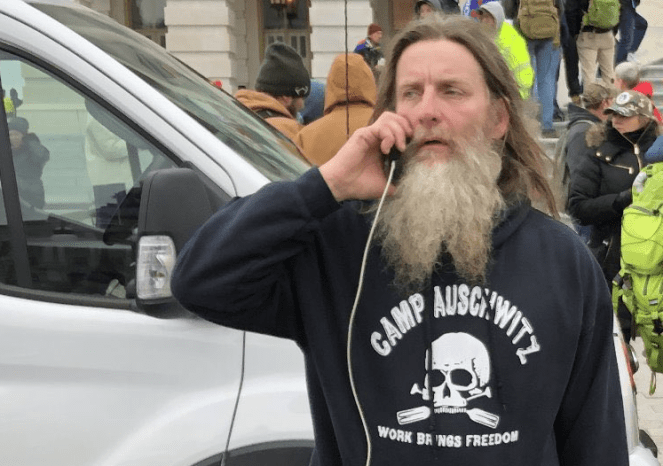
This week, fascists marched on the White House. They carried Confederate flags into Congress. A Nazi showed up among the rioters wearing a shirt that said: “Camp Auschwitz” on the front, and “staff” on the back, as if taking credit for the mass murder of Jews. They proudly displayed nooses, the symbol of anti-Black lynchings. Every brand of far-right conspiracy theorist and white supremacist descended on Washington, and video evidence shows that the police not only tolerated them but let them in.

Where has all our doubt and consideration left us? In our desire to find common ground and engage in reasoned discourse, we now come across as morally ambiguous and uncertain in our principles. We have left an ethical vacuum, and fascists have stormed into it. Intellectual curiosity is little use against the blunt force of white supremacists seeking to violently cease power.

Rabbi Professor Tony Bayfield has pointed out that our uncertainty is what differentiates us from fascists. Fascists are, by definition, absolutists. They do not interrogate their views or consider other perspectives. Our advantage over fascists comes from the fact that we give arguments due consideration and approach our own convictions with humility.

He may be right. Doubt might separate us intellectually from fascists. But it is action that separates fascists politically from power. There is no joy to be had in feeling superior if white supremacists gain power in government.

This week’s events may have been a terrifying climax to Trump’s presidency. But it is equally likely that they are a prelude to worse events. American white nationalists are emboldened and convinced that they can seize power through either ballots or bullets, depending on whichever method suits them. The situation in Britain is scarcely different, where racists have not felt so confident in decades.

Whether Trump now recedes into the background or his racist ideas come to dominate the world will depend on how we act. It will not depend on what we think, but on what we do. Events are calling us to action. If we want to eradicate fascism, we must be willing to fight it.

By all means, have doubts. Moses doubted. Moses was unsure. But God said to him, ‘go anyway. Get down to Egypt and free those people.’

We must be willing to face the Pharaohs of our time with the same vigour. We must be able to say: “I have come to act because God sent me. I am standing for justice because I know it to be right and true. I am standing against racism because I know it to be wrong. I will free these people. I will uproot tyrants. I will defend democracy and advance the cause of the oppressed.”

The integrity of the upright will guide us.

Although we may not fully understand these monsters before us, we will slay them.

And we will vanquish fascism for good.

Shabbat shalom.


I am giving this sermon on 9th January 2021 at Newcastle Reform Synagogue for Parashat Shmot.

[1] Job 1

[2] Job 40

[3] Job 41

[4] Job 42

[5] Job 11

[6] Ex 3

[7] Ex 3:11-12

[8] Ex 3:14

[9] Ex 4:1-9

[10] Ex 4:11-12

[11] Ex 24:7

[12] BT Shabbat 88a

[13] Prov 11:3

[14] BT Shabbat 88b