high holy days · judaism · sermon

It is time to tell a different story about ourselves

It is time to tell a different story about ourselves.

We are writing a story about our lives right now.

On Rosh Hashanah, our story is written. On Yom Kippur, the story is sealed.

What, then, are we doing today? 

This morning, we are editing. We are looking over our story and choosing what to keep and what to discard. What to highlight and what to relegate to the footnotes.

Of course, we cannot change the events of our past, but we can decide what they mean. In writing our story today, we choose what role we played in the narrative of our own lives. 

When you tell this story, are you a victim, or a villain? A saviour or a sinner? 

Look at your mistakes. The way you tell your story will help you decide whether they were a defining part of your personality, or whether they were opportunities you took to learn and grow. 

Look at your suffering. Others have hurt you. You need to tell your own story of what that pain means. You need to decide if your suffering is the sum of your life, or if it is something you overcome. 

You are writing the story of your life right now. Be careful how you tell it.

In our Mishnah, Rabbi Yehudah HaNasi teaches: “Apply your mind to three things and you will not come into the clutches of sin: Know that there is above you: an eye that sees, an ear that hears, and all your deeds are written in a book.”

But here is what the Mishnah does not tell us:

The eye that sees can see more perspectives than we can.

The ear that listens knows all hearts in ways we do not.

And, most importantly, the book is constantly being edited and re-written.

We are always re-writing the Book of Life with our God, and that means we have the power to shape our story.

We cannot imagine that God’s eyes and ears are anything like ours, or that God writes a book the way we would. The story that an Infinite Being has to tell about you must be incomprehensible from your perspective. 

When we tell ourselves our story, we are biased, seeing only our perspective. Our narrative is partial, not knowing what others really feel.  Our account is unreliable, because we tell it to fit the character we have already made of ourselves. 

God, on the other hand, sees not just what we did, but what we hoped to do. God says to the prophet Samuel: “I do not see as human beings see; human beings see only what is visible, but I see into the heart.”

God instructs the Prophet Isaiah: “Whenever anyone turns back to Me for pardon, I freely forgive, for as the heavens are high above the earth, so are My ways high above your ways, and My plans above your plans.” 

God is able to see errors in ways we cannot. And God can understand our pain in a context that is beyond us.

This is because God is telling a different story about you to your own.

In God’s plan, you are the main character. Of course, so is everyone else. 

But that is because God has written a great novel where every creature has a vital role to play. No character could be introduced if they did not have a role in the great unfolding tale that progresses towards goodness’s triumph over evil.

So, today, look at the manuscript of your life. Decide what you want to focus on. Tell yourself stories of gratitude and joy. Consider the events that have given you pride and a sense of accomplishment. 

Look, too, at the stories in your life that are hard. Re-tell the stories of where you have been hurt, and decide for yourself what meaning you take from them.

Re-examine the stories of when you have hurt others, and decide what changes these will bring for you when you enter your next chapter.

In this way, you can take control over the story of your life. 

You cannot change what happened, but you can decide what it means. 

Only you can decide how your story ends.

Treat God as your co-editor, rather than as the author of your destiny.

For some of you, the story I have told so far is too wrapped up in religious language. You cannot get on board with all this God-talk, and the quotations from Scripture prove nothing. 

Let us turn, then, to the science of psychology. 

Over many decades, psychologists have experimented with what makes for a good life. We now have more data than ever about how people forgive. We understand a great deal more about how to overcome trauma. And we know what motivates people to live better lives.

I am going to assume that, if you are here on Yom Kippur, you came because you want to let go of some past hurt, to repent of things you have done wrong, and to live a more fulfilling life.

The Scriptures tell us how to do this, but the language they use may feel too alien to the modern mind. The sciences, however, can corroborate the same claims.

Dr Fred Luskin runs the Stamford University forgiveness project. His team has researched the best methods to help people overcome their grudges and live more fulfilling lives. 

He has tried out his techniques for helping hundreds of people forgive, including in the most extreme cases, like mothers whose children were killed in sectarian violence.

His book, Forgive for Good, is an accessible version of his research.

Dr Luskin teaches that our inability to forgive comes when we tell ourselves a “grievance narrative.” 

You may have such a story yourself. If you keep coming back to an event in your life where you were wronged and replaying it, you may be stuck on recalling a past hurt. If, in this story, there is a clear villain, and you are a helpless victim, the chances are you have a grievance narrative.

Don’t worry, you’re not alone. Many people do. 

I began reading Dr Luskin’s book out of academic curiosity, but soon found I was noticing my own grievance narratives. Some of them went right back to old hurts in school. I looked over some of the stories I had about my own life, and found they did not serve me.

Dr Luskin says that the key to getting out of the trap of these painful stories is to consider how you tell them.

First of all, decide how much space in your mind you want this story to occupy. Yes, you have been hurt, but do you want to keep letting those same people hurt you by giving them unlimited air play in your head? 

One way forward is just to change how much you think about them. Rather than letting them be the main character in your story, focus your internal account on your own successes and joys.

Secondly, consider how you are telling your story. If you have a grievance narrative, the hurt you experienced may determine everything that comes after. 

You were wronged, and that may have a lasting impact. But is it not also true that you survived, overcame, and learnt from the experience? You have the power to tell the story so that you are not a victim, but a hero.

None of this means pretending that pain doesn’t hurt, or that the wrongs others did were not wrong. Quite on the contrary: in order to move on with anything, you have to be able to say how wrong it was, and what it made you feel. 

The difference is that you get to decide what it means. You can decide whether someone else has written your story for you, or whether you are your own author. You can choose to focus your attention on your own pride and resilience.

Just as our faith tells you to pay attention to how you tell your story, so, too, do the psychologists. The story you tell can help shape how able you are to move on from past pain and be a better person.

This is true, not just on the individual level, but also at the collective level. The stories we tell about Jews are the stories we tell about ourselves. What is the story we tell about ourselves as Jews?

There are plenty of stories out there about us. There are stories where we are perfect victims, forever blameless for the suffering we endured. There are stories where we are bloodthirsty brutes, responsible for the worst evils in the world. 

Both of these stories deny us agency. These stories turn us into history’s stock character, whether as martyr or as monster. They deny Jews the ability to do what everyone else does: to hurt others, to learn from our mistakes, and to become better people. They strip us of the opportunity to grow and change.

We need, therefore, to think hard about what the narrative is that we are writing about Jews.

Rabbi Dr Tirzah Firestone sits at the intersection of spirituality and psychiatry. Firestone began her career as a psychoanalyst, then came back to the religion of her birth, embraced Renewal Judaism, and became one of its leading rabbis.

Firestone grew up with Holocaust-surviving parents. She felt that she and her siblings inherited great trauma from her family, and from the stories they told. Or rather, did not tell. Much of their former life escaping genocide was clouded by secrecy. The stories her father did tell were of persecution: that the non-Jews inherently hated Jews and would destroy them at every opportunity.

As a therapist and rabbi, Firestone urgently felt the need to tell different stories about Jews. She insists: “Identifying ourselves as victims freezes our focus on the past, and therefore forecloses our future.”

This does not mean pretending that Jews have never been victims. We need to face up to the traumas of Jewish history, including Shoah, pogroms, and persecution. Ignoring them, and refusing to tell the stories, can actually exacerbate the transmission of trauma.

What we need to do, says Rabbi Firestone, is honour Jewish history without internalising the harmful aspects of Jewish trauma. 

We need to remember that, as Jews, we have collective power. We are able to influence the world, and not just subject to the vicissitudes of history. We must claim our agency, and take ownership over what happens to our future. 

Most importantly, says Firestone, we should draw connections with others suffering from persecuting systems. By making these links, we strengthen ourselves, support our neighbours, and find positive meaning out of difficult circumstances.

We must, therefore, tell a new story about Jews. A story where we are survivors, who have been hurt and used creativity and resilience to overcome our pain. A story where we are complete human beings, who can hurt others, and who can repent and change. A story where our story connects to all of humanity for the sake of a shared future.

The story we are writing does not have to be one where we are always victims, nor incomparable monsters. We can create a narrative that acknowledges our past, honours it, and uses it to direct us towards a more positive future.

On Rosh Hashanah, our story is written. On Yom Kippur, the story is sealed.

We are writing a story about our lives right now.

Today, with the help of God and this sacred time, write your story.

Write a story you can be proud of. Write a story where you have the power to do better. Write a story where you overcome your challenges.

The events of your life so far have already been written. What they mean is up to you.

Gmar chatimah tovah – may you be written in the Book of Life for good.

Yom Kippur Shacharit 5786

sermon · torah

When do we know that the day has come?

How can we tell that it is morning?

Perhaps, says the Mishnah, it is when we can see the difference between light blue and white. Or when we can see the difference between sky-blue and leak-green. Or perhaps it is when the sun is fully visible in the sky.

‘No,’ says the Tosefta. It is the moment when you can stand four paces from a friend and recognise their face. That is when you know that the day has come.

In the sunlight, new rays shine upon a familiar face and you can truly see them. In the morning, when the darkness has receded, you can recognise who is standing before you.

How different is this face, and yet how familiar. I see this person, this stranger, and, if the day has come, they are no longer a stranger. They are recognisable. It is possible to interpret their face fully; to understand it in ways one could not comprehend in the night.

Then we know that it is morning.

This is not just true for the passing of time. This is something that happens in life.

There are moments when we encounter someone we thought we knew, and new information, or a new realisation, means that we see them in a completely new light. They are transformed. And, in that process, we, who thought we knew, are transformed too, and our understanding of ourselves is changed.

In 4th Century Greece, the philosopher Aristotle termed this moment “anagnorisis.” It means recognition, or discovery. Aristotle writes that, in the world of theatre, anagnorisis “is a change from ignorance to knowledge, producing either friendship or hatred in those who are destined for good fortune or ill.” 

How different you appear in the new light of day. I stand four paces away from you and I can finally see that the night has disappeared and some glints of the morning have come.

It is most effective, says Aristotle, when it coincides with a reversal. The one who seemed weak is strong; the one who appeared as a pauper is rich; the one who we thought was dead has been alive all along.

Aristotle presents the example of Oedipus. Throughout the entirety of his tragedy, Oedipus believed he was avoiding a prophecy that warned he would kill his father and marry his mother. In the moment of anagnorisis, at the cathartic climax of the play, Oedipus discovers that he had already fulfilled this prediction right at the start of his story. His father was not his father and his mother was his wife.

The idea of anagnorisis received a revival a few months ago, when the British-Palestinian author, Isabella Hammad, delivered the annual Edward Said lecture. Hammad spoke of anagnorisis as it appears in Palestinian literature, where recognition scenes are crucial.

“To recognise something,” says Hammad, “is to perceive clearly what you have known all along, but that perhaps you did not want to know. Palestinians are familiar with such scenes in real life: apparent blindness followed by staggering realization. When someone, a stranger, suddenly comes to know what perhaps they did not want to know.”

In Hammad’s understanding, anagnorisis is not just a literary trope, but something deeply personal and political, filled with moral meaning.

Let us turn, then, to our own narrative. This week, in the Torah, we witness one of the most staggering moments of anagnorisis.

Joseph wept so loudly that the Egyptians heard him, and Pharaoh’s household heard about it.

Joseph, the Egyptian vizier, strips off his royal clothes, and cries out: “I am your brother Joseph!”

Until this point, Joseph’s brothers believed that he was probably dead, or a slave somewhere miles away. Joseph’s brothers had believed that he was contemptible; a downtrodden misfit. Joseph’s brothers had believed that they themselves were contemptible; that they had sold their own kin into slavery and could never be redeemed for their sin.

Now they learn that Joseph is alive and is, in fact, the vizier over Egypt.

But this itself is not anagnorisis. Because in a real moment of recognition it is not only the characters who understand the truth of their situation, but the audience also discovers something new. We, the audience, already knew that the vizier was Joseph.

So, what did we really find out?

Joseph cried because he finally knew that his brothers regretted what they did to him, and that his father truly mourned his loss. He wailed because he now realised that these brothers could act as a family and care for their youngest brother. Joseph’s brothers were really penitent. Joseph never knew this, and nor did we.

When Joseph sees his brothers as they really are, Joseph changes how he sees himself. 

“Then Joseph said to his brothers, “Come close to me.” When they had done so, he said, “I am your brother Joseph.” One word in Hebrew – just one word – changes entirely our understanding of who Joseph is in this context.

 אֲחִיכֶם – your brother

“I am your brother.”

Joseph recognises himself as someone else. Not as the grand vizier of Egypt, but as the lost brother of his family.

Now we, the audience, can finally understand what Joseph wanted from this tragic play all along. All he ever wanted was to be loved. He did not really want power or favouritism or grandeur. He was just a lonely boy who wanted to be loved and did not know how. He resorted to such ridiculous measures to get attention, but all he ever wanted was to be accepted by his family. He wanted to be their brother. 

This story was not about what we had thought. We thought it was a divine unfolding of a great man’s place in history. We thought we were reading a rags-to-riches story that explained the hidden greatness of our nation and its God.

Then, instead, we see the entire cast as vulnerable human beings. Joseph is just a flawed boy seeking to make his family happy. Judah is just a stupid brother who made a terrible decision and regretted it. This is no tale of triumph, but is a far more gentle narrative, about family reconciliation and the power of repentance.

In the light of this moment, the entire story of the Torah comes into sharp focus. Cain killed Abel. Abraham tried to kill Isaac. Jacob tricked Esau. Laban tried to kill Jacob. Everyone in this family, going right back to the beginning, deployed violence and cruelty to achieve their aims. This is the first time, the climax of the book of Genesis, when these men are able to be vulnerable, use their words, and find healing. 

Suddenly, we understand that this story was not about fulfilling a prophecy but about breaking an intergenerational curse. 

In this moment of anagnorisis, everybody is somebody else. They are not hostages to fortune but breathing human beings capable of shaping their own family relationships. They cease being stock characters and become emotionally deep people who can recognise the vulnerability in each other.

So, how do we know when it is morning?

In the sunlight, new rays shine upon a familiar face and you can truly see them. In the morning, when the darkness has receded, you can recognise who is standing before you. How different is this face, and yet how familiar. 

When you can stand four paces away from someone whom you thought was a stranger, and see yourself anew. That person is not a stranger, and you are in fact a friend.

There is no more a struggle for power, but a moment of recognition. You recognise who you are, and you can finally say: “I am your brother.”

I am your sister. I am your family. I am your kin.

Now I recognise myself in you.

Now I know that the day has come.

Shabbat shalom.

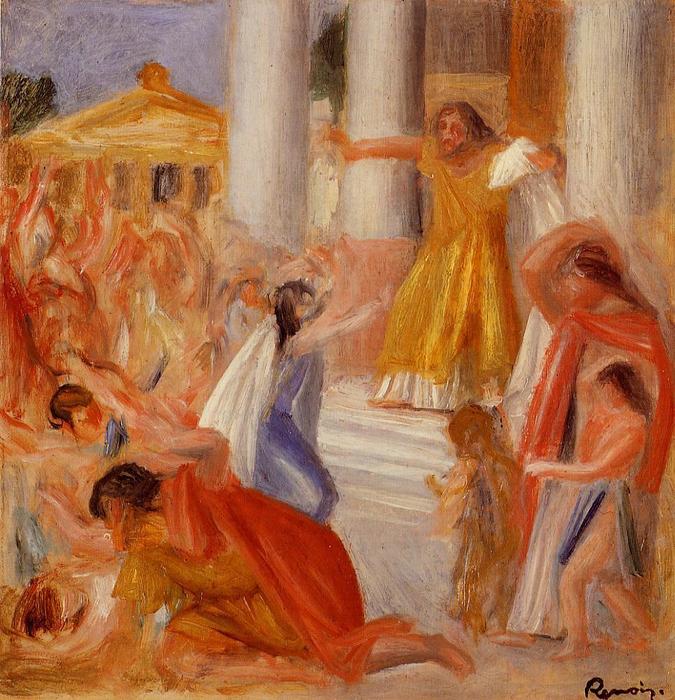
Pierre-Auguste Rodin, Oedipus Rex
high holy days · liturgy · sermon

Do not build a prison in your heart

Imagine a courtroom. Picture those big wooden panels that line the grand hall of a traditional Crown court. The deep reds of the carpets. The judge sitting loftily on a bench,  at the front, draped in black gowns, donning that full-bottomed wig. And all the lawyers surrounding you, speaking Latin and legalese, bewildering you with their words. 

You have not been here before, but, suddenly, you find your life depends on your correct participation. You will have spent extra time ironing your clothes and polishing your shoes. You may have spent weeks picking out an outfit. Perhaps you already know what you would wear. 

How does it feel to stand trial here? Is this somewhere you want to be? From here, how much do you think you will learn and grow? And do you think there might be a better place where you could improve yourself?

This is the metaphor we are often given for Yom Kippur. The Heavenly court and the earthly one. The trial of our souls. The God of Justice, who sits in judgement over us.

We beg for clemency:

סלח לנו – forgive us

We announce our expectation of a just verdict:

סלחתי כדברך – I have forgiven according to your plea.1

We rejoice in the judgement:

אשרי נשוי פשע כסוי חטאה – happy are those whose transgression is forgiven, whose sins are pardoned.2

This is the courtroom of our hearts.

C. S. Lewis, the great 20th Century English author, famed for his Chronicles of Narnia, picked up on this aspect of our thinking. When he wasn’t writing beloved children’s novels, Lewis dabbled in biblical studies as a lay Anglican theologian. 

C. S. Lewis writes: “The ancient Jews, like [Christians], think of God’s judgement in terms of an earthly court of justice. The difference is that the Christian pictures the case to be tried as a criminal case with himself in the dock; the Jew pictures it as a civil case with himself as plaintiff (sic). The one hopes for acquittal; the other for a resounding triumph with heavy damages.”3

Now, Lewis is no antisemite. In fact, he repudiated the hatred of Jews, long before it became fashionable to do so.4 He is eager to point out that, at his time of writing, immediately after the Second World War, the Christian had much to atone for, and the Jew had much to charge against God. 

In many ways, he has us down. We do indeed take this as an opportunity to bring all our charges against God, and to vent our grievances against the injustice of the universe. Lewis is talking about ancient Israelite religion; the religion  of Scripture. 

Lewis would, I’m sure, willingly acknowledge that we modern Jews also share much in common with modern Christians, in terms of our admissions of guilt and prayers for pardon.

C. S. Lewis has astutely picked up that we see all this as a trial. 

But where he errs, I think, is in his understanding of what an ancient Jewish court was. The tribunal of our ancestors looked nothing like the judge’s dock of today. 

A metaphor that worked so well for poets and liturgists many centuries ago can become quite damaging when it is used with the projection of our criminal justice system.

Where today, a court can dole out sentences of imprisonment, the goal of the ancient court was about restitution and social harmony.

Where today, the court expects to find a person innocent or guilty, the ancient court sought to make sure everyone felt like they had a place in their community.

The focus of our sacred writings is to create a society based on compassion, community accountability, and healing.

When we rethink what justice looked like for the authors of our Torah, concepts of trials, pardons, and sentences start to look very different. By seeing the court through ancient eyes, we can re-imagine the trial as a process of growth and healing.

We get mere glimpses of what the earliest courts might have been. In the book of Judges, the archetypal ideal of the judge is Deborah, the prophetess. Her court is a base underneath palm trees in the hill country. We receive an image of her sitting there, while Israelites come up to have their disputes decided.5 Her court was one where people came to negotiate and be heard, but there is no indication they came to be punished. This was in the time of the Judges, the earliest of Israelite civilisations.

Later, however, ancient Israel developed a class system and a monarchy. With a state system came power and punishments. In the book of Samuel, King David pursues after the city of Avel Beit-Maacah, threatening capital punishment against everyone who rebels against him. Here, an unnamed elder-woman comes out. She admonishes the general, saying: “we are among the peaceful and faithful of Israel, will you destroy God’s inheritance?” She rebukes them with a reminder of the old system – that, before there were kings, people used to come and talk out their issues in the city. The generals agree to spare the city, providing they can enact punishment against one ringleader.6

From these two stories, we can garner an insight into what justice may have looked like in the earliest part of the biblical period. The first thing we notice is that women were leaders. This, then, may be a justice system from before patriarchal power was cemented. We also do not detect any hint of crime and punishment. Instead, the courts seem more like public cafes, where experienced negotiators help community members talk through their problems. If this is correct, we are looking at a very different type of court.

Still, courts did develop in ancient Israel, but not like those of today, nor even  of the surrounding empires. In our narratives, most of the times that characters are imprisoned, it is outside of the Land of Israel, by a Pagan power, and unjustly.

Joseph is sent to prison in Egypt on trumped-up charges without any due process.7 Samson the warrior is sent to toil at grinding grain in the jailhouse by the Philistines, not because he has done anything wrong, but as a prisoner of war.8 When the Babylonian rulers send Daniel to the Lion’s Den, it is because of xenophobic laws that stop him practising Judaism.9

Our Scripture treats prisons as something foreign, where good people are sent for bad reasons.

Even when we do see examples of prisons in Israel, they are always treated by the Torah’s authors with contempt. Three of our prophets are sent to prison: Jeremiah;10 Micaiah;11 and Hanani.12  In every single case, this is a monarch warehousing a prophet because they are speaking truth to power. In the Torah’s view of justice, it is hard to see how prisons could have any meaningful role at all.

That does not mean this was a world without punishment. Scripture presents exile, flogging, and even death as options for what might constitute justice in the ancient world.13

Yet, based on our commentaries and traditions, we have the impression that such penalties were implemented only in the most egregious cases. What somebody had to do was so heinous that the death penalty would almost never actually occur.14 

In the Mishnah, we read, the court that puts to death one person in seven years is bloodthirsty. Rabbi Eleazar Ben Azariah takes it even further, saying, ‘One person in seventy years.’ Rabbi Tarfon and Rabbi Akiva say, ‘If we had been in the Sanhedrin, no one would have ever been put to death.’15

What kind of justice system was this then? No prisons, no death penalty? No patriarchy, no punishments? 

The ancient court sounds more like people just sitting around having a chat.

What if it were? What if, instead of biblical justice being all about burning and smiting, it was mostly about negotiating and feeling? How would that change how we look at our tradition? How would it change how we approach our relationship with God?

Perhaps I am over-egging how different the biblical court was. If so, bear with me. 

I am well aware of how terrible some of the Torah’s punishments were. I am also conscious that what I am describing is so outside of our reality as to make it feel fictitious. If the world of restorative justice I am describing never really existed, please at least indulge me in entertaining the possibility that it could. 

We are not, in this room, coming up with a proposal for how to govern Britain. We are just asking what metaphors work when we think about how to hold our own hearts on Yom Kippur. For me, the metaphor of court cases has proven really problematic, and I am looking to explore new ones with you.

The problem of the courtroom metaphor initially struck me quite suddenly. I was talking with my therapist about an issue that I felt kept coming up in my own behaviours. I said: “I’ve got another case to talk about…”

He looked around the room and said “you know you’re not on trial here, right?” 

I think I had expected, on some level, that, through counselling, I could be acquitted or found guilty for all my past deeds and thought patterns. 

I had built a prison in my own heart, to which I could sentence the parts of myself  I liked least. I had conjured up a jury in my head, who would judge all my actions, according to the standards I had set myself. According to the standards I imagined God has set for me.

What was I doing? The point of therapy is not punishment or exoneration. It’s to learn and grow, and find ways of being better in the life I actually have. The point is not to condemn or discard my negative traits or past mistakes. The point is to work towards loving all of myself and learning from all I have done.

Perhaps you can relate to this. Have you imagined how you might punish others, or cast them into our prison in your heart? Maybe you even seek to punish people or get them out of your life. Maybe you, too, have hoped there were parts of yourself you could lock away.

We cannot apply the carceral system to our spirit. When we are doing wrong or feeling guilty, we must be free to look ourselves in the eye, and change willingly.

Is this not what God wants from us, after all? That we make amends, grow, become better. That we embrace ourselves and each other. That we turn from our ways and live. 

If, then, we are in a court with God, we should make it one where we are in conversation with a loving elder, not facing a law lord who seeks to punish and acquit.

So, let us imagine a new court. It is not the court we thought into existence at the start of this sermon. It is a very ancient one, where our ancestors went thousands of years ago. Deborah’s court. 

You are in the dusty scrubland of Canaan, and a few yards away you can see an oasis. People are gathering around it to fetch water. They are laughing and catching up and telling stories. They are feeding their livestock: sheep, goats, donkeys, camels. 

At the edge of this well is a row of palm trees, and the tribal leaders sit, drinking sweet tea. You cannot go to prison. There is no prison. You cannot be acquitted, because nobody thinks you are guilty. You are just a person, a member of the community, looking for a way through a problem. The goal will be to find a solution that benefits everyone, and that sees maximum spiritual growth. 

When you come away from this court, you can say “happy is the one whose sin is forgiven.” You don’t mean that you are relieved because you thought you were in trouble. You mean you are jubilant, because you are at peace with yourself, your community, and your God.

Let this be your court. Let this be the place you take your heart over Yom Kippur. 

Come before God, not as a claimant nor a defendant, but as a congregant, seeking growth.

And thank God that there is no prison in your heart; only an opportunity for ongoing healing and change.

May this be where we judge ourselves. May this be where we judge others. 

And let us say: amen.

  1. Birkat Selichot ↩︎
  2. Psalms 32:1 ↩︎
  3. CS Lewis, Reflections on the Psalms ↩︎
  4. PH Brazier, A Hebraic Inkling: C. S. Lewis on Judaism and the Jews ↩︎
  5. Judges 4:5 ↩︎
  6. II Samuel 20 ↩︎
  7. Genesis 28 ↩︎
  8. Judges 16 ↩︎
  9. Daniel 6 ↩︎
  10. Jeremiah 37 ↩︎
  11. I Kings 19 ↩︎
  12. II Chronicles 16 ↩︎
  13. Ezra 7:25-26 ↩︎
  14. eg. BT Sanhedrin 71a ↩︎
  15. M Makkot 1:10 ↩︎
sermon · talmud

Approaching an ending

We are approaching the end of our time together.

In January, I handed in my notice. 

Over the last few months, I have packed away my books and cleared my office.

On Wednesday, I will hand back my keys to the synagogue building.

Today is the last time I will stand up here and address you. 

We are approaching the end of Pesach. In two days from now, we will carry out our final service of this festival. In the evening, we will start eating leaven again, and bring back out our toasters and bread machines.

We are also approaching the end of the rainy season. In ancient Israel, this time of year marked the transition from when they hoped for life-giving downpours to the dry heat of summer when they prayed for morning dew.

The rabbis could not agree on exactly when the change took place. The Mishnah asked when we should stop praying for the rain and switch to asking for dew.

Rabbi Yehudah said: “We should keep our prayers going until the festival of Pesach has ended.” 

Rabbi Meir disagreed: “We should keep our prayers going until the end of the month of Nissan.” 

Centuries later, in Babylon, Rav Hisda came along and said: “this is not difficult.”

Now, this is the Talmud. If I’ve learnt one thing from studying the Talmud, it’s that, when a rabbi comes along and says something isn’t difficult, what follows will be really confusing.

Rav Hisda says these rabbis do not actually disagree at all! They’re just talking about different things. There’s a difference, he says, between praying for rain, and mentioning rain in your prayers. 

Clear? As muck.

You can see why this question made the rabbis feel anxious. Endings are hard. And knowing when one thing ends and another begins is important. 

Don’t worry. Another rabbi, Ulla, comes in. He says the problem isn’t that Rabbi Meir and Rabbi Yehudah disagree with each other. It’s that there are two different ways of reading Rabbi Yehudah. 

We are going to have to agree with Rabbi Yehuda, says Ulla. We’re just not sure what he means.

Rabbi Yehuda says that prayers for rain end when Pesach ends. And we agree with him.

But hang on a minute! When does Pesach end?

A whole new raft of rabbis enter the discussion, each with conflicting opinions. 

Personally, I would have thought Pesach would end at evening on the eighth day. The rabbis do not even consider this as an option.

No – their first suggestion is that Pesach is the first day, so that is when we should shift our prayers.

But we don’t put requests into our prayers at festivals. They’re like Shabbat – they’re God’s days off from being bothered by us. So that can’t possibly be the day we stop asking for rain. We weren’t going to ask for anything then anyway.

So maybe,  instead, after Pesach means after the need for slaughtering a paschal lamb has passed. In Temple times, the paschal lamb was killed just before the Pesach festival started. 

So the prayers for rain end when we would have slaughtered the paschal lamb. 

But that would mean Pesach ends before Pesach starts!

And the Talmud is even more confused now, because we no longer have a Temple and we live in the Diaspora and we are still nowhere closer to knowing when one prayer for rain stops and another one starts.

Clear? But Rav Hisda said it wasn’t difficult!

OK I have chosen a really complicated bit of Talmud to hang this sermon on. I still don’t understand it myself. Maybe that’s just because the changes of seasons really are confusing.

Perhaps the Talmud doesn’t quite want to resolve the question. They want to leave us hanging, so that there is always a slight liminal time when one season is ending and another is beginning.

Transitions are hard. In fact, this sugya of Talmud keeps coming back to the same stock phrase: this isn’t difficult. It seems to say it so often because it knows that it is.

This obviously matters to me, because I am standing here in liminal time, in the gap between having been a rabbi here and not being one anymore. It is important to say, with surety, that there is an end date. I won’t be preaching here again.

But I think we can learn something from the Talmud too. The Talmud knows that sometimes dew comes in winter and sometimes there are heavy downpours when it’s dry. All water is part of a bigger cycle of seasons. 

The rain teaches us how transitions carry within them all that has gone before and all that is yet to come.

Seasons and rainfalls are strange, transitory moments. We can read great meaning into them. 

Having a clear sense of when one passes into another matters. So let’s make this our moment of acknowledging a shift. 

This is our last time praying on Shabbat together. It is my last time preaching from here. 

You will continue to grow in this community, and I will go and minister elsewhere. 

And, just like the passing between the winter and the summer rains, we will always be part of the same water cycle. Our rains will be part of each other forever.

I will hold onto and cherish the droplets I carry from Oaks Lane. Your piety, your care for the sick, your love of music, your attention to detail, your Yiddish soul. 

I pray that some of the best of the waters I poured here will stay, and that you will find some use in them too, after I have gone.

It has been a privilege.

Shabbat shalom. 

judaism · sermon · torah

Perhaps we are not powerless

I have a horrible, on-off relationship with the news. I wouldn’t call it a love-hate relationship so much as a hate-hate relationship. 

There are days when I can do nothing but stare at it, soaking in every detail: climate collapse; species extinction; earthquakes: natural disasters; social breakdown; cost of living; refugees in detention centres; wars, wars, wars…

And then there are days when I switch off entirely. I become so overwhelmed I refuse to hear the radio or see current events on TV. I don’t look at any of the news apps or social media for fear that I’ll be reminded of all that is wrong in the world.

Whether endlessly scrolling through the horrors or studiously avoiding admitting they are there, I think I’ve become trapped in a cycle of feeling powerless. It’s all so big, and so frightening. 

But what can I do? I’m one person, seeing the world collapse, and all I can do is observe. 

If this feels at all relatable to you, perhaps you’ll find some comfort in this week’s Torah portion, as I did.

After all, didn’t Moses feel too small and powerless too, at the beginning? He tried to change things, and look where that got him. Stuck in exile, looking after sheep. Moses looked at all that was wrong in his world, found it far too much to bear, and retreated into the wilderness. 

And he would have stayed there too. He could have lived out the rest of his life with a lovely family tending flocks in Midian. 

But God had other ideas. God heard the cry of the Israelites in bondage and decided it was time to set them free. 

So God reached out to Moses from a thornbush. God set a small thicket in the wilderness ablaze and called Moses on his mission.

A thornbush, of all things. Why would God decide to speak from such a lowly and despised place? The thornbush is, at best, a plant to be ignored and, at worst, an annoyance that scratches against bare legs. It’s the desert equivalent of stinging nettles. 

In our Talmud, Rav Yosef says: not because the thornbush is the greatest of plants did God choose to speak from it, but because it is the least of the creatures. God disregarded all the most beautiful trees of the desert in order to be with the lowliest. 

Similarly, God chose to give the Torah from Mount Sinai not because it was the highest or most magnificent of desert peaks, but because it was small and covered in unremarkable roughage. 

In the natural world, God singles out the powerless and unimportant. That’s where God works the real miracles. 

That’s why God chose Moses too. Moses had no idea of his miraculous birth or impressive destiny. As far as he was concerned, he was a loner in the desert.

When Moses gets the call, it’s not God that he doubts. He doubts himself

His first question is: “Who am I that I should go to Pharaoh and bring the Israelites out of Egypt?”

God doesn’t build Moses up or tell him how he wonderful he is. He says: just trust. Have faith.

We don’t get to decide what times we live in or what role we have to play in them. God decided that Moses was going to take the Israelites from Egypt and that was what was going to happen.

But Moses still can’t see how he can make a difference. He doesn’t doubt God’s power, he doubts his own. He says: “what if nobody believes me? What if they don’t listen to me? What if they don’t trust that I spoke with God?”

At this point, God shows Moses some miracles. We might think these miracles are about God flexing Divine might, showing Moses all the wonders. In fact, a bush burning in the desert without being consumed by flames would be quite enough to achieve that.

These miracles aren’t about showing God’s power: they’re about showing Moses his own. 

First, God turns Moses’s shepherd’s crook into a venomous snake. Moses recoils in fear. Then God turns it back again.

Next, God afflicts Moses with a deadly skin disease. Moses thinks his life is over. Then God heals him.

Both miracles make Moses face his greatest fears. They are exposure therapy. The worst thing that Moses could imagine is death. God shows him that he can stare it in the eye. Moses thinks he is not brave enough. God shows him that he is.

It’s not that Moses ever doubted God’s power. What he doubted was his own. Now God shows him he does indeed have power. He is stronger and more resilient than he realised.

It’s not that Moses ever doubted God’s importance. What he doubted was his own. Why would anyone care what a stammering wreck like him had to say? 

When God performs miracles through Moses, the message is clear: “I, the Eternal One, care. I care enough to work wonders on you. I care enough to meet you in the desert. I care enough to save you from death.”

And, if God can care about Moses that much, why can’t the Israelites? Why can’t Moses care about Moses that much?

Still, Moses is not ready to own his power. He protests to God: “I can’t speak. I’m slow of speech and stammer constantly.”

God gives the perfect answer: “And who made you that way?”

God made Moses that way. God decided that Moses would be who he was. His speaking ability is not a flaw – it’s the characteristic God gave him that makes him exactly the right man for the moment.

What a message this brings for us, who feel so powerless and insignificant. 

What are we but matter in the void, and yet the Creator of the Universe has chosen for us to be alive at this time?

Who are we with all our foibles and imperfections? But God has made us exactly as we are.

So why don’t we trust in ourselves, and recognise our own power? 

Don’t ask why God made a world with so many problems and sent no solution. The solution is here: God made us.

So I think I need to stop the cycle of doomscrolling and avoiding. Life isn’t just something that happens to me – it’s something I make, too. Society doesn’t just exist apart from me, I’m an active player in making it. And the news isn’t just something that lives on TVs and in devices – it’s something that we can create, every day, if we so choose.

In the Mishnah, Ben Azzai teaches: “Hate nobody, because everyone has their time and everything has its place.” 

We did not choose to be born here and now, but God saw fit that we should be alive at this place and time. God wants us here, in this moment. 

We are like that weedy thornbush in the desert. We might seem insignificant. But God has chosen for us to be here. And, because of that, we can burn brightly enough to change everything.

Shabbat shalom.

judaism · sermon

How to be a Jewish man

וּבְמָקוֹם שֶׁאֵין אֲנָשִׁים הִשְׁתַּדֵּל לִהְיוֹת אִישׁ

Pirkei Avot 2:6

“In a place where there are no men, strive to be a man.”

This is one of the central teachings of the founder of rabbinic Judaism, Hillel. You may know him better from his famous aphorisms “treat others as you would be treated” and “if not now, when?” This one gets quoted a little less. Perhaps it is because we instinctively recoil at the expression. It brings to mind those horrible exhortations to “man up.” 

So uncomfortable are we with the idea that some have reinterpreted the verse as “in a place where there is no humanity, strive to be human.” We want to make it gender-neutral, so as not to exclude over half of the Jewish population. But it seems to me that the verse means what it says: “in a place where there are no men, strive to be a man.” 

This is a teaching about masculinity, and it comes with Hillel’s own manifesto of what it means to be a Jewish man:

A brute cannot fear sin; an ignorant person cannot be compassionate; a lazy person cannot learn; an angry person cannot teach; and a money-grabbing person cannot become wise. 

These are the qualities of masculinity Hillel is seeking to impart: be conscientious, not brutal. Be loving, not bigoted. Be studious, not idle. Be generous, not rash. Be sagely, not greedy.

This is a far cry from the image of manhood many of our boys are receiving. 

This week, I want to talk about manhood and masculinity. I must, therefore, apologise to the rest of the room, because, in many ways, this sermon is mostly for the men. I hope, however, that the women and non-binary people in this community will appreciate that this is coming from an urgent need to intervene in ongoing conversations directed at teenage boys in Britain. 

Every few years, a new figurehead emerges for an unfolding crisis of masculinity. Their goal is to bring back an imagined past of burly blokes who hunted animals, chopped wood and went to war. Right now, their leader is Andrew Tate – a man who looks like he stole the entire Russian Olympic swimming team’s supply of steroids. 

Tate is a famous YouTuber, determined to restore what he sees as masculinity lost to a war on men. He wants a return to men’s “natural instincts” as territorial, violent and unemotional. He advocates for men to adopt avarice and aggression to bend the world to their will. His advice to his subscribers is to control, manipulate and stake ownership over women. 

He has even forayed into the world of theology, saying: “Read the Bible, every single man had multiple wives, not a single woman had multiple husbands. It’s against the will of God.” This is his justification for having multiple “girlfriends” whose passports he has confiscated and made to work for him in scam call centres.

This misogyny is taking a sinister hold on our youth. A study carried out only a few months ago found that 8 in 10 British teens had watched his videos and nearly half had a positive view of what he had to say. Increasingly, schoolteachers are raising alarm bells about boys being radicalised into sexism.

We have to be honest. If boys are looking to answers like these, it is because they are confused about what their role is in our society. We have to be able to answer them with better values and better role models.

Let us look at the example of Moses. Early on in his story, Moses witnesses a slaver beating an elderly Israelite. According to our Torah, Moses looked this way and that, saw that there was no man, and beat the slaver back. Our tradition asks: what can mean that Moses saw no man? We know that everyone saw what Moses did. 

Rather, he saw no man in the sense that Hillel advocated. He saw nobody who cared enough to do anything. The rabbis rebuke Moses for his violence, but praise him for his motivations. What made him a man, in this setting, was that he burned with compassion, even for a complete stranger, and the lowliest in society. His masculinity is defined by his sense of love and justice.

Right now, Andrew Tate is going through the judicial courts in Romania for human trafficking, sexual exploitation, and violence against women. Tate is nothing like what Torah imagines to be a real man. He has literally taken on the role of the slaver. He is everything that God sees as contemptible and wrong.

In this week’s parashah, Moses warns the Israelites not to become like the other nations. He insists that Israelites must not be seduced into worshipping what others worship or valuing what they value. Their practices, Moses warns, burn their sons and their daughters. So it is with the misogyny we see here: it might look alluring to some, but are ultimately destructive.

According to Professor Daniel Boyarin, one of the world’s leading Talmud scholars, Jewish masculinity has always been articulated differently. In Eastern Ashkenaz, the ideal male was gentle and pale, buried in books, concerned with sensitivity and kindness. They imagined the non-Jews, by comparison, as brutes. Their boasts of success in domination of women, land, and resources were dismissed as “goyishe naches.”

For most of Jewish history, women have been the primary breadwinners in households. This is still the case, especially in the most traditional communities. Eastern European Jews prized many of the things that non-Jews saw as feminine traits. They were musicians, gardeners, candle-makers, tailors, and translators. Our Christian neighbours were so surprised by Jewish men’s commitment to housework and childcare that it was even a common rumour among gentiles that Jewish men menstruate. 

Think about this in the context of the bar mitzvah, and what we do to turn Jewish boys into men. They are set the task of learning a new language, and mastering a section of holy text. We get them to talk about how these words make them feel, and treat their ideas as if they matter. We send them on expeditions to do charity work, getting them to raise money, visit the sick and care for the elderly. We encourage them to lead the community in prayer. These are the values of traditional Jewish masculinity: scholarly, thoughtful, emotional, charitable, and caring.

Professor Boyarin is keen to be clear that this does not mean Jewish masculinity is unproblematic. After all, we, too, have operated a patriarchal society, and it is still an ongoing struggle, even in Reform synagogues, for us to produce gender-equal communities. 

Personally, much of my own journey over the last three years has been to learn that being a man is not just about self-sacrifice, but must also include self-care. I had imagined my only role was to provide, and didn’t know how to receive. I have had to learn to talk about feelings with trusted friends, include my own needs in important decisions, and strive towards open dialogue. This is hard, but I recognise that this is part of the work of becoming a good Jewish man.

I know that there are many men in this community who have been on similar journeys. I see the way you love your families; how you treat discussions with reasoned compassion; how you have spent your lives perfecting your professional crafts; how you seek to model your lives on Torah teachings of gentle wisdom.

That is why this is a heartfelt plea to the men in the community to talk with teenage boys in their lives about what being a man means. Teach them what you have learned about respect, tolerance, and sensitivity. Talk to the boys. Because somebody else is talking to them, and you would be horrified by what he is saying. 

And if his ideas infect the minds of our youth, we will lose our nice Jewish boys. And then there truly will be no more men. 

So, in a place where there are no men, strive to be a man. A loving, kind, generous, sensitive, and gentle man.

Shabbat shalom. 

festivals · high holy days · sermon

From an open roof to a closed scroll

We are nearing the end of Sukkot and entering Simchat Torah.

We move from fragility to strength, from an open roof to a closed scroll, from the impermanence of life to the eternal truth of God.

What makes a sukkah kosher is its frailty. With its open walls and starlit roof, it stands in for all our wanderings and confusion. It is makeshift and temporary.

In its fragile state, it teaches us about the human condition: that we are vulnerable, at the whim of forces beyond our control. Into this transient home, we bring guests, both living and ancestral, who teach us that we only live by community. 

The sukkah teaches us about the human heart: that it must be open and porous, welcoming to strangers, able to let others in and accept our own emotional helplessness.

But the sukkah also has another feature of what makes it kosher. It must be able to stand for eight days. It must be strong enough to withstand the weather. It cannot be drowned by rain or upended by windstorms. 

This, too, teaches us about the spirit. We must be resilient. We must be confident enough to know our boundaries. We must be strong enough not to let others wave or topple us.

This is the tension we hold in the transition between Sukkot and Simchat Torah: between fragility and strength.

There is a story that Abraham’s tent was open on all sides. 

Wherever Abraham looked, he could see whether strangers were coming to visit him.

If he looked out and saw them coming, he would run to meet them. Abraham was the model of generosity, so full of love for the wayfarer that he would do anything to let them in.

This explains why he greeted the angels who came to visit him at Mamre so enthusiastically, even though he thought they were just human beings. It explains how he was righteous enough to receive God’s blessing, and to become the progenitor of monotheism. 

This is the version of the story that we find in Bereishit Rabbah, and you will find it printed in all sorts of commentaries. It is a beautiful myth that captures our imaginations and features heavily in sermons preaching charity. It teaches us about the importance of welcoming. 

But it is not the only version of the story in rabbinic literature. A few centuries later, Avot deRabbi Natan, a commentary on the same text, explains it slightly differently. Instead of the example of Abraham, this midrash says we should be like Job. 

It teaches:

Your house should have a spacious entrance on the north, south, east, and west, like Job’s, who made four openings to his house. Job opened up every side so that the poor would not be troubled to go all around the house: no matter what direction a stranger came from, they could enter in their stride.

At a glance, it tells the same story, just with a different prophet named. Job was also described as righteous and upright, a man who feared God and turned away from evil. 

But there is a difference. Unlike Abraham’s, Job’s house is actually mentioned as having four sides. How do we know? Because, at the very start of Job’s story a messenger comes to tell Job that his house has blown down. “A mighty wind swept in from the desert and struck the four corners of the house. It collapsed on the young people and they are dead.”

Job’s house was so open that it was destroyed and killed everyone in it.

Job’s house was open on all sides. No wonder it fell down!

This later midrash is satirising the earlier one. Sure, openness is good, but too much openness leaves you exposed. 

We have to exist, instead, in the tension between fragility and strength; between vulnerability and boundaries.

It may seem strange to preach boundaries from the bimah. Admittedly, it feels strange to me. 

I used to believe that openness was the ultimate religious value. That being hospitable and welcoming were the most important spiritual attributes. And I do still hold them in high regard.

But I am increasingly learning that it is equally important to have structural integrity, and borders, and lines that cannot be crossed. Without them, the entire structure collapses, and the people the structure was established to protect can be destroyed with it.

Sukkot teaches us to live with utmost susceptibility, but only for a short time. We must eat and sleep and live in this shaky fruity shack, exposed to all elements and strangers. It teaches us to put ourselves in harm’s way. 

But not forever.

At some point, the sukkah must come down. At some point, we must return to our own beds and kitchen tables and modern comforts. At some point, we have to hold on to something firm.

As we enter Simchat Torah, we turn to that certainty. That is our Torah, our faith, our belief in God-given moral truths. We grasp it steadfastly, and refuse to waiver from it.

Torah is our foundation. It is our immovable structure. There is some truth that we must hold on to tightly, never allowing it to be permeated or eroded. For us, that is our moral conviction.

The Mishnah instructs us to build a fence around the Torah. This commandment has been abused by some in Orthodoxy to justify always taking the most conservative approach, defending every law against the slightest leniency or adaptation. As such, Reform Jews have often poured scorn on the assertion, seeing it always as a reactionary threat.

But a fence is not the same as a wall. In fact, the word used in the Mishnah is siyag, which is closer to hedge. It is a boundary. It is a line that keeps some things in and some things out. It is a way of protecting the essence. 

That does not mean it has no ways in and no ways out. It just means that some things must be shielded. 

We are nearing the end of Sukkot and entering Simchat Torah.

We move from fragility to strength, from an open roof to a closed scroll, from the impermanence of life to the eternal truth of God.

We have learnt to be vulnerable and precarious. Now, we must learn to protect what we love.

Shabbat shalom.

Shabbat Chol HaMoed 5783, October 15th 2022

judaism · social justice · story

Welcome to the Queer Yeshiva

Hello and welcome to the Queer Yeshiva.

My name is Lev. I’m one of the teachers here, with Jo, Hava and Daniel.

A month ago, I was ordained as a rabbi. One of the things that most made me want to be a rabbi was bring gay. I wanted to be part of a religious life that made being queer feel as empowering and magical as it really is.

I love being queer. I love queer people. One of the things I love most about us is that no matter what life throws at us, we always rebuild.

I think about the lives of queer people. Everyone I know has had to struggle with who they are, face down violence, and out of adversity, rebuild themselves as someone stronger than anyone could have imagined.

When I was a kid, I was already too fabulous to be contained. All I wanted in life was to wear dresses and do Spice Girls dance routines. I knew I was different and I didn’t care.

But the rest of the world did. I grew up in a small town with few opportunities. For most of my teens, I was beaten up on a near daily basis. I was attacked at school, walking home, in the shops, and outside my front door. That was only the other kids. The adults were worse: at best they ignored it; at worst they encouraged it. At the school leavers’ assembly, the teachers gave me an award for “most likely to have a sex change.”

But I’m not bitter. I’m proud. I came out of all that knowing who I was and willing to fight for others. That’s why we have parades. That’s why we stand up celebrate our community, because we have withstood discrimination and violence and built out of it fantastic cultures. All that queer art, queer music, and queer innovation- that came out of queer struggle. We are who we are because of who we were.

And that’s not limited just to us here. That’s something queer people have to do in every generation. Think how many times we have been destroyed, and think how many times we have rebuilt.

Consider only the last century. At the beginning of the 1900s, our people were dealing with criminalisation, as many had been imprisoned. Against that backdrop, Magnus Hirschfield created the Institut for Sexualwissenschaft, pioneering the understanding of queer people.

His work was burned by the Nazis. Queers were turned into pariahs and murdered in te death camps. Even once the Second World War was over, many homosexuals were forced to stay in prison to complete their sentences.

In the aftermath, our ancestors picked themselves up again. They built the Gay Power movement. They formed the Lavender Menace. They created the ballroom scene in the nightclubs of New York.

Once again, they were decimated by the AIDS crisis. Government indifference and vengeful homophobia killed a generation of queers.

And still, we could not be destroyed. We came back stronger, demanding legislative changes and pushing for a transformed world. We recreated community to fight for our liberation.

In every generation, people have tried to destroy us. In every generation, they have failed. We will always rebuild. We will always imagine a greater future. We will always reappear.

We are indestructible.

In that sense, we are the heirs to the rabbinic tradition.

Judaism, as we know it, is the product of people who saw their world crash around them repeatedly and, every time, rebuilt it.

Our Judaism was born out of a time of fundamental crisis. At the start of the last millennium, the Jews were a nation. They had their country, the land of Israel. They had their capital, Jerusalem. They had their cultic centre, the Temple. They had their religious leadership, the priests. And they had their religious practices, sacrifices.

Then, they faced catastrophe. The Romans came and waged an aggressive war, killing off the leadership, and starving the people of Jerusalem. They destroyed the Temple and abolished its customs.

Yesterday was the fast of Tish BAv. It was, for many religious Jews, a day of weeping and despair. We recalled the genocide, the disruption, the pain. We remembered the destruction of the Temple in the context of all the times that Jews have been destroyed.

But, in that act of ritualised remembering, we also remember that we have survived. Jews and Judaism have kept going, even two thousand years later.

Let us remember why.

Faced with annihilation, the Jews had three choices. One: they could dig their heels and pretend nothing happened. They could decide that they were going to carry on with the Temple and the priesthood, even though they were gone.

Two: they could abandon their old religion altogether. That was what normally happened to ancient peoples when they were conquered: they gave up their old traditions and gave in to colonisation.

Three, the third option: they could retell their story for the sake of their contemporary situation. They could look at everything they had been, and use their history to reimagine their future.

Our rabbis chose option three.

Put yourself in their position.

Imagine you were there, not just in the aftermath but right in the thick of it. Jerusalem is under seige. Your family are starving. Your people are fighting the Romans, but mostly they’re fighting each other. You can see your world on fire. You don’t even know if you will survive.

What would you do?

That’s how it was for Rabban Yohanan Ben Zakai. He was alive then. That was what he saw.

He told his students to put him in a coffin, pretend he was dead, and smuggle him out of Jerusalem. Once out of the besieged city gates, he got out and demanded to speak to the Roman emperor, Vaspasian.

As it happened, Vaspasian was willing to compromise. He said: “OK, tell me you want.”

Rabban Yochanan Ben Zakai said: “Give me Yavne and students of Torah.”

What was Yavne? It was a refugee camp in the middle of nowhere. It was filled with displaced people. Who were the students of Torah? Just a bunch of people who remembered what the old religion used to be like.

Why? Why would you ask for such a thing? If the commander of the imperial Roman army is willing to negotiate, why not find a way to get the troops to leave?

Because a people that knows who they are cannot be destroyed.

Sure, the colonisers might go, and the Jews might live, but Judaism could end. The only way for anyone to live on after facing near annihilation is to look at where they’ve been. They have to take a long look at their story and reimagine it for a new era.

Rabban Yochanan Ben Zakai and his students learnt everything. They committed to memory their whole history so that they could recite it by heart.

Then, they revolutionised it. They said: we don’t need the land of Israel or Jerusalem any more. From now on, we’re going to be spread across the whole world. We’re going to make our religion portable so that it can be sustained in any nation.

They looked at their Temple and its sacrifices and said: we’re not going back to that. We’re going to reinvent our practices. We will replace them with prayer and study. As long as people keep our words alive, we won’t need for animals to die.

They looked at the priesthood and said: that’s done. From now on, we have no hierarchy.
From hereon out, we are equals. The measure of Jewishness won’t be who your father was but how imaginative you can be in reexamine your tradition.

They looked over their old systems of justice, and interrogated them. Who is included here, and who is left out? What is justice going to look like for us now? They were so radical that they tried to work out how they could turn the Torah against the Torah.

And that instantly transformed Judaism. Rabbi Yochanan’s disciples weren’t from the elites. They were blacksmiths and peasant farmers and outsiders. They saw, from that vantage point, how their people could creatively rebuild. And that is why we have our Judaism today.

And here’s the thing. Rabbi Yochanan had, maybe, ten students. There were fewer people in his beit midrash than there are in this room.

You only need a handful of visionaries to spark a revolution.

Be in no doubt, that is what could happen here this week.

We are, as always, facing catastrophe. Queer people are under attack once more. The planet is burning. Capitalism is in crisis. The old ways of doing Judaism are floundering.

Do you think that the future of Judaism is going to be secured by happy people in their comfortable homes? No way. They have nothing to lose from the current situation. They don’t have the imagination to see how things could be different.

The future of our people lies with those on its margins. Its the queers. It’s the weirdos. It’s the radicals. It’s you.

That’s why we’re here. We’re going to do what queers and Jews have always done. We’re going to rebuild while our world is on fire.

We’re going to learn everything we can, internalising the words of our ancestors so fully thar they will travel with us everywhere. We’re going to re-analyse them in light of our own circumstances, seeing how these traditions bear on our own lives and struggles. And, out of that, We’re going to completely retell our story.

This is where the future of Judaism starts again.

I love being queer. I love queer people. And I can’t wait to see what we achieve.

This talk was based on the Crash Talk by Rabbi Benay Lappe, used for Queer Yeshiva Summer Intensive 5782 in Essex

judaism · sermon · social justice

You are not sick

Imagine if I stood up here on a shabbat and I told you I could fix you. 

Imagine if I said there was something fundamentally wrong with you. That some property intrinsic to you, about your soul, was fundamentally wrong. Sinful.

Imagine if, when we read out the names of people in need of healing, your name was on there. You hadn’t asked to be placed there and you felt fine. But somebody in the community had decided that who you were, as a person, was contrary to their religious beliefs, and that made you sick.

Imagine if your child or grandchild came to see me at the synagogue and ask for rabbinic advice about their personality. Instead of offering them love and support to be happy with who they were, I told them that they needed to repent. I told them that God thought they should feel guilty. I told them they should pray and fast until the wickedness in them was gone.

Imagine it. Imagine any preacher in any religious building doing such a thing.

You don’t have to imagine. It happens today, here in Britain.

It is called conversion therapy. 

Conversion therapy is when queer people are told, often by a religious leader, that prayer, exorcism or counselling can change their gender or sexuality. It is when somebody tells a gay person that they can be made straight, or a trans person they can be made cis.

It happens in the British Jewish community. One survivor of this practice, Joe Hyman, spoke out about how a religious Jewish group tried to counsel him out of homosexuality. At first, it involved telephone appointments where he was told he could be healed. He sat round in a room and was forced to examine every homosexual thought he experienced through a lens of judgement and shame.

Another British-Jewish woman, Maya, went through conversion therapy classes that told her that her parents hadn’t nurtured her enough and that she must have been abused as a child. 

There are Jewish retreats in New York and Israel, where participants are made to do psychologically damaging activities including stripping naked and berating themselves while staring at a mirror.

You might well wonder why such an abhorrent practice has not yet been banned. For that, you would have to ask Boris Johnson. 

This week, his government leaked reports that they have abandoned plans to stop conversion therapy. They have bowed to pressure from conservatives and fundamentalists. 

When the various LGBT charities expressed their outrage, and the public followed suit, the government back-pedalled, but only slightly. They said they would ban conversion therapy for sexuality, but not for gender identity. They have decided that lesbian, gay, and bi people should not be subjected to this psychological torture, but that they will keep it up for trans people. 

Not content to only permit the practice, the government has decided to get in on bullying trans people. Boris Johnson used a recent speech to mock trans people. A public discourse has emerged that pathologises and humiliates people who do not conform to gendered expectations. 

Trans women, in particular, are the subject of a horrible narrative of hate. I don’t think it would be helpful or responsible to repeat the things I’ve heard, even from respectable platforms like the BBC. You have probably heard it too, and speaking it from the pulpit would only lend this hate speech legitimacy it doesn’t deserve.

The pathologisation of sex and bodies is as old as the Bible. In ancient Israel, when a person’s genitals seemed emitted an unusual discharge, or found they could not ejaculate, a priest would declare them a zav. This meant they were ritually impure, prohibited from entering holy places and forbidden from engaging in acts of worship. 

This was not just recognising the existence of genital problems or sexual diseases. It was making them into signs of defilement. It was saying that the people who had them were in some way sinful. It turned the body into something shameful. 

By the time of the Mishnah, the rabbis were conscious of how problematic this system of stigmatising people was. They announced mitigating circumstances for when somebody might not be considered a zav: if they had jumped; lifted something heavy; been unwell; seen something arousing; thought about something sexual; had eaten or drunk something unusual. If they had done any of these things, even if they had symptoms of a zav, they were not considered a zav. They were exempt from being treated as sick.

To this already expansive list, Rabbi Akiva added two more categories: if somebody had eaten or drunk anything at all, they were not a zav. His students were astonished. They said: “if that’s the case, there will be no more zavim anywhere any more!” Rabbi Akiva responded: “it is not your job to make sure people are considered impure.”

Rabbi Akiva understood something profound. Nobody should be considered sick. Nobody should be stigmatised for who they are. So, to combat the stigma, he found a way to make sure everyone was exempted.

That is what is needed today to combat this senseless hatred against trans people. That is why we so desperately need to ban conversion therapy and stop treating people as if there is something wrong with them.

All we are asking is that people can access non-judgemental support to talk about their gender. We are asking that people can be free to explore it, open to the possibility that their gender might not be the one they have always been told it was. We are asking for people to have the freedom to go on a journey with their gender, open to the possibility that this might mean changing their name, or their pronouns, or the way they dress, or the way their body looks. 

I understand that perhaps that might sound frightening to some. But what truly terrifies me is that people can’t. Young people exploring their gender currently cannot feel safe turning to authority figures to talk about their gender when there is so much vitriol emanating from the country’s highest offices of power. And they are even less safe when leaders continue to have the power to tell trans kids that they are sick and can be cured.

From this pulpit, there is only one message you will get. You are not sick. You are loved. You are supported by this community. You are safe to be whoever you want to be. 

In this synagogue, we believe in a loving God. In this religious movement, we affirm that you have a unique journey to find your own way with your Creator. And we will never try to change you.

Shabbat shalom.

With massive thanks to Rabbi Laura Janner-Klausner for helping me think through how to talk about this when the issue makes me so emotional

social justice · talmud

Support our Queer Yeshiva

I am so excited to share this.

For years, I have harboured a dream of setting up a queer yeshiva. Now, we are launching a crowdfunder to get it started.

https://chuffed.org/project/queer-yeshiva

The Talmud is the most beautiful work of Jewish thought. It was what inspired me to train as a rabbi and got me through some of my most challenging times. It has so much to offer queers. Can you help fund it?

Since launching less than a week ago, we have raised over £4,000. We need your help to bring us up to our total goal of £5,000. Whatever you can give will be immensely welcome.

I hope you will join me in supporting this cause and sharing it with anyone you know who might be interested.

https://chuffed.org/project/queer-yeshiva

Our mission

We want to bring queer, radical Talmud learning to the UK. We are asking for your help to fund us. 

The Talmud is a beautiful and subversive text at the heart of traditional Judaism. 

Created by radicals who wanted to reinvent their religion, it teaches people how to think outside of binaries and assumptions. 

But for years, this sacred knowledge has been kept locked up by elite straight men. We want to break it open.

Our goal is to learn Talmud in a way that centres marginalised people. 

We are upending hierarchy and empowering queers with the tools and knowledge to bring these texts to life. We are here, we are queer, and we are ready for shiur.

https://chuffed.org/project/queer-yeshiva

The project

In the summer of 2022, we hope to launch a ‘Queer Yeshiva’: Four days of intensive rigorous learning. 

Based in East London, this will be an empowering experience of accessing traditional Jewish wisdom.

We need to be in a fully accessible venue, meeting the learning needs of everyone. We need this space to be open to single parents, unemployed people, and Jews who have never studied before.

This is a big undertaking, and it costs money. That is why we are asking for your help.

Within a year, we hope to be fully self-funding and sustainable, but first we need a cash injection to get this project off the ground. 

Can you help?

https://chuffed.org/project/queer-yeshiva

Who we are

For seven years, Babel’s Blessing has been London’s leading grassroots language school. We teach Yiddish, Arabic, Hebrew, Spanish and Sylheti so that Londoners can communicate with each other. We run a bnei mitzvah programme so that Jews can connect with their traditions on their own terms. We provide ESOL classes for migrants to the UK, including working as the only teachers of English as a foreign language in arrival centres.

Svara is a traditionally radical yeshiva in the United States. It teaches queer-centred Talmud pedagogy with methods designed to help oppressed people feel empowered within their tradition. Our educators have learnt from them and in their methods. 

Please donate and share now. We can’t do this without you.

https://chuffed.org/project/queer-yeshiva