On Monday evening, we will do something in this synagogue that would have horrified earlier generations of Liberal Jews.
It’s not that we’ll be drinking alcohol in the sanctuary. They did that at Simchat Torah.
It’s not that we’ll be getting dressed up. After all, why not?
It’s not that we will be hosting a Burlesque act. The founders of our movement were great patrons of the arts, and hearing that this was an expression of feminism would make the show even more appealing.
No. What we will be doing is a far greater sin in the eyes of our Liberal forebearers. We will be celebrating Purim.
For true Liberals, Purim is the most-maligned festival.
One year, while at Leo Baeck College, I dressed up as Lily Montagu and chastised all my classmates for reading the Megillah.
My grandfather, Rabbi John Rayner, was opposed to Purim altogether. He called it “unhistorical, irreligious and unethical.”
So I can only imagine how disappointed he would have been, as I put on my heels and stuffed a packet of cigarettes into my push-up bra, to think I was celebrating such an illiberal occasion.
In 1960, my grandfather was invited to give a lecture about Purim at a Reform synagogue, called Alyth, in Hampstead Garden Suburb. He told them that, while he wasn’t too bothered about it, he would let the facts speak for themselves.
The story of Purim never happened, he began. The entire tale is a fantasy built on other such plays from antiquity.
In fact, it couldn’t possibly have happened. No empire has ever been as expensive as the one attributed to Ahasveros. No royal feast has ever lasted six months uninterrupted. Esther was supposed to have spent an entire year on beauty treatments, Haman was supposed to have been bribed with millions of pounds, and his eventual gallows are supposed to have been 83 feet tall. The whole thing is ludicrous.
On this point, every reader of history agrees. But why should that stop us celebrating a festival? After all, we can’t prove that the Ten Plagues ever happened, but we’re not about to give up Pesach any time soon. What matters is the moral message the narrative conveys.
On that point, I’m afraid, granddad has already anticipated me. The point of religious services is ethical instruction, but there is no positive message in Purim.
God is completely absent from the Megillah. While many generations later, rabbis made great interpretations about God’s presence through absence, there is very little trace of divinity in the text.
Everything in the story is about chance. There is no room for human agency, moral conduct, or God’s deliverance. A movement dedicated to service of the sacred has no business entertaining something so atheist.
The entire premise of the story is based on ethnic prejudice. Mordecai refuses to bow down to Haman, the standard greeting in Persia, because Haman is an Amalekite, and the Jews have a centuries-old grudge against his entire people. My grandfather writes, quite rightly, that this chauvanistic loyalty to race has no relation to religion.
And that doesn’t even get into how gruesome the entire story is. The climax is an outrageous bloodbath, wherein Jews go from town to town slaughtering Amalekites by their thousands and tens of thousands. The murdered line the streets and Haman’s ten sons have their heads impaled on pikes and paraded.
It is the most gratuitously violent festival imaginable. It smacks says, my grandfather, of secular nationalism, which everyone knows is the primary enemy of Judaism, and should be given no encouragement.
What lesson are we meant to take from this? The moral, if you can call it that, is that you must commit genocide against others before they get the chance to do it to you.
This is a horrendous position, and I am certain no Progressive Jew would ever endorse it.
For this reason, despite my best efforts, some members of this synagogue continue to boycott Purim altogether. They are “Classical Liberals”: Progressive Jews who hold on to our original mission, that Judaism should be rational, ethical, and God-focused.
In fact, in recent times, even Orthodox Jews like Peter Beinart have come to agree with all these criticisms of Purim.
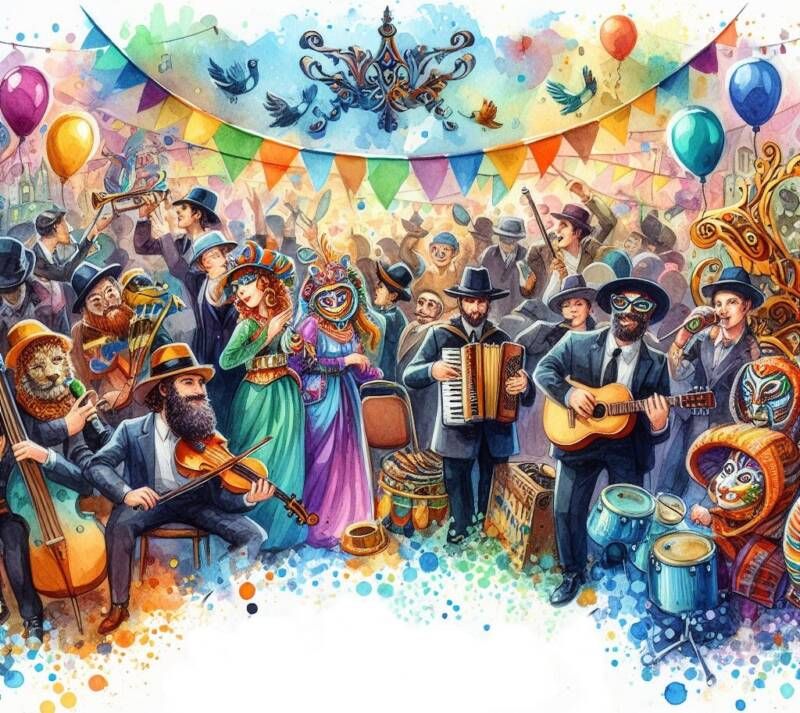
This sermon is not really an effort to convince the Classical Liberals that they should don their frocks and come for the Cabaret. Honestly, if I did succeed in changing their minds, I’d be a little disappointed to see the diehards give in. But I do want to make the case for why I do celebrate Purim, and why other members should feel free to get out their gladrags and their graggers.
Like the diehards, I also uphold a version of classical liberalism. I agree that Judaism should be God-focused, and I sometimes worry about the secular drift of our synagogues towards becoming cultural centres. Like them, I feel that Judaism only makes sense as an ethical system, and its goal should be to turn us all into better human beings.
But where we disagree, I think, is on what makes a religion rational. Just because our worship should be rational doesn’t mean it needs to be serious. As Oscar Wilde assured us, we must treat all the serious things of life with sincere and studied triviality.
The point of Purim is it’s a joke. The Megillah, the story, the festival, its mitzvot, and its observances, are supposed to be funny.
The story is an old rehash, and we know that because it has all the same characters as the Commedia dellArte from medieval Italy, whose tradition goes back to the court jesters of the ancient empires.
And, no, the empire was not that big. The oversized empire with its outlandish feasts is supposed to be ridiculous.
The characters, the story, and the props are all supposed to be impossibly big. Like a pantomime, with its villains, heroes and dames, its magic comes precisely from how unbelievable it is.
And, yes, it is horribly racist. The whole thing promotes Jewish violence and prejudicial fear. But we have to think about it in its context. This play was written for a time when Jews lived under persecution. It is a revenge fantasy against their oppressors, not a real-world instruction manual for the modern age.
That’s how we ought to understand the gory violence at the end. We should imagine it in the same way as the climax to Tarantino’s movie Inglorious Basterds, when the heroine burns all the Nazis alive, or like in Taika Waititi’s Jojo Rabbit, when the little boy kicks Hitler out the window. The bloodshed is catharsis for a beleaguered people.
And that is Purim’s real moral lesson for us. It’s about how to survive when you feel most downtrodden. Purim is an answer to a question: what do you do when you are persecuted, exiled, and you feel like God has abandoned you?
It answers us: try laughing.
Try to find the funny side.
Find a way to ridicule it all and remember that this whole life is one big joke.
The trouble only comes when you take Purim seriously. If you imagine this festival is supposed to be morally instructive. If that were the case, any rational person would scrap the festival altogether.
But, put in its proper context, this festival can give us the relief we really need.
We’re coming to the end of a long grey winter, in which many of us have felt weighted down and miserable. We’re living through unpredictable times. I can’t tell you how much I long for a news day that was precedented.
We need a bit of ridiculousness, a bit of raucousness, and a chance to do something stupid.
My grandfather actually left us with a little permission in his lecture notes. He said, if you must celebrate Purim, just do as Americans do, expunge the ugly bits, and turn it out into a carnival.
In other words, if you’re going to do it, don’t take it too seriously.
Wise words indeed.
Shabbat shalom.


 Sim Lev