academic · poem

Immanuel of Rome’s 9th Machberet

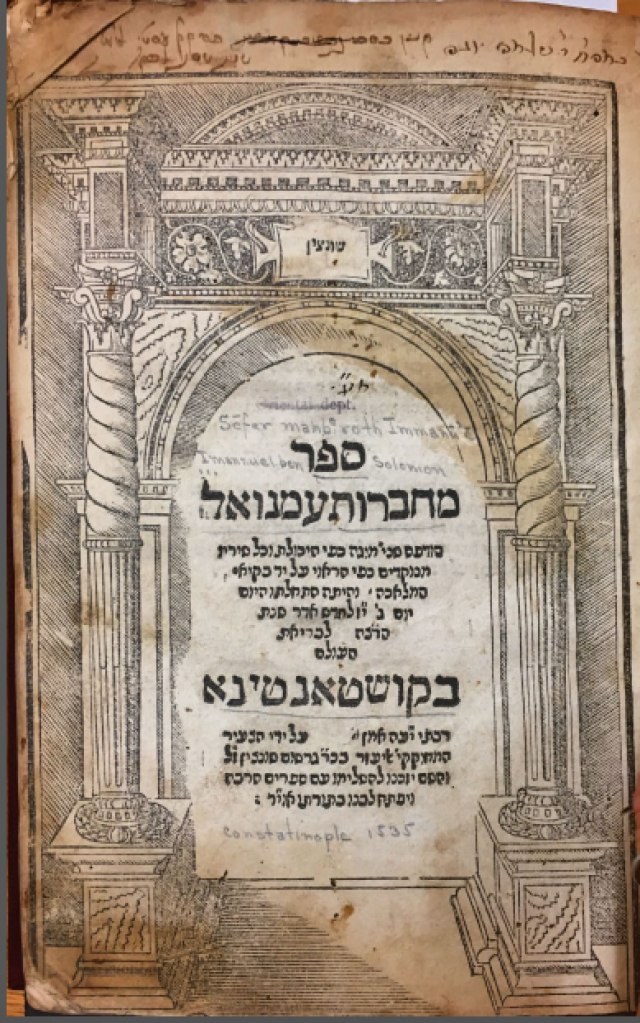
Emmanuel of Rome –in Hebrew, Emmanuel haRomi; in Italian, Manoello Giudeo – was born to an aristocratic Italian-Jewish family in 1261. Although only a minor poet by comparison to his pre-Renaissance contemporaries, Emmanuel was the first ever poet to write sonnets in any language other than Italian. Around 1300, Emmanuel produced a series of Hebrew sonnet collections that dealt with both secular and religious themes.

Using Dov Yarden’s edition of the Hebrew, I have created English translations of Immanuel’s 9th Machberet, which is a series of sonnets for each month of the Jewish year. So far, there has not been any systematic effort to translate all of Emmanuel’s works and only a few contemporary scholars show much interest in him. By putting these translations into the public domain, I hope others will take up interest in him.

I tell my story and say: וָאֶשָּׂא מְשָׁלִי וָאֹמַר 

TISHRI 

In Tishri, I rejoice; as the feasts to God 
Awaken me, to songs of passion sing  
I will delight in honey and nectar 
A time when willows string up violins 
And I shall surround myself  with youth 
I’ll eat a banquet fit to feed a king 
While staring at the apple of my eye, 
The juice of grapes and pomegranates drink. 
My face in battle, like before a flame 
I won’t be mute, but surely I will sing 
As her warden, I open up my lips  
I borrow kisses from Ofra’s wellspring 
And thank the Lord who made humanity 
Complete with all the perfect openings  
בְּתִשְׁרִי אֶשְׂמְחָה כִּי מוֹעֲדֵי אֵל
 יְעִירוּנִי לְשׁוֹרֵר שִׁיר עֲגָבִים
 וְאֶתְעַנַּג בְּנֹפֶת צוּף וּפַנַּג
 וְכִינוֹרַי תְּלוּיִם עַל עֲרָבִים
 וְאַצִּיבָה סְבִיבוֹתַי נְעָרַי
 וּמוּל פָּנַי לְאַיֶּלֶת אֲהָבִים
 וְאֶסְעַד מַעֲדַן מֶלֶךְ וְאֶשְׁתֶּה
 עֲסִיס רִמּוֹן וְאֶשְׁכַּר דַּם עֲנָבִ
ים וְאֶשְׁכַּח רִישׁ וְלֹא אַחְרִישׁ וְאָרֹן
 וּפָנַי בַּקְּרָב כִּפְנֵי לְהָבִים
 וְאֶלְוֶה מִשְּׂפַת עָפְרָה נְשִׁיקוֹת
 וְלִפְרֹעַ שְׂפָתַי לָהּ עֲרָבִים
 וְאוֹדֶה אֵל אֲשֶׁר יָצַר בְּחָכְמָה
 בֵּני אָדָם וּבָרָא בָם נְקָבִים 

MAR-CHESHVAN 

In Mar-Cheshvan, we’re lifted up by light 
I long to stand on dark borders of clouds 
And cry out from the fastened fires of night 
So sticky honey drips on land unploughed 
Upon the borders of the fields I press 
The nectar into syrup and the olives into chow 

I drink until I forget poverty 
And drive out all the grief from hearts somehow 
I bless each bairn to any woman born  
I see this as the time for seeds to sow 
The autumn plants assert this as their hour 
Nothing has thorns that sting as sharp as now 
But shoots will spring from barren earth again 
Like men from graves, accomplishing God’s vow  
בְּמַרְחֶשְׁוָן מְאוֹר יַעְלוֹת וְזִיוָן
 אֱהִי עֹרֵךְ לְמוּל אֹפֶל עֲנָנָיו
 וְקָרָתוֹ בְּאֵשׁ חֵשֶּׁק אֲגָרֵשׁ
 וְתַמְרוּרָיו בְּנֹפֶת צוּף עֲדָנָי
 וּמוּל פִּרְשׁוֹ יְהִי חֵשֶק וְדִבְשׁוֹ
 וְאֶל מוּל בָּאֳשׁוֹ רֵיחַ שְׁמָנָיו

  אֲנִי אֶשְׁתֶּה וְאֶשְׁכַּח רִישׁ וְאַחְרִישׁ
 וְאָסִיר מִלְּבָבִי עִצְּבוֹנָיו
 וּמִכָּל חַי יְלוּד אִשּׁה אֲבָרֵךְ
 אֲנִי נֹחַ וְנִטְעֵי נַעֲמָנָיו
 אֲשֶׁר לוּלֵי נְעִימוֹתָם יְכֻסֶּה
 זְמָן חָרוּל וְעָלוּ קִמְּשׁוֹנָיו
 עֲלֵי יָשְׁרוֹ אֲחוֹנֵן אֶת עֲפָרוֹ
 בְּתוֹךְ קִבְרוֹ וְאֶרְצֶה אֶת אֲבָנָיו 

KISLEV 

In Kislev, God’s horseman I will be 
And through calm pride I surely will agree 
A light on high supports a needy man 
To lift the dust of earth to build freely 
We light each night an eight pronged candel’bra 
Drink whiskey like the finest smooth honey 
The beauty of the girls’ arms, so exposed 
Whose eyes, like light’ning, shine in front of me 
One woman sets the table for the meal 
Another one runs after her to clean 
One coyly turns aside and rends men’s hearts 
Another bakes up biscuits for high tea 
I need not wonder what the meal will be 
The main course is spread out in front of me
בְּכִסְלֵו אֶהְיֶה שָׁלֵו וְאוֹדֶה
 לְצוּר רֹכֵב בְּגַאְוָתוֹ שְׁחָקִים
 וְאוֹר עֶלְיוֹן אֲשֶׁר אִישׁ דַּל וְאֶבְיוֹן
 מְרִימִי מֵעֲפַר אֶרֶץ וּמֵקִים
 וְנֵרוֹת אֶהְיֶה מַדְלִיק שְׁמֹנָה
 וְשִׁקּוּיַי כְּנֹפֶת צוּף מְתוּקִים
 וְהַיָּפוֹת זְרוֹעֹתָן חֲשׂוּפוֹת
 וְעֵינֵיהֶן יְרוּצוּן כַּבְּרָקִים
 וְאַחַת עֹרְכָה שֻׁלְחָן וְאַחַת
 תְּשַׂדֵּד אַחֲרֶיהָ הָעֲמָקִים
 וְאַחֶרֶת תְּלַבֵּב הַלְּבִבוֹת
 וְאַחֶרֶת תְּבַשּׁל הָרְקִיקִים
 וְצַפִּיחִת וּמַעְשֵׂה הַחֲבִתִּים
 וּמַרְחֶשֶׁת מְזָוֵינוּ מְפִיקִים 

TEVET 

The tenth Tevet: a fast for those who died 
When God’s children, like roaring seas, shall thrive 
They come in waves before the courts of God 
Where fools can dream and helping hands can strive 
To dig the chilly ground; this cold man shakes  

Those muscly men who work the harsh outside 
Who pull the jumpers round their necks and hide 
On snowy roads beneath the winter sky 
On days like these, I look for doe-eyed dames 
In secret surfaces where they reside 
My life is like a dead stalk in decay 
And yet, with only a gaze, I revive 
I know that God will crush all those who hate 
But meanwhile, I’ll be fortified by wine 
בְּטֵבֵת בַּעֲשָׂרָה בוֹ יְצוּמוּן
 בְּנֵי אֵל חַי וְכַיַּמִּים יְהִימוּן
 לְבוֹא צַר בֵּית אֱלֹהִים וַחֲצֵרָיו
 בְּכֵילַפּוֹת וְכַשִּׁיל יַהֲלֹמוּן
 וְהַקֹּר יַחֲלֹף הָאִישׁ וְיִדְקֹר

  פְּנֵי שָׂרִים הֲכִי חָבוּשׁ בְּטָמוּן
 וּמִטְרוֹת עֹז וְטִיט חוּצוֹת וְקֶרַח
 וְשֶׁלֶג עַל מְסִילֹּתַי יְרֻמוּן
 לְעֵת כָּזֹאת אֲשַׁחֵר הַצְּבִיּוֹת
 אֲשֶׁר סוֹד עַל יְגוֹנִים יַעֲרִימוּן
 וְעֵינֵיהֶן וְהוֹד צִיצַת לְחֵיהֶן
 יְחַיּוּנִי נְבֵלָתִי יְקִימוּן
 וְאֵיךְ אִירָא וְיֵינִי לִי לְעֶזְרָה
 וְהוּא יִמְחַץ מְשַׂנְאַי מִן יְקוּמוּן 

SHVAT 

Your face is harsh as bastards’ are, Shevat 
You send your time and frosty ice like loaves 
The whizzing snow breaks skies and cools my heart 
I spot the lovers hiding in alcoves 
They thrust and grab with their bosoms exposed 
Their voices cry out loud within their homes 
I cursed the stupid sermons as I froze 
And realised I was better off alone  
שְׁבָט אַכְזָר וְעַז פָּנִים כְּמַמְזֵר
 וּבוֹ יַשְׁלִיךְ זְמָן קַרְחוֹ כְפִתִּים
 וְהַשֶּׁלֶג גְּאוֹן הַלֵּב יְפַלֵּג
 וְהַדּוֹדִים בְּחֵיק יַעְלוֹת נְחִתִּים
 וְרָצֵי הַצְּבִיּוֹת הֵם דְּחוּפִים
 וְכָרוֹזָא בְּקוֹל קָרֵא בְּבָתִּים
 אֲרוּרָה דֹּרְשָׁה צֶמֶר וּפִשְׁתִּים
 לְעֵת כָּזֹאת לְבַד מַעְשֵׂה חֲבִתִּים 

ADAR 

Adar arrives to teach the bawdy tale 
Of how Haman and Zeresh caused such shame
If I had not such wealth and dignity 
I could not feast upon these geese and game 
In my right hand, a cup of toddy wine 
I shout each time I hear Haman’s curs’d name 
I join my mates and drink myself insane 
Until the heroes and the brutes are same 
We cheer with throats full of liquor and food 
For tyrants who will never rise again 
Only good wine can expel pain and strife 
And so we praise its healing holy name  
בְּאַדָּר אֶהְיֶה ישֵׁב וְדֹרֵשׁ
 וְאַזְכִּיר חַסְדֵי הָמָן וְזֶרֶשׁ
 וְלִי יוֹנִים וּבַרְבֻּרִים אֲבוּסִים
 וְלֹא אָחוּשׁ הֲאִם לִי הוֹן וְאִם רֵישׁ
 וְהַיַּיִן מְבֻשָּׂם אֶל יְמִינִי
 בְּקוֹל קֹרֵא וּבַדִּבּוּר יְפָרֵשׁ
 וְאִם אֹמַר אֲרוּר הָמָן וְזֶרֶשׁ
 יְשִׁיבוּן אַל תְּקַלֵּל דּוֹד לְחֵרֵשׁ
 וְקוֹל קֹרֵא אֱכֹל וּשְׁתֵה לְשָׁכְרָה
 וְלֹא תַשְׁאִיר לְנֹחֵל אוֹ לְיוֹרֵשׁ
 בְּיַעַן הוּא לְבַד רִפְאוּת וּמָזוֹר
 וְכָל רַע וָחֳלִי גָּרֵשׁ יְגָרֵשׁ 

NISSAN 

Nissan, I will recall God’s miracles 
Come see our homes, delight with joyous Jews 
How good and pleasant are these former slaves 
Our ancestors whom God opted to choose 
Once cloaked in cloud, they wandered in deserts 
But now delight and wonder are our views 
Up from these blossomed trees call turtle doves 
Our doorways filled with special treats, infused I fall
in love with her between the flower beds 
And couples ride the heavens in pursuit 
I will sacrifice the flesh and wool 
Of lambs and rams and farmers’ choicest ewes 
Let me cry out to all my famished friends: 
Jerusalem and food wait here for you!  
Upon the Torah’s head a diadem 
And graceful bracelets embedded with jewels 
Her crown reveals her lovely wonderment 
Each heart lights up to listen to her news 
Although a broken world encroaches now 
When morning comes, the world awaits her truth 
בְּנִיסָן אֶזְכְּרָה נִסֵּי אֱלֹהִים
 וּבֹו אוֹרָה וְשִׂמְחָה לַיְּהוּדִים
 וַּמה טּוּבוֹ וַּמה יָּפְיוֹ אֲשֶׁר בּוֹ
 אֲבֹתַי יָצְאוּ מִבֵּית עֲבָדִים
 וּפָשַׁט הַזְּמָן עָנָן לְבֻשׁוֹ
 וְעָטָה אוֹר וְכֻלּוֹ מַחֲמַדִּים
 וְקוֹל הַתּוֹר עֲלֵי מִפְתָּן וְכַפְתּוֹר
 וְאֶרְאֶה עַל פְּתָחַי כָּל מְגָדִים
 וְחשֵׁק עִם חֲשׁוּקָה בֵּין עֲרֻגוֹת
 בְּשָׂמִים רֹכְבִים יַחְדָּו צְמָדִים
 וְאֶזְבַּח שׁוֹר וְשֶׂה נָקֹד וְטָלוּא
 לְבַד מִן הַתְּיָשִׁים הָעֲקֻדִּים
 וְאַעְבִיר קוֹל לְכָל צַד כָּל דְּכָפִין
 וְצָרִיךְ לֶאֱכֹל יִהְיוּ עֲתִידִים
 וְאַצִּיב יַעֲלַת הַחֵן לְנֶגְדִּי
  בְּרֹאשָׁהּ צִיץ וְעַל יָדָה צְמִידִים
 וְהִיא תַעְנוּג לְכָל לֵב נוּג וְלַחְרֹט
 פְּאֵר הוֹדָהּ יְדֵי הָעֵט כְּבֵדִים
 לְדַעְתָּהּ יֵצְאוּ יָדַי גְּדוּדִים
 וְעַד בֹּקֶר הֲכִי נִרְוֶה בְדֹדִים 

IYYAR 

Iyyar asks me a joyful oath to swear  
I join my hands, both left and right, as pairs 
With lustful oxen, all Hebrews will unite 
By seeking dreams and chirpy birdsong pray’r 
I will never see liberation come 
Nor hear lads singing in the streets somewhere 
The world removes the mourning clothes she wears 
To swap for fancy garb, with lovers shared 
I free myself from books I have to read 
The Talmud’s texts, to which I am an heir 
Instead, I’ll set myself beside a doe 
Her body giving life beyond compare 
And though the heat of morning beats us slow 
When death does come, we will be holy there  
בְּאִיָּר אֶשְׂבְּעָה שׂבַע שְׂמָחוֹת
 וּבִשְׂמֹאלִי וּבִימִינִי נְעִימוֹת
 בְּשׁוּרִי חשְׁקִים מִכָּל עֲבָרִים
 בְּצִיץ צִצִּים לְשַׁחֵר הָעֲלָמוֹת
 וְלֹא אֶרְאֶה לְבַד גִּילַת וְרַנֵּן
 וְלֹא אֶשְׁמַע לְבַד שִׁיר עַל עֲלָמוֹת
 וְתֵבֵל תַּחֲלִיף סוּת אַלְמְנוּתָהּ
 וְלִכְבוֹד חשְׁקִים תִּלְבַּשׁ רְקָמוֹת
 וְאֶתֵּן גֵּט לְעֵרוּבִין וְגִטִּין
 וְסַנְהֶדְרִין וּמַסֶּכֶת יְבָמוֹת
 וְאֶבְחַר לִי לְצֵידָה הַצְּבִיָה
 לְחִי שׁוֹשָׁן נְשָׁמָה לַנְּשָׁמוֹת
 פְּנֵי חַמָּה אֲשֶׁר כָּל שֹׁחֲרֶיהָ
 קְדֹשִים יִהְיוּ בָהּ אַחֲרֵי מוֹת 

SIVAN 

Sivan makes me remember all God’s deeds 
How by wonder, He lifts us up, proceeds 
He brought His treasur’d people to freedom 
His children follow after where he leads 
They see his words and statutes as their light 
Enlightened by the Torah’s sacred creed 
Hear us, O God, as we cry out to You 
Comfort our fears in this, our hour of need 
O, show us Moses, whom we need so close 
Who came from mountains in the clouds, decreed 
To us the ten statutes by which we live 
For Jeshurun bowed down and found he’d heed 
Then Esau saw that God fulfilled His will 
And Ishmael learnt that God would be his steed  
בְּסִיוָן אֶזְכְּרָה פִּלְאוֹת אֱלֹהִים
 אֲשֶׁר נִשָּׂא וְגָבַהּ עַל גְּבֹהִים
 אֲשֶׁר יָצָא לְיֵשַׁע עַם קְרֹבוֹ
 יְלָדָיו הֹלְכִים אַחְרָיו וְנִנְהִים
 וְנָתַן הוֹד וְנֵר מִצְוָה וְתוֹרָה
 לְעַם קָדְשׁוֹ לְאוֹר יִשְׁעוֹ כְמֵהִים
 וְשָׁמַעְנוּ אֱלֹהִים חַי מְדַבֵּר
 וְנַחְנוּ פֹּחֲדִים מֶנְהוּ וְרֹהִים
 וְרָאִינוּ אֲזַי משֶׁה בְּגִשְׁתּוֹ
 לְעַרְפַלָּיו וְעָמַדְנוּ תְמֵהִים
 וְהִתְוָה תָו עֲשֶׂרֶת דִּבְּרוֹתָיו
 הֲתִשְׁתּוֹחַח יְשֻׁרוּן עוֹד וְתָהִים
 שְׁאַל עֵשָׂו הֲרָאָה כֵן בְּעֹשָׂיו
 וְיִשְׁמָעֵאל הֲשָׁמַע קוֹל אֱלֹהִים 

TAMMUZ 

Stripped bare and broken, in Tammuz, I go 
To play and say the eulogies of woe 
My contrite heart cries out in broken pain 
My clothes are drenched in blood and wet sorrow 
That soaks the valleys of God’s holy home 
The plunder and destruction of my foes 
Those heathens burn the sacred sites they hate 
And tear up Torah scrolls, they overthrow 
An idol stands upon God’s conquered throne 
It breaks my heart in ways I’ve never known 
I take my sword, prepare myself for war 
The huntsman within me readies his bow 
So all of my tears will break down these walls 
In grieving the lost ones, I cry alone 
בְּתַמּוּז אֵלְכָה עָרוֹם וְשׁוֹלָל
 וְלִשְׂחוֹק אֹמְרָה נַפְשִׁי מְהוֹלָל
 וְאֶתְעַנֶּה בְּלֵב נִשְׁבָּר וְנֶעְכָּר
 וּמַלְבּוּשִׁי בְּדַם דִּמְעִי מְגוֹלָל
 אֲשֶׁר בּוֹ הָבְקְעָה עִיר בֵּית אֱלֹהַי
 וְהֵצַר צַר וּבָזַז בַּז וְשָׁלָל
 וּבָטְלוּ הַתְּמִידִים בּוֹ וְשָׂרַף
 אֲפוֹסְטוֹמוֹס לְתוֹרַת אֵל וְחִלָּל
 וְצֶלֶם הֶעֱמִיד תּוֹךְ הֵיכְלֵי אֵל
 מְשׂוֹשׂ לִבִּי לְזֹאת חָרַב וְדָלָל
 הֲיַעְרֹךְ צִיר אֱלֵי צִירִי וּמַכְאֹב
 לְמַכְאֹבִי אֲשֶׁר בָּא לִי וְעוֹלָל
 וְלָכֵן כֹּל אֲשֶר דִּמְעָה יְפַכֶּה
 וְיִתְאַבֵּל לְפִי שִׂכְלוֹ יְהֻלָּל 

AV 

Throughout the month of Av, I will cry and grieve 
I’ll pump out reservoirs of tears of pain 
For desecration of God’s wasted home 
The refugees removed by Rome’s campaign 
On one long day, like Haman’s sons we hang 
While God destroys His seat of holy reign 
With fuming rage, my life force God destroys 
I sob out floods of salty tear-filled rain 
Now traitors and cynics surround me 
But I won’t eat or make love for the slain 
And were it not for God’s endless mercy 
My mouth would never know to laugh again  
בְּחֹדֶשׁ אָב אֱהִי נִכְאָב וְאֶדְאַב
 וְאֶשְׁאַב מֵי דְמָעַי מִכְּבֵדִי
 וְאֶתְעַנֶּה לְחָרְבַּן בֵּית אֱלֹהַי
 וְעִיר קָדְשׁוֹ וְעַל הָגְלַת כְּבוֹדִי
 בְּיוֹם אָרוּךְ כְּמוֹ וָי”ו וַיְזָתָא
 בְּחֻמּוֹ נֶהֱפַךְ חֹרֶב לְשַׁדִּי
 וְהַמַּיִם אֲשֶר אֶשְׁתֶּה לְשִׂכִּים
 בְּמוֹ עֵינַי וְלִצְנִינִים בְּצִדִּי
 וְאַרְחִיק הַצְּבִיָּה מִיְּצֻעַיְ
 וְאֶתְגּוֹלֵל בְּמִטָּתִי לְבַדִּי
 וְלוּלֵי נַחֲמוּ בִּבְנֵי אֲוָזָיו
 יְמַלֵּא פִי שְׂחוֹק אֶבְכֶּה בְעוֹדִי 

ELUL I 

The nobles’ daughters now are frollicing 
On flower beds of Elul’s evenings 
And balls run down the rafters of downswings 
Like those who made our rabbis into kings 
O, let us go and see the vineyards spring 
We’ll search for fresh grown figs until ev’ning 
Where trees not only grow but even sing 
And they will speak words kind and flattering 
Lift up your hand and don’t forget a thing  

I wrote these words of verse when I was young 
So ev’ry month could have its praises sung 
Today, in age, I wrote another one 
In sacred oil to praise the Elul month 
And now my greatest poem has begun…  
בְּאֵלוּל אֶעֱלֹז עִם בַּת נְדִיבִים
 בְּעֶרֶשׂ רַעֲנָנָה עַל עֲרָבִים
 וְהַגֻּלּוֹת יְרֻצוּן בָּרְהָטִים
 כְּאִלּוּ יִתְּנוּ שָׁמַי רְבִבִים
 וְנַשְׁכִּימָה וְנֵצֵא לַכְּרָמִים
 לְשַׁחֵר הַתְּאֵנָה עַד עֲרָבִים
 וְאָז אֶרְאֶה גְפָנַי אֹמְרִים לִי
 בְּפֶה חָנֵף וּבִדְבָרִים עֲרַבִים
 הֲתִקַּח הַתְּאֵנָה דּוֹד לְמָנָה
 נְשָׂא יָדְךָ וְאַל תִּשְׁכַּח עֲנָבִים

  אֵלֶּה הֵם הַשִּׁירִים הַמְפֹאָרִים
 אֲשֶר חִבַּרְתִּי עַל הֶחֳדָשִׁים בִּימֵי הַנְּעוִּרים
 וְעוֹד חִבַּרְתִּי שִׁיר עַל חֹדֶשׁ אֱלוּל
 בֶּשֶׁמן מִשְׁחַת קֹדֶשׁ בָּלוּל
 וּלְיָפְיוֹ הוּא עִלָּה וְכָל שִׁיר זוּלָתוֹ עָלוּל
 וְהוּא זֶה 

ELUL II 

If only you would bless my eyes, Elul, 
For you I would become an Amora 
A lord of words, a student to Rava 
And I will fast and search for sweet Mannah 
Within the vineyards I will sit pretty 
And sing and dance although my death’s not far
And I will leave my soul behind in words 
I’ll suckle breasts from vine shoots as they are 
בְּאֵלוּל תְּבַלּוּל בְּעֵינַי יְהִי אִם
 אֲקַנֵּא לְרָבָא וְלִהְיוֹת אֲמוֹרָא
 אֲנִי הַתְּאֵנָה אֲבַקֵּשׁ לְמָנָה
 לְנַפְשִׁי וְאֶדְרשׁ אֲנִי רֹאשׁ אֲמִיָרה
 וְתוֹךְ הַכְּרָמִים אֲנִי בַנְּעִימִים
 אֲכַלֶּה יְמוֹתַי בְּשִׁירָה וְזִמְרָה
 וְאָשִׂים גְּפָנַי סְבִיב צַוְּרֹנַי
 לְעָנָק וְאִינַק שְׁדֵי הַזְּמוֹרָה 
festivals · sermon

Do not leave any part of yourself in Egypt


Several years ago, at a seder, I was introduced to a new custom.

When it came time to sing Dayyenu, a Persian-Jewish friend passed us all a spring onion each.

“In my family,” she said, “we hit each other over the heads with spring onions while we are singing this song.”

“It’s supposed to get out of our heads any feeling that we might want to remain in Egypt. So we remind each other by hitting our heads that we do not want to go back there.”

I instantly fell in love with it, and have adopted it into my own family seders. In fact, in my home, it can turn into a bit of a food fight, as we chuck the spring onions around the room.

One year, a Muslim friend came, and was quite baffled by the proceedings. I put quite a unique twist on my seders, and try to make them fun. That year, I had people dress up as the Ten Plagues from bits of fabric around the house, and do a lip-synching competition to the Prince of Egypt soundtrack. As he left, he said: “I can believe all of it is normal Judaism, apart from that bit with the spring onions.” I said: “That’s the only bit that was a real tradition!”

Maybe you might not bash your dinner guests with greenery, but you do sing Dayyenu, don’t you? It’s such a highlight.

I worry that some of our families’ seders don’t get there. The food’s coming out of the oven, everything has already gone on far too long, you’re anxious to eat, maybe you skip this important bit. I hope you don’t.

How about afterwards, when you’ve finished eating: who does the whole thing? Who carries on and sings hallel afterwards, and does the benching, and drinks the next two glasses of wine?

I hope you do. In fact, if this sermon has a message, it’s this: do the whole seder.

As you will see, this is not just me being a stickler for making sure people treat liturgy seriously, or insisting on the importance of halachah. This is about how we live our lives.

Our story begins with slavery and ends with freedom.

So, when you come to have your Pesach meals, make sure you don’t just tell the story of slavery. Make sure you talk a good deal about the freedom that comes afterwards.

The haggadah is actually split into two parts. In the first half, we are supposed to see ourselves as slaves in Egypt, weighed down by the yoke of bondage. Then, we eat. After dinner, we are free. We cross the Sea of Reeds and sing praises to our God. We raise a glass of wine to our redemption. We raise another glass to our future. We keep back a fifth glass for Elijah, who will come and bring about the final redemption, when everyone everywhere will finally know freedom.

Now, which of those two halves of the meal is more important?

Of course, it’s the second one. We don’t get together with our families and communities to dwell on how miserable it was to be stuck in Egypt. We get together to rejoice that we are free. How wonderful is this festival, the season of our liberation, that reminds us of that miraculous exodus out of oppression.

We sing Dayyenu (and bash each other with spring onions) immediately before we eat. That moment comes on the cusp between staying in slavery and leaving for liberty.

Dayyenu comes at the point where we are leaving slavery for freedom. By bashing each other’s heads with the spring onions, we say: “don’t leave any part of your head there! Don’t go back there, not even in your mind! Don’t dwell on those narrow places that kept you oppressed!”

Come on, we’re about to be free. We’re about to eat. Let’s look now to the future, where we will never have to think about those things again.

There’s a good reason why we might use spring onions in particular for the hitting. When the Israelites do get free, and start wandering in the desert, they start moaning about how much they miss slavery. They whinge about how much better being oppressed was. And what do they say they missed eating? The onions.

Those Israelites understood something. Being oppressed can feel easier than getting free. Sure, Egypt might have involved great persecution, but you always knew where you stood. Getting free, or at least trying, is tough. It’s unpredictable. It combines dizzying excitement with a terror of the unknown.

So we have to remind ourselves, over and over again, that however difficult freedom feels, it is better than oppression. However easy it might be to wallow in misery or stay in a victim mentality, there is so much more to be gained from shaking off our chains.

The first part of the seder says: we were slaves in Egypt. The second reminds us: but God helped us get free.

In the 19th Century, the Progressive Jew Israel Abrahams wrote about exactly this optimism for the Jewish Chronicle. He began his article by saying how wonderful it was that even persecuted medieval Jews insisted on keeping their doors open for Elijah on seder night, adamant that God would protect them. He said: “truly there is no danger to Judaism while such eternal hope prevails over despair.”

Israel Abrahams goes on to talk about the messianic hope that Jews hold at Pesach. Look at the bigger picture of history, he says, and you can see that it is not a delusion. “Persecutions come and go, but the Jews go on.” Away with all pessimism,” he says, “away with all pessimism.”

Can you believe that such words appeared in the Jewish Chronicle? How much can change in just over a century! Today, there is no way our communal organs would say how great it is that Jews would keep their doors open. They’d tell us to keep them locked. They’d sell us a more advanced security system. They’d put in a fundraising pitch for CST while they were at it.

Can you imagine any of our great and noble communal representatives sharing a positive view of Jewish history and an even more positive view of our future? No, their message is always the same: we are terrified; we have always been persecuted; we always will be persecuted. All we can do is build up bigger defences, hire tougher security guards, buy more effective security cameras; and keep our bags packed to run away just in case.

Sometimes I think Anglo-Jewry is stuck in the first half of the seder. It is as if many of us believe that we ourselves were slaves in Egypt, but nobody can believe that we were redeemed.

Do any of us really believe we are worse off than Jews were in the time of Israel Abrahams? Do we have more reason to cower than did medieval Jews? And, if we did, is cowering behind even greater security really our best answer?

The point of the seder isn’t that we were slaves. It’s that we got free.

Think of the wonderful things Jews are doing, and that British Jews have done. We are stars of stage and screen, fully represented at every level of politics, working in every strata of society, innovating, building, and living happy lives among our neighbours.

Sure, you can talk about the bad bits. Whenever I talk about the good, someone is eager to remind me of some proof of how much they all hate us. Some people leap to lecture on antisemitism and misery at even the suggestion that things might sometimes be good. That is a mentality that keeps your head in Egypt.

It’s not that everything is miserable and it’s not that everything is fine. It’s always a bit of both, no matter who you are.

The point is that everything could be wonderful. We could build a future so much better than this one.

Many times, with God’s help, we have achieved wonderful things.

When you take up the third cup at your seders, remember all the incredible things you and your ancestors have achieved.

When you take up the final cup, look towards the great utopia you can build here on earth.

And when you leave your Pesach seders this year, don’t carry around with you the slavery and misery of the first part of the meal. Bring out into the world Judaism’s message of hope.

Keep your eyes always on the best of what may be to come.

Beat out of your head any desire to wallow in misery.

Do not leave any part of yourself in Egypt.

Shabbat shalom.

sermon · torah

The things you hate in others are the things you hate in you.

The things you hate in others are the things you hate in you.

All too often, we create monsters out of others because we fear there is something monstrous in ourselves. We turn outsiders into figures of hate because there is something we cannot stand inside ourselves.

In the Talmud, Laban is called the trickiest of tricksters. He came from a family of tricksters, in a town of tricksters, and all he ever did was trick.

Now, Laban was indeed a trickster. He was a thief and a manipulator. But was he really the worst of the worst? Most importantly, was he really worse than Jacob?

Laban did wrong, multiple times. He behaved appallingly. 

From the outset, he took Jacob in on false pretences. 

Laban told Jacob that, if he worked for him for seven years, he could marry his younger daughter, Rachel. Jacob adored Rachel, and was willing to do anything for her, so fulfilled his obligations. 

Then, on the day of the wedding, Laban swapped out Rachel for her older sister, Leah. Laban made Jacob work another seven years to marry the woman of his dreams.

Once Jacob had married both daughters, Laban continued to trick and deceive. He kept trying to rob Jacob, arbitrarily changing the terms of the contract. 

Jacob says that Laban had tried to swindle him with new rules ten times. In our midrash, the rabbis say it was in fact a hundred. Laban absolutely stole, and absolutely tricked.

Now, can we compare this to Jacob?

Only last week, we saw how Jacob tricked his father and his brother to steal from them. Jacob dressed up as his brother, pretended to cook like his brother, and stole his brother’s birthright. Jacob took advantage of his elderly father, who was going blind, to swindle him out of a blessing.

Jacob, too, stole and tricked.

To read the rabbinic tradition, however, you would think it only went one way!

The midrash bends over backwards to exonerate Jacob. It says that his father, Isaac, knew what was going on all along, and was only pretending to be deceived. It says that his mother, Rebecca, was given prophecy by God, so she knew what the future of her sons entailed. Throughout rabbinic commentaries, we get apologia for why Jacob was really right to receive the birthright, and why Esau would have been a terrible choice.

None of this is in the text. It is really a PR campaign to protect Jacob’s reputation. 

Laban, by comparison, is subjected to thorough demonisation.

The rabbis say that Laban sought to kill Jacob, despite there being no evidence of it. They go further: Laban wanted to massacre the Israelites entirely so they would have no future. Laban wanted to subjugate the Israelites worse than Pharaoh ever could. The rabbis say Laban lived hundreds of years, and could think of nothing else but swindling Israelites throughout that entire time, motivated only by spite. They call him ugly, and stupid, and say he slept with animals.

Contrary to the plain reading of the text, our tradition turns Laban into a monster, with every flaw exaggerated to absurd degree. They warp him from being a simple trickster into a demonic tyrant.

Our rabbis’ goal is to divide the world into the two camps: the innocent and the evil. On the one side, they have Jacob, who, no matter what he did, can never be held accountable. On the other side, they have Laban, the pinnacle of malice. No matter what may have motivated him, Laban will always be depicted as a corrupt crook, lusting after the death and misery of others.

In fact, the crimes of Jacob and Laban were almost identical. Laban tricked; so did Jacob. Laban stole; so did Jacob. 

There is a good reason why the rabbis would want to defend Jacob and castigate Laban in this way. Jacob is us. He changed his name to Israel and became the founder of the Jewish people. If Jacob is bad, so are we. 

Laban is our enemy. If he can be excused, what does that make us? How can we be the good guy, if he is not the bad one?

Naomi Graetz, a scholar at Ben Gurion University, compiled all these sources and suggests that what is going on here is a classic case of negative projection. 

We know that Jacob did those bad things. But, if we throw them all onto Laban, they no longer stick to us. By constructing Laban as a monster, we can feel assured in the positive self-image we want to hold. 

This, she says, is what groups often do. They create “others” – people that they imagine to be different to them – so that they can throw at them the worst fears of what they themselves might be.

The things we hate in others are often, really, the things we like least about ourselves.

Hating others gives us an easy way to escape our own feelings of discomfort. If we can hate them, we don’t have to look too hard in our own mirror.

In mediaeval Europe, that was a big part of how antisemitism functioned. Jews were the “other” onto which their neighbours projected all their anxieties.

The Jews, according to the antisemitic imagination of the time, were usurers, stealing money from people. In the Middle Ages, most money-lenders were not Jewish. They were Christians. At this time, certain Christians were also becoming very wealthy as landlords and merchants. Rather than deal with it as a social problem shared by everyone, they racialised it. They turned it into a Jewish problem, so that they did not have to face it as their own.

Even the blood libel, a mediaeval conspiracy theory that Jews drank Christian blood, can be understood as projection. As part of regular Catholic services, they drink the blood of Jesus, in the form of wine. Clearly feeling some guilt about their own rituals, they thrust this fear onto the Jews. It is not us who drink blood, it’s them!

It is probably not a coincidence that the modern antisemitic trope of Jews ruling the world came about when the European empires were at their height.

Antisemitism was a way for Europeans to resolve their discomfort about who they were by turning it into hatred of someone else.

Still, if I only talk about how bad and racist others once were, I would be projecting. The point is not that they can do it, but that we can. 

We are very capable of making demons where there are just people. We can just as equally project our own fear by turning it into hatred of others.

We need to remember that the world is not made of heroes and villains. Humanity cannot be divided up so easily. 

If we look at the biblical story, as it appears in the Torah, Laban is not a monster. Nor is Jacob. They are just people. Flawed, messy, human beings, doing wrong, and making mistakes. They both did wrong. But neither of them were evil.

The Torah gives us a whole host of complicated characters. They are not models of perfect behaviour. They are not even moralising cautionary tales. They are just a reflection of reality: which is complex and scary. We learn best from our imperfect prophets. 

Rather than trying to resolve our anxieties with hatred, let us look inside ourselves.

When you see something in someone else that you hate, ask: what is it in me that makes me feel this?

When another group seems like devils, ask yourself: are we really angels?

People will do wrong. All the time. They will mess up and cause pain in all kinds of ways.

Most of the time, we cannot change that.

But we can work on the things we can change in ourselves.

We can forgive the things we cannot change. 

And if you accept that you are capable of harm, without it making you evil, you may be able to have compassion for yourself.

And you may find that you love yourself, after all. 

You may see yourself the way God sees you. As an imperfect human who makes mistakes. Not a monster. Just a mess. A thoroughly lovable mess. 

And if you can love yourself, warts and all, you may find you have less space left to hate others. You may find that you contain more compassion and empathy than you knew. 

The things we hate in others are the things we hate in ourselves.

The things we love in ourselves, we can love in others too.

Shabbat shalom.

halachah · judaism · social justice

Are Jews allowed to lend money at interest?

Of course, I am Jewish, but I also consider myself very English. I am English in the very parochial sense that I love canal boats, think provincial churches are beautiful, will definitely barbecue on the only day of summer, and put mayonnaise with everything. But, last autumn, I did the most English thing I have ever done. 

I wrote a disapproving letter of correction.

I had never done it before. I’ve never written in to the BBC or a newspaper. To the best of my knowledge, I’ve never sent a letter of complaint about anything. But this one was too important to simply ignore.

Someone in a play had misrepresented a complex point of Jewish law. 

Now, this may seem trivial. But, six months later, I am still so incensed about this common misconception of halachah, that I feel the need to preach on it. 

In September, last year, I got a real treat: to go see one of our members perform at the Royal Court Theatre. Rachel Hosker, who will be getting married under our auspices in the summer, was performing in a play called ‘Jews. In their Own Words.’ Written by Jonathan Freedland, the play interviews famous Jews, including Tracy-Ann Oberman, Luciana Berger, Margaret Hodge, and Howard Jacobson, trying to give a sense of antisemitism, past and present. 

I’m not a theatre critic, but let me tell you: Rachel acted fantastically. She and the rest of the cast did a fantastic job of bringing the characters to life. 

But there was a line, really a throwaway comment, that stuck with me. The play was attempting to explain the trope of the money-hungry Jew, and how Jews had come to be associated with money-lending. An actor representing CST’s Dave Rich said: “the rulings of the church forbade lending money at interest, which was considered usury, whereas Jewish law allowed it.”

This, to me, is alarmingly inaccurate. It shows not only a misunderstanding of Jewish law, but also of antisemitism, and how it works. It places the responsibility for Jews as medieval money-lenders onto Jews, and our religion. Nothing could be further from the truth.

If it was the case that Jewish law allowed money-lending at interest, you would be hard-pressed to explain the commandment in this week’s Torah portion: “You may not act as a creditor to your people. You may not exact interest from them.” You would also have to reckon with the same commandment, given in the Holiness Code: “Do not exact advance or accrued interest, but fear your God… Do not lend your money at interest, and do not give your food at interest.” The same commandment is repeated again in Deuteronomy: “do not deduct interest from loans to your kindred.”

Of course, you might say, the Torah is not the only source of Jewish law. Perhaps these commandments are amended in the Mishnah, or the Talmud, or the Codes. No, no, and no. The Mishnah says charging interest is so reprehensible that it involves breaking six commandments. The Talmud says that even scribes and witnesses who participate in such contracts are guilty. 

In the defining law code for most of the Jewish world, the Mishneh Torah, Rambam looks at the word for interest – neshech – which is the same as the word for a snakebite, and says it is called as such “because it bites, it causes pain to a fellow human being, and consumes a person.” He repudiates it completely.

Be in no doubt: Jewish law does not permit money-lending at interest.

So, how did it happen that Jews nevertheless ended up associated with money-lending, despite its very explicit prohibition?

In the 4th Century CE, Church Father Augustine of Hippo declared that Jews would be permitted to survive as “living witnesses” to the truth of the Bible, but must be kept in a degraded state, with the mark of Cain, for their refusal to accept Jesus. This became the official policy of Christian Europe’s primary institutions: its churches and monarchies. 

Jews were allowed to live in England neither as citizens nor serfs. They could not own land or participate in the nation. They were excluded from universities, and cut out of the professions. They were only allowed to live in the country on condition that they did the dirty work of the ruling class: tax collecting and money-lending. 

Now, most Jews did not do such jobs. They did the work that was needed for their community, as bakers, vintners, stonemasons, and millers. But, as long as some Jews fulfilled these functions for the monarchy, all Jews could live in European countries as “treasured subjects” – effectively pets of the king. 

This had a profound impact on the lives of medieval European Jews. They were forced to wear humiliating clothes to mark them out. Associated with tax collecting and money-lending, many of the local peasants associated the Jews with all the financial problems they faced. 

The local lords actively exploited this division. They drummed up hatred against Jews, and treated them as a pressure valve, so that, in times of economic crisis, peasants would attack their local Jews rather than turn their ire on the landowner class.

That is why the worst pogroms that we have recorded came in times when the monarchy was in financial straits. In England, these came when the country was bankrupted by its military Crusades to capture Jerusalem. Jews, the perceived cause of money problems, and naturally associated with the Holy Land, had all the anger and resentment of impoverished people poured out on them. 

If the monarchy or the Church were struggling with their own debts, they had an easy way out: they could simply expel the Jews and confiscate all their property. In 1290, Edward I expelled the Jews from England to cancel his debts and win back the support of the knights and lords in parliament, who were also heavily indebted.

This put the rabbis, the arbiters of Jewish law, in a very difficult position. If they permitted lending at interest, they would turn their backs on their entire religious inheritance. If they insisted that Judaism forbade money-lending at interest, they would effectively force their community to leave where they were. And, since all of Christian Europe had adopted the same policy, they would have nowhere to go. 

So, the rabbis had to find a way. They looked at the laws, which said such lending was only prohibited to their kin. Rabbi David Kimchi, writing in medieval France during pogroms and expulsions, said that Jews were not permitted to lend at interest to people who respect Jews. The corollary was that if people would not treat the Jews as full human beings, then they, in turn, could lend to them at interest. In England, the Christians had estranged them and made them explicitly not their kin.

This is why correcting this point on the understanding of Jewish law is so important. It is not just because we are sticklers for getting the halachah right. It is so that we understand what antisemitism is and how it works. 

We Jews did not create this system. We did not allow it, nor have the power to stop it. For over a millennium, European powers embedded and promoted antisemitism to prop up their system. As Rabbi Lionel Blue, of blessed memory, so pithily wrote: “The problem of the Jews in Europe was never the Jews. It was Europe.”

Now, we are citizens in this country. With Emancipation, we might have hoped that it would bring an end to cultures of debt and division. True, most of the banks and money-lenders are now not owned by Jews, and very few Jews today engage in such work. 

But that is not because we are living closer to the laws of the Torah or our rabbis. It is because the whole of our society is caught up in loans. All of us are more indebted and more divided than we ever were. We are pitted against each other by a media eager to see us all fighting. 

Combating antisemitism does not only mean counteracting myths and biases against Jews. It is also about dismantling the material realities that created antisemitism. The hatred of Jews erupts when we are scapegoated for economic problems in society. We must not only contradict the myth that we are responsible, but also fight to ensure that the problems people face of economic hardship and drowning in debts no longer exist. 

When we realise that the world has enough for all of us, and distribute it so that everyone can prosper, we will be far closer to a world without prejudice and fear.

Shabbat shalom.