debate · judaism · spirituality

The spiritual possibilities for our new Jewish movement 

“The history of a community, like the history of an individual, is marked by the recurrence of periods of self-consciousness and self-analysis. At such times its members consider their aggregate achievements and failures, and mark the tendencies of their corporation.” 

These are the opening words of an essay that gave birth to our Jewish movement. 

In 1898, a social worker named Lily Montagu published an essay in the Jewish Quarterly Review, entitled “The Spiritual Possibilities of Judaism Today.” 

What this pioneering thinker asked of Jewish London was that it take stock of what it had achieved and what it wished to be.  Only by giving an honest and sober account of where we were, could we imagine a better future for our Jewish life.

This is the perfect time to revisit that essay. We are forming a new movement, which will be far bigger and broader than Miss Lily could have anticipated, and may even soon make up the majority of British Jews. Is that not summons enough to the period of introspection Montagu required of us? 

But, more than that, when you look at her essay from over 120 years ago, you can see that the issues Montagu wanted to address had much in common with the challenges facing us today. 

Montagu was scathing in her perception of Anglo-Jewry. She accused it of “materialism and spiritual lethargy” and charged “that Judaism has been allowed by the timid and the indifferent to lose much of its inspiring force.”

Judaism, she felt, was supposed to be a great and inspiring system that would draw Jews closer to God and motivate its adherents to face the real-world challenges of the day. Instead, it had been captured by a lazy spirit that wanted nothing more than to assimilate, appease the establishment, and provide a lackluster imitation of religious rituals. Does that sound familiar?

Montagu assessed how London’s Jews actually lived. She called them “East End Jews” and “West End Jews,” but was clear that this was not just a geographical phenomenon. She was talking about class, culture, and background. 

The “East End Jews” of her day were working class, poor, Ashkenazi immigrants. They were highly observant, but obedient to a fault. They followed along with the old words they already knew, but rarely spent much time thinking about what any of those prayers might mean for their soul. Their main motivation for practising Judaism was a combination of superstition and fear.

“West End Jews,” by contrast, were from higher classes and mixed ethnic backgrounds. They were materialistic, obsessed with status, and only attended synagogue because they thought it was more respectable to be Jewish than to have no religion at all. Yet, she said, by replacing real religion with possessions and status, they ultimately still had a vacuum where religion ought to be.

These types of Jews, as Montagu described them, don’t exist in the same way today as they did then. However much one might nostalgise the factory-working Jews of the Whitechapel shtetl or the days when Jewish aristocrats held drawing room parties in Maida Vale, that world is gone. Economic disparities persist, but far less visibly, and without entire Jewish cultures built around location and class.

She warned that, although the Jews of her age might be economically divided, they still had the same thing in common: their religion was vapid and empty. It was about having an identity rather than having a relationship with God. For both sets of Jews, Montagu argued, Judaism needed a complete spiritual revival.

Apparently, a great number of people agreed with her, because over the years and decades that followed, many came together to form congregations for exactly this purpose. Together, they made the Jewish Religious Union, which then became Liberal Judaism, and is now becoming part of Progressive Judaism. 

Our Judaism has, indeed, been reinvigorated. We have opened up new approaches to liturgy, prayer, and worship. Synagogue teams come together to make sure that every Shabbat and festival is meaningful.

Montagu warned a previous generation that they would have to actually live Jewishly, or they would not be Jewish at all. Her prediction has come true, as some generations have just shaken off their roots, while others have decided to commit to Jewish life entirely. 

One happy surprise is that, through the Liberals’ embrace of converts, we have Jews who are committed and educated in ways previously unknown in earlier generations. The dedication of converts has also inspired those who might have taken their Jewishness for granted to step up their game, learn more, and embrace their heritage.

Miss Lily did not just advocate for spiritual revival, but wanted to see Jews play a full role in the life of Britain. Full citizenship had only been granted to Jews a few decades previously, and Montagu wanted Jews to rise to the challenge. 

Other communal bodies felt that the best thing for Jews to do was toe the establishment line, tell the government how wonderful they were, and hope that they would let us stay in the country without impeding on our religious practices. Our founders wanted us to embrace a more expansive sense of citizenship. 

They wanted us to say: we live here, this is our home, and we have the right to change it. They wanted us not to grovel before power, but to make demands of it. They wanted us to ask ourselves “what does God require of our country?” and go about pushing for it. 

This wasn’t something that belonged to one political persuasion. The intellectual leader, Montefiore was a capital C Conservative. The first Liberal rabbi, Mattuck, was a socialist who wanted the religious institutions to unite with the unions for revolution.

Montagu herself was a political Liberal. She was a suffragist and social reformer. She believed that the pursuit of peace and human rights were sacred commandments. She dedicated herself to alleviating poverty.

While politically diverse, our founders held in common a conviction that Jews could, in conversation with our God, make demands.

We could change the world. The world, too, could change us, and we should not be afraid of it or hide away in ghettos.

Montagu asserted that the youth were crying out for a Judaism that made moral demands and had something to say to their society. If their elders did not rise to the challenge, the next generation of Jews would vanish away into nothingness.

Montagu knew such Jews because her daily life was taken up as a social worker in London’s youth clubs. 

I believe we are facing such a challenge today. Many Jewish young adults are looking at us, including in the movement she founded, and see a Judaism that is reluctant to take stands for fear of rocking the boat. They see a Jewish life where God is, at best, a nice accessory tacked onto a cultural centre. If we look honestly at our own institutions, can we deny their aspersions?

Throughout my twenties, I was one of these disaffected young people, bewildered by why my institutions were so ambivalent on the moral issues of the day, from massive inequality through catastrophic climate change to ongoing Israeli military occupation. 

I felt acutely the absence of religious conviction in the establishment and in the institutions. There were pioneering rabbis who led the way on some issues, like gay rights, women’s equality, and refugees, but they were often marginal, and their impact could be felt only dimly in most synagogues. There was a gap.

In terms of our spiritual life, there were peer-led groups that tried to engage in serious prayer and text study, but you’d struggle to find any evidence for their existence in most synagogues.

I do not know how many young Jews fell by the wayside, but I stuck around. I had a strong sense, at least from my peers, that a better Judaism was possible. That we could speak out on social issues and we could have meaningful spirituality. That the Judaism of tomorrow might be more meaningful. 

Now, in my thirties, I am a part of the establishment I railed against, and I feel that the issues facing Jewish youth are even worse. The moral and spiritual vacuum has only grown wider, and it looks even harder to fill.

I worry that the demands of our age for renewed spirituality and moral meaning are being quietly subsumed under a banner of “inclusivity.”

Inclusion is a positive and noble goal, but it must be inclusion in something. It must have real substance, if it isn’t just trying to market synagogue membership to the lowest common denominator while offering nothing and standing for nothing. 

The challenge facing our movement is, I think, not so much to be broader, but to go deeper. We need to have a deeper relationship with God. We need to ask ourselves searching questions about what God demands of us. We need, as they did over a century ago, a thorough moral and spiritual revival.

In her essay, Montagu warned: “no fresh discovery can be made exactly on the lines of the past; the temperament of one generation differs from that of another.” We cannot apply Montagu’s methods in the same way today. 

But we can ask the same questions that she did, and go through a serious process of reflection, as she suggested.

We can look together for new ways of revitalising our spiritual life, and put God at the centre of our synagogue.

We can work together to provide bold answers to the moral questions of our age. We can ask ourselves what God demands of Britain and hold up those prophetic clarions to our leaders.

These are the spiritual possibilities for Judaism today.

That is the spiritual challenge facing our new movement. 

If we can rise to it, Progressive Judaism may yet last another century and beyond.

judaism · sermon · theology

Barbie World’s Jewish Metaphysics

As you know from all the advertising hype, there is a film out at the moment that deals with some of the most complex moral and philosophical questions of our time. It is already touted to win many awards, and has spurned fantastic conversations about truth, ethics, and politics.

I’m talking, of course, about Barbie.

Barbie already holds such a sentimental place in my heart. While the other boys liked wrestling, Fifa and war toys, I just wanted to play with my dolls’ hair. 

I know, you’d never guess it. The butch man you see before you was once obsessed with the Dreamtopia Mermaid Barbie.

So, last week I did my duty as a good consumer, and went to the cinema for the first time since Dead Pool 2 came out. A lot has changed since I last went to the movies five years ago, and it seems that now everyone dresses up as the characters in the film. I was thrilled to get out my Ken costume, which I never knew I would have a use for.

During the film, I laughed, I cried, I reminisced. And as I left the theatre, I thought: “I’m sure I can squeeze a sermon out of this.”

Yes, that’s right, welcome to your Shabbat morning dvar Torah on the theological metaphysics of Barbie World.

Don’t worry if you haven’t seen the movie: I promise that will not help this make any more sense. 

To help put this into perspective, I’ll give a quick summary of the storyline. Margot Robbie is a Barbie girl, in a Barbie world. Her life in plastic is fantastic. She is driven by the power of imagination. Life is her creation. 

In Barbie World, a doll can be anything. A President, a marine biologist, a Nobel Laureate, a mechanic, a pastry chef, or a lawyer. Even a rabbi.

But then a great intrusion comes into Barbie’s dream world. She finds that she now has cellulite and existential dread. This plastic world of fantasy suddenly starts to turn into something… horrifyingly human. 

Barbie therefore must travel to the world in which people play with her, to find out what is going on in the world of real girls. 

The result is distressing. It turns out that the real world is defined by misery and hatred, and, in this world, girls absolutely cannot do anything they want. 

I am interested in the interplay between these two worlds. In the plastic world, anything is possible, but none of it matters. In the human world, everything matters, but nothing is possible. These two versions of reality conform to two popular narratives.

The first is that this world is just a simulation. That view is being propogated right now by Elon Musk and Neil deGrasse Tyson. It says: none of this is really real. Our world is like Barbie World: it is someone else’s fantasy that we are stuck in, playing roles. Anything is possible, but only the terms of the magnificent computer directing our lives.

I understand why that idea is so appealing. The word is a mess. There is something reassuring about believing that none of it is really happening and it’s all out of our control.

Although today this idea can appeal to new innovations in quantum physics, it is actually a very old idea. In the 17th Century, Irish philosopher Bishop George Berkeley promoted a similar philosophy, called “immaterialism.” We are all, he said, simply ideas in the mind of God.

Berkeley continues: if this world is just an illusion, your only duty is to conform to the role you have been given. You must blindly follow authority. We must all submit to the law and do as we are told.

Barbie has been told that she must fulfill the stereotype she has been molded in, and she has no choice but to accept it.

We need not wonder why a group of billionaires would like us to think this way. If reality is just an illusion, we just have to accept our place. And there’s no point resisting it, because the script has already been written, and none of it means anything anyway.

But the alternative world of the Barbie film – the human world – is not compelling either. In the human world, everything is made up of futile facts. It’s all real, and there’s nothing you can do about it. The grass is green. People grow old. You will get cellulite. Patriarchy is inevitable. It is all meaningful, but its only meaning is that everything is deeply, existentially depressing.

This is also a very popular worldview right now. It is best encapsulated by conservative talk show host, Ben Shapiro, whose dictum is “facts don’t care about your feelings.”

And that idea can be seductive too. The world is changing so fast and so much. Why can’t everyone just accept that everything is the way it is and stop moving so much?

Ben Shapiro offers brutal reality as an antidote to too many ideas. You think this world is horrible? Tough. You’re lumbered with it. This vulgar materialism, that says everything just is the way it is and nothing will ever change, is just as reactionary as the immaterialism that says nothing matters. 

So, let’s get to the point. What does Judaism have to say about this? 

Is this all just a simulation so that we are all just living in a fantasy world?

Or is this all the cold, hard, truth of reality?

In the 20th Century, Jewish philosopher Ernst Bloch tried to offer a third way. Bloch was a religious socialist from Germany, who fled around Europe as the Nazis took power everywhere he went. For him, it was deeply important to develop a view of the world where the unfolding horrors of fascism could be stopped. Any metaphysics that kept people from changing their circumstances had to be resisted.

Bloch turned to great religious thinkers of the past to remind people: it doesn’t just matter what is; it matters what could be. 

This world is real, and the one thing we know about reality is that it is constantly in flux. Everything is as it is, and everything will be different. 

Everything is subject to change. Everything that is is also something else that is not yet.

Ice turns into water turns into steam. Acorns become sprouts become mighty trees. People grow and age and learn. Societies progress from hunter-gatherers out of feudal peasantry and move to abolish slavery. 

In all of their forms, these things are exactly what they are, and are also everything they could be. They are only what they are for a brief moment as they are becoming something else. The movement of water into ice is just as real and possible as the movement for women’s equality.

To put it another way: this world is real, but it doesn’t have to be. There are so many other very real worlds we could live in. 

Ernst Bloch would have loved the metaphysics of Barbie World. It doesn’t just leave us with the misery of the real world or the pointlessness of the fantasy world. It shows us that both worlds speak to each other. The real world can become more like the fantasy world, and the fantasy world can become more like the real one.

This is the Jewish approach. Our task is not just to accept the world but to change it. As Rabbi Jonathan Sacks used to teach: “faith is a protest against the world-that-is by the world-that-ought-to-be.” Faith, for Sacks, is the demand that this imperfect world could be more like the utopian one. Like Bloch, Sacks talked about Judaism as the “religion of not-yet,” always moving towards what it would one day be.

This is what animates the Jewish religious mind: the possibility that this world, here and now, could be transformed into the vision we have of a perfected Paradise. 

So, how do we get there? 

Once again, we have to take our inspiration from Barbie. When Barbie  wanted to get from the fantasy world to the real one, first, she got in a car, then on a boat, a tandem, a rocket, a camper, a snowmobile, and finally a pair of rollerskates. 

To bridge the gap between worlds, all she had to do was put one foot in front of the other. 

That is what we must do too. We must take small steps in our pink stilettos, and set out towards the real fantasy world.

Utopia already awaits us.

Shabbat shalom.

sermon · social justice

A peasant farmer was my father

A peasant farmer was my father

When my mind wanders, I like to think about where I would go if I could travel in time. Have you ever considered this? When you would want to visit?

Personally, my first thought is Paris in the 1890s. In my higher moments, I project myself into medieval Andalus, the Golden Age of Hebrew poetry in Spain. 

And, of course, I’d love to go back to biblical times. Wouldn’t it be marvellous to see the First Temple in all its glory? What would it be like to inhabit that world of prophets and visionaries?

But this time travel thought experiment always comes with a corollary. I’d have to be a rich man. No matter what spot of history I got dropped in, the only way to enjoy it would be to be part of the elite.

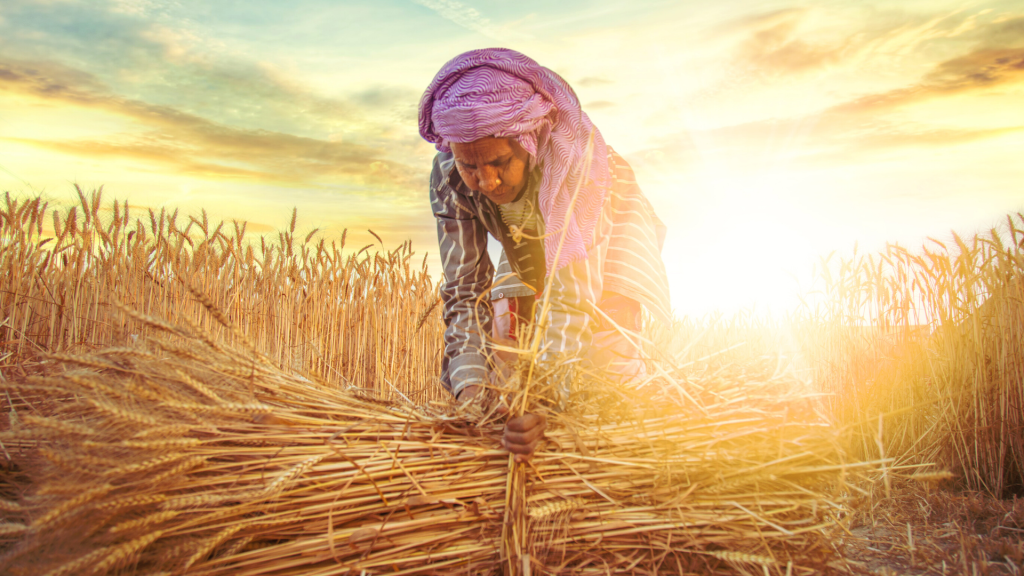
If I were sent back to biblical times without that condition, I’d probably be a peasant farmer. We like to imagine our ancestors as great kings and high priests. In reality, they were less than a small fraction of the ancient Israelite population.

95% of people in the biblical period worked the land. Dropped back to the time of David and Solomon, we probably wouldn’t be in their courts, but in the fields. 

I take a perverse pride in this knowledge.

Think how hard they must have worked to bring that ancient society into being!

As a peasant farmer in the ancient world, you would have about 3 acres, growing different crops, including grains, fruit trees, and olives. You would, almost certainly, have a chicken run and a small herd of goats. 

If you were really fancy, you might also have a cow.

Your home would be a collection of huts and tents, stretching out to include your extended family. Each would be a bustling, cramped place, with pots and pans and a fire stove. Your animals would potter in and out of your sleeping quarters. 

I am not trying to paint a romantic vision of any of this. Your life would be hard. You would pull a plough with your own hands and sow seeds with your back hunched over. You would cultivate and cut and glean your trees in the searing heat. 

You would spin your own wool, stitch your own clothes, bake your own bread, build your own dwellings, subsist on whatever you needed to survive.

Yes, all that is true for women, too, with an additional burden. You would give birth to ten children and breast feed all of them. You would count yourself incredibly lucky if all of them lived past the age of 5. If they did, they would likely be married off in their teens. 

No, there is nothing romantic about the lives of our real ancestors. 

But we should be proud of them. 

Peasants, labourers and serfs might not be the subject of great poetry and sagas, but without their efforts, nothing exists. There could be no food, no shelter, no community, and no culture, without their graft. That gruelling work made civilisation possible.

This week’s parashah tells us something of how they built ancient Israelite society.

If they had just stuck to their own homesteads, they would have had to survive on the paltry gains of subsistence farming. In a bad year – if rains failed to fall or crops failed to grow – they would simply perish.

So, our family, the farmers of the ancient world, signed up to participate in the agrarian state. 

The agrarian state was responsible for distributing food and creating common irrigation and transport systems. In ancient Israel, the centre of that state was the Jerusalem Temple. 

Our parashah explains the criteria for participating in its systems. You must not glean your fields right to their edges, so that you leave enough for travellers and strangers. You must donate a tenth of your grain and livestock to support those in the community who are most vulnerable, like widows and orphans. 

In some ways, this is the foundation of the earliest welfare state. 

But the poor are not the only beneficiaries of this redistribution. 

In fact, they were not even its primary targets. 

Our parashah begins with a ritual that Israelites must undertake each year. At each harvest of the year, you must collect your first and best fruits. You must bring these, the choicest of all the crops you worked so hard to create, and give them to the priests.

You must lift them above your head and say: “A wandering Aramean was my father. He was enslaved in Egypt, but God brought him out into this land of milk and honey. Now, I bring before you, the first fruits of the soil that God has given me.”

The priest will sacrifice it, perform closed rituals, and eat it in front of you.

That priest did not work to produce those fruits. He did not share in the exhausting work of raising children in a hovel, or run ploughs over the land. In fact, he wasn’t responsible for any land.

The priest’s sole job was to be the leader of the ancient cult. He was in charge. He profited from your work. 

That great Temple in Jerusalem, with all its priests and writings and rituals, only existed because the poor majority paid in and made it happen. That entire society functioned on the basis of our ancestors’ labour. How could they have done it without the work of the people who harvested the grain, built the bricks, and cared for the sick? 

I don’t resent the ancient priests. 

That work made possible great cultural developments. At that time, we couldn’t have had literary culture, organised society, music or scientific discovery without a class who had the leisure time to devote to such pursuits.

We then wouldn’t have benefited from the innovations in agriculture, technology, transport and trade that makes our lives today less horrible than they were in ancient times.

But, while resentment for ancient figures might not be productive, we should feel entitled to be critical.

After all, their world is our world. For all the social progress we have made, the divisions that defined civilisations millenia ago are only greater than they were then.

Far fewer people profit far more from the work of the majority than ever did in the biblical period. 

Almost all of us, I know, are worried about how energy price gouging, interest rate rises, and higher costs of living will affect us. Some are already feeling the effects of an economy where wages won’t rise but prices keep going up. 

Meanwhile, the energy companies and their shareholders are making record profits. These last few years, which have been so frightening for most people, have been a period of great abundance for the world’s richest. 

This is not accidental. The rich are not rich in spite of the poor. They are rich because of the poor.

Perhaps those inequalities were essential to create our current world. But how much greater would society be if we decided to eradicate them? Just imagine what we could accomplish if nobody had to worry about heating their home or feeding their family.

We could unleash the great talents of everyone, whether priest or pauper; shareholder or sharecropper; king or taxi driver. We could enjoy this world, with all its bounties, without the constant friction of struggle.

On reflection, if I could travel in time, I don’t think the past would be the place for me. I would prefer, instead, to make my way to the future.

I want to go to the time when technology is harnessed to benefit everyone in the world, regardless of who they are and where they live. An era in which it is not just a small minority that creams off the profits of the many, but when everything is redistributed between everyone. One in which the gains of civilisation are shared with all humanity. 

We can’t change the past. We can’t go back and rescue our ancestors from the harsh realities of peasantry. But we can build a different future for the next generation. We can make it so that the future is not defined by the same problems of the past.

Let us travel to that point in time together. 

Shabbat shalom.

Ki Tavo 5782, South West Essex and Settlement Reform Synagogue