israel · liturgy · theology

What can we learn from the Holocaust?

Back in January, I attended a civic service for Holocaust Memorial Day. As part of the proceedings, we watched a video, in which a local volunteer interviewed a survivor from the Warsaw Ghetto. The volunteer was kind and gentle. She asked sensitive questions about the survivor’s life.

Then, she asked another question: “what can we learn from the Holocaust?”

The survivor shook her head: “Nothing.”

This answer clearly took the interviewer aback, so she rephrased, and asked again: “What moral lessons do you think people should take away from what the Nazis did?”

Again, the survivor responded. “Nothing. There is nothing to learn. Nobody can take anything from it.”

Her tone was not accusatory or angry. It was matter-of-fact. It seemed so obvious to this survivor that the genocide was not ethically instructive. It seemed just as obvious to the interviewer that there must be some lesson from it.

This reflects something of how the Holocaust is taught today. In British schools, children are educated that the Nazi genocide is an example of man’s inhumanity to man, and that they must learn from it how to act morally.

In the aftermath of the Nazi genocide, the United Nations signed up to the Universal Declaration of Human Rights. When Holocaust Memorial Day was officially adopted by the United Nations in 2005, its then General-Secretary, Ban Ki-Moon said the purpose was to “apply the lessons of the Holocaust to today’s world.”

This was, presumably, the message the interviewer hoped to hear: “You should learn from the Holocaust how to be morally good.”


Why did the survivor refuse to give her that answer? I can only speculate. I think I can see why somebody who had endured such brutality would not want it to have moral meaning.

After all, what would it say about the death she witnessed and the misery she experienced if it was all just there to teach somebody else a lesson?

What is her life, as a victim of Nazi persecution, if she just a stepping stone for Christian Europeans to develop a moral conscience?

If it is all just a lesson in ethics, then the Shoah’s martyrs are just side characters to help the stars – that is, the genocide’s perpetrators – on their journey to self-improvement.

By giving the Holocaust meaning, something is detracted from the meaning of the survivor’s own life.

Tomorrow, Yom HaShoah starts. In Israel, tomorrow evening, the country will enter into 24 hours of solemn contemplation. They will remember all those who died and suffered during the Second World War.

Then, a week later, next Monday evening, the country will erupt into celebrations for Yom HaAtzmaut, Israeli Independence Day. The streets will be draped in blue and white flags as Israel rejoices at turning 76.

The proximity of genocide remembrance to national celebration is not a coincidence. It is part of how the Shoah is taught in Israel.

There, the country has a national liturgical cycle. The full name of this remembrance day is Yom HaZikaron leShoah veLigvurah: A Day for Remembering the Holocaust and Heroism.

Yom HaShoah is timed to coincide with the Warsaw Ghetto Uprising, when a thousand Jewish militants attempted to physically resist the Nazis. The date is chosen to tell a story that Jews were not passive victims, but did all we could to fight against them.

Six days after Yom HaShoah comes Yom HaZikaron, a day for remembering the soldiers who fought in Israel’s wars. This narrative paves a path. First, the deaths of those killed by Nazis; then, the deaths of those killed for the Israeli state; all pointing towards the joyous outcome, when Israel is founded.

That path is clearly outlined the evening after Yom HaZikaron with Yom HaAtzmaut, Israeli Independence Day.

This is the core story that the state of Israel tells through its Holocaust remembrance services. Once we were victims because we had no state. Now we are not victims because we have a state. The Jews as a people began as ghetto resistance fighters, became soldiers in the wars for Israel, and now enjoy security in their own country.

That liturgical cycle continues on to early June, when Israel celebrates Yom Yerushalayim, the anniversary of the conquest of Jerusalem in the 1967 War. Look, says the calendar, we won, we kept on winning, we will expand as far as we need. We are not victims after all, but military heroes.

You can see why people would want to tell this story. So much of the storytelling paints Jews as pathetic.

This version of events, the heroic one, stands in direct contrast to the one where the victims are just moral guides to instruct Europeans. Here, they are masters of history, taking events into their own hands.

Yet this story is deeply worrying, especially now, in a context of an ongoing and aggressive war. The deep wounds of the Nazi genocide, when told as a story of heroism, can become a justification for just about anything. Every conquest, every military victory, every land grab, becomes just another way of enacting vengeance for the Holocaust. In showing that Jews are not victims, this story absolves Jews of turning others into victims.

In different ways, the Shoah remembrance events are troubling. They tell stories, but, when you start to pick those stories apart, they look problematic.

We are trying to make sense of something which, by its very nature, was senseless. There is no reason to racism, and there is no great moral lesson in unimaginable suffering.

Nevertheless, we are forced to make our own meaning. Through liturgy, through rituals, and through storytelling, we have to find a way to explain how the world could be so incredibly cruel. We have to develop our own answers to that everlasting question of suffering.

Emil Fackenheim survived the Shoah. He was imprisoned in a concentration camp before escaping to Britain, then Canada, and becoming a Reform rabbi. He taught that the Holocaust might not have its own meaning, but that we Jews would create one from its ashes.

Rabbi Fackenheim argued that, in the wake of the Nazi genocide, we Jews had to add our own commandment to the prior 613. In addition to the Laws given to Moses, we would add a 614th Commandment: never to give Hitler a posthumous victory.

To Fackenheim, this meant that, despite everything, we would keep on being Jews. We would not abandon our faith. We would not forget those who had perished or the extent of their suffering. We would never give up hope. If we did any of these things, said Fackenheim, we would be letting Hitler win after his death.

So instead of looking for an answer to the Holocaust, where all of that suffering finally makes sense, let us take up Fackenheim’s clarion call and respond with a vow.

We will never allow Hitler to win.

We will survive as Jews, full of the hope and ethical mission and faith that make us Jews.

We will never allow anyone to erase the memory of the Shoah martyrs or deny what happened to them.

We will not allow fascists and genocidal forces to win.

Ever.

Anywhere.

Shabbat shalom.
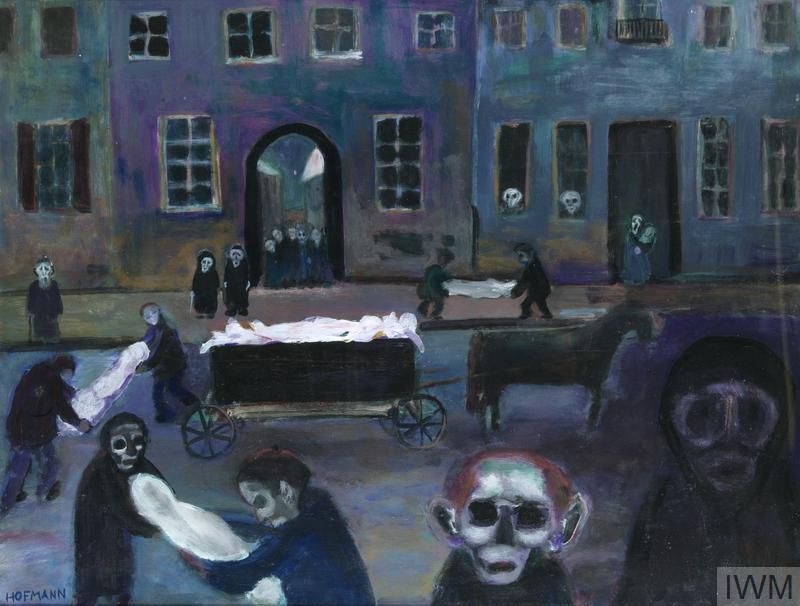
Picture: Edith Birkin, The Death Cart – Lodz Ghetto

Sermon for Birmingham Progressive Synagogue, Parshat Acharei Mot

fast · sermon · theology

Tonight, we begin grieving.

Tonight, we begin grieving.

As the sun goes down, I will eat my last meal for 25 hours. I won’t bathe or shave or change. I’ll probably read a book, or some poetry, and contemplate what it means to be destroyed.

Tonight, the fast of Tisha bAv begins. It commemorates every disaster that has befallen the Jewish people. If we were to dwell on every time we had been injured, our year would be non-stop suffering. We would never have time to celebrate. 

So, we compound all our catastrophes onto a single day. Every exile. Every genocide. Every desecration of sacred texts and spaces. Every racist law and every violent uprising. As far as we are concerned, they all happened on this day: on Tisha BAv.

It is a day of immense profundity. The tunes are haunting. The texts are harrowing. It is the hardest fast of the year, taking place in the heat of summer, with long days and disturbing topics. 

For years, I marked this fast alone. Very few Progressive Jews wanted to participate. Many Reform and Liberal synagogues don’t mark it at all. I would turn up to Bevis Marks, the centre of Sephardi Jewish life in the city, where cantors from the Netherlands regaled us with their greatest piyyutim. But this occasion attracted so little interest from the people who shared my religious beliefs: the other Progressives. 

Why would they not want to mark it?

The first reason is emotional. It is difficult to sit in misery for a full day. It paints a tragic picture of our past, compounding every struggle we have faced into a single problem, overwrit by centuries of destruction. 

In fact, I think this objection is what really commends Tish bAv. Grieving what’s gone can teach us important lessons. It can put us in touch with our most challenging emotions, like guilt, misery and despair. 

True, if we went around all the time complaining about how difficult Jewish history had been, we would never move on, and we would be bound by a negative self-image. By placing all of Jewish suffering on a single day, we are able to confront atrocities, and engage with them, then move on.

Progressives have also objected to Tish bAv on theological grounds. As Reform Jews, we have no desire to return to the Temple or its sacrifices. We are the heirs to the rabbinic revolution, which rebuilt our entire religion after Jerusalem was destroyed. 

Because of the early rabbis, we became a Diaspora people; replaced animal slaughter with prayer; and substituted hereditary priests for a system in which all Jews could be equals. 

But those rabbis understood something profound. You have to engage with the past in order to progress from it. We cannot just pretend things never happened. 

Our rabbis pored over their ancient texts, repeated their oral traditions, and grappled with the world that had gone before. They may have moved beyond the time of the Temple, but they always referred back to it. They faced their tragedy, and rebuilt their religion.

Perhaps the biggest reason that Tish bAv is not given the respect it’s due is because it has been replaced. Since the Second World War, many Jews now instead mark Yom HaShoah or Holocaust Memorial Day.

This is understandable. The Holocaust was, of course, unprecedented in the scale of slaughter; the degree to which industrial machinery could be dedicated to human suffering; and the gleeful participation of so much of Europe in Jewish extermination. It is absolutely right to mark it and honour so many outrageous deaths.

But these events have their own theology. They teach that Jewish suffering was a thing of the past, now resolved. In the case of Holocaust Memorial Day, the problem has now been solved by the United Nations in international commitments to human rights. 

Yom HaShoah is part of the secular cycle of the Israeli calendar, a week before Yom HaAtzmaut celebrates Israel’s victory in 1948, and a fortnight before Yom Yerushalayim celebrates Israel’s Conquest of Jerusalem in 1968. Yom HaShoah suggests that the answer to Jewish suffering is the state of Israel’s military might.

These may well be the political views of some congregants, but they are not the religious views of rabbinic Judaism. Judaism shies away from simplistic answers to subjugation and refuses to allow genocides to be resolved by slogans. We actually have to engage with the horrors of the Shoah, and to understand that they cannot be explained away. We have to sit with our grief.

Tisha bAv poses an alternative response to our experiences of evil. It tells us to fast and grieve, but, unlike on any other fast, we are to carry on working. We can still do many of the things we would on a normal day. Our world is upended, but we must keep going. 

The idea of Tish bAv is that we can face destruction and, through faith and community, nevertheless survive. We can still hold onto our God and our values. Even while we are being destroyed, we are able to rebuild.

Consider how Reform Jews of the past responded to the Shoah in the 20th Century. While in the camps, Rabbi Leo Baeck preached Torah beside waste heaps. When he was liberated from Theresienstadt, he immediately published a work of optimistic theology, expressing his hope of Judaism’s continuity. Think of Rabbi Albert Friedlander, who, having escaped the Nazis, spent the post-war years establishing synagogues and saving scrolls so that our religion could be preserved. Their lives are a testament to Jewish hope in the face of despair.

That is the story told by Tisha bAv. That, yes, we have suffered, but we have also survived. We have refused to let Judaism be extinguished. Into every generation, we have passed on our values and our faith. We have always found ways to rebuild. Tish bAv teaches us that we may always suffer, but that we have also always carried on. 

So, tonight, we begin grieving. I hope you will join me at ELELS for our ECAMPS service to mark this important fast. We will read poetry, hear the chanting of the Megillah, and reflect on the tragedies of destroyed cities and vanquished people. And, through this sorrow, we will learn again the strength and creativity of our people. We will remember all those who have kept this Judaism alive.

Tonight, we begin grieving. Tomorrow night, we will begin rebuilding.

Shabbat shalom.

judaism · liturgy · sermon

Pray for the right kind of rain

Every day, we pray for the right kind of rain. 

The Amidah praises God’s holiness and dominion over the natural world. 

We change how we address God in rhythm with the seasons. In the summer, we thank God for making dew descend. in the winter, for bringing on heavy rains. 

For us living in cities, we can feel quite disconnected from how important this water cycle is. I only catch snippets of how it causes concern. A radio broadcast says British farmers are worried that there hasn’t been enough frost in January. In a supermarket, a cashier tells me there is a shortage of aubergines because there wasn’t enough rain in Portugal this year. 

The cycle of the right rains affects whether we have enough to eat. It can mean the difference between living safely and losing everything. There is a reason the greatest catastrophe our ancestors could imagine was a flood.

This week, we gained a sense of how important and delicate the rain cycle is. 

At the start of the week, I was heading back from a holiday in the Lake District. It was searing hot. The hottest summer we’ve ever had, people kept saying. As I climbed mountains, normally soft moss felt like dry straw under my hands. The shops had stopped selling barbecues and matches. 

Everyone said that the slightest spark could set the whole forest on fire. We would wind up like California or the Amazon, with acres burnt to a crisp. Thankfully, it didn’t happen, but I left with an awareness of the forests’ fragility and a deep concern that England was not ready for climate catastrophe. 

Only days later, I came back to intense flooding. The rains fell intensely, relentlessly. I thanked God that I was safe inside as the skies turned black and stayed that way for what seemed like days. The area around our synagogue was drenched. Charlie Brown’s roundabout flooded again. Some in this community saw damage to their property. Members of our synagogue were displaced: moved initially to the higher floor of the care home, then relocated. 

I was taken aback by how well our care team took to handling the crisis. Claire, Sue, Debz and others made sure everyone who might be affected received calls, and that anyone who needed help got it. They showed the very best of what this synagogue is for. 

But I was most impressed by the bnei mitzvah students I met this week. Jacob and Layla, twins, are preparing to come of age around Pesach, at the time when we stop praying for heavy winter rains and start celebrating the gentle dew. I asked them what they want to be when they grow up. Jacob wants to be a primary school teacher. Layla says she wants to be an environmental activist.

I have to be honest. When I was Layla’s age, I had no idea campaigning could be a job. It is a testament to her curiosity and sense of justice that she has found this out.

But it is also a wake-up call of how dire things are with our environment that Layla has to think of this job. The problems we saw this week had many causes. We have a rapidly changing climate. Companies have over-consumed fossil fuels and spoiled the ecosystem. Developers have built on flood plains. Much of the development after the Olympics destroyed natural wetlands, worsening the situation. But all of these factors share a common problem: we have taken nature for granted.

In this week’s parashah, we read: 

If you listen, if you truly pay attention, the Eternal One your God will grant the right rains at the right times: autumn rain for autumn and spring rain for spring. You will be able to eat and so will your cattle. 

But you must guard yourself against a straying heart. If you serve other gods and bow down to them, God’s anger will blaze out against you. God will shut up the sky. There will be no rain.

This text might feel familiar. It is the second paragraph of the Shema, found on page 214 in your siddur for the Shabbat morning service. You may have read it before, but it’s unlikely you’ll have heard it read aloud in any service. 

It is the custom of this synagogue, and of all Reform synagogues, to read these verses in silence. So, why do we whisper it? 

One reason is that we are very uncomfortable with what is implied theologically here. It suggests that good things happen to good people and bad things to bad people. We know this isn’t true. The righteous suffer and the wicked prosper. Our rabbis knew long ago that there is no individual reward for good deeds in this life. So we won’t say it out loud when we have doubts about it.

But what if it is true? The warnings in these verses are not about how God might deal with individuals, but the impact of actions on entire groups of people. If you don’t pay attention to the ethics of Torah, you all can be destroyed. If you worship gods other than the Source of all creation, you will find yourself helpless before the forces of nature. Cause and effect. Action and consequence. 

In the biblical world, worshipping other gods meant turning to material things. Whereas the idol-worshippers bowed down to wood and stone, what marked out the ancient Israelites was that they only prayed to the transcendental God, who held all of nature in balance.

And that is what is happening in our world today. We are disregarding our ethical obligations to care for the planet, and we are seeing what happens. People have substituted the Eternal God for the material elilim of oil and gas. We have traded humility before nature for the arrogant belief that we can control and manipulate our environment without consequences. 

Now we are living the impact. We are dealing with the wrong rains. We are witnessing floods here, in China, in Germany, in New York, and in India. 

The Torah warns us: “Do not believe you have made all this with your own hands!”

We may have built cities and roads and bombs and planes, but we didn’t make the grass grow. We haven’t made the sun shine. It’s not us that makes the rains fall. 

All that is in the hands of a supreme Creator, who has charged us with protecting and sustaining this planet. We must hear, and truly pay attention, to that God, whose Word calls to us today. We must take up the challenge of replacing fossil fuels with renewable energy; of rebuilding our world in harmony with nature, rather than against it; of tackling carbon emissions and climate disaster. We must enable Layla to inherit a living planet so that she actually has something to protect.

We must act now. 

Shabbat shalom.

This sermon is for South West Essex and Settlement Reform Synagogue, 31 July, Parashat Eikev