A simple Jew prays to God on Yom Kippur, and says “Ribon shel olamim, ruler of the Universe, I do not have much to repent of. Not compared to you. Unlike you, O God, I have not taken away children from their parents; I have not taken away parents from their children; I have not allowed disease and starvation and war. Compared to you, Holy One, I have been a saint. So, this year, I won’t be repenting. It’s your turn to repent.”
The rabbi asks him, “what were you praying there?”
He tells her all that he’s said.
She says: “You fool! You let God off too easy. You should have told God to bring about the Redemption as well.”
I don’t know about you, but I haven’t felt much like repenting this year. After all, what have I done, compared to the enormity of wrongs perpetrated?
I haven’t killed anyone or waged any wars. I haven’t robbed anyone or embezzled any funds. To the best of my knowledge, I haven’t brazenly lied or misled. I certainly haven’t intentionally hurt anyone. I’m just not in the same league as the great sinners of our time.
And I don’t much feel like growing this year, either. Other years, I have enjoyed the stillness of Yom Kippur for reflection on being better. But I don’t feel like doing it this year.
Sure, I’m grateful for turning off my phone so I don’t have to look at all the bad news, but that’s more about self-care than self-improvement. I’m more interested in switching off from the world than in switching onto myself.
I mean, really, do I have to move? The world is changing so much, and not for the better. Shouldn’t I be allowed, as a one-off, to stop constantly evolving and just be as I am for a bit?
You know who else just wanted to stay still?
Jonah.
I think Jonah knew exactly how I am feeling now.
He was perfectly alright where he was, before God got involved and told him he needed to go and sort out all the problems of the world.
Who was Jonah in the scheme of things? He certainly was not a big player in the wrongs of the world. All of Nineveh’s sins were enormous and happening miles away. Why should he have to change himself?
So, when God called on Jonah to get up, that was already asking too much.
Jonah ran away to Tarshish. He shouted at God: “haven’t you got bigger fish to fry?”
God said: “you want to see a big fish? I’ll give you a big fish!”
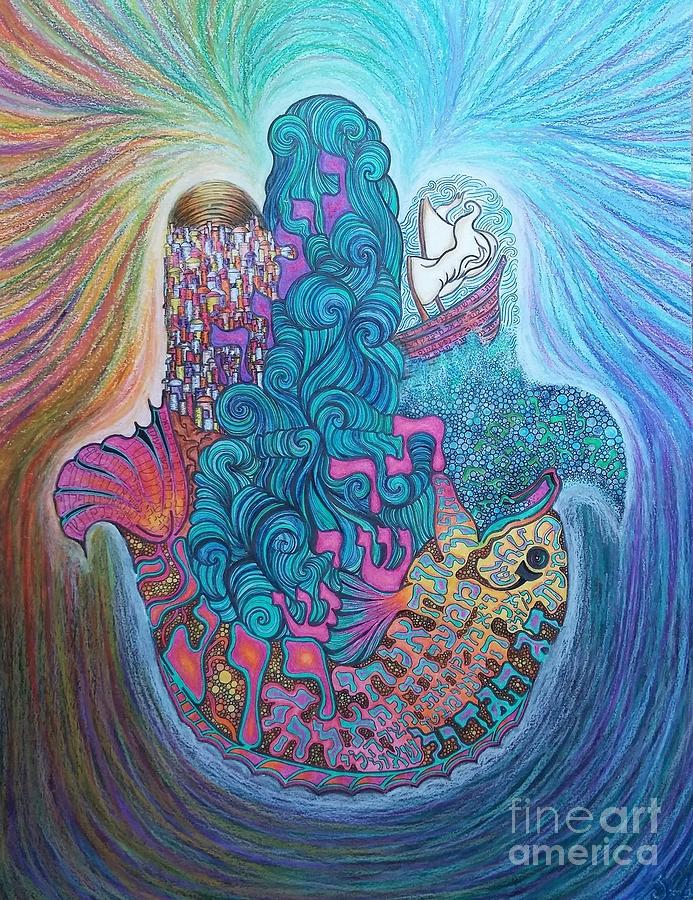
One came along and swallowed him whole.
Now, all of the story before is about Jonah not wanting to move and all of the story after is about what happened after God moved him.
What happened in the whale, however, should really interest us.
This year, I feel like I’m in the whale. I am sitting in a puddle from which I feel like I cannot budge. I am stuck here and have no idea how to get out. All around me, the waves are crashing down and there’s nothing I can do to stop them.
(A pedant will point out it’s not actually a whale. Technically, it’s a big fish, and the idea of it being a whale came later. But, technically, I’m not actually inside a whale at all, I’m in a synagogue, so I’m going to stick with the idea of the whale because it feels evocative.)
Now, I’m not even on the level of Jonah. My task is not nearly as big and I am not even inside a literal whale. So Jonah should be a good starting-place for my feelings of stubbornness and obstinacy.
What did Jonah do inside that whale? He despaired. He observed. He prayed. He sang. He learnt. And, eventually, he repented and grew.
So, this Yom Kippur, let’s engage with the whale. Let’s focus just on the three days Jonah spent inside the belly. Maybe we can learn from Jonah what to do when everything feels too overwhelming but we know we have to change anyway.
The second chapter of the book of Jonah is not narrative-form, like the rest of the book. Only the first verse, where Jonah gets swallowed by the whale, and the last verse, where the whale spits Jonah back out again, follow a linear storyline.
The rest of the chapter, only eleven verses long, reads more like a poem. It is a song, where each verses contains a parallel structure. It would fit just as well in the Book of Psalms, where there are similar supplications to God.
If the second chapter of Jonah is a journey, it is only a spiritual one. Jonah himself remains completely static, stuck in the belly of the beast.
His soul, on the other hand, begins in the depths of despair, goes through questioning and defeat, recognises the glory of God, and finally comes out committed to getting out there, thanking God, making offerings, and taking part in the deliverance.
This feels like the most important chapter to us, then. We are just sitting and standing in the same space. But we are expecting our souls to move.
I am feeling stuck in a world I cannot change, but I know I have to get somewhere else spiritually. We can’t just sit around here and hope to become better people. We know it needs work. But without a narrative, how do we know what to do?
Well, in the spaces left by the absence of narrative, the rabbis come up with their own stories. Pirkei deRabbi Eliezer is a collection of creative writing, compiled over many generations, that retells the biblical stories. These are our midrash, and in this rabbinic fan-fiction, we get a story to go with everything that Jonah says.
From these stories, we might come up with our own meanings of what we should be doing here.
The first thing Jonah does is acknowledge where he is. He accepts that he is in the belly of the fish.
The midrash gives us a grandiose interpretation of what that looked like. It was like entering into the great synagogue: an enormous, echoey chamber. The fish’s eyes were two great windows, so that Jonah could see what was going on underwater. Inside the fish was a giant pearl, which illuminated the belly and shone out towards the sea. With a lamp and windows, Jonah had a clear vision of where he was.
What can we learn from this? We learn that we need to be honest with ourselves about where we are. The world is a bit of a mess right now, and there’s no point putting on a happy face and pretending everything is OK. Equally, we are pretty safe here. We in this room are not under attack, and the risk we would be is very low.
So, start by taking stock of reality. Where am I? I’m in a synagogue, sitting on a comfy chair, with my feet planted on firm ground. I can see the lights of the room and smell that familiar sweet must of this religious space.
But it’s not enough to just say where we are. We need to say how we feel. That’s what Jonah does next.
He says: “I am crying out to God from my narrow-straits, please answer me.” Jonah says, “I am crying out from the belly of Hell, may God hear my voice.”
The midrash says, that’s exactly where the whale took him. It plunged him right down into the depths and showed him the gates to Hell.
So, we need to do the same. We need to ask ourselves how we are really feeling. Be honest about the frustrations and worries and anger we feel.
Next, Jonah finds a way to relate what is going on to what has gone before. In the depths of the ocean, Jonah says, he sees the billows and waves and reeds.
According to the midrash, this is because the whale took him on a tour, not just of the sea, but of Jewish history. The whale showed Jonah the foundations of the earth, deep on the ocean-floor, and reminded him that God had made the world. The fish took him to the Sea of Reeds, and showed him the flora of the spot where the Israelites had crossed out of Egypt.
Faced with adversity, we have to remember that it has happened before. Once, there was nothing, then the world came into being. Once, we were slaves, but then we were freed. Wars and persecutions and empires have all come before and, somehow, our people have survived.
We, as individuals, have also survived challenges before. How recent was the Covid pandemic? We can take pride in our own resilience at getting through such troubles before.
Knowing what had gone before, Jonah was able to feel confident that he could face what was to come. Jonah cries out: “You saved my life from the very pits, O Eternal One my God!”
The midrash says that this came when the whale took Jonah down to meet the great sea-monster of the deep, Leviathan. Jonah told that nautical dragon: “You may think you are going to swallow me up, but I carry the promise of Abraham, and I know that one day, when God chooses, it will be you who gets eaten by the righteous.”
Like Jonah, let’s look at the problems ahead of us, and say: “I have faith. I can face you.”
Next, Jonah reflects back on what he has learned. He notices: “Those who cling onto empty folly forsake their own welfare.” He had been willing to stay where he was, clinging onto old vanities, but he did so at the expense of his own soul.
So, he proclaims, instead: “I, with loud thanksgiving, will sacrifice to You, God.”
We, too, can be grateful for what we have, and take on this next year in service of our Creator.
That is the journey on which Jonah took his soul, and it is where I hope to take mine over this Day of Repentance.
I said I wanted to stay still, but stillness is not inactivity. The Rambam understood that serious thinking was the most active you could be. It connects you directly to that Most Active Intellect: the thinking, living God.
In stillness, you can nurture who you are. Jonah was stuck in an underwater pit, but that was when he got most energised. It was when he really engaged in the audit of his soul.
This year, I have spoken to friends and community members and witnessed them say things they normally would never. People who would ordinarily be very liberal, turn racist. People who are normally very peaceful, justifying violence. People who are normally pretty discerning, regurgitating conspiracy theories. People who are usually nuanced, turn to absolutist thinking.
I am not saying this with any judgement. I say it because I’ve done it too.
And when I meet this now, I try to say to myself: I know you are scared and angry, and while you are feeling scared and angry, you can hold all those feelings. You are inside the whale.
But one day, please God, you will be released from this whale, and you will have to reckon with who you became there.
Take care of your soul. It is a precious gift. Don’t let it become too cynical or warped by the horrors that surround it.
That’s my goal for this Yom Kippur: to hold my soul with gentleness, and ask it to be porous and empathic and kind.
I am here, inside the whale. I cannot change what whale I am inside. I cannot stop the waves from crashing or remake the world so it is less scary.
I can only change what I can change. And what I can change, in this moment, on this Yom Kippur, is myself. I just have to deal with who I am here and now.
So, let’s be like Jonah. Let’s accept the whale we’re in, and, yes, despair, but also observe, pray, sing, learn, repent.
And it may be that, when we finally get blown out from that great fish’s blowhole, we might still be better people than when we got swallowed up.
Amen.

 Sim Lev