high holy days · liturgy · sermon

Do not build a prison in your heart

Imagine a courtroom. Picture those big wooden panels that line the grand hall of a traditional Crown court. The deep reds of the carpets. The judge sitting loftily on a bench,  at the front, draped in black gowns, donning that full-bottomed wig. And all the lawyers surrounding you, speaking Latin and legalese, bewildering you with their words. 

You have not been here before, but, suddenly, you find your life depends on your correct participation. You will have spent extra time ironing your clothes and polishing your shoes. You may have spent weeks picking out an outfit. Perhaps you already know what you would wear. 

How does it feel to stand trial here? Is this somewhere you want to be? From here, how much do you think you will learn and grow? And do you think there might be a better place where you could improve yourself?

This is the metaphor we are often given for Yom Kippur. The Heavenly court and the earthly one. The trial of our souls. The God of Justice, who sits in judgement over us.

We beg for clemency:

סלח לנו – forgive us

We announce our expectation of a just verdict:

סלחתי כדברך – I have forgiven according to your plea.1

We rejoice in the judgement:

אשרי נשוי פשע כסוי חטאה – happy are those whose transgression is forgiven, whose sins are pardoned.2

This is the courtroom of our hearts.

C. S. Lewis, the great 20th Century English author, famed for his Chronicles of Narnia, picked up on this aspect of our thinking. When he wasn’t writing beloved children’s novels, Lewis dabbled in biblical studies as a lay Anglican theologian. 

C. S. Lewis writes: “The ancient Jews, like [Christians], think of God’s judgement in terms of an earthly court of justice. The difference is that the Christian pictures the case to be tried as a criminal case with himself in the dock; the Jew pictures it as a civil case with himself as plaintiff (sic). The one hopes for acquittal; the other for a resounding triumph with heavy damages.”3

Now, Lewis is no antisemite. In fact, he repudiated the hatred of Jews, long before it became fashionable to do so.4 He is eager to point out that, at his time of writing, immediately after the Second World War, the Christian had much to atone for, and the Jew had much to charge against God. 

In many ways, he has us down. We do indeed take this as an opportunity to bring all our charges against God, and to vent our grievances against the injustice of the universe. Lewis is talking about ancient Israelite religion; the religion  of Scripture. 

Lewis would, I’m sure, willingly acknowledge that we modern Jews also share much in common with modern Christians, in terms of our admissions of guilt and prayers for pardon.

C. S. Lewis has astutely picked up that we see all this as a trial. 

But where he errs, I think, is in his understanding of what an ancient Jewish court was. The tribunal of our ancestors looked nothing like the judge’s dock of today. 

A metaphor that worked so well for poets and liturgists many centuries ago can become quite damaging when it is used with the projection of our criminal justice system.

Where today, a court can dole out sentences of imprisonment, the goal of the ancient court was about restitution and social harmony.

Where today, the court expects to find a person innocent or guilty, the ancient court sought to make sure everyone felt like they had a place in their community.

The focus of our sacred writings is to create a society based on compassion, community accountability, and healing.

When we rethink what justice looked like for the authors of our Torah, concepts of trials, pardons, and sentences start to look very different. By seeing the court through ancient eyes, we can re-imagine the trial as a process of growth and healing.

We get mere glimpses of what the earliest courts might have been. In the book of Judges, the archetypal ideal of the judge is Deborah, the prophetess. Her court is a base underneath palm trees in the hill country. We receive an image of her sitting there, while Israelites come up to have their disputes decided.5 Her court was one where people came to negotiate and be heard, but there is no indication they came to be punished. This was in the time of the Judges, the earliest of Israelite civilisations.

Later, however, ancient Israel developed a class system and a monarchy. With a state system came power and punishments. In the book of Samuel, King David pursues after the city of Avel Beit-Maacah, threatening capital punishment against everyone who rebels against him. Here, an unnamed elder-woman comes out. She admonishes the general, saying: “we are among the peaceful and faithful of Israel, will you destroy God’s inheritance?” She rebukes them with a reminder of the old system – that, before there were kings, people used to come and talk out their issues in the city. The generals agree to spare the city, providing they can enact punishment against one ringleader.6

From these two stories, we can garner an insight into what justice may have looked like in the earliest part of the biblical period. The first thing we notice is that women were leaders. This, then, may be a justice system from before patriarchal power was cemented. We also do not detect any hint of crime and punishment. Instead, the courts seem more like public cafes, where experienced negotiators help community members talk through their problems. If this is correct, we are looking at a very different type of court.

Still, courts did develop in ancient Israel, but not like those of today, nor even  of the surrounding empires. In our narratives, most of the times that characters are imprisoned, it is outside of the Land of Israel, by a Pagan power, and unjustly.

Joseph is sent to prison in Egypt on trumped-up charges without any due process.7 Samson the warrior is sent to toil at grinding grain in the jailhouse by the Philistines, not because he has done anything wrong, but as a prisoner of war.8 When the Babylonian rulers send Daniel to the Lion’s Den, it is because of xenophobic laws that stop him practising Judaism.9

Our Scripture treats prisons as something foreign, where good people are sent for bad reasons.

Even when we do see examples of prisons in Israel, they are always treated by the Torah’s authors with contempt. Three of our prophets are sent to prison: Jeremiah;10 Micaiah;11 and Hanani.12  In every single case, this is a monarch warehousing a prophet because they are speaking truth to power. In the Torah’s view of justice, it is hard to see how prisons could have any meaningful role at all.

That does not mean this was a world without punishment. Scripture presents exile, flogging, and even death as options for what might constitute justice in the ancient world.13

Yet, based on our commentaries and traditions, we have the impression that such penalties were implemented only in the most egregious cases. What somebody had to do was so heinous that the death penalty would almost never actually occur.14 

In the Mishnah, we read, the court that puts to death one person in seven years is bloodthirsty. Rabbi Eleazar Ben Azariah takes it even further, saying, ‘One person in seventy years.’ Rabbi Tarfon and Rabbi Akiva say, ‘If we had been in the Sanhedrin, no one would have ever been put to death.’15

What kind of justice system was this then? No prisons, no death penalty? No patriarchy, no punishments? 

The ancient court sounds more like people just sitting around having a chat.

What if it were? What if, instead of biblical justice being all about burning and smiting, it was mostly about negotiating and feeling? How would that change how we look at our tradition? How would it change how we approach our relationship with God?

Perhaps I am over-egging how different the biblical court was. If so, bear with me. 

I am well aware of how terrible some of the Torah’s punishments were. I am also conscious that what I am describing is so outside of our reality as to make it feel fictitious. If the world of restorative justice I am describing never really existed, please at least indulge me in entertaining the possibility that it could. 

We are not, in this room, coming up with a proposal for how to govern Britain. We are just asking what metaphors work when we think about how to hold our own hearts on Yom Kippur. For me, the metaphor of court cases has proven really problematic, and I am looking to explore new ones with you.

The problem of the courtroom metaphor initially struck me quite suddenly. I was talking with my therapist about an issue that I felt kept coming up in my own behaviours. I said: “I’ve got another case to talk about…”

He looked around the room and said “you know you’re not on trial here, right?” 

I think I had expected, on some level, that, through counselling, I could be acquitted or found guilty for all my past deeds and thought patterns. 

I had built a prison in my own heart, to which I could sentence the parts of myself  I liked least. I had conjured up a jury in my head, who would judge all my actions, according to the standards I had set myself. According to the standards I imagined God has set for me.

What was I doing? The point of therapy is not punishment or exoneration. It’s to learn and grow, and find ways of being better in the life I actually have. The point is not to condemn or discard my negative traits or past mistakes. The point is to work towards loving all of myself and learning from all I have done.

Perhaps you can relate to this. Have you imagined how you might punish others, or cast them into our prison in your heart? Maybe you even seek to punish people or get them out of your life. Maybe you, too, have hoped there were parts of yourself you could lock away.

We cannot apply the carceral system to our spirit. When we are doing wrong or feeling guilty, we must be free to look ourselves in the eye, and change willingly.

Is this not what God wants from us, after all? That we make amends, grow, become better. That we embrace ourselves and each other. That we turn from our ways and live. 

If, then, we are in a court with God, we should make it one where we are in conversation with a loving elder, not facing a law lord who seeks to punish and acquit.

So, let us imagine a new court. It is not the court we thought into existence at the start of this sermon. It is a very ancient one, where our ancestors went thousands of years ago. Deborah’s court. 

You are in the dusty scrubland of Canaan, and a few yards away you can see an oasis. People are gathering around it to fetch water. They are laughing and catching up and telling stories. They are feeding their livestock: sheep, goats, donkeys, camels. 

At the edge of this well is a row of palm trees, and the tribal leaders sit, drinking sweet tea. You cannot go to prison. There is no prison. You cannot be acquitted, because nobody thinks you are guilty. You are just a person, a member of the community, looking for a way through a problem. The goal will be to find a solution that benefits everyone, and that sees maximum spiritual growth. 

When you come away from this court, you can say “happy is the one whose sin is forgiven.” You don’t mean that you are relieved because you thought you were in trouble. You mean you are jubilant, because you are at peace with yourself, your community, and your God.

Let this be your court. Let this be the place you take your heart over Yom Kippur. 

Come before God, not as a claimant nor a defendant, but as a congregant, seeking growth.

And thank God that there is no prison in your heart; only an opportunity for ongoing healing and change.

May this be where we judge ourselves. May this be where we judge others. 

And let us say: amen.

  1. Birkat Selichot ↩︎
  2. Psalms 32:1 ↩︎
  3. CS Lewis, Reflections on the Psalms ↩︎
  4. PH Brazier, A Hebraic Inkling: C. S. Lewis on Judaism and the Jews ↩︎
  5. Judges 4:5 ↩︎
  6. II Samuel 20 ↩︎
  7. Genesis 28 ↩︎
  8. Judges 16 ↩︎
  9. Daniel 6 ↩︎
  10. Jeremiah 37 ↩︎
  11. I Kings 19 ↩︎
  12. II Chronicles 16 ↩︎
  13. Ezra 7:25-26 ↩︎
  14. eg. BT Sanhedrin 71a ↩︎
  15. M Makkot 1:10 ↩︎
sermon · theology · torah

Purity or justice

Let’s start with a question.

An adult couple accidentally runs over their pet dog. Instead of burying their dog in the garden, they take it home, cook it in the oven, and eat it. 

Here’s the question: have they done something immoral? 

Most of us will have an instinctive reaction: what that couple did was disgusting. We will feel some revulsion.

But whether you think it was morally wrong will depend on how you see the world. It will depend on your moral palate. 

This was what was demonstrated by the Jewish-American psychologist, Jonathan Haidt, in his popular book, The Righteous Mind.

Haidt sought to find out why it was that caring, rational people could disagree so profoundly on moral issues. Why was it that America was so polarised? There, people fight furiously about issues like abortion, guns, and marriage, as if they have no common moral basis.

Haidt argues that we do have shared moral bases, but our morality is more like the palate on our tongue. “We humans all have the same five taste receptors, but we don’t all like the same foods,” he says. “It’s the same for moral judgments.”

We have, he says, five main taste receptors: care, fairness, loyalty, authority, and sanctity. 

If you are an educated person who lives in an urban area of a Western capitalist country, you are likely to feel that the couple who ate their dog did not do anything morally wrong. You’ll be disgusted, sure, but you might not think that they violated any kind of moral rule.

That’s because, in these cultures, people have a moral palate that puts a big emphasis on ethics of care and harm. If nobody was hurt, then there’s nothing immoral.

If, however, you live in a close-knit community of farmers, you are far more likely to say that the couple who ate their dog did do something morally wrong. That’s because those cultures have a strong sense of sanctity and taboo.

Both of these systems are ways to help people get on with each other. In a busy metropolis like London, you need to be able to live and let live, because if you can’t tolerate diversity, society will fall apart. In a tribal farming community, like ancient Israel, you need to have strong social norms to protect people.

Both these impulses – care and sanctity – come from a deep, ancient social need. 

Since humanity’s beginning, our survival has depended on our ability to care for our most vulnerable members. How would we have lasted a single generation if not for looking after the young, the old, and the vulnerable?

From the start of civilisation, we have also needed to be able to express disgust. It comes down to the most basic distinction between excrement and edibles. We need to tell each other: “this food is poisonous; this disease is contagious; this behaviour is dangerous…” Without clearly agreed boundaries and taboos, we would quickly perish.

It is worth holding these two tendencies in mind – care and sanctity; purity and justice – as we approach our readings for this week.

Our Torah portion goes into minute detail about how to do proper sacrifices, how to lay out the Temple, and who is supposed to do what in religious services. To us, the attention to detail might seem absurd.

But remember that this is part of a group of people’s moral palate. This is their sense of the sacred. Messing it up, from their point of view, would be ethically disastrous. It would be similar to eating the family pet. 

No wonder, then, that the prophet Ezekiel opens the haftarah by telling the Israelites “if they are ashamed of all they have done, make known to them the design of the temple.” Failure to get it right, says Ezekiel, is a serious sin.

There are two great moral impulses in Torah: justice and purity. This trend appears throughout the whole Scripture: contradictory, competing moral voices speak through our books.

The voice of justice tells us about care and compassion. It tells us about fairness and redistribution. The voice of justice charges us towards more equality and more freedom. Justice says that a society is only as strong as its weakest members.

The voice of purity tells us about how to keep holy things sacred. It tells us what the boundaries are on sex, so that we do not cross them. The voice of purity tells us not to eat octopus and not to mix linens. Purity makes sure everything is kept in its proper place, so that society can function, and people feel safe.

The voice of purity might feel less relevant to us today. We celebrate the prophets for their concern for the most vulnerable, because it fits so well with our ethics of care. We see ourselves in the narratives of the exodus because they chime with our moral intuitions about freedom from slavery. Laws on architecture… feel less like big moral issues.

That’s because what the big taboos and boundaries are can change a lot between time periods. 

When I was growing up, one of the big focuses of popular disgust was gay men. There was a long period when the media was seemingly obsessed over sex between men, especially in public toilets. This was the full gambit of taboos: waste and excrement; sex between the wrong sorts of people; and blurring the boundaries between public and private.

I think that is why some of the things that cause people moral disgust today just don’t bother me. I have had to push through a society telling me I was disgusting, and unlearn that contempt towards gay people. Now, the other sources of disgust just seem like passing fads. 

Knowing that has helped me understand where others are coming from.

I find Haidt’s ideas about moral palates really helpful for thinking through why sometimes it’s hard for people to agree. My ethical taste buds are highly attuned to care and fairness, but I don’t get much flavour from sanctity, and I can barely taste authority. 

Please do not think that one of these is left-wing and the other is right-wing. There are plenty of conservatives deeply motivated by wanting to make sure people are cared for and that distribution is just. There are just as many socialists who want to ensure the purity of the Marxist tradition, and to live in a world without contaminating ideas or contaminating people. 

What we morally feel is not just about ideology, but about all the factors in our cultures and upbringing that make us need to focus on certain values.

So, this is my advice. The next time you encounter someone that you really disagree with, try not to assume they are evil or weird. Think back, instead, to this Torah portion. Maybe what is just a building to you is somebody else’s Temple. Maybe what really triggers one person just doesn’t impact you.

Haidt’s goal, when he did this study, was to make it possible for people to talk to each other across divides. I don’t want us to become like America, where some issues cause massive wedges between neighbours. 

So let’s try listening to each other, and hearing each other’s worldviews.

Shabbat shalom.

festivals · sermon · theology

A night for finding answers

Tonight is a night for asking questions. Tonight, as we open the haggadah, we will tell the children they are free to ask. We will lay out plates of display foods, including an egg, a bone, and a mushy mixture of fruit and nuts, so that people will ask questions about our exodus from Egypt. 

In “mah nishtana,” the lovely song chanted by the youngest at the table, we hear four questions about why tonight is different from every other. Why do we lean to the left when we drink? Why do we dip things in salt water? Why do we eat that tear-jerking horseradish, maror? And why have we had to substitute delicious bread for mediocre matzah?

So highly valued is questioning at this season that Judaism has been described as a religion of questions. Ask us a question and we’ll answer with another question. A decade ago at this season, the American businessman Edgar Bronfman declared “to be Jewish is to ask questions.” This festival, with all its questioning, he said, proves that Judaism permits plenty of doubt and openness to many answers.

I have a problem with this approach. The trouble is… these questions have answers! They’re not open-ended speculations to which we’ll dedicate the rest of our lives pondering. 

We lean to the left when we drink our wine to show that we are free. We dip parsley in salt water to remind us of the taste of tears that came from enslavement. We eat the bitter herbs in commemoration of the bitterness of slavery. We eat matzah to recall that our ancestors left Egypt in a hurry, because we can waste no time in pursuing freedom.

These are the answers. They tell us what the festival is all about and what Judaism really means. It’s about how freedom tastes good and oppression is painful. It’s about the moral message of a God who saw the difference and decided to redeem the Israelites. These questions have a purpose, to provoke us into contemplating justice.

This idea that Judaism is all about questioning and doubt has taken such a hold that people have hung entire theologies on it. There is a story in the Talmud that the two great founding houses of rabbinic Judaism, Hillel and Shammai, were in a conflict for three years. Eventually, a divine voice announced from the sky: “these and these are the words of the living God.”

It is a beautiful story, but it has been repeatedly cited by Jewish educators to justify a relativism that firmly believes nothing. Everything is true. All views are valid.

These teachers always conveniently omit the subsequent words from that divine voice: that the halachah is in accordance with Beit Hillel. They both may have valid viewpoints, but only one can be implemented. The Talmud asks why it was that Hillel’s house won. It answers that they were עלובין – a word often translated to mean ‘modest’ but which really means ‘wretched’ or ‘poor.’

The House of Hillel really were comprised of the poor. Their judgements consistently advocated for the slaves against the masters and the peasants against the patrician class. They strove to make Judaism more accessible to the downtrodden and more just for the oppressed. In other words, God may be able to speak through many voices, but ultimately the one that champions moral truth is still the correct one.

I do understand why people might want to advocate for doubt and questioning. It is an antidote to dogmatism. It stops people becoming fundamentalists, Imagining that they alone can speak for God. 

But there are real problems with leaving everything open to debate. Surely it is not just an open question whether or not to hurt people. The words of oil barons and indigenous climate activists are surely not equally ‘the words of the living God.’ We can’t give equal weight to every view or only question without seeking answers.

My very favourite philosopher was a British-Jewish woman called Gillian Rose. She wrote with such beauty about things that really matter. She saw the problems of only questioning and allowing every viewpoint quite clearly. She also agreed that we couldn’t just assert answers. If either everyone is correct or only one answer is correct, there is no room for discussion. 

So, Gillian Rose says, you have to pick a side. You have to decide what you think is right. You have to look at what your conscience tells you and aim for meaningful justice. You might be wrong, so you have to keep your mind open to nuance and debate. But you also have to know right from wrong. 

Pesach is indeed a time for asking questions. But it is, above all, a night for seeking answers. 

Pesach invites us to ask about freedom so that we will fight for it. Pesach invites us to ask about oppression so that we will vanquish it.

We must ask these questions because Pharaoh was not just a man who lived a long time ago and the exodus was not a one-time event. These are words of a living God because they speak to struggles that are still very live.

Tonight is a night for asking questions. Tonight is a night for seeking answers.

The great question of Pesach is: what are you doing to bring about justice today?

And now you must give your answer.

theology · torah

Stop doubting. Start doing.

Job was a man of complete integrity. According to his eponymous book of the Tanach, no matter what happened, Job was the epitome of Jewish righteousness. Then hardship fell, and Job began to doubt God’s justice.

This was hardly surprising. God had stripped him of everything, ridden him with disease, killed his children and destroyed his livelihood to test whether or not Job would remain faithful.[1]

As it turned out, Job could only endure so much. His friends comforted him with explanations of how God must be righteous after all, but they were insufficient. Finally, Job began to snap. What if God was not just?

Just then, God burst out through the clouds. “Who are you to question Me?” demanded God.[2]

After a lengthy excursus from Job’s inadequate interlocutors, we might expect a more thorough explanation. God has arrived and will explain the nature of justice.

Instead, God goes off on one about mythical beings. God talks about the Behemoth, an enormous bull-like monster that can rampage fields. God describes Livyathan, a fire-breathing dragon that cannot be killed.[3]

And this, apparently, satisfies Job.[4] Well, I’m not satisfied. I don’t know about you, but if I’m having doubts about my faith, “have you heard about the monsters God tamed?” won’t really cut it for me. You can’t respond to rational concerns by piling on ever more improbable legends. Now I’m filled with even more doubts.

But perhaps that’s the point. The author of Job, arguably the most philosophically complex text in our Tanakh, probably knew that these myths weren’t really an answer to the question posed.

The real answer, hidden within these poetic arguments, is that we don’t know. Whatever God is, it is beyond our comprehension.[5] Whatever justice is, we cannot fully reason it enough to grasp it. ‘You don’t need to understand,’ is what God is really saying.

Similarly, our parashah this week concerns Moses’s doubts. We have come to the book of Exodus, and Moses has already run away into the wilderness. Out of a flaming thicket, God summons Moses to rescue the Israelites from their slavery in Egypt.[6]

Just as God answered Job from the clouds, so too does God answer Moses. But the answer Moses receives is no more comforting. ‘You don’t need to understand,’ says God, ‘you need to get going.’

“What if I’m not good enough?” asks Moses. “You will be,” says God.[7]

“Who even are you?” asks Moses. “I will be whatever I will be,” God roars back. “Tell the Israelites ‘I will be’ sent you.”[8]

“What if nobody believes me?” asks Moses. “They will,” says God.[9]

“But what if I can’t find the words?” asks Moses. At this point, God loses patience. “I gave you your mouth, I will give you the words! Now get yourself down to Egypt and set those slaves free!”[10]

Miracles might be convincing to some. Logic and reason might work some of the time. But, ultimately, you have to act. When faced with injustice, there is little time to contemplate the nature of sin and perfection and God’s role in it. You have to get out and do.

Rabbi Abraham Joshua Heschel was a Conservative theologian and civil rights activist, famously pictured alongside Martin Luther King Jr at the march on Selma. He said that Judaism does not require a leap of faith, but a leap of action. We are called upon, first and foremost, to act. Whatever we think about it can come later.

This might sound strange to us, educated in a Western thought system that teaches us to calculate and reason before making choices. But it was not strange to the Israelites. When God called on them at Mount Sinai, they replied “we will do and we will hear.”[11]

According to the Talmud, a heretic accused Rava using this verse. Rava was sitting, so engrossed in study, that he didn’t notice he had trapped his finger in a chair leg and it was spurting blood everywhere. “You impulsive people!” the heretic said. “You still bear your impulsiveness of acting before you think. Listen first, work out what you can do, then act.”[12]

Rava responded with the verse from Proverbs:[13] “The integrity of the upright will guide them.”[14] We trust in our integrity. We trust in our conscience. We can be moved by our faith that we know right from wrong.

I think, over the last few years, progressives have done a great deal of doubting. We have been introspective and thoughtful. We have wondered, internally and out loud, whether we are right after all. Perhaps, as nationalist ideas return and religious conservatism gains strength, we might be able to make compromises on our ideals and find a middle-ground with others.

This week, fascists marched on the White House. They carried Confederate flags into Congress. A Nazi showed up among the rioters wearing a shirt that said: “Camp Auschwitz” on the front, and “staff” on the back, as if taking credit for the mass murder of Jews. They proudly displayed nooses, the symbol of anti-Black lynchings. Every brand of far-right conspiracy theorist and white supremacist descended on Washington, and video evidence shows that the police not only tolerated them but let them in.

Where has all our doubt and consideration left us? In our desire to find common ground and engage in reasoned discourse, we now come across as morally ambiguous and uncertain in our principles. We have left an ethical vacuum, and fascists have stormed into it. Intellectual curiosity is little use against the blunt force of white supremacists seeking to violently cease power.

Rabbi Professor Tony Bayfield has pointed out that our uncertainty is what differentiates us from fascists. Fascists are, by definition, absolutists. They do not interrogate their views or consider other perspectives. Our advantage over fascists comes from the fact that we give arguments due consideration and approach our own convictions with humility.

He may be right. Doubt might separate us intellectually from fascists. But it is action that separates fascists politically from power. There is no joy to be had in feeling superior if white supremacists gain power in government.

This week’s events may have been a terrifying climax to Trump’s presidency. But it is equally likely that they are a prelude to worse events. American white nationalists are emboldened and convinced that they can seize power through either ballots or bullets, depending on whichever method suits them. The situation in Britain is scarcely different, where racists have not felt so confident in decades.

Whether Trump now recedes into the background or his racist ideas come to dominate the world will depend on how we act. It will not depend on what we think, but on what we do. Events are calling us to action. If we want to eradicate fascism, we must be willing to fight it.

By all means, have doubts. Moses doubted. Moses was unsure. But God said to him, ‘go anyway. Get down to Egypt and free those people.’

We must be willing to face the Pharaohs of our time with the same vigour. We must be able to say: “I have come to act because God sent me. I am standing for justice because I know it to be right and true. I am standing against racism because I know it to be wrong. I will free these people. I will uproot tyrants. I will defend democracy and advance the cause of the oppressed.”

The integrity of the upright will guide us.

Although we may not fully understand these monsters before us, we will slay them.

And we will vanquish fascism for good.

Shabbat shalom.


I am giving this sermon on 9th January 2021 at Newcastle Reform Synagogue for Parashat Shmot.

[1] Job 1

[2] Job 40

[3] Job 41

[4] Job 42

[5] Job 11

[6] Ex 3

[7] Ex 3:11-12

[8] Ex 3:14

[9] Ex 4:1-9

[10] Ex 4:11-12

[11] Ex 24:7

[12] BT Shabbat 88a

[13] Prov 11:3

[14] BT Shabbat 88b

climate change · protest · social justice · Uncategorized

Tzedakah annuls the evil decree

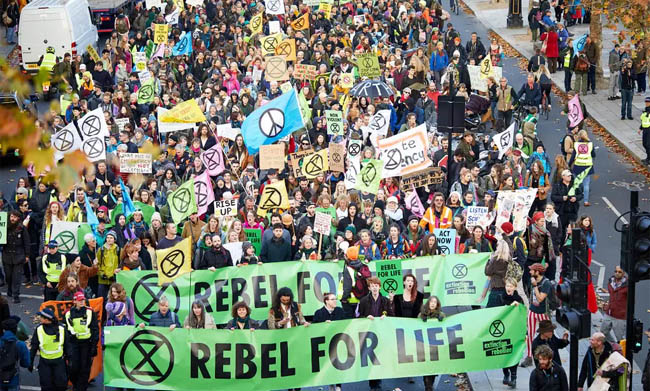
Tonight I will attend a protest against climate change in Parliament Square with Extinction Rebellion Jews. My speech for the demonstration is below.

Tzedakah annuls the evil decree! So we are promised every year in the liturgy for Rosh haShanah and Yom Kippur. And with those words, the chair of your synagogue will usually stand up to tell you about the charity appeal and where you should donate.

Do not be deceived for a minute into thinking that tzedakah is the same as charity. Tzedakah does not mean charity. Tzedakah comes from the same root as ‘tzedek’: economic justice. 

In Deuteronomy we are told: tzedek, tzedek tirdof. Justice, justice you shall pursue, so that you will live and inherit the land. Yes, Torah tells us that justice is a prerequisite for our continued life and for the continued health of the planet. 

This is not justice of the general kind, but specifically of the economic kind. When the Torah brings this word, it brings with it warnings that you must have fair weights and measures, resist corruption, and equitably distribute the wealth. This is what the Torah means when it tells us to pursue justice. 

So we know – we know – that climate justice is deeply connected to the economy. We are facing extinction because the richest corporations are squeezing the planet’s sacred resources for the sake of profit. The world is in crisis because capitalism demands constant production, consumption and expansion. 

When the Torah tells us to pursue justice that we may live, we have to understand this as an economic system that encourages life; that brings our natural world in accordance with people’s needs; where communities govern the resources ourselves. That system is called socialism, and we should not be afraid to say its name. We should be proud to pursue that form of justice.

Tzedakah is the smaller form of tzedek. It is the economic justice that we can do at an individual and community level. Yes, sometimes, that means redistributing wealth within the community. Sometimes that means donating to righteous causes. And sometimes that means taking money away from places where it should not be.

The most forward-thinking synagogues and Jewish movements in this country are taking their funds away from fossil fuels. They are refusing to bank with oil barons, frackers and gas extractors. They are divesting from any association with the corporations that are killing the planet.

That must be our tzedakah for this Extinction Rebellion. We must pursue economic justice in our own communities. When you leave here today, go back to your synagogues and ask them: where is our money invested? Who are we banking with? And does this accord with the stated values of this congregation?

If not, then we will take to our leaders the words of Torah: justice, justice shall you pursue, that you may live and inherit the land. 

May we see climate justice, speedily and in our days.

Amen veamen. 

Extinction-Rebellion

judaism · sermon · theology

How will we know when this crisis is over?

How will we know when this crisis is over?

Because this crisis will end. Every catastrophe there ever was has been brought to closure at some point.

Wars have begun with shots fired on foreign shores and ended with neighbours kissing outside their front doors.

Our scientists have conquered tuberculosis, leprosy, HIV and polio. It may take months and it may take years, but they will find a cure and people will recover.

Humanity has survived ice ages, famines and nuclear meltdowns. And it will survive this. This crisis will, one day, be over.

And when it is… how will we know?

The ancient world had rituals for bringing every ordeal to a close. When the sick returned from their quarantine, they were ritually bathed seven times, given new clothes, and shaved from head to toe.1

We, too, will wash ourselves anew. We will look at water and soap differently. We will cry in the shower to produce as much water as possible, knowing that those cleansing droplets are the secret to life itself.

And we still won’t know whether the crisis is over.

The priests of the bible would perform ceremonies to indicate that closure had occurred. On recovery from sickness, they would give offerings of unleavened cakes, fine flour, oil and animal blood.1 They would thank God for their health with their sacrifices.2 They would wave their hands in the air, bringing the ingredients together, embodying their wholeness.3

We, too, will make offerings. We will return to reopened pubs and put our glasses in the air and celebrate our survival with pints of cider and drams of whiskey and we will say ‘l’chaim’ like we never knew what it meant to say ‘to life’ before.

We will be grateful. We will thank God that we were among those who survived. We will thank God that even those who did not survive would be proud to see the continuity of the world they built. We will realise that a day when you can drink surrounded by friends and family should never be taken for granted. We will truly understand that life is a gift.

And still we will not know whether the crisis is over.

Our rabbis knew how to mark transitions with words. When good things happened for the first time in a long time, they instituted that we should say “blessed are you, Eternal One our God, Creator of the Universe, who has kept us alive and sustained us and allowed us to reach this season.”4

We will do old things for the first time. We will play in parks with our children again. And they will meet new children for the first time. And we will leave our houses without a purpose just to knock on old friends’ doors and see their faces for the first time. And we will hug. And we will kiss. And we will go to cinemas and nightclubs and gyms and synagogues. Yes! we will most certainly pack out our synagogues again. And we will treasure those moments and thank God that we lived to see them.

And we won’t know whether the crisis is over.

Our rabbis knew how to mark the bad with the good. They knew that not every transition was a recovery. They knew that sometimes people died and it felt like the whole world had been destroyed. They knew how to mark it. They told us to rip our clothes and let our hair grow long.5 They knew that sometimes so many loved ones would die that we would have to shred our whole wardrobes.6

We will grieve. We do not yet know how many we will grieve. It may be only the thousands who have already died. We will learn not to call thousands of deaths ‘only’. We may lose a person whom we love. We may lose many people whom we love. We will grieve for all of them.

We will cry in the streets in funeral processions for all those who never had the chance to mourn properly on lockdown. We will wail without abandon for every life taken too soon. Every life that will be taken will have gone too soon. We will huddle together in houses and let out all our sadness and anger.

We will feel guilty. Because, after all, feeling guilty is a part of grieving and surviving isn’t always such a cause for celebration. And although we will not believe it at first, we will recover. And we will move on.

And we still will not know whether the crisis is over.

Because the crisis will not yet be over.

If we leave our houses and go back to our old jobs to pay rent and mortgages in the same houses to barely survive in the same cities, Coronavirus will not have been defeated. We will only have signed an armistice with sickness, knowing that another plague will face us again. This will not be the last virus. Any effort to return to normality will only exacerbate the problems that have gone before.

Never again will we fight each other for dried pasta and toilet roll and sanitary pads and formula milk. Never again will we stare into our cupboards and wonder how long our tinned food will last us. We cannot ever return to the days of scarcity.

Before we can begin to move on, we have to be assured that all of humanity’s basic needs will be met unconditionally. Healthcare, food, water and clean energy will be considered human rights. When we struggle for them, we will struggle for everyone to have them. We will insist on it the way that world leaders pledge at the end of wars never to pick up weapons again, only this time we will mean it.

And still that will not be enough for us to say that the crisis is over.

Never again will people carry on working when they are sick because dying of starvation sounds worse than dying of disease. Never again will people live one pay cheque away from homelessness. Never again will family homes be foreclosed. Never again will people worry how they are going to self-isolate when they have nowhere to live. Housing will be provided universally on the basis of need, so that these crises can never be repeated.

And that won’t be enough for us to say it’s over.

Because there are today vulnerable, elderly and disabled people who are saying that self-isolation was already their standard practice, and that they did not choose it voluntarily. Because there are sick people who already feel like they are a burden to society when their lives are a gift from God. Because there are families torn about by borders and there is escalating racism that makes people feel even more afraid and we know that loneliness and bigotry and fear make life unbearable. We will judge our society not by the strength of its economy but by the strength of its weakest members. Only when we are assured that the value of human life is unquantifiable will be able to draw a line under the past.

And that day will come. This crisis will end. Ever crisis that ever was has come to an end.

And we will mark it. Every human being who is alive will sign a new international constitution, swearing allegiance only to each other and to God. And we will swear to protect everything that lives and the precious planet that sustains it. And on that document we will enshrine rights we never thought possible. And it will be the benchmark for everything that comes afterwards.

And everyone, all around the world, will subscribe to it.

We will not know the crisis is over because everything goes back to being the same. We will know the crisis is over when we are certain that everything has changed.

Then we will know beyond all doubt that this crisis is over.

salah taher peace treaty

I wrote this sermon for Leo Baeck College, Parashat Tzav. I then decided to publish it early because I have too much free time. 

1Lev 14:1-10

2Lev 7:1-15

3Plaut 787

4Berachot 54a

5Rambam Mishneh Torah Hilchot Avel 7

6Rambam Mishneh Torah Hilchot Avel 8

sermon · story · theology · torah

How can you condone slavery?

Around this time last year, I overheard a conversation.

Two women met each other early in the morning on a frosty hill overlooking the city. One had arrived slightly earlier than the other, draped in a long, white scarf. She was old but full of life in a way that made her impossible to place. The other joined her not long after. Her blue velvet dress and jewellery would have looked gaudy on somebody else, but somehow on her they were elegant. They sat down on a bench, facing downhill.

At first, they sat in silence, watching the sun rise higher in the sky. Then the lady in blue velvet turned to her friend and said: “You know, I believe in slavery.”

Her friend let out an exhausted sigh. Even though I couldn’t see her face, I could feel her roll her eyes. “Yes,” she said, “you’ve told me before.”

“Not cruel slavery,” she insisted. “I’d put limits on it. Seven years. Seven years is enough and then the slave goes free. And the masters have to take care of them properly.”

“I wish you wouldn’t say that.”

“I know you do, but I’m old. I’m set in my ways and I can’t change.”

“I’m not asking you to change. I just wish you’d realise that times have moved on. You can’t say things like that anymore.”

“Why not? If I thought it once, why should I be forced to change my mind?”

“Because you’re respected. People care what you have to say. They want you to say loving, hopeful things. If you tell everyone you believe in slavery, people will think that it’s OK.”

“But most of the time I do say nice things. And I’m coming from a good place. I want slaves to be treated well. I want them to have good lives.”

“But you still believe in slavery.”

“Yes, I still believe in slavery.”

“You know,” her friend nudged her, “I want to reinterpret what you’re saying. I want to think you’re speaking in a spiritual sense. I want to hear what you’re saying as that we should all be slaves to God. After all, God is our creator and provides for all our needs, and in turn we do God’s work on earth.”

The old lady laughed. “I like that, I like that a lot,” she chuckled… “But, you know, that’s not what I said.”

“No, it’s not what you said.”

“And you can interpret me any way you like, and I’ll accept what you’ve got to say, but nothing I say can depart from its original meaning.”

“Even now?” Her friend was exasperated. “Centuries after the abolition of slavery? Centuries after my ancestors fled Egypt? Even now, knowing everything you do about human history and human dignity, you can’t change just a bit?”

“Sure, I change, in my own way. But the core of me is still there. Like it or not, you’re stuck with me.”

They sat in silence a while longer. I could feel them both seething. A flock of birds murmured in the winter sky. I felt almost rude for eavesdropping, but couldn’t pull myself away.

This time, it was the woman in velvet’s turn to get frustrated: “You knew I would say this. You knew that if you came here, on this morning, at this time, you would hear me say these words. I believe in slavery. I say them at exactly this time every year. If you don’t want to hear me say it, then why do you even come?”

“Because I love you, Torah!” She threw her arms up in the air.

“I love you too, Kehillah,” Torah whispered back.

At once, I realised that I was not listening to any ordinary conversation between two people but the endless dialogue between the Jews and Torah. Torah, on the one hand, was fixed. She had been inscribed centuries ago and would continue to speak the words she always had. The Jews, on the other hand, had grown with history. Their thoughts had developed as God had revealed to them new insights about how to treat people.

They were locked in dialogue. One would always change and the other would always stay the same. But neither could leave each other. Sure, the Jews could get up and leave Torah at any time. Torah could even abandon the Jews. But if either of them walked away from the relationship, Torah would cease to be Torah and the Jews would cease to be Jews. Through their discussions, they drew out all of God’s contradictions: the contradiction between the past and present, between love and justice, between the world as it is and the world as it ought to be.

I felt myself transfixed by their conversation. I wanted to be part of it. I wanted to insist that, of course, slavery was wrong. I wanted to quote everything else back at Torah that she’d ever said to show how that one section in this week’s parashah was completely at odds with the rest of her message. But I realised that, even if I did, Torah would still say the same thing, and I would still have to wrestle with it. We, the Jewish people, would still have to wrestle with it.

Kehillah got ready to leave. Torah gently held her wrist. “You will come back and visit me, won’t you?” she asked. “I know I’m old and sometimes I say offensive things, but I still want to talk with you. You don’t have to do everything I say. Just sit with me and listen. I’m lonely without you.”

Kehillah sat back down. “Of course I will, Torah, I’ll be here every week. I love you and I need you. I’m lonely without you too. If I don’t come here and have these conversations with you, I’ll forget what my purpose is. I’ll forget that I have work on this earth to do. You ground me.”

“Thank you,” said Torah. “I’ll always be here.”

sunrisehampstead

I wrote this sermon for Parashat Mishpatim for the Leo Baeck College newsletter. I will deliver it on Shabbat for Manchester Liberal Jewish Community.

high holy days · sermon · story · theology · torah

The Torah was given to all of us

The Reform liturgy for Yom Kippur takes on a tour through the progression of Judaism. The reading choices are different to in Orthodoxy. Whereas in Orthodox synagogues, you would hear the story of the High Priest’s atonement rituals with the two goats in the morning and the rules of illicit sexual relations in the afternoon, the editors of the Reform machzor felt these texts did not reflect their values and substituted them. In the morning, in our community, we read Nitzavim, Moses’s final address to the people. For the haftarah, we read Isaiah’s denunciations of exploitation. Then, in the mussaf service, we read the stories of the martyrdoms of our sages with the destruction of the Temple in 70CE. Through this history, we see the values of progressive Judaism elucidated at each stage: freedom, personal responsibility, decentralisation and anti-authoritianism. For my Yom Kippur sermon this year, I retold those stories to show how those values emerged.

“You are all standing here today,” said Moses.

He looked out over the vast plains of Moab. He gazed at his assembled audience, stretching far back into steamed blurry visions in the distant desert. He saw their weariness and felt his own. At 120, his physical strength had not weakened. His eyes still saw clearly and his teeth worked perfectly. Although he carried a stick, he did not depend on it. Physically, he was fine. But, mentally, he was drained.

For forty years, Moses had presided over the people. Gradually, he had tried to cede power. He had appointed judges and officials who would help resolve disputes. He had tried to teach people as far as possible all the laws that he had received from God on that great mountain in the Egyptian desert. More than ever, he felt ready to go. But the question was: were the people ready to be without him? What could he tell them in this last speech to prepare them for a society where they would have to lead themselves?

“You are all standing here today,” Moses repeated. “All of you.”

“But, really, all of you. Women and men. Children and the elderly. All of you are here. All of you were present at Sinai. I need you to know that it wasn’t just me and Aaron who did all this. You emancipated yourselves. Nobody forced you to leave Egypt. You got up and went because you knew you deserved better. You could have turned back to Egypt any time, but you didn’t, because you had faith. Hold on to that feeling now.”

Perhaps, Moses thought, he had not been specific enough. “Yes, the strangers too. All the foreigners who have joined us on the way. And the wood-choppers and the water-drawers. The people who do the most menial work among you. The most neglected among you. I want to mention you especially. I want you to know that you were at Sinai. Nobody can take that away from you. You experienced the full might of God and you choose to be God’s people. Never let any priests or princes tell you this was all their work. It was yours.”

“This,” said Moses. “This covenant that God made stands for all time. It speaks to all future generations to come. The soul of every Jew is here with me. All of you are witnesses. All of you have had the responsibilities of this religion entrusted to you. Even if you are scattered to the ends of the Earth, God will find you there. This religion stands firm in every time and place.”

The Israelites stared back at Moses in a calm silence. Only the sounds of gentle winds and crickets interrupted Moses’s speech. These followers had long known that this speech was coming. They had had plenty of time to prepare for it, and yet felt completely at a loss.

“What I’m saying,” said Moses, “is that the Torah is yours. God didn’t give it to me or to the scholars. God gave it to you, to read it and learn it and interpret it in the way that works for you. These commandments that I put before you today are not too incredible for you, nor are they too far from you. They are not in the heavens, that you should say, ‘Who among us can go up to the Heavens and get it for us and impart it to us, that we may observe it?’ No. It is right with you. It has been with you all along. You are in charge of your lives. You are responsible for your destinies.”

That was the message Moses left with the Israelites and through them with us, the Jewish people. It has a stronger bearing on us now than we may realise. It demands of us way more than we might be prepared to accept. When Moses died, he did not place power in the hands of priests and kings. He handed it over to everybody. There would not be anyone to frighten the masses into following orders or to offer up commands. The rules were all already there. The people had been entrusted to follow them for themselves.

With time, certain leaders did try to control Judaism. With the rise of the Temple, a centralised cult in Jerusalem set out the rules. The priests insisted that penance could only be paid with animal sacrifices and ritual fires. They tithed the people and brought them under authoritarian rule. Outside the centre of the city, the prophets chastised the priests. Among the urban poor and the rural peasants, the prophets cried out that God had given the Torah of justice to everybody, that God abhorred inequality and would never give religious power to the elites.

That is why, today, we read also the haftarah of Isaiah. Isaiah looked upon the centralised cult and was revolted by it. He saw a nation rife with exploitation and hypocrisy. He chastised the wealthy: “On the days when you fast, you exploit the workers! You fast and you strike with a wicked fist.” Such fasts, said Isaiah, meant nothing to the Almighty. God would not listen to the pleas of the wicked. Instead, insisted the prophet, God sought for every oppressed person to be free, for every chain to be broken, for every mouth to be fed and every soul to be remembered. This religion, said Isaiah, was never given to the exploiting class. It is the blessing of the oppressed. It is the hope of freed slaves and menial workers. It is a promise of redemption for people who could never quite believe their lives had meaning. We are the heirs to their Judaism: to the Judaism of the prophets.

When the Temple was destroyed, a group of visionary rabbis realised that the time had finally come to take back control from the priests and hand it over to the people. Chief among them was Rabbi Akiva Rabbi Akiva had been a peasant farmer. He did not even learn to read until he was 40. He came from the poorest class and knew their struggles. He saw the Priesthood trying to control our religion in their own interests and vowed to resist them.

Akiva insisted that the Torah was not a dead letter, but the word of a living God. Everyone could read it and find something in it. Every letter could be analysed. Whole worlds lay hidden in subtle sentences in our holy text. Akiva and his disciples replaced Temple sacrifices with prayers, good deeds and study. These were acts of piety available to everyone, no matter what their wealth our status. He created a Judaism of the people, by the people, for the people.

Our parashah today says “the Torah is your life and the length of your days.” Akiva agreed. He said that Torah was to the Jews what water was to the fish.[1] Akiva truly understood what it meant for everyone to receive the Torah. All of us were there for it. Everyone in this room. So all of us know something unique about the words of the living God. All of us have something important to contribute.

Akiva handed us over freedom. He took Judaism out of the hands of invested leaders and put it into the lives of the Jewish people. Read it, he said. You will find your life’s meaning in it. You will see that these are the words of a loving God. You will realise that you were created in a Divine image and that everyone else was too. You will understand the need to pursue justice.

Moses, Isaiah, Akiva. The progenitors of our Judaism. All of them with a simple message: this is your Judaism. You are free to follow it as you wish. With that freedom, they gave us the greatest gift they could. They gave us responsibility. Pharaohs would not govern our lives. Nor would bearded men in big gowns. We would govern our lives. We would have to choose for ourselves between right and wrong. We would have to live according to the justice demanded on High, with nobody to judge us but the still, small voice of conscience God had planted within us.

Take this day of Yom Kippur and realise that your life is in your own hands. Whether the world is just or unjust is up to you. Whether you are kind or unkind is up to you. Whether the oppressed remain oppressed or go free – that is up to you.

Let us resolve this day to take the true meanings of our religion to heart and to pursue justice in every quarter.

Gmar chatimah tovah.

isaiah chagall

I gave this sermon on Yom Kippur morning at Kehillat Kernow, the Reform Jewish community in Cornwall. If ever you are in the area, I highly recommend going to this warm, welcoming spiritual community.

[1] Berakhot 61b