high holy days · sermon

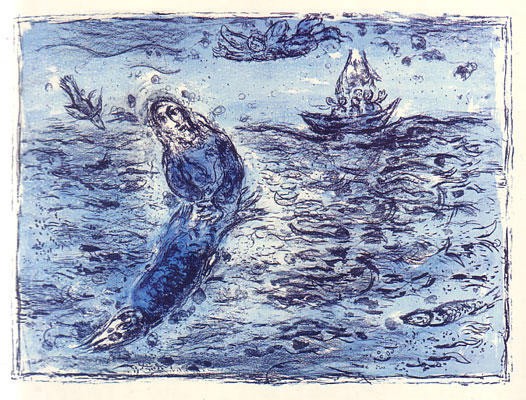
What did Jonah do inside the whale?

A simple Jew prays to God on Yom Kippur, and says “Ribon shel olamim, ruler of the Universe, I do not have much to repent of. Not compared to you. Unlike you, O God, I have not taken away children from their parents; I have not taken away parents from their children; I have not allowed disease and starvation and war. Compared to you, Holy One, I have been a saint. So, this year, I won’t be repenting. It’s your turn to repent.”

The rabbi asks him, “what were you praying there?” 

He tells her all that he’s said.

She says: “You fool! You let God off too easy. You should have told God to bring about the Redemption as well.” 

I don’t know about you, but I haven’t felt much like repenting this year. After all, what have I done, compared to the enormity of wrongs perpetrated? 

I haven’t killed anyone or waged any wars. I haven’t robbed anyone or embezzled any funds. To the best of my knowledge, I haven’t brazenly lied or misled. I certainly haven’t intentionally hurt anyone. I’m just not in the same league as the great sinners of our time.

And I don’t much feel like growing this year, either. Other years, I have enjoyed the stillness of Yom Kippur for reflection on being better. But I don’t feel like doing it this year. 

Sure, I’m grateful for turning off my phone so I don’t have to look at all the bad news, but that’s more about self-care than self-improvement. I’m more interested in switching off from the world than in switching onto myself. 

I mean, really, do I have to move? The world is changing so much, and not for the better. Shouldn’t I be allowed, as a one-off, to stop constantly evolving and just be as I am for a bit?

You know who else just wanted to stay still? 

Jonah.

I think Jonah knew exactly how I am feeling now. 

He was perfectly alright where he was, before God got involved and told him he needed to go and sort out all the problems of the world. 

Who was Jonah in the scheme of things? He certainly was not a big player in the wrongs of the world. All of Nineveh’s sins were enormous and happening miles away. Why should he have to change himself?

So, when God called on Jonah to get up, that was already asking too much. 

Jonah ran away to Tarshish. He shouted at God: “haven’t you got bigger fish to fry?” 

God said: “you want to see a big fish? I’ll give you a big fish!”

One came along and swallowed him whole.

Now, all of the story before is about Jonah not wanting to move and all of the story after is about what happened after God moved him. 

What happened in the whale, however, should really interest us. 

This year, I feel like I’m in the whale. I am sitting in a puddle from which I feel like I cannot budge. I am stuck here and have no idea how to get out. All around me, the waves are crashing down and there’s nothing I can do to stop them.

(A pedant will point out it’s not actually a whale. Technically, it’s a big fish, and the idea of it being a whale came later. But, technically, I’m not actually inside a whale at all, I’m in a synagogue, so I’m going to stick with the idea of the whale because it feels evocative.)

Now, I’m not even on the level of Jonah. My task is not nearly as big and I am not even inside a literal whale. So Jonah should be a good starting-place for my feelings of stubbornness and obstinacy.

What did Jonah do inside that whale? He despaired. He observed. He prayed. He sang. He learnt. And, eventually, he repented and grew.

So, this Yom Kippur, let’s engage with the whale. Let’s focus just on the three days Jonah spent inside the belly. Maybe we can learn from Jonah what to do when everything feels too overwhelming but we know we have to change anyway.

The second chapter of the book of Jonah is not narrative-form, like the rest of the book. Only the first verse, where Jonah gets swallowed by the whale, and the last verse, where the whale spits Jonah back out again, follow a linear storyline. 

The rest of the chapter, only eleven verses long, reads more like a poem. It is a song, where each verses contains a parallel structure. It would fit just as well in the Book of Psalms, where there are similar supplications to God. 

If the second chapter of Jonah is a journey, it is only a spiritual one. Jonah himself remains completely static, stuck in the belly of the beast. 

His soul, on the other hand, begins in the depths of despair, goes through questioning and defeat, recognises the glory of God, and finally comes out committed to getting out there, thanking God, making offerings, and taking part in the deliverance.

This feels like the most important chapter to us, then. We are just sitting and standing in the same space. But we are expecting our souls to move. 

I am feeling stuck in a world I cannot change, but I know I have to get somewhere else spiritually. We can’t just sit around here and hope to become better people. We know it needs work. But without a narrative, how do we know what to do?

Well, in the spaces left by the absence of narrative, the rabbis come up with their own stories. Pirkei deRabbi Eliezer is a collection of creative writing, compiled over many generations, that retells the biblical stories. These are our midrash, and in this rabbinic fan-fiction, we get a story to go with everything that Jonah says. 

From these stories, we might come up with our own meanings of what we should be doing here.

The first thing Jonah does is acknowledge where he is. He accepts that he is in the belly of the fish.

The midrash gives us a grandiose interpretation of what that looked like. It was like entering into the great synagogue: an enormous, echoey chamber. The fish’s eyes were two great windows, so that Jonah could see what was going on underwater. Inside the fish was a giant pearl, which illuminated the belly and shone out towards the sea. With a lamp and windows, Jonah had a clear vision of where he was.

What can we learn from this? We learn that we need to be honest with ourselves about where we are. The world is a bit of a mess right now, and there’s no point putting on a happy face and pretending everything is OK. Equally, we are pretty safe here. We in this room are not under attack, and the risk we would be is very low. 

So, start by taking stock of reality. Where am I? I’m in a synagogue, sitting on a comfy chair, with my feet planted on firm ground. I can see the lights of the room and smell that familiar sweet must of this religious space. 

But it’s not enough to just say where we are. We need to say how we feel. That’s what Jonah does next. 

He says: “I am crying out to God from my narrow-straits, please answer me.” Jonah says, “I am crying out from the belly of Hell, may God hear my voice.”

The midrash says, that’s exactly where the whale took him. It plunged him right down into the depths and showed him the gates to Hell. 

So, we need to do the same. We need to ask ourselves how we are really feeling. Be honest about the frustrations and worries and anger we feel. 

Next, Jonah finds a way to relate what is going on to what has gone before. In the depths of the ocean, Jonah says, he sees the billows and waves and reeds. 

According to the midrash, this is because the whale took him on a tour, not just of the sea, but of Jewish history. The whale showed Jonah the foundations of the earth, deep on the ocean-floor, and reminded him that God had made the world. The fish took him to the Sea of Reeds, and showed him the flora of the spot where the Israelites had crossed out of Egypt.

Faced with adversity, we have to remember that it has happened before. Once, there was nothing, then the world came into being. Once, we were slaves, but then we were freed. Wars and persecutions and empires have all come before and, somehow, our people have survived.

We, as individuals, have also survived challenges before. How recent was the Covid pandemic? We can take pride in our own resilience at getting through such troubles before.

Knowing what had gone before, Jonah was able to feel confident that he could face what was to come. Jonah cries out: “You saved my life from the very pits, O Eternal One my God!”

The midrash says that this came when the whale took Jonah down to meet the great sea-monster of the deep, Leviathan. Jonah told that nautical dragon: “You may think you are going to swallow me up, but I carry the promise of Abraham, and I know that one day, when God chooses, it will be you who gets eaten by the righteous.”

Like Jonah, let’s look at the problems ahead of us, and say: “I have faith. I can face you.”

Next, Jonah reflects back on what he has learned. He notices: “Those who cling onto empty folly forsake their own welfare.” He had been willing to stay where he was, clinging onto old vanities, but he did so at the expense of his own soul.

So, he proclaims, instead: “I, with loud thanksgiving, will sacrifice to You, God.”

We, too, can be grateful for what we have, and take on this next year in service of our Creator.

That is the journey on which Jonah took his soul, and it is where I hope to take mine over this Day of Repentance. 

I said I wanted to stay still, but stillness is not inactivity. The Rambam understood that serious thinking was the most active you could be. It connects you directly to that Most Active Intellect: the thinking, living God. 

In stillness, you can nurture who you are. Jonah was stuck in an underwater pit, but that was when he got most energised. It was when he really engaged in the audit of his soul.

This year, I have spoken to friends and community members and witnessed them say things they normally would never. People who would ordinarily be very liberal, turn racist. People who are normally very peaceful, justifying violence. People who are normally pretty discerning, regurgitating conspiracy theories. People who are usually nuanced, turn to absolutist thinking.

I am not saying this with any judgement. I say it because I’ve done it too.

And when I meet this now, I try to say to myself: I know you are scared and angry, and while you are feeling scared and angry, you can hold all those feelings. You are inside the whale. 

But one day, please God, you will be released from this whale, and you will have to reckon with who you became there. 

Take care of your soul. It is a precious gift. Don’t let it become too cynical or warped by the horrors that surround it.

That’s my goal for this Yom Kippur: to hold my soul with gentleness, and ask it to be porous and empathic and kind.

I am here, inside the whale. I cannot change what whale I am inside. I cannot stop the waves from crashing or remake the world so it is less scary. 

I can only change what I can change. And what I can change, in this moment, on this Yom Kippur, is myself. I just have to deal with who I am here and now. 

So, let’s be like Jonah. Let’s accept the whale we’re in, and, yes, despair, but also observe, pray, sing, learn, repent. 

And it may be that, when we finally get blown out from that great fish’s blowhole, we might still be better people than when we got swallowed up.

Amen.
high holy days · sermon

Being holy

These are the short sermons I am giving at Glasgow Reform Synagogue for Yom Kippur afternoon 5781.

Being holy

This afternoon’s Torah service instructs us: “You shall be holy, for I, the Eternal One your God, am holy.” But how do we live holiness? An answer to this comes from the great tradition of mussar. This was a movement that emerged in 19th Century Vilna for promoting Judaism as an ethical movement. The musarnikes, or moralists, argued that study alone was not enough, but that it had to be directed towards making Jews into better people.

The heir to that movement is the Mussar Institute in the USA. Earlier in the year, its leader, Alan Morinis, gave a four-day virtual conference at Edgware Reform Synagogue, advocating its ideas. In the musar system, people have attributes, called middot, that we must cultivate in order to be a holy people. Qualities like faith, modesty, willingness, and joy. In these short divrei Torah for the afternoon, I will give stories and quotations from the mussar tradition that reinforce our liturgical readings.

At every stage of this Torah reading, the reason for each commandment is “because I am the Eternal One your God.” It is repeated at the end of almost every verse. Rabbi Yisrael Salanter, the founder of the mussar movement, taught: “Do all you can to internalise faith and live with it daily.”

I know faith will mean many different things. For some, it is in God.  For others, it is in our fellow human beings. And for others still it is in the possibilities the future holds. Wherever your faith lies, cling to it, strengthen it, and build it into every decision you make.

Being simple

Our next Torah reading comes from Deuteronomy. It tells us: “These teachings are not too baffling for you, nor are they beyond your reach. It is not in the Heavens […] nor is it over the sea.” The Torah, we understand, is a simple text with a simple message. That message is summarised by Micah in the dictum: “do justice, love mercy, and walk humbly with God.”

This simple message is reinforced by the mussar tradition. Rabbi Eliyahu Dessler, a leader of the Orthodox community in 20th Century Britain, taught: “Human beings pursue worldly pleasures because they have a subconscious urge to still the pangs of spiritual hunger. Everyone has this nameless inner yearning: the longing of the soul for its state of perfection. Earthly indulgence is only an illusory substitute for this.”

In these trying times, we have to enjoy the simplicity of what we have. We may not be able to enjoy the luxuries of previous years, and even many essentials may seem out of reach. But this provides us with an opportunity to get in touch with what really matters. With our souls, with ourselves, with each other. To walk humbly with our God.

Being willing

Jonah ran away from everything he was supposed to do. He ran away to Tarshish to get away from Nineveh. He hid in the boat rather than face the other sailors. He sat in the belly of a giant fish before he accepted his responsibility. 

On Yom Kippur, we pray about the sins we have committed willingly and unwillingly. I think this year, we might also reflect on the good deeds we have done willingly and unwillingly. What has been a challenge to us to do right? 

Sometimes, for many, even getting out of bed in the morning feels difficult. The first line of the first part of the major law code, Shulchan Aruch, teaches: “One should strengthen herself like a lion to get up in the morning to serve her Creator, so that it is she who awakens the dawn.” 

The greatest challenge facing us this year is not to give in to futility. Whatever we can do, we must be full of enthusiasm. Rabbi Moshe Chaim Luzzatto of 18th Century Italy taught that we have to be self-motivated and not abandon ourselves to heaviness so that we come to merit divine service.

Even when the days can take their toll, may we approach winter’s tasks with willingness. May we pursue the needs of our community with enthusiasm, and hurry to do more for our loved ones.

Being joyous

We must be joyous. Of all the attributes to strive towards, joy might seem the strangest to mention in between the death bed confession and the recitation of sins. But it is, by far, the most important.

Rabbi Dovid Bliacher taught: “when faced with trouble, do not see it as a punishment for a past lapse, and do not be filled with guilt and despair. Rather, rejoice in this new opportunity to rise up by the medium of the test you now face.”

Even in the hardest times, we have to approach them with joy. Yes, we live in a crisis, but this is also an opportunity. Out of the rubble of Coronavirus, we can build back a better society, where people care for each other, where intergenerational communities support each other’s health and happiness, and where the needs of every human being on the planet are met.

Let us not delay for a moment in seeking to achieve that. And, as we go, let’s take joy in all that we have. This community. These friends. These bodies. This earth. This one precious life, in which every moment is a gift from God. Let us greet every day with joy.

high holy days · judaism · story · theology · torah

Jonah is a story about suicide

We know that life is sacred. I have mentioned it a few times over these Holy Days and we hear it all the time in our religion. Yet there is one question on which it seems almost silent. It is one that I’ve been thinking about a lot this year. Throughout the Tanakh, suicide is not mentioned. No tractates are written against it, no stories are written about it. Where could I turn to provide an answer? It seemed like a glaring oversight, and one that needed an answer more than ever for a generation where issues of anxiety and depression have never been so pronounced. And then, as I turned to the Yom Kippur readings, I realised that the answer had been staring me in the face.

The story of Jonah ends on an anti-climax. After hauling Jonah out of his home, sending him miles away into the heart of empire, drowning him, having a giant sea-monster swallow him, made him chastise his foreign enemy to give up on evil and actually convinced them to do so, God tells Jonah: “And should not I care about Nineveh, that great city, in which there are more than a hundred and twenty thousand persons who do not yet know their right hand from their left, and many beasts as well!”

Put yourself in Jonah’s shoes for a moment. All that, that whole mission, only to tell him that he cared about ignorant people and cattle. All that, when Jonah had thought he’d watch a city, ten times bigger than Manchester, burn to the ground, only to be told that God likes the animals in the city just like Jonah cares for a plant. What a disappointment.

It’s the kind of ending that leaves you scrambling back over everything you’ve read, wondering what the point of it all was. Did I miss something?

And here’s the real kicker: when God tells Jonah that he’s not going to destroy Niniveh, he’s also telling him that he’s not a prophet. In Deuteronomy we learn: “When a prophet speaks in the name of God, if the word does not come to pass or come true, that is a word that God has not spoken; the prophet has spoken it presumptuously. You need not be afraid of him.”[1]

Jonah has prophesied and he’s gone big. He’s told everyone in the capital city of the biggest empire on earth that they’re all doomed to die because they’re sinners. It’s a bit like getting on a boat from Southport, journeying to New York, pitching up in Time Square and announcing to everyone there that they’re about to die. In fact, it’s worse than that, because in this scenario, Jonah’s people and the Americans are sworn enemies. He’s gone through all of that, only to find that his prophesy did not come true. He was wrong. He was not a prophet.

But what was it that God actually told Jonah to prophesy? Was he told that Niniveh was going to be overthrown in forty days? No. At the very beginning, God says: “Go at once to Nineveh, that great city, and proclaim judgment upon it; for their wickedness has come before Me.”[2] Not tell them they’re going to be destroyed. Not tell them they’re all going to die. Not tell them to fast and weep. Just – tell them they’re going wrong.

Here’s what I want to suggest. That anti-climactic ending is much more profound than we might initially realise. The message given to Jonah was so much bigger than that. That prophecy was not about the wrongdoing of a city – it was about suicide. The story of Jonah is a story about a man contemplating suicide, rebutted over and over again by God’s message: choose life.

Today’s Torah portion announces that message. Moses stands on the edge of the Promised Land, knowing he will not be allowed to enter it, and gives the Israelites his final words: “This day I call the heavens and the earth as witnesses against you that I have set before you life and death, blessings and curses. Now choose life, so that you and your children may live.”[3] This message is so profound. Life, it says, is not an accident. It is a choice, and it is a choice we must make. We must decide whether to truly participate in this world.

The prophet Ezekiel says: “Turn ye, turn ye from your evil ways; for why will ye die, O house of Israel?”[4] This is God’s message to Jonah: choose life, for why would you die? Let’s read the story again, this time assuming the prophecy is different. We’ll realise that the story was not about whether the people of Niniveh should die, but about whether Jonah should live.

Several times throughout the story, Jonah threatens suicide. Sometimes those threats were so imperceptible you might not notice them. At the very beginning, when Jonah flees from Jaffa to Tarshish, he pays the fare before he gets on the boat. That might seem a reasonable enough thing to do now. But in the Ancient Near East, you didn’t pay your fare before travelling, you paid it afterwards. You paid it afterwards because otherwise you’d be at the mercy of sailors, who’d already have everything they needed from you, and could chuck you overboard so they wouldn’t have another mouth to feed. Paying your fare upfront is tantamount to a death-wish.

It doesn’t stop there. Once on the ship, God sends a mighty storm over the seas. Jonah could pray to have his life saved, but instead he curls up in the bowls of the ship, falls asleep and waits for the end. God has other plans, and Jonah will not die yet.

The captain of the ship and the rest of the sailors find him, realise that he’s the cause of the storm and ask him what they should do. Jonah could say: “take me to Niniveh so that I can do what God asked me.” He could say: “help me convince evil-doers to repent from what they’re doing.” Instead he says: “Heave me overboard!”[5] That’s right. Once again, Jonah tries to die. The sailors, who already have his money, who have never met Jonah before, who have a different religion and tribe to Jonah, beg God that they won’t have to kill Jonah. Jonah is insistent.

So the sailors heave Jonah overboard and it’ll take all but a miracle for him not to die. Thankfully, God is in the business of providing such things. God sends a giant fish, which swallows Jonah whole, leaving him able to survive. Jonah sits in the belly of the fish and sings: “I sank to the base of the mountains; The bars of the earth closed upon me forever. Yet You brought my life up from the pit, Eternal One, my God! When my life was ebbing away, I called God to mind; And my prayer came before You.”[6] Finally, it seems like Jonah’s getting it. Finally, brought to the very brink of death, it seems like Jonah is ready to choose life. God commands the fish to spit out Jonah on the land.

This time, Jonah does what God tells him. He heads out to Niniveh, that great city, to prophesy against them. Are his enemies, the overlords of the world’s biggest empire, rife with sin and iniquity, angry at him? Do they try and kill him? No, they’re horrified. It’s as if they’d never even considered what they were doing was immoral. They throw on sackcloth and ashes and prepare themselves for death. They even put sackcloth on the animals, so ready they are for utter annihilation. But God’s intention is not for them to die. As Ezekiel reminds us, God takes no pleasure in the death of them that die, but that they turn from their ways and live.[7]

Jonah is disappointed. He scolds God: “Please, Eternal One, take my life, for I would rather die than live.”[8] Has Jonah learned nothing? Close to death in the belly of the big fish, it seemed like Jonah was finally getting it that all God wanted was for him to live. Yet here he is again, begging to be allowed to die, threatening suicide once more.

God tries a different tactic. Instead of heavy-handed miracles and big displays in Niniveh, God tries out a gentle parable. God allows a gourd to grow over Jonah’s head, then allows it to die. Perhaps this will teach Jonah the precious, fragile sanctity of life. Quite the opposite. Jonah begs for death, saying: “I would rather die than live.” God asks Jonah: “Are you so deeply grieved about the plant?” “Yes,” he replied, “so deeply that I want to die.”[9]

Finally, we get to the prophecy that had been meant for Jonah all along. God says: “You cared about the plant, which you did not work for and which you did not grow, which appeared overnight and perished overnight. And should not I care about Nineveh, that great city, in which there are more than a hundred and twenty thousand persons who do not yet know their right hand from their left, and many beasts as well!”[10]

That’s why the story finishes by telling us about all the animals. God is saying: “Don’t you realise how much I care about you? I care even about the cattle in this city. I care even about a single plant in the desert. I love even your enemies, who are persecuting you, who do not worship me, who don’t follow my laws. How much do you think I care about you? Can’t you see how important you are? Choose life, Jonah. I’m begging you, stop with these thoughts of suicide. Give up on all that anger and hate you’ve been bottling up. Choose life, Jonah, why would you choose death?”

That’s what this whole story has been about. It was never about sin and death and punishment. It was so much simpler than that. It was about life. “Look Jonah,” says God. “I know you don’t think your life is worth living, but I do. To me, your life has meaning. To me, you are worth everything. Yes, even you. You with your stubbornness, your bitterness, your rage. You with all your unhappiness, your imperfections and mistakes. You mean so much to me that I will perform miracles. I will turn the world on its head to keep you alive. I will send you to the ends of the earth just to tell you I love you. Choose life, Jonah.”

That’s what this whole day has been about. Sometimes in prayer, especially deep in the fast of Yom Kippur, we can get so caught up in recounting our sins and holding onto our guilt, that we forget the whole point of the day. This day is not for wallowing in misery, it is to be thankful for life. We have been called here because our lives have meaning. By dint of being human, we are not just special, we are holy. To be a Jew means to affirm that life matters. It means to be willing to live a life that shows the best of what humanity can achieve. Of course, we may not succeed, but don’t we owe it to ourselves to try? Don’t we owe it to ourselves to choose life?

On the question of suicide, I think that Judaism has an answer. Judaism has only one answer, in fact, to every question, which is that life is holy. We are here to manifest the sacredness of life in everything we do. So today, let’s ask ourselves: are we doing that? Are we holding on to sadness and rage or are we thankful for another day? Are we dwelling on all that we’ve done wrong, or will we embrace the chance to get it right? Won’t we remember today that God wants for us to live?

Today God has put before you two choices: blessing and curse, life and death. Choose life, for why would you choose death?

jonah whale

This sermon was originally delivered on Yom Kippur 5778 at Manchester Liberal Jewish Community.

[1] Deut 18:22

[2] Jonah 1:2

[3] Deut 30:19

[4] Ezek 33:11

[5] Jonah 1:12

[6] Jonah 2:7-8

[7] Ezek 33:11

[8] Jonah 4:3

[9] Jonah 4:8-9

[10] Jonah 4:10-11