protest · sermon · theology

We are guests in God’s mansion


Suppose you woke up one morning and discovered, to your surprise, that you had inherited an enormous mansion.

The lord of the manor has welcomed you as a guest to his entire estate. You have no need to pay rent.

This country villa has plush places to sleep, wonderful waters to swim in, and endless entertainment.

More than that, this house is magical. It provides for your every need. Its luscious garden grows your favourite fruit and vegetables. There is plenty of space to graze and raise whatever animals you desire.

It belongs to you and your descendants forever.

What if I told you that you had indeed been bequeathed such a home, and that you were already living in it?

It is this Earth.

That is how Moses understood the planet on which we live when he instructed the Israelites in Deuteronomy. Moses wanted to impart to the people what a miracle it was to be alive, and to get to live in this abundant and fertile world.

So, says Moses, “the Eternal One your God is bringing you into a good land – with brooks, streams, and deep springs gushing out into the valleys and hills; a land with wheat and barley, vines and fig trees, pomegranates, olive oil and honey; a land where you can eat bread and never run out, where you will lack nothing; a land where the rocks are iron and you can dig copper out of the hills.”

This is the biblical mindset. You are guests in God’s mansion.

You have inherited a paradise and it is the whole world. The seas, the ice caps, the deserts, the mountains, and the forests. They are all yours. And they are all everyone else’s too.

Every human being was granted this world as a gift. Every living creature was placed here by their loving Creator.

Now, if you inherited a mansion like that, you wouldn’t trash it on the first day. You’d want to look after it and make sure your children and theirs got to enjoy it the way you did. You’d want to make sure the grass stayed green and the water kept flowing and the fruit trees kept producing. You’d want to know that everybody would be able to dwell in it for all time.

So, says Moses: “Keep faithfully every commandment I am giving to you this day, so that you can thrive and increase and come and inherit this land which was promised to your ancestors.”

Yes, this land requires no rent, but it does have conditions attached. You have to tend to it. You cannot be violent or greedy or deceitful. You must regularly redistribute the land, and make sure that everyone who lives in it gets their fill, and make sure everyone gets plenty of time for rest.

Well, these are small stipulations, given how wonderful my portion is. I get to live on this earth, which is so abundant, and all I have to do is look after it and share it? It sounds like a fantastic deal.

It is, but there is a trap. You see, you might get used to how great this mansion is. You might forget who gave it to you.

You might commit the gravest sin: you might think that this is yours, and yours alone.

This, says Moses, is a terrible error. “You may say to yourself, “My power and the strength of my hands have produced this wealth for me.” Instead, remember the Eternal One your God, for it is God who gives you the power to produce wealth.”

You might think that you earned the mansion, and you built it, and you can do with it as you please. Well, then, you would become a threat. A threat to the mansion and everyone that lives there. A threat to its babbling brooks and fig trees.

If you fool yourself into thinking this is yours, warns Moses, then “your heart will become proud and you will forget the Eternal One, your God, who brought you out of Egypt, out of the land of slavery.”

Yes, you have a dark past. A history of slaves and masters. There was a time when people claimed ownership over everything. They declared that the Nile River and the rainwater belonged to them. They hoarded the grain and took possession over the vineyards. They owned the animals. They even owned you.

Do you want to go back there?

Now, look around at our home, here in Surrey. This place truly is wonderful. Working here, I have had the chance to paddleboard down the River Wey, walk on the Surrey Downs, and watch others swim in Divers Cove. I can really believe this county was a gift from God.

And yet this county is certainly not treated as a common treasury.

How did it happen that God’s creation became so gated?

You see, Moses’s description of the world as a common heritage bequeathed by God wasn’t just an idle fantasy. That was how many people saw the world throughout a large part of history.

Until the start of the 17th Century, large swathes of English land were held in common by all people. This meant that everyone could graze the land together. They could rotate crops together; care for the land together; and make sure everyone got fed.

It’s not that England was one great egalitarian utopia. Far from it. There had been kings, paupers, lords, peasants, and landless workers, for centuries. But, at least a part of it was treated as a shared inheritance.

Then, in 1605, the government began a process called Inclosure. They took all that had been previously common and handed it over to the already wealthy. They stripped the poor from their land and forced them into the cities to work in factories. They destroyed whole ways of life.

This mansion, already divided, became the possession of just a few. Just as Moses had warned, the wealthy imagined that their power had come about by their own hands. They thought of themselves as more than lords; more than pharaohs: as gods.

Now, right here in Surrey, a group of people tried to resist them. In 1649, on St George’s Hill, and at Little Heath near Cobham, a group of religious dissidents got together, and decided that they would take the land back from the lords. They were called The Diggers.

Their leader, Gerard Winstanley, has a memorial plaque near Weybridge Station, and there is a tour you can take with historic placards, showing where the Diggers went.

The Diggers wanted a return to the Law of Moses and the biblical attitude.

In the Levellers’ Standard, Gerard Winstanley wrote: “The Earth (which was made to be a Common Treasury of relief for all, both Beasts and Men) was hedged in to In-closures by the teachers and rulers, and the others were made Servants and Slaves: And that Earth that is within this Creation made a Common Store-house for all, is bought and sold, and kept in the hands of a few, whereby the great Creator is mightily dishonoured, as if he were a respector of persons, delighting in the comfortable Livelihoods of some, and rejoycing in the miserable povertie and straits of others.”

Like Moses before him, Winstanley was adamant that God was not a propertarian but a generous host, and human beings simply welcome guests. How, then, could some divide up the land and force others off of it?

The Diggers lost their battle for the land, and the world we inherit is made according to the laws of those who enacted Inclosure.

But there is a message, that rings out through time, from the era of Moses through the 17th Century, and right up to today.

That message is that this world is a paradise, bequeathed to us all. And we need to act like it is so.

Shabbat shalom.

sermon · social justice · torah

Don’t make trans people scapegoats

“It makes no sense to hate anybody. It makes no sense to be racist or sexist or anything like that. Because whoever you hate will end up in your family. You don’t like gays? You’re gonna have a gay son. You don’t like Puerto Ricans? Your daughter’s gonna come home Livin’ La Vida Loca!”

This quotation is so erudite, you may wonder which ancient sage said it. That was in fact, the comedian Chris Rock, in his 1999 “Bigger and Blacker” set.

I must have been about 10 when I heard that line, but it has always stuck with me. Over the years since, I have watched it become true. The world is so small that whatever bigotries someone holds, the people they hate are bound to end up in their own homes.

Recently, I realised that this had happened to me. I hope I am not much of a hater, but a friend pointed out to me how much I used to make jokes about Surrey. I used to say that we should saw around the county lines of Surrey and sink it into the sea, drowning all the golf courses and making a shorter trip for Londoners to the beach. 

Now, here I am, eating my words. I am about to marry a man from Surrey and have all my in-laws in Surrey. I’m the rabbi for a congregation in Surrey, and looking to move as soon as I can to Surrey. That thing I hated, even in jest, is right here in my family and inside of me.

I had some terrible stereotypes that everyone who lived here was a tax-dodging, fox-hunting billionaire. They weren’t grounded in reality. They were just about my own fears, projected onto people I had never met. 

Chris Rock was right. Whoever you hate will end up in your family. 

More than that: whoever you hate is already something inside of you. 

All of us can do it: we can stereotype, generalise, and project all our antagonisms onto a group as a way to cast off all the fears we have about ourselves. What do we call someone who captures all this externalised hatred? A scapegoat.

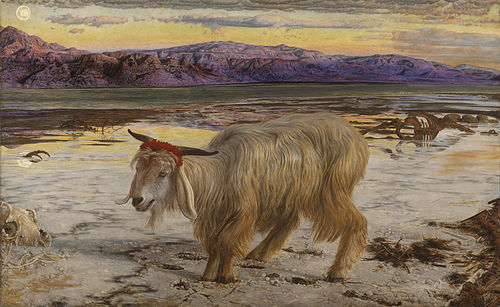
In this week’s Torah portion, we read about the original scapegoat. As part of the rituals for collective atonement, Aaron the High Priest gets two goats and brings them into the tabernacle. They pick straws for the goats. 

The lucky one is to be sacrificed for God. Onto the lucky one, Aaron ceremonially transmits all the sins of the Israelites, then chases it out into the wilderness. As it scarpers off, the scapegoat symbolically carries away all of the Israelites’ misdeeds.

The biblical narrative describes a psychological trick we can all play on ourselves. When we are ashamed of something inside ourselves, we take all that fear, turn it into hatred, and throw it at whatever unwitting bystander will carry it. 

Is this not precisely what Britain has been doing to trans people?

Gender is changing. The roles of men and women are shifting dramatically. There are so many new ways to live gender, to express ourselves, and to talk about our identities. 

Rather than embrace these changes and think about what opportunities they can afford us all to be more free, reactionary parts of British society have whipped up a concoction of bigotry and thrown it all at trans people. Every anxiety our bigots have about gender has been exaggerated and projected onto one small part of the population, who have been turned into monsters through these prejudiced eyes. 

It makes sense that people will find social changes scary and destabilising, but why should trans people bear the brunt of those fears?

A few years ago, I went to hear a panel of esteemed Jewish leaders give a retrospective talk about the ordination of gay, lesbian, bi and trans rabbis. On the bimah was Rabbi Indigo Raphael, Europe’s first openly trans rabbi. 

In his opening words to the congregation, Rabbi Raphael proclaimed: “I am a transgender man. I am not an agenda; I am not an ideology; and you can’t catch trans by respecting my pronouns.” The room immediately erupted into applause.

He should not need to say it. He shouldn’t need to defend his own existence, but such is the level of moral panic in parts of Britain that he has to assert his right not to be scapegoated before he can even teach Torah.

In the last few weeks, trans people have been subjected to legal rulings and government decrees that may make their lives unlivable and keep them from basic participation in public life. Like the goats of the ancient world, they are being cast out into the wilderness to carry away all of people’s fears.

It should not be this way. 

When we feel like scapegoating others, the best thing to do is look inside ourselves. We need to face our fears and work out why others bother us. The chances are, it’s something in ourselves that we’re not happy with, and when we need to get right with our own souls.

When we get to know those we “other” we get to know ourselves better. And when we realise we can like the difference in others, we learn more about what we can like in ourselves.

Reflecting on this, Margaret Moers Wenig, an American Reform rabbi wrote an essay called “Spiritual Lessons from Transsexuals.” She talks about how knowing trans people has enriched her own spiritual life. 

Interacting with trans people, Rabbi Wenig says, has taught her that all of us can craft our bodies as we will; we are all more than just our flesh and blood; we have living souls that can differ from others’ assumptions; that only God knows who we truly are. These are wonderful lessons that can only be learned when we turn away from fear and embrace curiosity.

They chime with my own experiences. At first, knowing trans people made me question myself. If gender is something we can change, am I really a man? With time, seeing other people embrace their gender and become who they are has made me feel far more happy in my own gender. I am a man, and I like being a man, and I like being an effeminate man.

When we turn away from fear, we see that we have no need for scapegoats. The parts within us don’t need to be divided up so that some are holy and others need to be chased out into the wilderness. Every part of us is for God.

The world has more than enough hate. It’s time we swapped it for loving curiosity.

After all, Surrey, it turns out, is rather lovely.

Shabbat shalom.

sermon · torah

The things you hate in others are the things you hate in you.

The things you hate in others are the things you hate in you.

All too often, we create monsters out of others because we fear there is something monstrous in ourselves. We turn outsiders into figures of hate because there is something we cannot stand inside ourselves.

In the Talmud, Laban is called the trickiest of tricksters. He came from a family of tricksters, in a town of tricksters, and all he ever did was trick.

Now, Laban was indeed a trickster. He was a thief and a manipulator. But was he really the worst of the worst? Most importantly, was he really worse than Jacob?

Laban did wrong, multiple times. He behaved appallingly. 

From the outset, he took Jacob in on false pretences. 

Laban told Jacob that, if he worked for him for seven years, he could marry his younger daughter, Rachel. Jacob adored Rachel, and was willing to do anything for her, so fulfilled his obligations. 

Then, on the day of the wedding, Laban swapped out Rachel for her older sister, Leah. Laban made Jacob work another seven years to marry the woman of his dreams.

Once Jacob had married both daughters, Laban continued to trick and deceive. He kept trying to rob Jacob, arbitrarily changing the terms of the contract. 

Jacob says that Laban had tried to swindle him with new rules ten times. In our midrash, the rabbis say it was in fact a hundred. Laban absolutely stole, and absolutely tricked.

Now, can we compare this to Jacob?

Only last week, we saw how Jacob tricked his father and his brother to steal from them. Jacob dressed up as his brother, pretended to cook like his brother, and stole his brother’s birthright. Jacob took advantage of his elderly father, who was going blind, to swindle him out of a blessing.

Jacob, too, stole and tricked.

To read the rabbinic tradition, however, you would think it only went one way!

The midrash bends over backwards to exonerate Jacob. It says that his father, Isaac, knew what was going on all along, and was only pretending to be deceived. It says that his mother, Rebecca, was given prophecy by God, so she knew what the future of her sons entailed. Throughout rabbinic commentaries, we get apologia for why Jacob was really right to receive the birthright, and why Esau would have been a terrible choice.

None of this is in the text. It is really a PR campaign to protect Jacob’s reputation. 

Laban, by comparison, is subjected to thorough demonisation.

The rabbis say that Laban sought to kill Jacob, despite there being no evidence of it. They go further: Laban wanted to massacre the Israelites entirely so they would have no future. Laban wanted to subjugate the Israelites worse than Pharaoh ever could. The rabbis say Laban lived hundreds of years, and could think of nothing else but swindling Israelites throughout that entire time, motivated only by spite. They call him ugly, and stupid, and say he slept with animals.

Contrary to the plain reading of the text, our tradition turns Laban into a monster, with every flaw exaggerated to absurd degree. They warp him from being a simple trickster into a demonic tyrant.

Our rabbis’ goal is to divide the world into the two camps: the innocent and the evil. On the one side, they have Jacob, who, no matter what he did, can never be held accountable. On the other side, they have Laban, the pinnacle of malice. No matter what may have motivated him, Laban will always be depicted as a corrupt crook, lusting after the death and misery of others.

In fact, the crimes of Jacob and Laban were almost identical. Laban tricked; so did Jacob. Laban stole; so did Jacob. 

There is a good reason why the rabbis would want to defend Jacob and castigate Laban in this way. Jacob is us. He changed his name to Israel and became the founder of the Jewish people. If Jacob is bad, so are we. 

Laban is our enemy. If he can be excused, what does that make us? How can we be the good guy, if he is not the bad one?

Naomi Graetz, a scholar at Ben Gurion University, compiled all these sources and suggests that what is going on here is a classic case of negative projection. 

We know that Jacob did those bad things. But, if we throw them all onto Laban, they no longer stick to us. By constructing Laban as a monster, we can feel assured in the positive self-image we want to hold. 

This, she says, is what groups often do. They create “others” – people that they imagine to be different to them – so that they can throw at them the worst fears of what they themselves might be.

The things we hate in others are often, really, the things we like least about ourselves.

Hating others gives us an easy way to escape our own feelings of discomfort. If we can hate them, we don’t have to look too hard in our own mirror.

In mediaeval Europe, that was a big part of how antisemitism functioned. Jews were the “other” onto which their neighbours projected all their anxieties.

The Jews, according to the antisemitic imagination of the time, were usurers, stealing money from people. In the Middle Ages, most money-lenders were not Jewish. They were Christians. At this time, certain Christians were also becoming very wealthy as landlords and merchants. Rather than deal with it as a social problem shared by everyone, they racialised it. They turned it into a Jewish problem, so that they did not have to face it as their own.

Even the blood libel, a mediaeval conspiracy theory that Jews drank Christian blood, can be understood as projection. As part of regular Catholic services, they drink the blood of Jesus, in the form of wine. Clearly feeling some guilt about their own rituals, they thrust this fear onto the Jews. It is not us who drink blood, it’s them!

It is probably not a coincidence that the modern antisemitic trope of Jews ruling the world came about when the European empires were at their height.

Antisemitism was a way for Europeans to resolve their discomfort about who they were by turning it into hatred of someone else.

Still, if I only talk about how bad and racist others once were, I would be projecting. The point is not that they can do it, but that we can. 

We are very capable of making demons where there are just people. We can just as equally project our own fear by turning it into hatred of others.

We need to remember that the world is not made of heroes and villains. Humanity cannot be divided up so easily. 

If we look at the biblical story, as it appears in the Torah, Laban is not a monster. Nor is Jacob. They are just people. Flawed, messy, human beings, doing wrong, and making mistakes. They both did wrong. But neither of them were evil.

The Torah gives us a whole host of complicated characters. They are not models of perfect behaviour. They are not even moralising cautionary tales. They are just a reflection of reality: which is complex and scary. We learn best from our imperfect prophets. 

Rather than trying to resolve our anxieties with hatred, let us look inside ourselves.

When you see something in someone else that you hate, ask: what is it in me that makes me feel this?

When another group seems like devils, ask yourself: are we really angels?

People will do wrong. All the time. They will mess up and cause pain in all kinds of ways.

Most of the time, we cannot change that.

But we can work on the things we can change in ourselves.

We can forgive the things we cannot change. 

And if you accept that you are capable of harm, without it making you evil, you may be able to have compassion for yourself.

And you may find that you love yourself, after all. 

You may see yourself the way God sees you. As an imperfect human who makes mistakes. Not a monster. Just a mess. A thoroughly lovable mess. 

And if you can love yourself, warts and all, you may find you have less space left to hate others. You may find that you contain more compassion and empathy than you knew. 

The things we hate in others are the things we hate in ourselves.

The things we love in ourselves, we can love in others too.

Shabbat shalom.

high holy days · sermon

We can be proud of how we handle death

It is no secret that Oaks Lane sees its fair share of death. The fact that so many of you are here for this service is testament to that.

This is one of the Reform movement’s largest synagogues, and a large number of our members die each year. During the Covid pandemic, Rabbi Lisa carried out some 350 funerals. How she managed to do that with such grace will always be a source of personal wonder to me.

Before I came here, then, I expected that coming to work at Oaks Lane would mean constantly swimming against a tide of grief. I thought that this community would be defined by pain and sadness, eking out moments of joy through a long slew of burials.

I was wrong. I was wrong about Oaks Lane. More importantly, I was wrong about grief.

I had accepted the conventional wisdom that grieving was the tough work of slogging through sadness. I believed, without much interrogation, that people had to process stages of denial and anger and sadness to eventually begrudgingly accept the mortality of their loved ones. 

Yet, when I began working in this synagogue, I was astounded by what actually happened. I discovered that, in their last moments, people were eager to pass on their happiest moments and their favourite jokes. 

I found that, while funerals were always deeply sombre affairs, shiva houses could be full of raucous laughter and mourners could be alleviated by relief that the deceased had gone on to a better place. I was amazed at how quickly families made meaning of their loss, and turned the memory of their loved one into positive action. 

Even concerning the saddest and most unjust deaths, the grieving people of this community are amazingly strong.

The truth is that this congregation can feel very proud of how it handles grief.

It turns out that grief is deeply sad, but that’s not all it is. It also shows the immense capacity human beings have to be resilient.

That observation is now supported by scientific study. The psychologist George Bonnano has dedicated his life to studying grief. When he first came to look at bereavement, he found that, while there were plenty of big claims about how grief works, there was scant little evidence to back it up. 

Over years of working with mourners, hearing their stories, and measuring their emotional responses, Dr Bonnano found that all the stereotypes about grieving were wrong. 

As it turned out, the five stages of grief rarely turned up in people’s lived experiences. In many cases, people did not need to go deep into the recesses of their subconscious to find out why a death had hurt them so much. 

Quite on the contrary, many mourners found that they could make meaning of their lives and honour their dead. Many grieving people found that their emotions were close at hand, and that they could handle them best by being honest about them.

Above all, mourners did not need to “get over” their sadness. Instead, people emotionally processed best when they understood their sadness as a helpful emotion. Sadness, it turns out, slows us down, makes us more contemplative, helps us to create more accurate memories, and focuses us on what truly matters.

Bonanno discovered that one of the factors that made people most adverse to handling grief was the Western obsession with reason. The demand that we be constantly rational, strip ourselves of rituals, and just ignore our spiritual inclinations in times of distress actually exacerbates emotional trauma, and can prolong the grieving process. 

Of course, that does not mean dealing with death is easy. For some people, the sadness can go on for years, and some people experience very traumatic and complex grief. In all of his studies, Bonnano could not find a single unifying factor for why some struggled more than others. It doesn’t really say anything about a person or their loved one if they struggle more with death.  In fact, it seems to be largely random.

One thing Bonnano did find is that, in cultures that ritualise communicating with their dead, and that have a sense of death’s sacred purpose, mourning is often healthier.

From that point of view, I think we Jews can be very proud of how we deal with death.

The tractate of the Talmud that deals with death and dying is called smachot. Literally, the word means “joys” or “festive celebrations.” I had always assumed that the title was a euphemism, to cover over all the other great feelings associated with death. 

Now, I wonder if perhaps the rabbis gave it that title as a reminder of what was at stake. Yes, you will feel sadness, but all of those are for the sake of remembering your joys. Yes, these mourning rituals will be sad and sombre occasions, but they may also be festive celebrations of the lives you have lost.

Smachot sets out a clear set of guidelines for how to handle death. Bury as soon as possible. Sit in remembrance for seven days. Avoid certain kinds of work for thirty. Say kaddish for a year. 

At every stage, the rabbis provide us with a spiritual framework that means we always have something to do, and continually have receptacles for our grief. With the infrastructure established, Jews are free to experience the full gambit of emotions associated with death.

In addition to its regulations on mourning, Smachot advises ways to handle people who are grieving. Rabbi Meir teaches that, in the early days of somebody’s bereavement, you should offer them words of consolation, then ask them how they are. After the first thirty days, you should ask them how they are, and then offer words of comfort. By the time twelve months have passed, you shouldn’t bring up the death at all unless the mourner does, so that you do not re-open wounds. 

All of this provides a way to speak openly and honestly about grief, without allowing it to be all-consuming. I find this rabbinic wisdom incredibly powerful, but it is even more poignant when we see it in real life.

Over the last year, I have watched in awe as our senior rabbi handled his own grief. This time last year, Rabbi Jordan and I switched our expected slots, and I took the yizkor service, so that Rabbi Jordan could have a chance to grieve his recently deceased mother. 

Grief could have swallowed Jordan up. Instead, he set up a weekly minyan so that he could say kaddish with all the others who were bereaved. He wore his mourning openly, and channelled it into helping everyone in the community to heal. Perhaps most surprisingly, throughout that whole period of aveilut, Jordan led this congregation with integrity, sincerity and passion. There is much in here for him to feel proud.

I am also continually impressed by the Jewish Joint Burial Society, whose work can never be sufficiently celebrated. Whenever I call Mitzi, Ian or Andrew, they combine a great sense of dignity with humour and good spirit. They oversee hundreds of funerals every year, and support families in their very hardest moments, and do so with an incredible sense of holy purpose. They are an endless source of pride.

More than anything, this community is a source of pride. Its volunteers in the care team leap at the chance to call up people on their yahrzeits. I rarely attend to a family that hasn’t already heard from a congregant already. Alan, Adrienne, Hazel, Brenda, Sheila, and Ailsa… you do more for the people in this congregation than you will ever fully know.

And that is true for all of you. As members, you repeatedly show up for each other and support each other. As mourners, you do everything in your power to honour your loved ones.

So keep on doing what you’re doing. Keep asking after each other. Keep showing up. Keep being vulnerable and honest. 

As we sit here, together, mourning our dear loved ones, know that you are here for yourself and you are here for everyone else. And we truly appreciate your presence. 

I am incredibly proud of how this community handles death.

Gmar chatimah tovah.

high holy days · sermon · theology

You are the impossible child God yearned for.

You are the impossible child God yearned for.

You are a miracle. 

You may not hear that often, and you probably think about it even less, but you truly are.

The British-Indian poet Nikita Gill has written about just how unlikely is the fact of your existence:

“The very idea that you exist considering those extremely low odds is a miracle on its own. You see, the exact DNA that comes from your parents to create you could have only happened when your parents met, which is 1 chance in 20,000. That alone should be enough, but when you add up the fact that it has taken 5-10 million years of human evolution for you to exist at this time, in this moment, you begin to recognise just how much of an impossibility you are.”

– Nikita Gill

Add to that, and remember that you are a Jew. Remember that in those 10 million years of evolution, Judaism has existed for only 3,000 of them, and is still one of the world’s oldest continuously existing cultures. You are the product of a long line of ancestors, dating back to desert nomads, who, at one time, heard the voice of an invisible God, and kept that story alive for hundreds of generations. That is a miracle.

In the last century, the ancestors who held onto that story fled from countries all over the world, and migrated to farthest corners of the earth, and faced down war and genocide, and survived extermination. Faced with such experiences, many turned away from their heritage and disappeared from Jewish life.

But you are here, in the 21st Century, alive, and Jewish, and living out that story. You are the product of billions of years of matter interacting and millions of years of human evolution and thousands of years of cultural transmission. You are here. And that is an incredible, awe-inspiring miracle.

One of the prevailing themes of Rosh Hashanah is the miracle of human life. It is everywhere: in our liturgy, in our Torah portions, and in our haftarah. All of them are bound together by a sense of wonder at our existence.

Three weeks ago, we read the prophet Isaiah, who expressed joy at the wonder of childbirth. His great prophecy opens:

“Sing for joy, infertile woman, you who never bore a child! Sing for joy and laugh aloud, you who never felt a stomach cramp. Because the children of the barren are more numerous than those who suckled infants.”

But who is this talking about? Who is the sterile woman giving birth to the miracle child?

In the 9th Century, the great collection of rabbinic stories, Midrash Pesikta Rabbati, offered us three answers: Sarah, Hannah, and Jerusalem. At Rosh Hashanah, we read the stories of all three.

In the Torah portion, we read of Sarah’s miraculous labour. Sarah was elderly and post-menopausal. When three angels told her she would give birth in a year, she laughed. For years, she had yearned for a child, but, in her old age, she had given up. How would her withered husband and her empty womb bear a child? 

A year later, Sarah gave birth. She ate her words and called her baby boy Yitzhak, meaning ‘laughter.’ She said: “God has brought me laughter, and everyone who hears about this will laugh with me.”

A miracle. An impossible birth. So that infertile woman who had never had a child rejoiced, just as Isaiah described.

In our haftarah, we read, too, of Hannah’s wondrous labour. She was infertile. Her husband Elkanah’s other wife, Peninah, had plenty of children. Peninah became her rival, and relentlessly mocked her, saying that God had closed her womb.

In the depths of her despair, Hannah prayed to God. She whispered fervent promises to God that, if she was allowed a baby, he would be dedicated forever to religious service. 

As Hannah prayed, she was so full of silent anguish and tears, that the High Priest Eli thought she was drunk. He heckled her to sober up. But when she explained that her behaviour was the product of deep distress, Eli prayed with her that her wish be granted.

A year later, Hannah gave birth, and called her baby “Shmuel,” meaning “I asked God for this.”

Another miracle. A barren woman who bore no children rejoiced, just as Isaiah described.

Pesikta Rabbati offers a third infertile woman to whom Isaiah’s proclamation might refer: the city of Jerusalem.

At the last major event in the Jewish calendar, Tisha BeAv, we commemorated Jerusalem’s destruction. We fasted, wept and prayed, remembering how the holy city was razed to the ground. Following the destructions by Assyria and Rome, that city was left stripped of its inhabitants. Its most sacred spaces were desecrated and burned. The whole town was abandoned like an empty womb.

And out of that barren place came Judaism. At the time when it most seemed like the Jews had been destroyed, the rabbis came forward and gave them life previously unknown. They developed tefillah, Mishnah, midrash, and Talmud. 

They spread the message of ethical monotheism throughout the entire globe. Judaism, from its point of near-destruction, became one of the world’s most notable religions, and influenced civilisations everywhere.

Jerusalem was an infertile womb, out of which came more children than could ever have been imagined.

Sarah yearned for a child and was blessed. Hannah yearned for a child and was blessed. Jerusalem yearned for children, and now has millions.

But there is another impossible birth that we must celebrate. An unbridled miracle. A human being created by God out of nothing, who had the potential to be the saviour of all humanity.

Whose birth was that? 

Yours.

What, did you think I was going to say somebody else?

For the Christians, that person was Jesus. In their story, their Messiah was born by immaculate conception to a virgin mother. For them, Jesus’ birth fulfilled the prophecy related by Isaiah.

In the 9th Century CE, when this midrash was composed, Christianity had become a full-fledged international religion. It was the official doctrine of the Roman Empire, and was spreading throughout Europe through the Carolingian Empire. Christian polemicists criticised Jews for denying the truth of their Testament, and insisted that their story completed our Torah. 

Part of the motivation for the compiler of Pesikta Rabbati must have been to show that Isaiah could easily be proven from texts within the Jewish canon. But, more than a difference of interpretation, this midrash speaks to a fundamental difference between how Jews and Christians have seen the world. For us, Jesus is not the beloved child of God born by miracle. You are.

As Lily Montagu, the great religious reformer and East End social worker, put it:

“We have the belief that man can directly commune with his God, that he needs no intercessor […] The Christian feels himself brought into contact with God by means of Jesus, his Saviour. Jesus is conceived as, in a special sense, the son of God, and as able to direct all seekers to the divine sanctuary. We Jews hold that every man is the son of God, and that all His children have access to Him when they try to live righteously.”

– Lily Montagu

So, all humanity is God’s miraculous creation. All humanity is in direct relationship with our Divine Creator. And all humanity has the potential to bring this world closer to its salvation.

Rosh Hashanah, as a festival, marks the sixth day of the world’s creation, on which the first ever human being was made. It celebrates the miraculous creation of Adam HaRishon, the original person, sculpted from clay and breathed alive with the sacred air from God’s nostrils.

Consider what a wonder this is. Knowing all that we do about the history of the universe, how many billions of years must God have spent yearning to create the first ever person. 

How impossibly beautiful is it, that, after the creations of thousands of galaxies and multitudes of planets, the Universe somehow put together the exact elements that would support life. And that life became social and conscious and able to reflect on its own existence. And, conscious of its own selfhood, that being was able to reach beyond itself and worship the Eternal Mystery that created it.

Who knows what the chances are? But it is certainly a miracle.

The cosmos was, at one point, an insignificant speck, devoid even of matter, and now it includes human beings. And now it includes you.

You are the impossible child God yearned for. You are a miracle.

However much you wish to connect with your Creator, just think how much your Creator wants to connect with you. Whenever you feel like you can’t quite find God, just take a second to contemplate how many billions of years God spent trying to find you.

Your existence is a miracle, and I am so glad you are here.

Shana tovah.

festivals · sermon · talmud

Why did the Rabbis rewrite Hanukkah?

Hanukkah. It’s such a great festival. The candles, the dreidls, the latkes. Everything about it seems so heimishe, so wholesome, so Jewish.

Would you believe me if I told you that, in the biggest, most important corpuses of Jewish literature, it barely gets a mention?

Of course, it doesn’t appear in our Bible, the Tanach. Hanukkah is one of the only festivals we celebrate that isn’t ordained by the Torah. That’s because everything recalled by the Hannukah festivities took place in the 2nd Century BCE, right at the time our canon was closing. All the stories that were going to be in our Bible were already there. 

The accounts of what happened – how the Hasmoneans rose up against Greek occupation – were only preserved by the Catholic Church, who considered them ‘Apocrypha,’ or intertestamental books, leading up to the time of Jesus. The Jews didn’t hold on to them.

But it’s not just our Bible that omits Hanukkah. Even our rabbis, the creators of Judaism as we know it, scarcely paid attention to the festival.

The Talmud is an enormous compendium on every aspect of Jewish life. Want to know about marriages? There’s a book for that? Divorces? There’s a book for that. What to do if somebody swears an oath that they won’t cut their hair and then wants to renege on it? There’s a book for that. What to do if your ox attacks another farm animal? Book for that.

Every festival has its own book. Yom Kippur, Rosh Hashanah, Pesach, Purim, Sukkot, and Shavuot all get extensive tractates. But not Hannukah.

If you want to know what the Talmud says about Chanukah, you have to look in a completely different treatise, on the topic of Shabbat. There, it gets a brief mention, in amongst a much larger conversation about candles. 

In the whole library that is rabbinic literature, Chanukah only gets four pages (or two sheets, front and back) dedicated to it. What did this poor Festival of Lights do to deserve such neglect?

You might say, well, it’s just a minor festival. It’s not one of our big ones. It’s only really become a major holiday in response to the booming of commercialised Christmas.

But, looking at what the Talmud actually says about Chanukah, we are confronted by a bigger mystery. The Talmud begins with a debate between the two great Sages who founded rabbinic Judaism, Hillel and Shammai. Shammai says that we should start by lighting eight candles, and decrease each day. Hillel says we should start with one and work our way up. As usual, we follow Hillel.

Here’s the thing. This debate does not appear anywhere earlier in the tradition. It’s not in the Mishnah or the Tosefta, where we would expect to find it. It’s certainly not attested from the time of Hillel and Shammai. Hillel would only have been born about 50 years after the Maccabees came to power. Surely we would expect to find something contemporary?

The Talmud seems to have invented this debate, nearly 800 years after the event took place and the rabbis named were alive.

There’s a good reason why they would want to do that. When we tell the story of Chanukah, we tell the rabbis’ version. We tell the story as it appears in the Talmud. You’ve probably heard it already. The invading Greeks defiled the Sanctuary and all that was left was one cruse of oil. That cruse of oil lasted eight days, which was an astonishing miracle. Now, as a result, we light candles for eight days.

The story from the time paints a very different picture. The Books of Maccabees were probably written as military propaganda by the Hasmoneans themselves. They show a zealous army of militants, who rose up against Greece, but spent a good chunk of their time massacring Jews who they thought had assimilated too much. They were, effectively, a terrorist organisation.

When they won power, they set up a theocratic dictatorship. They put themselves in charge of the monarchy, the Temple, and the economy. They ripped up centuries of checks and balances in Israelite politics. They engorged themselves with wealth and crushed all dissent.

At the time when Hillel was alive, they would still have been in power. It is unlikely they thought highly of the rabbis, whose interest in Jewish law would have threatened their power. They probably didn’t think much of the early rabbinic schools either, which looked suspiciously like Greek philosophy academies. There’s no way Hillel and Shammai would have celebrated their festivals.

It seems that, centuries later, the celebration of the Hasmonean victory persisted, but people had forgotten why. So, our rabbis came up with a new story to replace it. They replaced war with joy. They replaced spears with candles. They replaced military victory with faith in God.

That’s why they omitted the story of military conquest. Instead, they developed the stories of miracles and burning lights that we recognise today. They replaced the corrupt rulers and zealous extremists with pious sages, who saw the festival as a celebration of God’s surety, rather than of human strength.

The rabbis concocted a festival lectionary, giving us biblical readings to focus our mind on its themes. They chose for our haftarah the prophecy of Zechariah: “not by might, nor by power, but only by My Spirit, says God Almighty.” 

This verse directly contradicts the Maccabee myth. Not might. Not power. But God, and faith, and peace.

That is the Judaism we have inherited. That is the Judaism our rabbis intended for us when they created the Talmud. They wanted us to live as the prophets of old dreamed: in peace with our neighbours; seeking justice at every turn; and walking humbly with our God.

Faced with persecution under the corrupt tyranny of the Maccabees, our rabbis reinvented Judaism so that it would be a positive guiding force for all people.

That is a much greater revolution than the Hasmonean victory. 

That is the real miracle of Chanukah.

May this Festival of Lights bring you boundless joy. Chag urim sameach. 

May this Day of Rest bring you peace. Shabbat shalom.

fast · high holy days · sermon

Creating cultures of repentance

We are, apparently, in the grips of a culture war. 

It must be an especially intense one, because the newspapers seem to report on it more than the wars in Syria, the Central African Republic, or Yemen, combined. 

According to the Telegraph, this war is our generation’s great fight. It was even the foremost topic in the leadership battle for who would be our next Prime Minister, far above the economy, climate change, or Coronavirus recovery.

Just this last month, its belligerents have included Disney, Buckingham Palace, the British Medical Journal, cyclists in Surrey, alien library mascots, and rural museums.

But which side should I choose? One side is called “the woke mob.” That seems like it should be my team. After all, they are the successor organisation to the Political Correctness Brigade, of which I was a card-carrying member when that was all the rage.

The so-called “woke mob” are drawing attention to many historic and present injustices. From acknowledging that much of Britain was built on the back of the slave trade to criticising comedians who say that Hitler did a good thing by murdering Gypsies, they are shining a light on wrongs in society.

The trouble is, I hate to be on the losing side. For all the noise and bluster, this campaign hasn’t managed to get anyone who deserves it. The most virulent racists, misogynists, abusers, and profiteers remain largely unabated. 

Even if they were successful, I find the underlying ideas troubling. It seems to assume that people’s wrong actions put them outside of rehabilitation into decent society. Some people are just too bad

This strikes as puritanical. While the claims that so-called “cancel culture” is ruining civilisation are wildly overstated, it is right to be concerned by a philosophy that excludes and punishes.

So, will I throw my lot in with the conservatives? Perhaps it’s time I joined this fightback against the woke mob. 

On this side, proponents say that they are combatting cancel culture. How are they doing this? By deliberately upsetting people. They actively endeavour to elicit a reaction by saying the most hurtful thing they can.

When, inevitably, these public figures receive the condemnation they deserve, they go on tour to lament how sensitive and censorious their opponents are. As a result, they get book deals, newspaper columns, and increased ticket sales. 

Ultimately, this reaction to “cancel culture” is a mirror of what it opposes. It agrees that people cannot heal or do wrong. It celebrates the idea that people are bad, and provides a foil that allows people to prop up their worst selves.

If this is the culture war, I want no part in it. Neither side is interested in the hard work of repentance, apologies, and forgiveness. It offers only two possible cultures: one in which nobody can do right and one in which nobody can do wrong.

This is the antithesis of the Jewish approach to harm. 

Our religion has never tried to divide up the world into good and bad people. We have no interest in flaunting our cruelty, nor in banishing people.

Instead, the Jewish approach is to accept that we are all broken people in a broken world. We are all doing wrong. We all hurt others, and have been hurt ourselves. The Jewish approach is to listen to the yetzer hatov within us: that force of conscience, willing us to do better.

The culture we want to create is one of teshuvah: one in which people acknowledge they have done wrong, seek to make amends, apologise, and earn forgiveness. 

A few weeks ago, just in time for Yom Kippur, Rabbi Danya Rutenberg released a new book, called Repentance and Repair: Making Amends in an Unapologetic World.

Rabbi Rutenberg argues that Jewish approaches to repentance and repair can help resolve the troubled society we live in.

She locates some of the issues in America’s lack of repentance culture in its history. After the Civil War, preachers and pundits encouraged the people of the now United States of America to forgive, forget and move on. It doesn’t matter now, they said, who owned slaves or campaigned for racism, now they were all Americans. 

The Civil War veterans established a social basis in which there was no need for repentance or reparations, but that forgiveness had to be offered unconditionally. Without investing the work in true teshuvah, they created an unapologetic society that refused to acknowledge harm.

We, in Britain, also have an unapologetic and unforgiving culture, but our history is different. 

True, we also failed to properly address our history of slavery. When the slave trade was abolished at the start of the 19th Century, former slave traders and slave owners were given substantial compensation. The former slaves themselves were not offered so much as an apology.

But we have not been through a conscious process of nation-building the way the United States has. 

In fact, Britain has not really gone through any process of cultural rebuild since the collapse of its Empire. In 1960, the then Prime Minister Harold Macmillan gave his famous speech, in which he acknowledged “the wind of change” driving decolonisation. Whether Brits liked it or not, he said, the national liberation of former colonies was a political fact. 

At that time, he warned “what is now on trial is much more than our military strength or our diplomatic and administrative skill. It is our way of life.” Britain would need to work out who it was and what its values were before it could move forward and expect the family of nations to work with it.

More than 60 years later, it seems we still have not done that. As a nation, we are simply not clear on who we are. We do not know what makes us good, where we have gone wrong, or what we could do to be better.

So, we are caught in shame and denial. Shame that, if we admitted to having caused harm, we would have to accept being irredeemably evil. Denial that we could be bad, and so could ever have done wrong.

The two sides of the so-called “cancel culture” debate represent those two responses to our uncertainty. Those who are so ashamed of Britain’s history of racism and sexism that they have no idea how to move forward. And those who are so in denial of history that they refuse to accept it ever happened, or that it really represented the great moral injury that its victims perceived.

This creates a toxic national culture, stultified by its past and incapable of looking toward its future. 

So, Rabbi Rutenberg suggests, we need to build an alternative culture, one built on teshuvah. We need a culture where people feel guilty about what they have done wrong and try to repair it. For those who have been hurt, that means centering their needs as victims. For those who have done wrong, that means offering them the love and support to become better people. 

Rutenberg draws on the teachings of the Rambam to suggest how that might happen.  The Rambam outlined five steps people could take towards atonement, in his major law code, Mishneh Torah. 

First, you must admit to having done wrong. Ideally, you should stand up publicly, with witnesses, and declare your errors. 

Next, you must try to become a better person. 

Then, you must make amends, however possible. 

Then, and only then, can you make an apology. 

Finally, you will be faced with a similar opportunity to do wrong again. If you have taken the preceding steps seriously, you will not repeat your past mistakes.

For me, the crucial thing about Ruttenberg’s reframing of Rambam, is that it puts apologies nearly last. It centres the more difficult part: becoming the kind of person that does not repeat offences. It asks us to cultivate virtue, looking for what is best in us and trying to improve it.

You must investigate why you did what you did, and understand better the harm you caused. You must read and reflect and listen so that you can empathise with the wronged party. And, through this process, you must cultivate the personality of one who does not hurt again.

That is what Yom Kippur is really about. It is not about beating ourselves up for things we cannot change, nor about stubbornly holding onto our worst habits. It is not about shrugging off past injustices, nor is it about asking others to forget our faults.

It’s about the real effort needed to look at who we are, examine ourselves, and become a better version of that.

If there is a culture war going on, that is the culture I want to see. 

I want us to live in a society where people think about their actions and seek to do good. I want us to see a world where nobody is excluded – not because they are wrong or because they have been wronged. One where we are all included, together, in improving ourselves and our cultural life.

To build such a system, we need to start small. We cannot change Britain overnight. 

We have to begin with the smallest pieces first. Tonight, we begin doing that work on ourselves.

Gmar chatimah tovah – may you be sealed for good.

high holy days · sermon

Stop the privatisation of God


God is for everyone. God is supposed to unite everyone. Worship is supposed to be collective.

But, right now, God is under threat of privatisation.

In recent years, people have begun attempting to carve up God into small pieces and sell God off in individual packages.

Just 100 years ago, people knew that God was something they encountered with their fellow human beings, as they assembled in synagogues. These institutions were often the primary sources of solidarity, comfort, and welfare in any community. They bound people together.

Today, much of that community is collapsing in favour of individualism, where people are left alone to fend for themselves.

To combat this, some religions are starting to run on fee-for-service models, wherein people need not affiliate or contribute anything, but can buy access to religious experiences when it suits them.

This practice won’t save the synagogue. They are its enemy.

In these models, God is reduced to a commodity that individuals can purchase in their own homes. You need not go anywhere, but can browse online for your favourite version of God, packaged however you like it. The privatised God can be paid for whenever required, to perform whatever rites you like. The more money you have, the more of God you can get.

God was never meant to be divisible. The knowledge of the One God did not come from clever men in caves and deserts. Our prophets never claimed to have arrived at their conclusions alone.

Moses was a prince in Egypt, learned multiple languages, and could communicate expertly. But he was also the leader of a mass slave uprising in Egypt. His understanding of God’s unity came from a revelation to thousands at Mount Sinai. Together, they heard through clouds of fire: You are one people. There is one God.

Jeremiah was the eldest son of King Josiah’s High Priest, and aided by a scribe. Yet, when Jeremiah preached God’s unity, he did not do so as a lone prophet, but as a spokesperson for a large-scale anti-imperial movement. Huge groups of people were organising to resist invasion by Babylon, under the name of the one God. This collective had built over centuries, amassing momentum, as they agitated for refusal to accept foreign powers or their false gods.

Monotheism was born out of great social movements, in public, among peers.

It began with stories people told each other to build bridges. To keep peace and make relationships beyond their own homes, people developed common narratives.

“Did you know that we share a common ancestor, Abraham? Let me tell you a story of Abraham…” “Have you heard that we come from the same mother, Leah? In my tribe, this is what we know about Leah…” These stories were passed as oral traditions for many centuries, binding people together so that they could trust each other and work together.

As societies developed, so did their stories. Peoples formed into nations, and nations had their gods. The Hittites had Alalus; the Canaanites, Baal; the Egyptians had Ra; and the Sumerians, Anu. These gods looked after specific people within their borders, and supported them in their national wars, triumphs and tragedies.

Initially, the Israelites only had a national god, too, whom we now know as Hashem, or Adonai. It took time for them to develop the understanding that the god they worshipped in Israel was the God for the entire world. And that learning happened on the commons.

In the ancient world, all public activity happened on the commons. The commons brought in strangers from faraway places, and was the meeting-point for every tribe to engage with each other. It was a hub of activity, bursting with children playing, teachers educating the masses, exchange of goods and vegetables and, above all else, ideas.

There, in the open fields and marketplace, where people brought their stories, they swore oaths by their gods, and wrote promissory notes witnessed by every national god, so that their contracts would be binding in every country.

They said to each other: “I swear by Anlil… by Asherah… by Set…” They told the stories of their gods, who had created the world; flooded it; destroyed it; redeemed it.

“Perhaps,” they said, “the god that oversees Babylon is the same as the one who rules Egypt. Perhaps we simply have many names for one entity. Perhaps there is a force greater than national borders, whose justice is as expansive as the heavens, whose providence extends not just to the borders of one nation but to the entire world.”

“Just as we are one here on the commons, we might also be one at a deeper level, united by a common humanity, birthed by the same Creator. We might share a common destiny, to bring about unity on this earthly plane and to make known that God is one.”

Monotheism was a force of thousands of people seeking to reach across boundaries and divisions. A movement to imagine a future in which all people were diverse and equal. The original professors of the truth of one God sought unity of all humanity and nature , held together by something incomprehensibly greater than any of them.

Today, we still know the one God by many names. Hashem, Adonai, Shechinah. Allah, Buddha, Jesus, Jah. The names come from many languages but speak of a single truth. One God. One world. One people. One justice.

Of course, that unity is threatening to some. There are those who have a vested interest in maintaining tight borders, ethnic supremacy, and division. They have stoked up wars between the different names for the one God, seeking to divide that single truth again along national lines. Buddha was pitted against Allah; Jesus against Hashem. In Europe, they waged wars in the name of different understandings of one God and one book. Catholics and Protestants took doctrinal divisions and used them to carve up an entire continent and suppress all dissent.

For three centuries, European states fought each other over which version of God was the correct one. On either side of the divide, Jews were murdered, tortured and exiled, because if other Christians could be wrong, the Jews were really wrong. Hundreds of thousands of people were slaughtered because powerful people had stripped monotheism of its context and abused it to create new divisions.

At the end of the wars, European leaders ushered in a new age, that they called modernity. They vowed that they would never again fight wars on such grounds. They decoupled citizenship from faith.

Religion was now not national, but completely private. You could have a religion, but only in the privacy of your own home. The Jew would be a Jew at home and an Englishman in the street. If you want to keep a kosher kitchen, that’s your business, but you’d better not bring your values out into our political space.

In some countries, every detail of religious life was taken under the state’s authority. The religious could no longer do anything that would interfere with the supremacy of the nation state.

But monotheism was never meant to serve private individuals. It was developed to bring people together, regardless of nation or creed. The problem of wedding religion to nations was not that it made religion too public, but that it made religion not public enough. The one true God was supposed to transcend all borders and remind people that no matter their language or appearance, they originated from the same Creator.

In recent times, the privatisation of God has gone even further.

The mass collective meetings of religious people have declined in favour of each individual having their own “spirituality.” No more can people develop their sense of unity in public, but they must have their own little snippet of truth that they hold tightly and do not share. The one God has been carved up into tiny little pieces so small that they can only be held in each individual’s heart. The one great God is now reduced to seven billion small ones.

All of this only further divides people. It breaks people apart, entirely contrary to what monotheism was supposed to do.

Monotheism began as a movement of ordinary people coming together on the commons.

The task of this generation is to bring God back to the commons. Religion must again become a force that breaks down all divisions and brings people together.

To stop this tide of individualism, there is really only one thing you need to do: join and build the synagogue.

It doesn’t even have to be this one – although, obviously, we would love to have you. The important thing is to join.

The synagogue still stands as a bulwark against this atomisation of society. It requires of people what we really need to keep the one God alive: commitment to each other in public. When people pay their subscriptions into a synagogue, they are not buying a service for themselves, but sustaining a community for everyone else.

In this synagogue, we are seeking to build community beyond our own walls, currently fundraising for local youth, the nearby refugee group, and our sister community of Jews that have fled Ukraine.

We must build communities in these small places where we live, while looking beyond them, with a knowledge that our God is so much bigger than any one community.

The message of monotheism is that all of truth is for all the people. Not some bits of truth for some. One love, one justice, one truth, uniting one people on one planet.

Our liturgy teaches that, once humanity has shaken off the fetters of prejudice and the worship of material things, equality and justice will reign over every land.

We must work towards the day when all peoples declare in every tongue that they have a common Creator, and that the destiny of one person is bound up in the fate of all humanity.

On that day, God will be one and known as One.

Shanah tovah.

interfaith · sermon

Where Abraham came from

Once there was, and once there wasn’t. In the long-distant days of yore, when haystacks winnowed sieves, when genies played jereed in the old bathhouse, fleas were barbers, camels were town criers, I softly rocked my baby grandmother to sleep in her creaking cradle…

So begin Turkish folk stories. And this is a folk story, although whether it is Turkish, you will have to decide.

This is the story of our common ancestor, Abraham. For as long as there have been followers of his mission, there have been people telling his story. Across trade routes and migratory passages, Jews, Muslims, Christians, Samaritans and Druze exchanged legends of the man who made monotheism. 

These stories could be more valuable than coinage because they allowed people to connect across boundaries of language, ethnicity and religion. He could be called Avraham, Ibrahim, and everyone would know who you were talking about. There weren’t right or wrong versions of the story – only different iterations of the same truth.

That story, as we know it, begins today. It starts when a man named Avram sat in his ancestral home in Ur. He heard a God he did not know call to him and say: “Lech lecha! Go! Get out.”

“Go forth from your native land and from your father’s house to the land that I will show you. I will make of you a great nation, and I will bless you. I will make your name great, and you shall be a blessing. I will bless those who bless you and curse those that curse you; and all the families of the earth shall bless themselves by you.”

Avram pilgrimages from there to many places: through Canaan, Jordan, and Egypt. He meets many people: friends, enemies, family, and angels. To mark his changed status, Avram receives a new name: Avraham. The father of many nations. God promised him that he would have as many descendants as there are stars in the sky. He would have as many children as there are grains of sand on the shore.

And, indeed, just as God had promised, Avraham’s spiritual descendants now comprise over a third of the globe. Those who affirm monotheism and lay a claim to this spiritual tradition started in his name call themselves “Abrahamic faiths.” Their stories and beliefs, although disparate, fall under the banner of a single prophet who taught of a single God, revealed through history, known by good deeds.

Because of his great international fame, many places claim to be his hometown. There are various cities in Iraq, Syria and Lebanon named “Ur,” or with variant names, that say they are Abraham’s father’s house, from which he went out on his mission. 

One such city is named Urfa. It is located in the modern-day state of Turkey, in a southeastern corner inhabited largely by Kurds, and bordering Syria. It has been Akkadian, Armenian, Byzantine, Arab and Ottoman. About seven years ago, I was lucky enough to visit the place.

It is stunning. The entire city is built around a cave where, the locals say, Abraham was born. According to their legends, Abraham was birthed there in secret to avoid the wrath of the wicked king Nimrod. 

Around the cave, there is an incredible mosque complex. Beautiful off-white stones form curving arches, high ceilings, and expansive courtyards.

There are carved streams with carp in them. A local told me that these had been there since the time of Abraham. The Pagans had attempted to burn our prophet alive, but God intervened. As they set alight a bonfire with Abraham at the centre, the flames became water and the logs became fish. Today, if you eat any of the fish in the surrounding streams, you will instantly go blind.

I was certainly not going to test this superstition.

I went during the month of Ramadan, as pilgrims wandered around the site. It remains one of the most blissfully spiritual places I have ever been. I went through the mosque and into the cave. 

Around me, some men were doing the raqqas of Muslim prayer. I prayed as a Jew, mumbling Hebrew verses as I faced the spot where our patriarch was allegedly born.

Nobody batted an eyelid. We were all praying to the same God at the site of a shared prophet. I felt on some level that Abraham himself would have approved. This was the movement he had spawned. Uniting people in love of their One Creator. 

That unity, however, is threatened. Overhanging my time in Turkey was the heavy weight of nationalism. Over the last century, Turkish authorities have attempted to homogenise the country – transferring their Christian population to Greece; imposing taxes specifically on Jews to push them to move to Israel.

The country today has a virulently ethno-nationalist government that only briefly allowed the Kurdish minority some relative freedom to speak their language and live their culture. When Erdoğan launched counter attacks against ISIS, part of his goal was to crush Kurdish rebellion and extend Turkish military control.

Turkey is not unique. Nationalism has defined the politics of Europe and the Middle East for over a century. Entire groups seem increasingly set on defining themselves by ever narrower criteria, and enforcing the boundaries of who belongs with greater violence. 

This nationalist tendency permeates religious thought too. There are those who want to claim Abraham only as their own. There are those who try to say that they, and only they, have access to the true religion. There are people who want to pretend they are exceptional, and that with their difference comes claims to land, wealth and military might.

What could be more antithetical to the message of Abraham! This prophet sought to unify. His mission was one of going beyond borders, defying the lies of national gods and bringing people together under the truth of something beautiful and transcendent. 

There are many stories about Abraham. These stories can place him all over the world and ascribe to him all kinds of miracles. These stories can be used to bridge divisions and form common purpose. And they can be used to foster conflict and hatred.

We must be careful with which stories we tell.

Shabbat shalom. 

sermon · social justice · theology

What do we stand for?

Five years ago, I interviewed to start rabbinic training. Over four days, I went into different rooms, where rabbis, academics and lay leaders quizzed me about why I wanted to be a rabbi. 

It was intense. In one interview, one of the rabbis asked me: “what do you think you most want to learn while you are here?”

I said: “I’d like to learn what we stand for.” 

My interviewers scrunched up their faces. I imagined them thinking, “are you sure you’re in the right place?”

How could I not know what we believe? We are Progressive Jews; we stand for Progressive Judaism. Perplexed, she pushed me: “can you think of any principles of Progressive Judaism?” 

I thought, and said: “informed choice.” We do what we like, in conversation with Jewish tradition.

The rabbi sat back and took notes. I wasn’t sure whether I had given a correct answer, and she was confused how I could say I didn’t know what we stood for if I had that grounding, or if I’d missed something more important.

What I was trying to ask was: surely we don’t just choose whatever we like? A Progressive Jew can’t make the informed choice to commit murder. We don’t look at that central commandment and think: ‘ah, but it was for its time.’ We have a shared assumption that the prohibition on killing applies to every time. So how do we make these informed choices? What decides for us which choices are right and wrong?

Permissiveness is not really a value. It’s something you do out of indifference. There must be something stronger than that motivating our congregants to get out of bed and labour for the welfare of their community. 

Apparently, I am not alone. Throughout my time as a student, going to congregations across the country, people have asked me that very same question in different ways. 

What are the values of Reform Judaism? What does living by Progressive Jewish values actually mean?

After 4 years of study, well… I still don’t have the answer. But I feel much closer to it than I did when I started. And the answer begins with this week’s parashah.

At the end of Masei, we hear the story of the daughters of Tzelafchad. They come forward before Moses and assert their rights to inheritance. Their father, they say, was a good man who had no sons. As it stands, his property will be passed on to nobody, and these women will be left destitute. They argue that they should be the ones to inherit his estate. Moses talks to God. God agrees.

This is a big deal in Torah terms. It shows that a law can change. Decisions are not fixed in stone but can adapt with the times. It fits exactly with the Progressive mindset. We look at the laws again, and work out if they are still relevant. Moses looked at inheritance law, saw that it wasn’t working, and decided it was time to set a new precedent.

This is at the heart of Progressive Judaism. We progress. We treat the Torah and our traditions as our basis, but we are always willing to review it, and find new ways that better suit our reality.

The case of the daughters of Tzelafchad is a great example. It fits with our intuitions about what is right and wrong. Of course these women should inherit.

But does that mean every time a law changes, it’s an improvement? In the course of the Torah, laws also change to take rights away from people. Laws can change that make people’s lives worse. 

The reason why we consider this legal change so praiseworthy is because it makes life better for people. In particular, because it makes life better for women. 

It fits with the feminist lesson we have learnt from history. Through the last century of the women’s liberation movement, our religion learned the importance of giving everyone their full rights and abilities to participate in Jewish life.

We have our own hashkafah: our own way of looking at the world. We see progress in terms of what gives people the most equality, dignity, and justice. 

Other strands of Judaism may give priority to tradition, nationalism, or conservatism. We say that what matters is equity. 

We did not decide to pursue this egalitarian cause because we thought it would make things easier. Quite on the contrary: it made things harder for many people. At the start of our movement, people were disowned by their families and ridiculed by the religious establishment because of their conviction that equality mattered. They took the more difficult course because it was the right one.

Since the early days of Reform Judaism, we have prioritised gender equality. This week, I met with one of the founder members of SWESRS, who said that in their very first days, the community discussed what they wanted from a synagogue. Even in the 1950s, they insisted that equality between men and women would be of the utmost importance.  

This synagogue has gone on to create a legendary legacy. The UK’s first woman rabbi, Jackie Tabick, was raised here. This is a place with a proud history of putting forward that great principle of Reform Judaism: that equality matters.

That is how we approach the question of whether and when to change a law. We are not beholden to tradition, forced to do everything today and tomorrow, just because we did it that way yesterday. Nor will we go along with every change, just because it feels fashionable or convenient. 

At every stage, the question we ask ourselves is: is this right? Is this just?

We seek to make changes that will make people more equal, more empowered, and more dignified. 

So, now, if I am asked what we stand for, I have a much clearer answer.

We stand for equality.

We stand for the emancipation of all of humanity.

We stand up for the oppressed and stand beside the marginalised.

We stand in the footsteps of Moses, who changed laws because he could see that justice mattered.

We stand before God, proud to inherit a tradition; and courageous enough to change that tradition for the better. 

That is where we stand.

Shabbat shalom. 

This sermon is for South West Essex and Settlement Reform Synagogue, Parashat Matot-Masei, 10th July 2021