judaism · sermon · theology

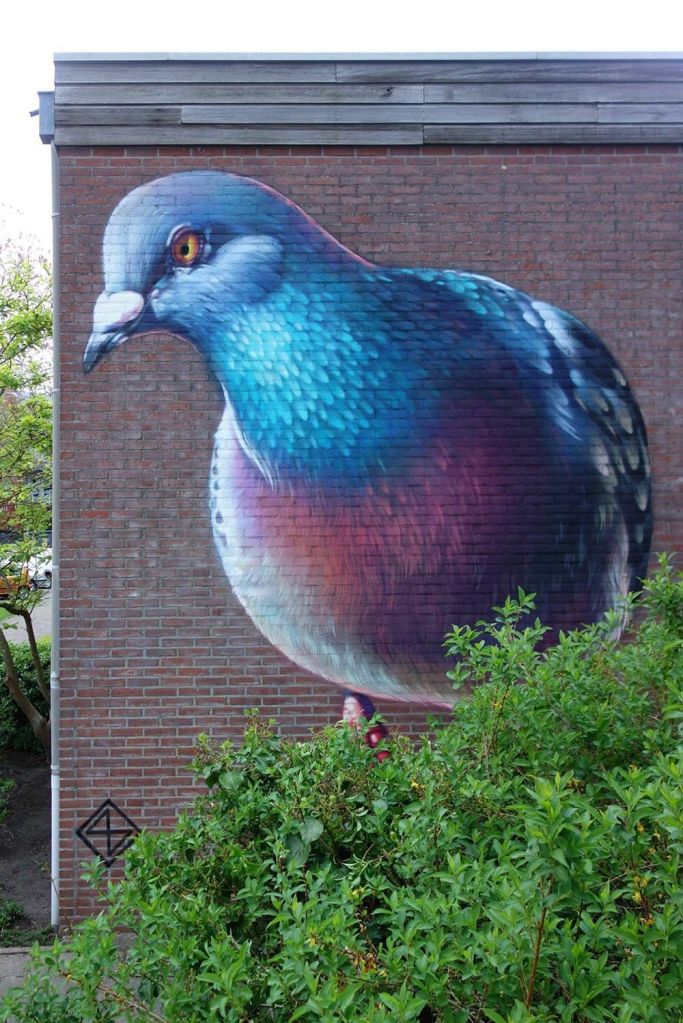
If you don’t fancy killing pigeons, you’re probably a Progressive Jew


Have you ever done something wrong, completely accidentally, with all the best intentions, and, feeling ashamed and repentant, thought to yourself: “that’s it, I better go kill a pigeon.”

Of course you haven’t. Because as an astute reader of Torah knows, if you have committed a sin, you need to sacrifice at least two pigeons. A goat for serious misbehaviour. A bull, if you really messed up.

This week, we enter the Book of Leviticus, an impressive catalogue of sins and sacrifices. This third book in the Torah cycle, called in Hebrew Vayikra, acts as a directory for priests.

Here, you can match up any misdeed or lifecycle event with the appropriate sacrificial animal, and it comes with a handy recipe book for how to make the meat smell nice enough that God forgives you.

(Bit of oil… bit of incense… bake for three days in a smoke oven…)

We leave behind the great moral myths of Genesis. We leave behind the inspiring liberatory narrative of Exodus. And this, too, is where we leave behind Orthodox Judaism.

If you are an Orthodox Jew, the only problem you can see with killing a pigeon to atone for your mistakes is that you don’t have a Temple to do it in.

In the Koren Sacks Siddur, the Orthodox daily prayer book, you will find petitions to be recited every day that God rebuilds the Temple in Jerusalem, brings back the hereditary priesthood, and restores the sacrificial cult.

Finally, if I make an accidental mistake, I will be able to fulfil the Torah’s command that I should splatter a bull’s blood and entrails all over a table.

Frankly, I don’t know how our friends further up the Thames have managed to go so long without enacting this sacred duty.

At its best, the rebuilt Temple of Orthodox Judaism involves some kind of mystical descent of a palace from the clouds at the end of time. At its worst, there are Jews currently hoping to blow up the Al Aqsa Mosque on the Temple Mount and replace it with a gaudy pillared Roman-style shrine.

I’m not going to get into the geopolitics of why that would be a terrible idea. My area is theology, and I can tell you now, that from a religious, moral, spiritual, and ethical perspective, bringing back any kind of Temple would be a terrible idea.

Even as a metaphor, the yearning for Temple Judaism is an abrogation of responsibility, a refusal to engage in the real world, and a fantasy that blood can avenge wrongdoing. We cannot tolerate this idea on any level, whether real or abstract.

It is hard to overstate what a fundamental difference this is between Progressive and Orthodox Judaism. Opposition to rebuilding the Temple is central to Progressive theology.

In 1885, American Jews came together at the Rodef Shalom Synagogue in Pennsylvania and signed up to their foundational document: the Pittsburgh Platform. This decree has influenced how Progressive Jews see our religion ever since.

In it, they declare: “we expect no sacrificial worship under the sons of Aaron.” From the outset, we have believed that the synagogue has permanently replaced the Temple.

The author of the Pittsburgh Platform was an inspiring rabbi, named Kaufmann Kohler. Born in Germany, he became America’s preeminent Reform scholar. If you’ve ever dipped into the Jewish Encyclopedia, you’ve probably read something written by him.

Kohler wrote an introduction to Jewish theology that dealt thoroughly with how we Progressive Jews should understand these Temple texts. They were, for their time, a tool to help Jews gain moral understanding. The rituals and sacrifices showed us how to take responsibility for our thoughts, and even our conduct.

But, over time, we outgrew pigeon slaughter. We moved on to the world of rules and structures created by the early rabbis. And now, in our modern age, we are still moving forwards: so that we will do the right thing without being bound by old laws.

That’s what the progress in Progressive Judaism means: progressing from the age of slaughter through the age of laws towards the age of morals.

It’s not that we should discard the laws, or even the stories of slaughter. We should be like students who learn more through our schooling- at each stage, we retain what we learnt earlier, but we refine it, and we realise that some of our earlier ideas were too simplistic. Wanting to rebuild the Temple is like wanting to go back to the crayons of nursery school.

Throughout the moral education of humanity, we received hints that this was where we were going all along. In the Book of Proverbs, written when cattle murder was the normal way of dealing with guilt, it says: “To do what is right and just is more desired by the Eternal One than sacrifice.”

Throughout the books of the prophets we are repeatedly assured that God is far more interested in our moral conduct than in how much fat we can burn off the bones of a lamb.

Centuries later, when the early rabbis were busy codifying all their laws, the midrash explained why the Torah would say this. Sacrifices could only happen in the Temple, but you can do good deeds anywhere. Sacrifices can only atone for mistakes, but with good deeds you can repent for what you did wrong on purpose. Sacrifices only last a short while, but righteousness can endure forever.

At every stage of its development, says Rabbi Kohler, we Jews were a priestly people. Even in the days of animal sacrifice, we were always trying to demonstrate how to live with knowledge of God and concern for morality.

So, says Kohler, our mission on earth is to constantly be a beacon of moral behaviour. If we forfeit that, even for a moment, we will cease to be worthy of being called God’s people.

The idea of rebuilding a Temple isn’t just a dead end: it is a reversal of history. It takes us backwards from reason to superstition. It is the most retrograde step from our understanding of animal suffering to treating God’s creatures as subjects for abuse. It is abhorrent.

And I think most people know that. I honestly believe that, if we asked the vast majority of our friends and family who attend United or Federation synagogues if they think we would be better off with a cult of butchery based in Jerusalem, they would be repulsed by the concept.

In that case, they do not believe in Orthodox Judaism. Mazel tov, they’re Progressives already! Come through our doors, come celebrate with us, come pray with us!

You can leave your fantasies of pigeon massacres at the door. Come and be God’s priestly people.

Come and be a Progressive Jew.

Shabbat shalom.
festivals · halachah · sermon

I refuse, therefore I am

There are seventeen sleeps to go until Pesach. I am genuinely excited.

You know, one of the things I love most about Pesach is the matza. 

I enjoy clearing out all the leavened products from the house, dumping bags of pasta with the food bank, hiding the toaster in the garage, and eating only matza for a week.

It’s not that I like the taste. (Although it is good as a vehicle for my favourite food group: butter.)

In fact, I think it’s precisely the discipline that I enjoy. It is having a religiously-mandated prohibition built into my life, if only for a little while.

I am going to talk here about my own relationship with consumption, food, and restriction, but this will be very different for everyone. I know that, for some, ‘saying no’ to food can become a burden rather than a blessing, and that achieving a neutral relationship with food is its own spiritual discipline. 

Judaism teaches us that if a fast or a restriction endangers our health—physical or mental—the commandment is actually to eat. Our goal is to be masters of our impulses, not enemies of our own survival.

So, in telling you what is meaningful to me, I am not trying to tell you how to live your life (I have no such right), but to tell you why the practice of clearing out chametz and eating only matza matters to me.

And, personally, I love the moments of spiritual discipline.

I think there is something in the human condition that means we want some help sublimating our desires. Every religion, throughout the world, places restrictions, either permanently or for short periods, on how people can consume. 

We all want to know that we are not slaves to endless gluttony, but can serve something Higher than ourselves.

Two weeks ago, I had the privilege of joining the Dialogue Society‘s iftar at Kingston Guildhall. This is a daily meal, served after sunset every day throughout the month of Ramadan. 

Throughout the evening, we learned a number of facts about Ramadan and iftars. But as the evening went on, I reflected that I could never truly know what Ramadan was. I would never understand it as an insider; as one who fasts every day for a month; as one who considers this deprivation a pillar of faith. 

The iftar was lovely, but the fast is what brings people to the meal. Through their fast, Muslims learn what it is to sympathise with the poor, to feel one with a global community, and to submit to their Creator’s will.

I was seated with the other clergy: the imams and vicars that KLS has enabled me to befriend. Reverend Joe shared that the Christians were also going through their own period of deprivation: the Fast of Lent. During these forty days, Christians give up the things that tempt them most. In Reverend Joe’s case, this was alcohol and chocolate. 

As an outsider, I have seen the end product of Lent – its festival of Easter, filled with chocolate hunts, painted eggs and, once or twice, even a gory reenactment of Jesus’s crucifixion. 

Easter looks fun, but I realise that what must make it so meaningful is the period of deprivation beforehand. Their experience of refusing temptation is designed to help them better understand Jesus’s suffering. Here, too, the spiritually important part is saying no to something else. 

The idea of saying no to consumption feels so alien to our modern world. The second I want something, I can order it online and have it delivered a day later. If I like the sound of any food from anywhere in the world, I barely need to think before I’m eating it. 

And, personally, I have a hard time saying no to just about anything. I struggle to eat just one biscuit or drink just one glass of wine. And, if there’s food on the table, I can be sure I’ll keep eating until there isn’t. 

I shouldn’t be surprised by this.

I’ve been completely inundated with advertising and consumer culture since birth. When I’m bored, I can stare at my phone to shut off my brain and get more of the same.

Our old medieval superstitions have been replaced by the new religion of consumption. You can practise all of them at once: eat chocolate at Easter and turkey at Christmas; eat doughnuts at Chanukah and soup at Pesach. 

And, of course, at every opportunity, we must buy; we must spend money. We must make sacrifices to the god of The Market who will slump and weep if we stop purchasing for even a moment. In the name of our new religion, we must swallow the whole world.

So, refusing consumption feels like something medieval and irrational. 

But isn’t it precisely the foundation of Judaism?

The tenth commandment is לֹא־תַחְמֹד – thou shalt not covet. Do not desire. Do not lust. Do not gaze greedily at everything around you from your friend’s partners to your neighbour’s animals. Do not envy.

This is the basis of all the other commandments. If we don’t want what others have, why would we ever steal? If we don’t lust after anybody else, why would we ever betray our partners? If we don’t want anything but what we have, why would we ever go chasing after other gods?

But wanting is not like stealing or cheating. Wanting is a primal urge. 

How can I be expected to have no desires at all for what is beautiful? This rule is telling me to suppress my own feelings; that just the very fact of wanting anything is a sin. That feels cruel and punitive.

We’re not the first to feel this way. Generations of Jews have grappled with exactly this problem.

There is a lovely midrash from thousands of years ago on this topic, that says, it’s not that we’re supposed to say we have no desires for things we can’t have. Instead, we should say “actually I do want all these things, but God in Heaven has decreed against it.”

Some part of me does want to consume everything; to own everything; to control everything. I need to know that this is within me. And then I need to remember that I am more than a gluttonous animal. I have the ability to exercise restraint.

The medieval commentator, ibn Ezra, taught that this is deeper than just self-deprivation. By saying no to our desires, we say yes to our God. We say yes to trust and faith. We see the world’s beauty as even more beautiful precisely because we know it is forbidden to us.

The French-Algerian philosopher, Albert Camus, wrote that saying no is the foundation of all human values. “I refuse, therefore I exist.” What we are willing to say no to determines who we are. 

The Israelites were not truly God’s people until they refused to be Pharaoh’s slaves. Our ancestors said no to subjugation; no to tyranny; no to being someone else’s property; no being held back by the false gods of greed and idolatry. 

With one no, they could say many yeses. Yes to the God of all Creation. Yes to being commanded by a greater power. Yes to the festivals and yes to the holy days. Yes to the humble pursuit of God’s will. Yes to peace, equality, dignity, and freedom.

And that is what the matza symbolises to me today. 

It is more than a cracker. It is a statement about what I am willing to say no to. 

I say no to leaven, and therefore no to a system that demands I consume everything until there is nothing left of the world. 

I say yes to matza, and therefore yes to pursuing justice, living with simplicity, and walking in God’s ways.

As we come to this Pesach, consider what you can do to exercise spiritual discipline. My practice is to cut out leavened food, but you may find your own.

Can you clear out your cupboards, and give excess clothes to charity? Can you look at your spending, and set a bigger portion aside for those in need? Can you put a restriction on your phone usage?

What is the chametz, the leaven, that is weighing you down in your life? And how will you make the conscious choice to say no to it?

I refuse, therefore I am.

We say no, so we are.

Shabbat shalom.

judaism · ritual · sermon

Make like a spider and weave

This sermon will be addressed to two girls who are having baby blessings at Kingston Liberal Synagogue. Their names are redacted from this online version.

Girls, welcome to your synagogue.

I will address this sermon to you, but you will not remember it, and that’s OK, because I am really speaking to all Jewish children when I give this address. And you should know that all adults, no matter how big they get, never stop being children. So I am speaking to you, but really I am speaking to everybody gathered here today.

My message for you, girls, and for all Jews is: learn to be like a spider. 

You see, from the moment a spider is born, she already carries everything inside herself to make a home. The silk with which she will construct her web is built into her body. Without ever learning from a parent or attending a school, the spider already knows how to build her home, wherever she goes. 

In this way, the spider is the perfect Jew. Jews, wherever we are, carry in us all we need to make our home. Our home can be woven absolutely anywhere. Whether in a desert, an ocean, or an Arctic tundra, Jews will always find ways of creating our sacred spaces. 

Our home is not made of silk, like a spider’s. Our home is made of the bonds we build with each other. Between every community member, there is an invisible thread. If you look around this room and squint in exactly the right light, you will see how one thread connects to each other, and every thread interlocks somewhere. That is the web of our community.

Our home is also made of rituals. In Hebrew, the word for a tractate of Talmud is masechet. The masechet is the page of our religious texts that tells us how to mark every moment and celebrate every festival. Do you know what masechet also means, dear girls? It means a weaving; a web. 

Because our home is made of rituals, you can find yourself anywhere in the world, and if somebody starts a prayer, or lights a candle, or cooks a food, you will realise that you are suddenly back in your Jewish home.

Our home is made of stories. Yes, we sew together patchworks from ancient traditions and family tales and our life experiences and all of it comes together in this great big web, so that Jews are all brought together by these stories.

Now, some religious knowledge may be innate. Girls, there is a story that before a baby is born, her soul has already been to the Garden of Eden and heard the revelation at Mount Sinai. Perhaps you are sitting there, knowing far more about the secrets of the universe than any of us. 

But the truth is, we are not like spiders. We can’t just weave the Jewish home from the moment we are born. We need to learn how to do it. We need teachers and elders who have learned to build the web from the generations before them. The thread we spin with comes from a yarn thousands of years old, and you need people who will pass on the tools to you.

That’s why, here, in your synagogue, you will be able to come to Kinderlach when you are small, and join Beiteinu as you grow, and come to many family services, and go on adventures with your youth movement. All of this exists to help you learn how to make your web, so that it is strong and beautiful and unique, like you.

Children, a moment ago, you came and were held underneath the tallit to receive a blessing. We call the tallit a “sukkah” – a tent, a tabernacle. It represents the Jewish home. “Sukkah” has the same root in Hebrew as “masechet” – the weaving we mentioned earlier. You see, the Jewish home is a portable prayer shawl, made by people skilled with textiles, and we can pull it out at any moment.

In the Torah portion we read today, on this day of your Simchat Bat, God tells us how to build a mishkan – a sacred place where God can live. I’ll give you one guess what it’s made of. 

The tabernacle where God lives is made of wool and cloth and thread and yarn. Oh, it comes in so many colours! Blues and purples and crimsons all finely interlocking on a great stretched canvas made of animal hides. 

That is where God lived with the Jews for the years we wandered in the desert. After slavery, the Jews had to learn how to be truly free. We needed to be independent of the great demands of Egyptian slaveowners and even the comforts of their homes. We needed to know how to live transiently. 

Yes, we needed to learn to be more like spiders. We needed to build a home wherever we went.

And you, dear girls, need to learn to make a home too.

Girls, I have been to your house, and I know how lovely it is. Somehow your dads manage to keep it such a calm and clean place at all times. I don’t know how they do it. I hope they can manage some semblance of the same order when you both start crawling. 

But even if you ransack the living room, and draw all over the walls, and leave your toys strewn across the stairs, they will still love you, and it will still be your home. You may move many times, or you may stay in one place, but your home will be the people you come back to. It will be the stories you tell, and the songs you sing, and the rituals you make up. Home will be your own private language that only makes sense between you.

You come today into this synagogue, and know that it will be your home. Around you, you have your whole community, who have come here to show that they will love and support you. They will teach you how to weave webs, and you will soon start wrapping your own silky strands into the patchwork of this community. 

When I welcome you to your synagogue, I am not talking about the building. That’s not our home – it’s just the frame we use to make it in.

Our home is the web we weave together – the invisible threads that connect everyone in this community. 

We are like the ancient Israelites who carried their home through the desert. 

We are like the spiders who carry their homes in their bodies.

We build our home through connection and song and story.

May you build this home with us.

Shabbat shalom.

interfaith · sermon · torah

Do not hide the tears of tolerance


As some of you know, my kippah is a permanent fixture on my head, and has been since my early 20s. I often get asked whether I experience any feedback for being so visibly Jewish. My answer is: yes. Occasionally, Christians come up to me and say “shalom.” I say “shalom” back.

Well, this week, I have a more interesting story to tell.

Last Saturday night, Laurence and I were on our way back from a friend’s birthday lip synch. (Yes, in my time off, I do competitively mime to Nicki Minaj wearing a space suit and kitten heels.)

We were heading into Vauxhall Station. A group of men in their early 20s were dancing around, holding hands, and reaching out their hands for others to join them.

It will probably not surprise you to hear that I joined in. The boys cheered.

Within moments of joining them, I realised I might have made a terrible mistake. The man whose hand I was holding was, in fact, wearing a Palestine football shirt. They were all speaking Arabic. A taller man noticed my kippah and said to the others “hu yehudi.” I know what this means in Arabic, because you say it the same way in Hebrew: he’s Jewish.

And I thought, well, it’s basically the same language, I’ll try talking with them in Hebrew. Friends, these gentlemen did not, in fact, speak Hebrew. Their English was pretty stilted too.

Right next to us, a fist fight broke out between two white guys.

We all fumbled awkwardly, and tried to communicate across a language barrier. The tension became palpable. It was just me and Laurence and a whole group of Palestinian men.

I asked: “where are you from?”

“We are from Gaza,” the one who had been holding my hand said. “Do you support the government?”

I said: “of course not.”

The man said: “Really?”

I said: “Yes.”

The men cheered, and resumed dancing. I got on my train back to Ditton.

There was no time to explain that the Israeli government wasn’t actually my government at all, but my answer would have been the same whichever government he was talking about.

I am under no illusion that this story could have ended differently. But, as it is, the story ended with dancing in the streets of London, and everybody walking away with their dignity intact.

Now, I may have been the first visibly Jewish person these men had met who was not wearing a military uniform. And perhaps now, with the freedom of London, they will get the chance to learn more about who Jews are.

And perhaps I will go away and actually do my Arabic homework so that I can have a better quality conversation. At least, in the future, I won’t default to Hebrew as a good enough alternative.

I think we tend to imagine that tolerance is the true harmony of everyone fully understanding each other; living side by side; eating in the same restaurants; celebrating and grieving together.

I still believe that true peace will come, when everyone has full equality, and nobody has any more need for conflict.

But, most of the time, life is not like that.

As long as there is inequality, those with less will want what those with more have; and those who have more power will exert it over those with less. Until we all have everything we need, there will be conflict for the power and possessions we lack.

Tolerance, in our society, is the decision to set grudges aside, to suspend prejudice, and to just let each other go on with life. It is the decision of the stronger to spare the weaker. It is a choice to ignore stock characters and old grievances for the sake of everyone getting on with their day.

It is not easy passivity, but a conscious choice to accept the world as it is. Sometimes, that is painful.

So it is with Joseph and his brothers.

Consider all the array of feelings Joseph must have held when he first saw his brothers. The last time he had encountered them, they had thrown him in a pit, then sold him at a cheap price to travelling merchants.

Do you think he was in the mood for forgiving?

And what about his brothers? They are now in abject poverty. They have travelled miles on foot to escape famine in their homeland. And they have to prostrate themselves and beg before a foreign king in a language they do not understand.

The powerful and the powerless have switched places; the resources are now all in Joseph’s hands.

Joseph doesn’t just shrug his shoulders and get over it. Instead, he decides to test his brothers and bring his entire estranged family to Egypt.

Joseph hides a silver cup in his brother Benjamin’s satchel and uses the supposed theft as a pretext to hold him hostage. Joseph announces to his family that he is going to keep their youngest brother as a slave, making them relive what they did to him.

At the moment when our parashah ends, we don’t actually know how the story is going to pan out. We, who have heard this story many times, are already aware that the brothers will repent and offer their lives for Benjamin’s. We know that Joseph will announce himself and forgive his siblings.

But, for this week, we are suspended in the tests of Joseph and his brothers.

The Joseph narrative is the longest part of the Book of Genesis, not least because of the extensive detail given to Jacob’s sons’ journey back and forth between the two countries, and the lengthy description of how Joseph examines his brothers’ hearts.

This story is, in fact, repeated almost exactly in the Quran. Surah Yusuf is a lengthy narrative in the formative text of Islam. Within the chapter itself, the Quran says that it is repeating the words of previous prophets and is confirming the prior revelation of the Torah.

But there is a key difference between the Torah’s version and the Quran’s. In the Islamic retelling, Benjamin is in on the ruse from the start. Joseph reveals himself to Benjamin before hiding the cup and tells him to go along with the ploy.

Perhaps the goal here is to make Joseph seem more righteous. That is, indeed, what many of our midrash do when they retell Torah narratives. They iron out biblical figures’ imperfections.

But, if you look at the texts of the stories side by side, the parallel verse in the Torah reveals something more interesting. In our recension, rather than revealing himself, Joseph runs off to his room and cries.

The Quran’s version, then, makes the story less painful. It glosses over how heart-wrenching and difficult this process is of forgiving and letting go.

There is a lesson here for us. We all want to jump ahead to the part of the story where everyone is friends again and loves each other. We all want to fast forward to the point in history where there is lasting peace and harmony.

But, the Torah tells us, you have to stay in the feelings. You have to live in the mess for a while.

As Jews in Britain, we are forever doing a delicate dance of interfaith relations, while plagued by trauma. As the whole world seems ever more oriented towards intolerance and tribalism, we still need to show up to shared spaces with our best faces and our best expectations of others. We need to set aside prejudices for the sake of a better society.

And that is hard. So don’t gloss over the tears. Don’t hide the pain away in another room. Let us be honest with ourselves and each other that the task of building a multicultural society is tough.

But, while we hold the challenge, remember that we do still know how this story ends. We know that we are heading towards an ultimate conclusion of liberty and equality. God has a plan for the world. And it will end with true peace.

One day, all people will embrace one another as members of the human family. One day, we will all weep together over the years wasted on war. One day, without fear, we will all dance unabashedly in the streets.

May that time come soon and last forever.

Amen.

Alexander Ivanov, The Silver Goblet is Found in Benjamin’s Sack

protest · social justice

We must build a wall to protect you from the Moabites.

We must build a wall to protect you from the Moabites.

We must build a wall. You cannot trust the Moabites.

The Moabites are on the other side of the salty Dead Sea and the Jordan River. A river is not big enough to keep the Moabites away from our land. They will take everything we have if they get the chance.

The Moabites are dangerous and brutal. They will destroy you if they get the chance. 

We must destroy the Moabites before they can destroy us. We must kill their kings. Their king Eglon is a murderous tyrant. You will never be safe as long as he reigns. You must kill him.

You must kill every Moabite that stands in your way. You must capture the Moabite city of Heshbon. We need it to keep the Moabites away from us. 

We must build a wall to protect you from the Moabites.

They must never come near you. 

You must never meet them. 

Because, if you met the Moabites, you might see that they are not monsters. You might see that they are like you.

And then you would not be able to kill them.

And then you would ask why we are building walls.

And then you would ask who was building these walls.

So you must always abhor the Moabites. You must fear them and revile them.

We must build a wall to protect you from the Moabites.

It must be high enough to protect you from them. It must be high enough to protect you from yourselves. It must be high enough to protect you from peace.

You may not immediately notice it, but nestled in this week’s Torah portion is an early example of war propaganda. In the vulgar and violent story of Lot is an origin myth for the Israelites’ greatest enemy: the Moabites.

The scene begins as God destroys Sodom and Gamorrah, two cities so wicked and licentious that they have to be wiped out and turned into the Dead Sea.

Only Lot and his daughters escape from that awful place. They retreat into the mountains on the east of the Jordan. There, the two daughters get Lot drunk, seduce him, and use him to sire their children.

The oldest is called Moab. And to really drive the point home, the Torah adds explicitly: the father of the Moabites.

The women in this story are not even given names. They are just grotesque plot devices to tell us how awful the Moabites are. 

Those people, Israel’s nearest neighbours to the east, are so wicked that they came from Sodom. Their ancestors are so twisted that they were born of incest, drunkenness, and assault. It is a story to inspire revulsion in its Israelite listeners.

This is part of a general campaign of literary warfare against the Moabites, continued throughout the Torah. 

Isaiah promises that the Moabites will be trampled like straw in a dung pit. Ezekiel vows endless aggression and possession. Amos says the whole of Moab must be burned down. Zephaniah swears that Moab will end up just like Sodom, a place of weeds and salt pits, a wasteland forever.

The war propaganda reflects real wars. The ancient Israelites did repeatedly wage war, conquer, and capture Moabites. They did kill their kings, and they did turn Moab into a vassal state. 

Based on the Moabites’ texts, we can see that it also went the other way, and that Moab also captured, conquered and slaughtered Israel.

We do not know how many Israelites or Moabites died in these wars. We do not know how many people grieved their families and homes. All that remains is the propaganda of the competing tribes.

Today, it is hard to imagine why anyone would have hated the Moabites so much, or even that we would believe the hyped-up stories of how vulgar they were. With centuries of hindsight, we can see that they were probably very similar to the Israelites, but dragged into wars for the glory and material wealth of their kings.

Of course, there were dissenting voices at the time. The Book of Ruth can be read as a polemic about love between Israelites and Moabites. It is a beautifully humanising story where the central character, Ruth, is portrayed as a Moabite who is kind, loving, devoted to her family, and committed to Israelites.

As long as there has been war propaganda, there has been anti-war propaganda, and our Torah contains it all.

This Shabbat, we honour Remembrance Day. We think of all of those who died in wars past, and those who served their countries in military operations. This feels so close to our hearts, as we reflect on the great toll wars took on military personnel and their families, including many in our communities. 

We remember the pain of those who have lived through and died in the awful wars that have passed.

This solemn day dates back to the armistice of the First World War, on November 11th 1918. The following year, England hosted France for a shared banquet as they recalled the ceasefire. From then on, it became an annual day of reflection on the horrors and sacrifices of war.

During the First World War itself, even as the conflict was ongoing, many challenged the war. The great British-Jewish soldier-poet, Siegfried Sassoon, charged that the war had been whipped up by jingoistic propaganda.

In July 1917, Sassoon published “A Soldier’s Declaration,” which denounced the politicians who were waging and prolonging the war with no regard for its human impact. 

Sassoon lambasted “the callous complacence with which the majority of those at home regard the continuance of agonies which they do not share, and which they have not sufficient imagination to realise.”

It is true that people like me, who enjoy peace, cannot even contemplate the pain that people went through in fighting wars and enduring bombing. 

Today, we honour them.

Honouring them does not mean parroting propaganda and whipping up war. 

Quite on the contrary. It is the duty of every civilian to ensure as few people as possible ever have to fight in wars. It is our responsibility to minimise the number of people who suffer and die in armed conflicts.  It is our task to pursue peace.

We, who will never know the sacrifices of the front line, must heed Sassoon’s call, and resist the drive to war.

So instead:

We must tear down every wall with the Moabites. 

Yes, with the Moabites, and, yes, with the Germans, the Russians, the Chinese, the Koreans and the Iranians.

We must find commonalities and engage in shared struggles.

We must learn to trust our fellow human beings and distrust the propaganda of war.

We must cease all killing. The machinery of war has destroyed too much and taken too many lives. We must endeavour to put an end to violence and destruction.

We must learn to understand the people we are told are our enemies.

We must tear down every wall.

Shabbat shalom.

sermon · torah

Who gets to see the world?

Hello, I am back from my holidays in Spain and France. I brought you all back some lovely little trinkets from The Louvre. Just don’t tell anybody you got them from me. 

I spent my holiday thinking about how easy it is for me to travel, and how impressive my journey would seem to previous generations. I wondered about what it was like in earlier centuries for people travelling the world. 

In 1532, a great king travelled across the Atlantic to meet a previously unencountered tribe. The king was, in some ways, disgusted by the society he encountered, which was rife with inequality, governed by a despotic ruler, near constantly in a state of war, and yet to develop serious hygiene practice.

He was, however, impressed by the luxuries he saw in the local king’s palace, and intrigued by the sophisticated religious culture the people had developed. 

The indigenous people went by many names, but the locals called themselves “the English.”

That’s right, in the early 16th Century, an Aimoré king travelled across the Atlantic from Brazil to the court of King Henry VIII and attended the palace as a distinguished guest.

We are used to thinking of international travel in the Tudor Age as something that voyagers from England, Portugal, Italy and Spain did to the so-called “New World,” but plenty of people also went the other way. 

Recently, the historian Caroline Dodds Pennock released a book called On Savage Shores, which looks at the people who travelled from the Americas to Europe. They gave their own verdicts on European society, often quite damning of its inequality and sanitation.

Dodds Pennock is well aware that, by telling these stories, she is reversing the gaze. To the indigenous travellers, it was the Europeans who were the strange exotic outsiders. 

If this feels surprising to us, it is probably because we are so in the habit of imagining that rich colonising men go out and see the world, but we don’t often think of those same men getting looked at by the world.

There is a reason that Abraham’s story of setting out from Haran was so compelling to its ancient listeners. Most people did not travel more than a mile from their own town. The world beyond was a mysterious and exciting place. They could only hear about the journeys, people, animals, and plants that others saw from testimonies, like those given in the Torah.

Abraham’s trek belongs, then, in a similar category of travel literature to Homer’s Odyssey, which was likely told as an oral story, and then committed to writing at a similar time to Abraham’s journey in the Torah. Odysseus encounters singing sirens, multi-headed monsters, and lotuses that make you forget your home. 

Abraham, on the other hand, goes on a thousand-mile hike with no less than the One True God. Along the way, he marries a foreign princess, meets the king of Egypt, does battle in the Dead Sea with local lords, and meets angelic messengers over a meal.

This story must have remained compelling to many generations of Jews afterwards. Medieval Jews were used to living in one place. They may have been visited by merchants and Crusaders. Some may have gone away on fixed routes as merchants, and there were times when whole communities had to leave in haste. 

But the idea that one of their own – the first ever Jew – went out on such an exciting adventure would have been thrilling to the Torah’s audience. 

We know much of what other people thought of the Jews they met. Medieval accounts describe Jews almost as a people fixed in time; like a noble relic from a simpler age. The European travellers who encounter Jews treat them with a combination of scorn and exotic interest. In that sense, the Jews of Europe had more in common with the colonised people of the Americas, who were similarly treated as foreign oddities. 

Bucking the trend, however, was a fascinating figure of the 12th Century, called Benjamin of Tudela. Born in the Spanish kingdom of Navarre, Benjamin went out on a journey tracing the Jewish communities of southern Europe, northern Africa, and south west Asia. 

He took a long route on pilgrimage to Jerusalem that brought him through countries we would know today as Italy, Greece, Turkey, Syria, Lebanon, Iraq and Iran. He seems also to have travelled around the Arabian peninsula, looking for the Jews of Africa, but never reaching the Gondar region of Ethiopia, where he might have found them. 

Benjamin recorded all of his encounters in Hebrew, in a book called Sefer HaMasa’ot, the Book of Travels. His chronicles were so fascinating that they were reproduced over many centuries, and translated into Latin and most European languages.

Today, Benjamin’s records have attracted scholarly attention, not least because they subvert our expectations of who goes exploring and who gets explored. Benjamin writes with fascination and joy about the Pope in Rome and the Caliph in Baghdad. 

Most importantly, when Benjamin meets Jews in other countries, he is at once meeting his own people and meeting people entirely different from himself. When he sees how other Jews do things differently, he feels joy in diversity. When he sees Jews doing well, he feels pride; and when he sees other Jews in a persecuted condition, he suffers with them as his own.

This is the great blessing of Benjamin’s travelogue: he can see the world through two sets of eyes – as both an outsider and as an insider. When he travels, he is never quite the colonialist going out to comment on others, but he’s never just looking at his own people. This gives him an impressive position of humble curiosity.

As British Jews, we may learn to do the same thing. 

We have a blessing by dint of our position. That blessing is a special ability to look at the world through multiple sets of eyes.

We can, indeed, look at the world through European eyes. We are Europeans, and we belong here. We can see England as it is imagined by the English, where this island is the centre of the world, its monarchs the most illustrious, its culture the highest human attainment. We should not shy away from seeing the best in Europe: we are part of it, and there is much to love.

We can also, if we choose too, see this continent through outsiders’ eyes. We can see its flaws, its delusions of grandeur, and its odd habits. We can be the best possible internal critics of our country, because we understand what it is to belong, and what it is to feel like we do not.

The danger in either of these sets of eyes is that we turn them into a haughty gaze. Like the early colonialists, we have the capacity to see every other culture as backward and barbaric, or its people and lands as subjects for exploitation. Inverting the gaze, we might come to see the Europeans as horrible invaders, without directing the critical lens on ourselves. 

But if, instead, we can approach the whole world with modesty, we can see every nation and every place with loving curiosity. With humility, we can see ourselves as fellow travellers with everyone else, discovering this wonderful world together.

If we can do this, then, like Abraham, we may truly learn to walk with God.

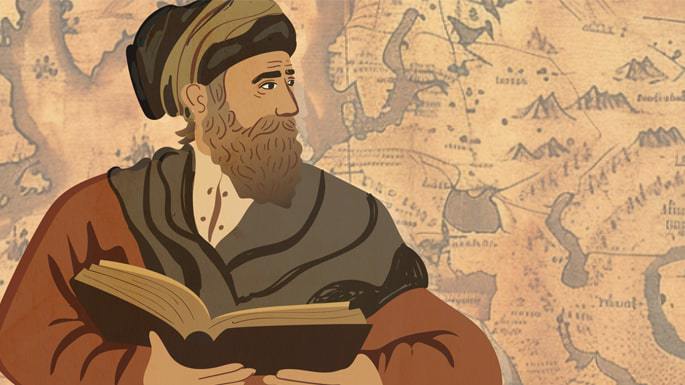
Benjamin of Tudela

academic · poem

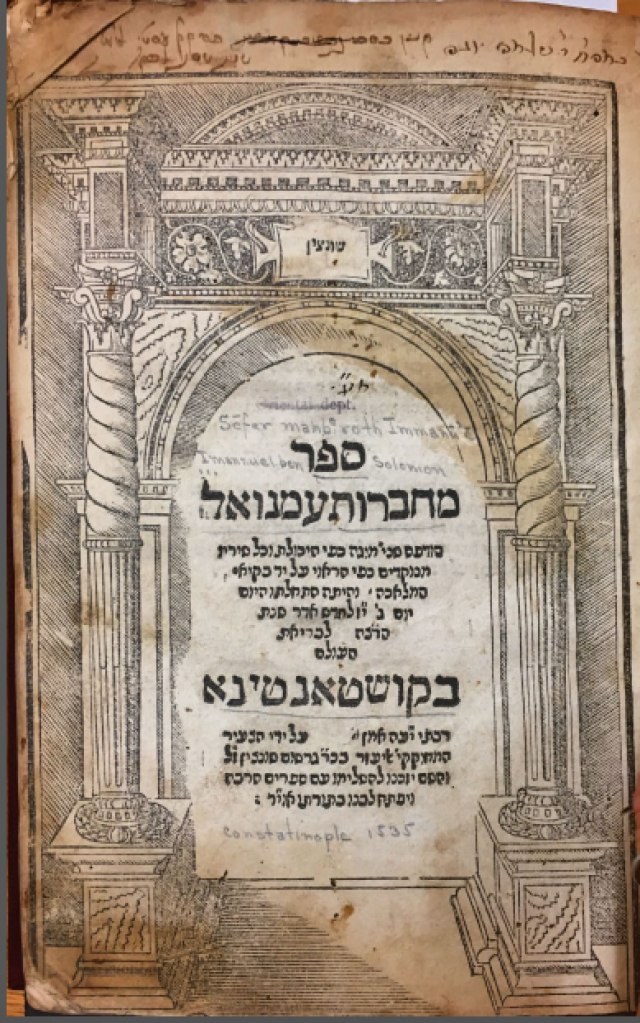
Immanuel of Rome’s 9th Machberet

Emmanuel of Rome –in Hebrew, Emmanuel haRomi; in Italian, Manoello Giudeo – was born to an aristocratic Italian-Jewish family in 1261. Although only a minor poet by comparison to his pre-Renaissance contemporaries, Emmanuel was the first ever poet to write sonnets in any language other than Italian. Around 1300, Emmanuel produced a series of Hebrew sonnet collections that dealt with both secular and religious themes.

Using Dov Yarden’s edition of the Hebrew, I have created English translations of Immanuel’s 9th Machberet, which is a series of sonnets for each month of the Jewish year. So far, there has not been any systematic effort to translate all of Emmanuel’s works and only a few contemporary scholars show much interest in him. By putting these translations into the public domain, I hope others will take up interest in him.

I tell my story and say: וָאֶשָּׂא מְשָׁלִי וָאֹמַר 

TISHRI 

In Tishri, I rejoice; as the feasts to God 
Awaken me, to songs of passion sing  
I will delight in honey and nectar 
A time when willows string up violins 
And I shall surround myself  with youth 
I’ll eat a banquet fit to feed a king 
While staring at the apple of my eye, 
The juice of grapes and pomegranates drink. 
My face in battle, like before a flame 
I won’t be mute, but surely I will sing 
As her warden, I open up my lips  
I borrow kisses from Ofra’s wellspring 
And thank the Lord who made humanity 
Complete with all the perfect openings  
בְּתִשְׁרִי אֶשְׂמְחָה כִּי מוֹעֲדֵי אֵל
 יְעִירוּנִי לְשׁוֹרֵר שִׁיר עֲגָבִים
 וְאֶתְעַנַּג בְּנֹפֶת צוּף וּפַנַּג
 וְכִינוֹרַי תְּלוּיִם עַל עֲרָבִים
 וְאַצִּיבָה סְבִיבוֹתַי נְעָרַי
 וּמוּל פָּנַי לְאַיֶּלֶת אֲהָבִים
 וְאֶסְעַד מַעֲדַן מֶלֶךְ וְאֶשְׁתֶּה
 עֲסִיס רִמּוֹן וְאֶשְׁכַּר דַּם עֲנָבִ
ים וְאֶשְׁכַּח רִישׁ וְלֹא אַחְרִישׁ וְאָרֹן
 וּפָנַי בַּקְּרָב כִּפְנֵי לְהָבִים
 וְאֶלְוֶה מִשְּׂפַת עָפְרָה נְשִׁיקוֹת
 וְלִפְרֹעַ שְׂפָתַי לָהּ עֲרָבִים
 וְאוֹדֶה אֵל אֲשֶׁר יָצַר בְּחָכְמָה
 בֵּני אָדָם וּבָרָא בָם נְקָבִים 

MAR-CHESHVAN 

In Mar-Cheshvan, we’re lifted up by light 
I long to stand on dark borders of clouds 
And cry out from the fastened fires of night 
So sticky honey drips on land unploughed 
Upon the borders of the fields I press 
The nectar into syrup and the olives into chow 

I drink until I forget poverty 
And drive out all the grief from hearts somehow 
I bless each bairn to any woman born  
I see this as the time for seeds to sow 
The autumn plants assert this as their hour 
Nothing has thorns that sting as sharp as now 
But shoots will spring from barren earth again 
Like men from graves, accomplishing God’s vow  
בְּמַרְחֶשְׁוָן מְאוֹר יַעְלוֹת וְזִיוָן
 אֱהִי עֹרֵךְ לְמוּל אֹפֶל עֲנָנָיו
 וְקָרָתוֹ בְּאֵשׁ חֵשֶּׁק אֲגָרֵשׁ
 וְתַמְרוּרָיו בְּנֹפֶת צוּף עֲדָנָי
 וּמוּל פִּרְשׁוֹ יְהִי חֵשֶק וְדִבְשׁוֹ
 וְאֶל מוּל בָּאֳשׁוֹ רֵיחַ שְׁמָנָיו

  אֲנִי אֶשְׁתֶּה וְאֶשְׁכַּח רִישׁ וְאַחְרִישׁ
 וְאָסִיר מִלְּבָבִי עִצְּבוֹנָיו
 וּמִכָּל חַי יְלוּד אִשּׁה אֲבָרֵךְ
 אֲנִי נֹחַ וְנִטְעֵי נַעֲמָנָיו
 אֲשֶׁר לוּלֵי נְעִימוֹתָם יְכֻסֶּה
 זְמָן חָרוּל וְעָלוּ קִמְּשׁוֹנָיו
 עֲלֵי יָשְׁרוֹ אֲחוֹנֵן אֶת עֲפָרוֹ
 בְּתוֹךְ קִבְרוֹ וְאֶרְצֶה אֶת אֲבָנָיו 

KISLEV 

In Kislev, God’s horseman I will be 
And through calm pride I surely will agree 
A light on high supports a needy man 
To lift the dust of earth to build freely 
We light each night an eight pronged candel’bra 
Drink whiskey like the finest smooth honey 
The beauty of the girls’ arms, so exposed 
Whose eyes, like light’ning, shine in front of me 
One woman sets the table for the meal 
Another one runs after her to clean 
One coyly turns aside and rends men’s hearts 
Another bakes up biscuits for high tea 
I need not wonder what the meal will be 
The main course is spread out in front of me
בְּכִסְלֵו אֶהְיֶה שָׁלֵו וְאוֹדֶה
 לְצוּר רֹכֵב בְּגַאְוָתוֹ שְׁחָקִים
 וְאוֹר עֶלְיוֹן אֲשֶׁר אִישׁ דַּל וְאֶבְיוֹן
 מְרִימִי מֵעֲפַר אֶרֶץ וּמֵקִים
 וְנֵרוֹת אֶהְיֶה מַדְלִיק שְׁמֹנָה
 וְשִׁקּוּיַי כְּנֹפֶת צוּף מְתוּקִים
 וְהַיָּפוֹת זְרוֹעֹתָן חֲשׂוּפוֹת
 וְעֵינֵיהֶן יְרוּצוּן כַּבְּרָקִים
 וְאַחַת עֹרְכָה שֻׁלְחָן וְאַחַת
 תְּשַׂדֵּד אַחֲרֶיהָ הָעֲמָקִים
 וְאַחֶרֶת תְּלַבֵּב הַלְּבִבוֹת
 וְאַחֶרֶת תְּבַשּׁל הָרְקִיקִים
 וְצַפִּיחִת וּמַעְשֵׂה הַחֲבִתִּים
 וּמַרְחֶשֶׁת מְזָוֵינוּ מְפִיקִים 

TEVET 

The tenth Tevet: a fast for those who died 
When God’s children, like roaring seas, shall thrive 
They come in waves before the courts of God 
Where fools can dream and helping hands can strive 
To dig the chilly ground; this cold man shakes  

Those muscly men who work the harsh outside 
Who pull the jumpers round their necks and hide 
On snowy roads beneath the winter sky 
On days like these, I look for doe-eyed dames 
In secret surfaces where they reside 
My life is like a dead stalk in decay 
And yet, with only a gaze, I revive 
I know that God will crush all those who hate 
But meanwhile, I’ll be fortified by wine 
בְּטֵבֵת בַּעֲשָׂרָה בוֹ יְצוּמוּן
 בְּנֵי אֵל חַי וְכַיַּמִּים יְהִימוּן
 לְבוֹא צַר בֵּית אֱלֹהִים וַחֲצֵרָיו
 בְּכֵילַפּוֹת וְכַשִּׁיל יַהֲלֹמוּן
 וְהַקֹּר יַחֲלֹף הָאִישׁ וְיִדְקֹר

  פְּנֵי שָׂרִים הֲכִי חָבוּשׁ בְּטָמוּן
 וּמִטְרוֹת עֹז וְטִיט חוּצוֹת וְקֶרַח
 וְשֶׁלֶג עַל מְסִילֹּתַי יְרֻמוּן
 לְעֵת כָּזֹאת אֲשַׁחֵר הַצְּבִיּוֹת
 אֲשֶׁר סוֹד עַל יְגוֹנִים יַעֲרִימוּן
 וְעֵינֵיהֶן וְהוֹד צִיצַת לְחֵיהֶן
 יְחַיּוּנִי נְבֵלָתִי יְקִימוּן
 וְאֵיךְ אִירָא וְיֵינִי לִי לְעֶזְרָה
 וְהוּא יִמְחַץ מְשַׂנְאַי מִן יְקוּמוּן 

SHVAT 

Your face is harsh as bastards’ are, Shevat 
You send your time and frosty ice like loaves 
The whizzing snow breaks skies and cools my heart 
I spot the lovers hiding in alcoves 
They thrust and grab with their bosoms exposed 
Their voices cry out loud within their homes 
I cursed the stupid sermons as I froze 
And realised I was better off alone  
שְׁבָט אַכְזָר וְעַז פָּנִים כְּמַמְזֵר
 וּבוֹ יַשְׁלִיךְ זְמָן קַרְחוֹ כְפִתִּים
 וְהַשֶּׁלֶג גְּאוֹן הַלֵּב יְפַלֵּג
 וְהַדּוֹדִים בְּחֵיק יַעְלוֹת נְחִתִּים
 וְרָצֵי הַצְּבִיּוֹת הֵם דְּחוּפִים
 וְכָרוֹזָא בְּקוֹל קָרֵא בְּבָתִּים
 אֲרוּרָה דֹּרְשָׁה צֶמֶר וּפִשְׁתִּים
 לְעֵת כָּזֹאת לְבַד מַעְשֵׂה חֲבִתִּים 

ADAR 

Adar arrives to teach the bawdy tale 
Of how Haman and Zeresh caused such shame
If I had not such wealth and dignity 
I could not feast upon these geese and game 
In my right hand, a cup of toddy wine 
I shout each time I hear Haman’s curs’d name 
I join my mates and drink myself insane 
Until the heroes and the brutes are same 
We cheer with throats full of liquor and food 
For tyrants who will never rise again 
Only good wine can expel pain and strife 
And so we praise its healing holy name  
בְּאַדָּר אֶהְיֶה ישֵׁב וְדֹרֵשׁ
 וְאַזְכִּיר חַסְדֵי הָמָן וְזֶרֶשׁ
 וְלִי יוֹנִים וּבַרְבֻּרִים אֲבוּסִים
 וְלֹא אָחוּשׁ הֲאִם לִי הוֹן וְאִם רֵישׁ
 וְהַיַּיִן מְבֻשָּׂם אֶל יְמִינִי
 בְּקוֹל קֹרֵא וּבַדִּבּוּר יְפָרֵשׁ
 וְאִם אֹמַר אֲרוּר הָמָן וְזֶרֶשׁ
 יְשִׁיבוּן אַל תְּקַלֵּל דּוֹד לְחֵרֵשׁ
 וְקוֹל קֹרֵא אֱכֹל וּשְׁתֵה לְשָׁכְרָה
 וְלֹא תַשְׁאִיר לְנֹחֵל אוֹ לְיוֹרֵשׁ
 בְּיַעַן הוּא לְבַד רִפְאוּת וּמָזוֹר
 וְכָל רַע וָחֳלִי גָּרֵשׁ יְגָרֵשׁ 

NISSAN 

Nissan, I will recall God’s miracles 
Come see our homes, delight with joyous Jews 
How good and pleasant are these former slaves 
Our ancestors whom God opted to choose 
Once cloaked in cloud, they wandered in deserts 
But now delight and wonder are our views 
Up from these blossomed trees call turtle doves 
Our doorways filled with special treats, infused I fall
in love with her between the flower beds 
And couples ride the heavens in pursuit 
I will sacrifice the flesh and wool 
Of lambs and rams and farmers’ choicest ewes 
Let me cry out to all my famished friends: 
Jerusalem and food wait here for you!  
Upon the Torah’s head a diadem 
And graceful bracelets embedded with jewels 
Her crown reveals her lovely wonderment 
Each heart lights up to listen to her news 
Although a broken world encroaches now 
When morning comes, the world awaits her truth 
בְּנִיסָן אֶזְכְּרָה נִסֵּי אֱלֹהִים
 וּבֹו אוֹרָה וְשִׂמְחָה לַיְּהוּדִים
 וַּמה טּוּבוֹ וַּמה יָּפְיוֹ אֲשֶׁר בּוֹ
 אֲבֹתַי יָצְאוּ מִבֵּית עֲבָדִים
 וּפָשַׁט הַזְּמָן עָנָן לְבֻשׁוֹ
 וְעָטָה אוֹר וְכֻלּוֹ מַחֲמַדִּים
 וְקוֹל הַתּוֹר עֲלֵי מִפְתָּן וְכַפְתּוֹר
 וְאֶרְאֶה עַל פְּתָחַי כָּל מְגָדִים
 וְחשֵׁק עִם חֲשׁוּקָה בֵּין עֲרֻגוֹת
 בְּשָׂמִים רֹכְבִים יַחְדָּו צְמָדִים
 וְאֶזְבַּח שׁוֹר וְשֶׂה נָקֹד וְטָלוּא
 לְבַד מִן הַתְּיָשִׁים הָעֲקֻדִּים
 וְאַעְבִיר קוֹל לְכָל צַד כָּל דְּכָפִין
 וְצָרִיךְ לֶאֱכֹל יִהְיוּ עֲתִידִים
 וְאַצִּיב יַעֲלַת הַחֵן לְנֶגְדִּי
  בְּרֹאשָׁהּ צִיץ וְעַל יָדָה צְמִידִים
 וְהִיא תַעְנוּג לְכָל לֵב נוּג וְלַחְרֹט
 פְּאֵר הוֹדָהּ יְדֵי הָעֵט כְּבֵדִים
 לְדַעְתָּהּ יֵצְאוּ יָדַי גְּדוּדִים
 וְעַד בֹּקֶר הֲכִי נִרְוֶה בְדֹדִים 

IYYAR 

Iyyar asks me a joyful oath to swear  
I join my hands, both left and right, as pairs 
With lustful oxen, all Hebrews will unite 
By seeking dreams and chirpy birdsong pray’r 
I will never see liberation come 
Nor hear lads singing in the streets somewhere 
The world removes the mourning clothes she wears 
To swap for fancy garb, with lovers shared 
I free myself from books I have to read 
The Talmud’s texts, to which I am an heir 
Instead, I’ll set myself beside a doe 
Her body giving life beyond compare 
And though the heat of morning beats us slow 
When death does come, we will be holy there  
בְּאִיָּר אֶשְׂבְּעָה שׂבַע שְׂמָחוֹת
 וּבִשְׂמֹאלִי וּבִימִינִי נְעִימוֹת
 בְּשׁוּרִי חשְׁקִים מִכָּל עֲבָרִים
 בְּצִיץ צִצִּים לְשַׁחֵר הָעֲלָמוֹת
 וְלֹא אֶרְאֶה לְבַד גִּילַת וְרַנֵּן
 וְלֹא אֶשְׁמַע לְבַד שִׁיר עַל עֲלָמוֹת
 וְתֵבֵל תַּחֲלִיף סוּת אַלְמְנוּתָהּ
 וְלִכְבוֹד חשְׁקִים תִּלְבַּשׁ רְקָמוֹת
 וְאֶתֵּן גֵּט לְעֵרוּבִין וְגִטִּין
 וְסַנְהֶדְרִין וּמַסֶּכֶת יְבָמוֹת
 וְאֶבְחַר לִי לְצֵידָה הַצְּבִיָה
 לְחִי שׁוֹשָׁן נְשָׁמָה לַנְּשָׁמוֹת
 פְּנֵי חַמָּה אֲשֶׁר כָּל שֹׁחֲרֶיהָ
 קְדֹשִים יִהְיוּ בָהּ אַחֲרֵי מוֹת 

SIVAN 

Sivan makes me remember all God’s deeds 
How by wonder, He lifts us up, proceeds 
He brought His treasur’d people to freedom 
His children follow after where he leads 
They see his words and statutes as their light 
Enlightened by the Torah’s sacred creed 
Hear us, O God, as we cry out to You 
Comfort our fears in this, our hour of need 
O, show us Moses, whom we need so close 
Who came from mountains in the clouds, decreed 
To us the ten statutes by which we live 
For Jeshurun bowed down and found he’d heed 
Then Esau saw that God fulfilled His will 
And Ishmael learnt that God would be his steed  
בְּסִיוָן אֶזְכְּרָה פִּלְאוֹת אֱלֹהִים
 אֲשֶׁר נִשָּׂא וְגָבַהּ עַל גְּבֹהִים
 אֲשֶׁר יָצָא לְיֵשַׁע עַם קְרֹבוֹ
 יְלָדָיו הֹלְכִים אַחְרָיו וְנִנְהִים
 וְנָתַן הוֹד וְנֵר מִצְוָה וְתוֹרָה
 לְעַם קָדְשׁוֹ לְאוֹר יִשְׁעוֹ כְמֵהִים
 וְשָׁמַעְנוּ אֱלֹהִים חַי מְדַבֵּר
 וְנַחְנוּ פֹּחֲדִים מֶנְהוּ וְרֹהִים
 וְרָאִינוּ אֲזַי משֶׁה בְּגִשְׁתּוֹ
 לְעַרְפַלָּיו וְעָמַדְנוּ תְמֵהִים
 וְהִתְוָה תָו עֲשֶׂרֶת דִּבְּרוֹתָיו
 הֲתִשְׁתּוֹחַח יְשֻׁרוּן עוֹד וְתָהִים
 שְׁאַל עֵשָׂו הֲרָאָה כֵן בְּעֹשָׂיו
 וְיִשְׁמָעֵאל הֲשָׁמַע קוֹל אֱלֹהִים 

TAMMUZ 

Stripped bare and broken, in Tammuz, I go 
To play and say the eulogies of woe 
My contrite heart cries out in broken pain 
My clothes are drenched in blood and wet sorrow 
That soaks the valleys of God’s holy home 
The plunder and destruction of my foes 
Those heathens burn the sacred sites they hate 
And tear up Torah scrolls, they overthrow 
An idol stands upon God’s conquered throne 
It breaks my heart in ways I’ve never known 
I take my sword, prepare myself for war 
The huntsman within me readies his bow 
So all of my tears will break down these walls 
In grieving the lost ones, I cry alone 
בְּתַמּוּז אֵלְכָה עָרוֹם וְשׁוֹלָל
 וְלִשְׂחוֹק אֹמְרָה נַפְשִׁי מְהוֹלָל
 וְאֶתְעַנֶּה בְּלֵב נִשְׁבָּר וְנֶעְכָּר
 וּמַלְבּוּשִׁי בְּדַם דִּמְעִי מְגוֹלָל
 אֲשֶׁר בּוֹ הָבְקְעָה עִיר בֵּית אֱלֹהַי
 וְהֵצַר צַר וּבָזַז בַּז וְשָׁלָל
 וּבָטְלוּ הַתְּמִידִים בּוֹ וְשָׂרַף
 אֲפוֹסְטוֹמוֹס לְתוֹרַת אֵל וְחִלָּל
 וְצֶלֶם הֶעֱמִיד תּוֹךְ הֵיכְלֵי אֵל
 מְשׂוֹשׂ לִבִּי לְזֹאת חָרַב וְדָלָל
 הֲיַעְרֹךְ צִיר אֱלֵי צִירִי וּמַכְאֹב
 לְמַכְאֹבִי אֲשֶׁר בָּא לִי וְעוֹלָל
 וְלָכֵן כֹּל אֲשֶר דִּמְעָה יְפַכֶּה
 וְיִתְאַבֵּל לְפִי שִׂכְלוֹ יְהֻלָּל 

AV 

Throughout the month of Av, I will cry and grieve 
I’ll pump out reservoirs of tears of pain 
For desecration of God’s wasted home 
The refugees removed by Rome’s campaign 
On one long day, like Haman’s sons we hang 
While God destroys His seat of holy reign 
With fuming rage, my life force God destroys 
I sob out floods of salty tear-filled rain 
Now traitors and cynics surround me 
But I won’t eat or make love for the slain 
And were it not for God’s endless mercy 
My mouth would never know to laugh again  
בְּחֹדֶשׁ אָב אֱהִי נִכְאָב וְאֶדְאַב
 וְאֶשְׁאַב מֵי דְמָעַי מִכְּבֵדִי
 וְאֶתְעַנֶּה לְחָרְבַּן בֵּית אֱלֹהַי
 וְעִיר קָדְשׁוֹ וְעַל הָגְלַת כְּבוֹדִי
 בְּיוֹם אָרוּךְ כְּמוֹ וָי”ו וַיְזָתָא
 בְּחֻמּוֹ נֶהֱפַךְ חֹרֶב לְשַׁדִּי
 וְהַמַּיִם אֲשֶר אֶשְׁתֶּה לְשִׂכִּים
 בְּמוֹ עֵינַי וְלִצְנִינִים בְּצִדִּי
 וְאַרְחִיק הַצְּבִיָּה מִיְּצֻעַיְ
 וְאֶתְגּוֹלֵל בְּמִטָּתִי לְבַדִּי
 וְלוּלֵי נַחֲמוּ בִּבְנֵי אֲוָזָיו
 יְמַלֵּא פִי שְׂחוֹק אֶבְכֶּה בְעוֹדִי 

ELUL I 

The nobles’ daughters now are frollicing 
On flower beds of Elul’s evenings 
And balls run down the rafters of downswings 
Like those who made our rabbis into kings 
O, let us go and see the vineyards spring 
We’ll search for fresh grown figs until ev’ning 
Where trees not only grow but even sing 
And they will speak words kind and flattering 
Lift up your hand and don’t forget a thing  

I wrote these words of verse when I was young 
So ev’ry month could have its praises sung 
Today, in age, I wrote another one 
In sacred oil to praise the Elul month 
And now my greatest poem has begun…  
בְּאֵלוּל אֶעֱלֹז עִם בַּת נְדִיבִים
 בְּעֶרֶשׂ רַעֲנָנָה עַל עֲרָבִים
 וְהַגֻּלּוֹת יְרֻצוּן בָּרְהָטִים
 כְּאִלּוּ יִתְּנוּ שָׁמַי רְבִבִים
 וְנַשְׁכִּימָה וְנֵצֵא לַכְּרָמִים
 לְשַׁחֵר הַתְּאֵנָה עַד עֲרָבִים
 וְאָז אֶרְאֶה גְפָנַי אֹמְרִים לִי
 בְּפֶה חָנֵף וּבִדְבָרִים עֲרַבִים
 הֲתִקַּח הַתְּאֵנָה דּוֹד לְמָנָה
 נְשָׂא יָדְךָ וְאַל תִּשְׁכַּח עֲנָבִים

  אֵלֶּה הֵם הַשִּׁירִים הַמְפֹאָרִים
 אֲשֶר חִבַּרְתִּי עַל הֶחֳדָשִׁים בִּימֵי הַנְּעוִּרים
 וְעוֹד חִבַּרְתִּי שִׁיר עַל חֹדֶשׁ אֱלוּל
 בֶּשֶׁמן מִשְׁחַת קֹדֶשׁ בָּלוּל
 וּלְיָפְיוֹ הוּא עִלָּה וְכָל שִׁיר זוּלָתוֹ עָלוּל
 וְהוּא זֶה 

ELUL II 

If only you would bless my eyes, Elul, 
For you I would become an Amora 
A lord of words, a student to Rava 
And I will fast and search for sweet Mannah 
Within the vineyards I will sit pretty 
And sing and dance although my death’s not far
And I will leave my soul behind in words 
I’ll suckle breasts from vine shoots as they are 
בְּאֵלוּל תְּבַלּוּל בְּעֵינַי יְהִי אִם
 אֲקַנֵּא לְרָבָא וְלִהְיוֹת אֲמוֹרָא
 אֲנִי הַתְּאֵנָה אֲבַקֵּשׁ לְמָנָה
 לְנַפְשִׁי וְאֶדְרשׁ אֲנִי רֹאשׁ אֲמִיָרה
 וְתוֹךְ הַכְּרָמִים אֲנִי בַנְּעִימִים
 אֲכַלֶּה יְמוֹתַי בְּשִׁירָה וְזִמְרָה
 וְאָשִׂים גְּפָנַי סְבִיב צַוְּרֹנַי
 לְעָנָק וְאִינַק שְׁדֵי הַזְּמוֹרָה 
high holy days · judaism · sermon

Knowing we will die helps us live to the fullest

Here’s the deal. Let’s see who will take it.

Today, you get a million pounds. But the catch is, tomorrow you die.

Any takers?

I didn’t think so.

You value living more than you value money. 

In fact, when you put death into the equation, you realise how much living matters to you. It matters more than any amount of wealth or status you could accrue.

Knowing we will die helps us understand what we value from life.

In many ways, Yom Kippur is a death rehearsal.

We act out today as if these were the last moments we would be alive.

Like the dying, we refrain from food and water. 

We turn up in modest clothes, without jewellery. Some wear white, the colour of the funeral shroud. Some wear kittels, the gowns in which we will be buried. Some wear tallits all day, from evening to evening – a unique point in the year when we do so – just as the dead are traditionally buried wearing their tallits. 

Over the course of this fast, we repeatedly recite vidui, the prayer of deathbed confession. We say psalms and chant petitions that are associated with death and funerals.

All of this serves as a ritual memento mori: a reminder that we will die.

Then, as we approach the end, we erupt into songs. We joyfully recite the neilah prayers. For many of us, there is a great rush of relief and joy as we realise we have made it through this marathon day. 

Yes, today is a reminder of our death, and it is one that affirms life. 

On this day, our Torah instructs us: “choose life.” Only by recognising that death is inevitable can we do so.

By really considering the finite amount of time we have on this earth, we are able to celebrate the days we have and live them to the fullest.

So much of modern Western society shies away from death.

For previous generations, death was a sacred process undertaken among family and community.

Today, it is sanitised: dealt with in hospitals and hospices by qualified experts.

There are great advantages to this. The professionalisation of death means that the sick can receive high quality care and pain relief right up to the last moments of their life. It takes a great deal of pressure off of family and friends, because the care for the dying does indeed require constant work.

But one downside to our compartmentalisation of death is that it means it is kept out of sight and taboo. 

When we do have to face death, it is often a shock, and can cause great trauma to living loved ones. Intellectually, all of us know we are mortal, but facing death as a lived and embodied experience can feel like a real rupture.

Having the Yom Kippur experience – which draws our attention to our mortality and makes us reflect on the quality of our lives – can be a powerful way to help us face death. In these rituals and fasts, we can prepare for our mortality. 

This real confrontation with death isn’t morbid. It’s a direction to truly embrace life. 

Knowing we will die helps us consider what we want to do with life.

In Progressive Judaism, we have a tendency to downplay some of the more explicit symbolism of death and mortality in our services. It is there in the machzor – in our silent confessions, themed readings, and traditional prayers. But our services often tiptoe over death’s undercurrents in the prayers.

This year, I have tried to reintroduce some of those themes to the service. 

Last night, at Kol Nidrei, we joined the rest of the Jewish world in holding the scrolls out of the ark, leaving it bare. The great American Reform liturgist, Rabbi Larry Hoffman, points out that the open ark is supposed to evoke a coffin. We stare into the empty space, which usually includes our Book of Life, and lay witness to our own tomb.

This morning, during shacharit prayers, we reintroduced the prayer “who by fire,” a traditional part of Unetaneh Tokef, which recounts the many ways in which a person might die. It is painful to consider life’s fragility, and all the vulnerabilities we face in life. 

But, by facing up to the possibility we will die, we get better at deciding how we will live.

We realise that we value life, and we take stock of what it is we love about it.

Marie de Hennezel is a French therapist focused on end-of-life care. In the early 90s, she was among the first staffers at a palliative care unit for people dying of HIV/AIDS. At this time, there was no cure – the deaths of HIV patients often involved rapid deterioration and great suffering. 

In 1995, de Hennezel wrote up her experiences of accompanying the dying into a memoir, entitled Intimate Death: How the Dying Teach Us to Live. The book even carried a foreword by French president Francois Mitterand.

She recounts stories of individual patients, as well as their carers, doctors, and nurses. In each vignette, she tenderly lays out how important it is to be with the dying. 

From her support, the patients often learn to live through challenging ordeals. Those who feel like giving up or who contemplate suicide decide that they will indeed live until their last moments on earth. By helping them face their death, the patients gain the strength to embrace their life.

This work, it seems, also transforms the carer. De Hennezel writes that she has learnt so much about living from the dying.

She writes poignantly:

Life has taught me three things: The first is that I cannot escape my own death or the deaths of the people I love. 

The second is that no human being can be reduced to what we see, or what we think we see. Any person is infinitely larger and deeper than our narrow judgments can discern. 

And third: one can never be considered to have uttered the final word on anything, is always developing, always has the power of self-fulfilment, and a capacity through all the crises and trials of life.

Let us take this as our message from Yom Kippur today.

Our lives are not over. We can affirm them. We can do so much with them.

And, though we do not always realise it, we love our lives more than any amount of wealth or status.

By facing up to the fact that we will die, we can live the days we have to the fullest.

Gmar chatimah tovah – may you be inscribed in the Book of Life for good.

Yom Kippur Yizkor 5786

high holy days · judaism · sermon

It is time to tell a different story about ourselves

It is time to tell a different story about ourselves.

We are writing a story about our lives right now.

On Rosh Hashanah, our story is written. On Yom Kippur, the story is sealed.

What, then, are we doing today? 

This morning, we are editing. We are looking over our story and choosing what to keep and what to discard. What to highlight and what to relegate to the footnotes.

Of course, we cannot change the events of our past, but we can decide what they mean. In writing our story today, we choose what role we played in the narrative of our own lives. 

When you tell this story, are you a victim, or a villain? A saviour or a sinner? 

Look at your mistakes. The way you tell your story will help you decide whether they were a defining part of your personality, or whether they were opportunities you took to learn and grow. 

Look at your suffering. Others have hurt you. You need to tell your own story of what that pain means. You need to decide if your suffering is the sum of your life, or if it is something you overcome. 

You are writing the story of your life right now. Be careful how you tell it.

In our Mishnah, Rabbi Yehudah HaNasi teaches: “Apply your mind to three things and you will not come into the clutches of sin: Know that there is above you: an eye that sees, an ear that hears, and all your deeds are written in a book.”

But here is what the Mishnah does not tell us:

The eye that sees can see more perspectives than we can.

The ear that listens knows all hearts in ways we do not.

And, most importantly, the book is constantly being edited and re-written.

We are always re-writing the Book of Life with our God, and that means we have the power to shape our story.

We cannot imagine that God’s eyes and ears are anything like ours, or that God writes a book the way we would. The story that an Infinite Being has to tell about you must be incomprehensible from your perspective. 

When we tell ourselves our story, we are biased, seeing only our perspective. Our narrative is partial, not knowing what others really feel.  Our account is unreliable, because we tell it to fit the character we have already made of ourselves. 

God, on the other hand, sees not just what we did, but what we hoped to do. God says to the prophet Samuel: “I do not see as human beings see; human beings see only what is visible, but I see into the heart.”

God instructs the Prophet Isaiah: “Whenever anyone turns back to Me for pardon, I freely forgive, for as the heavens are high above the earth, so are My ways high above your ways, and My plans above your plans.” 

God is able to see errors in ways we cannot. And God can understand our pain in a context that is beyond us.

This is because God is telling a different story about you to your own.

In God’s plan, you are the main character. Of course, so is everyone else. 

But that is because God has written a great novel where every creature has a vital role to play. No character could be introduced if they did not have a role in the great unfolding tale that progresses towards goodness’s triumph over evil.

So, today, look at the manuscript of your life. Decide what you want to focus on. Tell yourself stories of gratitude and joy. Consider the events that have given you pride and a sense of accomplishment. 

Look, too, at the stories in your life that are hard. Re-tell the stories of where you have been hurt, and decide for yourself what meaning you take from them.

Re-examine the stories of when you have hurt others, and decide what changes these will bring for you when you enter your next chapter.

In this way, you can take control over the story of your life. 

You cannot change what happened, but you can decide what it means. 

Only you can decide how your story ends.

Treat God as your co-editor, rather than as the author of your destiny.

For some of you, the story I have told so far is too wrapped up in religious language. You cannot get on board with all this God-talk, and the quotations from Scripture prove nothing. 

Let us turn, then, to the science of psychology. 

Over many decades, psychologists have experimented with what makes for a good life. We now have more data than ever about how people forgive. We understand a great deal more about how to overcome trauma. And we know what motivates people to live better lives.

I am going to assume that, if you are here on Yom Kippur, you came because you want to let go of some past hurt, to repent of things you have done wrong, and to live a more fulfilling life.

The Scriptures tell us how to do this, but the language they use may feel too alien to the modern mind. The sciences, however, can corroborate the same claims.

Dr Fred Luskin runs the Stamford University forgiveness project. His team has researched the best methods to help people overcome their grudges and live more fulfilling lives. 

He has tried out his techniques for helping hundreds of people forgive, including in the most extreme cases, like mothers whose children were killed in sectarian violence.

His book, Forgive for Good, is an accessible version of his research.

Dr Luskin teaches that our inability to forgive comes when we tell ourselves a “grievance narrative.” 

You may have such a story yourself. If you keep coming back to an event in your life where you were wronged and replaying it, you may be stuck on recalling a past hurt. If, in this story, there is a clear villain, and you are a helpless victim, the chances are you have a grievance narrative.

Don’t worry, you’re not alone. Many people do. 

I began reading Dr Luskin’s book out of academic curiosity, but soon found I was noticing my own grievance narratives. Some of them went right back to old hurts in school. I looked over some of the stories I had about my own life, and found they did not serve me.

Dr Luskin says that the key to getting out of the trap of these painful stories is to consider how you tell them.

First of all, decide how much space in your mind you want this story to occupy. Yes, you have been hurt, but do you want to keep letting those same people hurt you by giving them unlimited air play in your head? 

One way forward is just to change how much you think about them. Rather than letting them be the main character in your story, focus your internal account on your own successes and joys.

Secondly, consider how you are telling your story. If you have a grievance narrative, the hurt you experienced may determine everything that comes after. 

You were wronged, and that may have a lasting impact. But is it not also true that you survived, overcame, and learnt from the experience? You have the power to tell the story so that you are not a victim, but a hero.

None of this means pretending that pain doesn’t hurt, or that the wrongs others did were not wrong. Quite on the contrary: in order to move on with anything, you have to be able to say how wrong it was, and what it made you feel. 

The difference is that you get to decide what it means. You can decide whether someone else has written your story for you, or whether you are your own author. You can choose to focus your attention on your own pride and resilience.

Just as our faith tells you to pay attention to how you tell your story, so, too, do the psychologists. The story you tell can help shape how able you are to move on from past pain and be a better person.

This is true, not just on the individual level, but also at the collective level. The stories we tell about Jews are the stories we tell about ourselves. What is the story we tell about ourselves as Jews?

There are plenty of stories out there about us. There are stories where we are perfect victims, forever blameless for the suffering we endured. There are stories where we are bloodthirsty brutes, responsible for the worst evils in the world. 

Both of these stories deny us agency. These stories turn us into history’s stock character, whether as martyr or as monster. They deny Jews the ability to do what everyone else does: to hurt others, to learn from our mistakes, and to become better people. They strip us of the opportunity to grow and change.

We need, therefore, to think hard about what the narrative is that we are writing about Jews.

Rabbi Dr Tirzah Firestone sits at the intersection of spirituality and psychiatry. Firestone began her career as a psychoanalyst, then came back to the religion of her birth, embraced Renewal Judaism, and became one of its leading rabbis.

Firestone grew up with Holocaust-surviving parents. She felt that she and her siblings inherited great trauma from her family, and from the stories they told. Or rather, did not tell. Much of their former life escaping genocide was clouded by secrecy. The stories her father did tell were of persecution: that the non-Jews inherently hated Jews and would destroy them at every opportunity.

As a therapist and rabbi, Firestone urgently felt the need to tell different stories about Jews. She insists: “Identifying ourselves as victims freezes our focus on the past, and therefore forecloses our future.”

This does not mean pretending that Jews have never been victims. We need to face up to the traumas of Jewish history, including Shoah, pogroms, and persecution. Ignoring them, and refusing to tell the stories, can actually exacerbate the transmission of trauma.

What we need to do, says Rabbi Firestone, is honour Jewish history without internalising the harmful aspects of Jewish trauma. 

We need to remember that, as Jews, we have collective power. We are able to influence the world, and not just subject to the vicissitudes of history. We must claim our agency, and take ownership over what happens to our future. 

Most importantly, says Firestone, we should draw connections with others suffering from persecuting systems. By making these links, we strengthen ourselves, support our neighbours, and find positive meaning out of difficult circumstances.

We must, therefore, tell a new story about Jews. A story where we are survivors, who have been hurt and used creativity and resilience to overcome our pain. A story where we are complete human beings, who can hurt others, and who can repent and change. A story where our story connects to all of humanity for the sake of a shared future.

The story we are writing does not have to be one where we are always victims, nor incomparable monsters. We can create a narrative that acknowledges our past, honours it, and uses it to direct us towards a more positive future.

On Rosh Hashanah, our story is written. On Yom Kippur, the story is sealed.

We are writing a story about our lives right now.

Today, with the help of God and this sacred time, write your story.

Write a story you can be proud of. Write a story where you have the power to do better. Write a story where you overcome your challenges.

The events of your life so far have already been written. What they mean is up to you.

Gmar chatimah tovah – may you be written in the Book of Life for good.

Yom Kippur Shacharit 5786

high holy days · sermon

The world is governed by compassion

“Hineni he’ani mi-ma’as – behold, I am poor in deeds and lacking in merit. Nevertheless, I come trembling in the presence of You, O God, to plead on behalf of Your people Israel who sent me, although I am neither fit nor worthy of the task. You who examine hearts, be my guide, and accept my prayer. Treat these words as if they were spoken by one more righteous than me. For you listen to prayers and delight in repentance. Blessed are You, O God, who hears our prayers.”

In the synagogues of medieval Europe, the service leader used to begin with this public prayer of atonement, openly acknowledging their own inadequacy. 

In the Liberal world, we have been shaped by the Victorian attitude that eschewed public vulnerability. So, instead, this prayer is given out to rabbis to read privately to themselves. 

The days when we had to pretend to be perfectly put-together are over. In our age, we recognise that openly sharing our insecurities builds a more emotionally authentic culture, where people are better at handling their feelings.

So, this year, I not only quietly recite this prayer in my office, but share it with you openly.

This year, these words feel more profound than usual. 

This is a sensitive time, and I know how fragile so many hearts are. 

In the build-up to these Days of Repentance, an American Masorti rabbi, Joshua Gruenberg, wrote:

“Rabbis stand before their congregations with trembling hearts. We know that every word matters. We know that words can wound and words can heal. And we know that in a climate like this one, the margin for error feels impossibly thin. […] The only way we will find wholeness is if we grant each other the space to be imperfect, the courage to be vulnerable, and the grace to be human.”

As this year came to an end, I thought back on the conversations I’d had with you over my time here. I thought back over some of the pain and worry you had felt, and realised just how much stress some members of the community were feeling. 

Words can, indeed, hurt and heal. They matter. I want to honour that, by reflecting on the pain some of you have expressed.

We come here because we want to be together, in our fullness, with all our wounds and trauma, so that we can move towards healing. 

To that end, let’s consider how we can approach anxious and hurting people with compassion. That is, after all, what we all need from each other.

The world has changed greatly in the last few years. So much feels more precarious. 

Ten thousand people rallied at Tommy Robinson’s far right march in London to a speech by Elon Musk telling the crowds to get ready for violence against immigrants. The news from Israel and Gaza, and Russia and Ukraine, and Sudan and Ethiopia, keeps rolling in, feeling ever worse. 

For me – and I know for some of you – the horrors of October 7th and the ensuing assault on Gaza marked a major turning point. In many of us, these events have brought up trauma responses we didn’t even know we had.

Since then, so much has unfolded that is out of our hands. This can feel painful when your instinct is to find solutions and assume control.

We have to accept our own limitations. I sometimes recite to myself the Serenity Prayer: “God, grant me the serenity to accept the things I cannot change, the courage to change the things I can, and the wisdom to know the difference.”

Those of us within this room do not have the power to bring about peace between the Israelis and the Palestinians. We cannot get the hostages back or stop the starvation of Gaza.

That feels hard. If it were up to the members of this synagogue I have no doubt that the whole world could live in peace. 

I am certain that we could indeed solve the country’s problems and fix our hurting planet. But nobody seems to be letting us do that, outside of setting the world to rights over kiddush.

But that does not mean we have no power at all. 

The one area where we have real power is in our own homes and our own community. 

And, there, we have the power to decide how much compassion we feel.

Even in the face of our own trauma and fear, we can choose to feel compassion for others.

Perhaps you can relate: in the immediate aftermath of October 7th, I felt intensely isolated. I felt a void where compassion ought to be.

I felt, among Jews, my own people, that I struggled to find many people who felt compassion for the people in Gaza. 

On the left, as much my natural home as the synagogue, I struggled to find many people who felt compassion for Israelis. 

Initially, I narrowed my circle to a small niche of Progressive Jews with left-wing opinions. It was comfortable and reassuring, when what I needed was to feel safe. 

But if I was looking for compassion in the world, I needed to bring it into the world. I needed to model it. 

Not just with the people who I knew felt like I did, but also with those whom I assumed were miles away from me. 

It is easy to love humanity in general, and fine to pity people on TV. It is much harder to love the people nearest you when you feel so distant, or to understand them when it feels like they are living in a different world. 

How could I look for compassion elsewhere if it wasn’t in my own heart? 

How can we look for compassion if we do not feel it?

You can’t expect others to extend compassion to strangers when you can’t even have conversations with the people you already know.

I felt then – I still feel – that, perhaps, if we can feel compassion in our synagogues, and extend it out towards the world, and that others could extend their compassion too, then it might cause something to shift.  

And, ultimately, that shift might make this world, which is harsh and unkind, a little better than it has been.

The message of compassion is already explicit in the liturgy of our Yom Kippur service. 

God’s name is Compassion. 

We read the refrain that repeats throughout the High Holy Days: “Adonai, adonai, el rachum vechanun… a God compassionate and gracious, slow to anger, abounding in compassion and faithfulness…”

It is a beautiful invocation of God’s qualities to help us through Yom Kippur. 

The verses come from Moses’s second acsent of Mount Sinai, when he takes the new set of the Ten Commandments in his hand. As Moses walks down the mountain, God comes with him.

As Moses chants out these declarations of God’s mercy, it is as if Moses has truly understood what kind of God he is dealing with.

He learns how the world really works. He sees that it is governed by compassion.

Just before coming to get the new tablets of the law, Moses had seen the Israelites worshipping a golden calf, and smashed up the first set of the Ten Commandments. 

These are great sins: idol worship and wanton destruction are strictly prohibited. The Israelites have been wayward. Moses has been angry. 

Still, God, abounding in compassion and faithfulness, says: “Try it again. Have another go.”

In the Talmud, Rabbi Yohanan teaches that whenever the Jewish people sin, they should think back to this verse.

In the repetition of “Adonai, Adonai,” the Jews should understand that God is their Loving Creator before a person sins, and God is their Loving Creator after a person sins and performs repentance.

God is always willing to give people another chance.

In the same section of Talmud, we learn that, in the moment when Moses recited those words, God made a covenant based on thirteen attributes of mercy. It was a promise that God would always hear our prayers.

Later, in the Middle Ages, the French commentator Rashi elucidated what these thirteen attributes were.

In each word, says Rashi, is a reflection of the type of compassion God feels. 

God is slow to anger to give you a chance to repent.

God is abundant in mercy, even with those who don’t deserve it.

God remembers good deeds even for a thousand years.

Even when we hear that God holds grudges for three and four generations, Rashi says that this only refers to people who maintain the evil ways of their ancestors. If they repent, all can be forgiven of them too.

This is how one truly maximises compassion.

So, let us be compassionate.

Let us maximise how much compassion we feel.

Our own community and our own homes are small places where we can truly practise compassion in a world where it seems so sorely lacking.

Last week, in her Rosh Hashanah address, Rabbi Angela Buchdahl, of the American Reform movement’s flagship synagogue in New York, reflected on how the division in the world was creating strife even within her synagogue.

She urged her congregation to practise compassion, saying:

“It now seems that any expression of compassion for “the other side” is regarded with suspicion – as disloyal, or even threatening. Is our capacity for empathy so finite? Are our hearts so small, that if we increase our empathy for certain people, that we need to reduce it for others — until one day, we conclude: that ‘other side’ is not deserving of any compassion?”

Here, the “other side” could be so many different groups in this increasingly polarised and hostile world. 

We all want to feel like people understand our own side, but struggle to extend our understanding the other way.

You don’t have to agree with people to love them. You just have to be curious, and try to understand them.

Some days, we may be capable of less compassion than others. On those days, let’s give ourselves grace, take time out, and remember how flawed we all are.

Even on our worst days, we can always try to understand each other. We can hold our own hearts while making them permeable enough to feel others’ pain too.

When people challenge us, let’s look for the best in them. Imagine their best intentions, and try to consider what problems they might be facing.

We are, all of us, flawed and temperamental. We all ask good grace of others, and we can all give it in return.

This year, let’s try to feel compassion for the people in our own families and homes.

Let’s try to find compassion for the people in our neighbourhoods. Perhaps we will shift something in them.

Let’s find compassion for the people in our community, so that we can hold each other, in our diversity, through these trying times. 

And, as much as we can, let’s try to find compassion for everyone. 

It won’t change the news cycle, but it might change you. And you might change others. 

It is a small contribution to this world, but it is a mighty one. 

It is the best that we can do.

Behold, I am poor in deeds and lacking in merit. Nevertheless, I come trembling in the presence of the One who hears the prayers of Israel. O God, You listen to prayers and delight in repentance. Blessed are You, O God, who hears our prayers.

Amen.

Kol Nidrei 5786, Kingston Liberal Synagogue