diary · israel

How many machine guns do you need in a synagogue?

A person shall not go out with a sword, nor a bow, nor a shield, nor a dagger, nor a spear. If one does, they are liable for sin. Rabbi Eliezer says: they are decorations for him. And the sages say: they are simply disgraceful, as the Torah says: “they shall beat their swords into ploughshares and their spears into pruning hooks; nation will not raise up sword against nation, nor will they learn war any more.” –  Shabbat 63a

I wish the sages had the foresight to extend their prohibition to machine guns.

On Friday morning, I sat in a session learning how to lay tefillin with other queers at Kol HaNeshama synagogue in Jerusalem. It was a wonderful expression of LGBT leadership, with meaningful intention-setting and prayer. It felt truly special.

I found it hard to concentrate, and not just because my Hebrew is too poor to keep up. Just a few chairs away from me, a man was holding a gun larger than his torso, pointed towards the floor in front of him. I don’t know what type of gun this was, or what it can do, nor do I want to.

I asked a friend why so many men now carried guns. I had assumed it was a result of Ben Gvir handing out over 100,000 gun licenses since October 7th. In this case, however, the man was a military reservist, and had no choice but to keep his weapon on him at all times.

“We used to have a policy of no weapons at LGBT events, but it’s getting increasingly hard to enforce. There is a place in the city centre where you can leave your gun with the police for an hour, but people don’t do it any more. Once they feel the safety of holding it, they don’t want to let it go.”

When I came here for the first time, 15 years ago, the thing that struck me most was how many people had enormous weapons. Now, there are far more guns, and the people holding them look so much younger.

On the train from Tel Aviv last week, all the boys sitting around me had different types of guns. In the hostel where I am staying, a large family has come for a reunion. In this family, the women wear enormous beautiful headwraps and the men wear rifles like necklaces.

I prayed with Chabad this weekend. In every service and meal, I looked around: guns everywhere. Even these Orthodox, Shabbat-observant Jews were fully-armed.

The civilians have guns. The settlers have guns. The army have guns. It seems only the peace movement does not. There is, however, something powerful about standing with the believers holding nothing but faith.

When the sun went down, I once again joined the protests for a ceasefire and a hostage deal. The police were heavily armed and facing us. I was warned they might get violent. That threat has a very different resonance to in London, where police very rarely carry guns.

I long for the day when this entire region is disarmed and demilitarised. What will it be like when Jews can pray at the Kotel, Christians at the Holy Sepulchre, and Muslims on Al-Aqsa, when nobody has a single gun? How different will the prayers from this city sound when nobody has reason to fear being shot?

Some trust in chariots and some in horses, but we trust in the name of the Eternal One our God. – Psalm 20:7
diary · israel

Who are my people?

At a time when the community is suffering, one may not say: “I will go home, and eat, and drink, and be at peace in my soul.” – Talmud Taanit 11a

I began studying this sugya in the immediate aftermath of October 7th and the subsequent war on Gaza. It was evident that people were seriously suffering, and I felt that I could not just sit at home and be at peace in my soul.

No matter where I went, the war was on my mind. I thought that, if I came here, at least my mind and body would be more aligned.

But the sugya prompted a question I did not expect: who is my community? The question of suffering and how to respond seemed already self-answered, but whose suffering ought to concern me? Who were ‘my people’?

Perhaps there was a time when ‘the community’ was just the neighbourhood. Those who lived in close proximity shared in times of trouble. The people on my street might well share with me in some suffering – missed bin collections and sewage in the river – but this suffering was specific.

I found, sometimes, I would talk to my neighbours and realise they were not obsessing about Gaza. They maybe had not thought about it for weeks. They were my community, but they also were far away from it.

In that sense, the Jews were my community. No matter their politics, every Jew was stuck in the same place of fear. Over different things, with different prescriptions, but certainly with the same neurosis.

Yet, in the weeks following October 7th, I heard people in “my” community call to flatten Gaza, and watched Netanyahu’s government heed them. I was sent the most bellicose memes, hungry for war. Most chillingly, a one sentence text from a person I previously respected: “you can’t give human rights to people who aren’t human.” How could I say these were my people? How could I claim them as my community when our values were so misaligned?

At a Friday night dinner, a friend suggested thet our community should be all oppressed people of the world. Jews, he said, were not an ethnic category, but a political one, and anyone who suffered under the burden of injustice was one of us.

Another gently chided him: “it’s too easy to only associate ourselves with victims. It stops us thinking about all the complex ways we are complicit in oppression too,” she said. “We can be both, and we need to face the problems in our own community.”

I wondered if I would find my people here among the international left, with those striving against occupation and war. There are people whom I love greatly here. I see them, beaten down in body and spirit, weary from fighting against a world that may destroy them, and destroy all they care about.

I am here to join them in struggle, but when this month ends, I know that I will go back to my own home in England, and tend to my own garden, and eat the foods I am used to, and drink that diluted squash you can only get in British supermarkets.

But my soul will not be at peace.

Perhaps all of these people are my people. Perhaps none of them are. But I will suffer on with them anyway.

Whoever they are, I know my soul will not be at peace while any of them are hurting.

And anyone who suffers with the community has achieved merit and will live to see the consolation of the community.

diary · israel

Because of my Jewish friends

“And who occupied us first, before Israel?”

I am getting grilled on my understanding of Jerusalem’s history.

“Wait, how far back are we going?”

“Just before Israel, who was here?”

“The British.”

“Exactly. The British.”

The fact that I am a rabbi in kippah and tzitzit in this Palestinian man’s home is largely unremarkable. But the fact that I am British makes me circumspect.

Saleh, an activist in Sheikh Jarrah, wants to see if I actually know Britain’s colonial history and the role it played in shaping problems today.

Blessed is God, Creator of the Universe, who has not made me a stranger.

There is no way he could know this, but I come from a socialist family, and listing the crimes of every empire is a longstanding tradition of the dinner table. As he curses the indifference of Arab leaders and the ineffectiveness of diplomats, I am fondly reminded of my dad.

“I tell the diplomats: the shoes of one street activist are worth more than all of you put together.”

Blessed is God, Sovereign of the Universe, who supports every step a human being takes.

Saleh tells me his family’s story, getting out grainy photos going back decades of settler violence, police brutality, threats, and harm.

As he pulls out the photos, he occasionally stops on one and says “this is my Jewish friend.” He is talking about the Israeli activists from Free Jerusalem who turn up to protest against the settlers.

There are some in Sheikh Jarrah, like the al-Qurd family, who will not work with Israeli activists because they want to maintain their autonomy. But Saleh doesn’t see it this way. At every stage, he is eager to tell me that he hates nobody and respects the Jews.

“This is my Jewish friend. He was arrested trying to stop demolitions here.”

Blessed is God, Sovereign of the Universe, who frees all those who are imprisoned.

“This is my Jewish friend. She was shot and lost an eye defending Sheikh Jarrah. I was the first to visit her in the hospital. Her father came too. He used to be a settler and hated Arabs. After weeks of seeing me support his daughter and seeing what the occupiers did, he apologised and changed his mind completely. He told me he could now understand all the lies he had been told.”

Blessed is God, Sovereign of the Universe, who opens the eyes of those who cannot see.

It is remarkable that a racist could turn away from hate. It is more remarkable that such a man as Saleh would not feel it.

On either side of his home, there are settlers. At the back, from behind barbed wire, settlers throw rocks at his family. At the front is another house, filled up with Israeli flags and security infrastructure, where settlers live who have told him they want to burn him alive, just like they did to the Dawabsheh family in Duma.

Blessed is God, Creator of the Universe, who lifts up those bent low.

“After October 7th, I had to stop doing the protests. Not for me, but because of my Jewish friends. Since Smotrich, everyone has machine guns. I cannot stand to see someone die because of me. I am ready to die. I have been to jail 25 times. I can endure anything. But I cannot put my Jewish friends in danger any more.”

Blessed is God, Creator of the Universe, who gives strength to the weary.

“I do not hate any Jew, or anyone for being British. I hate the people who are trying to steal my house. Whoever it was, I would try to stop them. I have to have faith in God. I know I have not committed sins, and God knows my heart, and I know God will be with me in the end. We just have to keep our eyes on the future, always looking towards the future.”

He reminds me so much of my dad. And if someone was trying to steal my family’s homes, I would hate them too. I do not know if I would be as compassionate as Saleh. I do not know if I could do that.

Blessed is God, Creator of the Universe, who wipes away sleep from my eyes and slumber from my eyelids.

diary · israel

A commitment to myself

In my early 20s, when university friends first came back from the West Bank with stories of what they had seen, I did not listen as I should have done.

One friend described the death of a child and sitting consoling her mother and said, “There’s just not enough sad in the world for how sad it is.”

I thought, “yes, yes, I know, let’s get onto talking about action we will take and what our solutions are and how we theorise all this.”

I feel thoroughly embarrassed at how callous I was. I feel deep shame and a need to make amends.

I understand better now why I was wrong.

Yesterday, we went to the ruins of Umm al-Khair to show solidarity. There were not enough activists there to keep a permanent protective presence.

So, as we were in the car on the way to a peace conference, we received news that the villagers had been shot by settlers. Apparently, it was a “revenge” attack on them for daring to show their devastation to internationals.

I listened to speeches with grand promises of peace, equality, and coexistence.

Then, in the car on the way back, we heard that the army had also gone in to shoot at the Bedouin too, and destroyed one of their temporary structures.

The people in Umm al-Khair now have had their homes, water, and electricity destroyed. And they have at least two elderly women in hospital. And these were people I met and looked in the eye and wished for God to give them strength. These were friends of friends with full lives.

After the conference, we had no discussions about the speeches or the ideas. There was nothing to talk about. Only Umm al-Khair. Only getting as many internationals and Israelis there as possible. Only doing everything possible to stop them dying.

It is a small piece of everything that is happening here. How can we talk ideologies when people are dying imminently? We may waste our entire time coming up with solutions while entire families, cultures, and livelihoods are destroyed.

This is my promise to myself. I will not be part of that.

I will never, for a moment, let myself think that ideologies matter more than human lives.

I will always prioritise people first.

Because there is not enough sad in the world, and I wish I had seen that sooner.

diary · israel

The whole world wants us to be free!

Before coming here, a friend sent me a podcast about how resilience is not so much an intrinsic quality as it is the culture of support you have around you. Who can stay strong when nobody is holding them up?

The podcast was talking about the experiences of people living through illness and disability. How much more true must it be for those trying to defend their land against an entire military and its bureaucracy?

Last night, we slept with the Bedouin shepherds doing “protective presence” to keep the settlers away. Before we went to sleep, an Israeli activist showed the Palestinian women and girls her videos from Saturday’s protests. They rejoiced watching.

The oldest woman called out: “Yes! Free Palestine! Everyone in the world wants us to be free! All the Arabs want us to be free! All the Jews around the world want us to be free!”

Despite everything, knowing that others were calling for her freedom was giving her strength. If it weren’t for international protests, solidarity from Israelis coming to camp with them, and activists worldwide showing their support, she might feel insignificant against the much mightier force of the occupier.

In the morning, we drove over to Umm al-Khair, a Bedouin village where the settlers just razed 12 families’ homes to the ground. Delegation from all around the world were there to denounce these illegal actions and demand international law.

“What are we doing here?” I asked.

“We are showing them they are not alone, right in front of the settlers. Everyone needs to know the Palestinians are not alone.”

After that, we headed to Susiya with aid packages. Susiya’s economy has been destroyed since Israel withdrew all work permits. We came with food and formula milk to tide them over, as they struggled with having their economic independence taken from them.

In a way, it is a sticking plaster. What they really need is access to their own land which has been taken from them. But the food is also more than food. It is a statement: “Stay strong. Don’t leave. You have the right to be here.”

As long as Palestinians refuse to leave, their fight is not over. As long as people keep supporting them, they will have the resilience to resist.

“If we could just flood the West Bank with activists, I truly believe this place would look so different,” one of the Israelis told me.

He is right. I hope others will come out and join us here in being part of this.

(Seriously, sign up now.)

But everything everyone is doing – all the solidarity from around the world – is giving people the strength to carry on.

As long as Moses held up his hands, the Israelites were winning, but whenever he lowered his hands, the Amalekites were winning. When Moses’ hands grew tired, they took a stone and put it under him and he sat on it. Aaron and Hur held his hands up—one on one side, one on the other—so that his hands remained steady till sunset.

diary · israel

The settler wants to live, and he wants the Palestinian not to live

When King David was a boy, he worked as a shepherd in the valleys. His job was to keep the wolves away from the flocks.

Today, in the valleys of this ancient land, there are no wolves.

But there are settlers.

We are waiting in the shadow of a large Israeli settlement, comprised of roughly 1,000 people. Palestinian shepherds graze their flocks, hoping the settler youth won’t turn up and attack the locals. If they do, our only role is as a “protective presence.” The hope is that Israeli and international observers will deter them from being excessively violent. It is unlikely that the police or army will intervene and, if they do, it will be on the side of the settlers.

I am amazed by the resilience of the shepherds. The Palestinians call it by the Arabic word sumud: going to ground and not giving up.

Yet what other choice do they have? This is not just their ancestral land and their generational way of life. They have nowhere else to go. Why should they join others as refugees or in displaced person camps?

The shepherds describe how their space has got ever smaller. “Our lives are very hard. The settler wants to live, and he wants the Palestinian not to live.” This, they say, has ramped up significantly since the start of the war.

Their homes have already been destroyed. The settlers have cut off their water, made it harder for them to access their land, and paved motorways with military checkpoints through the grazing pastures.

It is so unjust, and I cannot see how anything will change.

For now, I hope, we may be able to keep the wolves at bay.

diary · israel

Bring them home now

In the morning, at Shabbat services, a young woman got up at the end to announce that last week was the birthday of a girl she had taught as a youth leader. Her friends all met up in Tel Aviv to celebrate it. She wasn’t there.

Her name is Naama Levy. She was taken hostage on October 7th. The images of her capture are burned into my brain. If you have not seen them, please exercise extreme caution before you look them up.

After Shabbat services, I went down to see friends in Rechavya. There, all the posters are displayed for a guy called Hersh Goldberg-Polin. He is an ultra for the local football team, HaPoel Yerushalayim.

Hersh was abducted on October 7th after his arm was blown off by a grenade. His mother has been campaigning tirelessly for diplomatic measures to get her son home safe.

At my friend’s house, she asks: “my mum says that back home in America “bring them home” is a pro-war slogan? Can that be true?”

“Yes, it is in Britain too. It’s been quite the adjustment seeing it here.”

“But who is it directed at?”

“I don’t know, I guess they’re petitioning Hamas.”

“I don’t understand though: how can people want the hostages home and be pro-war?”

“The hostages are the pretext for all the attacks on Gaza.”

“But they are not in Gaza for the hostages!” her husband insists.

I know. They know. Everyone here knows. I wish people in Britain knew too.

When Shabbat ended and the first stars appeared in the sky, I joined the protests to bring the hostages home.

Everyone had banners calling for an end to war and an end to occupation. Supporters of Hersh’s mum handed out stickers with the number of days he has been held captive.

At the end, legendary Israeli peacenik David Grossman gave a speech as police charged at demonstrators.

Where is their support from Diaspora Jews? I wish I could hear my own community’s voices raised like these in Jerusalem- against war.

diary · israel

They are destroying the world on top of our heads

We are looking at a video of a little girl, learning to dance, waving to her daddy.

He has not seen her since October.

Gone is the joy of our hearts; our dancing has turned into mourning.

Yesterday, I spent the day with paperless workers from Gaza in the West Bank. After October 7th, all of the workers from Gaza who had passed the security checks had their work permits revoked. If they stayed at their postings in Israel, they would be taken to detention centres, where they would be beaten. If they returned to Gaza, they may well die. They fled to the West Bank, where they are now in hiding.

One of them is showing me a video of his daughter learning a traditional Palestinian dance. “The war has destroyed everything beautiful,” he says.

These men tell me their stories, and I hear them intermingled with every other story of disaster I have ever heard. I was not prepared for the scale of despair I would feel. I hear their words, and I hear the prophet Jeremiah echoing back lamentations.

I am the strong man who has seen oppression under the totem of his overflowing rage.

They are still not safe in the West Bank, either. A few days ago, the Israeli army marched up and down their stairs at night. If they had found them, they would have deported them to Gaza or imprisoned them. They weren’t actually looking for anyone, though. The army calls it “making our presence known.” Breaking the Silence reports it as a common intimidation tactic.

“We haven’t left the house in three days. It just feels too scary to go outside.”

He has walled me in and I cannot escape; he is weighed me down with chains.

They are catching up on the situation, sharing news from Gaza City, Khan Younis, Nuseirat, Rafah. We watch a video of an old lady woken up in the night by soldiers, who set their dog on her.

Streams of water fall from my eyes over the destruction of my people.

We hear stories of families back home. They cannot eat properly. People have only eaten tinned food. There are no fresh vegetables. The water is dirty. People are smoking leaves from trees. Everything is so expensive. People will fight each other for scraps.

Children beg for bread, but not a scrap for them.

Now they are getting sick. Skin diseases. Insects that eat up arms. Sores and spots appearing on the face. Why are my child’s lips fuzzy red? Why can’t my mother get up out of bed? They are all so sick in mind and body.

Our skin glows like an oven with the fever of famine.

They have been chased around by bombs to every corner of the beseiged area of Gaza. Now, one man’s entire family are staying in a sweaty fabric tent on a cousin’s land. Everything is destroyed. Where there are buildings, they cram twenty people into tiny rooms. It is already so very hot here.

Swifter were our pursuers than the eagles of the sky. In the mountains they pursued us and in the wilderness they ambushed us.

Back in London, there were all kinds of debates about ideology and tactics and strategies. Now, in front of me, there are real human beings, who just want to go home and see their children. “They are destroying the world on top of our heads.”

My life is bereft of peace. I have forgotten what happiness is.

I ask about their childhoods in Gaza. “We had a lot of adventures. We had days at the beach. We endured wars and all kinds of problems but never anything like this. Our celebrations were so huge. A wedding lasts a week and thousands of people come from all round. I married my best friend’s sister and he married mine and we were all going to grow up together…”

He has ravaged the booth like a garden; he has slaughtered his sanctuary.

“I don’t want a big house any more. I just want the war to be over. I just want to see my daughters again.”

diary · israel

The jackals braying in the mountains

I woke up this morning in a friend’s home on a moshav in Israel-Palestine. I am here for a month to learn and to volunteer with Rabbis for Human Rights.

The setting is beautiful. As the sun set last night over the mountains, the shrublands lit up in shades of orange and brown. Then jackals began to bray, calling out in the echoing valley. As we went to sleep, we even heard a hyena.

Overlooking us is a massive military compound for Israeli surveillance. On the walk to my friend’s home, I could see the separation wall.

We are on land that was taken during the Nakba of 1948. The people who lived here were dispersed, and their farmland taken. We can now see the native fig vines still, but alongside European pine trees planted by the JNF. The village opposite us is comprised of people who were forcefully evicted from a neighbouring town. They are Palestinian citizens of Israel within the “Green Line.”

It is all here. The beauty and the architecture of war. The reality of cruelty and the possibility of what might be.

“If anything, I am more convinced I want to stay now,” my friend says.

Since the start of the war, they have been protesting for peace several times a week. They have been involved in grassroots solidarity actions and getting aid to the people who need it most. At the very beginning, they were part of underground efforts to get people to safety. (And now you understand why I have to write so vaguely.)

The work looks exhausting. They and their friends have been beaten, imprisoned, shot at, and surveyed, only for trying to bring about peace.

“I have to stay now because I can see what it could be.”

Amidst all the rubble, they can see even more clearly the possibilities of a shared peaceful future with the Palestinians. And feel even more that is worth fighting for.

Once our rabbis were ascending to Jerusalem.  When they reached Mount Scopus, they tore their garments.  When they reached the Temple Mount, they saw a jackal leaving from the site of the inner sanctum of the Temple ruins. They began weeping, but Rabbi Akiva laughed.

The sages said to him, “Why do you laugh?”  He said to them, “Why do you weep?”

They said to him, “Jackals now tread on the site regarding which it is written, ‘And the stranger who approaches shall die’ (Bamdibar 1:51) – shall we not weep?”

He said to them, “For this very reason I laugh… In the context of the prophecy of Uriya it is written, ‘Therefore, because of you, Zion shall be plowed like a field’ (Yirmiyahu 26:18), and in the prophecy of Zekharya it is written, ‘Elderly men and women shall once again sit along the streets of Jerusalem’ (Zekharya 8:5). 

Until Uriya’s prophecy was realized, I feared that perhaps Zekharya’s prophecy would not be realized; but now that Uriya’s prophecy has been realized, it is certain that Zekharya’s prophecy will be realized.”

There are jackals braying in the mountains here. There is occupation and division and war.

And there are also the people building solidarity. Because of them, the prophecies of peace may be fulfilled.

israel · liturgy · theology

What can we learn from the Holocaust?

Back in January, I attended a civic service for Holocaust Memorial Day. As part of the proceedings, we watched a video, in which a local volunteer interviewed a survivor from the Warsaw Ghetto. The volunteer was kind and gentle. She asked sensitive questions about the survivor’s life.

Then, she asked another question: “what can we learn from the Holocaust?”

The survivor shook her head: “Nothing.”

This answer clearly took the interviewer aback, so she rephrased, and asked again: “What moral lessons do you think people should take away from what the Nazis did?”

Again, the survivor responded. “Nothing. There is nothing to learn. Nobody can take anything from it.”

Her tone was not accusatory or angry. It was matter-of-fact. It seemed so obvious to this survivor that the genocide was not ethically instructive. It seemed just as obvious to the interviewer that there must be some lesson from it.

This reflects something of how the Holocaust is taught today. In British schools, children are educated that the Nazi genocide is an example of man’s inhumanity to man, and that they must learn from it how to act morally.

In the aftermath of the Nazi genocide, the United Nations signed up to the Universal Declaration of Human Rights. When Holocaust Memorial Day was officially adopted by the United Nations in 2005, its then General-Secretary, Ban Ki-Moon said the purpose was to “apply the lessons of the Holocaust to today’s world.”

This was, presumably, the message the interviewer hoped to hear: “You should learn from the Holocaust how to be morally good.”


Why did the survivor refuse to give her that answer? I can only speculate. I think I can see why somebody who had endured such brutality would not want it to have moral meaning.

After all, what would it say about the death she witnessed and the misery she experienced if it was all just there to teach somebody else a lesson?

What is her life, as a victim of Nazi persecution, if she just a stepping stone for Christian Europeans to develop a moral conscience?

If it is all just a lesson in ethics, then the Shoah’s martyrs are just side characters to help the stars – that is, the genocide’s perpetrators – on their journey to self-improvement.

By giving the Holocaust meaning, something is detracted from the meaning of the survivor’s own life.

Tomorrow, Yom HaShoah starts. In Israel, tomorrow evening, the country will enter into 24 hours of solemn contemplation. They will remember all those who died and suffered during the Second World War.

Then, a week later, next Monday evening, the country will erupt into celebrations for Yom HaAtzmaut, Israeli Independence Day. The streets will be draped in blue and white flags as Israel rejoices at turning 76.

The proximity of genocide remembrance to national celebration is not a coincidence. It is part of how the Shoah is taught in Israel.

There, the country has a national liturgical cycle. The full name of this remembrance day is Yom HaZikaron leShoah veLigvurah: A Day for Remembering the Holocaust and Heroism.

Yom HaShoah is timed to coincide with the Warsaw Ghetto Uprising, when a thousand Jewish militants attempted to physically resist the Nazis. The date is chosen to tell a story that Jews were not passive victims, but did all we could to fight against them.

Six days after Yom HaShoah comes Yom HaZikaron, a day for remembering the soldiers who fought in Israel’s wars. This narrative paves a path. First, the deaths of those killed by Nazis; then, the deaths of those killed for the Israeli state; all pointing towards the joyous outcome, when Israel is founded.

That path is clearly outlined the evening after Yom HaZikaron with Yom HaAtzmaut, Israeli Independence Day.

This is the core story that the state of Israel tells through its Holocaust remembrance services. Once we were victims because we had no state. Now we are not victims because we have a state. The Jews as a people began as ghetto resistance fighters, became soldiers in the wars for Israel, and now enjoy security in their own country.

That liturgical cycle continues on to early June, when Israel celebrates Yom Yerushalayim, the anniversary of the conquest of Jerusalem in the 1967 War. Look, says the calendar, we won, we kept on winning, we will expand as far as we need. We are not victims after all, but military heroes.

You can see why people would want to tell this story. So much of the storytelling paints Jews as pathetic.

This version of events, the heroic one, stands in direct contrast to the one where the victims are just moral guides to instruct Europeans. Here, they are masters of history, taking events into their own hands.

Yet this story is deeply worrying, especially now, in a context of an ongoing and aggressive war. The deep wounds of the Nazi genocide, when told as a story of heroism, can become a justification for just about anything. Every conquest, every military victory, every land grab, becomes just another way of enacting vengeance for the Holocaust. In showing that Jews are not victims, this story absolves Jews of turning others into victims.

In different ways, the Shoah remembrance events are troubling. They tell stories, but, when you start to pick those stories apart, they look problematic.

We are trying to make sense of something which, by its very nature, was senseless. There is no reason to racism, and there is no great moral lesson in unimaginable suffering.

Nevertheless, we are forced to make our own meaning. Through liturgy, through rituals, and through storytelling, we have to find a way to explain how the world could be so incredibly cruel. We have to develop our own answers to that everlasting question of suffering.

Emil Fackenheim survived the Shoah. He was imprisoned in a concentration camp before escaping to Britain, then Canada, and becoming a Reform rabbi. He taught that the Holocaust might not have its own meaning, but that we Jews would create one from its ashes.

Rabbi Fackenheim argued that, in the wake of the Nazi genocide, we Jews had to add our own commandment to the prior 613. In addition to the Laws given to Moses, we would add a 614th Commandment: never to give Hitler a posthumous victory.

To Fackenheim, this meant that, despite everything, we would keep on being Jews. We would not abandon our faith. We would not forget those who had perished or the extent of their suffering. We would never give up hope. If we did any of these things, said Fackenheim, we would be letting Hitler win after his death.

So instead of looking for an answer to the Holocaust, where all of that suffering finally makes sense, let us take up Fackenheim’s clarion call and respond with a vow.

We will never allow Hitler to win.

We will survive as Jews, full of the hope and ethical mission and faith that make us Jews.

We will never allow anyone to erase the memory of the Shoah martyrs or deny what happened to them.

We will not allow fascists and genocidal forces to win.

Ever.

Anywhere.

Shabbat shalom.

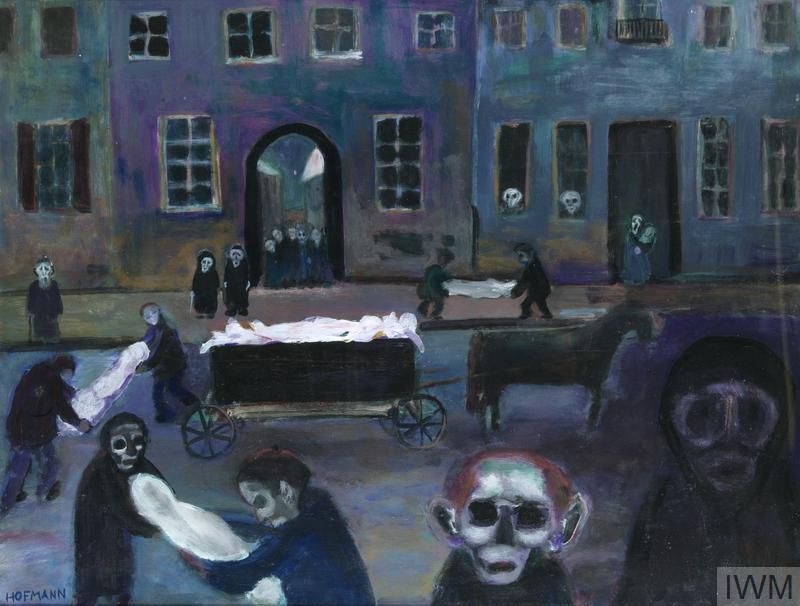
Picture: Edith Birkin, The Death Cart – Lodz Ghetto

Sermon for Birmingham Progressive Synagogue, Parshat Acharei Mot