israel · sermon · torah

This is Torah. This is its reward.

Loving others will not make you popular.

Pursuing peace will not make you safe.

Choosing life will not protect you from death.

But, if you do not love others, if you do not seek peace, if you do not choose life, who will you be?

When Moses ascended Sinai, he found God adding flourishes to the Torah’s letters, which only Rabbi Akiva would ever be able to read. Moses asked to see what became of Akiva.

The Holy One showed Moses how the Romans flayed Rabbi Akiva’s skin as they martyred him, then sold his flesh in their marketplace.

Moses threw his hands in the air and demanded: “Is this Torah, and this its reward?”

“Silence,” said God. “Such is My will.”

This is Torah. This is its reward.

Vivian Silver was murdered by Hamas on October 7th.

Vivian Silver founded the Israeli peace organisation, Women Wage Peace. She worked for human rights groups like Btzelem and ALLMEP. She lived on Kibbutz Beeri, near the Gaza border, where she engaged in solidarity work with Bedouins, Gazans, and Palestinian construction workers.

Three days before October 7th, she organised a march of 1500 Israeli and Palestinian women for peace.

On October 7th 2023, terrorists broke into her home and murdered her.

Even as she hid from the militants, she gave an interview to Israeli radio, where she said the very fact that she was under attack showed the need for a peace deal.

A year later, her son, Yonatan Zeigen, eulogised her. He said:

“Being a peace activist is not something to save you from being killed in war. It’s something to prevent a war from happening. And to create a reality where war is not an option.”

Silver’s love of others did not make her popular.

Pursuing peace did not make her safe.

Choosing life did not protect her from death.

But it made her fully human.

This is Torah. This is its reward.

On Monday evening, as my community sat down to listen to poetry in preparation for Tisha B’Av, I received a text to say that a Palestinian peace activist I knew had been murdered.

Awdah Hathaleen was shot in the chest in his home.

Awdah lived in the village of Umm al-Khair in the south Hebron hills. I visited his village twice last year with Rabbis for Human Rights. The second time, I stayed in the bunk beds adjacent to his home. In the morning, he brought breakfast to me and the other solidarity activists.

A delegation of Progressive rabbis met Awdah earlier this year when they went to the West Bank with Yachad.

Awdah was an English teacher. He was born in the south Hebron hills and had known tanks, guns and occupation all his life. He worked with Israelis to protect his home and build a peaceful future.

This did not make him popular. For some Palestinians in neighbouring villages, this meant that he was engaged in normalisation with the Israeli occupier.

Indeed, after the Oscar-winning movie about his village, No Other Land, gained international recognition, the BDS movement called to boycott it, because it showed Israelis and Palestinians working together.

Awdah chose the path of non-violence. Even after his uncle, Haj Suleiman, was crushed by an Israeli police tow truck; yes, even after his elder was cruelly murdered; and yes, even after those who killed his uncle were never brought to justice; after all that, he still chose the peaceful path.

For the settlers who wanted to capture his home and ethnically cleanse his village, his activism made him a target.

He and his family never knew safety.

Awdah wrote for 972 Magazine, a joint Israeli-Palestinian publication, about the struggles of raising his traumatised son in this village under attack. He wrote: “He even knows some of the settlers by name. Sometimes I tell him that they went to jail; I’m lying, but I want to make him feel safe.”

He was lying. Settlers who carry out murders do not go to jail.

The man who murdered Awdah was called Yinon Levi. He was filmed doing it. Still, the only person who has been taken into custody by the Israeli police is Awdah’s cousin, Eid, a fellow non-violent activist.

Yinon Levi was already subject to EU sanctions and recognised internationally as a terrorist. But he is protected by government minister, Ben Gvir, who has dedicated his life to helping settlers get away with murder. Even before the far right coalition took power, plenty of settlers had been able to perpetrate atrocities with impunity.

Loving others did not make Awdah popular.

Pursuing peace did not make him safe.

Choosing life did not protect him from death.

No; you will not be better off if you do the right thing.

But God does not ask us to live lives that are comfortable.

There is no commandment in the Torah that we should be popular.

All of us, regardless of religion, are placed on this earth to be God’s stewards; to uphold God’s most sacred commandments; that we must choose life, pursue peace; seek justice; and love the stranger.

This is Torah. This is its reward.

This sacred work comes with no promises. But who else would you want to be?

It is a charge often laid against woolly moralists like me that we do not really get how militants like Hamas think; that we just cannot understand the mentality of the settlers.

That is true. I do not want to think like them. I do not want to become like them.

Who will we be if we let our hearts become warped and set our minds to cruelty?

Loving others will not make you popular. But it will make you loving. And pursuing peace will make you peaceful. And seeking justice will make you just. And that is what your God asks of you.

We are approaching Tisha B’Av, when we recall every catastrophe that befell our people. If you believe that peace is possible and that these assaults on basic humanity are wrong, you can add another disaster to the roster. On Monday, Awdah was murdered.

Yes, a Muslim murdered by a Jew is a tragedy for us all.

A man who was committed to non-violence was shot in the chest by a settler, leaving behind 3 children. He was 31.

Do not give in to cynicism or try to calculate what you might gain for kindness. This world has no guarantees. And we know nothing about the hereafter.

You do what is right because it is right. Because if you do not, who will you be?

This is Torah. This is its reward.

May God have mercy on us all.

story · torah

When is a person truly dead?

At home, my fiance paces back and forth, preparing for his exams in anaesthetics. In a week, he will be tested orally to see if he can become a consultant. He recites definitions of key medical terms, revises laws of physics, gives diagnoses of uncommon diseases. 

One definition he has repeated so many times it is now imprinted in my mind too.

Death is the irreversible loss of capacity for consciousness and loss of capacity for breathing.

At times, we have pondered over such terms together. On long walks, we have discussed medical ethics through Jewish lenses. We have debated whether and how modern medicine aligns with ancient wisdom. 

Now is not the moment to challenge him on the medical definition of death. But the definition sticks with me, because this is an area where I do not think science and religion align. 

While Laurence prepares for his exams, you will have to listen to my thoughts on what Judaism teaches about mortality.

Death is the irreversible loss of capacity for consciousness and loss of capacity for breathing.

Is it? Is that what it means to die?

If it were, then would living simply be brain activity and breathing? Is that all we are?

Chayyei Sarah – the life of Sarah – is our portion. It opens with her death. By telling us about her life from her death, the Torah is telling us something about how life and death interact. 

The parashah is a recounting of Sarah’s burial. It is a terse text, where the primary narrative concerns Abraham’s attempt to purchase a lot for internment. 

So much is left unsaid. So many emotions are not expressed. In the silences and interstices, we are left to reconstruct our own imaginings of what Abraham was thinking. Let us try.

Abraham proceeded to cry and eulogise Sarah.

He held her hands, once so strong and firm. Those hands had kneaded bread for strangers at a moment’s notice. They had sewn garments for whole families. They had, at times, pointed accusations, separated children, raised objections… Strong hands. Determined hands. Strong, determined hands, that were now drained of all their vigour, and sat coldly in his own palms.

Abraham rose from beside his dead, and spoke to the Hittites.

Abraham sprang into action. Sarah had not died in the land of her own family in Egypt, nor of Abraham’s in Chaldea. They were in a strange place, far from their own homes, among Hittites in the hill-country of Canaan. 

Abraham said: “Here I am, a stranger and a foreigner among you. Please sell me a piece of land so I can give my wife a proper burial.”

Sarah had left her father’s home in the palaces of Egypt, where she lived as a princess. She was an aristocrat in a great empire who gave it up to travel with a wandering man. Abraham claimed to have spoken with the One True God, and Sarah just followed him. She forsook luxury for a life on the road. Now, she lay dead on the road, and there would be no fine processions to pyramids to entomb her.

The Hittites replied to Abraham, “Listen, my lord, you are an honoured prince among us. Choose the finest of our tombs and bury her there. No one here will refuse to help you in this way.”

Sarah used to laugh with her whole belly. Her shoulders bounced up and down. She can find humour where nobody else could. Even when she struggled with infertility, she found ways of making jokes. Abraham would not hear her laugh again.

So Abraham bowed low before the Hittites and said, “Since you are willing to help me in this way, be so kind as to ask Ephron son of Zohar to let me buy his cave at Machpelah, down at the end of his field. I will pay the full price in the presence of witnesses, so I will have a permanent burial place for my family.”

Sarah had been so beautiful people tripped over themselves staring at her. On their wanders, every prince desired her. Sarah was as beautiful at 127 as she had been when they had first met. She was still just as honourable and God-fearing. Nobody would be as good and beautiful and true again. 

Ephron was sitting there among the others, and he answered Abraham as the others listened, speaking publicly before all the Hittite elders of the town. 

Sarah received no ennoblement or reward for marrying Abraham. Yet so much honour came to Abraham through her. She could see visions and speak with God. 

“No, my lord,” he said to Abraham, “please listen to me. I will give you the field and the cave. Here in the presence of my people, I give it to you. Go and bury your dead.” 

Abraham had bargained over everything. He had struck a deal with Avimelech to share water sources. He had even negotiated with God over the destruction of a city. This was a bargain he could not accept.

Abraham again bowed low before the citizens of the land, and he replied to Ephron as everyone listened. 

“No, listen to me. I will buy it from you. Let me pay the full price for the field so I can bury my dead there.”

Abraham was ageing too. Who would bury him? He had cast out one son and tried to murder another. 

Ephron answered Abraham, “My lord, please listen to me. The land is worth 400 pieces of silver, but what is that between friends?”

What is four hundred shekels between strangers? What is a price on the life of Sarah? What sort of burial could ever be enough for her? 

Ephron said: “Go ahead and bury your dead.”

These are some words we may complete into the silences. They come from the other biblical stories and midrash, and they paint a fuller picture. In the spaces, we see that this is not a negotiation over a burial plot, but a negotiation over the nature of death.

Death is the irreversible loss of capacity for consciousness and loss of capacity for breathing.

Is it? Is that what it means to die?

If it were, then would living simply be brain activity and breathing? Is that all we are?

Medically, scientifically… maybe.

Spiritually, Jewishly… no. 

Death is as much a journey as life is. 

For seven days, we eulogise, as the last imprint of a person leaves us. For thirty days, we mourn, as the shock and grief harrow us. For eleven months, we pray, as some part of the soul heads on its journey to Heaven. 

Then, every year, we say the names of the dead, and some part of our loved ones returns to us. Their soul breaks through the gaps in Aramaic words and we feel them with us once more.

Thousands of years later, we still say Sarah’s name, and some part of her keeps living long after breath and consciousness. 

We are more than what we exhale: we are the laughter and joy we bring to others. We are more than our own thoughts: we are the memories living on in others. 

In memory, in prayer, in faith, we grasp something greater than the material world.

Trusting in You, Eternal God, we see life beyond death.

Amen.

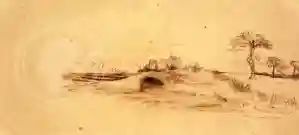
Van Gogh, The Cave of Machpelah