high holy days · sermon

To be the head and not the tail

Everything has changed. Everything keeps changing. 

We meet tonight to pause. 

Tonight is a return to a definite, reliable point in the calendar. While the world spins on outside, for a brief moment, we stop. We reflect. We take stock of all that has changed, so that we might change too.

You have already seen this evening many simanim – symbols of the Rosh Hashanah seder. These small tokens speak to us about what the festival means.

There is another one, though, that you won’t see here, partly because our synagogue is a meat-free site, and partly because it just would not feel right in a Liberal synagogue. 

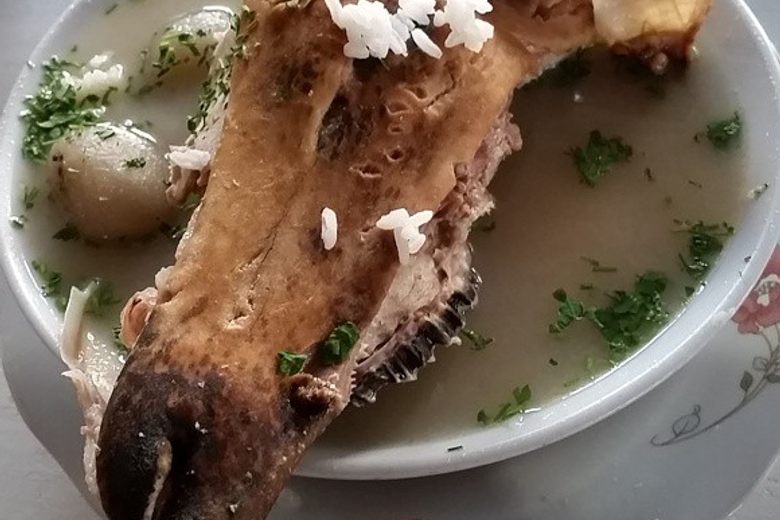
It is a ram’s head.

Yes, in many New Year seders throughout the centuries, Jews would place the carcass of a sheep’s skull in the centre of the table. This tradition goes all the way back to 9th Century Babylonia.

By the 15th Century, the German rabbi, the Maharil, explained the custom using a phrase from the Psalms: 

שנהיה לראש ולא לזנב 

that we should be the head and not the tail.

There is a play-on-words here. After all, what does Rosh Hashanah literally mean?

The Rosh is the head. It is the head as in the beginning; it is the head as in the body part; and it is the head as in the one who has control. 

This symbolism works because, in Hebrew, a word contains multiple meanings and associations. 

So, the fish head represents our being on top of our own lives.

Now, what about hashanah? The word shanah does indeed mean year, but its root ש-נ-ה also means cycle, difference, repetition, or change

This makes sense: a year is a cycle, a return point that we repeat, each time observing the change. 

So Rosh Hashanah does mean “start of the year.” But, through the associations with the words’ other meanings, Rosh Hashanah is also “the master of change.”

Outside of these walls, the world is full of changes. AI unleashes new technology into a society that has already been completely transformed by the Internet. Our climate is changing, and we are truly starting to notice its effects on our own seasons. 

International relations are changing: violence, war, and fear feel like a new normal. And, of course, we are only a few years out of global pandemic and lockdowns.

So, at this juncture, we return to the start, and try to find a small oasis of calm to reflect on this changing world. 

Yet, inside these walls, things have changed too. This is my first High Holy Days with you. This is your first High Holy Days in the newly refurbished sanctuary. This is our first High Holy Days where we have voted to join a new movement. 

This is our first time doing the High Holy Days without the choir in every service and, as you will see, that means we are changing how we do music.

In every case, these changes will evoke many feelings, including excitement, trepidation, loss, and growth. This is a chance to face all our feelings. 

Change is inevitable. Change can be good. And, yes, change is hard. 

I don’t know about you, but I have changed. I have not just grown a year older since the last Rosh Hashanah. I also feel like I have aged many decades in the last few years.

The world transforms and I shift with it. As I shift, I do not even always notice the ways I change, or work out what they mean. 

I don’t even have time to decide if I like who I am becoming before I find that things changing again.

So, at Rosh Hashanah I come to this space, this synagogue, this everlasting home with God, and ask: can I love myself better? Can I love my community? Can I muster up the strength to face all that is changing? 

Can I find a way to be the head and not the tail?

Blessed are You, Eternal One our God, who gives us the power to change.
judaism · ritual · spirituality

Wrap your body in prayers

Most of the time, when I’m experiencing something emotional, I feel it in my body before I can even process it. 

I’ll feel a sinking in my stomach and know I’m dealing with dread. I’ll wake up grinding my teeth and realise I must be anxious. I go to bed feeling full of life and visceral feel my joy.

Every emotion is a physical experience. It is not just something we can rationally understand.

In Biblical Hebrew, if you want to say that you are angry, you say that your nose flares. If you are compassionate, you are womb-ful. If you are sad, you rip your hair. If you are lustful, you are big-balled. If you feel respect and awe, that’s in your liver.

In the biblical imagination, the body is a map of all the emotions we might feel. Each limb and organ corresponds to the full range of affective experience. 

We must bear this in mind when we come to read this week’s parashah and its resultant commandments:

Put these words that I command you today on your heart… Wrap them as signs on your arms. Bind them in front of your eyes. 

The words are recited daily by the most observant Jews. They form part of the first paragraph of the Shema, Judaism’s central prayer. 

The Shema begins with an instruction to listen; to pay attention. Hear, O Israel, the Eternal One is our God. The Eternal God is One. 

It then tells us the embodied experiences we must have to make sense of what we are hearing. Heart. Arms. Eyes. 

Of course, these carry metaphorical meanings. For the ancient Israelites, the heart was the seat of thinking, much in the same way as we consider the brain in the modern West. When Torah tells us to keep it on our hearts, it means that it should be part of our whole intellectual being.

The arm is the site of action. It is synonymous with power. The arm is what gives to charity and shields the vulnerable. It is also the body part that raises swords and strikes stones. With an outstretched arm, God redeemed the Israelites from Egypt. The instruction to keep God’s word on our arms is a call to use our power for God.

Eyes, for the Hebrews, are for desiring. Your eyes can wander after foreign gods. They can delight at the wonders of nature. They can covet things that aren’t yours. They can favour children. The Eternal’s eye is always on those who have hope and mercy. If the commandments are frontlets before your eyes, enacting them as all you want to do. You are singularly focused on doing good deeds. 

Over time, our ancestors came to see these words as more than just symbols. Rabbi Akiva, the Mishnah’s great thinker on metaphor and interpretation, is credited with codifying the rules for tefillin.

Tefillin are compartmentalised boxes affixed to leather straps. You can see people wear them wrapped around their heads and arms in weekday morning prayers. 

These prayer aides were invented so that observant Jews could literally enact the commandment of binding the words on the body. Inside the boxes are the words of the Shema. Cheder children tell me they look like Go-Pros.

Carefully, we tie them to our arms, close by our heart. We wrap the leather straps around our arms, seven times. We place them as a crown around our heads, settled between our eyes. We finish up by plotting the straps around our fingers and palms in a set pattern.

If ever you come to Leo Baeck College’s shacharit services, you will see a bunch of students and teachers adorned in them. 

If the founders of the College and its movements could see us, they would be aghast. For many of the originators of our movement, such embodied practices were strange and arcane. 

Progressive Judaism was a response to the Enlightenment. Across Europe, people heralded the triumph of science and reason. Ideas, not feelings, were paramount. Rational thought, not embodied emotion, would be what guided humanity to greatness. 

Reforming rabbis of the past called the practice of bending knees in prayer “bowing and scraping.” They saw their Orthodox contemporaries’ kissing the scroll as a form of idolatry. Above all, they certainly never wore tefillin. 

When, in my early 20s, I asked my dad for a tefillin set for an upcoming birthday, he raised an eyebrow. “Isn’t that an Orthodox thing?” he asked. We didn’t talk much about the theology, but I told him I liked the idea of it, and he got me a beautiful pair.

In a way, he was right. Tefillin were an Orthodox thing. But, over time, progressive Jews have reclaimed them and made them our own. 

Reason is still deeply important. We still hold to the importance of modern scientific inquiry and rational debate. It’s just that we can no longer isolate what goes on in our bodies from what goes on in our brains. 

Living with chronic pain, I see daily how intertwined are my spine and my spirit. Every part of my mental and physical health is connected. I would struggle to draw a line between my body and my ‘self,’ and can’t really comprehend their separateness. 

This is just as true in prayer. So I wrap tefillin. I feel my religious inclinations before I can process them. 

I’ll stick a box on my left bicep and know that my body is part of the miracle of creation. I wrap it around my arms and I am bound by God, submitting to the commandments. I set the straps over my head and feel the weight of responsibility. I rest the box before my eyes and see what I have to do. I tangle the knots around my fingers as if I am being married and I am overwhelmed by the loving gift of a new day.

I wrap my body in prayers. I can work out what they mean later. 

I wrote this sermon for Leo Baeck College’s newsletter, Parashat Vaetchanan