judaism · sermon · theology

God is here, and I did not know it

One of the loveliest parts of synagogue life, which many of you will have experienced here, is getting to teach our religion to visiting schools. It’s such a joy to pull out things we normally leave aside, and point to things we often take for granted.

By teaching others about our ritual objects, things that are familiar become foreign. We have to reconsider what they are, and why we have them.

Take, for example, the tallit. Of course, these prayer shawls have existed in some form since biblical times. But, showing them to non-Jewish children, we need to come up with an explanation for why we continue to use them here and now.

I tell the school kids: these four corners remind me that God is everywhere, and the knots on them tell me all of the good deeds I can do in my life.

I do, indeed, feel that way when I wrap myself in the tzitzit. I feel enveloped by God’s mantle. I see the strings and think of all the mitzvot- not, in the Orthodox sense of listing out food rules, but of all that God has asked me to do in this world.

It’s nice to have a visible reminder of God’s presence.

That’s just what Jacob gets in this week’s Torah portion. Jacob lies down while travelling on a certain mountain and has the profound dream of a ladder ascending to heaven, with angels going up and down.

In his dream, the Eternal One appears to promise Jacob many descendants, spreading out like dust across the desert, and that God will forever accompany Jacob on his travels.

When he awakes, Jacob exclaims: “Wow, God is in this place and I did not know it!”

How could Jacob not realise that God was on that mountain? Surely he already knows that God is everywhere?

Perhaps Jacob did not realise already that God is everywhere. For some commentators, this is the beginning of Jacob’s prophecy. Only now does he really understand who God is and that this God is with him.

There is a deeper meaning in the language, too. Before the revelation, God is called Elohim. For the ancients, Elohim was universal- the God that permeates all places and things.

Then, in the dream, God is announced by the ineffable Name, Hashem, which we often render as Adonai. This name of God, in Torah, is specific. It is the personal God, who communicates directly with human beings.

When Jacob awakes, he says: “Behold, Hashem is in this place, and I did not know it.”

Jacob knew that God in general was there, because God is generally everywhere, but only at this moment does Jacob realise that the personal God who cares about him is also present.

Now we can understand why God says to Jacob: “I will not leave you until I have done with you what I promised.” God is helping Jacob understand that he is never truly alone. Not only is the world full of God, but so is Jacob’s own life.

In fact, in the moment before Jacob falls asleep, a miracle happens that is so subtle it can’t be noticed until after he wakes up.

When Jacob lays down his head, the Torah says there are many stones in the place, and he takes one of them as a pillow. When he wakes up, there is only one under his head.

Our Talmud says that this is a divine act. According to Rabbi Yitzḥak, all the stones on the mountain argued with each other about who would lie under Jacob’s head. Unable to decide, they merged together into a single rock. That rock, in turn, became an altar to God.

This is a wonderful view of the world, where God is not only in all places and with human beings personally, but acts in every part of nature. Even stones are agents of miracles and servants of God.

If we take seriously this idea that God is everywhere and personally connected with all that exists, there are real consequences for our lives. It means that everything is sacred. It suggests that we need to treat this world as an arena for revealing divinity.

For Progressive Jews, this is one way we might think of commandments. Rather than just a list of dos and don’ts, they’re an attitude towards reality. They see everything as an opportunity to do good, and to make the world better. We are blessed with the chance to show how God is everywhere, including in our own actions.

The same section of the Talmud says that this is why God loves humanity so much. Angels can only praise God when they are told to. Rocks can only move by miracle. But we, endowed with freedom and reason, can perform miracles and make things sacred whenever we want.

That’s what I see when I look at the tzitzit of my tallit. That God is in every place and that every moment is a chance to do right.

You don’t need to wear a tallit to do that. This is my suggestion to you for this week. Try and shift, ever so slightly, how you see the world.

Look around, for a moment, and imagine that everything permeates God’s presence. See God in the bricks of your home and the slabs of the street. At some point this week, try to picture the space where you are as a massive canvas that you can paint with good deeds.

Let us all try to be like Jacob and say: “Wow, God was here, and I did not even know it.”

Shabbat shalom.


high holy days · judaism · sermon

If God can change, why can’t you?

Everyone changes. People change all the time.

In our Scriptures, the changes are often dramatic. 

Avram is an idol worshipper who lives in Mesopotamia, then undergoes complete conversion to monotheism and sets out on foot to a new country. With that, he gets a new name: Abraham.

Sarai is barren then, miraculously, in her old age, conceives a son. God gives her a new name: Sarah.

Jacob is a lying trickster who wrestles with an angel in the wilderness. When his heart has truly changed, he gets a new name: Yisrael. 

In fact, in each biblical story, a change of direction, outlook, and often name, are the key points of the narrative.

So, what about our Rosh Hashanah reading? Who is it that changes there?

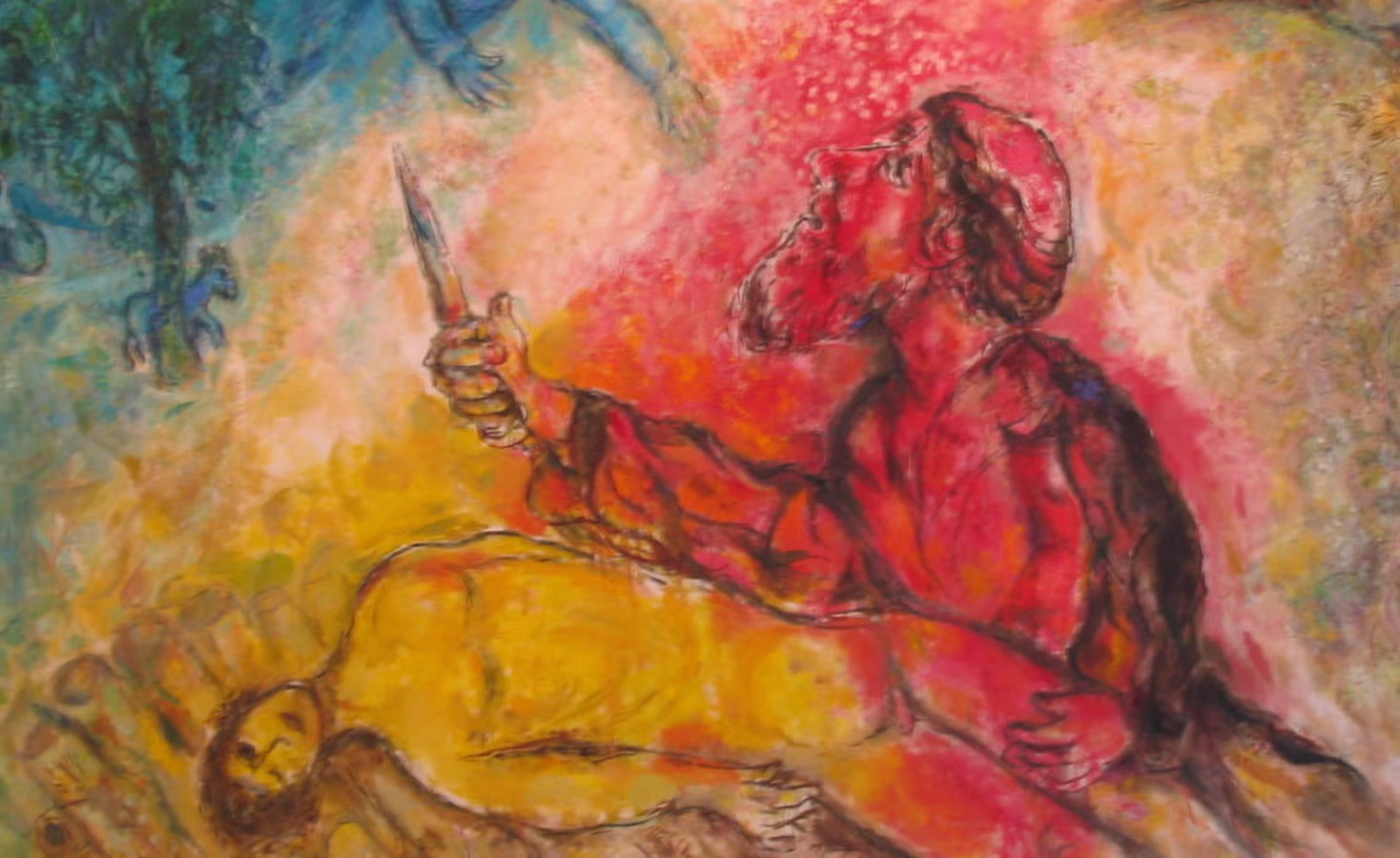
In the Aqeidah, our Torah reading for the new year, Abraham is called upon to climb a mountain and sacrifice his son.

We know nothing about Sarah, who is largely kept out of the story. We don’t know anything of how Isaac feels about this, since he stops talking once he realises what his dad could do to him. 

Abraham is remarkably unchanged. At the bottom of the mountain, he is willing to do whatever God says. At the top, God says Abraham is no longer required to sacrifice his son, and to sacrifice the ram instead. At the top of the mountain, Abraham still just does whatever God says.

But there is a character who really changes in this story: God. 

God begins the narrative as zealous and demanding of human sacrifice. God ends the story compassionate and eager to enter into meaningful relationships. God begins by effectively threatening to blot out all of Abraham’s children, then ends by promising Abraham as many descendants as stars in the sky.

And, yes, God undergoes a change of name. Through the whole of the story, God is called Elohim, a name associated with strict justice and universal truth. At the very end, God is revealed by a new name – יהוה – Adonai, a name associated with the close personal relationship God has with every human being. 

In this story, the character who undergoes the greatest change is God.

Even God, the Creator of the world, the Almighty and All-Powerful, can transform. The Holy One, who by nature is completely eternal, can shift from being strict and distant to close and loving.

So, if even God can change, why can’t you?

In our Talmud, the rabbis introduce us to the idea that we are supposed to imitate God.

Rabbi Hama baRabbi Hanina teaches: be like God. Just as God clothed Adam, you will care for the poor. Just as God visited Abraham when he was unwell, you will visit the sick in your community. Just as God consoled Isaac over the death of his father Abraham, you will comfort the mourners. Just as God buried Moses, you will inter the dead.

God shows us a model of how we ought to live. Like God, we are supposed to be compassionate, loving, kind, morally clear, and doing justice in the world.

But more than that. Like God, we are supposed to change.

Here, at Rosh Hashanah, we learn: just as God can change, so can we.

We are made in God’s image. At the start of each year, we read a story where our Creator transforms. So we know that we can change too.

We can face our fast-shifting world. We can rise to the challenge of our changing community. We can look inside ourselves and love our own souls a little more.

Blessed are You, Eternal One our God, who gives us the power to change.

israel · theology · torah

I believe that God is screaming.

A few weeks back, I attended a retreat with Christian colleagues. At some point, surprisingly enough, we got onto talking about God. I asked one of the priests a question: “do you believe God speaks to you?”

He looked slightly bewildered by the question. “Literally?” he asked. “No, not really.” He shook his head.

The answer seemed obvious. After all, we were liberals, at an interfaith event. That kind of talk is for fundamentalists. We’re all too rational for that. 

“Why?” he asked, turning back to me, “do you?”

“No,” I said, sheepishly. I don’t know why I felt so embarrassed. Of course, many believers see the voice of God mostly as a metaphor, or as a way of giving expression to moral intuition. I’m just not one of them. 

I do believe in a personal God, who has a loving relationship with every human being on earth. And I do talk to God. It’s not that I expect answers in any sense, but I do believe some One is listening: that prayers are more than idle words I recite to myself.

Perhaps my Christian colleague would have agreed with me if I’d put it in these terms, because finding vocabulary to talk about God is hard. Words like ‘literally’ and ‘metaphorically’ start to evaporate when you are dealing with faith.

I think, perhaps, the reason I gave a sheepish no – maybe even that I asked the question at all – was that I was having a mini-crisis of faith of my own. Ever since the war broke out, I have been praying differently, more fervently, desperately begging the Universe for peace. I have been hurling questions and recriminations into the void. I have been wondering… do I still believe in this God?

My personal relationship with God has carried me through some of the toughest times. When I have felt most lonely, God has been like a best friend. When I have hated myself, God has been like a lover. When I have needed direction, God has been a wise counsellor. I have looked to God in every time of disaster, and always found comfort in a loving Presence that reaches out and caresses from across a boundary of unknowability.

But now I listen for God’s voice. And all I can hear is screaming. 

As long as there have been people who believed in religious meaning, there have been those who questioned it. Usually, they were the same people. Abraham, Moses, Hannah, Kohelet, Job: they all had faith, and they all questioned it. They asked questions so that they could challenge their beliefs, and refine them. Lately, although less adequately than those prophets, I have been forced to do the same thing.

The first question we usually ask when confronted with crises of faith is “do I believe in God?” Fairly regularly, people come to me with conclusions one way or the other: “you should know, rabbi, I don’t believe…” or “you should know, I have a strong sense of belief…” My follow-up is always the same “… and what is it that you do (or don’t) believe in?”

For me, the answer is moral truth. When I talk about believing in God, what I am saying is that moral statements are not just opinions. When we say “murder is wrong” we are not just expressing a preference, like “my favourite flavour of ice cream is tutti-frutti.” We are describing a reality, no different to the claim that there are 24 hours in a day. We are describing something literally true.

I think that’s what God is. When we want to know why our feet are firmly on the ground, we give the shorthand answer of “gravity.” When we want to explain why objects in space interact with each other as they do, we use words like “attraction.” And when we want to express how we know that murder is wrong, we use the word “God.”

So, in feeling the great sense of angst I have had since the war began at the end of the High Holy Days, I am forced to return to the old questions. I am forced to ask whether I still think moral statements are true. I am forced to ask whether I still believe murder is wrong.

I do.

And that is why I believe that God is screaming.

What we talk about when we describe God is obviously more complicated: it is something infinite, and greater than we can put into words. That’s why words like “metaphor” and “literal” are so inadequate – because we are describing something more real than reality. So we have to find shortcuts. We have to find ways of talking about God in human language, to make sense of God on human terms. God is then “a tender parent”; “a loving shepherd”; “a righteous judge”; “a generous creator.” All of these are good descriptors, and all of them are incomplete.

I have been relying on a version of God that has worked for me for a while. I have imagined a sweet aunty or a gentle older friend. In times of loneliness, desperation and heartache, that image of a loving God has helped me get through the day. But that image doesn’t serve me now. I think if I used God for comfort in a time like this, I would be retreating from responsibility. God does not need me to feel safe now, but to shake me from illusions and complacency.

If God is the moral voice of the universe, that voice must be crying out in desperation.

In the last few months, 23,000 Palestinians in Gaza have been killed by Israeli bombs. I am kept awake at night thinking about that. I imagine God, smothered by the rubble of obliterated hospitals, calling out. Like Abel, stricken by Cain, the voice of the blood is calling out from the ground (Gen 4:10). I imagine God, pulled from the wreckage, crying: “Thou shalt not kill. (Ex 20:13) Thou shalt not kill. (Deut 5:17)”

Those were the commandments given to the Jews, above all others. In some variations, it is the very first commandment, the one that holds the most power. And as Israel stands in the dock at the Hague, it is not only South Africa that places it on trial, but God too, who comes with the accusation: “did I not tell you: thou shalt not kill.”

Since the war began, Israeli settlers, with governmental support, have seized around 20 villages in the West Bank, displacing thousands of people, so that Jewish Israelis can expand their territory and claim others’ homes. I imagine God calling out from deserted towns, on the trail with refugee families, wailing “thou shalt not steal” (Ex 20:15), “thou shalt not steal” (Deut 5:19).

Netanyahu says, unabashedly, that he will push the Palestinians from Gaza and create a new border with Egypt. The Torah answers, in desperation: “thou shalt not move thy neighbour’s boundary” (Deut 19:14). Land theft is a sin.

Israeli soldiers enter Gaza and use Jewish symbols as weapons. They recite the Shema from the pulpits of mosques and place mezuzahs on Palestinian homes. They desecrate our religion. They destroy our faith. From the depths of history, God cries out “honour thy mother and thy father (Ex 20:12); honour thy mother and thy father (Deut 5:16).” Do not profane the faith of your ancestors with war crimes.

Worse still, the politicians claim that God gave them the right. That this is what the Torah intended. Can you not hear the scream of revulsion as God decries: “thou shalt not take My name in vain (Ex 20:7); thou shalt not take My name in vain (Deut 5:11).” This is what was intended: do not abuse God’s name for worthless pursuits like war, but elevate it for the purposes of peace. 

I believe that God is screaming. 

The commandments may once have been given as words of instruction or even as a love letter, but now they are a desperate plea. 

God says “I am the Eternal One thy God, which brought thee out of the land of Egypt, from the house of bondage. Thou shalt have none other gods before me.”

No other gods. No state, no flag, no military, no leader, no ideology, no grudge, no border, nothing. None of these can ever be placed before God. None of them have any trump over God’s words.

God’s word says: “You shall not pollute the land in which you live; for blood pollutes the land, and no expiation can be made for the land, for the blood that is shed in it.” (Num 35:33)

So I believe I can hear God screaming: thou shalt not kill.

And I do not want to silence that voice. I want to amplify it. I want the Holy Torah to be heard now, more than ever. I hear God screaming, and I want to join in.

Thou shalt not kill.

Thou shalt not kill.

Thou shalt not kill.

judaism · sermon · torah

Perhaps we are not powerless

I have a horrible, on-off relationship with the news. I wouldn’t call it a love-hate relationship so much as a hate-hate relationship. 

There are days when I can do nothing but stare at it, soaking in every detail: climate collapse; species extinction; earthquakes: natural disasters; social breakdown; cost of living; refugees in detention centres; wars, wars, wars…

And then there are days when I switch off entirely. I become so overwhelmed I refuse to hear the radio or see current events on TV. I don’t look at any of the news apps or social media for fear that I’ll be reminded of all that is wrong in the world.

Whether endlessly scrolling through the horrors or studiously avoiding admitting they are there, I think I’ve become trapped in a cycle of feeling powerless. It’s all so big, and so frightening. 

But what can I do? I’m one person, seeing the world collapse, and all I can do is observe. 

If this feels at all relatable to you, perhaps you’ll find some comfort in this week’s Torah portion, as I did.

After all, didn’t Moses feel too small and powerless too, at the beginning? He tried to change things, and look where that got him. Stuck in exile, looking after sheep. Moses looked at all that was wrong in his world, found it far too much to bear, and retreated into the wilderness. 

And he would have stayed there too. He could have lived out the rest of his life with a lovely family tending flocks in Midian. 

But God had other ideas. God heard the cry of the Israelites in bondage and decided it was time to set them free. 

So God reached out to Moses from a thornbush. God set a small thicket in the wilderness ablaze and called Moses on his mission.

A thornbush, of all things. Why would God decide to speak from such a lowly and despised place? The thornbush is, at best, a plant to be ignored and, at worst, an annoyance that scratches against bare legs. It’s the desert equivalent of stinging nettles. 

In our Talmud, Rav Yosef says: not because the thornbush is the greatest of plants did God choose to speak from it, but because it is the least of the creatures. God disregarded all the most beautiful trees of the desert in order to be with the lowliest. 

Similarly, God chose to give the Torah from Mount Sinai not because it was the highest or most magnificent of desert peaks, but because it was small and covered in unremarkable roughage. 

In the natural world, God singles out the powerless and unimportant. That’s where God works the real miracles. 

That’s why God chose Moses too. Moses had no idea of his miraculous birth or impressive destiny. As far as he was concerned, he was a loner in the desert.

When Moses gets the call, it’s not God that he doubts. He doubts himself

His first question is: “Who am I that I should go to Pharaoh and bring the Israelites out of Egypt?”

God doesn’t build Moses up or tell him how he wonderful he is. He says: just trust. Have faith.

We don’t get to decide what times we live in or what role we have to play in them. God decided that Moses was going to take the Israelites from Egypt and that was what was going to happen.

But Moses still can’t see how he can make a difference. He doesn’t doubt God’s power, he doubts his own. He says: “what if nobody believes me? What if they don’t listen to me? What if they don’t trust that I spoke with God?”

At this point, God shows Moses some miracles. We might think these miracles are about God flexing Divine might, showing Moses all the wonders. In fact, a bush burning in the desert without being consumed by flames would be quite enough to achieve that.

These miracles aren’t about showing God’s power: they’re about showing Moses his own. 

First, God turns Moses’s shepherd’s crook into a venomous snake. Moses recoils in fear. Then God turns it back again.

Next, God afflicts Moses with a deadly skin disease. Moses thinks his life is over. Then God heals him.

Both miracles make Moses face his greatest fears. They are exposure therapy. The worst thing that Moses could imagine is death. God shows him that he can stare it in the eye. Moses thinks he is not brave enough. God shows him that he is.

It’s not that Moses ever doubted God’s power. What he doubted was his own. Now God shows him he does indeed have power. He is stronger and more resilient than he realised.

It’s not that Moses ever doubted God’s importance. What he doubted was his own. Why would anyone care what a stammering wreck like him had to say? 

When God performs miracles through Moses, the message is clear: “I, the Eternal One, care. I care enough to work wonders on you. I care enough to meet you in the desert. I care enough to save you from death.”

And, if God can care about Moses that much, why can’t the Israelites? Why can’t Moses care about Moses that much?

Still, Moses is not ready to own his power. He protests to God: “I can’t speak. I’m slow of speech and stammer constantly.”

God gives the perfect answer: “And who made you that way?”

God made Moses that way. God decided that Moses would be who he was. His speaking ability is not a flaw – it’s the characteristic God gave him that makes him exactly the right man for the moment.

What a message this brings for us, who feel so powerless and insignificant. 

What are we but matter in the void, and yet the Creator of the Universe has chosen for us to be alive at this time?

Who are we with all our foibles and imperfections? But God has made us exactly as we are.

So why don’t we trust in ourselves, and recognise our own power? 

Don’t ask why God made a world with so many problems and sent no solution. The solution is here: God made us.

So I think I need to stop the cycle of doomscrolling and avoiding. Life isn’t just something that happens to me – it’s something I make, too. Society doesn’t just exist apart from me, I’m an active player in making it. And the news isn’t just something that lives on TVs and in devices – it’s something that we can create, every day, if we so choose.

In the Mishnah, Ben Azzai teaches: “Hate nobody, because everyone has their time and everything has its place.” 

We did not choose to be born here and now, but God saw fit that we should be alive at this place and time. God wants us here, in this moment. 

We are like that weedy thornbush in the desert. We might seem insignificant. But God has chosen for us to be here. And, because of that, we can burn brightly enough to change everything.

Shabbat shalom.

high holy days · sermon

Can you pass the human test?

This is the human test, a test to see if you are a human.

These questions were posed by the American comedian, Ze Frank, to see whether his audience was human. I will ask you some of them, and you can see if they apply.

  • Have you ever made a small, weird sound when you remembered something embarrassing?
  •  Have you ever seemed to lose your aeroplane ticket a thousand times as you walked from the check-in to the gate?
  • Have you ever laughed or smiled when someone said something mean to you and then spent the rest of the day wondering why you reacted that way?
  • Have you ever had a nagging feeling that one day you will be discovered as a fraud?
  • Have you ever stared at your phone smiling like an idiot while texting with someone?

Well, congratulations you are human.

With these questions, Ze Frank taps into the parts of being human we so rarely discuss. Our deep anxieties, our senseless irrationalities, our abilities to love people completely. 

Perhaps we laugh because they are embarrassing. It feels awkward to acknowledge that we feel all these things.

But we do. They are, truly, what makes us human.

In 1950, the English mathematician Alan Turing developed a series of tests to distinguish between robots and people. The questions, called ‘The Turing Test,’ can be used with some accuracy to ascertain whether, when speaking to a character online, they are a real human being or a highly intelligent software programme.

This year, those questions gained an entirely new relevance. An AI Language Model, called ChatGTP, became a viral sensation. You can pose the most fascinating questions to this robot, and it will answer them as if you were speaking to a real human being. It can have conversations and play word games and share thoughts on current events. It can even write a half-decent sermon.

But there were some questions it couldn’t answer. It still cannot pass the Turing Test. Tech experts promise that, very soon, it might. But, for now, there are certain things it cannot find adequate responses for.

The questions the Turing Test poses of robots to distinguish them from humans ask them to think critically about their inner lives. You might ask them:

  • “What event from your life changed the way you think?”  
  • “How do you feel when you remember your childhood?”
  • “Can you describe your emotions in only shapes and colours?”

What makes us human, provably so, is that we feel. We rejoice by laughing from our bellies. We hurt by letting tears fall from our eyes. We rage by clenching our fists. We cringe by curling our toes in our shoes. We fall in love by feeling butterflies in our stomachs. 

No algorithm can do that. An algorithm cannot pass that test.

Although machines cannot pass human tests, humans are nevertheless often tested by machines, and measured according to standards set by software.

From the moment children first enter schooling, they are subjected to rigorous examination. Can they multiply figures? Can they recall important historical events and their dates? Can they identify adjectives, verbs, and nouns in sentences? 

Of course, it is impressive when children can do these things. But it also measures them by the kinds of things machines can do much better. Often, these exams are even marked by machines.

By the time we finish schooling, we may have spent most of our formative years revising for, sitting, or fretting about the results of exams.

This process doesn’t stop once you enter adulthood. Throughout our working lives, many of us find ourselves undertaking tests to prove we are competent in our jobs. 

It’s not entirely a bad thing.

We’d all be quite worried if doctors weren’t checked for their abilities to carry out surgeries or bus drivers didn’t prove they could drive without crashing. Food hygiene certificates and accountancy qualifications are an important part of life.

But they are not all of life. They are not what makes us human.

And, sometimes, they detract from our humanity. 

I am going to talk briefly about suicide, and how dehumanising tests can drive people to take their own lives. If you are not in a place where you can hear that right now, I do welcome you to take a break, without judgement, because it is a difficult topic. And if this discussion brings up anything for you, please know that me and Rabbi Jordan are always on-hand for pastoral support and a listening ear.

Earlier this year, a headteacher at a primary school in my hometown, named Ruth Perry, killed herself after receiving a poor Ofsted report.

A study in 2017 found that teen suicides peaked around exam season, as the pressures to do well affronted young people’s mental health. 

There are data spreadsheets that recommend redundancies, crashing people’s entire working lives. Disabled people in Britain have to prove to computers that they are sufficiently unwell, or they will have all their benefits cut.

We live in a world full of judgements. You must prove your competence. Or you must flagellate yourself to prove your incompetence. You must prove that you are who you say you are. You must prove you can be somebody else. You must prove your worth.

But, here, you are in God’s house. Your value is not determined by what you can do. You are valuable in this space because God has chosen to make you human.

On Yom Kippur, we are summoned to face a test. But, this time, it’s the human test. The only question you have to answer today is “are you human?”

During the course of this year, have you breathed? Has your heart beat? Has your blood pumped through your veins?

Have you felt sadness and grief and elation and worry and love? 

Have you been moved by events in the lives of others, and have you formed new memories of your own?

Congratulations. You have passed the human test.

This is the task that God set for you. That you would be alive. And you are. You are here with us.

God has set you the task of being human, which means feeling, in all its complexity. 

Even if you can only remember feeling one thing this year. Even if you only felt bored or exhausted or impatient or in pain, you still felt. You succeeded at doing everything God wanted of you just by being human.

We cannot take it for granted. You might have given up. But if you felt like giving up, well, that was also a success, because that was a feeling. You were being human, just the way God wanted for you.

On Yom Kippur, we read “Kedoshim,” a glorious compilation of the Torah’s greatest laws from the Holiness Code. The first dictum of this parsha from Leviticus is “you will be holy people because the Eternal your God is holy.” It is less a commandment than a statement of fact. You are sacred by the virtue of being human. Your life is blessed because your God is blessed.

There may have been moments this year when you felt like you were being treated as less than human. On Yom Kippur, you are reminded of your humanity. You were never supposed to be a cog in a machine. You were supposed to hunger, and thirst, and tire, and mourn, and reminisce, and sing, and connect, and pray.

Once you have passed the test of being human, all you need to do is extend that humanity to others. Kedoshim continues by reminding you of how to treat others with maximum humanity. 

It is a summons to empathy. You will be human and you will treat others as human. You will not only laugh, but you will laugh with others. You will not only hurt, but you will share the hurt of others. When you feel, others will feel with you. And when others feel, you will feel with them. 

Torah gives specific examples.

You will feed the poor and house the foreigner. You will be honest with people who do not know if you are lying. You will pay workers straight away. 

You will never insult the deaf or lead the blind astray. You will not defer to the powerful, no matter how wealthy they are. You will not take advantage of people who work for you.

All of these laws refer to moments when human beings are at their most vulnerable. They refer to people experiencing poverty, disability, homelessness, and exile. These are people experiencing the greatest possible despair, terror, and misery. 

And because they are experiencing these emotions, this is when they are most mortal. This is a picture of humanity at its most human.

Confronted with others in this susceptible state, your Torah commands you to remember that you are human and so are they. You will see the most vulnerable people as if God is shining out through them, and treat them as you would the greatest among yourself.

You will see yourself as fully human, and set aside that robotic urge to calculate kindness or run profit assessments on your mitzvot. You will feel with them instead. You will experience empathy. 

If you can feel, you are human. And, if you are human, you have passed God’s test.

That is the human test. The test to see if you are human.

Congratulations. You have passed.