debate · sermon · torah

Did the God of the Bible have a body?


After our wedding, everyone was excitedly sharing photos and videos. Laurence pored over them and made albums.

I liked them, but the pictures felt a bit flat. What I was craving was words.

I wanted to re-read everything everyone had said. I went about collecting the speeches people had given, and recounted them again. On honeymoon, Laurence and I re-read our vows to each other, this time pausing and discussing them.

I discovered anew how much more I loved words than pictures or videos. Pictures are static. Even videos, because they only caption one moment from one perspective, feel too final.

To me, words feel so much more alive. Stories are such a great way to engage with events and ideas, because they can be retold so many times and in different ways.

Isn’t this, after all, what religion is: storytelling to access something sublime and unfathomable; a collaboration by people sharing their best narratives and ideas?

We have inherited a literary tradition, our Torah, which is an exercise in storytelling:  a process of openly wondering at the world through poetic sagas and emotion-filled songs.

For some, however, these stories fall flat. They see the words the way that I see pictures.

Fundamentalists will look at our story of a donkey talking to a prophet about an angel and think: that must be the historical truth of what happened.

Similarly, the New Atheists look at this beautiful poetic piece about the prophet Balaam and think: how stupid must religious people be to believe this nonsense?

This is not just a misunderstanding of Scripture. It’s a misunderstanding of storytelling itself.

Seemingly, it does not occur to them that this might be an invitation into conversation. They can’t comprehend that this might be a poem, crying out to be read aloud, sung, chanted, interpreted, and retold to make sense of all the wonders of the world.

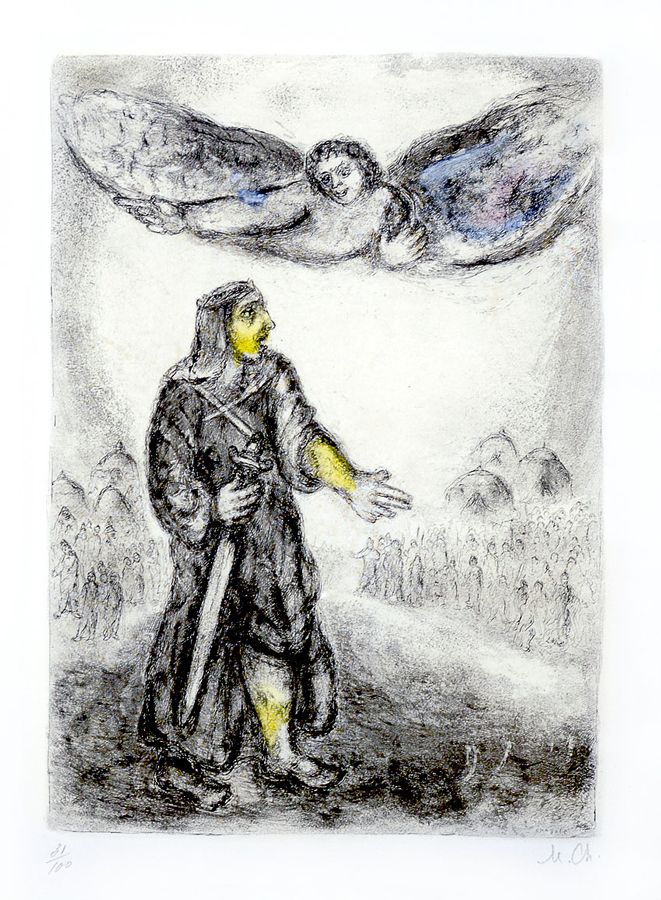
Perhaps these talking animals and sword-wielding celestial beings aren’t part of history textbooks but reveal a different kind of truth altogether.

In Britain, we are mercifully spared from most of these types of fundamentalist reading. We don’t have to deal with as many evangelical Christians as our American cousins do.

But we have our own local brand of biblical literalists. They are the radical atheists who have got to know our sacred texts solely for the purpose of showing how irrational they are. The most famous of them is Professor Francesca Stavrakopoulou, a biblical scholar at the University of Exeter.

In 2021, Stavrakopoulou brought out her most recent work, God: An Anatomy. The book’s objective is to show that the God of the Bible was an embodied being. He was a gargantuan man with a big beard who sat on his throne in the Jerusalem Temple, gobbling up the sacrifices priests burned for Him.

The God of the Bible, Stavrakopoulou argues, was just like any other ancient god: basically a massive person with all the associated wants and desires. She collapses about 4,000 years of history and three continents into one culture and seeks to show that the biblical god was just like all the others.

And, like all the others, the biblical god had a body.

Sometimes, her evidence for this scant. There are entire pages dedicated to making quite wild claims about the biblical god, appended with just one footnote that points to an obscure translation of a verse from the Psalms.

But, overall, there is plenty of material to go off. If you open up any page of Tanach, you will probably find God described in anthropomorphic terms.

Take our haftarah.

This week’s reading comes from the book of Habakkuk, a 6th Century BCE Prophet in Judah. The book is a vivid war fantasy, where the prophet describes the Judahites crushing the invading armies, some time in the mythic past, and hopes that it will happen again.

Throughout the text, God comes alive as a warrior. He (and I’m going to use the masculine pronoun advisedly here) is an embodied fighter on behalf of the people.

God’s hand lights up with radiance; God’s feet trample over mountains; God’s piercing eyes make the nations trembled with fear. 

God has all the equipment of an ancient military commander. He rides in on a chariot  with His horses and shoots out arrows from His archer’s bow. God rips the spear from the opposing general’s arm and stabs it into his head.

How are we supposed to read this?

Well, for a biblical literalist, you have to take it at face value. That’s exactly what Stavrakopoulou does. She makes the case that this was precisely how the ancient biblical authors and audience understood their god.

Their god was a big bloke with some massive weapons and blood lust.

Stavrakopoulou draws on other ancient gods, whose worshippers also describe them in embodied terms. The Canaanite high god El also had radiant arms. The Akkadian god Enki also trampled over mountains. The Assyrian god Ashur also fought with a bow.

The Israelites, then, were just riffing on old themes. Like the Pagans around them, they were silly enough to believe in all that religious nonsense of big beings. The biblical god was no different to Zeus or Jupiter.

Overall, reading Stavrakopoulou, you get the impression of someone listening to a concerto who can identify every note from every instrument but cannot hear the music. Her entire objective is to show that the tune isn’t even that good because other songs have been written before.

All the way through, it seems like a strange motivation for going to all the effort of learning Scripture and Ancient Near Eastern texts. Then, we get to the final chapter, entitled “Autopsy,” and we understand her true objectives.

She concludes: “the God of the Bible looks nothing like the deity disected and dismissed by modern atheism. […] Their dead deity is a post-biblical hybrid being, a disembodied, science-free Artificial Intelligence, assembled over two thousand years from selected scraps of ancient Jewish mysticism, Greek philosophy, Christian doctrine, Protestant iconoclasm and European colonialism. In the contemporary age, this composite being has become a god who forgot to create dinosaurs and failed to account for evolution; a god who allows cancer to kill children but hates abortion…”

Stavrakopoulou despises religious belief. So, if she can demonstrate that the biblical god was just like the Egyptian pantheon, and that this embodied god could be killed, then she can also strip the modern god of His powers and kill Him too.

This is the worst of Enlightenment hubris. 19th-century anti-religionists imagined that all religion was just silly superstition, which would eventually be washed away by the cold science of reason.

Our movement, like all progressive religions, has consistently argued for an alternative approach. We see all of history as an evolving effort to understand the sacred mystery beyond our comprehension.

It almost certainly is true that, before Ezra led the exiles back from Babylonian captivity in the 4th Century BCE, most Israelites did worship a small pantheon of Canaanite deities. The Prophets from before this time regularly condemn them for it.

But, while they may have been idolaters, they were not idiots.

If you told one of them that you’d just seen the fertility goddess Asherah out for a stroll in the marketplace, or that the storm god Baal came to your house this morning for a cup of tea, they would think something was wrong with you.

Another scholar of ancient religion, Iraqi Assyriologist Zainab Bahrani, helps us make sense of the ancient worldview. For the Mesopotamians, images were not reproductions of originals like portraits and photographs are for us today.

Instead, they saw their icons as ways of writing existence into being. They were in an active process with their gods of creating reality.

In matters of religion, literal interpretations are dead-ends. Words like metaphor don’t do it justice. Symbols like clay deities stand in for whole cosmologies. They are ways that human beings have tried to understand something that, by definition, is beyond our comprehension.

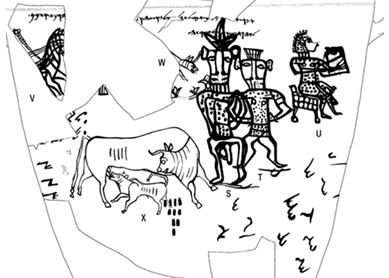
Perhaps most importantly, Stavrakopoulou misses what a massive departure it was that ancient Israelites abandoned all images in favour of a predominantly literary culture.

In a society where you cannot depict God, but can only engage in description and storytelling, you have to be more imaginative when you try to make sense of infinity.

Poems, sagas, and speeches, like those from our Tanach, are never fixed in their meaning. They are openings that invite listeners to think with them, talk back to them, and struggle for deeper understandings.

When someone reads a text too literally, they strip it of its vitality. Atheists and fundamentalists, both literalists of different kinds, strip the soul from the search for divine truth.

Tell stories, make poems, create art, look for that great truth beyond our reach… and don’t take any of it too seriously.
israel · sermon

The nation is (not) at war


Fifteen years ago, the Nigerian author Chimamanda Ngozi Adichie gave a powerful speech, in which she warned about “the danger of the single story.” This, she says, is how you create a single story: “show a people as one thing, as only one thing, over and over again, and that is what they become.”

Because of the single story told about Africa, Westerners knew it only as backwards, poor, and disease-ridden. They did not know how diverse, interesting and resilient Africans were. They did not know that Africans were not, in fact, one people with one story, but billions of people with billions of stories.

She warns her listeners: “The consequence of the single story is this: It robs people of dignity. It makes our recognition of our equal humanity difficult. It emphasises how we are different rather than how we are similar.”

In the book of Joshua, we are presented with a single story about the Israelites and their enemies. In our haftarah, Joshua gathers the tribes of Israel at Shchem and presents his account of the conquest of Canaan. He declares:


You crossed the Jordan and came to Jericho. The citizens of Jericho fought against you, as did also the Amorites, Perizzites, Canaanites, Hittites, Girgashites, Hivites and Jebusites, but I gave them into your hands. I sent the hornet ahead of you, which drove them out before you—also the two Amorite kings. You did not do it with your own sword and bow. So I gave you a land on which you did not toil and cities you did not build; and you live in them and eat from vineyards and olive groves that you did not plant.

In Joshua’s single story, the Israelites are a nation united at war. They all came over at once and went to conquer the land of Canaan. Their enemies were diverse in name but unified in mission. In the list of warring tribes that came up against the Israelites, there is no distinction. Every one of them fought the Israelites. Every one of them lost. By God’s miraculous deeds, the Israelites took over the entire country, and now they have a whole land, ready-made, for them to inhabit.

But wait. There is a flaw with this single story. Just as Joshua decrees that the entirety of these foreign nations has been wiped out, he also warns the Israelites not to mix with them.

All of these other tribes have been completely driven out of the land of Israel; all of them have been vanquished; now the only people left are the Israelites.

But even though the Israelites are the only people remaining, you must not marry the others; or get involved in their cultural practices; or go to their shrines with them and worship their gods.

The Jewish bible scholar, Rachel Havrelock, has written a book looking at why this contradiction is so stark. She suggests that, while the Book of Joshua would love to tell a single story of unanimous military victory, it cannot get away from what the people see with their own eyes.

In reality, all the nations that the Israelites “drove out” are still there. The Israelites are still meeting them, marrying them, striking deals with them, and fraternising with them.

Joshua is putting together the war story as a national myth to bring the people together. In his story, the Israelites must be one people and so must all their enemies. Victory must be total and war must be the only way.

In fact, Havrelock finds that there are lots of contradictions in the book of Joshua. It says that the nation was united in war, while also describing all the internal tribal disagreements and all the rebellions against Joshua.

It says that they took over the whole land, but when it lists places, you can clearly see that plenty of the space is contested, and that the borders are shifting all the time. It says they took over Jerusalem, and also says that it remains a divided city to this day.

So what is the reality? Archaeological digs suggest it is very unlikely that the conquest of Canaan ever happened in the way the Book of Joshua describes. The land was not vanquished in one lifetime by a united army. Instead, more likely, the Israelites gradually merged with, struck deals with, and collaborated with, lots of disparate tribes.

They were never really an ethnically homogenous group. They were never really a disciplined military. They were a group of people who gathered together other groups of people over many centuries to unite around a story. Ancient Israel was the product of cooperation and collaboration.

Our Torah takes all the different stories of lots of different tribes and combines them into a single narrative. That is why the Torah reads more like a library of hundreds of folktales than a single spiel.

But a government at war needs a single story. It needs to tell the story that there is only one nation, which has no internal division. It needs to tell the story that there is only one enemy, and that the whole of the enemy is a murderous, barbarous bloc. It needs to insist that the enemy must be destroyed in its entirety. It needs to tell the story that war is the only way.

Reality, however, rarely lives up to the single story that war propaganda would like us to believe.

Over the last few months, we have been bombarded with a single story of war. We are all at war. Not only Israel, but the whole Jewish people. We are all at war until every hostage is freed from Gaza. We are all at war until Hamas is destroyed. We are all at war and there is no other way.

But hidden underneath that story are other stories. Suppressed stories. Stories that suggest Israel may not be united in war.

There is the single story that Gaza must be bombed to release the remaining hostages.

There is another story. Avihai Brodutch was with his family on Kibbutz Kfar Aza on October 7th. He survived. His wife, Hagar, was taken hostage, along with their three children, aged 10, 8 and 4. His whole family and his neighbours were taken hostage.

Only a week later, at 3am, Avihai took a plastic chair and his family dog, and went to launch a one-man protest outside the Israeli military offices. He insisted that blood was on Bibi’s hands for refusing to negotiate. He said that Netanyahu was treating his family as collateral damage in his war. He initiated a rallying cry: “prisoner exchange.”

This has become a demand of Israeli civil society. They will swap Palestinian prisoners for the Israeli hostages. This was achieved, when 240 Palestinian prisoners were swapped in return for 80 Israelis and 30 non-Israelis captive in Gaza.

There are still over 100 hostages in Gaza. There are still around 4,000 Palestinian political prisoners in Israeli jails. Around 1,000 are detained indefinitely without charge. Around 160 are children.

It is simply the right thing that Hamas should release the hostages. It is also simply the right thing that Netanyahu should release the Palestinian prisoners. If they did agree, everyone would be able to return safely to their families. Doesn’t that sound more worth fighting for than war?

There is a single story, promoted by Netanyahu, that Israel must fight until it has destroyed Hamas.

There is another story. Maoz Inon’s parents were both murdered by Hamas on October 7th. As soon as he had finished sitting shiva, he took up his call for peace. All he wanted was an end to the war.

Speaking to American news this week, he said: “A military invasion into Gaza will just make things worse, will just keep this cycle of blood, the cycle of death, the cycle of violence that’s been going for a century.”

His call for peace is echoed by other families of those who lost loved ones on October 7th. They have lobbied, produced videos, and sent letters to Netanyahu, begging to be heard.

Some are desperate for the government to recognise that further death is not what they want. Now, as Netanyahu has killed more than 20,000 Palestinians, their call has still not been heard.

And after all those dead, is Hamas any closer to being destroyed? Of course not. All this bombing does is ensure that a new generation of Palestinians trapped in Gaza will grow up to hate Israel.

This war is how you get more terrorists. It’s how you ensure that war never ends. Wouldn’t it be better to fight for a ceasefire than to fight for a war?

There is a single story that the nation is united in war.

There is another story. This week, 18-year-old Tal Mitnik was sent to military prison in Israel for refusing to fight in the war. Although this news has barely made it into English-language media, many Israelis have expressed their support.

Writing to Haaretz, one refusenik wrote: “I was inside. We were so brainwashed there. I refused and I’m not the only one. I have a family and this is not a war with a clear purpose. […] My children will have a father and I hope yours will too.” Another parent wrote: “My son is also refusing. I will not sacrifice him for Bibi.”

There is another story: that this is Netanyahu’s war, not ours.

There is another story: that war is not the answer.

There is another story: that every captive must go free.

There is another story: that all bombs and rockets must end.

There is another story: that we will not give licence to any more bloodshed.

There is a story that the nation is at war. In times of war, the government must tell that as the only story, to blot out alternative stories, to ensure that war is the only way.

But there are other stories. And, if we tell those other stories, there will be other ways.

Shabbat shalom.

climate change · sermon

This world could just as easily be wonderful


In the time that we are alive on this earth, it could burn in front of us. There could be droughts and famines and wildfires and pandemics of deadly diseases.

But. In the time that we are alive on this earth, it could be transformed into a paradise. The planet could become run entirely on renewable energy, with enough food for everyone, where everything that lives could have all its needs met.

Within our lifetimes, we could once more see a resurgence of fascism, racist nationalism, and global war. We might see once more the increased subjugation of women and the rise of bigoted intolerance.

But. Within our lifetimes, we might be the first generation to witness world peace. We might see a new flourishing of tolerance and inclusion. We might live in a society without inequality, where the rights of all are respected.

Why is it so much easier to imagine disaster than success? Why do we allow our imaginations to deprive us of the possibilities of a better world?

Sure, this world could be horrible. But it could just as easily be wonderful.

What world will our children inherit?

Will it be the burning dystopia that feels so present, or the perfected society that seems so distant?

The Prophet Isaiah was not sure either.

In the build-up to the High Holy Days, we read haftarot from the Prophet Isaiah. The lectionary cycle offered us three readings of warnings and six of comfort. That great leader of ancient Israel struck fear into our hearts with threats of how horrible the future might be. Then he promised us solace with visions of how wonderful life could be. Which should we believe?

In one of his prophecies, Isaiah warns that the coming world will be “a cruel day, with wrath and fierce anger—to make the land desolate and destroy the sinners within it.” He forewarns of unending darkness and exile and terror. He offers no remedy. He tells us that everyone will go to war against each other, that every neighbour will become the other’s oppressor, and nobody will win.

Yet elsewhere, Isaiah envisions a redeemed world, in which the poor see justice, and wolves lie with lambs, and refugees find home, and people beat their swords into ploughshares and no nation goes to war any more.

Isaiah holds two visions in the balance. One of hope and one of fear.

Perhaps we might say that this is the same vision seen from different perspectives: that what would be wondrous for some would seem disastrous for others. That justice for the poor would feel like tragedy to the rich. That the end of war for its victims would be calamity for its profiteers.

But that doesn’t seem plausible. Surely, there will either be outright war or there will be none? Justice may be subjective, but conflict over resources is a fact. Either everyone will have all they need or all humanity will battle fir scraps.

You might say: perhaps these prophecies were given at different points in Isaiah’s life? The historical critics argue that the book of Isaiah in fact had three different authors, all writing in different periods.

But this still doesn’t explain the discrepancy. Within even the same chapter and verse, Isaiah oscillates between dream and nightmare, holding both possibilities in contrast.

The contradiction only exists if you imagine prophets as fore-tellers of a pre-ordained history. The Jewish tradition has tended to see them instead as forth-tellers: bringing God’s word to show what might be possible.

In this week’s haftarah, Isaiah promises both together. Isaiah talks about vengeance and redemption.

Isaiah is showing us the two ways in which humanity might go, and leaving open both options. This world might be brought to its end by disaster. But it could be wonderful too.

The fear of what this world might be can sometimes keep me up at night. I think of unfolding climate catastrophes, with floods and wildfires already engulfing parts of the globe. I see escalating wars between major powers in multiple countries. I hear the rhetoric from political leaders, ramping up racism, xenophobia, sexism and transphobia. And Isaiah’s nightmares do not seem so distant.

But I am trying to rejig my perspective. There is nothing radical or interesting about pessimism. Misery is easy. It is the default for minds accustomed to defeat, prone to anticipate worst case scenarios.

But hope. Hope is harder. Hope demands far more imagination as we expand our horizons of the possible. If we have hope, we cannot give in to how things are. Hope demands of us action.

Recently, I have found reason to hope in fiction. There is a wealth of writing by Jewish eco-futurists, who create worlds set in the not-too-distant future. Instead of the dystopias imagined by 20th Century writers like Orwell and Huxley, they ask a much bolder question: what if we made it right? What would the world look like if, instead of accepting the inevitability of defeat, we projected winning?

A few years ago, TV star and beloved Essex Jew, Simon Amstell, made a film imagining a world fifty years in the future. In it, the whole world is engaged in a truth and reconciliation process, as elders try to explain to the young where they went wrong and how they rebuilt. The new world is idyllic, and all that had to happen, says Amstell, is that everyone stopped eating meat.

The film, called Carnage, is clearly satirical, and takes a self-referential jibe at preachy vegans. But it also posits something intuitively true and beautiful: a better world than this one could be possible with very small changes.

Over the summer, I have been reading the solar-punk fiction of author Sim Kern. Their works imagine alternative worlds to this one. In their major book, ‘Depart Depart’ a dybbuk haunts a Jewish youth as he makes his way through a world ravaged by climate catastrophe. Yet, in more recent works, Kern imagines alternative worlds in which humanity made steps towards addressing these disasters. Imperfect, true, and still full of tension – otherwise there would be no story – but they still pitch another reality. And inhabiting those fictional worlds has helped me realise how real they could be.

Enough with pessimism.

Sure, this world could be horrible. But it could just as easily be wonderful.

Let’s make it so.